
Beauty and the Beast
Novels

Beauty and the Beast, illustrated by Walter Crane, 1890s
| Original Versions | Modern Retellings | By Titles | By Authors |
| By Illustrators | Type of Beasts | By dates/ Full listings |
| Phantom's Theater Favorite Versions | Aarne–Thompson–Uther (ATU) |
| Newly Added |
| By Illustrators | Type of Beasts | By dates/ Full listings |
| Phantom's Theater Favorite Versions | Aarne–Thompson–Uther (ATU) |
| Newly Added |
🌹Updated June 5, 2026🌹
Under Construction
(PT translation), is a translation done specifically for Phantomstheater. If someone else did it then credit is given.
If you know of a novel or version that is not listed here please email us Here
Under Construction
(PT translation), is a translation done specifically for Phantomstheater. If someone else did it then credit is given.
If you know of a novel or version that is not listed here please email us Here
Different Versions
Listed by Aarne–Thompson–Uther Index
~~~
Incarnations from around the world
"The Animal/Monster as Bridegroom"
Listed by Aarne–Thompson–Uther Index
~~~
Incarnations from around the world
"The Animal/Monster as Bridegroom"
Types of tales; Aarne–Thompson–Uther Index (ATU Index) & Thompson Motif (TM)
Despite what Phans may think, the Phantom of the Opera is not classified as a Beauty and the Beast type tale. The Beauty and the Beast tale is classified as Aarne-Thompson-Uther tale type ATU 425, more specifically ATU 425C (subtype), which features a Beauty character falling in love with a cursed prince (Beast/ animal) and breaking the enchantment, by either a kiss, proclaiming her love (Beaumont) or lying in bed with him (Villeneuve). There are specifications that make up the Beauty and the Beast story. Father goes on a journey, asking what gifts he can bring back for his children. Father steals the gift of a flower for the youngest daughter, (beast/ animal, rarely an ugly, inhuman man) gets upset, threatens to kill him, or he can give him one of his daughters. The girl goes and lives with the Beast due to her father stealing one of his flowers and her taking his place (moral duty). Every night, the Beast asks the Beauty character if she will marry him. She always says no. She learns her father is ill, misses her family, or a sister is gettign married and gets permission to go visit them, but always for a given amount of time, typically she ends up staying too long, upon her return to the castle, the Beast is gone, prompting the Beauty character to serach for him, only to find him dying, where she proclaims her love for him transforming him back into a Prince. None of these classifications fit the Phantom of the Opera. Erik is a man who was born deformed, not a cursed prince. Erik is shunned by society, forced to wear a mask just to fit in, and ends up living under an Opera. The only thing that the two stories have in common is a male character who is perceived by society to be ugly or deformed. The confusion probably came from two sources. The first Lon Chaney's 1925 silent film of The Phantom of the Opera. Despite what people may think, Erik never monogrammed any of Christine's things in his house in the original French novel; this is a direct nod to some version of Beauty and the Beast. He also carries her to her room after she passes out due to seeing his funerary room and coffin bed. Most certainly, Cocteau borrowed this, even the angle is similar. The next confusion comes from Jean Cocteau's 1946, Beauty and the Beast film. He admitted that Leroux's Phantom inspired him, and most certainly Lon Chaney's Phantom. However, the original tale of La Belle et la Bête written in 1740, by Contes de Madame de Villeneuve and even Jeanne-Marie Leprince de Beaumont's 1757 version, which today most are familiar with, has nothing to do with the story Gaston Leroux wrote of Le Fantôme de l'Opéra. While it's a similar theme, the stories are not even close to each other in classification. More specific Aarne Thompson classifications below.
Classifications
~ ATU 425 - "The Search for the Lost Husband" "The Animal (Monster) as Bridegroom"
(A Monster is born because of a wish by a parent, a girl promises herself as a bride to a monster
or her father promises her in order to save his life for the slight of stealing a flower, that his
daughter asked for. 2) Girl disenchants the monster (breaking the curse/spell) of the monster, by
means of a kiss, tears, or burning the animal skin. 3) Loses husband/monster because she
either burned the animal skin too soon, revealed his enchantment to a family member, or broke
a prohibition, looking at him (Polar Bear Prince), stayed too long at home. 4) searches for lost
husband goes through trials, undergoes a sorrow, receives a magic gift(s). 5) Recovers lost
husband, by winning him back.)
"Green Serpent / Serpentin Vert" Here
"King Crin/ La storia del Re Crin" Here
"The Beast" Here
"The Enchanted Prince" Here
"The Tale of the Hoodi" Here
"The Ram" Here
"The Wonderful Sheep" Here
~ ATU 425A - "The Animal (Monster) as Bridegroom or Monster Husband" often with
"The Search for the Lost Husband"
(Beauty's character has to go on a quest to find and free her lost husband)
"Beauty and the Beast/ Vakurleikin og beistið" Here
"Cupid and Psyche" Here
"East of the Sun and West of the Moon" Here
"Grannonia and the Fox" Here
"Green Serpent / Serpentin Vert" Here
"Melion" Here
"Princess Gulungi-luri / Ngo Pitiri-Gulungi-luri" Here
"Serpent Knight" Here
"The Black Bull of Norroway" Here
"The Brown Bear of Norway" Here
"The Enchanted Pig" 1890 Here
"The Enchanted Prince" Here
"The Enchanted Snake" Here
"The Girl with Two Husbands" Here
"The Hoodie-Crow" Here
"The Prince Who Was Bewitched" Here
"The Serpent" 1697 Here
"The Singing, Springing Lark/Das singende springende Löweneckerchen" Here
"The Sprig of Rosemary" 1885, 1897 Here
"The Snake" 1634 Here
"The Snake" 1864 Here
"The Snake Bridegroom" Here
"The Snakeprince" Here
"The Tale of the Hoodi" Here
"Whitebear King's Son" Here
"White-Bear-King Valemon" Here
~ ATU 425B - "The Disenchanted Husband: The Son of the Witch" / "The Witch's Tasks"
(Beauty character performing difficult tasks for her husband's family/her mother-in-law,
where she works as her servant. One of the tasks is to go to another witch's house (relative)
and gets from there some sort of container, something or something, husband warns her not
to open, but she does. Mother-in-law (humiliates) Beauty character sometimes betrothes her
son to another bride and sends Beauty character on wedding errands. She must perform the
tasks before she can get her husband back.)
"Cupid and Psyche" Here
"Green Serpent" Here
"The Enchanted Prince" Here
~ ATU 425C - "Beauty and the Beast" **Click Here for types of Beasts**
(Youngest of three sisters, most beautiful, father asks what he can bring back from the journey,
modestly gift (typically a flower) [(TM) L221], angers Beast character typically, by a slight, either
ungrateful for services rendered or theft of a gift (typically a flower). Beast threatens to kill the father or he can give one of his daughters in exchange. Daughter willingly goes in her father's place, typically to become Beast's bride or thinks she will be killed in his place. Asks to visit family, stays too long (taboo)[(TM) C761.2]. Looses Beast/vanishes. Beauty character breaks enchantment by some sign of love [(TM) D735.1], Enchantment is broken, the prince is revealed.)
"A Terrible Monster/ Straszny Potwór" Here
"Beauty and the Beast / La Belle et la Bête" Here (1740 - Villeneuve)
"Beauty and the Beast/ La Belle et la Bête" Here (1756 - Beaumont)
"Gift to the Youngest Daughter" Here
"The Girl Who Wanted a Flower / Dekle, ki je hotela rožico" Here
"Little Broomstick/ Besenstielchen" Here
"The Ram / Le Mouton" Here
"The Singing, Springing Lark/Das singende springende Löweneckerchen" Here
"The Summer and Winter Garden/ Von dem Sommer- und Wintergarten" Here
"Three Roses on One Stem/ Drei Rosen auf Einem Stiel" Here
"Zafarana" Here
~ ATU 425F "The Thieving Bird"
"Princess's Kerchief" Here {Bird Beast} (Crane)
~ ATU 432 - "The Prince as Bird"
"The Blue Bird" Here
"The Merchant's Daughter" Here
"Yonec" Here
~ ATU 433 - "The Enchanted Snake" "The Prince as Serpent" (Dragon, Snake, or Devil)
"Oda and the Snake" Here (1845), Here (1853)
"The Enchanted Brahman's Son" Here
"The Enchanted Prince" Here
"The Snakeprince" Here
~ ATU 433B - "King Lindworm" (originally listed as 433A)
(serpent husband's disenchantment, A queen gives birth to a serpent (Lindworm). When grown,
he demands a bride. The first bride dies, but the second bride (usually a shepherd's daughter) is kind to him and disenchants him by wearing multiple layers of clothing to peel off his skin. The
bride's role in upholding taboos, bride must adhere to nocturnal rituals without light or interruption
or risk potential separation via violation (premature exposure, followed by reunion)
"Dragon-Child and Sun-Child" Here
"East of the Sun and West of the Moon" Here
"King Lindworm" (1854, 1880, 1897, 1904) Here
"Prince Lindworm" Here
"Beast that Took a Wife" Here
"Little Ruby Fish/ Muchie-Lal" Here
"The Girl with Two Husband" Here
"The Serpent" Here
"The Snake" 1634 Here
"The Snake" 1864 Here
"The Snake Bridegroom" Here
"The Snake King" Here
"The Tale of the Monkey" (1922) Here
~ ATU 433C - "The Serpent Husband & the Jealous Girl" "The Snake Bridegroom"
(A young woman marries a snake (who is a prince underneath). Her envious sister tries to imitate
her, but her snake is "real" (un-enchanted), resulting in the sister’s death.)
"The Caterpillar Boy" Here
"The Tale of the Monkey" (1922) Here
~ ATU 440 - "Frog Prince/ Frog King" "The Donkey Bridegroom" {Frog Prince} {Donkey Beast}
(A princess breaking a promise to a frog who retrieved her golden ball, followed by the frog forcing her to let him eat and sleep with her, after which he transforms into a prince.)
"Oda and the Snake" Here (1845), Here (1853)
"The Enchanted Frog" Here
"The Frog Came to the Mill Door" Here
"The Frog King; or, Iron Henry" Here (1812), Here (1834)
"The Frog Prince" Here (1815), Here (1890), Here (1909)
"The Kind Stepdaughter and the Frog" Here
"The Maiden and the Frog" Here
"The Wonderful Frog" Here
"The Story of The Frog Prince" Here
"The Tale of the Queen Who Sought a Drink From a Certain Well" Here
"The Little Donkey" Here
~ ATU 441 - "Hans My Hedgehog" (In Enchanted Skin)
"Hans My Hedgehog" Here
"The Enchanted Pig" Here
"The Enchanted Prince" Here
~ ATU 449 - "The Werewolf's Son" " The Tsar's Dog"
"The Werewolf / Bisclavret" Here
Despite what Phans may think, the Phantom of the Opera is not classified as a Beauty and the Beast type tale. The Beauty and the Beast tale is classified as Aarne-Thompson-Uther tale type ATU 425, more specifically ATU 425C (subtype), which features a Beauty character falling in love with a cursed prince (Beast/ animal) and breaking the enchantment, by either a kiss, proclaiming her love (Beaumont) or lying in bed with him (Villeneuve). There are specifications that make up the Beauty and the Beast story. Father goes on a journey, asking what gifts he can bring back for his children. Father steals the gift of a flower for the youngest daughter, (beast/ animal, rarely an ugly, inhuman man) gets upset, threatens to kill him, or he can give him one of his daughters. The girl goes and lives with the Beast due to her father stealing one of his flowers and her taking his place (moral duty). Every night, the Beast asks the Beauty character if she will marry him. She always says no. She learns her father is ill, misses her family, or a sister is gettign married and gets permission to go visit them, but always for a given amount of time, typically she ends up staying too long, upon her return to the castle, the Beast is gone, prompting the Beauty character to serach for him, only to find him dying, where she proclaims her love for him transforming him back into a Prince. None of these classifications fit the Phantom of the Opera. Erik is a man who was born deformed, not a cursed prince. Erik is shunned by society, forced to wear a mask just to fit in, and ends up living under an Opera. The only thing that the two stories have in common is a male character who is perceived by society to be ugly or deformed. The confusion probably came from two sources. The first Lon Chaney's 1925 silent film of The Phantom of the Opera. Despite what people may think, Erik never monogrammed any of Christine's things in his house in the original French novel; this is a direct nod to some version of Beauty and the Beast. He also carries her to her room after she passes out due to seeing his funerary room and coffin bed. Most certainly, Cocteau borrowed this, even the angle is similar. The next confusion comes from Jean Cocteau's 1946, Beauty and the Beast film. He admitted that Leroux's Phantom inspired him, and most certainly Lon Chaney's Phantom. However, the original tale of La Belle et la Bête written in 1740, by Contes de Madame de Villeneuve and even Jeanne-Marie Leprince de Beaumont's 1757 version, which today most are familiar with, has nothing to do with the story Gaston Leroux wrote of Le Fantôme de l'Opéra. While it's a similar theme, the stories are not even close to each other in classification. More specific Aarne Thompson classifications below.
Classifications
~ ATU 425 - "The Search for the Lost Husband" "The Animal (Monster) as Bridegroom"
(A Monster is born because of a wish by a parent, a girl promises herself as a bride to a monster
or her father promises her in order to save his life for the slight of stealing a flower, that his
daughter asked for. 2) Girl disenchants the monster (breaking the curse/spell) of the monster, by
means of a kiss, tears, or burning the animal skin. 3) Loses husband/monster because she
either burned the animal skin too soon, revealed his enchantment to a family member, or broke
a prohibition, looking at him (Polar Bear Prince), stayed too long at home. 4) searches for lost
husband goes through trials, undergoes a sorrow, receives a magic gift(s). 5) Recovers lost
husband, by winning him back.)
"Green Serpent / Serpentin Vert" Here
"King Crin/ La storia del Re Crin" Here
"The Beast" Here
"The Enchanted Prince" Here
"The Tale of the Hoodi" Here
"The Ram" Here
"The Wonderful Sheep" Here
~ ATU 425A - "The Animal (Monster) as Bridegroom or Monster Husband" often with
"The Search for the Lost Husband"
(Beauty's character has to go on a quest to find and free her lost husband)
"Beauty and the Beast/ Vakurleikin og beistið" Here
"Cupid and Psyche" Here
"East of the Sun and West of the Moon" Here
"Grannonia and the Fox" Here
"Green Serpent / Serpentin Vert" Here
"Melion" Here
"Princess Gulungi-luri / Ngo Pitiri-Gulungi-luri" Here
"Serpent Knight" Here
"The Black Bull of Norroway" Here
"The Brown Bear of Norway" Here
"The Enchanted Pig" 1890 Here
"The Enchanted Prince" Here
"The Enchanted Snake" Here
"The Girl with Two Husbands" Here
"The Hoodie-Crow" Here
"The Prince Who Was Bewitched" Here
"The Serpent" 1697 Here
"The Singing, Springing Lark/Das singende springende Löweneckerchen" Here
"The Sprig of Rosemary" 1885, 1897 Here
"The Snake" 1634 Here
"The Snake" 1864 Here
"The Snake Bridegroom" Here
"The Snakeprince" Here
"The Tale of the Hoodi" Here
"Whitebear King's Son" Here
"White-Bear-King Valemon" Here
~ ATU 425B - "The Disenchanted Husband: The Son of the Witch" / "The Witch's Tasks"
(Beauty character performing difficult tasks for her husband's family/her mother-in-law,
where she works as her servant. One of the tasks is to go to another witch's house (relative)
and gets from there some sort of container, something or something, husband warns her not
to open, but she does. Mother-in-law (humiliates) Beauty character sometimes betrothes her
son to another bride and sends Beauty character on wedding errands. She must perform the
tasks before she can get her husband back.)
"Cupid and Psyche" Here
"Green Serpent" Here
"The Enchanted Prince" Here
~ ATU 425C - "Beauty and the Beast" **Click Here for types of Beasts**
(Youngest of three sisters, most beautiful, father asks what he can bring back from the journey,
modestly gift (typically a flower) [(TM) L221], angers Beast character typically, by a slight, either
ungrateful for services rendered or theft of a gift (typically a flower). Beast threatens to kill the father or he can give one of his daughters in exchange. Daughter willingly goes in her father's place, typically to become Beast's bride or thinks she will be killed in his place. Asks to visit family, stays too long (taboo)[(TM) C761.2]. Looses Beast/vanishes. Beauty character breaks enchantment by some sign of love [(TM) D735.1], Enchantment is broken, the prince is revealed.)
"A Terrible Monster/ Straszny Potwór" Here
"Beauty and the Beast / La Belle et la Bête" Here (1740 - Villeneuve)
"Beauty and the Beast/ La Belle et la Bête" Here (1756 - Beaumont)
"Gift to the Youngest Daughter" Here
"The Girl Who Wanted a Flower / Dekle, ki je hotela rožico" Here
"Little Broomstick/ Besenstielchen" Here
"The Ram / Le Mouton" Here
"The Singing, Springing Lark/Das singende springende Löweneckerchen" Here
"The Summer and Winter Garden/ Von dem Sommer- und Wintergarten" Here
"Three Roses on One Stem/ Drei Rosen auf Einem Stiel" Here
"Zafarana" Here
~ ATU 425F "The Thieving Bird"
"Princess's Kerchief" Here {Bird Beast} (Crane)
~ ATU 432 - "The Prince as Bird"
"The Blue Bird" Here
"The Merchant's Daughter" Here
"Yonec" Here
~ ATU 433 - "The Enchanted Snake" "The Prince as Serpent" (Dragon, Snake, or Devil)
"Oda and the Snake" Here (1845), Here (1853)
"The Enchanted Brahman's Son" Here
"The Enchanted Prince" Here
"The Snakeprince" Here
~ ATU 433B - "King Lindworm" (originally listed as 433A)
(serpent husband's disenchantment, A queen gives birth to a serpent (Lindworm). When grown,
he demands a bride. The first bride dies, but the second bride (usually a shepherd's daughter) is kind to him and disenchants him by wearing multiple layers of clothing to peel off his skin. The
bride's role in upholding taboos, bride must adhere to nocturnal rituals without light or interruption
or risk potential separation via violation (premature exposure, followed by reunion)
"Dragon-Child and Sun-Child" Here
"East of the Sun and West of the Moon" Here
"King Lindworm" (1854, 1880, 1897, 1904) Here
"Prince Lindworm" Here
"Beast that Took a Wife" Here
"Little Ruby Fish/ Muchie-Lal" Here
"The Girl with Two Husband" Here
"The Serpent" Here
"The Snake" 1634 Here
"The Snake" 1864 Here
"The Snake Bridegroom" Here
"The Snake King" Here
"The Tale of the Monkey" (1922) Here
~ ATU 433C - "The Serpent Husband & the Jealous Girl" "The Snake Bridegroom"
(A young woman marries a snake (who is a prince underneath). Her envious sister tries to imitate
her, but her snake is "real" (un-enchanted), resulting in the sister’s death.)
"The Caterpillar Boy" Here
"The Tale of the Monkey" (1922) Here
~ ATU 440 - "Frog Prince/ Frog King" "The Donkey Bridegroom" {Frog Prince} {Donkey Beast}
(A princess breaking a promise to a frog who retrieved her golden ball, followed by the frog forcing her to let him eat and sleep with her, after which he transforms into a prince.)
"Oda and the Snake" Here (1845), Here (1853)
"The Enchanted Frog" Here
"The Frog Came to the Mill Door" Here
"The Frog King; or, Iron Henry" Here (1812), Here (1834)
"The Frog Prince" Here (1815), Here (1890), Here (1909)
"The Kind Stepdaughter and the Frog" Here
"The Maiden and the Frog" Here
"The Wonderful Frog" Here
"The Story of The Frog Prince" Here
"The Tale of the Queen Who Sought a Drink From a Certain Well" Here
"The Little Donkey" Here
~ ATU 441 - "Hans My Hedgehog" (In Enchanted Skin)
"Hans My Hedgehog" Here
"The Enchanted Pig" Here
"The Enchanted Prince" Here
~ ATU 449 - "The Werewolf's Son" " The Tsar's Dog"
"The Werewolf / Bisclavret" Here
~~~~~~~~~~~~~~~~~~~~~~~~~~~~~~~~~~~~~~~~~
Enchanted Dog/Wolf Prince Here
Enchanted Dog/Wolf Prince & Kings Daughter Here
Enchanted Snake Prince Here
Enchanted Snake Prince from birth Here
~~~~~~~~~~~~~~~~~~~~~~~~~~~~~~~~~~~~~~~~~
Enchanted Dog/Wolf Prince Here
Enchanted Dog/Wolf Prince & Kings Daughter Here
Enchanted Snake Prince Here
Enchanted Snake Prince from birth Here
~~~~~~~~~~~~~~~~~~~~~~~~~~~~~~~~~~~~~~~~~
Type of Beasts
{Anthro Deitie Beast}
"Cupid and Psyche" (2nd Century CE) Here
{Ape Beast}
"Beauty and the Beast/La Belle et la Bête" (1870) Here
"Beauty and the Beast" (1891) Here
"Beauty and the Beast/ La Belle et la Bête" (1930) Here
{Bear Beast}
"Beauty and the Beast" (Edric Vredenburg) (Illustrator: A.L. Bowley)(1910) Here
"Beauty and the Beast" (Illustrator: Alfred Crowquill) (1912) Here
"(The) Brown Bear of Norway" (1866) Here
"The Girl Who Wanted a Flower / Dekle, ki je hotela rožico" (Valentina Pielich)(Milko Matičetov)(1973) Here
"Prince Whitebear/ Prinds Hvidbjørn or Prins Hvidbjørn" (1823) Here
"Whitebear King's Son" (1856)Here
"White-Bear-King Valemon" (1852) Here
{Beastly Beast} {Animal hybrid} - any combo of animals
"A Terrible Monster/ Straszny Potwór" (1852) Here
"The Beast" (1964) Here
"Beauty and the Beast" Vol. II (William H. Thwaites)(1855) Here
"Beauty and the Beast" (1889) Here
"Beauty and the Beast" (1891) Here
"Beauty and the Beast" (1895) Here
"Beauty and the Beast" (1918) Here
"Beauty and the Beast" (Illustrator: Jennie Harbour) (1920) Here
"Beauty and the Beast" (Richard Howard)(Illustrator: Hilary Knight)(1963) Here
"Beauty and the Beast" (Lesley Young)(Illustrator: Annabel Spenceley)(1968) Here
"Beauty and the Beast" (Philippa Pearce)(Illustrator: Alan Barrett)(1972) Here
~ "Beauty and the Beast" (Philippa Pearce)(Illustrator: James Mayhew)(1996) Here
"Beauty and the Beast" (1992) Here
"Beauty and the Beast : and Other Stories" (Adèle Geras)(Illustrator: Louise Brierley)(1996) Here
"Beauty and the Beast" (2016) Here
"Belinda and the Monster/ Belinda e il Mostro" (1956) Here
"Bellinda and the Monster/ Bellinda e er mostro" (1900) Here
"Little Broomstick/ Besenstielchen" (1847) Here
"Prince Darling/ Le Prince Chéri" (1756) Her
"(The) Story of Beauty & the Beast" (1908) Here
"(The) Story of Five Heads" (c. 16th CE) Here
"(The) Summer and Winter Garden/ Von dem Sommer- und Wintergarten" (1812) Here
"Three Roses on One Stem/ Drei Rosen auf Einem Stiel" (1852) Here
{Bird Beast}
"Beauty and the Beast" (Illustrator: Gordon Browne) (1886) Here
"(The) Blue Bird/ L'Oiseau bleu" (1697) Here
"(The) Green Knight / Den Grønne Ridder" (1870) Here
"(The) Hoodie-Crow" (1910) Here
"(The) Merchant's Daughter" (1911) Here
"(The) Tale of the Hoodi" (1890) Here
"Yonec" (c.1160) Here
{Boar Beast} {Hog Beast}
"Beauty and the Beast: Or, A Rough Outside With A Gentle Heart" (1811) Here
"Beauty and the Beast" (Illustrator: Walter Crane)(1874) Here
~ "Beautiful Elsje/ Mooi Elsje" (Illustrator: Walter Crane)(1874) Here
"Beauty and the Beast" (Illustrator: Robert Anning Bell)(1894) Here
"Beauty and the Beast/ La Belle et la Bete" (Illustrator: Michael Fiodorov)(French)(1991) Here
"Beauty and the Beast (Illustrator: Faith Jaques)(1981) Here
{Bull Beast} {Buffalo Beast}
"Beauty and the Beast And Other Stories" (Illustrator: J. Watson Davis)(1910) Here
"Beauty and the Beast" (Illustrator: Charles Robinson)(1917) Here
"(The) Black Bull of Norroway" (1870) Here
{Demon Beast}
"Beauty and the Beast - Blanch and Rosalinda" (Popular Fairy Tales)(c. 1835) Here
"Beauty and the Beast" Bo-Peep Story Books (Illustrator: Alfred W. Croxall ?)(1852) Here
"Beauty and the Beast/ La Belle et la Bête" (Illustrator: Charles Bertall)(c. 1865-1870) Here
"Beauty and the Beast" (Illustrator: Dinah Maria Mulock)(1880) Here
"Beauty and the Beast" (Illustrator: Paul Woodroffe)(1906) Here
"Beauty and the Beast" (Illustrator: Charles Copeland)(1908) Here
{Donkey Beast}
"(The) Donkey/Asinarius" (14th CE) Here
"(The) Little Donkey" (1815) Here
{Dragon Beast}
Beauty and the Beast" (Illustrator: Byam Shaw) Here
"Beauty and the Beast" (1740) Here
"Beauty and the Beast" (1756) Here
"Beauty and the Beast" (D’Aulnoy) (1909) Here
"Beauty and the Beast" (Brock) (1914) Here
"Beauty and the Beast" (Beaumont), (Illustrator: Ducornet)(1968) Here
"Dragon-Child and Sun-Child" (1884) Here
"Zelinda and the Monster/ Zelinda e il Mostro" (1877) Here
"Zelinda and the Monster/ Zelinda e il Mostro" (1885) Here
{Fish Beast}
"Little Ruby Fish/ Muchie-Lal" (1868) Here
{Frog Beast} {Toad Beast}
"(The) Enchanted Frog" (1854) Here
"(The) Frog Came to the Mill Door" (1549) Here
"(The) Frog King; or, Iron Henry" (1812) Here
"(The) Frog King; or, Iron Henry" (1834) Here
"(The) Frog Prince" (1815) Here
"(The) Frog Prince" (1909) Here
"(The) Kind Stepdaughter and the Frog" (1889) Here
"(The) Maiden and the Frog" (1849) Here
"(The) Rosy Story" (1937) Here
"(The) Story of The Frog Prince" (1890) Here
"(The) Tale of the Queen Who Sought a Drink From a Certain Well" (1890) Here
"(The) Wonderful Frog" (1889) Here
{Elephant Beast}
"Beauty and the Beast" (1889) Here
{Hedgehog Beast}
"Hans My Hedgehog" (1815) Here
{Lion Beast}
"Beauty and the Beast" (1857) Here
"Beauty and the Beast and Other Stories" (Illustrator: Horace Elisha Scudder)(1909) Here
"Beauty and the Beast" (Illustrator: H. M. Brock)(1914) Here
"Beauty and the Beast" (Beaumount) (Translator: P.H. Muir) (Illustrator: Edy Legrand)(1949) Here
"Beauty and the Beast" (Translator: P.H. Muir) (Illustrator: Erica Ducornet)(1968) Here
"Beauty and the Beast" (Beaumount), (Translator: Richard Howard) (Illustrator: Diane Goode)(1978) Here
"Beauty and the Beast" (Illustrator: Anabel Spenceley)(1991)
"(The) Singing, Springing Lark/Das singende springende Löweneckerchen" (1815 ) Here
{Lizard Beast}
"Kapapitoe and the Lizard" (2008) Here
"(The) Lizard King / El Rey Lagarto" (1991) Here
"(The) Lizard Prince / El príncipe lagarto" (Mid-20th CE) Here
"(The) Tailor's Daughters / Las Hijas Del Sastre" (1991) Here
{Monkey Beast} {Ape Beast}
"(The) Monkey Son-in-Law/ 猿婿/ Saru Muko" (16th - 17th CE)
"(The) Tale of the Monkey" (1907) Here
"(The) Tale of the Monkey" (1922) Here
{Ogre Beast}
"Beauty and the Beast" Vol. II (Illustrator: William H. Thwaites) (1855) Here
"Beauty and the Beast/La Belle et la Bête" (1870) Here
"Beauty and the Beast" (1891) Here
"Beauty and the Beast" (Illustrator: Edmund Dulac)(1910) Here
"Beauty and the Beast" (Illustrator: Katharine Pyle)(1918) Here
"Beauty and the Beast" (1920) Here
"Beauty and the Beast" (1979) Here
"Beauty and the Beast" (1989) Here
{Pan Beast}
"Beauty and the Beast" (Illustrator: Paul Woodroffe)(1906) Here
"Beauty and the Beast" (Richard Howard) (Illustrator: Hilary Knight)(1963) Here
"(The) Story of Zelinda and the Monster or Beauty and the Beast" (1895) Here
{Pig Beast}
"(The) Enchanted Pig/ Porcul cel fermecat" (1872) Here
"(The) Enchanted Pig" (1890) Here
"King Crin/ La storia del Re Crin" (1882) Here
"(The) Pig King/ Il re porco" (c. 16th CE (1550-1553) Here
"Prince Marcassin" (17th CE) Here
{Ram Beast}{Sheep Beast}
"(The) Ram / Le Mouton" (1697-1698) Here
"(The) Wonderful Sheep" (1889) Here
{Saber-toothed panther Beast}{Walrus Beast}
"Beauty and the Beast" : An Old Tale New-Told (1875) Here
{Serpent Beast} {Snake Beast} {Lindworm Beast}
"Beast that Took a Wife" (1980) Here
"East of the Sun and West of the Moon" (1844) Here
"(The) Enchanted Brahman's Son" (1859) Here
"(The) Enchanted Snake" (1892) Here
"Grannonia and the Fox" (1993) Here
"Green Serpent / Serpentin Vert" (1697) Here
"(The) Girl with Two Husband" (1953) Here
"King Lindworm" (1854, 1880, 1897, 1904) Here
"Oda and the Snake" (1845) Here , (1853) Here
"Prince Lindworm" (1917) Here
"(The) Prince Who Was Bewitched" (1956) Here
"Serpent Knight" (1965) Here
"(The) Snake/ Lo Serpe" (1634) Here
"(The) Snake/ Die Schlange" (1864) Here
"(The) Snake Bridegroom" (1870) Here
"(The) Snake King" (1822) Here
"(The) Snakeprince/ Der Schlangenprinz" (1822) Here
"(The) Sprig of Rosemary" (1885, 1897) Here
{Troll Beast}
"Beauty and the Beast/ Vakurleikin og beistið" (1898) Here
{Ugly Man Beast}
"Bellindia" (1875) Here
"Bellindia" (1880) Here
"(The) Singing Rose" (1852) Here
"Zafarana" (1870) Here
{Wolf Beast} {Werewolf Beast}
"Beauty and the Beast" (Lumsden and Son)(c. 1820) Here
"Beauty and the Beast" (Laura E. Richards)(Illustrator: Gordon Browne)(1886) Here
"Melion" (c. 1190 & 1204) Here
"The Werewolf / Bisclavret" (12th CE) Here
"Cupid and Psyche" (2nd Century CE) Here
{Ape Beast}
"Beauty and the Beast/La Belle et la Bête" (1870) Here
"Beauty and the Beast" (1891) Here
"Beauty and the Beast/ La Belle et la Bête" (1930) Here
{Bear Beast}
"Beauty and the Beast" (Edric Vredenburg) (Illustrator: A.L. Bowley)(1910) Here
"Beauty and the Beast" (Illustrator: Alfred Crowquill) (1912) Here
"(The) Brown Bear of Norway" (1866) Here
"The Girl Who Wanted a Flower / Dekle, ki je hotela rožico" (Valentina Pielich)(Milko Matičetov)(1973) Here
"Prince Whitebear/ Prinds Hvidbjørn or Prins Hvidbjørn" (1823) Here
"Whitebear King's Son" (1856)Here
"White-Bear-King Valemon" (1852) Here
{Beastly Beast} {Animal hybrid} - any combo of animals
"A Terrible Monster/ Straszny Potwór" (1852) Here
"The Beast" (1964) Here
"Beauty and the Beast" Vol. II (William H. Thwaites)(1855) Here
"Beauty and the Beast" (1889) Here
"Beauty and the Beast" (1891) Here
"Beauty and the Beast" (1895) Here
"Beauty and the Beast" (1918) Here
"Beauty and the Beast" (Illustrator: Jennie Harbour) (1920) Here
"Beauty and the Beast" (Richard Howard)(Illustrator: Hilary Knight)(1963) Here
"Beauty and the Beast" (Lesley Young)(Illustrator: Annabel Spenceley)(1968) Here
"Beauty and the Beast" (Philippa Pearce)(Illustrator: Alan Barrett)(1972) Here
~ "Beauty and the Beast" (Philippa Pearce)(Illustrator: James Mayhew)(1996) Here
"Beauty and the Beast" (1992) Here
"Beauty and the Beast : and Other Stories" (Adèle Geras)(Illustrator: Louise Brierley)(1996) Here
"Beauty and the Beast" (2016) Here
"Belinda and the Monster/ Belinda e il Mostro" (1956) Here
"Bellinda and the Monster/ Bellinda e er mostro" (1900) Here
"Little Broomstick/ Besenstielchen" (1847) Here
"Prince Darling/ Le Prince Chéri" (1756) Her
"(The) Story of Beauty & the Beast" (1908) Here
"(The) Story of Five Heads" (c. 16th CE) Here
"(The) Summer and Winter Garden/ Von dem Sommer- und Wintergarten" (1812) Here
"Three Roses on One Stem/ Drei Rosen auf Einem Stiel" (1852) Here
{Bird Beast}
"Beauty and the Beast" (Illustrator: Gordon Browne) (1886) Here
"(The) Blue Bird/ L'Oiseau bleu" (1697) Here
"(The) Green Knight / Den Grønne Ridder" (1870) Here
"(The) Hoodie-Crow" (1910) Here
"(The) Merchant's Daughter" (1911) Here
"(The) Tale of the Hoodi" (1890) Here
"Yonec" (c.1160) Here
{Boar Beast} {Hog Beast}
"Beauty and the Beast: Or, A Rough Outside With A Gentle Heart" (1811) Here
"Beauty and the Beast" (Illustrator: Walter Crane)(1874) Here
~ "Beautiful Elsje/ Mooi Elsje" (Illustrator: Walter Crane)(1874) Here
"Beauty and the Beast" (Illustrator: Robert Anning Bell)(1894) Here
"Beauty and the Beast/ La Belle et la Bete" (Illustrator: Michael Fiodorov)(French)(1991) Here
"Beauty and the Beast (Illustrator: Faith Jaques)(1981) Here
{Bull Beast} {Buffalo Beast}
"Beauty and the Beast And Other Stories" (Illustrator: J. Watson Davis)(1910) Here
"Beauty and the Beast" (Illustrator: Charles Robinson)(1917) Here
"(The) Black Bull of Norroway" (1870) Here
{Demon Beast}
"Beauty and the Beast - Blanch and Rosalinda" (Popular Fairy Tales)(c. 1835) Here
"Beauty and the Beast" Bo-Peep Story Books (Illustrator: Alfred W. Croxall ?)(1852) Here
"Beauty and the Beast/ La Belle et la Bête" (Illustrator: Charles Bertall)(c. 1865-1870) Here
"Beauty and the Beast" (Illustrator: Dinah Maria Mulock)(1880) Here
"Beauty and the Beast" (Illustrator: Paul Woodroffe)(1906) Here
"Beauty and the Beast" (Illustrator: Charles Copeland)(1908) Here
{Donkey Beast}
"(The) Donkey/Asinarius" (14th CE) Here
"(The) Little Donkey" (1815) Here
{Dragon Beast}
Beauty and the Beast" (Illustrator: Byam Shaw) Here
"Beauty and the Beast" (1740) Here
"Beauty and the Beast" (1756) Here
"Beauty and the Beast" (D’Aulnoy) (1909) Here
"Beauty and the Beast" (Brock) (1914) Here
"Beauty and the Beast" (Beaumont), (Illustrator: Ducornet)(1968) Here
"Dragon-Child and Sun-Child" (1884) Here
"Zelinda and the Monster/ Zelinda e il Mostro" (1877) Here
"Zelinda and the Monster/ Zelinda e il Mostro" (1885) Here
{Fish Beast}
"Little Ruby Fish/ Muchie-Lal" (1868) Here
{Frog Beast} {Toad Beast}
"(The) Enchanted Frog" (1854) Here
"(The) Frog Came to the Mill Door" (1549) Here
"(The) Frog King; or, Iron Henry" (1812) Here
"(The) Frog King; or, Iron Henry" (1834) Here
"(The) Frog Prince" (1815) Here
"(The) Frog Prince" (1909) Here
"(The) Kind Stepdaughter and the Frog" (1889) Here
"(The) Maiden and the Frog" (1849) Here
"(The) Rosy Story" (1937) Here
"(The) Story of The Frog Prince" (1890) Here
"(The) Tale of the Queen Who Sought a Drink From a Certain Well" (1890) Here
"(The) Wonderful Frog" (1889) Here
{Elephant Beast}
"Beauty and the Beast" (1889) Here
{Hedgehog Beast}
"Hans My Hedgehog" (1815) Here
{Lion Beast}
"Beauty and the Beast" (1857) Here
"Beauty and the Beast and Other Stories" (Illustrator: Horace Elisha Scudder)(1909) Here
"Beauty and the Beast" (Illustrator: H. M. Brock)(1914) Here
"Beauty and the Beast" (Beaumount) (Translator: P.H. Muir) (Illustrator: Edy Legrand)(1949) Here
"Beauty and the Beast" (Translator: P.H. Muir) (Illustrator: Erica Ducornet)(1968) Here
"Beauty and the Beast" (Beaumount), (Translator: Richard Howard) (Illustrator: Diane Goode)(1978) Here
"Beauty and the Beast" (Illustrator: Anabel Spenceley)(1991)
"(The) Singing, Springing Lark/Das singende springende Löweneckerchen" (1815 ) Here
{Lizard Beast}
"Kapapitoe and the Lizard" (2008) Here
"(The) Lizard King / El Rey Lagarto" (1991) Here
"(The) Lizard Prince / El príncipe lagarto" (Mid-20th CE) Here
"(The) Tailor's Daughters / Las Hijas Del Sastre" (1991) Here
{Monkey Beast} {Ape Beast}
"(The) Monkey Son-in-Law/ 猿婿/ Saru Muko" (16th - 17th CE)
"(The) Tale of the Monkey" (1907) Here
"(The) Tale of the Monkey" (1922) Here
{Ogre Beast}
"Beauty and the Beast" Vol. II (Illustrator: William H. Thwaites) (1855) Here
"Beauty and the Beast/La Belle et la Bête" (1870) Here
"Beauty and the Beast" (1891) Here
"Beauty and the Beast" (Illustrator: Edmund Dulac)(1910) Here
"Beauty and the Beast" (Illustrator: Katharine Pyle)(1918) Here
"Beauty and the Beast" (1920) Here
"Beauty and the Beast" (1979) Here
"Beauty and the Beast" (1989) Here
{Pan Beast}
"Beauty and the Beast" (Illustrator: Paul Woodroffe)(1906) Here
"Beauty and the Beast" (Richard Howard) (Illustrator: Hilary Knight)(1963) Here
"(The) Story of Zelinda and the Monster or Beauty and the Beast" (1895) Here
{Pig Beast}
"(The) Enchanted Pig/ Porcul cel fermecat" (1872) Here
"(The) Enchanted Pig" (1890) Here
"King Crin/ La storia del Re Crin" (1882) Here
"(The) Pig King/ Il re porco" (c. 16th CE (1550-1553) Here
"Prince Marcassin" (17th CE) Here
{Ram Beast}{Sheep Beast}
"(The) Ram / Le Mouton" (1697-1698) Here
"(The) Wonderful Sheep" (1889) Here
{Saber-toothed panther Beast}{Walrus Beast}
"Beauty and the Beast" : An Old Tale New-Told (1875) Here
{Serpent Beast} {Snake Beast} {Lindworm Beast}
"Beast that Took a Wife" (1980) Here
"East of the Sun and West of the Moon" (1844) Here
"(The) Enchanted Brahman's Son" (1859) Here
"(The) Enchanted Snake" (1892) Here
"Grannonia and the Fox" (1993) Here
"Green Serpent / Serpentin Vert" (1697) Here
"(The) Girl with Two Husband" (1953) Here
"King Lindworm" (1854, 1880, 1897, 1904) Here
"Oda and the Snake" (1845) Here , (1853) Here
"Prince Lindworm" (1917) Here
"(The) Prince Who Was Bewitched" (1956) Here
"Serpent Knight" (1965) Here
"(The) Snake/ Lo Serpe" (1634) Here
"(The) Snake/ Die Schlange" (1864) Here
"(The) Snake Bridegroom" (1870) Here
"(The) Snake King" (1822) Here
"(The) Snakeprince/ Der Schlangenprinz" (1822) Here
"(The) Sprig of Rosemary" (1885, 1897) Here
{Troll Beast}
"Beauty and the Beast/ Vakurleikin og beistið" (1898) Here
{Ugly Man Beast}
"Bellindia" (1875) Here
"Bellindia" (1880) Here
"(The) Singing Rose" (1852) Here
"Zafarana" (1870) Here
{Wolf Beast} {Werewolf Beast}
"Beauty and the Beast" (Lumsden and Son)(c. 1820) Here
"Beauty and the Beast" (Laura E. Richards)(Illustrator: Gordon Browne)(1886) Here
"Melion" (c. 1190 & 1204) Here
"The Werewolf / Bisclavret" (12th CE) Here
Phantom's Theater Favorite Versions
of
the Beauty and the Beast tale
of
the Beauty and the Beast tale
Adaptations
1740 - "Beauty and the Beast / La Belle et la Bête" (Villeneuve) Here
1756 - "Beauty and the Beast/ La Belle et la Bête" (Beaumont) Here
1852 - "A Terrible Monster/ Straszny Potwór" Here
1858 - "The Scarlet Flower/ А́ленький цвето́чек/ Alen'kiy tsvetochek" Here
1864 - "The Snake/ Die Schlange" Here
1875 - "Bellindia" Here
1882 - "Belinda and the Monster/ Belinda e il mostro" Here
1900 - "Bellinda and the Monster/ Bellinda e er mostro" Here
Illustrations
1874 - "Beauty and the Beast" (Walter Crane) Here
1886 - "Beauty and the Beast" (Gordon Browne) Here
1978 - "Beauty and the Beast" (Mercer Mayer) Here
1920 - "Beauty and the Beast/ La Belle et la Bête" (Lucienne Loyeux) Here
1983 - "Beauty and the Beast" (Michael Hague) Here
1989 - "Beauty and the Beast" (Carol Heyer) Here
2003 - "Beauty and the Beast" (Charles van Sandwyk) Here
1740 - "Beauty and the Beast / La Belle et la Bête" (Villeneuve) Here
1756 - "Beauty and the Beast/ La Belle et la Bête" (Beaumont) Here
1852 - "A Terrible Monster/ Straszny Potwór" Here
1858 - "The Scarlet Flower/ А́ленький цвето́чек/ Alen'kiy tsvetochek" Here
1864 - "The Snake/ Die Schlange" Here
1875 - "Bellindia" Here
1882 - "Belinda and the Monster/ Belinda e il mostro" Here
1900 - "Bellinda and the Monster/ Bellinda e er mostro" Here
Illustrations
1874 - "Beauty and the Beast" (Walter Crane) Here
1886 - "Beauty and the Beast" (Gordon Browne) Here
1978 - "Beauty and the Beast" (Mercer Mayer) Here
1920 - "Beauty and the Beast/ La Belle et la Bête" (Lucienne Loyeux) Here
1983 - "Beauty and the Beast" (Michael Hague) Here
1989 - "Beauty and the Beast" (Carol Heyer) Here
2003 - "Beauty and the Beast" (Charles van Sandwyk) Here
Illustrators
by last name
by last name
"Beauty and the Beast"
Adrian (Iacob Adrian) 1885 Here
Andrews (Eddie J. Andrews) 1891 Here
Ashman (Malcolm Ashman)[Author: Kara May] 1992 Here
Barrett (Angela Barrett)[Retelling: Max Eilenberg] 2006 Here
Barrett (Alan Barrett)[Retelling: Philippa Pearce] 1972 Here
Batten (John D. Batten) 1895 Here
Bell (Robert Anning Bell)(R. Anning Bell) 1894 Here
Bowley (A.L. Bowley ; Ada Leonora Bowley)[Retold by : Edric Vredenburg] 1905-1920 Here
Bowley (Sophia May Bowley)[Retold by : Edric Vredenburg] 1905-1920 Here
Boyle (Eleanor Vere Boyle)[Author : E. V. B. (Eleanor Vere Boyle)] 1875 Here
Brett (Jan Brett)[Author: Jan Brett] 1989 Here
Brierley (Louise Brierley) 1996 Here
Brock (H. M. Brock)[Adapter anonymous] 1914 Here
Browne (Gordon Browne) 1886 Here
Brundage (Frances Brundage) [Tuck] Here
Cain (Errol Le Cain) Here
Davis (John Watson Davis) 1910 Here
Dominguez (Ángel Dominguez) 2017 Here
Ducornet (Erica Ducornet) Here
Dulac (Edmund Dulac) Here
Chestnutt (David Chestnutt) Here
Craft (Kinuko Y. Craft) 2016 Here
Crane (Walter Crane) 1874 Here
Crowquill (Alfred Crowquill (Alfred Henry Forrester) 1854-1855 Here
Condor (Charles Condor) 1908 Here
Corcould (Corcould) 1858 Here
Cummings (Pat Cummings) 2014 Here
Endera (Lucille Endera) 1922 Here
Fiodorov (Michael Fiodorov) 1991 Here
Ford (Henry Justice Ford) (H. J. Ford) [and G. P. Jacomb Hood] 1889 Here
French School Here
Goble (Warwick Goble) Here
Goode (Diane Goode) 1978 Here
Gool (Van Gool) Here
Gibb (Sarah Gibb) 2014 Here
Gray (Felix de Gray) 1926 Here
Hague (Michael Hague) Here
Harbour (Jennie Harbour) Here
Harrdy (Evelyn Stuart Harrdy) Here
Haslewood (Constance Haslewood) Here
Hassall (John Hassall) Here
Heyer (Carol Heyer) 1989 Here
Hook (Christa Hook) , Heap (Jonathon Heap) 1989 Here
Hughes (Arthur Hughes) c.1863 Here
Ideal (The Ideal Fairy Tales) (Charles Perrault) Here
Jaques (Faith Jaques) Here
Johnstone (Janet Grahame Johnstone and Anne Grahame Johnstone ) Here
King (Jessie Marion King) c.1915 Here
Knight (Hilary Knight) 1963 Here
Laite (Gordon Laite) Here
Legrand (Edy Legrand) 1949 Here
Loyeux (Lucienne Loyeux) 1920 Here
Mayer (Mercer Mayer) Here
James (James Mayhew) 1996 Here
Jaques (Faith Jaques) 1981 Here
Margetson (William Henry Margetson) 1909 Here
Mulready (William Mulready) 1811 Here
Newell (Peter Newell) 1907 Here
Palmer (Pamela Silin-Palmer) 2001 Here
Patience (John Patience) 1992 Here
Pyle (Katharine Pyle) 1918 Here
Rackham (Arthur Rackham) 1933 Here
Robinson (Charles Robinson) Here
Robinson (W. Heath Robinson) Here
Sanderson (Ruth Sanderson) 1993 Here
Sandwyk (Charles van Sandwyk) 2003 Here
Schroeder (Binette Schroeder) 1986 Here
Shaw (Byam Shaw) (John Liston Byam Shaw) Here
Tarrant (Margaret W. Tarrant) Here
Thwaites (William H. Thwaites ; W.H. Thwaites) Here
Tuck (Father Tuck Books) Here
Santa Series (Santa Claus Serie, McLoughlin Bro) Here
Santa (The Santa Claus Story Book) Here
Spenceley (Annabel Spenceley) 1968 Here
Spenceley (Annabel Spenceley) 1991 Here
Wolcott (Elizabeth Tyler Wolcott) Here
Wortley (Mary Stuart Wortley) Here
Titles
Marked newly added New
Marked newly added New
A
"A Terrible Monster/ Straszny Potwór" (1852) Here
B
"Beautiful Elsje/ Mooi Elsje" (1874) Here New April2026
"(The) Beast" (1964) Here New April2026
"Beast that Took a Wife" (1980) Here New May172026
"Beauty and the Beast / La Belle et la Bête" (1740) [Gabrielle-Suzanne de Villeneuve](French) Here
~ "Beauty and the Beast - The Story of the" (1858) [Translator: J. R. Planché](English) Here
~ "Beauty and the Beast" (1874) [Translator:?][Illustrator: Walter Crane](English) Here
~ "Beauty and the Beast" (1889) [Translator: Minnie Wright; Editor: Andrew Lang](English) Here
~ "Beauty and the Beast" (1895) [Translator: Joseph Jacobs][Illustrator: John D. Batten](English) Here
~ "Beauty and the Beast" (1907) [Illustrator: Peter Newell](English) Here
~ "The Story of Beauty & the Beast" (1858) [Translator: J. R. Planché][Illustrator: Corcould] Here
~ "The Story of Beauty & the Beast" (1908) [Translator: Ernest Dowson][Illustrator: Charles Condor](English) Here
~ "Beauty and the Beast" (1909) [Madame D’Aulnoy](French) Here
~ "Beauty and the Beast" (1933) [Arthur Rackham][Illustrator: Arthur Rackham](English) Here New May172026
~ "Beauty and the Beast" (2003) [Edited by: Andrew Land ][Illustrator: Charles van Sandwyk] (English) Here
"Beauty and the Beast/ La Belle et la Bête" (1756) [Jeanne-Marie Leprince de Beaumont](French) Here
~ "Beauty and the Beast" (c. 1820) [Lumsden and Son] Here
~ "Beauty and the Beast/ La Belle et la Bête" (1930) [Illustrator: J. Bailly](French) Here
~ "Beauty and the Beast" (1921) [Translator: Robinson Perrault][Illustrator: W. Heath Robinson](English) Here
~ "Beauty and the Beast" (1968) [Translator: P.H. MuirI][Illustrator: Erica Ducornet](English) Here
~ "Beauty and the Beast" (1978) [Translator: Richard Howard][Illustrator Diane Goode](English) Here
~ "Beauty and the Beast/ La Belle et la Bete" (1991) [Illustrator: Michael Fiodorov](French) Here
"Beauty And The Beast: Entertainment for Young People" (1854-18550) [Julia Corner][Illustrator: Alfred Crowquill] Here
"Beauty and the Beast" (1855) Vol. II (William H. Thwaites) Here
"Beauty and the Beast / La Belle et la Bête" (1870) Here
"Beauty and the Beast" : An Old Tale New-Told (1875) Here
"Beauty and the Beast" (1886) [Laura E. Richards, Illustrator: Gordon Browne] Here
"Beauty and the Beast" (1891) Here
"Beauty and the Beast/ Vakurleikin og beistið" (1898) Here
"Beauty and the Beast" (1910) [Adaptor: Quiller-Couch][Illustrator Edmund Dulac] Here
"Beauty and the Beast" (1910) (Edric Vredenburg) [Illustrator: A.L. Bowley] Here
"Beauty and the Beast" : And Other Stories (1910) [Illustrator: John Watson Davis]
"Beauty and the Beast" (1914) [Illustrator Brock] Here
"Beauty and the Beast" (1920) Here
"Beauty and the Beast" (1920) [Illustrator: Jennie Harbour] Here
"Beauty and the Beast" (1949) [Translator: P.H. Muir] [Illustrator: Edy Legrand] Here
"Beauty and the Beast" (1963) [Illustrator: Hilary Knight] Here
"Beauty and the Beast" (1968)(Adapted: Lesley Young)[Illustrator: Annabel Spenceley] Here New May172026
"Beauty and the Beast" (1972) (Adapted: Philippa Pearce)[Illustrator: Alan Barrett] Here New May172026
"Beauty and the Beast" (1979) Here
"Beauty and the Beast" (1989) Here
"Beauty and the Beast" (1991) (Adapted: Robert Mathias)[Illustrator: Annabel Spenceley] Here New May172026
"Beauty and the Beast" (1996) [Adapted: Philippa Pearce][Illustrator: James Mayhew] Here New May172026
"Beauty and the Beast: and Other Stories"(1996) [Adapted: Adèle Geras][Illustrator: Louise Brierley] Here New May2026
"Beauty and the Beast: Or, A Rough Outside With A Gentle Heart" (1811) [Charles Lamb][Illustrator: Mulready] Here
"Belinda and the Monster/ Belinda e il Mostro" (1956) Here
"Bellinda and the Monster/ Bellinda e er mostro" (1900) Here
"Bellindia" (1875) Here
"Bellindia" (1880) Here
"(The) Black Bull of Norroway" (1870) Here
"(The) Blue Bird/ L'Oiseau bleu" (1697) Here New March2026
C
"(The) Caterpillar Boy" (1909) Here New April2026
"Cupid and Psyche" (2nd Century CE) Here
D
"The Donkey/Asinarius" (14th CE) Here
"Dragon-Child and Sun-Child" (1884) Here New April2026
E
"East of the Sun and West of the Moon" (1844) Here
"(The) Enchanted Brahman's Son" (1859) Here New Feb2026
"(The) Enchanted Frog" (1854) Here
"(The) Enchanted Pig/ Porcul cel fermecat" (1872) Here
"(The) Enchanted Pig" (1890) Here
"(The) Enchanted Snake" (1892) Here
F
"(The) Frog Came to the Mill Door" (1549) Here
"(The) Frog King; or, Iron Henry" (1812) Here
"(The) Frog King; or, Iron Henry" (1834) Here
"(The) Frog Prince" (1815) Here
"(The) Frog Prince" (1909) Here
G
"The Girl Who Wanted a Flower / Dekle, ki je hotela rožico" (1973) Here New March17th2026
"(The) Girl with Two Husband" (1953) Here New March17th2026
"Grannonia and the Fox" (1993) Here New March2026
"(The) Green Knight / Den Grønne Ridder" (1870) Here
"Green Serpent / Serpentin Vert" (1697) Here
H
"Hans My Hedgehog" (1815) Here
"(The) Hoodie-Crow" (1910) Here
I
J
K
"Kapapitoe and the Lizard" (2008) Here New April2026
"(The) Kind Stepdaughter and the Frog" (1889) Here
"King Crin/ La storia del Re Crin" (1882) Here
"King Lindworm" (1854, 1880, 1897, 1904) Here
L
"Little Broomstick/ Besenstielchen" (1847) Here
"(The) Little Donkey" (1815) Here
"Little Ruby Fish/ Muchie-Lal" (1868) Here New May172026
"(The) Lizard King / El Rey Lagarto" (1991) Here
"(The) Lizard Prince / El príncipe lagarto" (Mid-20th CE ) Here
"(The) Lizard with the Seven Skins / El lagarto de las siete camisas" (1924) Here
M
"(The) Maiden and the Frog" (1849) Here
"Melion" (c. 1190 & 1204) Here
"(The) Merchant's Daughter" (1911) Here
N
O
"Oda and the Snake" (1845) Here , (1853) Here
P
"(The) Pig King/ Il re porco" (c. 16th CE (1550-1553) Here
"Prince Darling/ Le Prince Chéri" (1756) Here
"Princess Gulungi-luri / Ngo Pitiri-Gulungi-luri" (1904) Here
"Princess's Kerchief" (1953) Here
"Prince Lindworm" (1917) Here
"Prince Marcassin" (17th CE) Here
"Prince Whitebear/ Prinds Hvidbjørn or Prins Hvidbjørn" (1823) Here
"(The) Prince Who Was Bewitched" (1956) Here
Q
R
"(The) Ram / Le Mouton" (1697-1698) Here
"Ringkitan and Kusoi / Si Ringkitan dan Kusoi" (1973) Here
"The Rosebud/ Růžový puk" (1858) Here New April2026
"(The) Rosy Story" (1937) Here New April2026
"Little Ruby Fish/ Muchie-Lal" (1868) Here
S
"(The) Serpent / Serpentin Vert" (1697) Here
"Serpent Knight" (1965) Here
"(The) Singing Rose" (1852) Here
"(The) Singing, Springing Lark/Das singende springende Löweneckerchen" (1815) Here
"(The) Snake/ Die Schlange" (1864) Here
"(The) Snake Bridegroom" (1870) Here
"(The) Snake King" (1822) Here
"(The) Snakeprince/ Der Schlangenprinz" (1822) Here
"(The) Sprig of Rosemary" (1885, 1897) Here
"(The) Story of Five Heads" (c. 16th CE) Here
"(The) Story of The Frog Prince" (1890) Here
"(The) Story of Zelinda and the Monster or Beauty and the Beast" (1895) Here
"The Summer and Winter Garden/ Von dem Sommer- und Wintergarten" (1812) Here
T
"(The) Tailor's Daughters / Las Hijas Del Sastre" (1991) Here
"(The) Tale of the Hoodi" (1890) Here
"(The) Tale of the Monkey"(1907) Here New April2026
"(The) Tale of the Monkey"(1922) Here New April2026
"(The) Tale of the Queen Who Sought a Drink From a Certain Well" (1890) Here
"Three Roses on One Stem/ Drei Rosen auf Einem Stiel" (1852) Here
U
V
W
"(The) Werewolf / Bisclavret" (12th CE) Here New May2026
"White-Bear-King Valemon" (1852) Here
"Whitebear King's Son" (1856) Here
"(The) Wonderful Frog" (1889) Here
"(The) Wonderful Sheep" (1889) Here
X
Y
"Yonec" (c.1160) Here New May2026
Z
"Zafarana" (1870) Here New May2026
"Zelinda and the Monster/ Zelinda e il Mostro" (1877) Here
"Zelinda and the Monster/ Zelinda e il Mostro" (1885) Here
"A Terrible Monster/ Straszny Potwór" (1852) Here
B
"Beautiful Elsje/ Mooi Elsje" (1874) Here New April2026
"(The) Beast" (1964) Here New April2026
"Beast that Took a Wife" (1980) Here New May172026
"Beauty and the Beast / La Belle et la Bête" (1740) [Gabrielle-Suzanne de Villeneuve](French) Here
~ "Beauty and the Beast - The Story of the" (1858) [Translator: J. R. Planché](English) Here
~ "Beauty and the Beast" (1874) [Translator:?][Illustrator: Walter Crane](English) Here
~ "Beauty and the Beast" (1889) [Translator: Minnie Wright; Editor: Andrew Lang](English) Here
~ "Beauty and the Beast" (1895) [Translator: Joseph Jacobs][Illustrator: John D. Batten](English) Here
~ "Beauty and the Beast" (1907) [Illustrator: Peter Newell](English) Here
~ "The Story of Beauty & the Beast" (1858) [Translator: J. R. Planché][Illustrator: Corcould] Here
~ "The Story of Beauty & the Beast" (1908) [Translator: Ernest Dowson][Illustrator: Charles Condor](English) Here
~ "Beauty and the Beast" (1909) [Madame D’Aulnoy](French) Here
~ "Beauty and the Beast" (1933) [Arthur Rackham][Illustrator: Arthur Rackham](English) Here New May172026
~ "Beauty and the Beast" (2003) [Edited by: Andrew Land ][Illustrator: Charles van Sandwyk] (English) Here
"Beauty and the Beast/ La Belle et la Bête" (1756) [Jeanne-Marie Leprince de Beaumont](French) Here
~ "Beauty and the Beast" (c. 1820) [Lumsden and Son] Here
~ "Beauty and the Beast/ La Belle et la Bête" (1930) [Illustrator: J. Bailly](French) Here
~ "Beauty and the Beast" (1921) [Translator: Robinson Perrault][Illustrator: W. Heath Robinson](English) Here
~ "Beauty and the Beast" (1968) [Translator: P.H. MuirI][Illustrator: Erica Ducornet](English) Here
~ "Beauty and the Beast" (1978) [Translator: Richard Howard][Illustrator Diane Goode](English) Here
~ "Beauty and the Beast/ La Belle et la Bete" (1991) [Illustrator: Michael Fiodorov](French) Here
"Beauty And The Beast: Entertainment for Young People" (1854-18550) [Julia Corner][Illustrator: Alfred Crowquill] Here
"Beauty and the Beast" (1855) Vol. II (William H. Thwaites) Here
"Beauty and the Beast / La Belle et la Bête" (1870) Here
"Beauty and the Beast" : An Old Tale New-Told (1875) Here
"Beauty and the Beast" (1886) [Laura E. Richards, Illustrator: Gordon Browne] Here
"Beauty and the Beast" (1891) Here
"Beauty and the Beast/ Vakurleikin og beistið" (1898) Here
"Beauty and the Beast" (1910) [Adaptor: Quiller-Couch][Illustrator Edmund Dulac] Here
"Beauty and the Beast" (1910) (Edric Vredenburg) [Illustrator: A.L. Bowley] Here
"Beauty and the Beast" : And Other Stories (1910) [Illustrator: John Watson Davis]
"Beauty and the Beast" (1914) [Illustrator Brock] Here
"Beauty and the Beast" (1920) Here
"Beauty and the Beast" (1920) [Illustrator: Jennie Harbour] Here
"Beauty and the Beast" (1949) [Translator: P.H. Muir] [Illustrator: Edy Legrand] Here
"Beauty and the Beast" (1963) [Illustrator: Hilary Knight] Here
"Beauty and the Beast" (1968)(Adapted: Lesley Young)[Illustrator: Annabel Spenceley] Here New May172026
"Beauty and the Beast" (1972) (Adapted: Philippa Pearce)[Illustrator: Alan Barrett] Here New May172026
"Beauty and the Beast" (1979) Here
"Beauty and the Beast" (1989) Here
"Beauty and the Beast" (1991) (Adapted: Robert Mathias)[Illustrator: Annabel Spenceley] Here New May172026
"Beauty and the Beast" (1996) [Adapted: Philippa Pearce][Illustrator: James Mayhew] Here New May172026
"Beauty and the Beast: and Other Stories"(1996) [Adapted: Adèle Geras][Illustrator: Louise Brierley] Here New May2026
"Beauty and the Beast: Or, A Rough Outside With A Gentle Heart" (1811) [Charles Lamb][Illustrator: Mulready] Here
"Belinda and the Monster/ Belinda e il Mostro" (1956) Here
"Bellinda and the Monster/ Bellinda e er mostro" (1900) Here
"Bellindia" (1875) Here
"Bellindia" (1880) Here
"(The) Black Bull of Norroway" (1870) Here
"(The) Blue Bird/ L'Oiseau bleu" (1697) Here New March2026
C
"(The) Caterpillar Boy" (1909) Here New April2026
"Cupid and Psyche" (2nd Century CE) Here
D
"The Donkey/Asinarius" (14th CE) Here
"Dragon-Child and Sun-Child" (1884) Here New April2026
E
"East of the Sun and West of the Moon" (1844) Here
"(The) Enchanted Brahman's Son" (1859) Here New Feb2026
"(The) Enchanted Frog" (1854) Here
"(The) Enchanted Pig/ Porcul cel fermecat" (1872) Here
"(The) Enchanted Pig" (1890) Here
"(The) Enchanted Snake" (1892) Here
F
"(The) Frog Came to the Mill Door" (1549) Here
"(The) Frog King; or, Iron Henry" (1812) Here
"(The) Frog King; or, Iron Henry" (1834) Here
"(The) Frog Prince" (1815) Here
"(The) Frog Prince" (1909) Here
G
"The Girl Who Wanted a Flower / Dekle, ki je hotela rožico" (1973) Here New March17th2026
"(The) Girl with Two Husband" (1953) Here New March17th2026
"Grannonia and the Fox" (1993) Here New March2026
"(The) Green Knight / Den Grønne Ridder" (1870) Here
"Green Serpent / Serpentin Vert" (1697) Here
H
"Hans My Hedgehog" (1815) Here
"(The) Hoodie-Crow" (1910) Here
I
J
K
"Kapapitoe and the Lizard" (2008) Here New April2026
"(The) Kind Stepdaughter and the Frog" (1889) Here
"King Crin/ La storia del Re Crin" (1882) Here
"King Lindworm" (1854, 1880, 1897, 1904) Here
L
"Little Broomstick/ Besenstielchen" (1847) Here
"(The) Little Donkey" (1815) Here
"Little Ruby Fish/ Muchie-Lal" (1868) Here New May172026
"(The) Lizard King / El Rey Lagarto" (1991) Here
"(The) Lizard Prince / El príncipe lagarto" (Mid-20th CE ) Here
"(The) Lizard with the Seven Skins / El lagarto de las siete camisas" (1924) Here
M
"(The) Maiden and the Frog" (1849) Here
"Melion" (c. 1190 & 1204) Here
"(The) Merchant's Daughter" (1911) Here
N
O
"Oda and the Snake" (1845) Here , (1853) Here
P
"(The) Pig King/ Il re porco" (c. 16th CE (1550-1553) Here
"Prince Darling/ Le Prince Chéri" (1756) Here
"Princess Gulungi-luri / Ngo Pitiri-Gulungi-luri" (1904) Here
"Princess's Kerchief" (1953) Here
"Prince Lindworm" (1917) Here
"Prince Marcassin" (17th CE) Here
"Prince Whitebear/ Prinds Hvidbjørn or Prins Hvidbjørn" (1823) Here
"(The) Prince Who Was Bewitched" (1956) Here
Q
R
"(The) Ram / Le Mouton" (1697-1698) Here
"Ringkitan and Kusoi / Si Ringkitan dan Kusoi" (1973) Here
"The Rosebud/ Růžový puk" (1858) Here New April2026
"(The) Rosy Story" (1937) Here New April2026
"Little Ruby Fish/ Muchie-Lal" (1868) Here
S
"(The) Serpent / Serpentin Vert" (1697) Here
"Serpent Knight" (1965) Here
"(The) Singing Rose" (1852) Here
"(The) Singing, Springing Lark/Das singende springende Löweneckerchen" (1815) Here
"(The) Snake/ Die Schlange" (1864) Here
"(The) Snake Bridegroom" (1870) Here
"(The) Snake King" (1822) Here
"(The) Snakeprince/ Der Schlangenprinz" (1822) Here
"(The) Sprig of Rosemary" (1885, 1897) Here
"(The) Story of Five Heads" (c. 16th CE) Here
"(The) Story of The Frog Prince" (1890) Here
"(The) Story of Zelinda and the Monster or Beauty and the Beast" (1895) Here
"The Summer and Winter Garden/ Von dem Sommer- und Wintergarten" (1812) Here
T
"(The) Tailor's Daughters / Las Hijas Del Sastre" (1991) Here
"(The) Tale of the Hoodi" (1890) Here
"(The) Tale of the Monkey"(1907) Here New April2026
"(The) Tale of the Monkey"(1922) Here New April2026
"(The) Tale of the Queen Who Sought a Drink From a Certain Well" (1890) Here
"Three Roses on One Stem/ Drei Rosen auf Einem Stiel" (1852) Here
U
V
W
"(The) Werewolf / Bisclavret" (12th CE) Here New May2026
"White-Bear-King Valemon" (1852) Here
"Whitebear King's Son" (1856) Here
"(The) Wonderful Frog" (1889) Here
"(The) Wonderful Sheep" (1889) Here
X
Y
"Yonec" (c.1160) Here New May2026
Z
"Zafarana" (1870) Here New May2026
"Zelinda and the Monster/ Zelinda e il Mostro" (1877) Here
"Zelinda and the Monster/ Zelinda e il Mostro" (1885) Here
Authors / Translators
by Last name
by Last name
Beaumont (Jeanne-Marie Leprince de Beaumont) "Beauty and the Beast/ La Belle et la Bête" (1756) (French) Here
~ [Illustrator: Edy Legrand] "Beauty and the Beast" (1949) (English) Here
~ Translator: Richard Howard [Illustrator: Hilary Knight] "Beauty and the Beast" (1963) Here
~ Translator: P.H. Muir (Illustrator Erica Ducornet) "Beauty and the Beast" (1968) (English) Here
~ [Illustrator: Diane Goode] "Beauty and the Beast" (1978) (English) Here
~ [Illustrator: Michael Fiodorov] "Beauty and the Beast/ La Belle et la Bete" (1991) (French) Here
Corner (Julia Corner) "Beauty And The Beast : An Entertainment for Young People" (1854-1855) Here
Lamb (Retelling: Charles Lamb) "Beauty and the Beast: Or, A Rough Outside With A Gentle Heart" (1811) Here
Mathias (Robert Mathias)[Illustrator: Anabel Spenceley] "Beauty and the Beast" (1991)
Němcová (Božena Němcová) "The Rosebud/ Růžový puk" (1858) Here
Pielich (V Pielich/Wajtawa)(Matičetov)"The Girl Who Wanted a Flower/Dekle, ki je hotela rožico" (1973) Here
Spenceley (Retelling: Lesley Young)[Illustrator: Annabel Spenceley] "Beauty and the Beast" (1968) Here
Villeneuve (Gabrielle-Suzanne de Villeneuve) "Beauty and the Beast / La Belle et la Bête" (1740) (French) Here
~ Translator: J. R. Planché "Beauty and the Beast - The Story of the" (1858) (English) Here
~ Translator:? [Illustrator: Walter Crane] "Beauty and the Beast" (1874) (English)Here
~ Translator: Minnie Wright ; The Blue Fairy Book "Beauty and the Beast" (1889) (English) Here
~ Translator: Henry Altemus [Illustrator: Robert Bell] "The History of Beauty and the Beast"(1894)(English) Here
~ Translator: Arthur Rackham][Illustrator: Arthur Rackham]"Beauty and the Beast" (1933)(English) Here
Wajtawa (Tina Wajtawa/Pielich)(Matičetov)"The Girl Who Wanted a Flower/ Dekle, ki je hotela rožico" (1973) Here
~ [Illustrator: Edy Legrand] "Beauty and the Beast" (1949) (English) Here
~ Translator: Richard Howard [Illustrator: Hilary Knight] "Beauty and the Beast" (1963) Here
~ Translator: P.H. Muir (Illustrator Erica Ducornet) "Beauty and the Beast" (1968) (English) Here
~ [Illustrator: Diane Goode] "Beauty and the Beast" (1978) (English) Here
~ [Illustrator: Michael Fiodorov] "Beauty and the Beast/ La Belle et la Bete" (1991) (French) Here
Corner (Julia Corner) "Beauty And The Beast : An Entertainment for Young People" (1854-1855) Here
Lamb (Retelling: Charles Lamb) "Beauty and the Beast: Or, A Rough Outside With A Gentle Heart" (1811) Here
Mathias (Robert Mathias)[Illustrator: Anabel Spenceley] "Beauty and the Beast" (1991)
Němcová (Božena Němcová) "The Rosebud/ Růžový puk" (1858) Here
Pielich (V Pielich/Wajtawa)(Matičetov)"The Girl Who Wanted a Flower/Dekle, ki je hotela rožico" (1973) Here
Spenceley (Retelling: Lesley Young)[Illustrator: Annabel Spenceley] "Beauty and the Beast" (1968) Here
Villeneuve (Gabrielle-Suzanne de Villeneuve) "Beauty and the Beast / La Belle et la Bête" (1740) (French) Here
~ Translator: J. R. Planché "Beauty and the Beast - The Story of the" (1858) (English) Here
~ Translator:? [Illustrator: Walter Crane] "Beauty and the Beast" (1874) (English)Here
~ Translator: Minnie Wright ; The Blue Fairy Book "Beauty and the Beast" (1889) (English) Here
~ Translator: Henry Altemus [Illustrator: Robert Bell] "The History of Beauty and the Beast"(1894)(English) Here
~ Translator: Arthur Rackham][Illustrator: Arthur Rackham]"Beauty and the Beast" (1933)(English) Here
Wajtawa (Tina Wajtawa/Pielich)(Matičetov)"The Girl Who Wanted a Flower/ Dekle, ki je hotela rožico" (1973) Here
Original Tales
& it's diffarent incarnations from around the world
By Date and Author
& it's diffarent incarnations from around the world
By Date and Author
18th BCE - "Epic of Gilgamesh" (Enkidu)
{Anthro Deitie Beast}
[Mesopotamian]
{Anthro Deitie Beast}
[Mesopotamian]
Character Enkidu in the epic. Before meeting Gilgamesh, Enkidu is a wild man, hairy and strong, living with animals, a figure comparable to the Beast's wildness, highlighting early concepts of a "beast" figure tamed by love/connection.
2nd Century CE - "Cupid and Psyche"
The Golden Ass
Author: Apuleius
Read Here ; The Metamorphosis: Or Golden Ass By Apuleius (p. 66 2ndP -p.99)
Read Here ; The Story of Cupid and Psyche, translated by Charles Stuttaford (from the Apuleius (Latin)(1903)(English)
Read Here ; The Age of Fable, Or, Stories of Gods and Heroes; by Thomas Bulfinch (1855) [XI](p. 115-128)(English)
Aa 425X (or) ATU 425B
{Anthro Deitie Beast}
[Roman]
The Golden Ass
Author: Apuleius
Read Here ; The Metamorphosis: Or Golden Ass By Apuleius (p. 66 2ndP -p.99)
Read Here ; The Story of Cupid and Psyche, translated by Charles Stuttaford (from the Apuleius (Latin)(1903)(English)
Read Here ; The Age of Fable, Or, Stories of Gods and Heroes; by Thomas Bulfinch (1855) [XI](p. 115-128)(English)
Aa 425X (or) ATU 425B
{Anthro Deitie Beast}
[Roman]
The story begins with a king and queen who had 3 daughters who were all very beautiful, but the youngest and most beautiful daughter was Psyche. She is so extraordinarily beautiful that people begin worshipping her instead of Venus (Aphrodite). Offended by this slight, Venus commands her son Cupid to punish Psyche by making her fall in love with something monstrous. However, Cupid accidentally wounds himself with his own arrow and falls deeply in love with her instead. Meanwhile, Psyche remains unmarried despite her beauty, and her father consults the oracle of Apollo, who declares that she is destined to wed a terrifying, dragon-like being feared even by the gods.
Dressed as if for her own funeral, Psyche is left on a mountaintop to meet this dreadful husband. Instead of death, she is carried away by Zephyrus to a magnificent hidden palace. There she lives in luxury, attended by unseen servants. At night, an invisible husband comes to her, treating her tenderly but forbidding her ever to look upon his face. Though fearful at first, Psyche grows to love him and soon becomes pregnant.
When her jealous sisters visit and see her splendor, they convince her that her unseen husband must be the monster foretold by the oracle. They urge her to look at him and kill him if necessary. One night, Psyche lights a lamp while he sleeps and discovers not a monster, but the breathtakingly beautiful Cupid himself. Overcome with shock, she accidentally burns him with hot oil. Betrayed by her mistrust, Cupid awakens and flees, leaving Psyche heartbroken and alone.
Desperate to find him, Psyche wanders the earth. Her sisters, consumed by envy when they learn the truth, attempt to claim Cupid for themselves but perish in the attempt. Eventually Psyche falls into the hands of Venus, who subjects her to cruel trials. First, she must sort a vast heap of mixed grains in a single night, a task completed with the help of ants. Next, she is sent to gather golden wool from savage sheep, but a divine reed advises her how to do so safely. Then she must fetch black water from the deadly rivers Styx and Cocytus, a feat accomplished with the aid of Jupiter’s eagle.
For her final and most dangerous task, Psyche is ordered to descend into the Underworld and bring back a box containing a portion of the beauty of Proserpina. Guided by supernatural instructions, she succeeds. However, overcome by curiosity, she opens the box, hoping to enhance her own beauty, and falls into a deathlike sleep. By this time Cupid has recovered. Escaping from his mother, he finds Psyche, removes the deadly sleep from her, and resolves to save her.
Cupid appeals to Zeus, who consents to their marriage. Psyche is granted immortality by drinking ambrosia, and Venus is reconciled. The gods celebrate their union with a magnificent heavenly wedding banquet. From their marriage is born a daughter, Voluptas (Hedone), whose name means “Pleasure.” The tale ends as a story of love tested by suffering and doubt, ultimately transformed into divine and eternal union.
Dressed as if for her own funeral, Psyche is left on a mountaintop to meet this dreadful husband. Instead of death, she is carried away by Zephyrus to a magnificent hidden palace. There she lives in luxury, attended by unseen servants. At night, an invisible husband comes to her, treating her tenderly but forbidding her ever to look upon his face. Though fearful at first, Psyche grows to love him and soon becomes pregnant.
When her jealous sisters visit and see her splendor, they convince her that her unseen husband must be the monster foretold by the oracle. They urge her to look at him and kill him if necessary. One night, Psyche lights a lamp while he sleeps and discovers not a monster, but the breathtakingly beautiful Cupid himself. Overcome with shock, she accidentally burns him with hot oil. Betrayed by her mistrust, Cupid awakens and flees, leaving Psyche heartbroken and alone.
Desperate to find him, Psyche wanders the earth. Her sisters, consumed by envy when they learn the truth, attempt to claim Cupid for themselves but perish in the attempt. Eventually Psyche falls into the hands of Venus, who subjects her to cruel trials. First, she must sort a vast heap of mixed grains in a single night, a task completed with the help of ants. Next, she is sent to gather golden wool from savage sheep, but a divine reed advises her how to do so safely. Then she must fetch black water from the deadly rivers Styx and Cocytus, a feat accomplished with the aid of Jupiter’s eagle.
For her final and most dangerous task, Psyche is ordered to descend into the Underworld and bring back a box containing a portion of the beauty of Proserpina. Guided by supernatural instructions, she succeeds. However, overcome by curiosity, she opens the box, hoping to enhance her own beauty, and falls into a deathlike sleep. By this time Cupid has recovered. Escaping from his mother, he finds Psyche, removes the deadly sleep from her, and resolves to save her.
Cupid appeals to Zeus, who consents to their marriage. Psyche is granted immortality by drinking ambrosia, and Venus is reconciled. The gods celebrate their union with a magnificent heavenly wedding banquet. From their marriage is born a daughter, Voluptas (Hedone), whose name means “Pleasure.” The tale ends as a story of love tested by suffering and doubt, ultimately transformed into divine and eternal union.
12th CE (1160's) - "Yonec"
Alt Title: "The King of Yonec/ Le Lai d’Yonec"
Lais,
Author: Marie de France
Read Here (p. 65-84)(Marie de France: seven of her lays done into English,"Yonec" 1901)(English)(Archive)
Read Here [XIII.](French Mediaeval Romances, "The Lay of Yonec" 1924 )(p. 125-136)
Read Here (Old French)
ATU 432
{Bird Beast} (Dark Bird)
[French/ English]
Alt Title: "The King of Yonec/ Le Lai d’Yonec"
Lais,
Author: Marie de France
Read Here (p. 65-84)(Marie de France: seven of her lays done into English,"Yonec" 1901)(English)(Archive)
Read Here [XIII.](French Mediaeval Romances, "The Lay of Yonec" 1924 )(p. 125-136)
Read Here (Old French)
ATU 432
{Bird Beast} (Dark Bird)
[French/ English]
(About)
In the 1160s, Marie de France composed twelve lais in verses inspired by the Breton folk tales from which they borrow the wonderful elements (magical objects such as the ring guaranteeing oblivion, metamorphoses, werewolves, fairies) and structure. These courteous stories tell the adventures of tried and tested lovers. Yonec's lai tells the unhappy love of a woman married to a jealous lord and in love with a knight-around who visits her in his dungeon. The survival of their love depends on their secret. Once revealed, the bird lover dies tragically. Mrs. d'Aulnoy will draw from this story the material of The Blue Bird.
(Summary)
The lord of Caerwent, a rich old man, marries a beautiful young woman. He fears that she will be unfaithful to him, so he imprisons her in a tower and assigns his aged sister to watch over her. As the years go by, she laments her situation and stops taking care of herself, making her beauty fade away. One day, she cries out to God, wishing that she could experience a romantic adventure as she has heard in fairy tales. Suddenly, a dark bird resembling a goshawk appears at her window. The bird transforms into a handsome knight named Muldumarec. Muldumarec declares his love for her and reveals that, while he has loved her from afar, he could only approach her once she had called for him. The woman refuses his advances unless he can prove that he was not sent by the devil to lead her astray. Muldumarec says that he is a Christian, and as proof of such, he assumes the woman's shape and receives the Eucharist. When the rich lord is away, the knight arrives by the window, in the same way he first appeared. The woman glows with her newfound love. The other people of the household become suspicious of her renewed beauty and put her under discreet surveillance. When the jealous husband learns of the shapechanging knight, he surrounds the window with iron spikes. The next time the knight arrives, he is mortally wounded. He tells the woman that their unborn child, whom she is to name "Yonec", will grow up to avenge their deaths. The knight flies away, and the woman hurls herself from the window and follows a trail of blood to a city made of silver. After passing through a succession of rooms, she eventually finds the knight on his deathbed. He gives her a magic ring that will make her husband forget about her infidelity. He also gives her his sword. As the woman flees the city, she hears the bells tolling for her lover's death. As prophesied, the lady gives birth to a child, and names him "Yonec". When the child is grown, the husband, the lady, and Yonec travel to an abbey, where they see a beautiful tomb. They ask the abbot about the tomb, who explains that this is the tomb of Muldumarec. At this time, Yonec's mother tells him of his true parentage, and gives him his father's sword. She collapses and dies. Yonec kills his stepfather with the sword, thus avenging his real parents. He buries his mother alongside his father, and Yonec becomes the new lord of Caerwent.
(Wiki)
In the 1160s, Marie de France composed twelve lais in verses inspired by the Breton folk tales from which they borrow the wonderful elements (magical objects such as the ring guaranteeing oblivion, metamorphoses, werewolves, fairies) and structure. These courteous stories tell the adventures of tried and tested lovers. Yonec's lai tells the unhappy love of a woman married to a jealous lord and in love with a knight-around who visits her in his dungeon. The survival of their love depends on their secret. Once revealed, the bird lover dies tragically. Mrs. d'Aulnoy will draw from this story the material of The Blue Bird.
(Summary)
The lord of Caerwent, a rich old man, marries a beautiful young woman. He fears that she will be unfaithful to him, so he imprisons her in a tower and assigns his aged sister to watch over her. As the years go by, she laments her situation and stops taking care of herself, making her beauty fade away. One day, she cries out to God, wishing that she could experience a romantic adventure as she has heard in fairy tales. Suddenly, a dark bird resembling a goshawk appears at her window. The bird transforms into a handsome knight named Muldumarec. Muldumarec declares his love for her and reveals that, while he has loved her from afar, he could only approach her once she had called for him. The woman refuses his advances unless he can prove that he was not sent by the devil to lead her astray. Muldumarec says that he is a Christian, and as proof of such, he assumes the woman's shape and receives the Eucharist. When the rich lord is away, the knight arrives by the window, in the same way he first appeared. The woman glows with her newfound love. The other people of the household become suspicious of her renewed beauty and put her under discreet surveillance. When the jealous husband learns of the shapechanging knight, he surrounds the window with iron spikes. The next time the knight arrives, he is mortally wounded. He tells the woman that their unborn child, whom she is to name "Yonec", will grow up to avenge their deaths. The knight flies away, and the woman hurls herself from the window and follows a trail of blood to a city made of silver. After passing through a succession of rooms, she eventually finds the knight on his deathbed. He gives her a magic ring that will make her husband forget about her infidelity. He also gives her his sword. As the woman flees the city, she hears the bells tolling for her lover's death. As prophesied, the lady gives birth to a child, and names him "Yonec". When the child is grown, the husband, the lady, and Yonec travel to an abbey, where they see a beautiful tomb. They ask the abbot about the tomb, who explains that this is the tomb of Muldumarec. At this time, Yonec's mother tells him of his true parentage, and gives him his father's sword. She collapses and dies. Yonec kills his stepfather with the sword, thus avenging his real parents. He buries his mother alongside his father, and Yonec becomes the new lord of Caerwent.
(Wiki)
12th CE - 'The Werewolf / Bisclavret"
One of the twelve Lais of Marie de France
Author: Marie de France
Translator: Eugene Mason (English)
More info Here
Read Hear (English translated Judith P. 1996)
Read Here (English translated Robert Hanning & Joan Ferrante)
ATU 449 (The Werewolf's Tale)
{Werewolf Beast}
[Breton, French]
One of the twelve Lais of Marie de France
Author: Marie de France
Translator: Eugene Mason (English)
More info Here
Read Hear (English translated Judith P. 1996)
Read Here (English translated Robert Hanning & Joan Ferrante)
ATU 449 (The Werewolf's Tale)
{Werewolf Beast}
[Breton, French]
The story of a noble Breton knight cursed to become a werewolf (Bisclavret) three nights a week, a secret he entrusts to his wife, who then betrays him by stealing his clothes to trap him in wolf form, leading to his capture by the King, eventual mercy, and bitter revenge on the treacherous wife, highlighting themes of love, betrayal, and the blurring of human and beastly nature.
|
1902 - "Sir Marrok: A Tale of the Days of King Arthur"
Author: Allen French {Wherewolf Beast} [English] ]New York, USA] |
c.12-13th CE (1190 & 1204)- "Melion"
Author: Anonymous
[Picard dialect]
C. Paris, Bibliothèque de l'Arsenal, 3516, f. 343r, col. 1 - 344r, col. 4. This manuscript dates from 1268
Read Here (English)
ATU 425A
{Werewolf Beast}
[France]
Author: Anonymous
[Picard dialect]
C. Paris, Bibliothèque de l'Arsenal, 3516, f. 343r, col. 1 - 344r, col. 4. This manuscript dates from 1268
Read Here (English)
ATU 425A
{Werewolf Beast}
[France]
The story is like Bisclavret and has a knight who transforms into a werewolf for the love of his wife who betrays him. A knight named Melion who serves King Arthur and who vows that he will never marry a woman who has loved another man. In the age of courtly love, it is impossible for Melion to find such a woman at court. One day while out hunting, Melion meets the daughter of the King of Ireland who tells him that she has never loved a man other than him. They happily marry and have two children. Three years later, Melion, his wife, and a squire go hunting. Melion sees a beautiful stag, and his wife declares that she will die if she does not eat the flesh of this particular animal. Melion promises her the meat and asks her to help him transform into a wolf using a magical ring. The wife touches Melion's head with the stone of the ring, and he heads off into the forest after the stag. Meanwhile, the wife takes Melion's clothes and the ring, and she elopes to Ireland with the squire.
14th CE - "The Donkey/Asinarius"
{Donkey Beast}
[Latin]
{Donkey Beast}
[Latin]
c. 16th CE - "The Story of Five Heads"
{Beastly Beast} {Monster with many heads Beast}
[African]
{Beastly Beast} {Monster with many heads Beast}
[African]
Xhosa origin, collected in the late 19th century by George McCall Theal. Mentioned as a variant where a woman marries a monster (with multiple heads), and her kindness breaks his curse, traditional African folktale
1549- "The Frog Came to the Mill Door/ The Frog cam to the Myl dur"
Complaynt of Scotland
Author: Robert Wedderburn and Sir David Lindsay
Edited by: John Leyden
Publisher: Edinburgh, Archibald Constable
Read Here (p. 234, 278, 100)(1801)(Archive)
ATU- 440 ?
{Frog Prince}
[Scots, Scotland]
Complaynt of Scotland
Author: Robert Wedderburn and Sir David Lindsay
Edited by: John Leyden
Publisher: Edinburgh, Archibald Constable
Read Here (p. 234, 278, 100)(1801)(Archive)
ATU- 440 ?
{Frog Prince}
[Scots, Scotland]
Inspired Folk song "Frog Went a-Courtin' " by Robert Russell Here, also known as "A Frog He Would A-Wooing Go" & The song in Thomas Ravenscroft's Melismata, 1611, Country Pastimes 21. "It was the frogge in the well- The Marriage of the Frogge and the Movse."
Said to have inspired "Frog Prince"
Said to have inspired "Frog Prince"
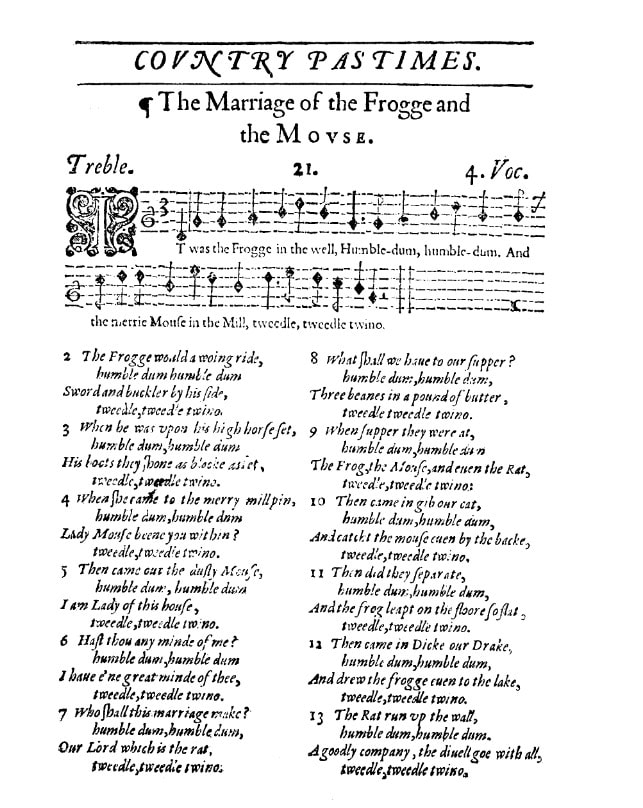
|
~ 19th CE - "The Paddo"
Read Here ("Tales on the Tongue" 2007 – Storytelling Voices in Scotland. Ed. Bea Ferguson (Scottish Storytelling Centre), Edinburgh) {Frog Prince} [Scots, Scotland] ~ ?- "The Well O' The Warld's End"
Popular Rhymes of Scotland. As told by Margaret Tollick, with credit to Robert Chambers’ Read Here (p. 236) {Frog Prince} [Scots, Scotland] ~ 1890 - "The Tale of the Queen Who Sought a Drink From a Certain Well/ Sgeulachd
Ban-Righ a dh' Iarr Deoch a Tobar Araid" Popular Tales of the West Highlands (Vol. 2) Author: John Francis Campbell, Alexander Gardner? Publisher: Collcted from informants: Mrs. MacTavish, Port Ellen, Islay Noted Scource: "The Frog Came to the Mill Door/ The Frog cam to the Myl dur" from The Complaynt of Scotland, 1549 Here Read Here (Gaelic)[XXXIII./ 33.](p. 141) ATU-440 {Frog Prince} [English, London]
~ 1892 - "The Well Of The World's End"
English Fairy Tales Collected by: Joseph Jacobs Illustrator: John D. Batten Publisher: New York : Grosset & Dunlap Recorded in the Scottish Lowlands Scource: "The Frog Came to the Mill Door/ The Frog cam to the Myl dur" from The Complaynt of Scotland, 1549 Here and some elemnts of the German Brother's Grimm "Frog Prince"; List of Scources Here Read Here (p. 224)(Archive) ATU-440 {Frog Prince} [English, Scottish]
|

|
~ 1812 - "The Frog King; or, Iron Henry/ Der Froschkönig oder der eiserne Heinrich"
Alt Title: "The Frog Prince/ Der Froschprinz" Children's and Household Tales/ Kinder-und Hausmärchen (KHM) Authors/Collectors: Jacob and Wilhelm Grimm (Brothers Grimm) Publisher: Jacob and Wilhelm Grimm (Brothers Grimm) **Older version collected in Grimms' handwritten Ölenberg Manuscript, 1810** **Said to be inspired by Scottish Tale "The Frog Came to the Mill Door/ The Frog cam to the Myl dur" from The Complaynt of Scotland, 1549 Here . Differences in story between 1812 and 1857 (English) Here Differences in story between 1812 and 1857 (German) Here Read Here (1812)(English) Read Here (Wiki) Read Here [1.](German)(Archive) ATU- 440 {Frog Prince} [Germany]
|


|
~ 1823 - "The Frog-Prince"
German Popular Stories (Vol 1) Orginal Authors/Collectors: Jacob and Wilhelm Grimm (Brothers Grimm) Translated from Grimm's "The Frog-King, or Iron Henry/ Der Froschkönig oder der eiserne Heinrich" Translator: Edgar Taylor and David Jardine Illustrator: George Cruikshank Publisher: C. Baldwyn Read Here (p. 205) ATU-440 {Frog Prince} [English, London] |
|

|
~ 1879 - "The Frog-Prince"
Grimm's Goblins Orginal Authors/Collectors: Jacob and Wilhelm Grimm (Brothers Grimm) Translated from Grimm's "The Frog-King, or Iron Henry/ Der Froschkönig oder der eiserne Heinrich" Translator: Edgar Taylor and David Jardine Illustrator: George Cruikshank Publisher: by R. Meek & Co 15, Wine Office Court. Fleet St, LONDON 1877 Read Here (p.134)(Wiki) ATU-440 {Frog Prince} [English, London] ~ 1882 - "The Frog Prince"
Household stories from the collection of the Bros Grimm Orginal Authors/Collectors: Jacob and Wilhelm Grimm (Brothers Grimm) Translated from Grimm's "The Frog-King, or Iron Henry/ Der Froschkönig oder der eiserne Heinrich" Translator: Lucy Crane Illustrator: Walter Crane Publisher: Macmillan And Co., Limited , London • Bombay • Calcutta, Melbourne; The Macmillan Company New York • Boston • Chicago, Dallas • San Francisco; The Macmillan Co. Of Canada, Ltd. Toronto Read Here (p. 32 )(Wiki) ATU-440 {Frog Prince} [English, London] |
|
~ 1912 - "The Frog-Prince"
Grimm's Household Tales Orginal Authors/Collectors: Jacob and Wilhelm Grimm (Brothers Grimm) Translated from Grimm's "The Frog-King, or Iron Henry/ Der Froschkönig oder der eiserne Heinrich" Translator: Edgar Taylor, David Jardine, Marian Edwardes Editor: Marian Edwardes Illustrator: Robert Anning Bel Publisher: London, J. M. Dent & Sons Ltd, New York, E.p. Dutton & Co. Read Here (p. 288)(Wiki) {Frog Prince} [English, London] |
|
|

|
~ 1849 - "The Maiden and the Frog"
Popular Rhymes and Nursery Tales (II.—fireside Nursery Stories) Collected by: James Orchard Halliwell-Phillipps Publisher: London: John Russell Smith, 4, Old Compton Street, Soho Square Read Here (Gutenberg) ATU-440 {Frog Prince} [England]
|
|
~ 1888 - "The Singing Frog/ Den syngende frø"
The Treasure Digger: A Journal/ Skattegraveren: Et Tidsskrift (Vol 9) Collector: Evald Tang Kristensen Sourced from: Jens Jakobsen, who heard it from an old woman in Mejlby, Jutlan Publisher: Danish Society for the Collection of Folklore Read Here [#331](p. 106-108)(Google Books) {Frog Beast} [Denmark] ~ 1889 - "The Kind Stepdaughter and the Frog"
The Folk-Tales of the Magyars Collected by: W. Henry Jones and Lewis L. Kropf Publisher: London: Published for the Folk-Lore Society by Elliot Stock Read Here ATU-440 {Frog Beast} [German]
|
c. 16th CE (1550-1553) - "The Pig King/ Il re porco"
The Facetious Nights of Straparola (Vol 1)
Second Night, First Fable. The Pig Prince
Author: Giovanni Francesco Straparola
**Said to have inspired Gabrielle-Suzanne de Villeneuve
Italian fairytale
Read Here (Gutenberg)
{Pig Beast}
[Italian]
The Facetious Nights of Straparola (Vol 1)
Second Night, First Fable. The Pig Prince
Author: Giovanni Francesco Straparola
**Said to have inspired Gabrielle-Suzanne de Villeneuve
Italian fairytale
Read Here (Gutenberg)
{Pig Beast}
[Italian]
Galeotto, King of Anglia, has a son who is born in the shape of a pig. This son marries three wives, and in the end, having thrown off his semblance, becomes a handsome youth. A king and queen, after seven years without children, were gifted a son by three fairies who bestowed different virtues and a curse that he would be a pig until he married three times. The pig, raised as a child, learned to speak and wished to marry. His first two brides were killed on their wedding nights. The third sister, who was kind to him, married him and eventually discovered his true form as a handsome man when he shed his pigskin at night. They had a son, and after she revealed the secret to the king and queen, the king abdicated in favor of his son, known as King Pig, who lived happily with his queen.
|
~ 1882 - "King Crin/ La storia del Re Crin"
Alt Title "The Story of King Crin" Collected by: Antonio Arietti Italian fairy tale Sourced the tale from Monteu da Po, Piedmont Read Here (p. 424)(Google Books) ATU 425 {King Crin - Beast name} {Pig Beast} [Italian]
~ 17th CE - "Prince Marcassin"
Alt Names "The Wild Boar"or "Prince Wild Boar" The Fairy Tales of Madame D'Aulnoy Author: Marie Catherine Baronne D'Aulnoy, The Fairy Tales of Madame D'Aulnoy Translators: Miss Annie Macdonell and Miss Lee Read Here (Archive) {Boar Beast} [French]
|
~ 1875 - "King Pig/ Re Porou"
Fiabe, novelle e racconti popolari siciliani
Author: Giuseppe Pitrè
Publisher: L. Pedone Lauriel
Read Here (Sicilian)(p. 36)(Archive)
Fiabe, novelle e racconti popolari siciliani
Author: Giuseppe Pitrè
Publisher: L. Pedone Lauriel
Read Here (Sicilian)(p. 36)(Archive)
|
The wife, invited to a dance party, while she is enjoying her husband, is mockingly referred to as the wife of a pig for three nights in a row; and almost reviled for having the audacity to mingle with women who have handsome husbands. On the third evening, however, she loses her patience and, forgetting her husband's command to keep his secret, declares that what they think is a pig is actually, at night is a handsome man. Having said this, her husband disappears. (Montevago)
(Translated by PT) |
~ 1875 - "The King's Son, a Pig/ Il figlinolo del re, maiale"
Italian Folk Tales/Novelline popolari italiane
Author: Domenico Comparetti
Publisher: E. Loescher
Read Here [IX.](Italian)(p. 38-39)(Archive)
Italian Folk Tales/Novelline popolari italiane
Author: Domenico Comparetti
Publisher: E. Loescher
Read Here [IX.](Italian)(p. 38-39)(Archive)
|
Once there was a king who had a son, and this son was like a pig during the day, and a handsome knight at night. He lived this way until he was twenty years old, always staying in the back of the palace, and they fed him like a man. One day the king was at the table, and he felt the palace tremble, as if there were an earthquake. The servants went to see what it was, and they saw the pig in a room jumping, and with his jumps he touched the ceiling. They asked him what was wrong, and he said he wanted to get married, and he wanted the eldest daughter of a miller who had three daughters. The king sent for the miller, and told him that his son wanted to marry one of his daughters, and described what he was like, and everything. The miller replied that he was happy if his daughter was happy; and she, too, for the ambition of being queen, was content. So they prepared a feast for the newlyweds, and while they were eating, the pig tried to put his snout in the bride's plate, but she pushed him back with a fork; and she pricked his snout so much that it bled. Then evening came, and the queen went to sleep in her bed. When it was midnight, she heard the glass breaking, and a handsome young man entered the room, but with his face all bloody. And he said to her: "If you hadn't treated me like that, we would have enjoyed life together; instead, you will die by my hand." And he drew his sword and killed her. In the morning, the whole court went to greet the bride, and they found her dead and the whole room full of blood. Two or three months later, another tremor was felt in the palace, stronger than the first. After two or three months, another tremor was felt in the palace, stronger than the first. It was the king's son who wanted to take a wife, and he wanted the miller's second daughter. She hesitated for a while, but then agreed to marry him. At the table, the pig wanted to stick its snout everywhere, but she, with a fork, gave it so many jabs on the snout that it looked like it had been tortured. That evening, going to bed, she fared worse than her sister, because the young man tore her to pieces. After five or six months, the palace trembled again, because the king's son wanted the miller's third daughter. And his father gave her to him, saying: — "Beware, after this one, consider yourself seventy years old, for you will find no more wives to marry." — They had the wedding and went to the table. This third sister, who was more prudent than the others, when the pig put its snout in the plate, she cleaned it with a cloth, so he could eat better. When they had finished eating, they went to bed. At midnight, the most handsome young man on earth arrived in the room. She gave him a flatbread to eat, and he remained a handsome young man for the rest of his life. In the morning, they thought they heard funeral bells ringing, but instead they found the bride and groom alive and happy; and then there were dinners and celebrations. Go and see, they've started dancing. (Monferrato)
(Translated by PT) |
16th - 17th CE - "The Monkey Son-in-Law/ 猿婿/ Saru Muko"
Buy Here "Monkey Son-In-Law" in Beauties and Beasts by Hearne (Amazon)
{Monkey Beast}
[Japanese]
Buy Here "Monkey Son-In-Law" in Beauties and Beasts by Hearne (Amazon)
{Monkey Beast}
[Japanese]
featuring a monkey-like husband, showing the widespread nature of the "maiden marries a beast" motif. traditional Kyogen play
|
~ 1984 - "Monkey Son-In-Law"
Ancient Tales in Modern Japan: An Anthology of Japanese Folk Tales. Bloomington Author: Fanny Hagin Mayer Producer: Bloomington, IN: Indiana University Press |
Enchanted Snake Prince from birth
Women can't have child/ wishes for even if snake
Son born a snake/ finds snake raises as own child
Marries Beauty character princess/common women
Beauty character finds out Beast is a prince in disguise, sees skin
Beauty character tells family about enchantment
Snake husband leaves
Beauty character has to go through trials
Enchanted Serpent Prince from birth
1634 - "The Snake/Lo Serpe"
The Tale of Tales, or the Pentamerone/ Lo cunto de li cunti, overo lol Pentamerone (Il Pentamerone ; Lo cunto de li cunti )
The story of the "The Enchanted Snake"
Author: Giambattista Basile
Croce, Benedetto (ed.). Lo cunto de li cunti (Il Pentamerone): Testo conforme alla prima stampa del MDCXXXIV - VI. Napoli. pp. 209–219
Read Here (p. 207-219)(Archive)
ATU - 433B , 425A
{Grannonia-Beauty name}
{Serpent Beast}
[Neapolitan, Sicilian Italian]
The Tale of Tales, or the Pentamerone/ Lo cunto de li cunti, overo lol Pentamerone (Il Pentamerone ; Lo cunto de li cunti )
The story of the "The Enchanted Snake"
Author: Giambattista Basile
Croce, Benedetto (ed.). Lo cunto de li cunti (Il Pentamerone): Testo conforme alla prima stampa del MDCXXXIV - VI. Napoli. pp. 209–219
Read Here (p. 207-219)(Archive)
ATU - 433B , 425A
{Grannonia-Beauty name}
{Serpent Beast}
[Neapolitan, Sicilian Italian]
In the Kingdom of Starzalonga, a poor childless woman adopts a tiny talking snake that her husband finds in a bundle of firewood. She raises it lovingly as her son, and it grows into a gigantic serpent. When grown, the snake demands to marry the king’s daughter. The king, hoping to avoid such a match, sets impossible tasks: turning the orchard fruit to gold, transforming the garden walls and ground into precious stones, and changing the entire palace into gold. Following the snake’s instructions, the peasant husband performs each miracle using ordinary objects, forcing the king to keep his promise. Princess Grannonia bravely accepts her fate, and when alone with her, the serpent sheds his skin and reveals himself as a handsome enchanted prince.The king and queen, spying on the couple, burn the discarded snakeskin, hoping to free their daughter. Instead, they break the enchantment too soon. The prince transforms into a dove and escapes through a window, severely injuring his head on the broken glass. Grannonia, devastated, leaves the palace at night to search for him. In the forest she meets a fox who explains the prince’s story: he was cursed by a rejected witch to live as a serpent for seven years, and now lies dying from his wounds. The only cure is an ointment made from the blood of certain birds and a fox. With cunning determination, Grannonia gathers the birds’ blood and kills the fox to complete the remedy, then travels to the prince’s homeland, the kingdom of Vallonegruosso. Disguised as a healer, Grannonia promises the prince’s father she will cure his son in exchange for marriage. She heals the prince with the blood ointment, but he does not recognize her and refuses to marry, declaring his loyalty to the woman he already loves. Overjoyed by his faithfulness, she reveals her identity. The prince embraces her, recounts all that he endured for her sake, and the royal families are reunited. Their marriage is celebrated with great joy, and the tale concludes with the moral that love often passes through suffering before reaching true happiness.
(Thank you Clark for the summary)
(Thank you Clark for the summary)
|
~ 1859 - "The Enchanted Brahman's Son/ Der verzauberte Brahmanensohn"
Alt Names: "The Woman Who Married a Snake" , The Girl Who Married a Snake” , "The Fairy Serpent" The Panchatantra (ancient Indian collection of fables) (vol 2) Author: Theodor Benfey Publisher: Leipzig: F. A. Brockhaus Ancient origins 300–500 CE Read Here (1859)[8](p. 144-48.)(German) Read Here (English) Read Here (1998)(Translator: D. L. Ashliman)(English) ATU- 433 {Serpent Beast} [Sanskrit, Indian/ German]
~ 1892 - "The Enchanted Snake"
The Green Fairy Book Author: Andrew Lang Read Here Read Here (English)(Archive) ATU - 425A {Grannonia-Beauty name} {Serpent Beast} [English]
~ 1822 - "The Snake King"
Narratives in Society. A Performer-Centered Study of Narration Folklore Fellows Vol. 255 Author: Linda Dégh Publisher: Helsinki: Suomalainen Tiedeakatemia (p. 139) **Claims to have found the first recorded variant** ATU 433B [Hungarian]
~ 1861 - "The Snakeskin/ A Kigyóbör/ Die Schlangenhaut"
Original Folktales/ Eredeti Népmesék (Prt 1) Collected by: László Merényi Read Here (p. 3-39.)(Gutenberg) Published by: Gusztáv Heckenast {Serpent Beast} [Hungarian]
~ 1870 - "The Snake Bridegroom/ Zmija mladoženja"
Serbian Folk Tales/ Srpske narodne pripovijetke 2nd Ed Collected by: Vuk Karadžić Publisher: Vienna, published by Ana, widow of V. S. Karadžić. Read Here [9.](p. 51–54) (Wiki) AaTh 433B (Croatian folklorist Maja Bošković-Stulli classified) {Serpent Beast} [Croatian/ Serbian]
~ 1884 - "Dragon-Child and Sun-Child"
Original title: "Snake and Sunse/ ՕՁԷՄԱՆՈՒԿ, ԱՐԵՒՄԱՆՈՒԿ/Armenian: "Ojmanuk, Arevmanuk" ; Frédéric Macler translated it into French as "Enfant-Serpent/Enfant-Soleil" ; A. G. Seklemian translated it into English by as "Dragon-Child and Sun-Child" Hamov-Hotov Author: Karekin Servantsians Read Here (Snake Child Otsamanuk and Arevamanuk, who Angered the Sun, translated by: A. G. Seklemian, 2007)(p. 19–23)(English)(Google Books) ATU- 433B {Dragon Beast} [English]
~ 1887 - "The Dragon-Prince"/A sárkány-királyfi"
Alt Title: "The Dragon-Prince and the Stepmother" Oszmán-török Népköltési Gyűjtemény (Vol. I.) Collected: Ignácz Kunos Publisher : Budapest : Magyar Tudományos Akademia Turkish fairy tale Read Here (Hungarian) Read Here [n° 44](p. 195-200)(Hungarian)(Google books) Read Here in Forty-four Turkish fairy tales, by Ignacz Kunos (p. 188–197)(English) Read Here "Der Drachenprinz und die Stiefmutter" Türkische Volksmärchen aus Stambul, by Ignaz Kúnos, 1905 (p. 221-230) (German) ATU 433B , ATU 425A {Dragon Beast} [Hungarian]
~ 1908 - "A small snake from the mud/ A sárig kicsi kígyó"
Csángó folktales from Hétfalus/ Hétfalusi csángó népmesék (Folk Poetry Collection Volume 10)/(Népköltési gyüjtemény 10. kötet) Collected: Antal Hoger Publisher : Budapest, Az Athenaeum Részvénytársulat Tulajdona Read Here [16.](p. 123-128)(Gutenberg) {Serpent Beast} [Hungarian, Budapest]
~ 1914 - "Snake Johnny/ Kígyó Jancsi"
Ipolyi Arnold népmesegyüjteménye/Arnold Ipolyi's Folktale Collection (Collection of Folk takes, Volume 13) Collected by: Arnold Ipolyi Editor: Lajos Kálmány Gyula Sebestyén Producer: Budapest: az Athenaeum Részvénytársulat Tulajdona Read Here [38.](p. 238-243)(Gutenberg) [Hungarian
1916 - "The Serpent Prince"
Edmund Dulac's Fairy-Book: Fairy Tales of the Allied Nations Author : Edmund Dulac Illustrator : Edmund Dulac Publisher : New York: George H. Doran Company Read Here (Gutenberg) From the Italian Fairy Tale ATU - 425A {Grannmia - Beauty name} {Serpent Beast} [English, NY, USA]
~ 1943 - "The Snake Groom/A kígyó-vőlegény"
Kalangya Author: István Banó Scourced from Zenta, Serbia Zentai folk tale (p. 169–172)(XII (4) {Serpent Beast} [Hungarian]
~ 1953 - "The Girl with Two Husband"
Modern Greek folktales Author: Dawkins, R. M. (Richard McGillivray) Publisher: Oxford, Clarendon Press Greek Folktale Read Here [14.](p. 70-)(English)(Archive) ATU - 433B ; ATU - 425A {Serpent Beast} [English] ~ 1954 - "The Snake Child/ A kígyófiú"
First the dance, then the feast: Folktales from the Mezőség region/Előbb a tánc, azután a lakoma: Mezõségi népmesék Author: Faragó József Collected by: Olga Nagy and József Faragó Publisher: Bucharest: State Literary and Artistic Publishing House (p. 75-80) {Serpent Beast} [Palóc,,Hungarian]
~ 1965 - "Serpent Knight/ Kígyóraj vitéz"
Collection of Palóc folklore /Palóc népköltési gyűjtemény (Vol. 2) Collected: Gyula Istvánffy Publisher: Miskolc, A miskolci Herman Ottó Múzeum néprajzi kiadványai. (text for tale nr. 5) Read Here [5.](p. 211–215, 271) AT - 425A {Serpent Beast} [Palóc,,Hungarian]
~ 1971 - "Snakegroom/Kígyóvőlegény"
Yugoslav Hungarian Folktales (New Collection of Hungarian Folktale)/ Jugoszláviai magyar népmesék (Új magyar népköltési gyűjtemény) (Vol. 16) Author: Olga Penavin Publisher: Budapest: Akadémiai Kiad Read Here [64.](p. 323-325 (text for tale nr. 64), 603 (classification) Collected from Vojvodina, Serbia [Yugoslavian-Hungarian]
~ 1979 - "Snake-Blowing Beautiful Prince/ Kígyófújta Szép Királyfi"
Alt Title: "Snake-Blowing Prince/ Kígyófújta Királyfi" Jávorfácska: Félszáz szajáni népmese Author: Beszédes Valéria Publisher: Szabadka, Veljko Vlahović Munkásegyetem. Read Here "Snake-Blowing Prince/ Kígyófújta Királyfi" [3.](p. 22-29) Collected in Száján [Yugoslavian-Hungarian]
~ 1993 - "Grannonia and the Fox"
Cinderella and other classic Italian fairy tales pp. 85-94. Publisher: New York: Children's Classics; Avenel, N.J.: Distributed by Outlet Book Co. ATU - 425A {Serpent Beast} ~ 1997 - "The Prince in Snakeskin/ Kígyóhéjú királyfi"
Folktales of the Uz Valley/ Úz-völgyi népmesék (Hungarian) Author: Orbán Dénes; Karácsony Gyula Porducer: Szentendre: Tillinger Péter műhelyében pp. 33–38. Collected from Uz valley, Romania [Hungarian]
~ 2007 - "The Serpent"
The Golden Trunk: Fourth Entertainment of the Fifth Day". Giambattista Basile's The Tale of Tales, or Entertainment for Little Ones. pp. 169–176. Wayne State University Press. ISBN 978-0-8143-3738-7. Author : Nancy Canepa ATU - 425A {Serpent Beast} |


1697 - "Green Serpent / Serpentin Vert"
Alt title: "Green Dragon"
New Tales or Modern Fairies/Les Contes nouveaux ou les Fées à la mode
Author : Baronne Marie-Catherine d'Aulnoy (Madame d'Aulnoy)
**Closer to Eros and Psyche**
Read Here (p. 305-349)(1825)(Wiki)(French)
ATU 425 (Zipes), ATU 425B , ATU 425A (Delarue & Thèneze)
{Laideronnette - Beauty name}
{Serpent Beast}{Dragon Beast} (Green)
{Curse broken - true love}
[French, France]
Alt title: "Green Dragon"
New Tales or Modern Fairies/Les Contes nouveaux ou les Fées à la mode
Author : Baronne Marie-Catherine d'Aulnoy (Madame d'Aulnoy)
**Closer to Eros and Psyche**
Read Here (p. 305-349)(1825)(Wiki)(French)
ATU 425 (Zipes), ATU 425B , ATU 425A (Delarue & Thèneze)
{Laideronnette - Beauty name}
{Serpent Beast}{Dragon Beast} (Green)
{Curse broken - true love}
[French, France]
(Summary)
This narrative centers around the birth of twin princesses, Laideronnette and Bellotte, whose celebration is marred by the omission of the wicked fairy Magotine from the guest list. Furious over her exclusion, Magotine casts a spell on Laideronnette, transforming her into the world's ugliest woman, while Bellotte is spared. As the years pass, Laideronnette lives a lonely life until a Green Serpent becomes enamored with her. Initially frightened, she flees but is later saved by him after a perilous ocean encounter. In a twist, Laideronnette, unaware of the Green Serpent's true identity as a spell-bound king, falls in love with him through their nightly conversations and they wed under the condition that she must not see him for seven years to avoid renewing the enchantment. Despite her resolve, she eventually succumbs to familial pressure and secretly gazes at her husband, discovering his true form as the Green Serpent. This revelation triggers conflict in the kingdom, leading to the Green Serpent being condemned to Hades and Laideronnette being imprisoned by Magotine. The good fairy Protectress assists Laideronnette through three daunting trials set by Magotine, ultimately aiding her to drink from the "Fount of Discretion," which restores her beauty and grants her the virtue of discretion. After several years in hiding, Queen Discreet returns only to face Magotine's hardest challenge—fetching water of long life from Proserpina in Hades. With the intervention of Love, who aids her in both obtaining the water and resisting its temptation, Discreet’s trials culminate in the reunification with her husband. Ultimately, Love triumphs, breaking Magotine's spells and allowing the couple to return to their kingdom, where they live happily ever after. The moral imparted highlights the dangers of excessive curiosity and champions the virtues of discretion and the redemptive power of love. (Wiki)
This narrative centers around the birth of twin princesses, Laideronnette and Bellotte, whose celebration is marred by the omission of the wicked fairy Magotine from the guest list. Furious over her exclusion, Magotine casts a spell on Laideronnette, transforming her into the world's ugliest woman, while Bellotte is spared. As the years pass, Laideronnette lives a lonely life until a Green Serpent becomes enamored with her. Initially frightened, she flees but is later saved by him after a perilous ocean encounter. In a twist, Laideronnette, unaware of the Green Serpent's true identity as a spell-bound king, falls in love with him through their nightly conversations and they wed under the condition that she must not see him for seven years to avoid renewing the enchantment. Despite her resolve, she eventually succumbs to familial pressure and secretly gazes at her husband, discovering his true form as the Green Serpent. This revelation triggers conflict in the kingdom, leading to the Green Serpent being condemned to Hades and Laideronnette being imprisoned by Magotine. The good fairy Protectress assists Laideronnette through three daunting trials set by Magotine, ultimately aiding her to drink from the "Fount of Discretion," which restores her beauty and grants her the virtue of discretion. After several years in hiding, Queen Discreet returns only to face Magotine's hardest challenge—fetching water of long life from Proserpina in Hades. With the intervention of Love, who aids her in both obtaining the water and resisting its temptation, Discreet’s trials culminate in the reunification with her husband. Ultimately, Love triumphs, breaking Magotine's spells and allowing the couple to return to their kingdom, where they live happily ever after. The moral imparted highlights the dangers of excessive curiosity and champions the virtues of discretion and the redemptive power of love. (Wiki)
|
~ 1916 - "The Green Serpent"
Fairy Tales of the Allied Nations Translator: Edmund Dulac Producer: G.H. Doran Read Here (p. 129–140)(Gutenberg) [English] |
1697 - "The Blue Bird/ L'Oiseau Bleu"
New Tales or Modern Fairies/Les Contes nouveaux ou les Fées à la mode
Author : Baronne Marie-Catherine d'Aulnoy (Madame d'Aulnoy)
Read Here (p. 59-110)(1825)(Wiki)(French)
ATU 432
{Florine - Beauty name}
{Bird Beast}
[French, France]
New Tales or Modern Fairies/Les Contes nouveaux ou les Fées à la mode
Author : Baronne Marie-Catherine d'Aulnoy (Madame d'Aulnoy)
Read Here (p. 59-110)(1825)(Wiki)(French)
ATU 432
{Florine - Beauty name}
{Bird Beast}
[French, France]

(Summary)
After a wealthy king loses his dear wife, he meets and falls in love with a woman, who is also recently widowed and they marry. The king has a daughter named Florine and the new queen also has a daughter named Truitonne. While Florine is beautiful and kind-hearted, Truitonne is spoiled, selfish and ugly and it is not too long before she and her mother become jealous of Florine's beauty. One day, the king decides the time has come to arrange his daughters' marriages and soon, Prince Charming visits the kingdom. The queen is determined for him to marry Truitonne, so she dresses her daughter in all her finery for the reception and bribes Florine's ladies-in-waiting to steal all her dresses and jewels. But her plan backfires for when the Prince claps eyes on Florine, he falls in love with her at once and pays attention only to her. The queen and Truitonne are so furious that they badger the king until he agrees to lock Florine up for the length of the visit and they attempt to blacken her character to the Prince. The queen sends Prince Charming many gifts, but when he hears they are from Truitonne, he rejects them. The queen angrily tells him that Florine will be locked in a tower until he leaves. Prince Charming is outraged and begs to speak with Florine for a moment. The devious queen agrees, but she goes to meet the Prince instead. In the darkness of their meeting place, Prince Charming mistakes Truitonne for Florine and unwittingly asks for the princess's hand in marriage. Truitonne conspires with her fairy godmother, Mazilla, but Mazilla tells her it will be difficult to deceive the Prince. At the wedding ceremony, Truitonne produces the Prince's ring and pleads her case. When Prince Charming realises he has been tricked, he refuses to marry her and nothing that Truitonne or Mazilla do can persuade him. At last, Mazilla threatens to curse him for breaking his promise and when Prince Charming will still not agree, Mazilla transforms him into a blue bird. The queen, on hearing of the news, blames Florine; she dresses Truitonne as a bride and shows her to Florine, claiming that Prince Charming has agreed to marry her. She then persuades the King that Florine is so infatuated with Prince Charming that she had best remain in the tower until she comes to her senses. However, the bluebird flies to the tower one evening and tells Florine the truth. Over many years, the bluebird visits her often, bringing her rich gifts of jewels. Over the years, the queen continues to look for a suitor for Truitonne. One day, exasperated by the many suitors that have rejected Truitonne, the Queen seeks Florine in her tower, only to find her singing with the bluebird. Florine opens the window to let the bird escape, but the Queen discovers her jewellery and realises that she has been receiving some kind of aid. She accuses Florine of treason, but the bluebird manages to foil the queen's plot. For many days, Florine does not call the bluebird for fear of the queen's spy; but one night, as the spy sleeps soundly, she calls the bluebird. They continue to meet for some nights thereafter until the spy hears one of their meetings and tells the Queen. The Queen orders for the fir tree, where the bird perches, to be covered with sharp edges of glass and metal, so that he will be fatally wounded and unable to fly. When Florine calls for the bluebird and he perches on the tree, he cuts his wings and feet and cannot fly to Florine. When the bluebird does not answer Florine's call, she believes he has betrayed her. Luckily, an enchanter hears the Prince lamenting and rescues him from the tree. Florine bribes her stepsister. The enchanter persuades Mazilla to change Prince Charming back into a man for a few months, after which if he still refuses Truitonne, he will be turned back into a bird. One day, Florine's father dies and the people of the kingdom rise up and demand Florine's release. When the Queen resists, they kill her and Truitonne flees to Mazilla. Florine becomes queen and makes preparations to find King Charming. Disguised as a peasant woman, Florine sets out on a journey to find the King and meets an old woman, who proves to be another fairy. The fairy tells her that King Charming has returned to his human form after agreeing to marry Truitonne and gives her four magical eggs. The first egg she uses to climb a great hill of ivory. The second contains a chariot pulled by doves that brings her to King Charming's castle, but she can not reach the king in her disguise. She offers to sell to Truitonne the finest jewellery that King Charming had given her, and Truitonne shows it to the King to find out the proper price. He recognizes it as the jewellery he gave to Florine and is saddened. Truitonne returns to Florine, who will sell them only for a night in the Chamber of Echoes, which King Charming had told her of one night: whatever she says in there will be heard in the king's room. She reproaches him for leaving her and laments all night long, but he has taken a sleeping potion, and does not hear her. She breaks the third egg and finds a tiny coach drawn by mice. Again, she trades it for the Chamber of Echoes, and laments all the night long again, but only the pages hear her. The next day, she opens the last egg and it holds a pie with six singing birds. She gives it to a page, who tells her that the King takes sleeping potions at night. She bribes the page with the singing birds and tells him not to give the King a sleeping potion that night. The King, being awake, hears Florine and runs to the Chamber of Echoes. Recognising his beloved, he throws himself at her feet and they are joyfully reunited. The enchanter and the fairy assure them that they can prevent Mazilla from harming them, and when Truitonne attempts to interfere, they quickly turn her into a sow. King Charming and Queen Florine are married and live happily ever after. (Wiki)
After a wealthy king loses his dear wife, he meets and falls in love with a woman, who is also recently widowed and they marry. The king has a daughter named Florine and the new queen also has a daughter named Truitonne. While Florine is beautiful and kind-hearted, Truitonne is spoiled, selfish and ugly and it is not too long before she and her mother become jealous of Florine's beauty. One day, the king decides the time has come to arrange his daughters' marriages and soon, Prince Charming visits the kingdom. The queen is determined for him to marry Truitonne, so she dresses her daughter in all her finery for the reception and bribes Florine's ladies-in-waiting to steal all her dresses and jewels. But her plan backfires for when the Prince claps eyes on Florine, he falls in love with her at once and pays attention only to her. The queen and Truitonne are so furious that they badger the king until he agrees to lock Florine up for the length of the visit and they attempt to blacken her character to the Prince. The queen sends Prince Charming many gifts, but when he hears they are from Truitonne, he rejects them. The queen angrily tells him that Florine will be locked in a tower until he leaves. Prince Charming is outraged and begs to speak with Florine for a moment. The devious queen agrees, but she goes to meet the Prince instead. In the darkness of their meeting place, Prince Charming mistakes Truitonne for Florine and unwittingly asks for the princess's hand in marriage. Truitonne conspires with her fairy godmother, Mazilla, but Mazilla tells her it will be difficult to deceive the Prince. At the wedding ceremony, Truitonne produces the Prince's ring and pleads her case. When Prince Charming realises he has been tricked, he refuses to marry her and nothing that Truitonne or Mazilla do can persuade him. At last, Mazilla threatens to curse him for breaking his promise and when Prince Charming will still not agree, Mazilla transforms him into a blue bird. The queen, on hearing of the news, blames Florine; she dresses Truitonne as a bride and shows her to Florine, claiming that Prince Charming has agreed to marry her. She then persuades the King that Florine is so infatuated with Prince Charming that she had best remain in the tower until she comes to her senses. However, the bluebird flies to the tower one evening and tells Florine the truth. Over many years, the bluebird visits her often, bringing her rich gifts of jewels. Over the years, the queen continues to look for a suitor for Truitonne. One day, exasperated by the many suitors that have rejected Truitonne, the Queen seeks Florine in her tower, only to find her singing with the bluebird. Florine opens the window to let the bird escape, but the Queen discovers her jewellery and realises that she has been receiving some kind of aid. She accuses Florine of treason, but the bluebird manages to foil the queen's plot. For many days, Florine does not call the bluebird for fear of the queen's spy; but one night, as the spy sleeps soundly, she calls the bluebird. They continue to meet for some nights thereafter until the spy hears one of their meetings and tells the Queen. The Queen orders for the fir tree, where the bird perches, to be covered with sharp edges of glass and metal, so that he will be fatally wounded and unable to fly. When Florine calls for the bluebird and he perches on the tree, he cuts his wings and feet and cannot fly to Florine. When the bluebird does not answer Florine's call, she believes he has betrayed her. Luckily, an enchanter hears the Prince lamenting and rescues him from the tree. Florine bribes her stepsister. The enchanter persuades Mazilla to change Prince Charming back into a man for a few months, after which if he still refuses Truitonne, he will be turned back into a bird. One day, Florine's father dies and the people of the kingdom rise up and demand Florine's release. When the Queen resists, they kill her and Truitonne flees to Mazilla. Florine becomes queen and makes preparations to find King Charming. Disguised as a peasant woman, Florine sets out on a journey to find the King and meets an old woman, who proves to be another fairy. The fairy tells her that King Charming has returned to his human form after agreeing to marry Truitonne and gives her four magical eggs. The first egg she uses to climb a great hill of ivory. The second contains a chariot pulled by doves that brings her to King Charming's castle, but she can not reach the king in her disguise. She offers to sell to Truitonne the finest jewellery that King Charming had given her, and Truitonne shows it to the King to find out the proper price. He recognizes it as the jewellery he gave to Florine and is saddened. Truitonne returns to Florine, who will sell them only for a night in the Chamber of Echoes, which King Charming had told her of one night: whatever she says in there will be heard in the king's room. She reproaches him for leaving her and laments all night long, but he has taken a sleeping potion, and does not hear her. She breaks the third egg and finds a tiny coach drawn by mice. Again, she trades it for the Chamber of Echoes, and laments all the night long again, but only the pages hear her. The next day, she opens the last egg and it holds a pie with six singing birds. She gives it to a page, who tells her that the King takes sleeping potions at night. She bribes the page with the singing birds and tells him not to give the King a sleeping potion that night. The King, being awake, hears Florine and runs to the Chamber of Echoes. Recognising his beloved, he throws himself at her feet and they are joyfully reunited. The enchanter and the fairy assure them that they can prevent Mazilla from harming them, and when Truitonne attempts to interfere, they quickly turn her into a sow. King Charming and Queen Florine are married and live happily ever after. (Wiki)
|
~ 1892 - "The Blue Bird"
The Green Fairy Orginal Author : Baronne Marie-Catherine d'Aulnoy (Madame d'Aulnoy) Translator: Andrew Lang Illustrator: H. J. Ford Read Here (p. 1-26)(Archive)(English) ATU 432 {Fiordelisa - Beauty name} {King Charming - Beast} {Bird Beast} [English] |
|
|

|
~ 1920 - "Five Wonderful Eggs"
Fairy stories my children love best of all Orginal Author : Baronne Marie-Catherine d'Aulnoy (Madame d'Aulnoy) Adapted by: Edgar Dubs Shimer Publisher: New York, L. A. Noble Read Here (p. 213-228)(Archive) ATU 432 {Florina "Little Flower" - Beauty name} {Prince Charming - Beast} {Bird Beast} [English] |
~ 1870 - "The Green Knight / Den Grønne Ridder"
Folklore from Hanved Parish near Flensburg/ Folkeminder fra Hanved Sogn ved Flensborg
Author: Jens Madsen
Publisher: Kjobenhavn: i komission C. S. Ivensens Boghandel
Danish fairy tale
Read Here (p. 17-20)
ATU 510A, ATU 425N, ATU 432
{Bird Beast}
[English]
Folklore from Hanved Parish near Flensburg/ Folkeminder fra Hanved Sogn ved Flensborg
Author: Jens Madsen
Publisher: Kjobenhavn: i komission C. S. Ivensens Boghandel
Danish fairy tale
Read Here (p. 17-20)
ATU 510A, ATU 425N, ATU 432
{Bird Beast}
[English]
|
(Summary)
A dying queen asked her husband, the king, to do whatever their daughter asked. The king promised this. A widow and her daughter tried to win the princess' favor and said they could only stay if the king married the widow. The princess urged the king to marry her, and despite his doubts, he did. Once married, the new stepmother treated the princess cruelly. To protect her, the king sent the princess to a summer palace and visited her before leaving for a long journey to a tournament. The princess asked him to send greetings to the Green Knight. During the tournament, the king did not meet a Green Knight but later found a swineherd in a forest who told him about the Green Knight. Upon reaching the beautiful castle of the Green Knight, the king conveyed his daughter's greetings. The Green Knight, a handsome young man, welcomed him and gifted him either a green book or a casket with his portrait. When the king returned, the princess unknowingly spoke about the Green Knight. In one version, when she looked through the book, the Green Knight appeared as a bird to court her; in another version, he came to court her after she recognized him from her dreams. They met secretly because of her stepmother, who eventually discovered their meetings. In some stories, she poisoned scissors at the window; in others, she poisoned a nail in the boat he used to visit. The princess learned of the Green Knight's illness from two birds and found a snake with nine young snakes in her father's stables that could cure him. She cooked soup for him using the snakes for three days, and he recovered. In some tales, he recognized her in the kitchen, while in others, she proposed marriage, but he initially refused due to an earlier promise. In all versions, they eventually married. (Wiki) |
|
~ 1876 - "The Green Knight / Den Grønne Ridder"
Danish Folk Tales: Based on Unprinted Sources /Danske Folkeaeventyr: Efter Utrykte Kilder Author: Sven Grundtvig Publisher: Kjøbenhaven: C. A. Reitzel Read Here (p. 159-175.) ~ 1907 - "The Green Knight / Den Grønne Ridder"
The Olive Fairy book Author: Andrew Lang Publisher: London ; New York : Longmans, Green Read Here (p. 152-166)(Archive) [English] ~ 1920 - "The Parrot Prince / El Príncipe Lor"
Author: Ramón Laval Alvial Publisher: Chilean/Latin American Read Here Latin American Folktales, by John Bierhorst (p.240) ATU 432 |
~ 1911 - "The Merchant's Daughter"
The Blue Rose Fairy Book
Adapted by: Maurice Baring
Publisher: New York: Maude, Dodd and Company
Greek variation
Read Here (p. 193-218)(Gutenberg)
ATU 432
{Gift - Golden Ring from India}
{Daphne- Beauty name}
{Prince Fortunate - Beast name}
{Bird Beast}(wood pigeon)
[English]
The Blue Rose Fairy Book
Adapted by: Maurice Baring
Publisher: New York: Maude, Dodd and Company
Greek variation
Read Here (p. 193-218)(Gutenberg)
ATU 432
{Gift - Golden Ring from India}
{Daphne- Beauty name}
{Prince Fortunate - Beast name}
{Bird Beast}(wood pigeon)
[English]
|
(Summary)
The youngest daughter titular merchant's daughters, asks for her father to bring her "The Golden Ring". The Golden Ring is a prince from a foreign country (India) who, after meeting the merchant, asks if his duaghter was beautifual he answers "(She) is like the first day of spring. She is more beautiful than any woman in the world." The Prince leads to a room with many beautiful pictures of beautiful women and asks "Is your daughter Daphne as beautiful as any of the people who are pictured here?" He answers "My daughter Daphne is a thousand times more beautiful than any of these pictures." The Prince then tells him he saw Daphne in his dreams and wishes to marry her. The merchant gives his daughter a letter, a cup and the golden ring. The prince metamorphoses into a pigeon to meet Daphne by her window in secret, flies in and jumps into a cup to become human. Some time later, jealous of her hidden happiness, her sisters see that a knife is inside the cup and summon the prince to be hurt while in bird form. It happens thus, and Prince Fortunate (the prince's name) flies back to his kingdom. Learning of her beloved's injuries, Daphne dons a masculine disguise, sails to India and wanders to her prince's kingdom. On the way, she overhears the conversation between two birds about a way to cure the prince: one would have to kill the birds and dip their bodies in a spring to make an ointment that can heal the prince. Daphne kills the birds, prepares the ointment and goes to Prince Fortunate's castle in a doctor's disguise to apply the cure on his body. |
~ 1963 - "The King's Daughter and the Rosebush/ La Fille du Roy et le Rosier"
Saharan Tales from the Souf/ Contes sahariens du Souf
Author: Jeanne Scelles-Millie
Publisher: G.-P. Maisonneuve et Larouse
Arab Algerian tale
Read Here (p. 291-297)
ATU 432
{Gift - Rosebush}
{Bird Beast}
{Curse Broken- liver and heart of a lion}
Saharan Tales from the Souf/ Contes sahariens du Souf
Author: Jeanne Scelles-Millie
Publisher: G.-P. Maisonneuve et Larouse
Arab Algerian tale
Read Here (p. 291-297)
ATU 432
{Gift - Rosebush}
{Bird Beast}
{Curse Broken- liver and heart of a lion}
|
(Summary)
A king has seven daughters, the youngest of which he loves the best of all, to her sisters' jealousy. One day, their father is ready to go to Mecca, and asks what presents he can bring him. They each ask for material gifts, but the youngest seems uncertain about her gift. Her elder sisters consult with a sorceress, who advises them to suggest a rosebush for their sister. The youngest princess follows her sisters' suggestion and asks the king for a rosebush, and curses her father not to come back until he finds her gift. The king goes to Mecca and buys gifts for his six elder daughters, but cannot seem to find the specific rosebush, and his camel does not move at all. The king is advised by an old man to stop by a cave entrance, sacrifice a ram and wait until a white dog comes to take the meat. It happens thus: the king sees a black dog and a white dog come out of the cave and take the meat. He enters the cave and meets a prince, who asks him the purpose of his visit. The king explains about his search for a gift for his daughter, and the prince says he is the rosebush, and orders the man to return home, for he will come to his daughter through the air and with the storm and the rain. The king returns home and tells his youngest daughter about the prince. The youngest princess waits in her room for the rosebush prince, talks to him all night and he flies away, leaving her some gold in the morning. As time passes, her elder sisters begin to envy her good fortune, and place needles by the window. The next time the rosebush prince flies in, he injures himself in the needles and has to fly back to his kingdom. The youngest princess decides to seek him out, and stops by a lion's den. She overhears a conversation between a lion and a lioness about the rosebush prince and how their liver and heart can cure him. After the lions sleep, the princess kills them to take their heart and liver to cure the prince. (Wiki) |
~ 1980 - "The Canary Prince /Il Principe Canarino"
Italian Folktales
Author: Italo Calvino.
Italian tale
Read Here [18.](p. 52-57)
ATU 432
[Italian]
Italian Folktales
Author: Italo Calvino.
Italian tale
Read Here [18.](p. 52-57)
ATU 432
[Italian]
|
(Differences) **Spoilers**
A prince turns into a canary to visit the heroine (often in a tower setting with Rapunzel-like elements); includes the wounding and healing quest motifs of ATU 432. (Summary) A jealous stepmother persuades her husband, the king, to lock his daughter in a castle in the forest. One day, a king's son goes by, hunting, and is astounded to see the abandoned castle in use. He sees the daughter, but they are unable to communicate except by gesture. A witch, to help them, tricks the ladies-in-waiting into giving the princess a book. When she ruffles the pages forward, her lover turns into a canary; when she ruffles them back, he is restored to his human form. After some time, the queen arrives and sees a young man by the window, and puts pins on the window sill so that if the daughter leaned on it to flirt, she would be stabbed. These pins stab the prince in his canary form, and even when the princess restores him, the prince lies on the ground, bleeding, and his companions must bear him back to his father. The princess escapes by cutting up her sheets for a rope, and overhears witches talking of things; one describes how to heal the prince. She does so, and asks for his coat-of-arms, his standard, and his vest as her reward. He goes hunting, and she turns him into a canary. When he flies to her room and she turns him back, he reproaches her for his injury. She produces her reward to prove that she saved him, and tells him that it was her stepmother's doing. They marry, and the daughter reveals to her father how wicked her imprisonment had been. (Wiki) |
~ 1988 - "Krahlamaj/Крахламадж"
Georgian Folk Tales/Грузинские народные сказки (Book 1)
Author: T. D. Kurdovanidze/ Т. Д. Курдованидзе
Translated by: N. Dolidze
Publisher: Moscow: Main Editorial Board of Oriental Literature, Nauka Publishers
Georgian tale
**More like Cupid and Psyche**
Read Here [no. 50][356 , classification](Russian)(p. 199–204)
ATU 432
{Gift - krahlamaj flower}
{Anthro Deitie Beast}(Angel)
[Russian]
Georgian Folk Tales/Грузинские народные сказки (Book 1)
Author: T. D. Kurdovanidze/ Т. Д. Курдованидзе
Translated by: N. Dolidze
Publisher: Moscow: Main Editorial Board of Oriental Literature, Nauka Publishers
Georgian tale
**More like Cupid and Psyche**
Read Here [no. 50][356 , classification](Russian)(p. 199–204)
ATU 432
{Gift - krahlamaj flower}
{Anthro Deitie Beast}(Angel)
[Russian]
|
(Summary)
A king has three daughters who are supervised by a governess. One day, he has to go on a journey and asks his daughters what they want as presents from the trip: the eldest asks for a dress unlike any other, the middle one for a jewel that shines brighter than the sun, and the youngest for the krahlamaj flower. The king goes on his journey and finds gifts for the elder ones, but cannot seem to find the krahlamaj, since no one appears to have heard of it. The king then reaches a distant kingdom, where a prophetess knows about the krahlamaj flower, and explains the situation: the king of this distant kingdom prayed to God for a son, even if he is an angel from Heaven, and God granted him one; at the same time, a flower sprouted at the garden and, a few days later, the little baby grew wings and flew back to Heaven; the king becomes sad, but another angel explains that his son can be summoned back to Earth by placing shiny objects and petals from the krahlamaj flower in a room, and clean it from any piece of glass. The prophetess then tells the first king that the flower is fiercely guarded by animals in the king's garden, but he can avoid them by throwing them fresh meat. The first king takes the flower and goes back to his daughters, giving them the presents. The princesses' governess, who worked at the second king's palace, knows the secret of the krahlamaj flower, so she puts it in a pot, places some shiny objects and some petals in a room, and prince Krahlamaj flies down from Heaven to meet the youngest princess. Later, the eldest princess spies on the cadette and, seeing the beautiful, angelic youth, grows jealous, and hatches a plan: the elder princess places glass on the bed and, when Krahlamaj appears next, he hurts himself and flies back to his kingdom badly hurt. Sensing her beloved's disappearance, the youngest princess dresses in masculine attire, takes the krahlamaj flower she owned and rushes to the prince's distant kingdom. She reaches her beloved's kingdom, where she learns the prince has been bedridden for years, so she introduces herself as a magician who has come to cure the prince, and is taken to his chambers. The princess enters the chambers and sees the injured prince, and, just as she comes, the smell of the krahlamaj flower she brought with her begins to heal the prince. After he is completely cured, the princess and the prince marry. (Wiki) |
1697-1698 - "The Ram / Le Mouton"
Alt Name "The Tragic Fate of the Ram"
New Tales or Modern Fairies/Les Contes nouveaux ou les Fées à la mode
Author : Baronne Marie-Catherine d'Aulnoy (Madame d'Aulnoy)
**English translations appeared much later, such as in the 1892 edition of her tales.**
Read Here (p. 239-262)(Wiki)(French)
ATU 425
{Ram Beast}
[French]
Alt Name "The Tragic Fate of the Ram"
New Tales or Modern Fairies/Les Contes nouveaux ou les Fées à la mode
Author : Baronne Marie-Catherine d'Aulnoy (Madame d'Aulnoy)
**English translations appeared much later, such as in the 1892 edition of her tales.**
Read Here (p. 239-262)(Wiki)(French)
ATU 425
{Ram Beast}
[French]
(Changes)
A strange combo of Snow White & Beauty and the Beast & Cinderella. Unhappy endeding.
(Story)
In the happy days when fairies lived, there reigned a king who had three daughters. They were beautiful and young, and all had merit, but the youngest was the kindest and most beloved. She was called Marvelous. Her father, the king, gave her more dresses and ribbons in a month than the others did in a year. And she had such a kind little heart that she shared everything with her sisters, so that they were very close. The king had wicked neighbors who, tired of leaving him in peace, waged such a fierce war against him that he feared defeat if he did not defend himself. He assembled a large army and set out on campaign. The three princesses remained with their governor in a castle, where they received good news from the king every day: sometimes that he had captured a city, then won a battle; finally, he did so much that he vanquished his enemies and drove them from his kingdom. Then he quickly returned to his castle to see his beloved little Merveilleuse again. The three princesses had three satin gowns made for themselves: one green, one blue, and one white. Their jewels matched the gowns: the green one had emeralds, the blue one turquoise, and the white one diamonds. Thus adorned, they went to meet the king, singing these verses they had composed about his victories, After so many illustrious conquests, What joy to see both her father and her king again! Let us invent pleasures, let us celebrate a thousand festivities, Let all here submit to his law, And let us strive to prove our tenderness, By our attentive care and our songs of joy. When he saw them so beautiful and cheerful, he embraced them tenderly, and lavished more caresses on Merveilleuse than on the others. A magnificent meal was served; The king and his three daughters sat down to eat; and as he was considering the implications of everything, he said to the eldest: "Tell me, why did you choose a green dress?" "My lord," she said, "having learned of your exploits, I thought green would signify my joy and the hope of your return." "That's very well said!" exclaimed the king. "And you, my daughter," he continued, "why did you choose a blue dress?" "My lord," said the princess, "to show that it was necessary to constantly implore the gods on your behalf, and that when I see you, I believe I see the heavens and the most beautiful stars." "What!" said the king, "you speak like an oracle!" "And you, Marvelous One, what reason did you have for dressing in white?" "My lord," she said, "because it suits me better than other colors." "What!" said the king, quite annoyed, "little coquette, was that your only intention?" "I had the desire to please you," said the princess, "and I think I shouldn't have any other." The king, who loved her, found the matter so well arranged that he said he was pleased with this little trick, and that there was even an art to it in not having revealed his thoughts all at once. "Oh now," he said, "I've had a good supper, I don't want to go to bed so early; tell me about the dreams you had the night before my return." The elder sister said she had dreamt that he was bringing her a dress, whose gold and jewels shone brighter than the sun. The younger sister said she had dreamt that he was bringing her a dress and a golden distaff to spin her shirts. The younger sister said she had dreamt that he was marrying off her second sister, and that on the wedding day, he held a golden ewer and said to her, "Come, Marvelous One, come, let me wash you." The king, indignant at this dream, frowned and made the ugliest face imaginable; everyone knew he was angry. He went into his room and abruptly got into bed; his daughter's dream kept returning to his mind. "That insolent little girl," he said, "wants to reduce me to her servant! I'm not surprised she took the white satin dress without a thought for me; she thinks me unworthy of her opinions, but I want to thwart her evil plan before it comes to fruition." He rose in a fury; And although it was not yet day, he sent for his captain of the guards and said to him, “You have heard about the dream Merveilleuse had; it signifies strange things against me. I want you to seize her immediately, take her into the forest, and slit her throat; then you will bring me her heart and tongue, for I do not intend to be deceived, or I will have you put to a cruel death.” The captain of the guards was quite astonished to hear such a barbaric order. He did not want to contradict the king, for fear of further angering him and having him give this commission to someone else. He told him that he would take the princess, slit her throat, and bring him her heart and tongue. He went immediately to his room, which they had great difficulty opening for him, as it was very early. He told Merveilleuse that the king was calling for her. She got up quickly. A little Moorish girl, named Patypata, grabbed the train of her dress; her hen and her dog, who always followed her, ran after her. Her hen was called Grabugeon, and the dog Tintin. The captain of the guards made Merveilleuse come downstairs and told her that the king was in the garden enjoying the fresh air; she went in. He pretended to look for him, and not finding him, he said, "No doubt the king has gone as far as the forest." He opened a small door and led her into the forest. Day was already breaking; the princess looked at her guide; he had tears in his eyes, and he was so sad that he could not speak. "What's wrong?" "She said to him with a charmingly kind air, 'You seem very distressed!' 'Ha! Madam, who wouldn't be,' he cried, 'at the most fatal order that has ever been issued. The king wants me to slit your throat here and bring him your heart and tongue; if I fail, he will have me killed.' The poor, frightened princess paled and began to weep softly; she looked like a little lamb about to be sacrificed. She fixed her beautiful eyes on the captain of the guards and, looking at him without anger, said, 'Will you have the courage to kill me, I who have never harmed you and who have only spoken well of you to the king? If I had deserved my father's hatred, I would suffer its effects without complaint. Alas! I have shown him so much respect and affection that he cannot complain without injustice.'" "Do not fear, fair princess," said the captain of the guards, "that I would be capable of lending him my hand for such a barbaric act. I would sooner resign myself to the death he threatens me with; but even if I were to stab myself, you would be no safer. We must find a way for me to return to the king and persuade him that you are dead." "What way shall we find?" said Merveilleuse. "For he wants you to give him my tongue and my heart; otherwise, he will not believe you." Patypata, who had overheard everything, and whom neither the princess nor the captain of the guards had even noticed, so sorrowful were they, bravely stepped forward and threw herself at Merveilleuse's feet. "Madam," she said, "I have come to offer you my life. You must kill me; I would be only too happy to die for such a good mistress." "Ha! I have no fear, my dear Patypata," said the princess, kissing her. After such a tender demonstration of your friendship, your life should be no less precious to me than my own. Grabugeon stepped forward and said: "You are right, my princess, to love a slave as faithful as Patypata; she can be more useful to you than I; I offer you my tongue and my heart with joy, wishing to immortalize myself in the empire of the Barbary macaques." "Ha! My dear Grabugeon," replied Merveilleuse, "I cannot bear the thought of taking your life." "It would be unbearable for me," cried Tintin, "that, being as good a dog as I am, another should give his life for my mistress; I must die or no one will die." A great argument arose between Patypata, Grabugeon, and Tintin; harsh words were exchanged. Finally, Grabugeon, more lively than the others, climbed to the top of a tree, and deliberately let herself fall headfirst, thus killing herself; and however much regret the princess had, she consented, since she was dead, that the captain of the guards should take her tongue, but it was found to be so small (for in all it was no bigger than a fist), that they judged with great sorrow that the king would not be deceived. Alas! My dear little monkey, so you are dead, said the princess, without your death securing my life. That honor is reserved for me, interrupted the Moorish woman. At the same time, she took the knife that had been used on Grabugeon and plunged it down her throat. The captain of the guards wanted to take her tongue, but it was so black that he didn't dare flatter himself he could deceive the king with it. Am I not very unhappy, said the princess, weeping, I am losing everything I love, and my fortune remains unchanged. If you had been willing, said Tintin, to accept my proposal, you would have had only me to regret, and I would have the advantage of being the only one missed. Merveilleuse kissed her little dog, weeping so hard she could no longer: she quickly moved away; so that when she turned around, she no longer saw her handler; She found herself surrounded by her Moorish wife, her hen, and her dog. She could not leave until she had placed them in a pit she happened upon at the foot of a tree. Then she wrote these words on the tree: Here lies one mortal, two mortal women, All three equally faithful, Who, wishing to preserve my life, Had hastened the end of theirs, Finally, she considered her safety; and since there was none for her in this forest, which was so close to her father's castle that the first passersby could see and recognize her, or that lions and wolves could eat her like a chicken, she began to walk as far as she could. But the forest was so vast, and the sun so scorching, that she was dying of heat, fear, and exhaustion. She looked in every direction without seeing the end of the forest. Everything frightened her; She still believed the king was chasing after her to kill her: it is impossible to repeat her mournful laments. She walked without following any definite path; the bushes tore at her beautiful dress and wounded her white skin. Finally, she heard a ram bleating: no doubt, she said, there are shepherds here with their flocks; they can guide me to some hamlet, where I will hide disguised as a peasant woman. Alas! she continued, it is not always sovereigns and princes who are the happiest. Who in this whole kingdom would believe that I am a fugitive, that my father, without cause or reason, wishes for my death, and that to avoid it, I must disguise myself! With these thoughts in mind, she advanced toward the place where she heard the bleating; But what a surprise it was for her, arriving in a rather spacious place, completely surrounded by trees, to see a large ram whiter than snow, with golden horns, a garland of flowers around its neck, its legs entwined with prodigiously thick strands of pearls, several diamond chains, and lying on orange blossoms; a pavilion of cloth of gold, suspended in the air, prevented the sun from bothering it; a hundred or so adorned ram were around it, not grazing, but some were drinking coffee, sorbet, ice cream, lemonade, others strawberries, cream, and preserves; some were playing basset, others lansquenet; several had gold collars enriched with gallant mottoes, pierced ears, ribbons, and flowers everywhere. Merveilleuse remained so astonished that she was almost motionless. She was searching with her eyes for the shepherd of such an extraordinary flock, when the most beautiful ram came bounding and leaping up to her. "Come closer, divine princess," he said to her, "do not be afraid of animals as gentle and peaceful as we are." "What a marvel! Talking ram!" "Ha! Madam," he replied, "your monkey and your dog spoke so beautifully, do you have any less reason to be astonished?" "A fairy," replied Merveilleuse, "had given them the gift of speech; that is what made the marvel all the more familiar." "Perhaps we have had some similar adventure," replied the ram, smiling at the ewe. "But, my princess, who is guiding your steps here?" "A thousand misfortunes, Lord ram," she said to him, "I am the most unfortunate person in the world; I am seeking refuge from my father's fury." "Come, Madam," replied the ram, "come with me; I will offer you one known only to you, and you will be its absolute mistress." “It’s impossible for me to follow you,” said Merveilleuse; “I’m so tired I could die.” The ram with the golden horns ordered his chariot to be brought. A moment later, six goats appeared, harnessed to a pumpkin of such prodigious size that two people could sit inside it very comfortably. The pumpkin was dry, and inside were thick patches of down and velvet everywhere. The princess sat down, admiring such a novel carriage. The master ram entered the pumpkin with her, and the goats ran with all their might to a cavern, the entrance of which was closed by a large stone. The golden ram touched her with its foot, and she immediately fell. It told the princess to enter without fear; she believed that this cavern held nothing but dread, and if she had been less alarmed, nothing could have compelled her to descend; but in the strength of her apprehension, she would have thrown herself into a well. So she did not hesitate to follow the ram, which walked before her: it led her down so low, so very low, that she thought she was going at least to the antipodes; and she was sometimes afraid that it might lead her to the realm of the dead. Finally, she suddenly discovered a vast plain adorned with a thousand different flowers, whose sweet fragrance surpassed all she had ever smelled; a large river of orange blossom water flowed around it, and fountains of Spanish wine, sundews, hippocras, and a thousand other kinds of liqueurs formed charming cascades and little streams. This plain was covered with unusual trees; there were entire avenues of partridges, better skewered and cooked than at Guerbois's, hanging from the branches; there were other rows of quail and rabbits, turkeys, chickens, pheasants, and ortolans; in certain places where the air seemed darker, it rained crayfish bisque, health soups, foie gras, sweetbreads in stews, white pudding, sausages, pies, pâtés, dry and liquid preserves, gold louis, crowns, pearls, and diamonds. The rarity of this rain, and at the same time its usefulness, would have attracted good company, if the fat ram had been a little more inclined to become familiar; But all the chronicles that have spoken of him attest that he maintained his composure better than a Roman senator. As it was the most beautiful season of the year when Merveilleuse arrived in this lovely place, she saw no other palaces than a long row of orange trees, jasmine, honeysuckle, and small nutmeg roses, whose intertwined branches formed cabinets, halls, and rooms, all furnished with gold and silver gauze, with large mirrors, chandeliers, and magnificent paintings. The master ram told the princess that she was sovereign in this place, that for some years he had had cause to grieve and shed tears, but that it was entirely up to her to make him forget his sorrows. "The way you behave, charming ram," she said to him, "is so generous, and everything I see here seems so extraordinary, that I don't know what to make of it." She had scarcely finished speaking when a troop of nymphs of admirable beauty appeared before her. They presented her with fruit in amber baskets; but when she tried to approach them, their bodies gradually receded. She stretched out her arm to touch them, felt nothing, and realized they were phantoms. "Ah! What is this?" she cried. "Who am I with?" She began to weep; and King Ram (for that was his name), who had left her for a few moments, returned to her side and, seeing her tears, was so overcome with grief that he thought he would die at her feet. "What is the matter, beautiful princess?" he said to her. “Has the respect due to you been neglected in this place?” “No,” she said, “I am not complaining. I only confess that I am not accustomed to living with the dead and a talking ram. Everything here frightens me; and however much I owe you for having brought me here, I will owe you even more for sending me back into the world.” “Do not be afraid,” replied the ram. “Please listen to me calmly, and you will learn of my deplorable fate. I was born on the throne. A long line of kings, my ancestors, had assured me of the possession of the most beautiful kingdom in the world. My subjects loved me, and I was feared and envied by my neighbors, and esteemed with some justice. It was said that no king had ever been more worthy of the title. My person was not indifferent to those who saw me; I was very fond of hunting; And having let myself be carried away by the pleasure of following a deer which took me a little away from all those who accompanied me, I saw it suddenly rush into a pond; I urged my horse into it with as much imprudence as recklessness; but as I advanced a little, I felt, instead of the coolness of the water, an extraordinary heat; the pond dried up; and through an opening from which terrible fires came out, I fell to the bottom of a precipice where one could see nothing but flames. I thought I was lost when I heard a voice say to me: "No less fire is needed, ungrateful one, to warm your heart." "Aha! Who here complains of my coldness?" I cried. "An unfortunate person," replied the voice, "who adores you without hope." At the same time, the fires went out; I saw a fairy whom I had known since my earliest youth, whose age and ugliness had always terrified me. She was leaning on a young slave of incomparable beauty; she wore gold chains that clearly indicated her station. "What wonder is happening here, Ragotte (that is the fairy's name)?" I said to her. "Could it be by your orders?" "Aha, by whose orders?" she replied. "Have you not known my feelings until now? Must I be ashamed to explain them?" Have my eyes, once so sure of their power, lost all their strength? Consider how low I stoop; it is I who confess my weakness to you, for though you are a great king, you are less than an ant before a fairy like me. "I am whatever you please," I told her, with an impatient air and tone; "but what do you ask of me? Is it my crown, my cities, my treasures?" "Ha! wretch," she replied disdainfully, "my kitchen boys, when I so choose, will be more powerful than you. I ask for your heart; my eyes have asked it of you a thousand times; you did not hear them, or rather, you refused to hear them." "If you were engaged to another," she continued, "I would let you make progress in your love affairs; But I was too eager to enlighten you not to have discovered the indifference that reigns in your heart. "Well then, love me," she added, pursing her lips to make it more agreeable, and rolling her eyes, "I will be your little Ragotte. I will add twenty kingdoms to the one you possess, a hundred towers full of gold, five hundred full of silver; in short, everything you desire." "Madame Ragotte," I said to her, "it is not in the depths of a pit where I thought I would be roasted that I wish to make a declaration to a person of your merit. I beg you, by all the charms that make you amiable, to set me free, and then we shall see together what I can do to satisfy you." "Ha! Traitor," she cried, "if you loved me, you would not seek the path to your kingdom." In a cave, in a fox den, in the woods, in the desert, you would be content. Don't think I'm a novice; you're thinking of slipping away, but I'm warning you that you must stay here; and the first thing you'll do is tend my ram: they're intelligent, and speak at least as well as you. At the same time, she walked out onto the plain where we were and showed me her flock. I barely glanced at it; the beautiful slave girl who was with her had seemed marvelous to me; my eyes betrayed me. Cruel Ragotte, noticing this, pounced on her and plunged an awl so deep into her eye that the lovely girl instantly lost her life. At this dreadful sight, I rushed at Ragotte, and, drawing my sword, I would have sacrificed her to those dear spirits, had she not, by her power, rendered me motionless. My efforts being in vain, I fell to the ground, and I was searching for a way to kill myself to free myself from my predicament, when she said to me with an ironic smile: "I want to show you my power; you are a lion now, you will become a ram." At once she touched me with her wand, and I found myself transformed as you see. I did not lose the power of speech, nor the feelings of pain that my condition caused me. "You will be a ram for five years," she said, "and absolute master of this beautiful place; while, far from you, and no longer seeing your pleasant face, I will think only of the hatred I feel for you." She disappeared. And if anything could have softened my disgrace, it would have been her absence. The talking ram, who are here, recognized me as their king; They told me they were unfortunate souls who had displeased the vindictive fairy in several different ways, and that she had gathered them into a flock; that their penance was not as long for some as for others. Indeed, he added, from time to time they revert to what they once were and leave the flock. As for the others, they are rivals or enemies of Ragotte, whom she has killed for a century or less, and who will then return to the world. The young slave girl I told you about is among them; I saw her several times in succession with pleasure, although she did not speak to me, and when I tried to approach her, I was dismayed to learn that she was only a shadow; but having noticed one of my ram lingering near this little phantom, I knew that it was her lover, and that Ragotte, susceptible to tender feelings, had wanted to take him away from her. This reason distanced me from the shadow of slavery; and for three years I have felt no inclination nothing but my freedom. That is what compels me to sometimes go into the forest. I saw you there, beautiful princess, he continued, sometimes on a chariot that you yourself drove with more skill than the sun when it guides its own, sometimes hunting on a horse that seemed untamable to anyone but you; then running lightly across the plain with the princesses of your court, you won the prize like another Atalanta. Ah! Princess, if in all those times when my heart made secret vows to you, I had dared to speak to you, what would I have not said? But how would you have received the declaration of a wretched ram like me? Merveilleuse was so troubled by everything she had heard up to that point that she hardly knew how to answer him; She did, however, show him some kindness that gave him a glimmer of hope, and said she was less afraid of the shades, since they were destined to come back to life one day. "Alas!" she continued, "if my poor Patypata, my dear Grabugeon, and handsome Tintin, who died to save me, could have a similar fate, I would no longer be bored here." Despite King Mouton's disgrace, he still enjoyed admirable privileges. "Go," he said to his chief squire (a rather handsome ram), "go and fetch the Moorish woman, the hen, and the dog; their shades will amuse our princess." A moment later, Merveilleuse saw them, and although they didn't approach close enough to be touched, their presence brought her immense comfort. King Mouton possessed all the wit and refinement necessary for pleasant conversation. He loved Merveilleuse so passionately that she too came to notice him, and then to love him. A pretty ram, so soft and cuddly, is bound to please, especially when one knows that he is a king, and that the metamorphosis must end. Thus the princess gently spent her beautiful days, awaiting a happier fate. The gallant ram cared only for her; he held parties, concerts, and hunts; his flock supported him, even the shades, playing their part. One evening, when the messengers arrived—for he diligently sent out news, and he always received the best—they came to tell him that Princess Merveilleuse's elder sister was to marry a great prince, and that nothing was more magnificent than all that was being prepared for the wedding. "Ah!" cried the young princess, "how unfortunate I am not to see so many beautiful things!" Here I am, underground with shadows and sheep, while my sister appears, adorned like a queen; everyone will pay her homage, and I will be the only one who shares in her joy. "What are you complaining about, madam?" said the king of the sheep. "Did I refuse you entry to the wedding? Leave whenever you please, but give me your word that you will return; if you do not agree, you will see me die at your feet, for my attachment to you is too strong for me to lose you without dying." The marvelous, moved woman promised the ram that nothing in the world could prevent her return. He gave her an carriage befitting her lineage; she dressed magnificently, and neglected nothing that could enhance her beauty; she climbed into a chariot of mother-of-pearl, drawn by six isabelline hippogriffs newly arrived from the antipodes; He had her accompanied by a large number of richly dressed and handsome officers; he had sent for them from afar to form the procession. She went to the palace of her father, the king, at the very moment the wedding was being celebrated. As soon as she entered, she astonished all who saw her with the brilliance of her beauty and her jewels. Around her, she heard nothing but acclamations and praise. The king gazed at her with an attention and pleasure that made him fear she might be recognized; but he was so forewarned of her impending death that he had no inkling of it. However, the fear of being arrested prevented her from staying until the end of the ceremony; she left abruptly, leaving behind a small coral chest adorned with emeralds; inscribed on it in diamond points were the words, "Gemstones for the bride." It was opened immediately, and what was found inside? The king, who had hoped to see her again and longed to meet her, was distraught at not seeing her again; he ordered that, should she ever return, all the gates be closed behind her, and she be detained. However short Merveilleuse's absence had been, it had seemed to the ram as long as a century. He awaited her by a fountain, deep in the forest; he had displayed immense riches there to offer them to her in gratitude for her return. As soon as he saw her, he ran towards her, leaping and bounding like a true ram; He showered her with tender caresses, lay at her feet, kissed her hands, and confided his worries and anxieties to her; his passion gave him an eloquence that charmed the princess. After some time, the king married off his second daughter. Merveilleuse learned of this and begged the ram to allow her to attend, as she had done before, a celebration in which she was so deeply interested. At this suggestion, he felt a pain he could not control, a secret premonition foretelling his misfortune; but since it is not always in our nature to avoid it, and since his devotion to the princess outweighed all other concerns, he lacked the strength to refuse her. "You wish to leave me, madam," he said to her; "this consequence of my misfortune stems more from my ill fortune than from you. I consent to your wish, and I could never make you a more complete sacrifice." She assured him that she would be as little delayed as the first time; that she would keenly feel anything that might separate her from him, and that she begged him not to worry. She used the same carriage that had already brought her, and she arrived as the ceremony was beginning. Despite the attention being paid to it, her presence caused a cry of joy and admiration, which drew the eyes of all the princes to her. They could not tire of looking at her, and they found her so exceptionally beautiful that they were ready to believe she was not mortal. The king was delighted to see her again; he only took his eyes off her to order that all the doors be securely closed to keep her there. As the ceremony was about to end, the princess quickly rose, wanting to slip away into the crowd, but she was extremely surprised and distressed to find the doors closed. The king approached her with great respect and a deference that reassured her. He begged her not to deprive them so soon of the pleasure of seeing her and of being part of the famous feast he was giving for the princes and princesses. He led her into a magnificent salon where the entire court was gathered; he himself brought a golden basin and a vase full of water to wash her beautiful hands. At that moment, she was no longer in control of her rapture; she threw herself at his feet and, embracing his knees, said, "My dream has come true! You gave me the privilege of washing on the day of my sister's wedding, and nothing untoward has befallen you." The king recognized her all the more easily because he had found more than once that she perfectly resembled Merveilleuse! "Ah! My dear daughter," he said, embracing her and shedding tears, "can you forget my cruelty?" I wanted your death because I believed your dream signified the loss of my crown. It did signify it, he continued; now your two sisters are married, each with a crown, and mine will be yours. At that very moment, he rose and placed it on the princess's head, then cried, "Long live Queen Marvelous!" The entire court shouted along with him. The young queen's two sisters rushed to embrace her and showered her with affection. Marvelous was beside herself with joy: she wept and laughed at the same time; she kissed one sister, spoke to the other, thanked the king, and amidst all these things, she remembered the captain of the guards, to whom she owed so much, and earnestly asked for him. But she was told he was dead: she felt this loss keenly. When she was seated at the table, the king asked her to recount what had happened to her since the day he had given such disastrous orders against her. She immediately began to speak with admirable grace, and everyone listened attentively. But while she was lost in her own thoughts with the king and her sisters, the lovelorn ram watched the hour of the princess's return pass, and his anxiety became so extreme that he could no longer control it. "She doesn't want to come back!" he cried. "My wretched sheepish face displeases her." Ah! What an unfortunate lover! How shall I manage without Merveilleuse? Ragotte, barbarous fairy, what vengeance will you not take for my indifference towards you? He complained for a long time, and seeing that night was approaching, without the princess appearing, he ran to the city. When he arrived at the king's palace, he asked for Merveilleuse; but as everyone already knew of her adventure, and no one wanted her to return with the ram, they harshly refused to see her. He uttered laments and expressed regrets capable of moving anyone but the Swiss guards who stood at the palace gate. Finally, overcome with grief, he threw himself to the ground and died there. The king and Merveilleuse were unaware of the sad tragedy that had just occurred. He suggested to his daughter that she ride in a chariot and be seen by the whole city by the light of a thousand torches that shone in the windows and in the main squares. But what a sight it must have been for her, to find her beloved ram lying on the pavement, no longer breathing, upon leaving her palace? She rushed from the cart, ran to him, wept, and groaned, realizing that her carelessness had caused the death of the royal ram. In her despair, she thought she herself would die. It was then agreed that even the highest-ranking people are subject, like everyone else, to the blows of fortune, and that they often experience the greatest misfortunes precisely when they believe their desires have been fulfilled. Often the most blessed gifts from heaven
Only serve to ruin us: The brilliant merit we ask of the Gods, Sometimes is the sad origin of our woes. The king ram would have suffered less, If he had not kindled that fatal flame That Ragotte avenged upon him, upon her rival: It is his merit that destroys him. He should have had a more favorable fate. Ragotte and his gifts could do nothing for him; He hated without pretense, loved without artifice, And was unlike the men of today. Even his end may seem quite rare to us, And befits only King Mouton. One does not see any in this region Die when their ram strays.
(Translated by GT)(PT Translation)
A strange combo of Snow White & Beauty and the Beast & Cinderella. Unhappy endeding.
(Story)
In the happy days when fairies lived, there reigned a king who had three daughters. They were beautiful and young, and all had merit, but the youngest was the kindest and most beloved. She was called Marvelous. Her father, the king, gave her more dresses and ribbons in a month than the others did in a year. And she had such a kind little heart that she shared everything with her sisters, so that they were very close. The king had wicked neighbors who, tired of leaving him in peace, waged such a fierce war against him that he feared defeat if he did not defend himself. He assembled a large army and set out on campaign. The three princesses remained with their governor in a castle, where they received good news from the king every day: sometimes that he had captured a city, then won a battle; finally, he did so much that he vanquished his enemies and drove them from his kingdom. Then he quickly returned to his castle to see his beloved little Merveilleuse again. The three princesses had three satin gowns made for themselves: one green, one blue, and one white. Their jewels matched the gowns: the green one had emeralds, the blue one turquoise, and the white one diamonds. Thus adorned, they went to meet the king, singing these verses they had composed about his victories, After so many illustrious conquests, What joy to see both her father and her king again! Let us invent pleasures, let us celebrate a thousand festivities, Let all here submit to his law, And let us strive to prove our tenderness, By our attentive care and our songs of joy. When he saw them so beautiful and cheerful, he embraced them tenderly, and lavished more caresses on Merveilleuse than on the others. A magnificent meal was served; The king and his three daughters sat down to eat; and as he was considering the implications of everything, he said to the eldest: "Tell me, why did you choose a green dress?" "My lord," she said, "having learned of your exploits, I thought green would signify my joy and the hope of your return." "That's very well said!" exclaimed the king. "And you, my daughter," he continued, "why did you choose a blue dress?" "My lord," said the princess, "to show that it was necessary to constantly implore the gods on your behalf, and that when I see you, I believe I see the heavens and the most beautiful stars." "What!" said the king, "you speak like an oracle!" "And you, Marvelous One, what reason did you have for dressing in white?" "My lord," she said, "because it suits me better than other colors." "What!" said the king, quite annoyed, "little coquette, was that your only intention?" "I had the desire to please you," said the princess, "and I think I shouldn't have any other." The king, who loved her, found the matter so well arranged that he said he was pleased with this little trick, and that there was even an art to it in not having revealed his thoughts all at once. "Oh now," he said, "I've had a good supper, I don't want to go to bed so early; tell me about the dreams you had the night before my return." The elder sister said she had dreamt that he was bringing her a dress, whose gold and jewels shone brighter than the sun. The younger sister said she had dreamt that he was bringing her a dress and a golden distaff to spin her shirts. The younger sister said she had dreamt that he was marrying off her second sister, and that on the wedding day, he held a golden ewer and said to her, "Come, Marvelous One, come, let me wash you." The king, indignant at this dream, frowned and made the ugliest face imaginable; everyone knew he was angry. He went into his room and abruptly got into bed; his daughter's dream kept returning to his mind. "That insolent little girl," he said, "wants to reduce me to her servant! I'm not surprised she took the white satin dress without a thought for me; she thinks me unworthy of her opinions, but I want to thwart her evil plan before it comes to fruition." He rose in a fury; And although it was not yet day, he sent for his captain of the guards and said to him, “You have heard about the dream Merveilleuse had; it signifies strange things against me. I want you to seize her immediately, take her into the forest, and slit her throat; then you will bring me her heart and tongue, for I do not intend to be deceived, or I will have you put to a cruel death.” The captain of the guards was quite astonished to hear such a barbaric order. He did not want to contradict the king, for fear of further angering him and having him give this commission to someone else. He told him that he would take the princess, slit her throat, and bring him her heart and tongue. He went immediately to his room, which they had great difficulty opening for him, as it was very early. He told Merveilleuse that the king was calling for her. She got up quickly. A little Moorish girl, named Patypata, grabbed the train of her dress; her hen and her dog, who always followed her, ran after her. Her hen was called Grabugeon, and the dog Tintin. The captain of the guards made Merveilleuse come downstairs and told her that the king was in the garden enjoying the fresh air; she went in. He pretended to look for him, and not finding him, he said, "No doubt the king has gone as far as the forest." He opened a small door and led her into the forest. Day was already breaking; the princess looked at her guide; he had tears in his eyes, and he was so sad that he could not speak. "What's wrong?" "She said to him with a charmingly kind air, 'You seem very distressed!' 'Ha! Madam, who wouldn't be,' he cried, 'at the most fatal order that has ever been issued. The king wants me to slit your throat here and bring him your heart and tongue; if I fail, he will have me killed.' The poor, frightened princess paled and began to weep softly; she looked like a little lamb about to be sacrificed. She fixed her beautiful eyes on the captain of the guards and, looking at him without anger, said, 'Will you have the courage to kill me, I who have never harmed you and who have only spoken well of you to the king? If I had deserved my father's hatred, I would suffer its effects without complaint. Alas! I have shown him so much respect and affection that he cannot complain without injustice.'" "Do not fear, fair princess," said the captain of the guards, "that I would be capable of lending him my hand for such a barbaric act. I would sooner resign myself to the death he threatens me with; but even if I were to stab myself, you would be no safer. We must find a way for me to return to the king and persuade him that you are dead." "What way shall we find?" said Merveilleuse. "For he wants you to give him my tongue and my heart; otherwise, he will not believe you." Patypata, who had overheard everything, and whom neither the princess nor the captain of the guards had even noticed, so sorrowful were they, bravely stepped forward and threw herself at Merveilleuse's feet. "Madam," she said, "I have come to offer you my life. You must kill me; I would be only too happy to die for such a good mistress." "Ha! I have no fear, my dear Patypata," said the princess, kissing her. After such a tender demonstration of your friendship, your life should be no less precious to me than my own. Grabugeon stepped forward and said: "You are right, my princess, to love a slave as faithful as Patypata; she can be more useful to you than I; I offer you my tongue and my heart with joy, wishing to immortalize myself in the empire of the Barbary macaques." "Ha! My dear Grabugeon," replied Merveilleuse, "I cannot bear the thought of taking your life." "It would be unbearable for me," cried Tintin, "that, being as good a dog as I am, another should give his life for my mistress; I must die or no one will die." A great argument arose between Patypata, Grabugeon, and Tintin; harsh words were exchanged. Finally, Grabugeon, more lively than the others, climbed to the top of a tree, and deliberately let herself fall headfirst, thus killing herself; and however much regret the princess had, she consented, since she was dead, that the captain of the guards should take her tongue, but it was found to be so small (for in all it was no bigger than a fist), that they judged with great sorrow that the king would not be deceived. Alas! My dear little monkey, so you are dead, said the princess, without your death securing my life. That honor is reserved for me, interrupted the Moorish woman. At the same time, she took the knife that had been used on Grabugeon and plunged it down her throat. The captain of the guards wanted to take her tongue, but it was so black that he didn't dare flatter himself he could deceive the king with it. Am I not very unhappy, said the princess, weeping, I am losing everything I love, and my fortune remains unchanged. If you had been willing, said Tintin, to accept my proposal, you would have had only me to regret, and I would have the advantage of being the only one missed. Merveilleuse kissed her little dog, weeping so hard she could no longer: she quickly moved away; so that when she turned around, she no longer saw her handler; She found herself surrounded by her Moorish wife, her hen, and her dog. She could not leave until she had placed them in a pit she happened upon at the foot of a tree. Then she wrote these words on the tree: Here lies one mortal, two mortal women, All three equally faithful, Who, wishing to preserve my life, Had hastened the end of theirs, Finally, she considered her safety; and since there was none for her in this forest, which was so close to her father's castle that the first passersby could see and recognize her, or that lions and wolves could eat her like a chicken, she began to walk as far as she could. But the forest was so vast, and the sun so scorching, that she was dying of heat, fear, and exhaustion. She looked in every direction without seeing the end of the forest. Everything frightened her; She still believed the king was chasing after her to kill her: it is impossible to repeat her mournful laments. She walked without following any definite path; the bushes tore at her beautiful dress and wounded her white skin. Finally, she heard a ram bleating: no doubt, she said, there are shepherds here with their flocks; they can guide me to some hamlet, where I will hide disguised as a peasant woman. Alas! she continued, it is not always sovereigns and princes who are the happiest. Who in this whole kingdom would believe that I am a fugitive, that my father, without cause or reason, wishes for my death, and that to avoid it, I must disguise myself! With these thoughts in mind, she advanced toward the place where she heard the bleating; But what a surprise it was for her, arriving in a rather spacious place, completely surrounded by trees, to see a large ram whiter than snow, with golden horns, a garland of flowers around its neck, its legs entwined with prodigiously thick strands of pearls, several diamond chains, and lying on orange blossoms; a pavilion of cloth of gold, suspended in the air, prevented the sun from bothering it; a hundred or so adorned ram were around it, not grazing, but some were drinking coffee, sorbet, ice cream, lemonade, others strawberries, cream, and preserves; some were playing basset, others lansquenet; several had gold collars enriched with gallant mottoes, pierced ears, ribbons, and flowers everywhere. Merveilleuse remained so astonished that she was almost motionless. She was searching with her eyes for the shepherd of such an extraordinary flock, when the most beautiful ram came bounding and leaping up to her. "Come closer, divine princess," he said to her, "do not be afraid of animals as gentle and peaceful as we are." "What a marvel! Talking ram!" "Ha! Madam," he replied, "your monkey and your dog spoke so beautifully, do you have any less reason to be astonished?" "A fairy," replied Merveilleuse, "had given them the gift of speech; that is what made the marvel all the more familiar." "Perhaps we have had some similar adventure," replied the ram, smiling at the ewe. "But, my princess, who is guiding your steps here?" "A thousand misfortunes, Lord ram," she said to him, "I am the most unfortunate person in the world; I am seeking refuge from my father's fury." "Come, Madam," replied the ram, "come with me; I will offer you one known only to you, and you will be its absolute mistress." “It’s impossible for me to follow you,” said Merveilleuse; “I’m so tired I could die.” The ram with the golden horns ordered his chariot to be brought. A moment later, six goats appeared, harnessed to a pumpkin of such prodigious size that two people could sit inside it very comfortably. The pumpkin was dry, and inside were thick patches of down and velvet everywhere. The princess sat down, admiring such a novel carriage. The master ram entered the pumpkin with her, and the goats ran with all their might to a cavern, the entrance of which was closed by a large stone. The golden ram touched her with its foot, and she immediately fell. It told the princess to enter without fear; she believed that this cavern held nothing but dread, and if she had been less alarmed, nothing could have compelled her to descend; but in the strength of her apprehension, she would have thrown herself into a well. So she did not hesitate to follow the ram, which walked before her: it led her down so low, so very low, that she thought she was going at least to the antipodes; and she was sometimes afraid that it might lead her to the realm of the dead. Finally, she suddenly discovered a vast plain adorned with a thousand different flowers, whose sweet fragrance surpassed all she had ever smelled; a large river of orange blossom water flowed around it, and fountains of Spanish wine, sundews, hippocras, and a thousand other kinds of liqueurs formed charming cascades and little streams. This plain was covered with unusual trees; there were entire avenues of partridges, better skewered and cooked than at Guerbois's, hanging from the branches; there were other rows of quail and rabbits, turkeys, chickens, pheasants, and ortolans; in certain places where the air seemed darker, it rained crayfish bisque, health soups, foie gras, sweetbreads in stews, white pudding, sausages, pies, pâtés, dry and liquid preserves, gold louis, crowns, pearls, and diamonds. The rarity of this rain, and at the same time its usefulness, would have attracted good company, if the fat ram had been a little more inclined to become familiar; But all the chronicles that have spoken of him attest that he maintained his composure better than a Roman senator. As it was the most beautiful season of the year when Merveilleuse arrived in this lovely place, she saw no other palaces than a long row of orange trees, jasmine, honeysuckle, and small nutmeg roses, whose intertwined branches formed cabinets, halls, and rooms, all furnished with gold and silver gauze, with large mirrors, chandeliers, and magnificent paintings. The master ram told the princess that she was sovereign in this place, that for some years he had had cause to grieve and shed tears, but that it was entirely up to her to make him forget his sorrows. "The way you behave, charming ram," she said to him, "is so generous, and everything I see here seems so extraordinary, that I don't know what to make of it." She had scarcely finished speaking when a troop of nymphs of admirable beauty appeared before her. They presented her with fruit in amber baskets; but when she tried to approach them, their bodies gradually receded. She stretched out her arm to touch them, felt nothing, and realized they were phantoms. "Ah! What is this?" she cried. "Who am I with?" She began to weep; and King Ram (for that was his name), who had left her for a few moments, returned to her side and, seeing her tears, was so overcome with grief that he thought he would die at her feet. "What is the matter, beautiful princess?" he said to her. “Has the respect due to you been neglected in this place?” “No,” she said, “I am not complaining. I only confess that I am not accustomed to living with the dead and a talking ram. Everything here frightens me; and however much I owe you for having brought me here, I will owe you even more for sending me back into the world.” “Do not be afraid,” replied the ram. “Please listen to me calmly, and you will learn of my deplorable fate. I was born on the throne. A long line of kings, my ancestors, had assured me of the possession of the most beautiful kingdom in the world. My subjects loved me, and I was feared and envied by my neighbors, and esteemed with some justice. It was said that no king had ever been more worthy of the title. My person was not indifferent to those who saw me; I was very fond of hunting; And having let myself be carried away by the pleasure of following a deer which took me a little away from all those who accompanied me, I saw it suddenly rush into a pond; I urged my horse into it with as much imprudence as recklessness; but as I advanced a little, I felt, instead of the coolness of the water, an extraordinary heat; the pond dried up; and through an opening from which terrible fires came out, I fell to the bottom of a precipice where one could see nothing but flames. I thought I was lost when I heard a voice say to me: "No less fire is needed, ungrateful one, to warm your heart." "Aha! Who here complains of my coldness?" I cried. "An unfortunate person," replied the voice, "who adores you without hope." At the same time, the fires went out; I saw a fairy whom I had known since my earliest youth, whose age and ugliness had always terrified me. She was leaning on a young slave of incomparable beauty; she wore gold chains that clearly indicated her station. "What wonder is happening here, Ragotte (that is the fairy's name)?" I said to her. "Could it be by your orders?" "Aha, by whose orders?" she replied. "Have you not known my feelings until now? Must I be ashamed to explain them?" Have my eyes, once so sure of their power, lost all their strength? Consider how low I stoop; it is I who confess my weakness to you, for though you are a great king, you are less than an ant before a fairy like me. "I am whatever you please," I told her, with an impatient air and tone; "but what do you ask of me? Is it my crown, my cities, my treasures?" "Ha! wretch," she replied disdainfully, "my kitchen boys, when I so choose, will be more powerful than you. I ask for your heart; my eyes have asked it of you a thousand times; you did not hear them, or rather, you refused to hear them." "If you were engaged to another," she continued, "I would let you make progress in your love affairs; But I was too eager to enlighten you not to have discovered the indifference that reigns in your heart. "Well then, love me," she added, pursing her lips to make it more agreeable, and rolling her eyes, "I will be your little Ragotte. I will add twenty kingdoms to the one you possess, a hundred towers full of gold, five hundred full of silver; in short, everything you desire." "Madame Ragotte," I said to her, "it is not in the depths of a pit where I thought I would be roasted that I wish to make a declaration to a person of your merit. I beg you, by all the charms that make you amiable, to set me free, and then we shall see together what I can do to satisfy you." "Ha! Traitor," she cried, "if you loved me, you would not seek the path to your kingdom." In a cave, in a fox den, in the woods, in the desert, you would be content. Don't think I'm a novice; you're thinking of slipping away, but I'm warning you that you must stay here; and the first thing you'll do is tend my ram: they're intelligent, and speak at least as well as you. At the same time, she walked out onto the plain where we were and showed me her flock. I barely glanced at it; the beautiful slave girl who was with her had seemed marvelous to me; my eyes betrayed me. Cruel Ragotte, noticing this, pounced on her and plunged an awl so deep into her eye that the lovely girl instantly lost her life. At this dreadful sight, I rushed at Ragotte, and, drawing my sword, I would have sacrificed her to those dear spirits, had she not, by her power, rendered me motionless. My efforts being in vain, I fell to the ground, and I was searching for a way to kill myself to free myself from my predicament, when she said to me with an ironic smile: "I want to show you my power; you are a lion now, you will become a ram." At once she touched me with her wand, and I found myself transformed as you see. I did not lose the power of speech, nor the feelings of pain that my condition caused me. "You will be a ram for five years," she said, "and absolute master of this beautiful place; while, far from you, and no longer seeing your pleasant face, I will think only of the hatred I feel for you." She disappeared. And if anything could have softened my disgrace, it would have been her absence. The talking ram, who are here, recognized me as their king; They told me they were unfortunate souls who had displeased the vindictive fairy in several different ways, and that she had gathered them into a flock; that their penance was not as long for some as for others. Indeed, he added, from time to time they revert to what they once were and leave the flock. As for the others, they are rivals or enemies of Ragotte, whom she has killed for a century or less, and who will then return to the world. The young slave girl I told you about is among them; I saw her several times in succession with pleasure, although she did not speak to me, and when I tried to approach her, I was dismayed to learn that she was only a shadow; but having noticed one of my ram lingering near this little phantom, I knew that it was her lover, and that Ragotte, susceptible to tender feelings, had wanted to take him away from her. This reason distanced me from the shadow of slavery; and for three years I have felt no inclination nothing but my freedom. That is what compels me to sometimes go into the forest. I saw you there, beautiful princess, he continued, sometimes on a chariot that you yourself drove with more skill than the sun when it guides its own, sometimes hunting on a horse that seemed untamable to anyone but you; then running lightly across the plain with the princesses of your court, you won the prize like another Atalanta. Ah! Princess, if in all those times when my heart made secret vows to you, I had dared to speak to you, what would I have not said? But how would you have received the declaration of a wretched ram like me? Merveilleuse was so troubled by everything she had heard up to that point that she hardly knew how to answer him; She did, however, show him some kindness that gave him a glimmer of hope, and said she was less afraid of the shades, since they were destined to come back to life one day. "Alas!" she continued, "if my poor Patypata, my dear Grabugeon, and handsome Tintin, who died to save me, could have a similar fate, I would no longer be bored here." Despite King Mouton's disgrace, he still enjoyed admirable privileges. "Go," he said to his chief squire (a rather handsome ram), "go and fetch the Moorish woman, the hen, and the dog; their shades will amuse our princess." A moment later, Merveilleuse saw them, and although they didn't approach close enough to be touched, their presence brought her immense comfort. King Mouton possessed all the wit and refinement necessary for pleasant conversation. He loved Merveilleuse so passionately that she too came to notice him, and then to love him. A pretty ram, so soft and cuddly, is bound to please, especially when one knows that he is a king, and that the metamorphosis must end. Thus the princess gently spent her beautiful days, awaiting a happier fate. The gallant ram cared only for her; he held parties, concerts, and hunts; his flock supported him, even the shades, playing their part. One evening, when the messengers arrived—for he diligently sent out news, and he always received the best—they came to tell him that Princess Merveilleuse's elder sister was to marry a great prince, and that nothing was more magnificent than all that was being prepared for the wedding. "Ah!" cried the young princess, "how unfortunate I am not to see so many beautiful things!" Here I am, underground with shadows and sheep, while my sister appears, adorned like a queen; everyone will pay her homage, and I will be the only one who shares in her joy. "What are you complaining about, madam?" said the king of the sheep. "Did I refuse you entry to the wedding? Leave whenever you please, but give me your word that you will return; if you do not agree, you will see me die at your feet, for my attachment to you is too strong for me to lose you without dying." The marvelous, moved woman promised the ram that nothing in the world could prevent her return. He gave her an carriage befitting her lineage; she dressed magnificently, and neglected nothing that could enhance her beauty; she climbed into a chariot of mother-of-pearl, drawn by six isabelline hippogriffs newly arrived from the antipodes; He had her accompanied by a large number of richly dressed and handsome officers; he had sent for them from afar to form the procession. She went to the palace of her father, the king, at the very moment the wedding was being celebrated. As soon as she entered, she astonished all who saw her with the brilliance of her beauty and her jewels. Around her, she heard nothing but acclamations and praise. The king gazed at her with an attention and pleasure that made him fear she might be recognized; but he was so forewarned of her impending death that he had no inkling of it. However, the fear of being arrested prevented her from staying until the end of the ceremony; she left abruptly, leaving behind a small coral chest adorned with emeralds; inscribed on it in diamond points were the words, "Gemstones for the bride." It was opened immediately, and what was found inside? The king, who had hoped to see her again and longed to meet her, was distraught at not seeing her again; he ordered that, should she ever return, all the gates be closed behind her, and she be detained. However short Merveilleuse's absence had been, it had seemed to the ram as long as a century. He awaited her by a fountain, deep in the forest; he had displayed immense riches there to offer them to her in gratitude for her return. As soon as he saw her, he ran towards her, leaping and bounding like a true ram; He showered her with tender caresses, lay at her feet, kissed her hands, and confided his worries and anxieties to her; his passion gave him an eloquence that charmed the princess. After some time, the king married off his second daughter. Merveilleuse learned of this and begged the ram to allow her to attend, as she had done before, a celebration in which she was so deeply interested. At this suggestion, he felt a pain he could not control, a secret premonition foretelling his misfortune; but since it is not always in our nature to avoid it, and since his devotion to the princess outweighed all other concerns, he lacked the strength to refuse her. "You wish to leave me, madam," he said to her; "this consequence of my misfortune stems more from my ill fortune than from you. I consent to your wish, and I could never make you a more complete sacrifice." She assured him that she would be as little delayed as the first time; that she would keenly feel anything that might separate her from him, and that she begged him not to worry. She used the same carriage that had already brought her, and she arrived as the ceremony was beginning. Despite the attention being paid to it, her presence caused a cry of joy and admiration, which drew the eyes of all the princes to her. They could not tire of looking at her, and they found her so exceptionally beautiful that they were ready to believe she was not mortal. The king was delighted to see her again; he only took his eyes off her to order that all the doors be securely closed to keep her there. As the ceremony was about to end, the princess quickly rose, wanting to slip away into the crowd, but she was extremely surprised and distressed to find the doors closed. The king approached her with great respect and a deference that reassured her. He begged her not to deprive them so soon of the pleasure of seeing her and of being part of the famous feast he was giving for the princes and princesses. He led her into a magnificent salon where the entire court was gathered; he himself brought a golden basin and a vase full of water to wash her beautiful hands. At that moment, she was no longer in control of her rapture; she threw herself at his feet and, embracing his knees, said, "My dream has come true! You gave me the privilege of washing on the day of my sister's wedding, and nothing untoward has befallen you." The king recognized her all the more easily because he had found more than once that she perfectly resembled Merveilleuse! "Ah! My dear daughter," he said, embracing her and shedding tears, "can you forget my cruelty?" I wanted your death because I believed your dream signified the loss of my crown. It did signify it, he continued; now your two sisters are married, each with a crown, and mine will be yours. At that very moment, he rose and placed it on the princess's head, then cried, "Long live Queen Marvelous!" The entire court shouted along with him. The young queen's two sisters rushed to embrace her and showered her with affection. Marvelous was beside herself with joy: she wept and laughed at the same time; she kissed one sister, spoke to the other, thanked the king, and amidst all these things, she remembered the captain of the guards, to whom she owed so much, and earnestly asked for him. But she was told he was dead: she felt this loss keenly. When she was seated at the table, the king asked her to recount what had happened to her since the day he had given such disastrous orders against her. She immediately began to speak with admirable grace, and everyone listened attentively. But while she was lost in her own thoughts with the king and her sisters, the lovelorn ram watched the hour of the princess's return pass, and his anxiety became so extreme that he could no longer control it. "She doesn't want to come back!" he cried. "My wretched sheepish face displeases her." Ah! What an unfortunate lover! How shall I manage without Merveilleuse? Ragotte, barbarous fairy, what vengeance will you not take for my indifference towards you? He complained for a long time, and seeing that night was approaching, without the princess appearing, he ran to the city. When he arrived at the king's palace, he asked for Merveilleuse; but as everyone already knew of her adventure, and no one wanted her to return with the ram, they harshly refused to see her. He uttered laments and expressed regrets capable of moving anyone but the Swiss guards who stood at the palace gate. Finally, overcome with grief, he threw himself to the ground and died there. The king and Merveilleuse were unaware of the sad tragedy that had just occurred. He suggested to his daughter that she ride in a chariot and be seen by the whole city by the light of a thousand torches that shone in the windows and in the main squares. But what a sight it must have been for her, to find her beloved ram lying on the pavement, no longer breathing, upon leaving her palace? She rushed from the cart, ran to him, wept, and groaned, realizing that her carelessness had caused the death of the royal ram. In her despair, she thought she herself would die. It was then agreed that even the highest-ranking people are subject, like everyone else, to the blows of fortune, and that they often experience the greatest misfortunes precisely when they believe their desires have been fulfilled. Often the most blessed gifts from heaven
Only serve to ruin us: The brilliant merit we ask of the Gods, Sometimes is the sad origin of our woes. The king ram would have suffered less, If he had not kindled that fatal flame That Ragotte avenged upon him, upon her rival: It is his merit that destroys him. He should have had a more favorable fate. Ragotte and his gifts could do nothing for him; He hated without pretense, loved without artifice, And was unlike the men of today. Even his end may seem quite rare to us, And befits only King Mouton. One does not see any in this region Die when their ram strays.
(Translated by GT)(PT Translation)
|
~ 1795 - "The Royal Ram, or, The Wishes"
The enchanter, or, Wonderful story teller: in which is contained a series of adventures, curious, surprising, and uncommon: calculated to amuse, instruct, and improve younger minds. London: Minerva Press, p. 36-50. ~ 1823 - "The Royal Ram"
Fairy Tales by The Countess d'Aulnoy Original Author: Madame d'Aulnoy Translator: James Robinson Planché (J. R. Planché) Illustrator: John Gilbert Publisher: London: G. Routledge & Co Farringon Street, New York: 18, Beekman Street Read Here Wiki (English) ATU 425 {Ram Beast} [English, London, England]
~ 1823 - "Miranda and the Royal Ram"
The court of Oberon, or, Temple of the fairies: a collection of tales of past times Author: Charles Perrault Publisher: London: J. Harris and Son, corner of St. Paul's Church-Yard Read Here (p. 95-103)(English)(Archive) ATU 425 {Ram Beast} [English, London, England]
~ 1889 - "The Wonderful Sheep"
The Blue Fairy Book Author (Collector): Andrew Lang Translator: Minnie Wright from Marie-Catherine d'Aulnoy's "Le Mouton" Editor: Andrew Lang Illustrator: Henry Justice Ford (H. J. Ford) & G. P. Jacomb Hood London, Longmans, Green, and Co. and New York: 15 East 16th Street Read Here (Wiki)(English) Book Illustrations Here ATU 425 {Sheep Beast} [English, London, England] ~ 1895 - "Miranda, or, The Royal Ram"
A Book of fairy tales Retold: S. Sabine Gould Illustrator: A. J. Gaskin London: Methuen Read Here (p. 150-160)(English)(Archive) [English, London, England] |

1740 - "Beauty and the Beast/ La Belle et la Bête"
The Young American and Marine Tales/ La Jeune Américaine et les contes marins
Author: Gabrielle-Suzanne de Villeneuve , (Gabrielle de Villeneuve), (Madame de Villeneuve in Contes Marins)
**Not Orginally illustraed**
Read Here (French)(1909)(Gallica)
ATU 425C Beauty and the Beast
{Animal hybrid Beast}
[French]
The Young American and Marine Tales/ La Jeune Américaine et les contes marins
Author: Gabrielle-Suzanne de Villeneuve , (Gabrielle de Villeneuve), (Madame de Villeneuve in Contes Marins)
**Not Orginally illustraed**
Read Here (French)(1909)(Gallica)
ATU 425C Beauty and the Beast
{Animal hybrid Beast}
[French]
|
Dans un pays fort éloigné de celui-ci, l'on voit une grande ville, où le commerce florissant entretient l'abondance. Elle a compté parmi ses citoyens un marchand heureux dans ses entreprises, et sur qui la fortune, au gré de ses désirs, avait toujours répandu ses plus belles faveurs. Mais s'il avait des richesses immenses, il avait aussi beaucoup d'enfants. Sa famille était composée de six garçons et de six filles. Aucun n'était établi. Les garçons étaient assez jeunes pour ne point se presser. Les filles trop fières des grands biens sur lesquels elles avaient lieu de compter, ne pouvaient aisément se déterminer pour le choix qu elles avaient à faire.
|
In a country far away from this one, there is a large city,
where flourishing trade maintains abundance. Among its citizens was a merchant who was successful in his ventures, and on whom fortune, according to his desires, had always bestowed its greatest favors. But although he had immense wealth, he also had many children. His family consisted of six boys and six girls. None of them had settled down. The boys were young enough not to be in a hurry, and the girls were too proud of the great wealth they could count on to easily decide on the choice they had to make. |
Features Beast asking Beauty, "May I sleep with you tonight?" instead of just "Will you marry me." known from Beaumont.
|
~ 1765 - "Beauty and the Beast/ La Belle et la Bête"
Tales by Madame de Villeneuve/ Contes de Madame de Villeneuve Author: Gabrielle-Suzanne de Villeneuve **Not illustraed** Read Here (p. 45-163)(French)(Archive) Read Here (p. 45-163)(French)(Wiki) Read Here (p. 45-163)(English/ Google translated)(Wiki) ATU 425C Beauty and the Beast {Animal hybrid Beast} [French]
~ 1858 - "The Story of the Beauty and the Beast"
Four and Twenty Fairy Tales: Selected from those of Perrault, and Other Popular Writers Originally Author: Gabrielle-Suzanne Barbot de Villeneuve Translator: J. R. Planché (James Robinson Planché) Illustrator: Corcould Publisher: London: G. Routledge and Company, Farringon Street **Not as faithful of a translation, although he does have notes for the changes he made(1)** Read Here (English)(Google books) Read Here (p. 225-284)(English)(Archive) Buy Here (English)(Amazon) Book Illustrations Here {Beastly Beast} (Elephant w/ lion paws Beast) [English, London, United Kingdom]
~ 1874 - "Beauty and the Beast"
Original Author: Gabrielle-Suzanne Barbot de Villeneuve Illustrator: Walter Crane Translator unknown Shilling Series (Toy Books) Publisher: George Routledge & Sons Read Here (Wikisource) Book Illustrations Here {Boar Beast} [English, London & NY] 🌹🌹🌹🌹🌹
~ 1889 - "Beauty and the Beast"
The Blue Fairy Book Original author: Gabrielle-Suzanne de Villeneuve Translated by: Minnie Wright Edited by: Andrew Lang Illustrator: Henry Justice Ford (H. J. Ford) [and G. P. Jacomb Hood] Read Here (Wiki) Read Here (Gutenberg) Book Illustrations Here {Elephant Beast} [English, London, England]
~ 1894 - "The History of Beauty and the Beast"
Jack the Giant-Killer & Beauty & the Beast The Banbury Cross Series Original Author: Gabrielle-Suzanne de Villeneuve Author: Henry Altemus Adapted and prepared for Children by Grace Rhysl Illustrator: Robert Anning Bell (R. Anning Bell) Publisher: J. M. Dent & Co. at Aldine House in Great Eastern Street Read Here (p. 45-)(Archive) Book Illustrations Here {Boar Beast} [English, London, England]
~ 1895 - "Beauty and the Beast" (5.)
Europa's fairy book Original Author: Gabrielle-Suzanne de Villeneuve Author: Joseph Jacobs Illustrator: John D. Batten (John Dickson Batten) Publisher: G. P. Putnam's Sons Read Here [5.](Wiki) Read Here [5.](Gutenberg) Read Here [5.](Googlebooks) {Bella - Beauty name} {Gift - rose} {Beastly Beast} {Curse broken - declare love for him} [English, London, NY]
~ 1901 - "Beauty and the Beast"
Original Author: Gabrielle-Suzanne de Villeneuve Illustrator: Frances Brundage or Nora Hopper (Maybe?) Publisher: A. L. Burt Company, New York Read Here (p. 1) {Bear Beast} [English, NY, USA]
~ 1907 - "Beauty and the Beast"
Favorite Fairy Tales: The Childhood Choice of Representative Men and Women Original Author: Gabrielle-Suzanne de Villeneuve Illustrators: Peter Newell Publisher : New York: Harper & Brother Read Here (p. 141-172)(Gutenberg) ATU 425C [English, NY, USA]
~ 1908 - " The Story of Beauty & the Beast" :
The complete fairy story translated from the French by Ernest Dowson With four plates in colour by Charles Condor Original Author: Gabrielle-Suzanne Barbot de Villeneuve Translated: Ernest Christopher Dowson (Ernest Dowson) Illustrator: Charles Condor Publisher: London J. Jane, Bodley Head **Most accurate translation of Villeneuve** Read Here (Archive) {Beastly Beast} [English, London]
~ 1909 - "Beauty and the Beast"
Collection Enfantine #4 Original Author: Gabrielle-Suzanne de Villeneuve Author: Madame D’Aulnoy Illustrators: ? Publisher: M. Bauche (Paris) Read Here (French)(1909)(Gallica) Book Illustrations Here ATU 425C Beauty and the Beast {Dragon Beast} [French]
~ 1909 - "Beauty and the Beast"
Journeys through Bookland : a new and original plan for reading applied to the world's best literature for children Original Author: Gabrielle-Suzanne de Villeneuve Author: (Charles H. Sylvester) (Charles Herbert Sylvester) Publisher: Chicago: Bellows-Reeve Company, Illustrator: H.J. Ford Read Here (p. 330-352) Book Illustrations Here 
Book Illustrations Here
~ 1922 - "Beauty and the Beast"
Journeys through Bookland : a new and original plan for reading applied to the world's best literature for children Original Author: Gabrielle-Suzanne de Villeneuve Author: (Charles H. Sylvester) (Charles Herbert Sylvester) Publisher: Topics Children's literature Publisher Chicago : Bellows-Reeve Illustrator: Lucille Endera; (Roy Appel 1st illuatration) Read Here (p. 318-338) Book Illustrations Here |


Book Illustrations Here
(Opening paragraph)
In a far-off country, a long time ago, lived a rich merchant and his happy family. There were six sons and six daughters; all the sons big, strong and manly; all the daughters graceful and beautiful. But one of the daughters, the youngest, was more graceful than her sisters, and so far surpassed them in comeliness that the only name she was known by was Beauty.
In a far-off country, a long time ago, lived a rich merchant and his happy family. There were six sons and six daughters; all the sons big, strong and manly; all the daughters graceful and beautiful. But one of the daughters, the youngest, was more graceful than her sisters, and so far surpassed them in comeliness that the only name she was known by was Beauty.
~ 1910 - "Beauty and the Beast"
The prettiest fairy tales/Les plus jolis contes de fées (for elementary classes in French)
Original Author: Gabrielle-Suzanne de Villeneuve
Edited: Jules Lazare
Publisher: Boston, New York [etc.] Ginn & Company
Read Here (p. 59-70)(Archive)
[French]
The prettiest fairy tales/Les plus jolis contes de fées (for elementary classes in French)
Original Author: Gabrielle-Suzanne de Villeneuve
Edited: Jules Lazare
Publisher: Boston, New York [etc.] Ginn & Company
Read Here (p. 59-70)(Archive)
[French]
1756 - "Beauty and the Beast/ La Belle et la Bête"
Author: Jeanne-Marie Leprince de Beaumont
**Major changes from Villeneuve (1) **
Read Here (English)
Read Here (p. 155-169)(English)(Archive)
Read Here (French)(1910)(Archive)
Reas Here (p. 72)(French)(1798)(Gallica)
ATU 425C Beauty and the Beast
{Beastly Beast}
[French]
Author: Jeanne-Marie Leprince de Beaumont
**Major changes from Villeneuve (1) **
Read Here (English)
Read Here (p. 155-169)(English)(Archive)
Read Here (French)(1910)(Archive)
Reas Here (p. 72)(French)(1798)(Gallica)
ATU 425C Beauty and the Beast
{Beastly Beast}
[French]
|
Once upon a time there was a merchant who was extremely rich. He had six children: three boys and three girls. And since this merchant was a man of intelligence, he spared no expense on his children's education and provided them with all sorts of tutors. His daughters were very beautiful, but the youngest, in particular, was admired by all, and when she was little, she was called “The Beautiful Child,” a name that stuck with her, much to the jealousy of her sisters. This youngest daughter, who was more beautiful than her sisters, was also better than them.
(Opening paragraph) |
Il y avait une fois un marchand qui était extrêmement riche. Il avait sis enfans : trois garçons et trois filles ; et, comme ce marchand était un homme d'esprit, il n'épargna rien pour l'éducation de ses enfans, et leur donna tontes sortes de maîtres. Ses filles étaient trèsbelles ; mais la cadette ', sur-tout, se faisait admirer , et on ne l'appelait, quand elle était petite, que La belle enfant ; en sorte que le nom lui en resta ; ce qui donna beaucoup de jalousie à ses soeurs. Cette cadette, qui était plus belle que ses soeurs, était aussi meilleure qu'elles. (Opening paragraph)
|
One major Change (1)
Major changse Beast asking Beauty, "Will you marry me." instead of "May I sleep with you tonight?" in Villeneuve's
Major changse Beast asking Beauty, "Will you marry me." instead of "May I sleep with you tonight?" in Villeneuve's
|
~ 1767 - "Beauty and the Beast/ Die Schöne und das Thier"
Magazine for children/ Magazin für Kinder Original Author: Jeanne-Marie Leprince de Beaumont Edited/translator: Johann Joachim Schwabe Ref Here [V.](p. 45)(Wiki) {Beastly Beast} [German]
~ 1787 - "Beauty and the Beast/ Лепа и звер / Lepa i zver"
Alt Title: „Lepotica i zver“ (Modern Serbian) „Poučitelni magazin za decu k prosvešteniju razuma i ispravleniju serdca“ Mrazovićevog Original Author: Jeanne-Marie Leprince de Beaumont Edited/translator: Mrazović Publisher: Avram Mrazović (translated from German to Serbian) Ref Here {Beastly Beast} [Cyrillic] 
~ 1806- "Beauty and the Beast/La Belle et la Bête"
Contes moraux pour l’instruction de la jeunesse Author: Jeanne-Marie Leprince de Beaumont Read Here (p. 1-32)(French)(Google Books) Read Here (p. 1-32)(French)(Gallica) {Beastly Beast} [French, Paris, France] ~ c. 1820 - "Beauty and the Beast"
A Tale for the Entertainment of Juveniles Readers Original Author: Jeanne Marie Leprince de Beaumont (James Lumsden and Son) Translated anonymous Publisher: James Lumsden and Son, Glasgow Read Here (Wiki) Book Illustrations Here {Wolf Beast}
~ 1835- "Beauty and the Beast/La Belle et la Bête"
Le Magasin des enfans Author: Jeanne-Marie Leprince de Beaumont Illustrator: Read Here (Gallica) {Beastly Beast} [French, Paris, France]
~ 1843-1847 - "Beauty and the Beast/La Belle et la Bête"
Le magasin des enfants Avec une notice sur l'auteur par Madame Eugénie Foa Author: Jeanne-Marie Leprince de Beaumont Illustrator: Th. Guérin Librairoe Pittoresque de la Jeunesse, Rue Caumaritn, 12 Read Here Book Illustrations Here {Dragon Beast}{Wolf Beast} [French, Paris, France]
|


|
~ 1838 - "Beauty and the Beast/La Belle et la Bête"
Magasin des fées , ou Contes de fées de Perrault, Mme Leprince de Beaumont, de Fénelon et de Mme d'Aulnoy Author: Jeanne-Marie Leprince de Beaumont Illustrator: Th. Guérin. Librairoe Pittoresque de la Jeunesse, Rue Caumaritn, 12 Read Here (Gallica) {Dragon Beast}{Wolf Beast} [French, Paris, France] ~ 1865 - "Beauty and the Beast/La Belle et la Bête"
Fairy tales/ Les contes de fées Author: Jeanne-Marie Leprince de Beaumont Illustrator: Gavarni Publisher: Librairie centrale (Paris) Read Here (Gallica) {Beast}? [French, Paris, France] |
~ c. 1865-1870 - "Beauty and the Beast/ La Belle et la Bête"
Original author: Jeanne Marie Leprince de Beaumont Illustrator: Charles Albert dArnoux Bertall (Beauge Bertall) Book Illustrations Here {Demon Beast} ~ 1874 - "Beautiful Elsje/ Mooi Elsje"
Original Author: Jeanne-Marie Leprince de Beaumont Translator: Agatha (Reinoudina de Goeje) Illustrator: Walter Crane Publisher: J. Vlieger Read Here (Google Book) {Beautiful Elsje/ Mooi Elsje - Beauty name} {Gift - Rose} {Boar Beast} {Breaks curse - agrees to marry him} [Dutch] 
~ 1880-1890 - "Beauty and the Beast/La Belle et la Bête"
The fairy tales offered to Baby by his good Mother/ Les Contes Des Fées Racontés À Bébé Par Sa Bonne Maman Original Author: Jeanne-Marie Leprince de Beaumont Author: Charles Perrault Illustrator: Meaulle, Erlier, Perrichon, Joliet, Pierdon, Castelli, Pelcoq, E. Morin ? Publisher : librairie Lefèvre et cie, Émile Guérin, Paris {Beastly Beast} [French, Paris France]
~ 1883 - "Beauty and the Beast/La Belle et la Bête"
Perrault's fairy tales Author: Jeanne-Marie Leprince de Beaumont Adaptor: Edwin Gile Rich Translator: Charles Charles Illustrator: M.W. T. (Margaret Winifred Tarrant?) Publisher: Boston, Small, Maynard & company Read Here (p. 62-81)(Archive) {Beastly Beast}{Pan Beast} [English, USA]
~ 1883 - "Beauty and the Beast/La Belle et la Bête"
Le Monde enchanté par Adolphe de Lescure Author: Jeanne-Marie Leprince de Beaumont Illustrator: A. Gaillard Publisher: Read Here (p. 389-406)(Wiki) Read Here (p. 389-406)(XI)(Google book) {Beastly Beast} [French, France]
~ c.1900 - "Beauty and the Beast/ La Belle et la Bête"
The Cabinet of the Fairies: the new children's book/ Le Cabinet des fées : le nouveau livre des enfants Author: Jeanne-Marie Leprince de Beaumont Illustrator: Gérard Seguin and Watier Publisher : Publié par Gustave Barba, Libraire-Éditeur, Rue de Seine, 31., 36. Read Here (p. 58-61)(Gallica) [French, France]
~ 1911 - "Beauty and the Beast"
The Big Book of Fairy Tales Author: Jeanne-Marie Leprince de Beaumont Illustrator: Charles Robinson Edited by Walter Jerrold Publisher : London by Blackie & Son Read Here ( ) [English, London]
~ 1920 - "Beauty and the Beast/ La Belle et la Bête"
Author: Jeanne-Marie Leprince de Beaumont Illustrator: Lucienne Loyeux Publisher: Hachette Buy Here (Abebooks) Book Illustrations Here {Demon Beast} [French] 🌹🌹🌹🌹🌹 PT Copy
~ 1921 - "Beauty and the Beast"
Favourite French fairy tales Author: Jeanne-Marie Leprince de Beaumont Translator: Barbara Douglas Publisher: New York, Dodd, Mead & Company Read Here (p. 85-116)(Archive) {Dragon Beast} [English]
~ 1921 - "Beauty and the Beast"
Children's literature : a textbook of sources for teachers and teacher-training classes Author: Jeanne-Marie Leprince de Beaumont Translator: Charles Madison Curry, and Erle Elsworth Clippinger **Not illustraed** Read Here (Archive) [English] |


|
~ 1963 - "Beauty and the Beast"
Evergreen Tales Series Original Author: Jeanne-Marie Leprince de Beaumont Translator: Illustrator: Hilary Knight Publisher: MacMillan Buy Here (Amazon) Book Illustrations Here {Beastly Beast}{Pan Beast} [English]
Book Illustrations Here
|


|
~ 1985- "Beauty and the Beast"
The Random House Book of Fairy Tales Original Author : Madame de Beaumount Adapted Amy Ehrlich Illustrator: Diane Goode Published by Random House Books for Young Readers, New York, 1985 Buy Here (Amazon) {Lion Beast} [English, New York, USA]
|


~ 1991 - "Beauty and the Beast/ La Belle et la Bete"
French Edition
Author: Jeanne-Marie Leprince de Beaumont
Illustartor: Michael Fiodorov
Publisher: DEUX COQS D OR
Language: French
ISBN-10: 2013921527
ISBN-13: 978-2013921527
Buy Here (Amazon)
{Boar Beast}
[French]
French Edition
Author: Jeanne-Marie Leprince de Beaumont
Illustartor: Michael Fiodorov
Publisher: DEUX COQS D OR
Language: French
ISBN-10: 2013921527
ISBN-13: 978-2013921527
Buy Here (Amazon)
{Boar Beast}
[French]

1756 - "Prince Darling/ Le Prince Chéri"
The Children's Store, or dialogues between a wise governess and several of her pupils/Magasin des enfants, ou dialogues entre une sage gouvernante et plusieurs de ses élèves (Vol 1)
Author: Jeanne-Marie Leprince de Beaumont
Publisher: London- J. Habrakorn Gerard-Street, Sabe & Chez Les Liberaire de cette Ville.
Read Here (p.18-44)(French)(Archive)
ATU-425C
{Beastly Beast}
[French, France]
The Children's Store, or dialogues between a wise governess and several of her pupils/Magasin des enfants, ou dialogues entre une sage gouvernante et plusieurs de ses élèves (Vol 1)
Author: Jeanne-Marie Leprince de Beaumont
Publisher: London- J. Habrakorn Gerard-Street, Sabe & Chez Les Liberaire de cette Ville.
Read Here (p.18-44)(French)(Archive)
ATU-425C
{Beastly Beast}
[French, France]
|
(Except)
"I promised your father,’ said she sternly, ‘to give you good advice, and to punish you if you refused to follow it. You have despised my counsel, and have gone your own evil way until you are only outwardly a man; really you are a monster—the horror of everyone who knows you. It is time that I should fulfil my promise, and begin your punishment. I condemn you to resemble the animals whose ways you have imitated. You have made yourself like the lion by your anger, and like the wolf by your greediness. Like a snake, you have ungratefully turned upon one who was a second father to you; your mean-spirit and rudeness has made you like a bull. Therefore, in your new form, take the appearance of all these animals.’ The Fairy had scarcely finished speaking when Prince Darling saw to his horror that her words were fulfilled. He had a lion’s head, a bull’s horns, a wolf’s feet, and a snake’s body. At the same instant he found himself in a great forest, beside a clear lake, in which he could see plainly the horrible creature he had become..." |
(Summary)
In this tale, an aged king, worried about his dying before his son comes of age, seeks the assistance of the Fairy of Truth. He desires that his only son, dubbed "Prince Darling" by the people due to his lavish upbringing, be made a good person. However, the fairy informs the king that while she cannot change his character, she can offer guidance. After the king passes away, the fairy gifts Prince Darling a magic ring that pricks his finger whenever he commits a wrongdoing. Despite initially heeding the advice of his wise mentor, Suleiman, Prince Darling succumbs to the influence of sycophantic companions who encourage his depravity. Arrogantly, he proposes to a shepherdess, who rejects him, forcing her imprisonment when she spurns him. When she mysteriously vanishes, Prince Darling unjustly blames Suleiman and imprisons him. The Fairy of Truth reappears, enraged by his disregard for her correction, and transforms Prince Darling into a grotesque creature—a combination of a lion's head, oxen horns, wolf's feet, and a snake's body—illustrating the ugliness of his soul. Alone and in despair, he is captured by a hunter who intends to present him as a curiosity. On their journey to town, they learn the news that the people have crowned Suleiman as the new king, believing Prince Darling to be dead. Amidst his rage, the hunter presents the monster to Suleiman, who places him in a menagerie. Observing the cruel treatment of the animals around him, Prince Darling reflects on the truth of his situation and the real motives of his former friends. He resolves to amend his ways and, in a moment of bravery, saves the abusive animal keeper from a severe accident, leading the Fairy of Truth to reward him by transforming him back into a dog. Taken to King Suleiman's court, the dog soon captures the attention of the king's daughter. While wandering outside, he discovers a palace filled with well-dressed people who are emaciated due to poisoned food. Upon encountering a starving girl, he selflessly gives her his food, warned not to enter the Palace of Pleasure. The fairy rewards his act of kindness by turning him into a dove, and while searching for the shepherdess, he eventually finds her with an old beggar woman. When he lands on the shepherdess’ finger, she expresses her admiration for him; the beggar woman unveils her true identity as the Fairy of Truth and transforms him back into Prince Darling. He humbly seeks forgiveness from the shepherdess, and the fairy reveals that she had always loved him, only rejecting his past behavior. The couple marries, and Prince Darling returns to the throne, transforming into a more just ruler, forever free from the curse of the magic ring.
In this tale, an aged king, worried about his dying before his son comes of age, seeks the assistance of the Fairy of Truth. He desires that his only son, dubbed "Prince Darling" by the people due to his lavish upbringing, be made a good person. However, the fairy informs the king that while she cannot change his character, she can offer guidance. After the king passes away, the fairy gifts Prince Darling a magic ring that pricks his finger whenever he commits a wrongdoing. Despite initially heeding the advice of his wise mentor, Suleiman, Prince Darling succumbs to the influence of sycophantic companions who encourage his depravity. Arrogantly, he proposes to a shepherdess, who rejects him, forcing her imprisonment when she spurns him. When she mysteriously vanishes, Prince Darling unjustly blames Suleiman and imprisons him. The Fairy of Truth reappears, enraged by his disregard for her correction, and transforms Prince Darling into a grotesque creature—a combination of a lion's head, oxen horns, wolf's feet, and a snake's body—illustrating the ugliness of his soul. Alone and in despair, he is captured by a hunter who intends to present him as a curiosity. On their journey to town, they learn the news that the people have crowned Suleiman as the new king, believing Prince Darling to be dead. Amidst his rage, the hunter presents the monster to Suleiman, who places him in a menagerie. Observing the cruel treatment of the animals around him, Prince Darling reflects on the truth of his situation and the real motives of his former friends. He resolves to amend his ways and, in a moment of bravery, saves the abusive animal keeper from a severe accident, leading the Fairy of Truth to reward him by transforming him back into a dog. Taken to King Suleiman's court, the dog soon captures the attention of the king's daughter. While wandering outside, he discovers a palace filled with well-dressed people who are emaciated due to poisoned food. Upon encountering a starving girl, he selflessly gives her his food, warned not to enter the Palace of Pleasure. The fairy rewards his act of kindness by turning him into a dove, and while searching for the shepherdess, he eventually finds her with an old beggar woman. When he lands on the shepherdess’ finger, she expresses her admiration for him; the beggar woman unveils her true identity as the Fairy of Truth and transforms him back into Prince Darling. He humbly seeks forgiveness from the shepherdess, and the fairy reveals that she had always loved him, only rejecting his past behavior. The couple marries, and Prince Darling returns to the throne, transforming into a more just ruler, forever free from the curse of the magic ring.
~ 1838 - "Prince Darling/ Le Prince Chéri"
Magasin des fées Contes de fées de Perrault, Mme Leprince de Beaumont, de Fénélon, et de Madame d'Aulnoy Orginal Author: Jeanne-Marie Leprince de Beaumont Author: Charles Perrault Illustrator: Publisher: Alphonse Henriot Read Here (p. 10-63)(French)(Gallica) ATU-425C {Beastly Beast} [French, France] ~ 1845 - "Prince Darling/ Le Prince Chéri"
Le cabinet des fées Orginal Author: Jeanne-Marie Leprince de Beaumont Illustrator: Lith. de Fr. Wentzel à Wissembourg Publisher: Dépôt chez Vve Humbert rue St. Jacques 65. Paris Read Here (all illustrations)(French)(Wiki) Book Illustrations Here ATU-425C {Beastly Beast} [French, France] ~ 1850 - "Prince Darling/ Le Prince Chéri"
Original Author: Jeanne-Marie Leprince de Beaumont Author: Charles Nicolas Auguste Illustrator: P. Didion Publisher: Metz Read Here (all illustrations)(French)(wiki) Book Illustrations Here Bibliotèques Médiathèques de Metz/ Limédia Galeries ATU-425C {Beastly Beast} [French, France] ~ 1853 - "Prince Darling/ Le Prince Chéri"
Original Author: Jeanne-Marie Leprince de Beaumont Editor: Déposé Illustrator: ? Publisher: Pellerin. Imprimeur-Libraire, à Epinal. Read Here (all illustrations)(French)(Gallica) Read Here (all illustrations)(French)(wiki) Book Illustrations Here ATU-425C {Beastly Beast} [French, France] ~ 1858 - "Prince Darling/ Prince Chéri"
Four and twenty fairy tales : selected from those of Perrault and other popular writers Orginal Author: Jeanne-Marie Leprince de Beaumont Translator: James Robinson Planché (J. R. Planché) Illustrator: Godwin, Corbould, and Harvey Publisher: London, G. Routledge & Co. Farringdon Street. Ny, 18 Beekman Street. Read Here (p. 483)(English)(Archive) Read Here (p. 483)(English)(Gutenberg) ATU-425C {Beastly Beast} [English, London] ~ 1853-1875 - "The Story of Prince Charming/ Histoire du prince Chéri"
Alt title: "Prince Charming/ Prince Chéri" Original Author: Jeanne-Marie Leprince de Beaumont Publisher: Épinal Pellerin Et, Imprimeurs-Libraires Read Here (French)(Gallica) Book Illustrations Here ATU-425C {Beastly Beast} [French] ~ 1883 - "Prince Darling/Le Prince Chéri"
The Children's Store, or dialogues between a wise governess and several of her pupils/ Magasin des enfants, ou dialogues entre une sage gouvernante et plusieurs de ses élèves Author: Jeanne-Marie Leprince de Beaumont Read Here (French)(p. 11-24)(Archive) Book Illustrations Here ATU-425C {Beastly Beast} [French] ~ 1889 - "Prince Darling"
The Blue Fairy Book Original Author: Jeanne-Marie Leprince de Beaumont Edited by: Andrew Lang Translator: Minnie Wright Illustrator: H. J. Ford and G. P. Jacomb Hood Publisher: London, Longmans, Green, And Co. And New York: 15 East 16th Street Read Here (p. 278-289)(English)(Wiki) Read Here (p. 278-289)(English)(Archive) Book Illustrations Here ATU-425C {Celia - Beauty name} {Beastly Beast} [English, London]
~ 1889- "Prince Cherry"
The Old, Old Fairy Tales Orginal Author: Jeanne-Marie Leprince de Beaumont Collected/ Edited: Laura Valentine Illustrator: Horace Petherick and Lionel Charles Henley Publisher: A.L. Burt Company, New York: Burt Read Here (p. 319-332)(English)(Archive) ATU-425C {Zelia - Beauty name} {Beastly Beast} [English, London] |
|

|
~ 1921 - "Prince Chéri"
My Book Of Favourite Fairy Tales Orginal Author: Jeanne-Marie Leprince de Beaumont Retold: Jennie Harbour Edited by: Capt. Edric Vredenburg, Raphael Tuck &. Sons. Illustrator: Jennie Harbour Publisher: Ltp, Publishers In Their Majesties The King & Queen, London & Paris Read Here (p. 85)(English)(Gutenberg) Book Illustrations Here ATU-425C {Zélie - Beauty name} {Beastly Beast} [English, London, Great Britten] |
|
(Except)
"I promised your father," said she in a stern voice, "to give you good advice, and to punish you if you refused to follow it. You have despised my counsels and your crimes have converted you into a monster, the horror of heaven and earth. Now it is time to fulfill my [pg 89]promise of punishment. I condemn you to take the resemblance of the beasts you are like in disposition—A lion, because of your fury—a wolf, on account of your greediness—a serpent, for destroying him who has been your second father—a bull, by reason of your brutality." Hardly had the Fairy pronounced these words, when Chéri perceived with horror that his body had been transformed. He had a lion's head, a bull's horns, the feet of a wolf, and the tail of a viper. At the same moment he found himself in a forest, and there, after roaming about miserably for some time, he fell into a pit dug by hunters. He was captured and led into the capital of his Kingdom. |
1785 - "The Beauty and the Monster" A Comedy. [Beauty and the Beast]
Original Author : Madame Gabrielle-Suzanne Barbot de Villeneuve
Adaptor/Author : Madame de Genlis (Caroline-Stéphanie-Félicité)
Publisher: Isaiah Thomas
From the French of the Countess de Genlis
Extracted from the Theatre of Education
Printed : Worcester, Maffachufetts, by Isaiah Thomes
Original Author : Madame Gabrielle-Suzanne Barbot de Villeneuve
Adaptor/Author : Madame de Genlis (Caroline-Stéphanie-Félicité)
Publisher: Isaiah Thomas
From the French of the Countess de Genlis
Extracted from the Theatre of Education
Printed : Worcester, Maffachufetts, by Isaiah Thomes

First American appearance of Beauty and the Beast
1772 - "The Faerie Queene" - Una and the Lion
Spencer's Fairy Queen
Author: Edmund Spenser
Illustrator: Benjamin West
Publisher: Boydell, John London
{Lion}
[English, London]
Spencer's Fairy Queen
Author: Edmund Spenser
Illustrator: Benjamin West
Publisher: Boydell, John London
{Lion}
[English, London]
While the lion isn't a cursed prince Una does subdued him by her innocence and virtue, causing him to protect her rather than harm her. The creature is a literal, savage animal that is subdued by virtue.

|
~ 1906 - "Una and the Lion"
Stories from the Faerie Queen Told to the Children (Told to the Children) Author: Jeanie Lan Illustrator: Publisher: London: TC & EC Jack, n.d. Read Here (p. 1-14)(Gutenberg) {Lion} [English]
|

1785 - "The Story of Princess Zeineb and King Leopard/Histoire de la Princesse Zeineb et du Roi Léopard"
{Leopard Beast}
ATU 425
[French]
{Leopard Beast}
ATU 425
[French]
Princess Zeineb, the youngest daughter of King Batoche of Gilolo, unwittingly becomes a pawn in her father's encounter with a mystical leopard who threatens to take a daughter unless appeased. Taking it upon herself to save her siblings, Zeineb willingly goes to the leopard's palace, where she discovers he is not merely an animal but a wise figure. As they coexist, suspicions arise when she finds out that the leopard is more than he seems; he is a cursed king seeking liberation.
After a series of events, including using her newfound magical powers against suitors, Zeineb faces execution due to the witchcraft accusation brought by spurned lovers. However, the execution is interrupted by the arrival of the king of Soucad, who turns out to be the leopard. He reveals that he is the rightful heir turned into a beast by his brother's treachery, bound to the curse unless freed by a princess’s love for a year. Ultimately, they marry, completing the narrative of transformation, loyalty, and the lifting of enchantment through love.
After a series of events, including using her newfound magical powers against suitors, Zeineb faces execution due to the witchcraft accusation brought by spurned lovers. However, the execution is interrupted by the arrival of the king of Soucad, who turns out to be the leopard. He reveals that he is the rightful heir turned into a beast by his brother's treachery, bound to the curse unless freed by a princess’s love for a year. Ultimately, they marry, completing the narrative of transformation, loyalty, and the lifting of enchantment through love.
|
~ 1812 - "The History of Princess Zeineb and the King Leopard"
Tales of the East: Comprising the Most Popular Romances of Oriental Origin Author: Henry Weber Read Here (p. 687-691) {Leopard Beast} ATU 425 [English] ~ 2001 - "Princess Zeineb and King Leopard"
The Great Fairy Tale Tradition: From Straparola and Basile to the Brothers Grimm Author: Jack Zipes W. W Norton., p. 800, ISBN 0-393-97636-X {Leopard Beast} ATU 425 [English] |
1811 -"Beauty and the Beast: Or, A Rough Outside With A Gentle Heart"
Author: Charles Lamb
Illustrator: William Mulready
- Beauty and the Beast, 1887, by Charles Lamb , Intro by Andrew Lang, Publisher London Field & Tuer, (featuring music:Beauty's Song at Her Spinning Wheel, Set to Music by Mr. Whitaker.)
Read Here (Google Books)
Read Here (p. 149-)(1891)(Archive)
Book Illustrations Here
ATU 425C
{Boar Beast}
[English, London, England]
Author: Charles Lamb
Illustrator: William Mulready
- Beauty and the Beast, 1887, by Charles Lamb , Intro by Andrew Lang, Publisher London Field & Tuer, (featuring music:Beauty's Song at Her Spinning Wheel, Set to Music by Mr. Whitaker.)
Read Here (Google Books)
Read Here (p. 149-)(1891)(Archive)
Book Illustrations Here
ATU 425C
{Boar Beast}
[English, London, England]
A MERCHANT who by generou pains
Prosper'd in honorable gains
Could boast, his wealth and fame to share, Three manly sons, three daughters fair; With these he felt supremely blest.
His latest-born surpasses the rest:
The neighbors call'd her LITTLE BEAUTY.
Prosper'd in honorable gains
Could boast, his wealth and fame to share, Three manly sons, three daughters fair; With these he felt supremely blest.
His latest-born surpasses the rest:
The neighbors call'd her LITTLE BEAUTY.
|
~ 1886 - "Beauty and the Beast: Or, A Rough Outside With A Gentle Heart"
A Poetical Version of an Ancient Tale. Field & Tuer, The Leadenhall press, E.C. Author: Charles Lamb Intro by: Andrew Lang Illustrated engravings (1 illustration) Read Here (1886)(Archive) [Bell, London] |
|
~ 1891 - "Beauty and the Beast: A Fairy Tale"
Royal Echoes; or Our Children Amung the Poets By: Julia A.Watkin Author: Charles Lamb Illustrated engravings (3 illustration) Publisher : Topics Children's poetry Publisher Chicago, Laird & Lee Read Here (p. 149-158)(1891)(Archive) Book Illustrations Here {Boar Beast} [English, USA ] 
|
1812 - "The Summer and Winter Garden/ Von dem Sommer- und Wintergarten"
Grimm's Children's and Household Tales/ Grimm Kinder und Hausmaerchen
Author: Jacob and Wilhelm Grimm
heard it from Ferdinand Siebert
German folktale
Read Here (German)(Wiki)
Read Here [KHM 68a:](p. 323-328)(German)(Archive)
Read Here (English)
ATU-425C
{Gift rose}(dead of winter, like Little Broomstick)
{Beastly Beast}
[German]
Grimm's Children's and Household Tales/ Grimm Kinder und Hausmaerchen
Author: Jacob and Wilhelm Grimm
heard it from Ferdinand Siebert
German folktale
Read Here (German)(Wiki)
Read Here [KHM 68a:](p. 323-328)(German)(Archive)
Read Here (English)
ATU-425C
{Gift rose}(dead of winter, like Little Broomstick)
{Beastly Beast}
[German]
(Differences) **Spoilers**
Here, the youngest daughter asks for a rose in the winter. After making a deal with the beast, the father does not tell his daughters anything. Eight days later, the beast appears in the merchant's house and takes his youngest daughter away. When the heroine returns home, her father is ill. She cannot save him, and he dies. The heroine stays longer for her father's funeral, and when she finally returns, she finds the beast lying beneath a heap of cabbages. After the daughter revives the beast by pouring water over him, he turns into a handsome prince.
(Full Story)
A merchant was preparing to set off for the fair, so he asked his three daughters what he should bring back for them. The eldest said, "A beautiful dress"; the second, "A pair of pretty shoes"; and the third, "A rose." However, procuring a rose was a difficult task, for it was the middle of winter; yet, because the youngest was the most beautiful—and because she took such great delight in flowers—her father promised that he would do his utmost to see if he could find one for her. When the merchant was on his way home, he had a magnificent dress for the eldest daughter and a fine pair of shoes for the second; but he had been unable to obtain a rose for the third. Whenever he had entered a garden and asked for roses, people had merely laughed at him, asking if he truly believed that roses grew in the snow. This grieved him deeply; and as he pondered whether he would have nothing at all to bring back for his dearest child, he came upon a castle. Beside it lay a garden—a place that was half summer and half winter; on one side, the most beautiful flowers, both large and small, were in full bloom, while on the other, everything was bare and covered in deep snow. The man dismounted from his horse, and when he spotted an entire hedge filled with roses on the summer side, he was overjoyed; he walked over, plucked a single rose, and then rode on his way. He had ridden but a short distance when he heard something running and panting behind him. He turned around and saw a large, black beast, which cried out: "Give me back my rose, or I will kill you! Give me back my rose, or I will kill you!" The man replied: "I beg of you, let me keep the rose; I promised to bring it to my daughter, who is the most beautiful girl in the world." — "Very well, but in exchange, you must give me your beautiful daughter to be my wife." To rid himself of the beast, the man agreed, thinking to himself that surely it would not actually come—nor would they make such a demand. Yet the beast called out after him as he left: "In eight days, I shall come and fetch my bride." The merchant returned home, bringing each of his daughters the gifts they had wished for; they were all delighted with their presents—none more so, however, than the youngest, who received the rose. Eight days later, the three sisters were sitting together at the table when a creature with a heavy tread came lumbering up the stairs; it stopped at the door and cried out: "Open up! Open up!" They opened the door, but recoiled in sheer terror when a great black beast stepped inside. "Since my bride has not come, and the appointed time has passed, I have come to fetch her myself." With these words, it advanced upon the youngest daughter and seized her. She began to scream, but to no avail; she was forced to go along with it. When her father finally returned home, his dearest child had been stolen away. The black beast carried the beautiful maiden off to its castle—a place of wondrous beauty, filled with musicians who played enchanting melodies. Outside, the garden was a curious blend of summer and winter; the beast devoted itself entirely to her happiness, anticipating her every wish and fulfilling it the moment it saw the desire in her eyes. They ate their meals together—and she had to serve him his food, for otherwise he would refuse to eat. In time, she grew fond of the beast, and eventually, she came to love him dearly. One day, she said to him: "I feel such deep anxiety—I know not exactly why—but I have a premonition that my father is ill, or perhaps one of my sisters. If only I could see them, just this once!" The beast led her to a mirror and said: "Look into it." And as she gazed into the glass, it was as if she were truly back home again. She saw her parlor and her father—who was truly ill, sick with grief because he blamed himself for allowing his dearest child to be snatched away by a wild beast, and perhaps even devoured by it. Had he known how well off she was, he would not have been so sorrowful. She also saw her two sisters sitting by his bedside, weeping. Her heart grew heavy at the sight of all this, and she begged the beast to let her go home again, just for a few days. For a long time, the beast refused; but finally, moved by her piteous pleading, it took pity on her and said: "Go to your father, but promise me that you will return in eight days." She gave her promise, and as she was leaving, the beast called out after her: "But be sure not to stay away for a single day longer than eight days!" When she returned home, her father rejoiced to see her once more; yet sickness and sorrow had already gnawed so deeply at his heart that he could not recover, and after a few days, he died. Overwhelmed by grief, she could think of nothing else; and when her father was subsequently laid to rest—she having walked in the funeral procession—she and her sisters wept together, finding solace in one another. But by the time she finally thought again of her beloved Beast, the allotted eight days had long since passed. She was seized with great anxiety, fearing that he, too, might have fallen ill; so she set out immediately and returned to his castle. Yet when she arrived, the place was utterly silent and sorrowful within; the musicians played no longer, and everything was draped in black mourning crepe. The garden, too, had turned completely to winter and lay buried beneath the snow. When she went to look for the Beast himself, he was nowhere to be found; she searched high and low, but she could not locate him. Her sorrow was now doubled, and she knew not how to comfort herself. One day, wandering disconsolately through the garden, she came upon a pile of cabbage heads; their outer leaves were old and rotting, so she began to turn them over. As she lifted a few aside, she discovered her beloved Beast lying beneath them—dead. Swiftly she fetched water and poured it over him without ceasing; suddenly he sprang to his feet, instantly transformed into a handsome prince. A wedding was celebrated at once; the musicians resumed their playing, the summer side of the garden burst forth in magnificent bloom, and the black mourning drapes were torn down. And so they lived together in happiness ever after.
Here, the youngest daughter asks for a rose in the winter. After making a deal with the beast, the father does not tell his daughters anything. Eight days later, the beast appears in the merchant's house and takes his youngest daughter away. When the heroine returns home, her father is ill. She cannot save him, and he dies. The heroine stays longer for her father's funeral, and when she finally returns, she finds the beast lying beneath a heap of cabbages. After the daughter revives the beast by pouring water over him, he turns into a handsome prince.
(Full Story)
A merchant was preparing to set off for the fair, so he asked his three daughters what he should bring back for them. The eldest said, "A beautiful dress"; the second, "A pair of pretty shoes"; and the third, "A rose." However, procuring a rose was a difficult task, for it was the middle of winter; yet, because the youngest was the most beautiful—and because she took such great delight in flowers—her father promised that he would do his utmost to see if he could find one for her. When the merchant was on his way home, he had a magnificent dress for the eldest daughter and a fine pair of shoes for the second; but he had been unable to obtain a rose for the third. Whenever he had entered a garden and asked for roses, people had merely laughed at him, asking if he truly believed that roses grew in the snow. This grieved him deeply; and as he pondered whether he would have nothing at all to bring back for his dearest child, he came upon a castle. Beside it lay a garden—a place that was half summer and half winter; on one side, the most beautiful flowers, both large and small, were in full bloom, while on the other, everything was bare and covered in deep snow. The man dismounted from his horse, and when he spotted an entire hedge filled with roses on the summer side, he was overjoyed; he walked over, plucked a single rose, and then rode on his way. He had ridden but a short distance when he heard something running and panting behind him. He turned around and saw a large, black beast, which cried out: "Give me back my rose, or I will kill you! Give me back my rose, or I will kill you!" The man replied: "I beg of you, let me keep the rose; I promised to bring it to my daughter, who is the most beautiful girl in the world." — "Very well, but in exchange, you must give me your beautiful daughter to be my wife." To rid himself of the beast, the man agreed, thinking to himself that surely it would not actually come—nor would they make such a demand. Yet the beast called out after him as he left: "In eight days, I shall come and fetch my bride." The merchant returned home, bringing each of his daughters the gifts they had wished for; they were all delighted with their presents—none more so, however, than the youngest, who received the rose. Eight days later, the three sisters were sitting together at the table when a creature with a heavy tread came lumbering up the stairs; it stopped at the door and cried out: "Open up! Open up!" They opened the door, but recoiled in sheer terror when a great black beast stepped inside. "Since my bride has not come, and the appointed time has passed, I have come to fetch her myself." With these words, it advanced upon the youngest daughter and seized her. She began to scream, but to no avail; she was forced to go along with it. When her father finally returned home, his dearest child had been stolen away. The black beast carried the beautiful maiden off to its castle—a place of wondrous beauty, filled with musicians who played enchanting melodies. Outside, the garden was a curious blend of summer and winter; the beast devoted itself entirely to her happiness, anticipating her every wish and fulfilling it the moment it saw the desire in her eyes. They ate their meals together—and she had to serve him his food, for otherwise he would refuse to eat. In time, she grew fond of the beast, and eventually, she came to love him dearly. One day, she said to him: "I feel such deep anxiety—I know not exactly why—but I have a premonition that my father is ill, or perhaps one of my sisters. If only I could see them, just this once!" The beast led her to a mirror and said: "Look into it." And as she gazed into the glass, it was as if she were truly back home again. She saw her parlor and her father—who was truly ill, sick with grief because he blamed himself for allowing his dearest child to be snatched away by a wild beast, and perhaps even devoured by it. Had he known how well off she was, he would not have been so sorrowful. She also saw her two sisters sitting by his bedside, weeping. Her heart grew heavy at the sight of all this, and she begged the beast to let her go home again, just for a few days. For a long time, the beast refused; but finally, moved by her piteous pleading, it took pity on her and said: "Go to your father, but promise me that you will return in eight days." She gave her promise, and as she was leaving, the beast called out after her: "But be sure not to stay away for a single day longer than eight days!" When she returned home, her father rejoiced to see her once more; yet sickness and sorrow had already gnawed so deeply at his heart that he could not recover, and after a few days, he died. Overwhelmed by grief, she could think of nothing else; and when her father was subsequently laid to rest—she having walked in the funeral procession—she and her sisters wept together, finding solace in one another. But by the time she finally thought again of her beloved Beast, the allotted eight days had long since passed. She was seized with great anxiety, fearing that he, too, might have fallen ill; so she set out immediately and returned to his castle. Yet when she arrived, the place was utterly silent and sorrowful within; the musicians played no longer, and everything was draped in black mourning crepe. The garden, too, had turned completely to winter and lay buried beneath the snow. When she went to look for the Beast himself, he was nowhere to be found; she searched high and low, but she could not locate him. Her sorrow was now doubled, and she knew not how to comfort herself. One day, wandering disconsolately through the garden, she came upon a pile of cabbage heads; their outer leaves were old and rotting, so she began to turn them over. As she lifted a few aside, she discovered her beloved Beast lying beneath them—dead. Swiftly she fetched water and poured it over him without ceasing; suddenly he sprang to his feet, instantly transformed into a handsome prince. A wedding was celebrated at once; the musicians resumed their playing, the summer side of the garden burst forth in magnificent bloom, and the black mourning drapes were torn down. And so they lived together in happiness ever after.
The Little Donkey
1815 - "The Little Donkey/ Das Eselein"
Author: Brothers Grimm
Märchen der Brüder Grimm - Märchenatlas/ Fairy tale by the Brothers Grimm- Fairy Tale Atlas; Buy Here (Amazon), Read Here (Archive)
Kinder-und Hausmärchen/Children's and Household Tales , vol. 2 (tale no. 22); Read Here (Archive)
ATU-430
{Donkey Beast}
[German]
Author: Brothers Grimm
Märchen der Brüder Grimm - Märchenatlas/ Fairy tale by the Brothers Grimm- Fairy Tale Atlas; Buy Here (Amazon), Read Here (Archive)
Kinder-und Hausmärchen/Children's and Household Tales , vol. 2 (tale no. 22); Read Here (Archive)
ATU-430
{Donkey Beast}
[German]
A king and queen, despite having all their desires fulfilled, remained childless until the queen unexpectedly gave birth to a donkey. Disappointed but resolute, the king decided to raise the donkey as his son. The donkey learned to play the lute masterfully, but upon seeing his reflection and realizing his true nature, he chose to leave the kingdom. His journey led him to a neighboring kingdom ruled by an elderly king with a beautiful daughter. Initially denied entry, the donkey gained the king's favor by playing his lute, eventually sitting beside the princess and winning her affection.
Though the donkey became despondent, the king tried to cheer him, and the donkey asked for the king's daughter as his bride. After their wedding, a servant was sent to ensure the donkey's good behavior and discovered that the donkey was actually a handsome young man beneath his skin. The servant informed the king, who later witnessed the truth and disposed of the donkey skin. When the young man awoke and found himself betrayed, he fled, but the king encouraged him to stay and offered him the position of heir. The young man accepted, became king upon the old king's death the following year, and lived a prosperous life.
Though the donkey became despondent, the king tried to cheer him, and the donkey asked for the king's daughter as his bride. After their wedding, a servant was sent to ensure the donkey's good behavior and discovered that the donkey was actually a handsome young man beneath his skin. The servant informed the king, who later witnessed the truth and disposed of the donkey skin. When the young man awoke and found himself betrayed, he fled, but the king encouraged him to stay and offered him the position of heir. The young man accepted, became king upon the old king's death the following year, and lived a prosperous life.

1815 - "Hans My Hedgehog/ Hans mein Igel"
Kinder-und Hausmärchen/Children's and Household Tales , vol. 2 (tale no. 22)
Author: Brothers Grimm
[#22](1815);
- Kinder-und Hausmärchen, Grimm Read Here [#108](p. 306-309)(1890)(German)(Archive)
- Grimm, Jacob und Wilhelm (1884). "Hans mein Igel /Hans the Hedgehog". Grimm's Household Tales: With the Author's Notes. Vol. 2. Translated by Margaret Hunt. G. Bell. Read Here [#108]( p. 91–96, 409–410)(English)(Google Books)
Book Illustrations Here
AT- 441
{Hedgehog Beast}
[German]
Kinder-und Hausmärchen/Children's and Household Tales , vol. 2 (tale no. 22)
Author: Brothers Grimm
[#22](1815);
- Kinder-und Hausmärchen, Grimm Read Here [#108](p. 306-309)(1890)(German)(Archive)
- Grimm, Jacob und Wilhelm (1884). "Hans mein Igel /Hans the Hedgehog". Grimm's Household Tales: With the Author's Notes. Vol. 2. Translated by Margaret Hunt. G. Bell. Read Here [#108]( p. 91–96, 409–410)(English)(Google Books)
Book Illustrations Here
AT- 441
{Hedgehog Beast}
[German]
A wealthy farmer, desiring a child, finds his wife has given birth to Hans My Hedgehog, a boy with a hedgehog body from the waist up. After eight years, Hans leaves home to find his fortune, riding a shod cockerel. He spends a year in the woods playing his bagpipe while observing animals. A lost king discovers him and makes a deal: Hans will guide him home in exchange for something upon their return. The king, thinking Hans foolish, deceives him by ordering that he receive nothing. Upon returning, the king's daughter greets them, but the king, refusing to honor the deal, undermines Hans. Undeterred, Hans continues with his life until another king arrives and honors the agreement, granting him his daughter.
Hans then confronts the first king, forcing him to give up his daughter through violence. The second king approves of the marriage, and Hans marries the princess. On their wedding night, Hans instructs guards to burn his hedgehog skin, revealing his true handsome self afterward. Eventually, he returns home to live with his father, solidifying his newfound life in the kingdom.
Hans then confronts the first king, forcing him to give up his daughter through violence. The second king approves of the marriage, and Hans marries the princess. On their wedding night, Hans instructs guards to burn his hedgehog skin, revealing his true handsome self afterward. Eventually, he returns home to live with his father, solidifying his newfound life in the kingdom.
|
~ 1854 - "The Merry Hedgehog "Porcupine"/ Der Lustige Zaunigel"
Collected by Heinrich Pröhle - Heinrich Pröhle. Märchen für die Jugend. Halle: 1854. pp. 48-53. - Grimm, Jacob und Wilhelm (1884). "Hans mein Igel /Hans the Hedgehog". Grimm's Household Tales: With the Author's Notes. Vol. 2. Translated by Margaret Hunt. G. Bell. pp. 91–96, 409–410. Here - Hans-Jörg Uther (2004), "441 Hans my Hedgehog", The Types of International Folktales: Animal tales, tales of magic, religious tales, and realistic tales, with an introduction, FF communications 284, Suomalainen Tiedeakatemia, Academia Scientiarum Fennica, p. 163. {Hedgehog/porcupine Beast} [German] |
|
~ 1872 - "Hedgehog as Bridegroom/ Ježek ženichem"
Národní pohádky/National Fairy Tales Author : Josef Košín z Radostova - Radostova z Košín, Josef. Národní Pohádky. Svazek IV. V Praze: Tisk a náklad Jarosl Pospisil, 1856. pp. 28-36. Here - August/Brugman Leskien, K. Litauische Volkslieder und Märchen. Straßburg: Karl J. Trübner, 1882. pp. 522-523. {Hedgehog/porcupine Beast} (sourced from Bohemia) [Czech ]
|
|
~ 1876 - "The (One With a) Pig-Head /Il tgiau piertg"
Translated as "The (One With a) Pig-Head/ Der Schweinskopf" (German) Published by Caspar Decurtins and collected in Surselva - Boehmer Eduard (1876). "Pranlas surselvanas". Rätoromanisch. Vol. 7 Vosgien. Berlin, Boston: De Gruyter. pp. 99-155 [148-149 (text for tale nr. 36)]. doi:10.1515/9783112513163-005 Here - Caspar Decurtins; Ursula Brunold-Bigler, Ursula. Die drei Winde, Rätoromanische Märchen aus der Surselva. Chur: Desertina Verlag. 2002. pp. 184-185 (text for tale nr. 66), 400 ISBN 9783856372736. {Hedgehog Beast} [Rhaeto-Romance]
|
|
~ 1883 - "Prince Hedgehog/ Prinz Igel"
- Fr. Salomo Krauss, Sagen und Märchen der Südslaven. Leipzig: Verlag von Wilhelm Friedrich, 1883. pp. 205-208. Here - Louise Seymour Houghton, "Prince Hedgehog" The Russian grandmother's wonder tales. New York: C. Scribner's sons. 1906. pp. 205-211. Here {Hedgehog Beast} [Slavic]
|
|
~ 1886 - "About the Hedgehog Bridegroom/ O ježu mladoženji"
Collected by : Croatian linguist Rudolf Strohal - Strohal, Rudolf [in Croatian] (1886). "O ježu mladoženji". Hrvatskih narodnih pripoviedaka (in Croatian). Tisak P. Battare. (25) pp. 125–127 Here [Croatian]
|
|
~ 1915- "The Hedgehog Bridegroom/Der Igelbräutigam"
Translator : August Leskien Leskien, August (1915). Balkanmärchen (in German). Jena: Eugen Diederichs. pp. 151–153. Here [German] |
|
~ 1892 - "Jack My Hedgehog"
The Green Fairy Book Translated by Andrew Lang ATU 441 {Hedgehog Beast} [Scottish] |
|
~ 1950 - "Prince-Hedgehog/ Królewicz-jeż"
Author: Julian Krzyżanowski - Julian Krzyżanowski, Polska bajka ludowa w ukìadzie systematycznym: Wa̜tki 1-999 . p139 Here {Hedgehog Beast} [Polish] |
|
~ 1983 - "The Hedgehurst"
Recited by Traveller storyteller Duncan Williamson published in book collection - Duncan Williamson, Fireside tales of the Traveller children: twelve Scottish stories, New York: Harmony Books, 1983. pp. 3-14. - Ruth Glass (1995), "(Review) Fireside Tales of the Traveller Children by Duncan Williamson; The Broonie, Silkies and Fairies by Duncan Williamson; The Well at the World's End: Folk Tales of Scotland by Norah Montgomerie and William Montgomerie", Folklore, 106: 121–122 - Robert Fell (2024). "International Tales and Traveller Ecotypes". Traveller Storytelling in Scotland: Folklore, Ideology and Cultural Identity. Edinburgh University Press. pp. 99–120 [107–108]. ISBN 978-1-3995-2634-0. JSTOR 10.3366/jj.15478416.10 {Hedgehog Beast} [Scottish] |
|
~ 1882 - "The Hedgehog That Married the King's Daughter / Vom Igel, der die Königstochter zur
Frau bekam" Lithuanian Folk Songs and Fairy Tales from Prussian and Russian Lithuania/ Litauische Volkslieder und Märchen aus dem preussischen und dem russischen Litauen (Vol 1) Author: A. Leskien (August Leskien) and K. Brugman Buy Here [3.](p. 355-357)(German) {Hedgehog Beast} [German] ~ 1903 - "The Hedgehog, the Merchant, the King, and the Poor Man"
Myths and Folk-Tales of the Russians, Western Slavs, and Magyars Author: Jeremiah Curtin Buy Here (p. 517-545)(English)(Google Books) {Hedgehog Beast} [Russian/ English] ~ 1913 - "Prince Hedgehog"
The Russian Grandmother's Wonder Tales Author: A. Leskien (August Leskien) and K. Brugman Buy Here (p. 205-211)(English)(Google Books) {Hedgehog Beast} [Russia] ~ 1961 - "Hans My Hedgehog / Hans mein Igel"
Swedish folk tales; origin and history/ Die Schwedischen Volksmärchen; Herkunft und Geschichte Author: Waldemar Liungman Researcher: Ines Köhler-Zülch tale type ATU 441 is reported in Germany Publisher :Berlin, Boston, De Gruyter (p. 103) Buy Here (Amazon) ATU 441 {Hedgehog Beast} [German, Berlin] |
1815 - "The Singing, Springing Lark/Das singende springende Löweneckerchen"
Children's and Household Tales , vol. 2/ Kinder-und Hausmärchen
Alt Titles: "The Singing, Soaring Lark" , "The Lady and the Lion"
Author: Brothers Grimm/ Brüder Grimm
Publisher: Realschulbuchhandlung
Read Here (# 88)(p. 7–16)(1815)(German)(Wiki)
Read here (# 88)(p. 6-13)(2nd edition)(1819)(German)(Wiki)
Read Here (# 88)(p.5-9)(1888)(German)(Google Books)
All the publication dates Here
Read Here (English)
Other Editions Here
ATU-425C, ATU- 425A
{Gift lark}
{Lion Beast}
[German, Berlin]
Children's and Household Tales , vol. 2/ Kinder-und Hausmärchen
Alt Titles: "The Singing, Soaring Lark" , "The Lady and the Lion"
Author: Brothers Grimm/ Brüder Grimm
Publisher: Realschulbuchhandlung
Read Here (# 88)(p. 7–16)(1815)(German)(Wiki)
Read here (# 88)(p. 6-13)(2nd edition)(1819)(German)(Wiki)
Read Here (# 88)(p.5-9)(1888)(German)(Google Books)
All the publication dates Here
Read Here (English)
Other Editions Here
ATU-425C, ATU- 425A
{Gift lark}
{Lion Beast}
[German, Berlin]
(Summery)
In the tale, a man with three daughters embarks on a journey, asking each daughter what she'd like him to bring back. The eldest wishes for diamonds, the second for pearls, and the youngest for a singing lark. He successfully acquires the diamonds and pearls but cannot find a lark until he spots one in a tree, prompting him to send his servant to catch it. However, a lion appears, threatening their lives in exchange for the lark, and the man reluctantly agrees to return with the first thing he encounters upon his return, fearing it will be his youngest daughter. Upon his return, the youngest daughter greets him first. Upon learning of the bargain he made, she reassures her father and heads to the lion’s castle the next day. There, she discovers that lions transform into humans by night and marries the lion whose lark her father attempted to seize. While living together, the lion informs her that her eldest sister is getting married and offers to send her. She visits her family, who are delighted to see her. Following this, the lion reveals the second sister is also marrying, requesting to accompany her with their child. During this time, the lion warns the youngest daughter that if candlelight touches him, he will turn into a dove for seven years. She constructs a chamber to shield him, but the door warps, allowing candlelight to seep in during her sister's wedding procession, transforming him into a dove. He tells her that she can track him by following the feathers and drops of blood he leaves behind, and then he flies away. As the seven years draw to a close, she loses the trail of feathers and blood. In desperation, she seeks help from various celestial bodies, including the sun, moon, and winds. Ultimately, the south wind informs her that he has reverted to a lion, battling a dragon who is an enchanted princess near the Red Sea. The night wind instructs her to intervene with a reed to ensure the lion's victory, allowing both parties to regain their true forms, and then escape on a griffin's back. Following the advice, she halts the battle, but the princess regains her form, taking the lion with her on the griffin. The youngest daughter pursues them to a castle where the princess is to marry. She opens a casket given by the sun, revealing a magnificent dress. The princess buys it, requiring the daughter to spend the night with her husband. To prevent the union, the princess uses a sleeping draught, leaving the daughter unheard. The next day, the daughter opens the egg provided by the moon, which hatches a chicken with twelve golden chicks. The princess buys them too, but her husband, realizing the betrayal of the page who administered the draught, refuses to drink it the second night. The couple then flees together on the griffin, returning home at last.
In the tale, a man with three daughters embarks on a journey, asking each daughter what she'd like him to bring back. The eldest wishes for diamonds, the second for pearls, and the youngest for a singing lark. He successfully acquires the diamonds and pearls but cannot find a lark until he spots one in a tree, prompting him to send his servant to catch it. However, a lion appears, threatening their lives in exchange for the lark, and the man reluctantly agrees to return with the first thing he encounters upon his return, fearing it will be his youngest daughter. Upon his return, the youngest daughter greets him first. Upon learning of the bargain he made, she reassures her father and heads to the lion’s castle the next day. There, she discovers that lions transform into humans by night and marries the lion whose lark her father attempted to seize. While living together, the lion informs her that her eldest sister is getting married and offers to send her. She visits her family, who are delighted to see her. Following this, the lion reveals the second sister is also marrying, requesting to accompany her with their child. During this time, the lion warns the youngest daughter that if candlelight touches him, he will turn into a dove for seven years. She constructs a chamber to shield him, but the door warps, allowing candlelight to seep in during her sister's wedding procession, transforming him into a dove. He tells her that she can track him by following the feathers and drops of blood he leaves behind, and then he flies away. As the seven years draw to a close, she loses the trail of feathers and blood. In desperation, she seeks help from various celestial bodies, including the sun, moon, and winds. Ultimately, the south wind informs her that he has reverted to a lion, battling a dragon who is an enchanted princess near the Red Sea. The night wind instructs her to intervene with a reed to ensure the lion's victory, allowing both parties to regain their true forms, and then escape on a griffin's back. Following the advice, she halts the battle, but the princess regains her form, taking the lion with her on the griffin. The youngest daughter pursues them to a castle where the princess is to marry. She opens a casket given by the sun, revealing a magnificent dress. The princess buys it, requiring the daughter to spend the night with her husband. To prevent the union, the princess uses a sleeping draught, leaving the daughter unheard. The next day, the daughter opens the egg provided by the moon, which hatches a chicken with twelve golden chicks. The princess buys them too, but her husband, realizing the betrayal of the page who administered the draught, refuses to drink it the second night. The couple then flees together on the griffin, returning home at last.
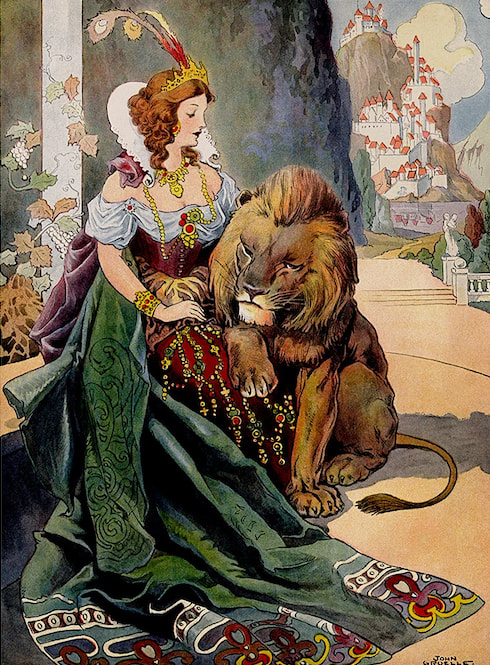
~ 1841 - "King Valemon, the White Bear / Kvitebjørn kong Valemon"
Norske Folkeeventyr Authors: Peter Christen Asbjørnsen and Jørgen Engebretsen Moe Publisher: Christiania: Jackob Dybwad i Komm Read Here [90.](p. 109) "580Valemon - The White Bear King" (Iversen & Nor. 16) ATU 425 {Bear Beast} [Norwegian]
~ 1844 - "East of the Sun and West of the Moon/Østenfor sol og vestenfor måne"
Norwegian Folktales/ Norske Folkeeventyr Publisher: Johan Dahl Read Here [42.](p. 1-15) ATU 425A {Bear Beast} [Norwegian]
|




1820 - "The Little Rose/ Das Röslein"
The Book of Fairy Tales for Childhood and Youth, Together with Sundry Anecdotes and Yarns — Volume 2/ Das Buch der Maehrchen für Kindheit und Jugend, nebst etzlichen Schnaken und Schnurren
Author: Johann Andreas Christian Löhr
Publisher: London: J. Harris and Son, corner of St. Paul's Church-Yard
Read Here [4.](p. 28- )(German)(Wiki)
ATU 425C
{Sumi - Beauty name}
{Gift rose with some buds}
{Lord Mordi - Beast name}
{Beastly Beast} {Dragon Beast}
{Curse broken - stroking him}
[German, Germany]
The Book of Fairy Tales for Childhood and Youth, Together with Sundry Anecdotes and Yarns — Volume 2/ Das Buch der Maehrchen für Kindheit und Jugend, nebst etzlichen Schnaken und Schnurren
Author: Johann Andreas Christian Löhr
Publisher: London: J. Harris and Son, corner of St. Paul's Church-Yard
Read Here [4.](p. 28- )(German)(Wiki)
ATU 425C
{Sumi - Beauty name}
{Gift rose with some buds}
{Lord Mordi - Beast name}
{Beastly Beast} {Dragon Beast}
{Curse broken - stroking him}
[German, Germany]
(Differences) **spoilers** The Merchant named Hali has a servant named Jusuf. Father wishes to send his daughters' best friend Little Broomstick/Besenstielchen to the Beast instead of his daughter Sumi. Little Broomstick messes up and says something about her father the broom maker and the Beast figures out it's not Sumi, but becuase Little Broomstick didn't only becuase she loves her friend the Beast lets her go with some gold but punishes Hail for his deceit.
(Full story)
There once lived a very wealthy merchant in the Orient—a truly kind and good man named Hali. The merchant had three beautiful daughters: Kadidja, Zemire, and Sumi. Sumi, however, was the youngest and most beautiful; she was also the gentlest, most modest, open-hearted, and cheerful of the three—and for this reason, she was her father’s favorite. The other two girls, however, were exceedingly haughty and domineering; they looked down upon other girls who possessed less wealth than they did, and consequently, no one in the household loved them—nor did anyone in the city. Every year, the merchant would undertake a great journey with his servants and camels, transporting precious wares to distant lands. In exchange, he would purchase other magnificent goods—items that were rare and costly—from which he reaped a handsome profit upon his return home. Thus, he grew ever wealthier. Such a journey, however, would typically last half a year or even longer; and whenever the merchant returned home, he would lay out his wares before his daughters so that they might each select a piece or two as a gift. The two eldest daughters invariably chose the most lavish items—garments and jewelry that were truly eye-catching, shimmering and gleaming from afar, intended solely to arouse envy among their friends. Sumi, however, felt that such expensive things did not make a person any happier or better; she usually asked for nothing more than a few small trifles. Her sisters would then think—and indeed tell her to her face—that she was a silly little thing who had no idea what true beauty was; yet Sumi paid little heed to their remarks and would often simply laugh them off. Now, on one occasion, as the father was preparing to set off on another journey, he said to his daughters, “Of all the wares I have brought back in the past, nothing has ever seemed quite good enough for the two of you eldest daughters. Therefore, tell me now: what shall I bring back for you this time? And you, Sumi—you, too, must tell me what you would like to have.” Then the eldest daughters asked for pearl necklaces and diamond earrings, and gowns interwoven with gold and silver, and precious red shawls—worth perhaps a thousand thalers—that shimmered and glowed from afar; but Sumi said, “Dearest Father, such magnificent things do not bring me joy; instead, bring me back a beautiful little rose—a truly beautiful one—with a couple of buds upon it.” With a father’s delight, Hali gazed upon his modest child. He set forth, traveling here and there; and the things his eldest daughters had wished for, he found with ease—paying a great deal of gold for them, and willing to pay three times as much had it only brought them true inner happiness. But the little rose for Sumi—that he could not find so easily. Roses were plentiful everywhere, to be sure; yet none could he find as beautiful—as truly exquisite—as the one he so dearly wished to bring home to his beloved Sumi. And even if he did happen upon one, he knew not how he might preserve it so that it would not wither during the long journey home. As he traveled further and further on his homeward journey, the season of roses had long since passed; and the father was so saddened by this that all the wealth he had amassed during his travels could bring him no joy. Where, then, was he to find a beautiful little rose for Sumi, now that autumn had arrived—when the wind was already blowing showers of red, yellow, and pale leaves from the trees, and many of the branches stood bare? Hali traveled on and on, finding no roses—only an ever-increasing number of bare trees and hedges. But one midday—when the sun was burning down with great heat—he came upon a region where all the trees and hedges were still in bloom and lush with greenery; where clear, fresh springs rippled here and there; and where the entire landscape seemed like one vast garden. He was filled with wonder and bade the camels, horses, and servants rest, while he himself resolved to stroll through the garden. "How is it," he asked his most faithful and experienced servant, Jusuf—"how is it that everything here is so different from everywhere else we have traveled? Why, spring and summer seem to dwell here side by side!" "Yes, Master," Jusuf replied, "for this is indeed Master Mordi’s garden"—and he spoke in a voice so low and apprehensive that it seemed as if speaking of the matter might be dangerous. "Who is Mordi?" the Master asked; but the servant earnestly implored him not to ask further questions just then; it was neither the right time nor a safe place to do so. Once they were safely out of the garden, he promised, he would tell him everything. Hali smiled, and as he strolled through the garden, he remarked, "You faithful old soul, you surely have fairy tales running through your head again, and are harboring fears where there is no need." Yet Jusuf begged him once more—with a certain air of secrecy and trepidation—to remain silent for the moment; then, pointing toward a magnificent, gleaming castle in the distance, he said, "That is where he dwells!" Many beautiful flowers lined the paths of the garden, yet not a single little rose was to be found. At last, however, he discovered one—one that had just burst into bloom, accompanied by two lovely buds. It was the only one in the entire garden, and more beautiful than any he had ever seen before. He resolved to pluck it for Sumi and pack it in damp moss, so that it might remain fresh throughout the two days’ journey that still lay between him and his home. But Jusuf fell to his knees before him and pleaded, “Do not pluck it, dear master; do not pluck it! You will be plucking your own death! Lord Mordi will not suffer so much as a single blade of grass to be plucked from his grounds.” “Fool!” said Hali impatiently. “I can surely repay the rose ten times over in gold!” He paid no further heed to his faithful servant’s entreaties; instead, he plucked the rose, delighting in its beauty and rejoicing in his find. And after holding it in his hands for a few moments, he chided Jusuf for putting his faith in such fairy tales. “Flee the garden, master! Flee! Flee!” begged Jusuf. He had barely uttered the words when servants and henchmen came rushing in from various directions—panting, terrified, and screaming, “It comes!—Come, save yourselves!—Long ears!—Eyes of fire!—A ghastly maw with long teeth!—They jut far out from its mouth!—Its tongue hangs down to its throat!—Save yourselves!” Now a terrifying roar resounded, and in an instant, a black, scaly monster stood before them—with a serpent’s tail, a dragon’s claws, long fangs, a lolling tongue, floppy ears, and horns upon its head. Hali sought to flee, but in his terror, he found himself rooted to the spot. At that very moment, the monster had coiled its tail around the merchant and, gripping him murderously by the armpits with two claws, stared with flaming eyes into his pale face, thirsting for blood. "You plucked my little rose," it growled with a dull roar; "for that, I shall break your neck!" Of what avail were Hali’s lamentations and whimpering? Of what use was it that he offered the beast—as ransom—first ten, then twenty, and finally all one hundred of his camels along with their cargo? The monster only grew more ferocious, digging its claws ever more painfully and deeply into his flesh as it declared: "I have no need of your paltry goods; I possess a thousand times more than you! Pay a better ransom: surrender Sumi—your youngest daughter, for whom you plucked that rose—to be mine." And when the merchant attempted to plead once more, the wicked monster sank a claw into his throat and gnashed its teeth. Then, in his abject terror, Hali pledged his beloved little daughter to the beast; he was forced to swear a solemn oath that he would deliver her on the third day, at which time the monster would send its servants to fetch her. Grief-stricken, Hali made his way home, and the faithful Jusuf grieved alongside him, for he loved his good master dearly. With a face etched with the deepest sorrow, Hali entered his home, greeted his daughters, and pressed Sumi twice to his heart. They could plainly see that something was deeply troubling their father; yet the two eldest daughters cared little, for they were greedy only for the gifts and could scarcely wait for the moment they would hold them in their hands. They received what they had wished for—and much more besides—for their father allowed them to choose whatever else pleased them from among his precious wares. So absorbed were they in this that they paid no heed to the sorrowful look upon their father’s face; and as they adorned themselves with these magnificent, costly things, they forgot it entirely, speaking only of how they now possessed far finer things than the Prince’s daughters, and how all the noble maidens would seethe with envy over them. Indeed! When one is of such a mind, one gives no thought to a father’s sorrow or a mother’s tears! Sumi had received her little rose; she was truly and innocently delighted by it, and grateful, yet she perceived her father’s inner anguish. She asked him what troubled him, and begged him not to be sad. "Oh, you poor child," said the father, "you will learn soon enough what troubles me; but go now and fetch your playmate—your dear 'Little Broomstick.'" Sumi went to fetch her at once. She was her dearest playmate from the neighborhood—one who could never spend enough time with her—even though she was merely the child of a broom-maker; for she was a truly sweet child, and one who bore a striking resemblance to Sumi. As always, Hali had brought along pretty and useful gifts for Little Broomstick this time as well. He presented them to her once Sumi had brought her back. "Oh, Father!" said Sumi. "I am so glad that you brought me this beautiful little rose—it smells so lovely, as if it held the fragrance of every flower in the world—and now you have given gifts to my dear Little Broomstick, too! But tell me now: what is it that makes you so sad? For how can I be happy if you are not?" "Poor, poor child! You must learn the truth sooner or later!" Thereupon, the father told her everything that had transpired in the garden—and how, the day after tomorrow, Lord Mordi would send for his dear Sumi—surely to devour her! "Oh!" cried Little Broomstick. "You poor, poor Lord Hali! Was it there, in Mordi’s garden—where the flowers bloom eternally—that you plucked that little rose? Alas, whoever does such a thing forfeits their very self to him, and will surely be devoured by him if they harbor any fear of him. No—dear Sumi must not go there! For she, I know, would surely be terrified of him." When Hali asked how she knew this, Little Broomstick replied that she knew it all from her grandmother; her parents had lived not far from Lord Mordi’s garden, and the grandmother had told her so much about it that it felt to her as if he had known Lord Mordi for a long time. She wanted to go to him, for Lord Mordi would surely know whether she was Sumi or not. “Oh, my good child,” said Hali, “your father cannot allow that.” But Little Broomstick replied that her father still had ten children and the elderly grandparents to feed, and often there was not a single crumb of bread in the house; his father would be only too glad to be rid of one extra mouth to feed. Little Broomstick's father consented, for he reasoned that his child would surely manage to get by with Lord Mordi—perhaps even make his fortune there—and one day be able to lift them all out of their poverty. And indeed, it all turned out just as he had hoped; Lord Mordi gave Little Broomstick’s father a great deal of money and goods. Early on the third morning—once Little Broomstick had been dressed to look exactly like Sumi—a magnificent carriage arrived, drawn by splendid horses and attended by footmen, servants, and a young lady’s maid, to fetch Little Broomstick away. Lord Mordi was waiting for her at the garden gate, and he sighed, “Oh, if only the dear child is not afraid! For otherwise, I shall be forced to tear her apart—so cruelly did that wicked mother curse me that I have no choice. For nine hundred years now, I have been a monster because of it.” As he thus sighed and lamented, the carriage arrived, and Little Broomstick stepped out; but instantly, the people were transformed into apes and poodles, and the lady’s maid into a pretty little kitten. Little Broomstick was astonished and asked, "Were you not just now human beings?" And the poodles barked, "Woof, woof!" The kitten cried, "Meow!" And the apes shook their heads and pulled strange faces, and they all nodded their heads; this was meant to signify, "Yes, yes!" Now Lord Mordi appeared. A secret shudder ran through Little Broomstick; yet, having imagined him—based on her grandmother’s description—a thousand times exactly as she now saw him, she composed herself all the more easily. "You aren't afraid, are you, child?" asked Lord Mordi. "You really mustn't be afraid!" "I am not afraid in the slightest. What would I have to fear?" answered Little Broomstick. "But what if I look at you with my great fiery eyes—surely you’d be afraid then?" "Not at all," answered Little Broomstick. "Your eyes are nowhere near as large and fiery as our hearth fire, or as the fire in our neighbor’s forge." "But what about my long floppy ears? My big teeth?" "Oh," said Little Broomstick, "I once saw an elephant that had much longer floppy ears than you, and much bigger tusks." "That is very good, Sumi," said Lord Mordi. "Come now! I want to show you the garden and the castle; there you will see many beautiful things that I wish to give you as gifts." With that, he reached out to take her by the hand with his claw and lead her away. But she said, "Keep your distance for a moment, Lord Mordi; I am not afraid of you in the slightest, but you are simply too ugly for me." Lord Mordi sighed, keeping a few paces’ distance from the girl, and showed her all manner of beautiful things. “But I don’t see any people,” said Little Broomstick. “Do you not have any children for me to play with?” “You shall have everything beautiful and lovely, my child,” said Lord Mordi sadly, “and everything your heart desires—but no people. Ah, that is precisely the point; you have seen what becomes of humans here. Only animals—animals that are as clever as humans and do everything you ask, yet possess neither human form nor speech.” As he led her about in this manner, they came upon a lovely, cool birch grove. There, Little Broomstick forgot herself and cried out, “Oh, what beautiful birches these are! How many brooms my father could bind if he had these!” “What?” asked Lord Mordi in astonishment. “So you are Little Broomstick, the broom-binder’s daughter—and not Sumi, Hali’s daughter?” The little girl tried to talk her way out of it, but it was no use; she had already said too much and could not possibly deny who she was—especially since she did not possess the little rose that Hali had plucked for his Sumi, and which, as Lord Mordi had said, would never wither. Lord Mordi summoned his carriage, his horses, and his servants, and gave orders that Little Broomstick be taken back immediately. "Little Broomstick," he said, "beware of returning, for that would be your undoing; but this time you may go back freely, because it was out of love for Sumi that you sought to deceive me—and for that very reason, you shall have the gold you will find in the carriage. Tell Hali that, since he too sought to deceive me, he shall atone for it with a severe illness."How Hali was struck with terror when Little Broomstick returned, and one of Mordi’s servants stepped into the house, demanded Sumi, and took her away! Wailing in anguish, her father cried out after her, stretching his hands toward her. Her older sisters, however, cared nothing for the fact that Sumi had to leave; they paid no heed to their father’s lamentations, but focused instead on the magnificent horses—which sped away like arrows—and on the carriage, which shimmered as if made of gold and precious gems. "Ah!" they thought to themselves, "if only we could possess such things someday, we would be perfectly happy and would ask for nothing else in the whole wide world." Yet they cared little for their father’s grief; amongst themselves, they whispered: "Why does Father make such a fuss over that silly goose? She is of no consequence whatsoever. Even if Mordi eats her, what does it matter?" And whenever their father confided to them how wretched he felt, they would reproach him, claiming it was entirely his own fault—for he simply *had* to pluck that rose for his "little darling." The father ought to have cast these spiteful wretches out of his home, but he was far too kind and gentle. Nevertheless, he no longer unburdened his sorrow to those hard hearts, but only to the faithful Jusuf, who wept alongside him. Sumi—having heard from Little Broomstick the full account of her experiences at Mordi’s abode—soon grew accustomed to Lord Mordi and ceased to fear him; indeed, Lord Mordi treated her with such kindness, ever attentive to anything that might bring her joy. The well-behaved little cat was always by her side; it helped her dress, accompanied her into the garden, and caught beautiful birds for her—yet it did not bite them, but rather brought them to its mistress, who would examine the little birds and, after a few moments, set them free again. The poodles and the monkeys, however, were eager to do whatever Sumi wished, and did so immediately—fetching and carrying things away just as she requested. Sumi might well have been happy and content there, but she could never forget her father; this made her sad, and she could not bring herself to get used to Mordi, either. Yes! In her heart, she felt kindly toward him—for he was so loving and gentle—but his appearance was altogether too repulsive and off-putting; and when, at times, he would plead with her most earnestly to stroke him—just a little, a very little bit—a shiver would run down her spine, and she simply could not bring herself to do it. Thus she lived for a long time in Lord Mordi’s home; and one day, she fell into deep and heartfelt contemplation of the fact that she knew absolutely nothing of her beloved father—neither how he fared, nor anything else. She thought of how he must surely be grieving over his dear child, for he would likely imagine that she had either been devoured or had met with some terrible misfortune. At this thought, she wept bitterly. As she sat there weeping—grieved to the very depths of her soul—Lord Mordi entered her room, bringing with him a small basket filled with the most beautiful flowers and fruits. He looked at her with compassion and asked, “Why is my Sumi weeping? Do you not like it here at all?” “I would like everything here very much,” she replied, “were it not that I know nothing of what my poor father is doing; perhaps he has already grieved himself to death over me?” Then Lord Mordi called to a poodle, bidding it fetch his mirror. He held it up before Sumi and said, “Simply think of your dear father, and you shall see exactly what he is doing.” And there she saw her father’s house and recognized everything once more; all that lay within the courtyard, the house, and the garden passed in review before her eyes: the faithful watchdog; the stable hands heading to the stalls to tend to the horses and camels; the servants attending to the trade and the various wares; and many other things besides. “But where are *you*, Father?” she cried out. There he was, in a garden arbor, where he sat sorrowfully—pale and weary—and only Yusuf, his faithful servant, was with him; and when he sought to rise, he had to hobble along on crutches, and the faithful Yusuf helped him. "Oh! Is none of my sisters there, then, to tend to our sick father?" she cried. "Where are they?" Then the mirror showed her the sisters. They were at a spa resort, far from their father’s home, dancing wildly through long, brightly lit halls. Then they hurried to the table, where they sat down amidst many others; they took handfuls of gold and laid them upon the table, and one among them held a larger pile of gold—along with a great stack of cards bearing curious images—which she distributed among the others. "There they are gambling," said Lord Mordi. "And your sisters—who have abandoned their poor father to fend for himself—are right there with them; for they are to be found wherever there is gambling and dancing, caring not a whit for their father. He has no one left but the physician and the faithful Jusuf—though even they are powerless to help him." "Oh! If only I were with you, my dear, ailing father!" Sumi sobbed aloud. "I would tend to you and nurse you back to health—and surely you would recover! Oh, if only I were with you... but—" "Servants! Harness the carriage!" Lord Mordi suddenly called out to his poodles. And Sumi asked, "Are you leaving, too, Lord Mordi? Am I to be left entirely alone, with no one left to comfort me?" "You good child!" said Lord Mordi. "I do not wish to leave, nor can I; but you *must* go—for you yearn so deeply to be with your ailing father. The carriage holds everything you might desire: clothing and jewelry, gifts for Little Broomstick, or whatever else you might fancy. But the most important thing is this little vial. Inside lies dew from the Tree of Life—the very substance with which you are to save your father from death. Yet you must also use it to save *me* one day; therefore, do not use it all up—at least, not if I am of any worth to you. Give my regards to your father, and do not forget me! You may be away for sixty days, but I beg you—come back a day early! I implore you: do not forget me!" Then Sumi vowed that she would never forget him—nor could she, seeing how kind he had been to her and to her father. “Keep your word, Sumi; keep your word! Take this magic mirror with you, and on the third evening, before you go to sleep, look into it and check on me. If you see that I am ill, then hasten to me with the healing dew. Know this: if you fail to check on me by the third day, I shall shrink a little in size, suffering unspeakable pain; and if this happens twenty times, I shall be utterly lost. Oh, Sumi, do not forget me!” Once again, Sumi vowed to him that she would truly not forget him. She took the magic mirror and stepped into the carriage—and Little Miss Cat sprang in right alongside her. She said to Lord Mordi, “Farewell!” and added, weeping, “I am truly sorry to have to leave you all alone like this; but I promise to check on you very often.” As she spoke, she offered him her hand—just the very tips of her fingers—for Lord Mordi had long since begun to seem less and less ugly to her, the more kindness he showed her. — And that, after all, is how things usually go. But in the meantime, how had poor Hali fared? He knew not where his wicked daughters had gone; and he grieved so deeply for his Sumi that he fell ill and wretched, and would surely have perished in his lonely sorrow had it not been for Jusuf and the faithful physician. Even the servants paid him little heed, reasoning that he could not have long left to live anyway, and that once he was gone, he would no longer be of any use to them. Hali’s condition worsened day by day. One day, he murmured, “I keep dreaming of a heavenly-blue balm—a balm that flows through every limb of my body, and by which I would be made whole and young again, if only I could have a little of it. But surely, such a balm cannot exist!” "Indeed, such a remedy exists," said the physician, "and would that it alone might suffice to cure you; but how are we to obtain it? It flows from the leaves of a tree that stands solely—and exclusively—in Mordi’s garden; many have attempted to fetch it, yet have forfeited their lives in the attempt." When Hali heard this, he was on the verge of despair—not because he was soon to die, but because he so deeply longed to gain some certainty regarding Sumi. It always felt to him as though she must still be alive, even while he grieved as bitterly as if she had already passed away. The physician summoned all of Hali’s servants and asked, "Your dear, good master—who has bestowed so many kindnesses upon you—is now gravely ill, and I know not whether I shall be able to keep him alive. Yet there remains one certain means to save him, if only I knew which of you holds him dearest in your heart?" At this, each man claimed to hold him dearest of all, and professed a willingness to lay down his own life for him, should the need arise. So said they all—save for Jusuf, who remained silent. The need *had* indeed arisen, the physician observed, and a life would, of course, have to be risked. He informed them that their beloved master could be saved only by the dew from the Tree of Life that stood in Mordi’s garden, and asked, "Who among you is willing to go and fetch it?" At once, they offered a thousand excuses. One man remarked: "Ah! If only I could be certain that the dew would truly heal him, I would gladly go and fetch it—and risk my life in the doing; but"—when the physician assured him that the dew *would* indeed heal him—the man replied, "that I simply cannot bring myself to believe." Another claimed to have duties within the household that were far too pressing to neglect, and thus could not possibly be spared; The third man spoke up: He would gladly cut the master free from the clutches of twenty—or even more—murderers and robbers, were it necessary; but he wanted nothing whatsoever to do with that "Mordi"—that, he claimed, was a monstrous, grey-maned brute. Thus, each man had a different excuse. And when the doctor tried to reason with them, pleading with great earnestness, they told him he was a fool and ought to leave them be; indeed, he would be better off going to fetch the dew himself—even though they knew full well that he could not leave the master’s side without the latter dying instantly. And when he still did not cease his entreaties, they flew into a rage and threatened to thrash him soundly if he did not shut his stupid mouth. The physician saw clearly that all his words and entreaties were of no avail, and he let them go. Jusuf, however, had remained behind and had kept his silence throughout. Now, when the others had departed, he said to the physician, "Sir, teach me to recognize this tree; tell me what it looks like and how I may obtain the dew. I will go and fetch it—if indeed I have the strength." "You? You faithful soul?" cried the physician. "Why, you are so old and frail, and so indispensable to your master; he has no one else but you!" Jusuf replied that he was willing to go—and gladly risk the few remaining years of life that might yet be allotted to him—for the sake of his master. While the two of them were still discussing the matter back and forth—and as Jusuf was receiving instructions on how to procure the life-giving dew for his master—a carriage filled with people came rattling down the road. It was Sumi. "Ah!" cried Jusuf. "You have arrived just in time to see our good father once more; for who knows whether I shall succeed in obtaining the Dew of Life that I intend to fetch for him?" "Oh, stay right here, my faithful Jusuf!" cried Sumi. "For I have brought the Dew of Life with me already; Lord Mordi gave it to me!" "You possess the Dew of Life?" exclaimed the physician. "Oh, then all is well! Show it to me—let me see if it is truly the one." "Yes, it is! It is!" he declared, after examining it and tasting a few drops. "It is indeed! But remain here for now, Sumi, lest the shock of seeing you cause our father to die of sheer joy." A new vitality coursed through Hali’s veins as he gradually consumed a small bowl of the azure-hued dew. He felt utterly rejuvenated; and when, at last, he and Sumi held one another in a loving embrace, both were filled with a bliss beyond words! The festivities that Hali, in his joy, wished to host for the whole world were to last for two months—festivities so brilliant and magnificent that no other prince could hope to rival them. Sumi—caught up in the joy of being with her father and with Little Broomstick, and in the intoxicating whirl of celebrations that daze the mind and make one forgetful—had not thought to look into the magic mirror to see how the lonely Mordi was faring. Many days had passed in this manner. Then, one evening, Käthchen—the lady-in-waiting who, in Mordi’s garden, had been merely the little kitten—spoke up, “Now it is nearly time for us to hasten back, if we wish to find Master Mordi still alive.” Sumi was struck with alarm and cried out, “Oh, poor, poor Mordi! Oh, my ungrateful forgetfulness!” She looked into the mirror. There lay Lord Mordi in the garden, wretched and miserable, withered away until he was little more than skin and bone; and it seemed as though she could read his very face—as if written upon it were the words, “Alas, Sumi! You have forgotten me; now I must die in misery!” The girl turned pale. “Käthchen, take the Dew of Life; we must set out this very night—without a farewell, for that would only delay us. Mordi’s life is in peril!” And so they departed immediately, for the horses were always harnessed and ready the very instant one wished it so. Yet no one noticed their departure, for everyone lay deep in the first slumber of the night. When Sumi at last arrived back in the garden, she searched for Master Mordi, but could not find him. In great anguish, she cried out, “Mordi! Oh, dear Mordi, where are you?” but no voice answered. She searched again; she called out once more; yet she could not find him. At that moment, Sumi was on the verge of despair; wringing her hands, she wailed, “Oh, he is dead! Mordi is dead! Now I shall be inconsolable forevermore!” After much calling and searching, she spotted something lying in the grass—she looked closer, and there lay Lord Mordi, yet he had become tiny, shriveled, and emaciated. He lay there as if devoid of life. But she knelt down beside him; and then he breathed ever so faintly, gave a soft moan, and gazed up at her with dim, sorrowful eyes. "Poor, poor Mordi!” she said sorrowfully. “Do not die! I possess the Dew of Life.” And as she spoke these words, she wept as she placed one hand against his neck and, with the other, gently stroked his head. But suddenly, Mordi vanished, and in his place lay a sick man clad in royal robes. Sumi asked, “What is this? Where is Mordi?” “It is I,” he moaned weakly. “The Dew of Life!” She then poured some of the Dew of Life for him, and he recovered sufficiently to take the flask himself and drink from it in small sips; and when he had drained it to the last drop, he stood before her—a handsome youth, healthy and radiant. Now both were happy—Sumi and Mordi. Mordi then recounted his story, his mother, he explained, had practiced many wicked enchantments; once, he had reproached her for this, whereupon she had cast a magic spell upon him, transforming him into a monster. Thereafter, he had been compelled to devour any human who dared to pluck anything from his garden—as well as all those maidens who had fallen into his power and harbored fear of him. Now, however, he was redeemed—simply because she had stroked him. "Oh, dear, beautiful Sumi, I shall be grateful to you for as long as I live. I am now a human being, and all my animals have become human again as well. But I am also a king and possess a vast kingdom. Oh, if only you would consent to love me and become my queen, then I would be truly happy. Your father, Little Broomstick, and the faithful Jusuf would then live with us; as for the wicked sisters, they may keep all of Father’s money and property—it would bring them no joy anyway, for they are not good at heart. We, however, would be happy." "Oh!" answered Sumi, "I have held you dear in my heart for a long time now, for you have always been so kind and loving; it was only your outward form that was so very ugly. But now I will gladly become your queen, if it brings you happiness—for you have, after all, saved my father’s life!" Thereupon, Mordi, enraptured, embraced his Sumi; and when the servants realized what was taking place, they raised a tremendous clamor of jubilation throughout the castle and garden. Those who had formerly been poodles barked along in their delight—"Woof! Woof!"—and the little cat cried out in joy, "Meow!" Lord Mordi and Sumi, however, took the greatest pleasure in it all. It was very early the next morning when Hali awoke and went to visit his Sumi; but Sumi, Käthchen, the horses, the carriage, and the servants were gone. "Alas!" sighed Hali, "so you have abandoned me once again! But where have you gone now?" He searched her room and found all the precious garments and jewelry that belonged to Sumi—but of what use was that to him? He could not find his dearest child. Then, however, his eye fell upon a curious mirror with a strange frame, filled with images and unknown symbols. This was, in fact, the very magic mirror that Sumi had forgotten in her haste and anxiety over Mordi. "Oh," said Hali, "could you show me where my Sumi is?" and he gazed into the mirror. There he caught sight of her just as she was entering the garden with the speed of a bird; he watched her searching anxiously; and by the movement of her lips, he saw that she was calling out to someone. Then he found her beside the emaciated Mordi, and it seemed to him as though he suddenly understood everything that was transpiring; and he felt deep pity for the good Mordi. But when Sumi stroked poor Mordi—and he suddenly transformed into a human being, and, having drunk the Dew of Life, stood there as a handsome, radiant youth—and when the animals, too, had turned into humans, then Hali understood it all. "I must go! I must go to my child!" he cried, and he told Jusuf what he had seen in the mirror, declaring that he wished to stay with Sumi and never return to his wicked daughters. The faithful servant, however, insisted on going along as well, to live and die by his master's side. And Little Broomstick was fetched and asked if she, too, wished to come along—and if she would be willing to stay with Sumi forever? She was more than eager to do so, and her father was happy to consent. So Hali appointed a faithful guardian over his house and wrote a few lines to his wayward daughters, stating that they should divide everything peacefully among themselves; for he would never return. Then he set off with Sami, Little Broomstick, and the magic mirror, taking nothing else with him; and when they arrived at Mordis’s garden, Mordis’s swift horses and carriage were already standing ready to fetch all three of them. However, that proved unnecessary. Oh, what joy there was! What bliss—such as no human tongue could ever express! Sumi became a queen; Little Broomstick, too, had found a heart that was good and true; and dear Sami was honored and loved by all, declaring, “I am living in heaven!” And indeed, they all lived in heaven, for they were all good. Hali’s older daughters, too, seemed to be living in heaven; yet this was not truly the case—it only appeared so. They danced, they played, they sat and dined at magnificent tables, they drove hither and thither; they could adorn themselves in splendor—and did so—yet they found no true happiness in it. If they lost at cards, or if another girl was asked to dance more often than they were, or was praised for her beauty, or possessed a new dress that was called pretty—such things secretly vexed them deeply, and they harbored nothing but hatred and envy in their hearts. Everyone noticed this well enough, and for that very reason, no one loved them. They learned that Sumi, their sister, had returned—radiant and magnificent—and was the most beautiful woman in the entire land. At this news, they felt as if they had swallowed poison; yet, knowing that their father lay on his deathbed, they consoled themselves, saying amongst one another: "He won't last much longer; then we shall cast that foolish creature of a servent out of the house, and she shall receive nothing of the inheritance." But when they heard that their father had recovered—restored to health and as vigorous as a youth—and was hosting magnificent feasts to celebrate both his recovery and Sumi’s return, they were struck with terror and nearly went mad with rage. However, when a messenger arrived bearing word that their father and Sumi had departed—never to return—and that the sisters were to divide all his worldly goods amongst themselves, they rejoiced. Yet, even then, each was already plotting how to secure the choicest share—more than her sisters—and on the journey home, they quarreled fiercely over who should lay claim to this or that item. When the time came to divide the estate, the true misery began. Each sister coveted what the others desired; they heaped insults upon one another, growing ever more spiteful and hostile. But when it came time to divide Sumi’s exquisite garments and jewels—treasures more beautiful than any that could be purchased on earth for all the gold in the world—their fury erupted completely. Not one of them was willing to relinquish a single piece of those magnificent treasures. They hurled abuse, struck one another, and, cursing all the while, clawed at each other’s faces. From that day forward, they loathed one another with a deadly hatred; they slandered one another relentlessly and made their own lives utterly wretched. As long as their father had lived, they had enjoyed the company of the Prince’s daughters; but now, because of their vile behavior, they were no longer permitted to enter those noble circles. They were utterly despised. Now they sought to demonstrate that they could live even more magnificently than the others—that they possessed greater wealth; moreover, the eldest of the younger sisters and the youngest of the elder sisters vied with one another to outshine the rest in splendor and opulence. Yet, because they had never performed a single useful task, nor ever concerned themselves with the management of a household—and because their father, who had always replenished their resources anew, was no longer there—they were utterly ruined within a few short years. They became so poor—so very poor—that they were forced to sell off their beautiful possessions and, in the end, resort to begging. But because everyone despised them and no one felt any pity for them, people would often refuse to give them even a morsel of bread, and they very nearly starved to death. Thus, driven by sheer necessity, they were compelled to leave their homeland and wander into foreign lands, roaming from place to place and begging for their daily bread at strangers' doors.
(Translated by Clark)(PT translation)
(Full story)
There once lived a very wealthy merchant in the Orient—a truly kind and good man named Hali. The merchant had three beautiful daughters: Kadidja, Zemire, and Sumi. Sumi, however, was the youngest and most beautiful; she was also the gentlest, most modest, open-hearted, and cheerful of the three—and for this reason, she was her father’s favorite. The other two girls, however, were exceedingly haughty and domineering; they looked down upon other girls who possessed less wealth than they did, and consequently, no one in the household loved them—nor did anyone in the city. Every year, the merchant would undertake a great journey with his servants and camels, transporting precious wares to distant lands. In exchange, he would purchase other magnificent goods—items that were rare and costly—from which he reaped a handsome profit upon his return home. Thus, he grew ever wealthier. Such a journey, however, would typically last half a year or even longer; and whenever the merchant returned home, he would lay out his wares before his daughters so that they might each select a piece or two as a gift. The two eldest daughters invariably chose the most lavish items—garments and jewelry that were truly eye-catching, shimmering and gleaming from afar, intended solely to arouse envy among their friends. Sumi, however, felt that such expensive things did not make a person any happier or better; she usually asked for nothing more than a few small trifles. Her sisters would then think—and indeed tell her to her face—that she was a silly little thing who had no idea what true beauty was; yet Sumi paid little heed to their remarks and would often simply laugh them off. Now, on one occasion, as the father was preparing to set off on another journey, he said to his daughters, “Of all the wares I have brought back in the past, nothing has ever seemed quite good enough for the two of you eldest daughters. Therefore, tell me now: what shall I bring back for you this time? And you, Sumi—you, too, must tell me what you would like to have.” Then the eldest daughters asked for pearl necklaces and diamond earrings, and gowns interwoven with gold and silver, and precious red shawls—worth perhaps a thousand thalers—that shimmered and glowed from afar; but Sumi said, “Dearest Father, such magnificent things do not bring me joy; instead, bring me back a beautiful little rose—a truly beautiful one—with a couple of buds upon it.” With a father’s delight, Hali gazed upon his modest child. He set forth, traveling here and there; and the things his eldest daughters had wished for, he found with ease—paying a great deal of gold for them, and willing to pay three times as much had it only brought them true inner happiness. But the little rose for Sumi—that he could not find so easily. Roses were plentiful everywhere, to be sure; yet none could he find as beautiful—as truly exquisite—as the one he so dearly wished to bring home to his beloved Sumi. And even if he did happen upon one, he knew not how he might preserve it so that it would not wither during the long journey home. As he traveled further and further on his homeward journey, the season of roses had long since passed; and the father was so saddened by this that all the wealth he had amassed during his travels could bring him no joy. Where, then, was he to find a beautiful little rose for Sumi, now that autumn had arrived—when the wind was already blowing showers of red, yellow, and pale leaves from the trees, and many of the branches stood bare? Hali traveled on and on, finding no roses—only an ever-increasing number of bare trees and hedges. But one midday—when the sun was burning down with great heat—he came upon a region where all the trees and hedges were still in bloom and lush with greenery; where clear, fresh springs rippled here and there; and where the entire landscape seemed like one vast garden. He was filled with wonder and bade the camels, horses, and servants rest, while he himself resolved to stroll through the garden. "How is it," he asked his most faithful and experienced servant, Jusuf—"how is it that everything here is so different from everywhere else we have traveled? Why, spring and summer seem to dwell here side by side!" "Yes, Master," Jusuf replied, "for this is indeed Master Mordi’s garden"—and he spoke in a voice so low and apprehensive that it seemed as if speaking of the matter might be dangerous. "Who is Mordi?" the Master asked; but the servant earnestly implored him not to ask further questions just then; it was neither the right time nor a safe place to do so. Once they were safely out of the garden, he promised, he would tell him everything. Hali smiled, and as he strolled through the garden, he remarked, "You faithful old soul, you surely have fairy tales running through your head again, and are harboring fears where there is no need." Yet Jusuf begged him once more—with a certain air of secrecy and trepidation—to remain silent for the moment; then, pointing toward a magnificent, gleaming castle in the distance, he said, "That is where he dwells!" Many beautiful flowers lined the paths of the garden, yet not a single little rose was to be found. At last, however, he discovered one—one that had just burst into bloom, accompanied by two lovely buds. It was the only one in the entire garden, and more beautiful than any he had ever seen before. He resolved to pluck it for Sumi and pack it in damp moss, so that it might remain fresh throughout the two days’ journey that still lay between him and his home. But Jusuf fell to his knees before him and pleaded, “Do not pluck it, dear master; do not pluck it! You will be plucking your own death! Lord Mordi will not suffer so much as a single blade of grass to be plucked from his grounds.” “Fool!” said Hali impatiently. “I can surely repay the rose ten times over in gold!” He paid no further heed to his faithful servant’s entreaties; instead, he plucked the rose, delighting in its beauty and rejoicing in his find. And after holding it in his hands for a few moments, he chided Jusuf for putting his faith in such fairy tales. “Flee the garden, master! Flee! Flee!” begged Jusuf. He had barely uttered the words when servants and henchmen came rushing in from various directions—panting, terrified, and screaming, “It comes!—Come, save yourselves!—Long ears!—Eyes of fire!—A ghastly maw with long teeth!—They jut far out from its mouth!—Its tongue hangs down to its throat!—Save yourselves!” Now a terrifying roar resounded, and in an instant, a black, scaly monster stood before them—with a serpent’s tail, a dragon’s claws, long fangs, a lolling tongue, floppy ears, and horns upon its head. Hali sought to flee, but in his terror, he found himself rooted to the spot. At that very moment, the monster had coiled its tail around the merchant and, gripping him murderously by the armpits with two claws, stared with flaming eyes into his pale face, thirsting for blood. "You plucked my little rose," it growled with a dull roar; "for that, I shall break your neck!" Of what avail were Hali’s lamentations and whimpering? Of what use was it that he offered the beast—as ransom—first ten, then twenty, and finally all one hundred of his camels along with their cargo? The monster only grew more ferocious, digging its claws ever more painfully and deeply into his flesh as it declared: "I have no need of your paltry goods; I possess a thousand times more than you! Pay a better ransom: surrender Sumi—your youngest daughter, for whom you plucked that rose—to be mine." And when the merchant attempted to plead once more, the wicked monster sank a claw into his throat and gnashed its teeth. Then, in his abject terror, Hali pledged his beloved little daughter to the beast; he was forced to swear a solemn oath that he would deliver her on the third day, at which time the monster would send its servants to fetch her. Grief-stricken, Hali made his way home, and the faithful Jusuf grieved alongside him, for he loved his good master dearly. With a face etched with the deepest sorrow, Hali entered his home, greeted his daughters, and pressed Sumi twice to his heart. They could plainly see that something was deeply troubling their father; yet the two eldest daughters cared little, for they were greedy only for the gifts and could scarcely wait for the moment they would hold them in their hands. They received what they had wished for—and much more besides—for their father allowed them to choose whatever else pleased them from among his precious wares. So absorbed were they in this that they paid no heed to the sorrowful look upon their father’s face; and as they adorned themselves with these magnificent, costly things, they forgot it entirely, speaking only of how they now possessed far finer things than the Prince’s daughters, and how all the noble maidens would seethe with envy over them. Indeed! When one is of such a mind, one gives no thought to a father’s sorrow or a mother’s tears! Sumi had received her little rose; she was truly and innocently delighted by it, and grateful, yet she perceived her father’s inner anguish. She asked him what troubled him, and begged him not to be sad. "Oh, you poor child," said the father, "you will learn soon enough what troubles me; but go now and fetch your playmate—your dear 'Little Broomstick.'" Sumi went to fetch her at once. She was her dearest playmate from the neighborhood—one who could never spend enough time with her—even though she was merely the child of a broom-maker; for she was a truly sweet child, and one who bore a striking resemblance to Sumi. As always, Hali had brought along pretty and useful gifts for Little Broomstick this time as well. He presented them to her once Sumi had brought her back. "Oh, Father!" said Sumi. "I am so glad that you brought me this beautiful little rose—it smells so lovely, as if it held the fragrance of every flower in the world—and now you have given gifts to my dear Little Broomstick, too! But tell me now: what is it that makes you so sad? For how can I be happy if you are not?" "Poor, poor child! You must learn the truth sooner or later!" Thereupon, the father told her everything that had transpired in the garden—and how, the day after tomorrow, Lord Mordi would send for his dear Sumi—surely to devour her! "Oh!" cried Little Broomstick. "You poor, poor Lord Hali! Was it there, in Mordi’s garden—where the flowers bloom eternally—that you plucked that little rose? Alas, whoever does such a thing forfeits their very self to him, and will surely be devoured by him if they harbor any fear of him. No—dear Sumi must not go there! For she, I know, would surely be terrified of him." When Hali asked how she knew this, Little Broomstick replied that she knew it all from her grandmother; her parents had lived not far from Lord Mordi’s garden, and the grandmother had told her so much about it that it felt to her as if he had known Lord Mordi for a long time. She wanted to go to him, for Lord Mordi would surely know whether she was Sumi or not. “Oh, my good child,” said Hali, “your father cannot allow that.” But Little Broomstick replied that her father still had ten children and the elderly grandparents to feed, and often there was not a single crumb of bread in the house; his father would be only too glad to be rid of one extra mouth to feed. Little Broomstick's father consented, for he reasoned that his child would surely manage to get by with Lord Mordi—perhaps even make his fortune there—and one day be able to lift them all out of their poverty. And indeed, it all turned out just as he had hoped; Lord Mordi gave Little Broomstick’s father a great deal of money and goods. Early on the third morning—once Little Broomstick had been dressed to look exactly like Sumi—a magnificent carriage arrived, drawn by splendid horses and attended by footmen, servants, and a young lady’s maid, to fetch Little Broomstick away. Lord Mordi was waiting for her at the garden gate, and he sighed, “Oh, if only the dear child is not afraid! For otherwise, I shall be forced to tear her apart—so cruelly did that wicked mother curse me that I have no choice. For nine hundred years now, I have been a monster because of it.” As he thus sighed and lamented, the carriage arrived, and Little Broomstick stepped out; but instantly, the people were transformed into apes and poodles, and the lady’s maid into a pretty little kitten. Little Broomstick was astonished and asked, "Were you not just now human beings?" And the poodles barked, "Woof, woof!" The kitten cried, "Meow!" And the apes shook their heads and pulled strange faces, and they all nodded their heads; this was meant to signify, "Yes, yes!" Now Lord Mordi appeared. A secret shudder ran through Little Broomstick; yet, having imagined him—based on her grandmother’s description—a thousand times exactly as she now saw him, she composed herself all the more easily. "You aren't afraid, are you, child?" asked Lord Mordi. "You really mustn't be afraid!" "I am not afraid in the slightest. What would I have to fear?" answered Little Broomstick. "But what if I look at you with my great fiery eyes—surely you’d be afraid then?" "Not at all," answered Little Broomstick. "Your eyes are nowhere near as large and fiery as our hearth fire, or as the fire in our neighbor’s forge." "But what about my long floppy ears? My big teeth?" "Oh," said Little Broomstick, "I once saw an elephant that had much longer floppy ears than you, and much bigger tusks." "That is very good, Sumi," said Lord Mordi. "Come now! I want to show you the garden and the castle; there you will see many beautiful things that I wish to give you as gifts." With that, he reached out to take her by the hand with his claw and lead her away. But she said, "Keep your distance for a moment, Lord Mordi; I am not afraid of you in the slightest, but you are simply too ugly for me." Lord Mordi sighed, keeping a few paces’ distance from the girl, and showed her all manner of beautiful things. “But I don’t see any people,” said Little Broomstick. “Do you not have any children for me to play with?” “You shall have everything beautiful and lovely, my child,” said Lord Mordi sadly, “and everything your heart desires—but no people. Ah, that is precisely the point; you have seen what becomes of humans here. Only animals—animals that are as clever as humans and do everything you ask, yet possess neither human form nor speech.” As he led her about in this manner, they came upon a lovely, cool birch grove. There, Little Broomstick forgot herself and cried out, “Oh, what beautiful birches these are! How many brooms my father could bind if he had these!” “What?” asked Lord Mordi in astonishment. “So you are Little Broomstick, the broom-binder’s daughter—and not Sumi, Hali’s daughter?” The little girl tried to talk her way out of it, but it was no use; she had already said too much and could not possibly deny who she was—especially since she did not possess the little rose that Hali had plucked for his Sumi, and which, as Lord Mordi had said, would never wither. Lord Mordi summoned his carriage, his horses, and his servants, and gave orders that Little Broomstick be taken back immediately. "Little Broomstick," he said, "beware of returning, for that would be your undoing; but this time you may go back freely, because it was out of love for Sumi that you sought to deceive me—and for that very reason, you shall have the gold you will find in the carriage. Tell Hali that, since he too sought to deceive me, he shall atone for it with a severe illness."How Hali was struck with terror when Little Broomstick returned, and one of Mordi’s servants stepped into the house, demanded Sumi, and took her away! Wailing in anguish, her father cried out after her, stretching his hands toward her. Her older sisters, however, cared nothing for the fact that Sumi had to leave; they paid no heed to their father’s lamentations, but focused instead on the magnificent horses—which sped away like arrows—and on the carriage, which shimmered as if made of gold and precious gems. "Ah!" they thought to themselves, "if only we could possess such things someday, we would be perfectly happy and would ask for nothing else in the whole wide world." Yet they cared little for their father’s grief; amongst themselves, they whispered: "Why does Father make such a fuss over that silly goose? She is of no consequence whatsoever. Even if Mordi eats her, what does it matter?" And whenever their father confided to them how wretched he felt, they would reproach him, claiming it was entirely his own fault—for he simply *had* to pluck that rose for his "little darling." The father ought to have cast these spiteful wretches out of his home, but he was far too kind and gentle. Nevertheless, he no longer unburdened his sorrow to those hard hearts, but only to the faithful Jusuf, who wept alongside him. Sumi—having heard from Little Broomstick the full account of her experiences at Mordi’s abode—soon grew accustomed to Lord Mordi and ceased to fear him; indeed, Lord Mordi treated her with such kindness, ever attentive to anything that might bring her joy. The well-behaved little cat was always by her side; it helped her dress, accompanied her into the garden, and caught beautiful birds for her—yet it did not bite them, but rather brought them to its mistress, who would examine the little birds and, after a few moments, set them free again. The poodles and the monkeys, however, were eager to do whatever Sumi wished, and did so immediately—fetching and carrying things away just as she requested. Sumi might well have been happy and content there, but she could never forget her father; this made her sad, and she could not bring herself to get used to Mordi, either. Yes! In her heart, she felt kindly toward him—for he was so loving and gentle—but his appearance was altogether too repulsive and off-putting; and when, at times, he would plead with her most earnestly to stroke him—just a little, a very little bit—a shiver would run down her spine, and she simply could not bring herself to do it. Thus she lived for a long time in Lord Mordi’s home; and one day, she fell into deep and heartfelt contemplation of the fact that she knew absolutely nothing of her beloved father—neither how he fared, nor anything else. She thought of how he must surely be grieving over his dear child, for he would likely imagine that she had either been devoured or had met with some terrible misfortune. At this thought, she wept bitterly. As she sat there weeping—grieved to the very depths of her soul—Lord Mordi entered her room, bringing with him a small basket filled with the most beautiful flowers and fruits. He looked at her with compassion and asked, “Why is my Sumi weeping? Do you not like it here at all?” “I would like everything here very much,” she replied, “were it not that I know nothing of what my poor father is doing; perhaps he has already grieved himself to death over me?” Then Lord Mordi called to a poodle, bidding it fetch his mirror. He held it up before Sumi and said, “Simply think of your dear father, and you shall see exactly what he is doing.” And there she saw her father’s house and recognized everything once more; all that lay within the courtyard, the house, and the garden passed in review before her eyes: the faithful watchdog; the stable hands heading to the stalls to tend to the horses and camels; the servants attending to the trade and the various wares; and many other things besides. “But where are *you*, Father?” she cried out. There he was, in a garden arbor, where he sat sorrowfully—pale and weary—and only Yusuf, his faithful servant, was with him; and when he sought to rise, he had to hobble along on crutches, and the faithful Yusuf helped him. "Oh! Is none of my sisters there, then, to tend to our sick father?" she cried. "Where are they?" Then the mirror showed her the sisters. They were at a spa resort, far from their father’s home, dancing wildly through long, brightly lit halls. Then they hurried to the table, where they sat down amidst many others; they took handfuls of gold and laid them upon the table, and one among them held a larger pile of gold—along with a great stack of cards bearing curious images—which she distributed among the others. "There they are gambling," said Lord Mordi. "And your sisters—who have abandoned their poor father to fend for himself—are right there with them; for they are to be found wherever there is gambling and dancing, caring not a whit for their father. He has no one left but the physician and the faithful Jusuf—though even they are powerless to help him." "Oh! If only I were with you, my dear, ailing father!" Sumi sobbed aloud. "I would tend to you and nurse you back to health—and surely you would recover! Oh, if only I were with you... but—" "Servants! Harness the carriage!" Lord Mordi suddenly called out to his poodles. And Sumi asked, "Are you leaving, too, Lord Mordi? Am I to be left entirely alone, with no one left to comfort me?" "You good child!" said Lord Mordi. "I do not wish to leave, nor can I; but you *must* go—for you yearn so deeply to be with your ailing father. The carriage holds everything you might desire: clothing and jewelry, gifts for Little Broomstick, or whatever else you might fancy. But the most important thing is this little vial. Inside lies dew from the Tree of Life—the very substance with which you are to save your father from death. Yet you must also use it to save *me* one day; therefore, do not use it all up—at least, not if I am of any worth to you. Give my regards to your father, and do not forget me! You may be away for sixty days, but I beg you—come back a day early! I implore you: do not forget me!" Then Sumi vowed that she would never forget him—nor could she, seeing how kind he had been to her and to her father. “Keep your word, Sumi; keep your word! Take this magic mirror with you, and on the third evening, before you go to sleep, look into it and check on me. If you see that I am ill, then hasten to me with the healing dew. Know this: if you fail to check on me by the third day, I shall shrink a little in size, suffering unspeakable pain; and if this happens twenty times, I shall be utterly lost. Oh, Sumi, do not forget me!” Once again, Sumi vowed to him that she would truly not forget him. She took the magic mirror and stepped into the carriage—and Little Miss Cat sprang in right alongside her. She said to Lord Mordi, “Farewell!” and added, weeping, “I am truly sorry to have to leave you all alone like this; but I promise to check on you very often.” As she spoke, she offered him her hand—just the very tips of her fingers—for Lord Mordi had long since begun to seem less and less ugly to her, the more kindness he showed her. — And that, after all, is how things usually go. But in the meantime, how had poor Hali fared? He knew not where his wicked daughters had gone; and he grieved so deeply for his Sumi that he fell ill and wretched, and would surely have perished in his lonely sorrow had it not been for Jusuf and the faithful physician. Even the servants paid him little heed, reasoning that he could not have long left to live anyway, and that once he was gone, he would no longer be of any use to them. Hali’s condition worsened day by day. One day, he murmured, “I keep dreaming of a heavenly-blue balm—a balm that flows through every limb of my body, and by which I would be made whole and young again, if only I could have a little of it. But surely, such a balm cannot exist!” "Indeed, such a remedy exists," said the physician, "and would that it alone might suffice to cure you; but how are we to obtain it? It flows from the leaves of a tree that stands solely—and exclusively—in Mordi’s garden; many have attempted to fetch it, yet have forfeited their lives in the attempt." When Hali heard this, he was on the verge of despair—not because he was soon to die, but because he so deeply longed to gain some certainty regarding Sumi. It always felt to him as though she must still be alive, even while he grieved as bitterly as if she had already passed away. The physician summoned all of Hali’s servants and asked, "Your dear, good master—who has bestowed so many kindnesses upon you—is now gravely ill, and I know not whether I shall be able to keep him alive. Yet there remains one certain means to save him, if only I knew which of you holds him dearest in your heart?" At this, each man claimed to hold him dearest of all, and professed a willingness to lay down his own life for him, should the need arise. So said they all—save for Jusuf, who remained silent. The need *had* indeed arisen, the physician observed, and a life would, of course, have to be risked. He informed them that their beloved master could be saved only by the dew from the Tree of Life that stood in Mordi’s garden, and asked, "Who among you is willing to go and fetch it?" At once, they offered a thousand excuses. One man remarked: "Ah! If only I could be certain that the dew would truly heal him, I would gladly go and fetch it—and risk my life in the doing; but"—when the physician assured him that the dew *would* indeed heal him—the man replied, "that I simply cannot bring myself to believe." Another claimed to have duties within the household that were far too pressing to neglect, and thus could not possibly be spared; The third man spoke up: He would gladly cut the master free from the clutches of twenty—or even more—murderers and robbers, were it necessary; but he wanted nothing whatsoever to do with that "Mordi"—that, he claimed, was a monstrous, grey-maned brute. Thus, each man had a different excuse. And when the doctor tried to reason with them, pleading with great earnestness, they told him he was a fool and ought to leave them be; indeed, he would be better off going to fetch the dew himself—even though they knew full well that he could not leave the master’s side without the latter dying instantly. And when he still did not cease his entreaties, they flew into a rage and threatened to thrash him soundly if he did not shut his stupid mouth. The physician saw clearly that all his words and entreaties were of no avail, and he let them go. Jusuf, however, had remained behind and had kept his silence throughout. Now, when the others had departed, he said to the physician, "Sir, teach me to recognize this tree; tell me what it looks like and how I may obtain the dew. I will go and fetch it—if indeed I have the strength." "You? You faithful soul?" cried the physician. "Why, you are so old and frail, and so indispensable to your master; he has no one else but you!" Jusuf replied that he was willing to go—and gladly risk the few remaining years of life that might yet be allotted to him—for the sake of his master. While the two of them were still discussing the matter back and forth—and as Jusuf was receiving instructions on how to procure the life-giving dew for his master—a carriage filled with people came rattling down the road. It was Sumi. "Ah!" cried Jusuf. "You have arrived just in time to see our good father once more; for who knows whether I shall succeed in obtaining the Dew of Life that I intend to fetch for him?" "Oh, stay right here, my faithful Jusuf!" cried Sumi. "For I have brought the Dew of Life with me already; Lord Mordi gave it to me!" "You possess the Dew of Life?" exclaimed the physician. "Oh, then all is well! Show it to me—let me see if it is truly the one." "Yes, it is! It is!" he declared, after examining it and tasting a few drops. "It is indeed! But remain here for now, Sumi, lest the shock of seeing you cause our father to die of sheer joy." A new vitality coursed through Hali’s veins as he gradually consumed a small bowl of the azure-hued dew. He felt utterly rejuvenated; and when, at last, he and Sumi held one another in a loving embrace, both were filled with a bliss beyond words! The festivities that Hali, in his joy, wished to host for the whole world were to last for two months—festivities so brilliant and magnificent that no other prince could hope to rival them. Sumi—caught up in the joy of being with her father and with Little Broomstick, and in the intoxicating whirl of celebrations that daze the mind and make one forgetful—had not thought to look into the magic mirror to see how the lonely Mordi was faring. Many days had passed in this manner. Then, one evening, Käthchen—the lady-in-waiting who, in Mordi’s garden, had been merely the little kitten—spoke up, “Now it is nearly time for us to hasten back, if we wish to find Master Mordi still alive.” Sumi was struck with alarm and cried out, “Oh, poor, poor Mordi! Oh, my ungrateful forgetfulness!” She looked into the mirror. There lay Lord Mordi in the garden, wretched and miserable, withered away until he was little more than skin and bone; and it seemed as though she could read his very face—as if written upon it were the words, “Alas, Sumi! You have forgotten me; now I must die in misery!” The girl turned pale. “Käthchen, take the Dew of Life; we must set out this very night—without a farewell, for that would only delay us. Mordi’s life is in peril!” And so they departed immediately, for the horses were always harnessed and ready the very instant one wished it so. Yet no one noticed their departure, for everyone lay deep in the first slumber of the night. When Sumi at last arrived back in the garden, she searched for Master Mordi, but could not find him. In great anguish, she cried out, “Mordi! Oh, dear Mordi, where are you?” but no voice answered. She searched again; she called out once more; yet she could not find him. At that moment, Sumi was on the verge of despair; wringing her hands, she wailed, “Oh, he is dead! Mordi is dead! Now I shall be inconsolable forevermore!” After much calling and searching, she spotted something lying in the grass—she looked closer, and there lay Lord Mordi, yet he had become tiny, shriveled, and emaciated. He lay there as if devoid of life. But she knelt down beside him; and then he breathed ever so faintly, gave a soft moan, and gazed up at her with dim, sorrowful eyes. "Poor, poor Mordi!” she said sorrowfully. “Do not die! I possess the Dew of Life.” And as she spoke these words, she wept as she placed one hand against his neck and, with the other, gently stroked his head. But suddenly, Mordi vanished, and in his place lay a sick man clad in royal robes. Sumi asked, “What is this? Where is Mordi?” “It is I,” he moaned weakly. “The Dew of Life!” She then poured some of the Dew of Life for him, and he recovered sufficiently to take the flask himself and drink from it in small sips; and when he had drained it to the last drop, he stood before her—a handsome youth, healthy and radiant. Now both were happy—Sumi and Mordi. Mordi then recounted his story, his mother, he explained, had practiced many wicked enchantments; once, he had reproached her for this, whereupon she had cast a magic spell upon him, transforming him into a monster. Thereafter, he had been compelled to devour any human who dared to pluck anything from his garden—as well as all those maidens who had fallen into his power and harbored fear of him. Now, however, he was redeemed—simply because she had stroked him. "Oh, dear, beautiful Sumi, I shall be grateful to you for as long as I live. I am now a human being, and all my animals have become human again as well. But I am also a king and possess a vast kingdom. Oh, if only you would consent to love me and become my queen, then I would be truly happy. Your father, Little Broomstick, and the faithful Jusuf would then live with us; as for the wicked sisters, they may keep all of Father’s money and property—it would bring them no joy anyway, for they are not good at heart. We, however, would be happy." "Oh!" answered Sumi, "I have held you dear in my heart for a long time now, for you have always been so kind and loving; it was only your outward form that was so very ugly. But now I will gladly become your queen, if it brings you happiness—for you have, after all, saved my father’s life!" Thereupon, Mordi, enraptured, embraced his Sumi; and when the servants realized what was taking place, they raised a tremendous clamor of jubilation throughout the castle and garden. Those who had formerly been poodles barked along in their delight—"Woof! Woof!"—and the little cat cried out in joy, "Meow!" Lord Mordi and Sumi, however, took the greatest pleasure in it all. It was very early the next morning when Hali awoke and went to visit his Sumi; but Sumi, Käthchen, the horses, the carriage, and the servants were gone. "Alas!" sighed Hali, "so you have abandoned me once again! But where have you gone now?" He searched her room and found all the precious garments and jewelry that belonged to Sumi—but of what use was that to him? He could not find his dearest child. Then, however, his eye fell upon a curious mirror with a strange frame, filled with images and unknown symbols. This was, in fact, the very magic mirror that Sumi had forgotten in her haste and anxiety over Mordi. "Oh," said Hali, "could you show me where my Sumi is?" and he gazed into the mirror. There he caught sight of her just as she was entering the garden with the speed of a bird; he watched her searching anxiously; and by the movement of her lips, he saw that she was calling out to someone. Then he found her beside the emaciated Mordi, and it seemed to him as though he suddenly understood everything that was transpiring; and he felt deep pity for the good Mordi. But when Sumi stroked poor Mordi—and he suddenly transformed into a human being, and, having drunk the Dew of Life, stood there as a handsome, radiant youth—and when the animals, too, had turned into humans, then Hali understood it all. "I must go! I must go to my child!" he cried, and he told Jusuf what he had seen in the mirror, declaring that he wished to stay with Sumi and never return to his wicked daughters. The faithful servant, however, insisted on going along as well, to live and die by his master's side. And Little Broomstick was fetched and asked if she, too, wished to come along—and if she would be willing to stay with Sumi forever? She was more than eager to do so, and her father was happy to consent. So Hali appointed a faithful guardian over his house and wrote a few lines to his wayward daughters, stating that they should divide everything peacefully among themselves; for he would never return. Then he set off with Sami, Little Broomstick, and the magic mirror, taking nothing else with him; and when they arrived at Mordis’s garden, Mordis’s swift horses and carriage were already standing ready to fetch all three of them. However, that proved unnecessary. Oh, what joy there was! What bliss—such as no human tongue could ever express! Sumi became a queen; Little Broomstick, too, had found a heart that was good and true; and dear Sami was honored and loved by all, declaring, “I am living in heaven!” And indeed, they all lived in heaven, for they were all good. Hali’s older daughters, too, seemed to be living in heaven; yet this was not truly the case—it only appeared so. They danced, they played, they sat and dined at magnificent tables, they drove hither and thither; they could adorn themselves in splendor—and did so—yet they found no true happiness in it. If they lost at cards, or if another girl was asked to dance more often than they were, or was praised for her beauty, or possessed a new dress that was called pretty—such things secretly vexed them deeply, and they harbored nothing but hatred and envy in their hearts. Everyone noticed this well enough, and for that very reason, no one loved them. They learned that Sumi, their sister, had returned—radiant and magnificent—and was the most beautiful woman in the entire land. At this news, they felt as if they had swallowed poison; yet, knowing that their father lay on his deathbed, they consoled themselves, saying amongst one another: "He won't last much longer; then we shall cast that foolish creature of a servent out of the house, and she shall receive nothing of the inheritance." But when they heard that their father had recovered—restored to health and as vigorous as a youth—and was hosting magnificent feasts to celebrate both his recovery and Sumi’s return, they were struck with terror and nearly went mad with rage. However, when a messenger arrived bearing word that their father and Sumi had departed—never to return—and that the sisters were to divide all his worldly goods amongst themselves, they rejoiced. Yet, even then, each was already plotting how to secure the choicest share—more than her sisters—and on the journey home, they quarreled fiercely over who should lay claim to this or that item. When the time came to divide the estate, the true misery began. Each sister coveted what the others desired; they heaped insults upon one another, growing ever more spiteful and hostile. But when it came time to divide Sumi’s exquisite garments and jewels—treasures more beautiful than any that could be purchased on earth for all the gold in the world—their fury erupted completely. Not one of them was willing to relinquish a single piece of those magnificent treasures. They hurled abuse, struck one another, and, cursing all the while, clawed at each other’s faces. From that day forward, they loathed one another with a deadly hatred; they slandered one another relentlessly and made their own lives utterly wretched. As long as their father had lived, they had enjoyed the company of the Prince’s daughters; but now, because of their vile behavior, they were no longer permitted to enter those noble circles. They were utterly despised. Now they sought to demonstrate that they could live even more magnificently than the others—that they possessed greater wealth; moreover, the eldest of the younger sisters and the youngest of the elder sisters vied with one another to outshine the rest in splendor and opulence. Yet, because they had never performed a single useful task, nor ever concerned themselves with the management of a household—and because their father, who had always replenished their resources anew, was no longer there—they were utterly ruined within a few short years. They became so poor—so very poor—that they were forced to sell off their beautiful possessions and, in the end, resort to begging. But because everyone despised them and no one felt any pity for them, people would often refuse to give them even a morsel of bread, and they very nearly starved to death. Thus, driven by sheer necessity, they were compelled to leave their homeland and wander into foreign lands, roaming from place to place and begging for their daily bread at strangers' doors.
(Translated by Clark)(PT translation)
|
~ 1847 - "Little Broomstick/ Besenstielchen"
Deutsches Märchenbuch Collected by: Ludwig Bechstein Publisher: Verlag von Georg Wigand Read Here (p. 228-232)(Germany)(Archive) ATU-425C {Nettchen - Beauty name} {Gift 3 roses on one stem} (dead of winter, like The Summer and Winter Garden) {Beastly Beast} {Curse broken - weeping for him} [German] |
|
(Summary) **spoilers**
Diffarences asks for rose dead of winter, tried to trick the Beast with sending Beauty character's best friend instead, Beast learns of this and sends her back for the right daughter. Beauty character breaks enchantment on the Beast and he turns back into the Prince before Beauty character visits her family. Beauty character curs sick father using the sap of a plant from the prince's garden. Beauty character's sisters are jealous of her fortune, sisters end up dping something horrible to her, but Beauty character is revived by the same sorceress who cursed the prince. Beauty character's eldest sisters are too dangerous, but she doesn't want them to be killed, but they are punished. (Full Story) Once there lived a merchant who had three daughters. The two elder were proud and arrogant, but the younger, though she far surpassed her sisters in beauty, was modest and virtuous. She dressed simply and thus, without knowing it, enhanced her beauty more than her sisters did with their finest adornments. Nettchen—that was the name of the youngest daughter—had one close friend. She was very poor, but just as beautiful and virtuous. She was the daughter of a broom-maker and was therefore called by young and old alike “Little Broomstick.” The two girls were one heart and one soul; they shared their little secrets, and all differences in rank had disappeared between them. This angered the two elder sisters greatly, but Nettchen let them scold and loved her Little Broomstick no less. One day the merchant decided to undertake a long journey, though the season was already far advanced. He asked his daughters what he should bring them. The eldest said, “Bring me a golden necklace!” The second said, “Bring me a pair of earrings so beautiful that all women will envy me!” The youngest said she wished for nothing, since her father’s kindness had already provided for her. But when he insisted, she smiled and said, “Well then, bring me three roses that have grown upon a single stem.” She was certain he would not find such roses in midwinter. He kissed her for her modesty and departed. On his return journey, he found the necklace and earrings easily enough—but not the three roses. He had almost decided to buy some other rich gift when suddenly he found himself before a green enclosure. Passing through a broad gate, he stood in a large blooming garden beside a splendid castle. Outside lay snow, but within the garden trees were in blossom, nightingales sang, and he even saw a rosebush bearing three half-opened buds upon one stem. Joyfully he broke off the branch. At once a monstrous beast stood before him—long, ugly snout, drooping ears, shaggy fur, tail, and long sharp claws. The merchant was terrified—more so when the beast spoke and threatened him with death for his crime. The merchant begged and explained that the roses were for his youngest daughter. The beast replied, “Your youngest daughter must be a true pearl of her sex. If you promise to give her to me as my wife in seven months, you may return home alive.” In fear, the merchant agreed, though he secretly intended to deceive the creature. He returned home, distributed the gifts, but was sorrowful. Nettchen begged him to reveal his trouble, but he evaded her. Only the two elder sisters knew the secret—and in their wickedness they rejoiced. When the seventh month had passed, a carriage stopped before the house. A servant handed the merchant a note with only the words, “Fulfill your promise.” In panic, the merchant summoned Little Broomstick instead, intending to deceive the beast. She was taken away in the carriage. But the beast knew of the deception. It ordered the girl returned and demanded the rightful bride. Soon Nettchen herself was seized and carried away. At the castle she was received respectfully by silent servants. Delicious meals were brought; she was shown to a magnificent bedroom. When she awoke the next morning, she saw with horror that the shaggy beast lay beside her. Yet it remained still and harmless. Gradually she grew accustomed to it. It became her nightly companion. She no longer feared it. She stroked its shaggy fur and even allowed its long cold snout to touch her lips. After four weeks, one night the beast did not come. Nettchen was troubled and anxious. The next morning she found it lying motionless by a pool in the garden, showing every sign of death. A bitter pain pierced her heart, and she wept for the poor creature. As soon as her tears fell, the beast transformed into a handsome young prince. “You have freed me from a terrible enchantment,” he said. “I refused to marry the wife my father chose for me. In anger, he had me transformed into a monster. I was to remain so until a pure maiden loved me despite my ugliness and wept for me. You have done this. Will you be my wife?” Nettchen gave him her hand, and they were married. The once-silent castle came alive with joy. However, she was forbidden to long for her father’s home for one year. She was given a mirror in which she could see everything happening among her family. She saw her father sorrowful, her sisters cheerful, and Little Broomstick mourning her. Later she neglected the mirror for some time. When she looked again, she saw her father on his deathbed. She told her husband in grief. He told her, “Your father will not die. In my garden grows a plant whose juice restores life. When the year is over, we shall fetch him.” When the year ended, they returned in splendor. The father recovered fully through the magical plant. Little Broomstick rejoiced and remained Nettchen’s faithful friend. Nettchen forgave her sisters and invited them to share her happiness. But their jealousy grew worse. One day, while bathing, they drowned her. Immediately a tall woman appeared—it was the enchantress who had once cursed the prince. She revived Nettchen and said, “These wretches killed you. Decide their fate.” Nettchen begged for mercy, but the enchantress refused. “They must die. You are never safe from their malice.” At last Nettchen sighed, “Do as you will.” The enchantress transformed the sisters into two stone pillars, where they stand to this day in the garden—for no man has ever fallen in love with cold, heartless stone. Little Broomstick remained Nettchen’s truest friend and shares her happiness still—if they have not both since died. (Thank you Clark for the translation)(PT Translation) |
|
~ 1852 - "Three Roses on One Stem/ Drei Rosen auf Einem Stiel"
German folk tales from Swabia/ Deutsche Volksmärchen aus Schwaben Collected by: Ernst Meier Publisher: C. P. Scheitlin From Swabia, German Read Here [57.](p. 202-204)(German) ATU-425C {Gift 3 roses on one stem} {Beastly Beast} {Curse broken - returning to him} [German] |
|
(Full Story)
Once upon a time, there was a man who had two daughters who did not get along well with each other; but one of them was particularly to blame for this. One day, the father wanted to go to the market and asked his daughters, “What shall I bring you?” One wanted a beautiful dress, the other, who was the better behaved, wanted three roses on one stem. “If only I can find them,” said the father, and he went off and bought a new dress at the market; but no matter how hard he looked for roses on the way and then at the market, he couldn't find any. Finally, when he was on his way home, he saw a flowering rose bush in a garden, and there were three roses on one stem, just as his daughter had wished for. So he climbed into the garden and picked the roses. But suddenly a black, hairy monster appeared and said, “What are you doing in my garden?” The man explained that he had a daughter who had wished for three roses on one stem and asked if he could take the roses he had been searching for so long. The beast said, “Yes, you may take them, but you must come here tomorrow at such and such an hour with your daughter, or you will die.” The man promised that he would return, went home with his rose, and brought his daughter the next day, but was a little late. However, it was still just in time. He found a beautifully laid table in the garden, laden with food, and he sat down with his daughter and ate. When they had finished, the beast appeared and asked if this was the daughter who had wished for the three roses. When the father said yes, the monster said, “Well, you may go home, but your daughter must stay here.” So the father went home alone, leaving his daughter behind, full of worry. But the monster immediately led her into a beautiful garden house and showed her the most magnificent jewelry made of gold, silver, and precious stones, from which she was allowed to choose whatever she liked; and when she had done so, the monster said: “Now you can go home again, but you must be back here tomorrow at such and such a time!” Yes, the girl was happy to do so, and returned cheerfully to her parents. But the other sister was angry about the precious jewelry, and the next day, when her little sister wanted to go back to the garden, she kept her waiting out of envy until she was too late. When she entered the garden, there was no one to be seen or heard. She cried out in fear, “Dear little creature, where are you?” Then she heard something whimpering and whining in the ditch to the side, and she went over and saw the animal lying there. “Oh,” sighed the beast, “if you hadn't come soon, I would have had to die.” But then it crawled out, suddenly shed its hairy fur, and stood there as a handsome young man. Both were delighted and held a wedding and lived happily together until the end of their days. (Translated by PT staff) |
|
~ 1941 : "Three Roses on One Stem/ Drei Rosen auf Einem Stiel"
The Wunderschiff - Swabian folk tales of anthologies/ Das Wunderschiff - Schwäbische Volksmärchen von Anthologien Author: Franz Georg Brustgi Publisher: Hohenstaufen-Verlag, Stuttgart Read Here (German)(Gutenberg)) Read Here (German) {Gift - 3 roses on one stem} {Bear Beast} {Curse broken - love and loyalty} [German |
|
(Full Story)
On a remote farm, near a large pine forest, there once lived a farmer whose wife had died years ago. Fortunately, he had two adult daughters, one blonde and the other black-haired; who now ran the household, looked after the stable and the chickens, and also helped out in the fields as best they could. Most of the time, however, they arranged it so that one helped her father with the farm work, while the other stayed at home and looked after things there. That's just how it was, and no one really knew why the two sisters didn't get along, but instead quarreled over every little thing or went days without speaking to each other, passing each other by without exchanging a word. But their father loved them both equally; he tried hardnot to favor one over the other, and often delighted them with gifts that they were always allowed to choose for themselves. So one day, when he went to the market again, he called them into the living room and asked: “You know, today is market day in the village down below; what shall I bring you?” “I would like a beautiful Sunday dress,” said one. “And I would like three roses on one stem,” replied the other. "Three roses on one stem?... If only I can get them," said the father and set off. When he had finished his business and had lunch at the inn, he bought one daughter a beautiful new dress; but although he walked up and down the entire market twice and also looked around long and hard on the way home, he could not find three roses growing on one stem anywhere. Finally, when he was already a good distance outside the village, he saw a flowering rose bush in a garden. He looked at it more closely, and sure enough, there were three roses growing together on one stem, just as the second daughter had wished. Without thinking twice, he entered the garden, took hold of the branch with the three roses, and was about to break it off. Suddenly, a brown-haired bear stood before him and said, “What are you looking for in my garden?” When he had recovered from his fright, the farmer explained that his daughter had wished for him to bring her three roses on one stem as a gift from the market. He had searched in vain for a long time; here on this bush, he had finally found such a miraculous branch. He asked if he could break it off and take it home with him. “You may take the three roses,” said the bear, but only on the condition that you come back here tomorrow at the same time and bring your daughter with you. No harm shall come to her. But if you do not do as I have commanded, you will die!" The farmer promised to return, thanked him for the three roses, and set off for home. When he arrived at the farm, his daughters were already waiting for him. The black-haired one greeted him at the well, where she was drawing water for the cattle; the blonde one came out of the kitchen to meet him joyfully. When she saw the sprig with the three roses in her father's hand, her eyes sparkled with happiness; she admired it for a long time and then carefully placed it in a glass by the window. The black-haired girl, however, who had immediately tried on her dress, only smiled contemptuously when she saw the three roses, and when she heard that her sister was to visit the wild bear tomorrow, she said, “You will pay dearly for your three roses and never return!” But the blonde said, "What Father promised the bear, I will keep." The next day, the farmer took his daughter to the bear's garden. As they entered, the bear came trotting up and asked, “Is this the daughter who wished for the three roses?” “Yes,” replied the father,“Leave her with me until sunset,” said the bear. “No harm shall come to her, and she will not regret it.” It was difficult for the farmer to leave his daughter all alone with the wild animal, and he thought about her anxiously all day long. But he needn't have tormented himself with such thoughts. For when the bear was alone with the girl, he gently took her by the hand and led her into a magnificent pleasure palace, which lay hidden among trees and flowering shrubs in the middle of the garden. He showed her all the magnificently painted rooms and also the jewelry cabinets, which glistened and sparkled with gold, silver, pearls, and precious stones. The simple farmer's daughter had never seen anything like it before, and she could hardly take her eyes off all the splendor. “Choose whatever you like best,” said the bear. “I will give it to you as a gift if you come back to my garden alone tomorrow.” The girl promised, chose a necklace and a ring, and returned home happily in the evening. When the black-haired girl saw the precious jewelry, she turned pale with envy. And because she suspected that her sister might receive even richer gifts on her next visit, she tried again to instill fear of the bear in her and persuade her not to keep her promise and to stay at home instead. But all her persuasion and whispering was in vain. So she got up secretly in the night, gathered her sister's clothes and shoes and hid them in the barn under the hay. The blonde sister searched for her clothes for a good hour the next morning and soon suspected that her jealous sister had had a hand in it. But she did not waver in her decision to keep her word to the bear, put on her old, worn and patched kitchen apron and left the farmyard barefoot. But because she had spent too long searching, she arrived late at the garden. There stood the rose bush with its sad, lifeless branches, and the roses hung pale and half-withered among the leaves. “It's so deathly quiet everywhere,” she thought and called out to the bear in a fearful voice. No one answered. Weeping, she wandered from one end of the garden to the other and called out, “Come, come, my bear! Where are you, my dear creature?” Finally, she heard something whimpering and whining from the rose bush, ran towards it and saw the bear lying on the moss as if dead. But when she touched the branches and flowers with her hands to clear the way for the animal, the withered vines and leaves straightened up again, the roses were fragrant and vibrant, and the bear opened his eyes, crept out of the thicket, shook off his shaggy fur, and stood before the girl as a handsome young prince. "Now I, unhappy, enchanted prince, am finally free!" he said. "To your love and loyalty, dear girl, I owe my new life, and therefore I will make you my wife and queen!" Beneath the rosebush, he gave her the betrothal kiss, and soon afterward, they were married and lived happily ever after. (Translation gifted anonymously)(PT translation) |
1823 - "Beauty and the Beast"
The court of Oberon, or, Temple of the fairies: a collection of tales of past times
Author: Charles Perrault
Publisher: London: J. Harris and Son, corner of St. Paul's Church-Yard
Read Here (Archive) (p. 95-103)
ATU 425C
[English, London, England]
The court of Oberon, or, Temple of the fairies: a collection of tales of past times
Author: Charles Perrault
Publisher: London: J. Harris and Son, corner of St. Paul's Church-Yard
Read Here (Archive) (p. 95-103)
ATU 425C
[English, London, England]

1823 - "Prince Whitebear/ Prinds Hvidbjørn or Prins Hvidbjørn"
Author: Mathias Winther
More Here
Read Here - Danske Folkeeventyr, samlede. (Gesammelte dänische Volksmärchen); "Prinds Hvidbjørn", 1823, by Mathias Winther (in Danish).(p. 20-25) (Google books)
{Bear Beast}
[Danish]
Author: Mathias Winther
More Here
Read Here - Danske Folkeeventyr, samlede. (Gesammelte dänische Volksmärchen); "Prinds Hvidbjørn", 1823, by Mathias Winther (in Danish).(p. 20-25) (Google books)
{Bear Beast}
[Danish]
Danish fairy tale
A king with three daughters is visited by a white bear who roars in his garden. The king sends his daughters to shoo away the animal: the eldest princess takes a large piece of wood to expel the bear, who asks her to sit on his back. The elder refuses. The next day, the bear returns, and the monarch sends his middle daughter to banish the animal. The middle princess takes another piece of wood to frighten the bear, who asks her to sit on his back, but she refuses. Lastly, the bear returns again, and asks the youngest princess to climb on his back. The girl agrees and departs with bear to the forest. The bear stops by a cave and indicates that it will be their new home for the next years. He tells her he becomes a prince at night, and, if she does not light any lamp at night for the next seven years, he will be disenchanted.
A king with three daughters is visited by a white bear who roars in his garden. The king sends his daughters to shoo away the animal: the eldest princess takes a large piece of wood to expel the bear, who asks her to sit on his back. The elder refuses. The next day, the bear returns, and the monarch sends his middle daughter to banish the animal. The middle princess takes another piece of wood to frighten the bear, who asks her to sit on his back, but she refuses. Lastly, the bear returns again, and asks the youngest princess to climb on his back. The girl agrees and departs with bear to the forest. The bear stops by a cave and indicates that it will be their new home for the next years. He tells her he becomes a prince at night, and, if she does not light any lamp at night for the next seven years, he will be disenchanted.
|
~ 1856 - "Whitebear King's Son/Hvidebjørn kongens søn or Hvidbjørn kongens søn" (Grundtvig)
Author: Svend Grundtvig Read Here Here Gamle Danske Minder I Folkemunde (p. 35-45) (Google books) Collected a variant from Vendsyssel AT 425A (1970's) {Bear Beast} [Vendsyssel, Denmark]
~ 1868 - "Prince Whitebear/ Prinds Hvidbjørn
Author: Berg Caspar Read Here Folkeæventyr i Danmark, Norge og Sverige; "Prinds Hvidbjørn" 1868, by Berg Caspar ( Danish). (p. 154–157) (Google books) ATU 425A
|
|
~ 1877 - "Prince White-Bear /Prinds Hvidbjørn"
Danske Folkeminder, æventyr, Folkesagn, Gaader, Rim Og Folketro Folktale collector: Jens Kamp Odense: R. Nielsen Read Here (p, 194-302) (Google Books) {Bear Beast} [Danish] |
|
In a tale about a king and his three daughters, the youngest is his favorite, while the two elder daughters are proud and arrogant. A pivotal moment occurs when the king encounters a bear in a misty forest, who offers to help him in exchange for his youngest daughter. After initially refusing, the king ultimately consents to the bear’s demand. The bear later visits to take the youngest princess, but the king tries to deceive him by sending the two older daughters instead. The bear tests their identities with a riddle, which only the youngest daughter answers correctly.
Taken to a magnificent castle, the princess and the bear live as husband and wife, producing three children. However, sorrow strikes when the bear takes their children away. The princess, yearning to see her family, is permitted to attend her sister's wedding on the condition she listens only to her father. Unfortunately, influenced by her mother and sisters, she lights a candle at night, revealing the bear's true form—a handsome man. Accidentally dripping candle wax onto him causes him to awaken and reveal that she has broken the curse by not waiting the required seven years. Reduced to a bear once more, he takes the princess to his sisters' castles, where each sister gifts her a dress and a precious object: a golden dress with a spinning wheel, a silver dress with a golden heel, and a bronze dress with a golden thread-winder. Unable to remain with her husband, the bear departs, leading the princess, now determined, to meet a blacksmith. He crafts her metal shoes that enable her to climb the Glass Mountain. Upon reaching a castle, she finds work as a servant, while her husband is set to marry his stepmother's daughter. The princess cleverly utilizes the dresses and golden objects to secure three nights with her husband. |
|
~ 1887 - "King Bear/Kung Björn"
Collected by : Äberg, G. A. Nyländska folksagor Nyland ; Helsingfors: Tidnings- & Tryckeri-Aktiebolagets Tryckeri. pp. 278-280 Here {Bear Beast} [Sweeden] ~ 1844 - "The Story of the Abandoned Princess/Eventyret om dem forladte prinsesse"
"Historien om den forladte Prindsesse" [Danish] Author: Camilla Collet More info {Bear Beast} [Norwegian] |
|
Norwegian fairy tale
A king is on a hunt, but loses his way in the forest, and cannot find his way home. He ventures deep into the woods, and suddenly a white bear comes out of the bushes. The king is afraid at first, but the bear begins to talk and assuages him that he means no harm, and promises to help him out of the forest in exchange for the king's youngest daughter. The king agrees to his terms and is carried on the bear's back to his castle. Time passes, and the king hopes the bear has forgotten their deal, until a golden carriage appears on the road to the castle. The king tries to send his elder daughters to the bear, but the carriage does not move, and, he reluctantly, sends the third princess to be with the bear
|
|
~ 1876 - "Whiteking's Son / Hvibekongens søn"
Gamle jyske folkeviser samlede af folkemunde: isaer i Hammerum-Herred Author: Evald Tang Kristensen {Bear Beast} [Gjern , Denmark] Read Here (p. 327-334)(Google books) |
|
~1890 - "Whitebear King's Son/Hvidbjörn kongesön"
Author: Evald Tang Kristensen {Bear Beast} [Danish] Book Here |
|
~ 1905 - "King Whitevalbear/ Kong Hvidevallbjørn or Kong Videvallbjønn"
Collected by : Hallvard Bergh collection Folke- og huldre-eventyr ifraa Valdres og Hallingda {Bear Beast} [Norway, Valdres ] |
|
~ 1917 - "King Bear/Kung Björn"
Author: Oskar Hackman Finlands svenska folkdiktning. Skrifter / utgivna av Svenska litteratursällskapet i Finland. Helsingfors. pp. 157-158 (entry 70.8); Finlands svenska folkdiktning, Volume 1, 520; p226 (entry 145.) Nyland, Lappträsk, Nayland II 229. Here {Bear Beast} [Finland] |
|
~ 1852 - "White Bear King Valemo/ Kvitebjørn Kong Valemo"
Alt Title: "White-Bear-King Valemon" Collected by: Jørgen Moe a variant of the tale from summarized in the 2nd edition of Norske Folke-Eventyr , by Asbjørnsen & Moe, Norske Folkeventyr:Ny Samling, 1871, p.v, (p.245) Here ; 90. "White-Bear-King Valemon" (p. 154) Read Here Book Illustrations Here ATU 425A {Bear Beast} [Bygland, Norwegian]
|
|
~ 1852 -"Prince Vilius/Prinz Vilius"
Norske Folke-Eventyr (2nd edition) ATU 425A {Bear Beast} [Swedish]
~ 1871 - "White-Bear-King Valemon/ Kvitebjørn Kong Valemon"
Collected by Asbjørnsen and Moe Norske Folkeventyr:Ny Samling, No. 90. /Norwegian fairy tale Read Here ATU- 425A {Bear Beast} [Norwegian] |
|
A king's horse becomes stuck in mud, and a white bear offers to help in exchange for the king's youngest daughter. After initially refusing, the king agrees as his horse sinks. The bear takes the princess to the woods, where she learns about her sisters’ marriages. Each time she visits, her mother provides her with items that later lead to her having three sons, all of whom the bear takes away. Eventually, she discovers that the bear is a cursed human prince. After lighting a candle given by her mother, she learns that if she had lived with him for four years without lighting it, he would have regained his human form. They retrieve magical items during their journey, and she faces a witch before finally waking the prince with a kiss. Together, they defeat the witch and her daughter, revealing the prince's golden castle where they live happily with their children.
~ 1871-1874 - "King Valemon, the White Bear"
Author: Peter Christen Asbjørnsen Illustrator: Moyr Smith Translator: George Webbe Dasent Tales from the Fjeld Read Here Read {Bear Beast} [Norwegian] ~ 1909 - "Whitebear King Valemon/Der Eisbär König Valemon"
Translated to German from Norwegian Read Here (German) Read Here {Bear Beast} [German]
|
c. 1835 - "Beauty and the Beast - Blanch and Rosalinda"
Popular Fairy Tales
Publisher: Baltimore : Published by Fielding Lucas, Jr., No. 138 Market street - John D. Toy, Print.
Read Here (Archive)
{Beauty - Beauty name}
{Demon Beast}
{Curse broken - consent to marry him}
[English, USA]
Popular Fairy Tales
Publisher: Baltimore : Published by Fielding Lucas, Jr., No. 138 Market street - John D. Toy, Print.
Read Here (Archive)
{Beauty - Beauty name}
{Demon Beast}
{Curse broken - consent to marry him}
[English, USA]

1836 - "Beauty and the Beast"
The Fairy-Book
Author: J. A. Adams
Illustrator: J. A. Adams
Topics Fairy tales Publisher New York : Harper & Brothers Collection - The Library of Congress
Read Here (Archive)
{Beastly Beast}
[English, New York, USA]
The Fairy-Book
Author: J. A. Adams
Illustrator: J. A. Adams
Topics Fairy tales Publisher New York : Harper & Brothers Collection - The Library of Congress
Read Here (Archive)
{Beastly Beast}
[English, New York, USA]


1840 - "The Red Rose/ Červená růže"
M. Mikšíčka Collected works; National tales of Moravia and Silesia/ M. Mikšíčka Sebrané spisy; Národní báchorky moravské a slezské
Author: Matěj Mikšíček
From Moravia (east of the Czech Republic)
Moravian folktale
Read Here [3.3.](p.70)
ATU-425C
{Joanna - Beauty name}
{Gift - rose}
{Bear Beast}
{Curse broken - kiss}
[Czech]
M. Mikšíčka Collected works; National tales of Moravia and Silesia/ M. Mikšíčka Sebrané spisy; Národní báchorky moravské a slezské
Author: Matěj Mikšíček
From Moravia (east of the Czech Republic)
Moravian folktale
Read Here [3.3.](p.70)
ATU-425C
{Joanna - Beauty name}
{Gift - rose}
{Bear Beast}
{Curse broken - kiss}
[Czech]
(Full Story)
A merchant sets out on a journey. The two older daughters wish for dresses and pearls, the youngest Joanna a red rose. Their father buys them their gifts, but decides to buy the rose on his way home. As he walks through the forest, he sees a beautiful castle with gardens. There is no one in the castle, so the father picks the most beautiful rose in the garden. Suddenly, an ugly, growling bear appears. The father apologizes, but the bear is angry and won't let him go home. The man has everything he needs in the castle, but he misses his home. The bear says he will only let him go when his youngest daughter arrives.
When the girl arrives at the castle, she happily hugs her father, but the bear is terrified. The animal assures her that she only has to stay with him for 14 days. Then she can return home if she wants. After two weeks, Joanna is looking forward to seeing her family, but the bear is sad and cries loudly. The girl feels sorry for him and promises to come visit him soon. At home, her sisters mock her and call her "Mrs. Bear." So Joanna soon returns to the castle and to her happy bear. One day, Joanna asks her companion who the castle belongs to. The bear explains that the whole castle belongs to him because he is an enchanted prince. Only a kiss from a pure maiden can free him. He begs Joanna so long and so hard to free him that she finally kisses him in fear. Suddenly, a handsome prince stands before her. Wedding preparations begin, and they invite everyone in the neighborhood, including her father and sisters. However, as soon as they see the groom, they turn to stone out of envy. Their statues then line the entrance to the castle, where Joanna lives happily with her husband, her father, and many sons.
(Translated by Clark)(PT translation)
A merchant sets out on a journey. The two older daughters wish for dresses and pearls, the youngest Joanna a red rose. Their father buys them their gifts, but decides to buy the rose on his way home. As he walks through the forest, he sees a beautiful castle with gardens. There is no one in the castle, so the father picks the most beautiful rose in the garden. Suddenly, an ugly, growling bear appears. The father apologizes, but the bear is angry and won't let him go home. The man has everything he needs in the castle, but he misses his home. The bear says he will only let him go when his youngest daughter arrives.
When the girl arrives at the castle, she happily hugs her father, but the bear is terrified. The animal assures her that she only has to stay with him for 14 days. Then she can return home if she wants. After two weeks, Joanna is looking forward to seeing her family, but the bear is sad and cries loudly. The girl feels sorry for him and promises to come visit him soon. At home, her sisters mock her and call her "Mrs. Bear." So Joanna soon returns to the castle and to her happy bear. One day, Joanna asks her companion who the castle belongs to. The bear explains that the whole castle belongs to him because he is an enchanted prince. Only a kiss from a pure maiden can free him. He begs Joanna so long and so hard to free him that she finally kisses him in fear. Suddenly, a handsome prince stands before her. Wedding preparations begin, and they invite everyone in the neighborhood, including her father and sisters. However, as soon as they see the groom, they turn to stone out of envy. Their statues then line the entrance to the castle, where Joanna lives happily with her husband, her father, and many sons.
(Translated by Clark)(PT translation)
1847 - "The Speaking Grapes, the Smiling Apple and the Tikling Apricot/ A szóló szőlő, mosolygó alma és csengő barack"
ÉGIG ÉRŐ MESEFA: Magyar népmesék, mondák, történetek
Collected by: János Erdélyi
Hungarian folktale
Read Here (p. 29-31)(Hungarian)
ATU 425H
{Gift - speaking grapes, smiling apple, and tikling apricot}
{Pig Beast}
[Hungarian]
ÉGIG ÉRŐ MESEFA: Magyar népmesék, mondák, történetek
Collected by: János Erdélyi
Hungarian folktale
Read Here (p. 29-31)(Hungarian)
ATU 425H
{Gift - speaking grapes, smiling apple, and tikling apricot}
{Pig Beast}
[Hungarian]
(Differences) **Spoilers**
The Beauty Character is a princess, she asks for fruit as a gift. The king agrees to give him his youngest daughter's hand in marriage if the pig is capable of moving the king's carriage, which is stuck in the mud
The Beauty Character is a princess, she asks for fruit as a gift. The king agrees to give him his youngest daughter's hand in marriage if the pig is capable of moving the king's carriage, which is stuck in the mud

|
~ 1889 - "The Speaking Grapes, the Smiling Apple, and the Tinkling Apricot"
The Folk-Tales of the Magyars (Hungarian folktales) Translator/ Edited: W. Henry Jones and Lewis L. Kropf Collected: Kriza, Erdélyi, Pap, and others Publisher: Elliot Stock, London Country of Origin: Hungary folktale Read Here (p. 130-132)(English)(Archive) Read Here (p. 130-132)(English)(Gutenberg) ATU 425H, ATU-425C {Gift- speaking grapes, a smiling apple, and a tinkling apricot} {Pig Beast} {Curse broken - win over a girl who asks for speaking grapes, a smiling apple, and a tinkling apricot} [Hungary/ English] |
|
(Summary)
Once, a king had three daughters. When he went to the market, the eldest two asked for golden and silver dresses, while the youngest wanted speaking grapes, a smiling apple, and a tinkling apricot. The king bought the dresses but couldn't find the special fruits. When he returned home, his carriage got stuck in the mud. A filthy pig offered to help if the king gave him his youngest daughter. Desperate, the king agreed, and the pig pushed the carriage free. Later, the pig returned for the girl. The king tried to trick the pig by sending a peasant girl, but the pig refused her. When he sent his daughter in rags, the pig happily took her away. The king regretted his promise as he watched his favorite daughter leave with the pig. They arrived at a dirty pigsty, and the pig commanded her to get out of the wheelbarrow and enter her new home, offering her corn and old straw for rest. Exhausted, she cried herself to sleep. The next day, she awoke in a beautiful palace with maids waiting on her. A young man introduced himself as her husband, explaining that everything belonged to her. He took her to a garden where the grapes spoke, the apples smiled, and the apricots tinkled. The young man revealed he was once a prince cursed to be a pig until a girl wished for the fruits. The girl, enchanted by the prince and the royal splendor, agreed to be with him. They planned to share their happiness with the king. |
|
~ 1988 - "The Princess and the Pig"
A Treasury of Turkish Folktales Author: Barbara Walker Publisher: Hamden, CT: Linnet Books Turkish tale Read Here (p. 114-117)(English)(Archive) {Gift - Grapes that speak, Apples that smile, and apricots that twinkle in the breeze} {Pig Beast} {Curse broken - win over a girl who asks for grapes that speak, Apples that smile, and apricots that twinkle in the breeze} [English/ Turkish] |
1840 - "The History of Beauty and the Beast"
Samuel and John Keys
Devonport, Samuel and John Keys, England
Read Here (Archive)
{Wolf Beast}
[English, United Kingdom]
Samuel and John Keys
Devonport, Samuel and John Keys, England
Read Here (Archive)
{Wolf Beast}
[English, United Kingdom]


|
~ 1894 - "Jack the giant-killer and Beauty and the Beast"
The History of Beauty and the Beast The Banbury Cross Series Author: Robert Anning Bel lllustrator : R. Anning Bell Prepared for Children by Grace Rhysl Publisher: London Dent Read Here (Archive) {Boar Beast} [English, London, England] |
|
~ c.1900 - "The History of Beauty and the Beast"
ChapBook Published by Glasgow |
1842 - "Rose without Thorns/ Roosken zonder Doornen"
Grandmother, Archives for Dutch Legends, Fairy Tales, Folk Songs, Folk Festivals and Folk Customs Ghent/ Grootmoederken, Archiven voor Nederduitsche Sagen, Sprookjes, Volksliederen, Volksfeesten en Volksgebruiken Gen
Author: Johann Wilhelm Wolf
Publisher: C. Annoot-Braeckman
Read Here [3.](p. 61-66)(Google books)
From Veurne (Belgian province of West Flanders) (Flemish)
{ATU 425C}
{Gift rose}
{Beastly Beast}
[Flemish, Belgian]
Grandmother, Archives for Dutch Legends, Fairy Tales, Folk Songs, Folk Festivals and Folk Customs Ghent/ Grootmoederken, Archiven voor Nederduitsche Sagen, Sprookjes, Volksliederen, Volksfeesten en Volksgebruiken Gen
Author: Johann Wilhelm Wolf
Publisher: C. Annoot-Braeckman
Read Here [3.](p. 61-66)(Google books)
From Veurne (Belgian province of West Flanders) (Flemish)
{ATU 425C}
{Gift rose}
{Beastly Beast}
[Flemish, Belgian]
(Summary)
Flemish folktale..The prince is disenchanted differently than in Beaumont's and Villeneuve's versions. The heroine and the monster attend each of the weddings of the heroine's elder sisters, and to break the spell, the heroine has to give a toast for the beast. In the first wedding, the heroine forgets, but in the second she remembers, and the beast becomes human. (ref wiki)
(Full Story)
Once there was a gentleman who was so rich, oh so rich, that it cannot be told, and he had three beautiful daughters. One day this gentleman had to undertake a long journey. Before he departed, he called his three daughters before him and said, “Tell me what I shall bring you as a gift.” The eldest said, “Dear father, I would very much like a golden spinning wheel.” “Good,” answered the gentleman, “you shall have it.” Then the second daughter said, “And I would like a golden sewing cushion, father.” “Good, you shall have that as well.” “And I,” said the youngest, “I wish for a little rose without thorns.” “That I will bring you,” replied the father, and he set off. In the first city he came to, he bought a golden spinning wheel at the market, and in the second city he bought a golden sewing cushion. But when he reached the third city, he could not find a rose without thorns, though he searched for a whole week and asked in every shop. This grieved him greatly, for he loved his youngest daughter especially, and so he resolved to travel farther and farther until he found such a rose. After traveling a very long way, he passed a garden filled with roses. Since the gate stood open, he entered and to his great joy saw that the roses there had no thorns. Without hesitation he picked one from a bush. But as soon as he did so, an ugly monster leapt out from behind the bush and demanded to know by whose permission he dared to pluck that rose. The gentleman was terrified and said, “This little rose is for my youngest daughter, whom I love dearly. I did not know it was forbidden to pick a flower here.”
The monster replied, “Very well, you may keep the rose. But you must promise me that in seven years I shall have your daughter.” The gentleman was so sorrowful at this that he thought his heart would break. Yet he dearly wished to take the rose home, and so he promised that his youngest daughter would belong to the monster in seven years’ time. Then he returned home. No sooner had he arrived than his daughters rushed to meet him and asked whether he had brought their gifts. He gave the eldest her golden spinning wheel and the second her golden sewing cushion. But when he gave the thornless rose to the youngest, he sighed deeply. She asked why he sighed, but at first he would not tell her. At last he said, “My dear child, I have reason to sigh, for in seven years an ugly monster will come to fetch you.” The poor girl was terribly frightened, yet she comforted her father as best she could. Gradually the years passed, and everyone forgot about the monster. When the seven years were up, a great feast was prepared, friends and relatives were invited, and all were merry and joyful. But as they sat at table, a great noise was heard in the air, growing nearer and nearer to the castle gate. A servant opened the door to see what it was and fainted in fright, for it was the monster dragging a huge block with chains behind it. It leapt into the hall where the feast was laid out. The father clutched his daughter, preferring to die with her rather than give her up. But she said, “Let me go, dear father. It is my fault that you plucked the rose, and I must pay for it. Do not be sad; I will go.” The monster seized her, bound her to the block with chains, and carried her far away to a cave deep beneath the earth. There she had to live with the monster. Yet it did her no harm; on the contrary, it granted her every wish. Over time she grew accustomed to the beast and even came to care for it. After they had lived together for a long time, the monster one day told her that her eldest sister was to be married. The girl wept and begged to attend the wedding. The monster allowed her to go, but on one condition: the first glass she drank at the feast must be to his health. She promised gladly. The monster carried her back to her father’s castle. Everyone rejoiced, believing her long dead. During the feast the monster hid quietly under the table, where guests tossed it bones. But when the health of the bride and groom was proposed, the girl forgot her promise and drank without remembering the monster. Immediately it sprang up, seized her, chained her to the block, and carried her back home. The monster sighed sadly, and she tried to comfort it. Later, the monster told her that her second sister was to be married. Again she begged to attend. At first the monster refused, but finally consented under the same condition—that the first glass be drunk to his health. This time she remembered. At the feast, when the toast was proposed, she rose and drank to the monster’s health. At once, instead of the monster, there stood the most handsome prince one could imagine. He said, “Beloved, you have freed me,” and asked her to marry him. Immediately a wedding was celebrated. When the festivities ended, a carriage drawn by four beautiful horses stood at the door. The prince and his bride rode back along the road they had come. But instead of the cave, there now stood a splendid castle. There they lived happily and joyfully together—and if they are not dead, they live there still.
(Thank you Clark for the translation)(PT translation)
Flemish folktale..The prince is disenchanted differently than in Beaumont's and Villeneuve's versions. The heroine and the monster attend each of the weddings of the heroine's elder sisters, and to break the spell, the heroine has to give a toast for the beast. In the first wedding, the heroine forgets, but in the second she remembers, and the beast becomes human. (ref wiki)
(Full Story)
Once there was a gentleman who was so rich, oh so rich, that it cannot be told, and he had three beautiful daughters. One day this gentleman had to undertake a long journey. Before he departed, he called his three daughters before him and said, “Tell me what I shall bring you as a gift.” The eldest said, “Dear father, I would very much like a golden spinning wheel.” “Good,” answered the gentleman, “you shall have it.” Then the second daughter said, “And I would like a golden sewing cushion, father.” “Good, you shall have that as well.” “And I,” said the youngest, “I wish for a little rose without thorns.” “That I will bring you,” replied the father, and he set off. In the first city he came to, he bought a golden spinning wheel at the market, and in the second city he bought a golden sewing cushion. But when he reached the third city, he could not find a rose without thorns, though he searched for a whole week and asked in every shop. This grieved him greatly, for he loved his youngest daughter especially, and so he resolved to travel farther and farther until he found such a rose. After traveling a very long way, he passed a garden filled with roses. Since the gate stood open, he entered and to his great joy saw that the roses there had no thorns. Without hesitation he picked one from a bush. But as soon as he did so, an ugly monster leapt out from behind the bush and demanded to know by whose permission he dared to pluck that rose. The gentleman was terrified and said, “This little rose is for my youngest daughter, whom I love dearly. I did not know it was forbidden to pick a flower here.”
The monster replied, “Very well, you may keep the rose. But you must promise me that in seven years I shall have your daughter.” The gentleman was so sorrowful at this that he thought his heart would break. Yet he dearly wished to take the rose home, and so he promised that his youngest daughter would belong to the monster in seven years’ time. Then he returned home. No sooner had he arrived than his daughters rushed to meet him and asked whether he had brought their gifts. He gave the eldest her golden spinning wheel and the second her golden sewing cushion. But when he gave the thornless rose to the youngest, he sighed deeply. She asked why he sighed, but at first he would not tell her. At last he said, “My dear child, I have reason to sigh, for in seven years an ugly monster will come to fetch you.” The poor girl was terribly frightened, yet she comforted her father as best she could. Gradually the years passed, and everyone forgot about the monster. When the seven years were up, a great feast was prepared, friends and relatives were invited, and all were merry and joyful. But as they sat at table, a great noise was heard in the air, growing nearer and nearer to the castle gate. A servant opened the door to see what it was and fainted in fright, for it was the monster dragging a huge block with chains behind it. It leapt into the hall where the feast was laid out. The father clutched his daughter, preferring to die with her rather than give her up. But she said, “Let me go, dear father. It is my fault that you plucked the rose, and I must pay for it. Do not be sad; I will go.” The monster seized her, bound her to the block with chains, and carried her far away to a cave deep beneath the earth. There she had to live with the monster. Yet it did her no harm; on the contrary, it granted her every wish. Over time she grew accustomed to the beast and even came to care for it. After they had lived together for a long time, the monster one day told her that her eldest sister was to be married. The girl wept and begged to attend the wedding. The monster allowed her to go, but on one condition: the first glass she drank at the feast must be to his health. She promised gladly. The monster carried her back to her father’s castle. Everyone rejoiced, believing her long dead. During the feast the monster hid quietly under the table, where guests tossed it bones. But when the health of the bride and groom was proposed, the girl forgot her promise and drank without remembering the monster. Immediately it sprang up, seized her, chained her to the block, and carried her back home. The monster sighed sadly, and she tried to comfort it. Later, the monster told her that her second sister was to be married. Again she begged to attend. At first the monster refused, but finally consented under the same condition—that the first glass be drunk to his health. This time she remembered. At the feast, when the toast was proposed, she rose and drank to the monster’s health. At once, instead of the monster, there stood the most handsome prince one could imagine. He said, “Beloved, you have freed me,” and asked her to marry him. Immediately a wedding was celebrated. When the festivities ended, a carriage drawn by four beautiful horses stood at the door. The prince and his bride rode back along the road they had come. But instead of the cave, there now stood a splendid castle. There they lived happily and joyfully together—and if they are not dead, they live there still.
(Thank you Clark for the translation)(PT translation)
1843 - "Beauty and the Beast:" An Entirely New Edition
Home treasury
Orginal Author : Jeanne-Marie Leprince de Beaumont
Author: Henry Cole
Illustrator: J. C. Horsley (Joseph Cundall)
Publisher: Joseph Cundall, 1843
Book Illustrations Here
{Ape Beast}
[English, United Kingdom]
Home treasury
Orginal Author : Jeanne-Marie Leprince de Beaumont
Author: Henry Cole
Illustrator: J. C. Horsley (Joseph Cundall)
Publisher: Joseph Cundall, 1843
Book Illustrations Here
{Ape Beast}
[English, United Kingdom]
|
~ 1859 - "Beauty and the Beast":
The Home Treasury of Old Story Books Orginal Author : Jeanne-Marie Leprince de Beaumont Illustrator: J. C. Horsley (Joseph Cundall) Publisher: Sampson Low, Son, and Co., London [English, London, England] |
1844 - "Beauty And The Beast"
Author: Albert Richard Smith
Illustrator: Alfred Crowquill (Alfred Henry Forrester)
comic verse adaptation
Buy Here (Amazon)
{Bear Beast}
[English, United Kingdom]
Author: Albert Richard Smith
Illustrator: Alfred Crowquill (Alfred Henry Forrester)
comic verse adaptation
Buy Here (Amazon)
{Bear Beast}
[English, United Kingdom]
|
~ 1854 - "Beauty And The Beast"
Aunt Mavor's picture books for little readers [second series] Illustrator: Alfred Crowquill (Alfred Henry Forrester) Publisher: George Routledge & Co. : 5 1854 Nov. 3, 1st edition 2000. 1855 March 13, 2nd edition 2000" Ref Images Here Book Illustrations Here {Bear Beast} [London : George Routledge & Co.] [English, United Kingdom] |
|
~ 1854-1855 - "Beauty And The Beast : An Entertainment for Young People" ;
The first of a series of little plays for little actors Children's play version Author: Julia Corner (Miss Corner) Illustrator: Alfred Crowquill (Alfred Henry Forrester) London Dean & Son, [1854]. Variant B: [1855] Corner's little plays : 1 Images Here Read Here Book Illustrations Here {Bear Beast} [English, London, England] 
|
|
~ 1873 - "Beauty And The Beast"
Author: Miss Corner Illustrator: Alfred Crowquill (Alfred Henry Forrester) Book Illustrations Here {Bear Beast} [English, United Kingdom] 
|
|
~ 1923 - "Beauty and the Beast" (Comic Nursery Tales in Humorous Verse)
Author: Albert Richard Smith (Albert Smith) Illustrator: Alfred Crowquill (Alfred Henry Forrester) Publisher: Trieste Publishing Pty Limited London: Wm S. Orr And Co. Amen Corner, Paternostre Row. Read Here (Archive) Buy Here (Amazon) Book Illustrations Here {Bear Beast} [English, London, England]
Books about Humor for Juveniles include comedy and satire that is deemed suitable for children. Titles include: Beauty and the beast.
|


Enchanted Serpent Prince
Father (King/merchant/commoner) promise to bring back gifts for 3 his daughters
Father gets lost , needs help , ends up in a place he shouldn't be
Slight towards the Beast character typically theft of a flower angering him, he demands life or daughter
or
character is upset, Beast character finds out why offeres object in place of duaghter
Beauty character wishes to go home - jealous family memeber conspires to keep her longer
Beast character almost/dies - Brakes spell/ dies
or
Finds out Beast character is enchanted - tells a family member(s)
Skin is burned in fire - Breaks spell or Beast character vanishes due to messing up spell
Beauty character must go through trials to get him back
Enchanted Snake Prince
More primative versions
The Beauty character typically a fave daughter of a chief or King
Typeiclaly a slight agaist the The Beast character
The Beauty character given as wife to the Beast character by her brother or Beast character's mother
The Beast character's mother, then she must, over come appearance & break the spell
The Beast character's mother or a Witchdoctor/Wizard breaks spell.
1844 - "Prince Hatt under the Ground /Prins Hatt under jorden"
Swedish Folktales and Fairy Tales/ Svenska Folk-sagor Och Äfventyr
19. The Maiden, who looked upon her Beloved by Light/Jungfrun, som såg på sin Käraste vid Ljus: (B)
Authors: Gunnar Olof Hyltén-Cavallius and George Stephens
Publisher: A. Bohlins Förlag, Stockholm
From S. Småland
Read Here [19. , B.](p. 354-379)
ATU 433B, ATU-425A
{Hatt Beast name}
{Gift 3 singing leaves}
{Serpent Beast}
[Swedish, Sweden]
Swedish Folktales and Fairy Tales/ Svenska Folk-sagor Och Äfventyr
19. The Maiden, who looked upon her Beloved by Light/Jungfrun, som såg på sin Käraste vid Ljus: (B)
Authors: Gunnar Olof Hyltén-Cavallius and George Stephens
Publisher: A. Bohlins Förlag, Stockholm
From S. Småland
Read Here [19. , B.](p. 354-379)
ATU 433B, ATU-425A
{Hatt Beast name}
{Gift 3 singing leaves}
{Serpent Beast}
[Swedish, Sweden]
A king promises to bring his three daughters a present from the fair. The youngest asks for "three singing leaves." The king finds these leaves in a hazel-bush, but is warned they belong to "Prince Hatt under the Earth." In exchange for the leaves, the king must give whatever greets him first upon his return—his youngest daughter. Although she lives alone in Prince Hatt's underground home during the day, he is kind at night, but she must never see his face. After three years and three children, her stepmother convinces her to look at his face using a candle. She sees a handsome man, but a wax drop blinds him. Desperate, she follows him but loses her children one by one. With the help of three old women, she acquires a golden spinning wheel, a yarning reel, and a money-producing purse. Eventually, she reaches a castle where a troll queen is to marry Prince Hatt. By bribing the troll with her gold, she spends three nights with her husband, during which he finally awakens and recognizes her, breaking the spell. They then live happily ever after.
|
~ 1853 -"Prince Hatt under the Earth" or "The Three Singing Leaves"
Yule-tide Stories: A Collection of Scandinavian and North German Tales and Traditions Translated by: Benjamin Thorpe Publisher: London : Henry G. Bohn Read Here [I. Sweedish, 11](p.15)(Archive) [English, London] ~ 1967 - "Prince Hat Beneath the Earth"
Fairy Tales From Sweden (World fairy tale collections) Translated by: Irma Kaplan Illustrator: Carol Calder Publisher: Follett Publishing Company Read Here (p. 162–199) Ref Here [English, USA] |
|
~ 1845 - "Oda and the Snake/ Ode und de Slang'"
Legends, fairy tales and songs of the Herzogthümer Schleswi (book 4, No. 1)/ Sagen, Märchen und Lieder der Herzogthümer Schleswig Holstein und Lauenburg Author: Karl Müllenhoff Publisher: Holstein and Lauenburg Read Here [1.](p. 383)(German)(Gutenberg) ATU-440 {Oda- Beauty name} {Serpent Beast} [Germany] |
|
Variant where a serpent replaces the frog
A man had three daughters, the youngest of whom was named Oda. One day, the man went to the market and asked his daughters what they wanted him to bring them. The eldest daughter asked for a golden spinning wheel, the middle daughter for a golden ring, and the youngest for whatever he found under his cart when he returned. After buying the spinning wheel and the ring, on his way home he found a snake slithering out from under his cart. The man caught the reptile, but when he arrived home, he left it outside. When Oda came home, the snake asked if it could come inside with her. Oda allowed it. Later, the snake asked to enter her room, and Oda let it in. When the girl went to bed, the snake asked to sleep with her, and Oda picked up the snake and put it in the bed. At that moment, the snake, which was actually an enchanted prince, regained its human form, and in gratitude to Oda for freeing him from the spell, the prince married her. |

|
~ 1855-1863 - "The Enchanted Tsarevitch/ Закля́тый царе́вич/ Zaklyátyĭ tsarévitch"
Alt title "The Enchanted Tsar's Son" Russian Fairy Tales/ Народные Русские Сказки/ Narodnye russkie skazki Collected by: Alexander Nikollaievich Afanasyev Translated by: Leonard Arthur Magnus Image Here Read Here Заклятый царевич/ Zaklyatyy tsarevich (Russian)(№ 276)(Wiki) Read Here Russian Folk-Tales (Magnus) (1919)(p. 283-286)(English)(Wiki) ATU-425C {Gift - flower} {Serpent Beast}(3 headed)(winged){Dragon Beast} {Curse broken - embrace and then a kiss} [Russian, Russia] |
|
(Differences) **spoilers**
The Beauty character ask for a flower that looks like the one on the sketch she drew. As part of the curse the Beast character asks the Beauty character to make up a bed for him beside the door. Then the next night he asks her to make up a bed for me right next to her own bed, then the next night after that he says he will lie in the same bed as her. Beast character suggest she go visit her father if she is board, still comes back late. (Full Story) Once there lived a merchant who had three daughters. When he had occasion to travel to foreign lands to trade for goods, he asked his daughters, "What shall I bring you from across the sea?" The eldest asked for a new gown, the middle daughter asked for the same; but the youngest took a sheet of paper and drew a flower, "Father," she said, "bring me a flower exactly like this one." The merchant traveled far and wide across many kingdoms, yet nowhere did he see such a flower. As he began his journey home, he spied along the way a magnificent, towering palace—complete with turrets, spires, and a garden. He stepped inside to stroll through the garden; and what a sight it was—filled with every manner of tree and flower! Each blossom was more beautiful than the last! As he looked around, he saw growing there the very flower—exactly identical—that his daughter had drawn for him. "Let me pluck it," he thought, "and take it to my beloved daughter; it seems there is no one about—surely no one will see!" He bent down and plucked the flower; but no sooner had he done so than, in that very instant, a violent wind arose, thunder rumbled, and a terrifying monster appeared before him—a hideous, winged serpent with three heads. "How dare you trespass in my garden?" the serpent roared at the merchant. "Why did you pluck my flower?" The merchant was terrified; he fell to his knees and began to beg for forgiveness. "Very well," said the serpent, "perhaps I shall forgive you—but only on one condition: you must give me, for all eternity, the very first person who comes out to greet you upon your return home. And if you attempt to deceive me, do not forget that there is nowhere you can hide from me; I shall find you wherever you go!" The merchant agreed. As he arrives home, his youngest daughter spotted him through a window and ran out to welcome him. The merchant hung his head in despair. He gazes upon his beloved daughter and weeps bitter tears. "What troubles you? Why do you weep, Father?" He handed her the flower and told her what had befallen him. "Do not grieve, Father!" said the youngest daughter. "God willing, I shall fare well even there! Take me to the Serpent." Her father took her there, left her in the palace, bade her farewell, and returned home. And so, the fair maiden—the merchant’s daughter—wandered through the various rooms; everywhere there was gold and velvet, yet not a soul was to be seen—not a single human being! Time passed and passed; the beauty grew hungry and thought to herself: "Oh, how I would love to have a bite to eat right now!" No sooner had the thought crossed her mind than a table appeared before her, laden with dishes, drinks, and sweets—everything imaginable, save perhaps for bird's milk! She sat down at the table, ate her fill, and quenched her thirst; then she rose—and everything vanished! Darkness fell; the merchant’s daughter entered the bedchamber, intending to lie down to sleep. Suddenly, a wild wind began to howl, and a three-headed Serpent appeared before her. "Greetings, fair maiden! Make up a bed for me right here, beside this door." The fair maiden made up a bed for him beside the door, while she laid down in her own small bed. When she woke up in the morning, there was still not a soul to be seen in the whole house; but there was one good thing: whatever she wished for would appear immediately! In the evening, the serpent slithered in and commanded, "Now, fair maiden, make up a bed for me right next to your own small bed." She made up a bed for him right beside her own. The night passed, and when the maiden awoke, the palace was once again deserted! On the third evening, the serpent slithered in and said, "Well, fair maiden, tonight I shall lie in the same bed with you." The merchant’s daughter was terrified at the thought of sleeping in the same bed as such a hideous monster, but she had no choice—she steadied her heart and lay down with him. The next morning, the serpent said to her, “If you’re bored, fair maiden, go visit your father and your sisters, spend the day with them, but be sure to return by evening. But make sure you’re not late! If you are even a minute late, I shall die of grief!"“No, I won’t be late!” replied the merchant’s daughter. She stepped out onto the porch, where a carriage stood waiting, ready and harnessed; she took her seat, and in that very instant, she found herself in her father's courtyard. Her father saw her, embraced and kissed her, and asked, "How does God favor you, my beloved daughter? Are you happy?" "Very well, Father!" She began to tell them of the riches within the palace, of how deeply the Serpent loved her, and how everything she so much as wished for was immediately granted. Her sisters listened, consumed by such envy that they knew not what to do. The day was drawing to an end; the fair maiden prepared to depart, bidding farewell to her father and sister, "Well," she told them; "it is time for me to go home! I was commanded to return by a specific hour." Her envious sisters rubbed their eyes with onions and feigned tears, crying, "Do not leave us, dear sister! Stay until tomorrow." Feeling pity for her sisters, she agreed to stay until the following day. At dawn, she bade farewell to everyone and departed for the palace. Upon her arrival, she found the palace as empty and silent as before; she went out into the garden, and there, lying dead in the pond, she saw the Serpent—he had cast himself into the water out of grief. "Oh, my God—what have I done!" — cried out the fair maiden, bursting into tears; she ran to the pond, pulled the serpent from the water, embraced one of its heads, and kissed it deeply— suddenly the serpent stirred and instantly transformed into a handsome young man. "Thank you, fair maiden!" said the young man to her. "You have saved me from a great misfortune; I am no serpent, but a prince who was cursed!" They immediately set off for the merchant’s home, got married, and lived happily ever after, building a prosperous life together. (Translated by Clark)(PT translation) |
|
~ 1864 - "The Snake/ Die Schlange"
Greek and Albanian Fairy Tales/ Griechische und Albanesische Märchen Author: Johann Georg von Hahn Publisher: abgerufen am 21 ATU 433B Read Here [123](Archive) {Röslein - Beauty name} {Gift - pay father's debts , when pressed some roses} {Flierauf - Beast name} {Serpent Beast} {Curse broken - she agrees to marry him, snake sheds skin} [German] |
|
(Differences) **Spoilers**
They lose their house due to the merchant's debts, and the two oldest daughters refuse to move with him. Gives the deadline of forty days till the Merchant needs to bring his youngest daughter to him. When the Beauty character eats the snake, it would lay on her lap and ask her to marry him. Snake gives the number of days she can visit her father as thirty-one days. She must put a ring in her mouth in order to return home. She comes back to the Beast character in time, but when he sees her, he is overjoyed and lies in her lap after she finishes her coffee and asks her if she would marry him. She agrees. (Full Story) Once upon a time, there lived a merchant, and his business extended perhaps as far as Baghdad; he owned twelve ships on which he made his sea voyages; moreover, he had three daughters. But from the time his wife died and his children were left motherless, a series of misfortunes befell him; he lost one ship after another, and finally he had to sell all his possessions to pay his debts, so that nothing remained for him except a small house in the countryside. There he intended to settle down and earn his daily bread by the work of his hands; but the two eldest daughters would not follow him there, and only the youngest, who was of a gentle nature, submitted to his wish. "Come, dear father, I am ready!" she said, and they set out. She soon began to dig and hoe in the manner of gardeners, rising early every morning and gathering the produce of the land, which her father then took to market in the city. This went on for twelve years. After this time, three of his ships returned, so his two eldest daughters asked him to bring them a petticoat; and because he was especially fond of the youngest, he also asked her what she wished for. "I wish for nothing, dear father," she answered, "but that you pay your debts." Since the father nevertheless pressed her to tell him what she would like, she said, "I wish for nothing but some roses; now they are cheap and plentiful at the market, and I would like to have a bouquet." He said he wanted to be back within forty days; then he mounted his horse and rode on his way. , so he pulled his hood over his head, leaned forward over the sack of his cloak, and let the horse go wherever it wanted. This soon came to a gate and stopped in front of it, which is why the merchant threw back his hood, and when he saw the gate, he was heartily glad to have found shelter from the storm. After he had stabled the horse, he entered a room and sat down on the divan, where coffee, sweets, and a hookah soon appeared, without him seeing anyone. Meanwhile, it had stopped raining, and the merchant got up and went from one room to another to find the owner of the house and thank him. But since he found no one, he led his horse out of the stable again to continue on his way; but first he saw a rose bush with three roses on one and the same branch and was tempted to pick them. No sooner had he done so than a snake appeared and said to him, "O ungrateful man! Is it not enough that I saved you from death, that you also had to begrudge me those few roses and pick them?" The merchant replied, "I searched all the rooms to find the owner of the house and thank him, but I did not find him." "Listen to what I say," replied the snake; "you have three daughters, bring me the youngest of them, and don't think that because I am a snake, I won't come looking for you if you refuse." Since the merchant was afraid, he said—well, what else could the poor man say? He said he would be back within forty days, then he mounted his horse and rode on his way. When he arrived home, the two oldest girls immediately came and demanded their petticoats, while the youngest remained shyly behind. "Come here, dear daughter," said the father, "here are the roses you wanted," and as he said this, he began to cry. The daughter asked him why he was crying, and he told her in detail what had happened to him. As soon as her sisters heard this, they reviled and mocked her, saying, "You arrogant thing, an underskirt wasn't enough for you, you had to have roses too, so that the snake would come here and eat us!" But the girl, who was sensible, turned her back on them and asked her father how many days he had set as a deadline. Forty days, dear daughter," he replied. She then went to her room, took paper and writing materials, and wrote down the date, but otherwise paid no further attention to it, while her sisters quarreled with her day and night. "Come on, come on!" said the girl, "the snake won't hurt me if I do what it wants." She immediately got up, said goodbye to her sisters, and set off with her father on their way. When they arrived at their destination, they led the horses into the stable and entered the room, where they sat down on the divan and coffee and sweets appeared without anyone being able to see them. Soon afterwards, however, the serpent appeared and asked the merchan, "Did you do what I asked and bring your daughter here?" And he replied, "Here she is!" Then he took his leave, mounted his horse, and returned home, while the girl remained with the snake. Before long, her father fell ill with grief and sorrow and had to take to his bed. But whenever the girl ate, the snake would lie down on her lap and ask her, "Will you take me as your husband, my dear?" And she always replied, "No, I am afraid of you." Meanwhile, she was very sad that her father was taking so long to visit her, and one day, as she sat at her little table, she opened it and saw that her father was sitting there. Then she began to cry, beat her breast, and tear at her hair, so that the snake, who heard this in the garden , immediately rushed over and asked her, "What's wrong, my beautiful little rose?" "Look here in the mirror!" she exclaimed, "can't you see that my father is close to death?" Then the snake said to her, "Open the drawer of this little table, and you will see a ring; put it on your finger and tell me how long you want to stay away." "Until my father is well again," replied the girl, and the snake then said, "As soon as your father sees you, he will recover; I will therefore give you a period of thirty-one days; if you do not return by then and stay even one day longer, you will find me dead." "Heaven forbid!" cried the girl. "Rest assured that I will be back with you before the deadline expires." "Very well," replied the sperpent, "eat your lunch first, and then I will tell you what to do next." And after she had eaten, he said to her, "Now, if you want to go to the other side of the river, you must take this snake with you. It will carry you across the river, and then you must return with it." "Well then," replied the snake, "first eat your lunch, and then I will tell you what to do next." And after they had eaten, she said to her, "Lie down in your bed and place the ring in your mouth, and you will instantly find yourself back in your old room." The girl did exactly as she was told. She lay down in her bed, then put the ring in her mouth and was instantly transported to in her former room, in her father's house. The maids who passed by and heard them snoring immediately ran to their mistresses and reported what they had heard. They hurried into the room, found the sleeping sister, and woke her up. She immediately left the bed and praised God for bringing her safely to her father's house and allowing her to see him again. The first question her father asked her was about the snake and how it was doing. She told him what the snake used to say to her, whenever she ate and how it would lie on her lap and ask her, "Will you take me as your husband?" She told him she would tell him no and he would then sigh and depart. The girl promised to do so; and when her sisters tried to dissuade her—arguing that she should not return, since the snake would surely die—she asked, "Why should I let the snake die, when it has been so kind and helpful to me?" The girl remained with her father until the appointed day, then said goodbye to him and her sisters, and as soon as she laid down in her bed, she put the ring in her mouth, whereupon she was immediately back with the snake. When the snake saw her, it exclaimed joyfully, "Are you here, my lovely rose/Röslein?" And after the girl had drunk some coffee, the snake lay down on her lap again and asked, "Will you marry me, my dearest?" When the girl replied, "Of course!" the snake shed its skin, and a prince stood before her; at the same time, a whole country appeared before her eyes, along with the people who lived there. The girl then asked the prince who he was and why he had been turned into a snake, and he told her that this was the result of a curse because he had loved an orphan; and if he did not find a woman who would have him as her husband, he would have to remain a snake forever. Flierauf invited the girl's father and her two sisters to the wedding, and when they arrived in the hall of his palace, he turned the latter two into two crows, however the girl and her father began to weep loudly; the prince, on the other hand, told them not to cry, for those evil souls had merely suffered their deserved fate. He then held a grand wedding, made his father-in-law a minister, and everything went very well for them; but here I find it even better. (Translated by Clark)(PT Translation) |
|
~ 1870 - "The Snake / Die Schlange"
Yearbook for Romance and English Literature/ Jahrbuch für romanische und englische Literatur (Vol 11) Author: Felix Liebrecht Publisher: Elfter Band Leipzig: F.A. Brockhaus Read Here [VII.](p. 374-379)(Google books) {Beautiful little rose (Beast calls her) - Beauty name} {Gift - for her father to pay debts, when pressed a few roses} {Serpent Beast} {Breaks curse - agrees to marry him} [German, Germany]
|
|
~ 1913 - "The Snake-Prince"
Greek wonder tales Translated/ editor: Lucy Mary Jane Garnett (Lucy M.J. Ganett) Illustrator: Edwin A Norbury Publisher: Adam and Charles Clack, London Image Here Read Here [XI](p. 180-188)(Archive) {Rosa - Beauty name} {Gift - damask Rose {Serpent Beast} {Curse broken- agrees to marry him, snake's skin falls off} [Greek][English, London] |
|
(Differences) **Spoilers**
The Beauty Character must put the ring on her tongue to get back to her father's house. The Beast Character asks the Beauty Character to marry him after she eats after she drinks coffee he lays in her lap and asked, "Wilt thou take me for thy husband?" (Full story) Scarlet thread, spun on the wheel, Twisting on the twirling reel, Like the dancers turn and spin, While I now my tale begin! Once upon a time there was a merchant, and he traded "all the way to Bagdad," as the saying is. He had twelve ships which sailed to foreign countries, and he had besides three pretty daughters. Well, as time went on, luck turned against the merchant. His wife died; one by one he lost his ships; and every year he became poorer and poorer. At last he had lost all his property with the exception of one farm, and he went to live there with his daughters. As they had now no money to hire laborers, the merchant told the girls that they must set to and work on the farm in order that they might gain a living."We cannot do farm work," replied the two eldest, tossing their heads. "We are not accustomed to it." But the youngest, whose name was Rosa, loved her father very dearly; and she at once prepared to do as he wished. So she set to with a will, and digged in the garden, and raked, and planted; and when the fruits and vegetables were grown, she rose early in the morning to gather them for her father to carry to market. Time passed, and after many months tidings came to the merchant that three of his belated ships had come into port laden with costly goods, when he immediately prepared to go to the city. But before mounting his horse, he asked his daughters what each desired as a present. The two eldest begged for fine silken gowns; but when he asked the youngest, she said, "I want nothing, papa mine, now that I see you released from your poverty." And when her father pressed her, she said, "Well, then, papa mine, bring me a rose, a beautiful, sweet-smelling damask rose." So the merchant set off for the port, and landed his goods. In twelve days' time he had sold them all save the two silken gowns which he had kept for his daughters; but he had found no rose for the youngest. As he was riding home to his farm, it began to rain so heavily that when they came to the open gateway of a house by the wayside, his horse trotted through it into the courtyard. There was no one about, so he put the horse in the stable, and went up to the house. The door stood wide open, so he walked in and sate himself down on a seat in the hall. At once he found by his side coffee and sweetmeats, and a long pipe filled with fragrant tobacco, without his seeing who had brought them. Presently the rain ceased, and the merchant arose and went from chamber to chamber to seek the host and thank him for the shelter and entertainment. Finding no one, however, he was going forth to take his beast from the stable and continue his journey, when, as he crossed the courtyard, he caught sight of a bush of damask roses which had three blossoms on one stem. No sooner, however, had he stretched out his hand and plucked them than there appeared at his feet a snake, who said, "Ah, thankless man! After I have opened my doors to save thee from the storm, canst not see a rose or two without desiring and plucking them?" "I sought through the chambers to find the host and say a "Thank you" to him, but found him not," the merchant replied. "Listen to me," then said the snake. "Thou hast three daughters, and thou must bring me the youngest. Think not to thyself that I am only a snake, and cannot come and find thee if thou dost not my bidding." The poor man asked how many days' grace he would give him; and he granted him forty days. At last he got home to his house; his daughters gathered round him; and when the two eldest had got their gowns he gave the roses to the youngest, and then sat down weeping. "What is the matter, papa mine, that you weep?" she asked, anxiously. Then, as the merchant related his adventure, Rosa's sisters began to reproach her, and point their fingers at her, saying, "Wretched girl that thou art! A gown was not good enough for thee, but thou must have a damask rose, forsooth, that the snake might come and destroy us!" When her father had also told them of the forty days' grace, Rosa went to her chamber and wrote down the date; and she did not seem at all troubled, though her sisters were continually reproaching her. On the thirty-eighth day she went to her father and said, "Papa mine, saddle now the horse so that we may go where I am invited." "Can I take thee, my darling child, to the snake who will destroy thee?" cried the unhappy man. "The snake will not destroy me, if I do his bidding," replied Rosa. "What ill-will can he have against me? Arise, and let us be gone." She bade farewell to her sisters; she and her father set out on their journey, and on the fortieth day they arrived at the snake's abode. The gate was open, as before, and when the merchant had stabled his horse he led his daughter into the house, and they sate them down. Soon came coffee and sweets, as before, without anyone being seen; and in a little while the snake appeared and said to the merchant, "So thou hast done my bidding and brought thy daughter?" "Yea, I have brought her, as I promised," he replied; and when he had kissed and embraced his daughter, he mounted his horse and rode home again. But in a few days he fell ill with grief and took to his bed. So the poor girl was left alone with the snake. And it became the snake's custom, every day when she was taking her coffee after dinner, to climb into her lap and ask her, "Wilt thou take me for thy husband?" And she would reply, "But I am afraid of thee." And she was very sad and lonely because her father did not come to see her as he had promised. Well, one day, as she was sitting at the table, it suddenly opened before her and disclosed a mirror in which all the world was reflected; and, when she saw in it her father lying ill in bed, she began to weep and tear her hair. The snake, who was in the garden, hearing her cries and her breast-beatings, hurried to her and asked, "What ails thee, my Rose?" "See in the mirror," she cried, "how my father lies nigh unto death!" Then said the snake, "Open the table drawer and thou wilt find a ring. Put it on thy finger, and tell me how many days thou wilt be absent?" "I will come back," she replied, "as soon as my father recovers." "Well, I will give thee thirty-one days' leave. If thou come one day later, thou wilt find me dead on some mound in the garden." "Do thyself no harm," said the girl. "When my leave has expired I will return to thee." The snake ordered supper to be served, and when she had eaten, he said, "Put the ring on thy tongue, and thou wilt find thyself at home in thy chamber." Rosa lay down, put the ring on her tongue, and closed her eyes. Her father's servants, passing the door of her chamber, heard her breathing, and ran to tell their young mistresses, who hastened in and found her asleep on her bed. The maiden awoke, and when she found that she was indeed at home again she praised God. Her father was rejoiced to see his Rosa again, and asked her many questions about her life with the snake. When she told him what the snake had said to her every day at dinner time, and that she had replied, "But I am afraid of thee," he said to her, "My daughter dear, the next time he asks thee that question, do thou answer, "Yea, I will take thee!" and we shall see what will hap." And she promised to say this. Her sisters, however, tried to persuade her not to go back, so that the snake might die and they would be rid of him. But Rosa was indignant, and replied, "How could I leave my beast to die, who have received such help from him?" So she remained with her father, whose joy she was, for as many days as she had leave. Then, bidding him and her sisters farewell, she lay down on her bed, put the ring in her mouth, and went back to the snake. When he saw her, he said, "Ah, thou hast come back to me, my Rose!" And after dinner, when coffee was served, and he lay in her lap as before and asked, "Wilt thou take me for thy husband?" she replied, "Yea, I will take thee!" When she had said these words the snake's skin fell off him, and he became a handsome prince. And the table again opened and all the world was seen therein. Then Rosa asked him what manner of man he was, and how he had become a snake. And he told her how that he had fallen under the spell of an enchantress who had changed him into a snake, and had doomed him to retain that shape until he should find a maiden who would consent to marry him. "But now," he said, "I will return to my kingdom. Thy father and sisters shall be conveyed thither, and then we will hold our wedding." So they were married, and the prince made his father-in-law his grand vizier. And we will leave them well, and return and find them better - God be praised! |
|
~ 1868 - "Tall-maiden/ Untombinde"
Izinganekwane ; Nursery tales and Histories of Others Zulus in their own words, Rev. Canon Callaway, M.D. (Vol1) Author/Editor: Henry Callaway Publisher: John .A. Blair Zulu Folktale Read Here (p. 55-69)(Google Books) {Untombinde/ Tall Maiden - Beauty name} {Unthlatu/ Boa man - Beast name} {Serpent - Beast}(Boa) {Curse broken - Untombinde somehow} [Xhosa (Bantu language)/ English] |
|
(Differences) **Spoilers**
The Beast Character's mother (Queen) wraps him in Boa skins to keep him safe. The Beauty Character goes to marry the Beast Character (Serpent), even thought he has been missing for years, for she wishes to merry no one but the King's heir an oldest son even when pressed. The Queen builds her a hut to stay in, since she wishes to marry her son and she leaves food for her son even though she hasn't seen him in years. The Beast Character invisible comes to the hut and questions the Beauty Character. He asks her what she is doing there, she tells him that she has come to marry the King's heir. He then asks her why she doesn't marry one of the King's youngest son who is look for a wife, instead of waiting for a man who was lost years ago. She answers that she will only marry the King's heir. He then tells the Beauty Character to eat but she refuses becuase she is not suppose to touch food before the marriage feast. The Beast Character's mother asks the Beauty Character who she was spekaing with in the night she does not say. In the third night the invisible Beast Character bades her to touch him and she find his skin is slippery and smooth like a snake. Then he tells her to light a fire so she can see him. |
|
~ 1919 - "The Marriage of Untombinde"
Native Fairy Tales of South Africa Author/Editor: Ethel L. McPherson Publisher: Harrap, London South Africa Folktale Read Here [VI.](p. 58-)(Google books) {Untombinde/ Tall Maiden - Beauty name} {Curse broken - the Beauty Character states she has come to marry the King's heir even when pressed she will not leave. Beast Character invisible comes ot hut question the Beauty Character she says she will only marry the King's heir. He tells the Beauty Character to eat but she refuses becuase she is not suppose to touch food before the marriage feast. The Beast Character's mother asks the Beauty Character who she was spekaing with in the night she does not say. In the third night the invisible Beast Character bades her to touch him and she find his skin is slippery and smooth like a snake. Then he tells her to light a fire so she can see him. Love and courage} [English] |
|
(Differences) **Spoilers**
The Beast Character's mother (Queen) wraps him in Boa skins to keep him safe. The Beauty Character goes to marry the Beast Character (Serpent), even thought he has been missing for years, for she wishes to merry no one but the King's heir an oldest son even when pressed. The Queen builds her a hut to stay in, since she wishes to marry her son and she leaves food for her son even though she hasn't seen him in years. The Beast Character invisible comes to the hut and questions the Beauty Character. He asks her what she is doing there, she tells him that she has come to marry the King's heir. He then asks her why she doesn't marry one of the King's youngest son who is look for a wife, instead of waiting for a man who was lost years ago. She answers that she will only marry the King's heir. He then tells the Beauty Character to eat but she refuses becuase she is not suppose to touch food before the marriage feast. The Beast Character's mother asks the Beauty Character who she was spekaing with in the night she does not say. In the third night the invisible Beast Character bades her to touch him and she find his skin is slippery and smooth like a snake. Then he tells her to light a fire so she can see him. the a loud voice "Hail, Chief! hail, thou who art as great as the mountains!" |
|
~ 1879 - " The Bewitched King/ Umambakamaqula"
Folk-Lore Journal. Vol. 1, Part V Collected by: the Rev. O. Stavem Publisher: Cape Town: Darter Brothers and Walton Read Here [IV.](p. 102-109)(Kituba/English)(Google books) {uMambakamaqula - Beast name} {Serpent - Beast}(Umamba (kind of name from Maqula) {Curse broken - The Beauty Character makes a fire in the hut with the Beast Character inside (Serpent), burns it to the ground, and takes his bones after they have cooled. She buries medical herbs, she then gets the skin of a game and asks her brothers to make a garment from it. Then she gathers the bones and digs a deep hole outside the Kraal. She pours the medical herbs down the hole and makes a fire in it. She puts the bones in and then puts more medical herbs over it fills the hole with soul, and stays there. He crawls out a man who wears the garment made of game skin.} [Kituba (creole language)/ English] ~ 1886 - "The Story of Five Heads"
Kaffir Folk-Lore: A SelecKaffir Folk-Lore: A Selection from the Traditional Tales Current Among the People Living on the Eastern Border of the Cape Colony Author: Geo. McCall Theal Read Here (p. 48-56) (Gutenberg) {Mpunzanyana - Beauty name} {Makanda Mahlanu/Five Heads - Beast name} {Serpent Beast} (big snake with five heads and large eye) {Curse broken - was un afraid fed him bread} |
|
(Differences) **Spoilers**
Chief want to get married. Man's eldest daughter Mpunzikazi wishes to marry the chief she goes through trials and fails all of them doing the opposite of what was suggested. She is told to make food for the Chief who will be there later and she barely grinds the millet and makes bread that isnt' very good. When she finally meets the chief who is a giant snake she is frightened, he then tells her to give him his food and he eats the bread and does not like it. He kills the girl. Then Mpunzanyana the youngest says she wants to marry the chief. She goes through trials but listens and does what they tell her, she then comes to the chiefs hut, she makes good bread and isn't frightens she he shows up. He turns back into a man. |
|
~ 1895 - "The Snake/ Monyohe" (1st version)
Folktales of the Basotho: South Africa/ Contes populaires des Bassoutos : Afrique du Sud Author: Edouard Jacottet Publisher: Paris: Ernest Leroux Read Here [1.](p. 214-225)(French)(Archive) {Senképeng - Beauty name} {Monyohe - Beast name} {Serpent - Beast} {Curse broken - kills by villages, his mother takes black ox to be killed mother wraps her son's remains in its hide and burns it to a black cinder then takes the ox's kaross, goes to "the pool" and throws it into the pool. She circles the pool a few times} [French/ African] |
|
(Differences) **Spoilers**
No Merchant, no gift, the Beauty Character is married to the Beast Character through his mother. (Summary) In the first tale, Senképeng, the sister of chief Masilo, does not want to marry. They attend a singing party at Morakapula, where Morakapula calls for rain after Senképeng refuses to dance with him. The rain falls all night, and the next day, Morakapula forbids anyone from offering refuge to Senképeng. Despite the rivers being flooded, Masilo and his people cross safely, but an unseen force prevents Senképeng from crossing. They part ways, and she continues along the Motikoe river, finding a "heap of asparagus" that the river carried. She leaves her thomo nearby, and a woman named Mamonyohe discovers her and is happy to have found a wife for her son. She takes Senképeng to her hut 'Mamonyohe sees that oxen and sheep have been slaughtered, strong beer has been brewed and bread has been baked, and instructs Senképeng to carry a basket of each to Monyohe's hut, who is to be her husband. 'Mamonyohe orders her to return and fetch the utensils. After entering the hut and seeing only the bones from the meat, Senképeng wonders who is the invisible figure that eats the food in an instant. The woman orders the girl to grind some corn and take it to her husband, along with some bread and thick milk. Again, Senképeng questions herself about the incident. 'Mamonyohe directs her to sleep at her husband's hut. On the first night, the girl sleeps on the ground and cannot see anything, but feels Monyohe's tail strike her. She wakes up and resumes yesterday's routine. One day, some people of the village questions her why she does not leave the place and go home, and she answers she does not know how. But one day, the girl goes to the fountain, puts down the jug and goes on a long journey home. Meanwhile, back at Monyohe's hut, he comes out of it hot in pursuit of his wife. Senképeng sings a song or a kind of spell to stop Monyohe in his tracks as she continues her way back to her village. Sighting two boys herding her village's cattle, she begs them to alert the people about the pursuing serpent. As soon as Monyohe arrives, tired due to the pursuit, the village kills him with knives and razors. 'Mamonyohe comes soon after and laments the death of her son. Then, she orders for a black ox to be killed. She wraps her son's remains in its hide and burns it to a black cinder. She takes the ox's kaross, goes to "the pool" and throws it into the pool. She circles the pool a few times, and Monyohe comes out of it no longer a serpent, but as a man. Senképeng marries the now human Monyohe. |
|
~ 1985 - "The Snake/ Monyohe" (1st version)
Myths and Legends of Botswana, Lesotho, and Swaziland Translator: Jan Knappert Publisher: Leiden: E.J. Brill Read Here [28.](English)(p. 122-126) [English] |
|
~ 1908 - "The Snake/ Monyohe" (2nd version)
The treasury of Ba-suto lore; being original Se-suto texts, with a literal English translation and notes Translator/editor: Édouard Jacottet Read Here [XIX.](p. 134-139)(English /Sesotho] (Archive) {Senképeng - Beauty name} {Monyohe - Beast name} {Serpent - Beast} {Curse broken - black ox slain and flayed. Mother of Beast Character makes a fire with firewood, give beer to her Serpent son. Now drunken, his mother tosses him into the fire and reduces to ashes, she gathers ashes puts into the ox's hide. Mother takes hide puts it in a hut with a pot turned upside down on top of it. One day, she tells the Beauty Character to watch over the pot, which must uncover by itself. Beauty Character tells Beast Character's mother the pot uncovered itself. Mother returns to the hut with some fat, ochre, antimony and mica to smear on the pot} [English/ Sesotho (Southern Bantu language)] |
|
(Differences) **Spoilers**
No Merchant, no gift, the Beauty Character is married to the the Beast Character through his mother. The Beast Character (serpent) is killed along with his mother when he pursues his wife when she runs back to her village. (Summary) In a second version, Monyohe is described as a serpent, to whom his mother has procured a wife. She finds one maiden and takes her back to his hut. Monyohe's mother orders the girl to take some food to her husband's hut and to fetch the utensils. One day, 'Mamonyohe (Monyohe's mother) instructs her to light a fire, but not to make any smoke (because her son lives under the roof), instead to use some fat inside the hut. After a month, the girl disobeys and lights a fire, generating smoke. Monyohe comes down from the roof and strikes the girl with his tail. The girl then escapes back to her village. Monyohe follows her, hot in pursuit. She approaches her village and sees two herd boys, who tell the men to ready their knives. Monyohe arrives and hides in a dog's kennel. His mother comes soon after and cries that his son might die. She summons her daughter-in-law (also named Senképeng in this version), who points her to the dog's kennel. Monyohe's mother orders a black ox to the slain and flayed. She gather some firewood and gives some beer to her serpentine son. Now drunken, his mother tosses him into the fire and reduces to ashes, which she gathers and puts into the ox's hide. Monyohe's mother takes hide and puts it in a hut with a pot turned upside down on top of it. One day, she tells Senképeng to watch over the pot, which must uncover by itself. Senképeng warns 'Mamonyohe about the pot uncovering itself. The woman returns to the hut with some fat, ochre, antimony and mica to smear on the pot. She finds a young man "just like one out of the circumcision". She presents the now human Monyohe to Senképeng as her husband, and they form a family. Senképeng gives birth to a child. Her husband, now in human form, orders his child not to be weaned, but her mother-in-law tells her the opposite. After returning from herding, he orders his wife to suckle their child, but Senképeng tells him of his mother's instructions. He strikes Senképeng, who runs away, back to her village. Monyohe goes to his parents-in-law's house to get Senképeng. They consent, and send a retinue of armed men to follow them. Once they go to the open field, the men kill Monyohe and, when his mother comes to fetch him, they kill her as well. |
|
(Differences) **Spoilers**
The Beast Character ends up being killed |
|
~ 1908 - "Maliane" (1st version)
Alt Title : Maliane and the Water Snake The treasury of Ba-suto lore; being original Se-suto texts, with a literal English translation and notes Translator/editor: Édouard Jacottet Read Here [XX.](p. 140)(English /Sesotho] (Archive) ATU 425A ; ATU 443B {Maliane - Beauty name} {Monyohe - Beast name} {Serpent - Beast} {Curse broken - the one who put the Beast Character in the snake skin, he slaughtered an ox before the fountain. He takes the fat, he took a burning coal, placed the burning coal before the mouth of the fountain. He then put the fat on the coal. He made the Beast Character smell it inside. A man came out; the skin remained in the fountain.} [English/ Sesotho (Southern Bantu language)] |
|
(Differences) **Spoilers**
The Beauty Character's (Maliane) father is a chief and she is most beloved daughter. The Beast Character (Monyohe) was chaned into into a serpent not out of malice but to protect him from his enemies and as put into a snake skin not technically transformed. (Summary) Maliane is the daughter of a chief and has a helpful dog. She turns into a whirlwind and flies to a bed of reeds, where her dog advises her to be polite to a talking rat. The rat invites her to follow, leading her to an old woman with itchy wounds, who asks Maliane to lick her wounds. After the woman is healed, she gives Maliane a potion to make her vomit and sacrifices the girl's heart to strengthen it for her journey to meet Monyohe. Maliane continues and meets Seroalakajana, who asks for her help to carry a pot of water. Seroalakajana warns her not to eat from the first loaf of bread or the first pot offered to her. They arrive at a reed enclosure where Maliane breaks a reed, and Seroalakajana announces her presence. Maliane is then tasked with grinding kaffir corn, fetching water, and preparing a meal. After completing the tasks, large portions of food are prepared for her husband, Monyohe, who appears as a serpent. The next morning, Monyohe checks on her. After some time, Maliane chooses to visit her family, and her husband gifts her new clothes and jewelry. Her younger sister, seeing Maliane's success, follows her path but ignores the warnings and help offered along the way. Upon reaching Monyohe's village, she does everything wrong, angering Monyohe, who attacks her. She escapes but causes the village fountain to dry up. A doctor is found who releases Monyohe from his snake skin and heals the younger sister. The water flows again, and Monyohe takes both wives back to his village. |
|
~ 1974 - "Maliane and the Water Snake" (1st version)
Tales from the Basotho Author: Minnie Postma Translator: Susie McDermid Said to be a true story of the Basotho people Read Here [10.](p. 71)(Google books) {Maliane - Beauty name} {Monyohe - Beast name} {Serpent - Beast} {Curse broken - Witchdoctor called who wrapped Monyohe in snake skin when he was young; They kill an ox, make a fire, he throws a piece of fat on a glowing ember, and smoke fills cave around the spring. Monyohe smells it, he crawls out of the water and out of his skin } [Afrikaans/ English] |
|
(Differences) **Spoilers**
The Beauty Character's (Maliane) father is a chief and she is most beloved daughter. The Beast Character (Monyohe) was changed into a serpent by a Witchdoctor when he was young by putting him into a snake skin. |
|
~ 1974 - "Monyohe, the Great Snake of the Deep Waters"
Tales from the Basotho Author: Minnie Postma Translator: Susie McDermid Said to be a true story of the Basotho people Read Here [9.](p. 58)(Google books) {Senkepeng - Beauty name} {Monyohe - Beast name} {Serpent - Beast} {Curse broken - Villagers plant knives and razors in the ground, and as he slides over them, they cut his snake skin from head to tail. A black ox is killed fat used, ashes thrown into pool comes out a human} [Afrikaans/ English] |
|
(Differences) **Spoilers**
Chief's wife can not conceive, a Witchdoctor is called, he tells her she will have a badly but it will be wrapped in a water serpents skin. No gift but the Beast Character (Monyohe) falls in love with Senkepeng daughter of the chief of the East of the mountains. He goes to watch her in the pool and calls her back she is unafraid of him but laughs at him for asking for her to marry her, becuase the Beast Character had no harms so how will he protect her, and has no legs so how will he dance with her and has no cattle to exchange for a bride, so he curses them by talking all their water causing a horrid drought. The Beauty Character's brother Masilo makes the deal with the Beast Character to give him his sister so he will end the drought. |
|
~ 1885 - "The Sprig of Rosemary/ Lol romaní"
Cuentos Populars Catalans Collected by: L D. Francisco de S. Maspons y Labros ATU-425A {Serpent Beast} [Catalan, Spain] |
|
Catalan fairy tale
The fairy tale follows a young woman, the only daughter of a hard-working father, who is sent to gather firewood. While foraging, she picks a sprig of rosemary and encounters a handsome lord who wishes to marry her, leading to their wedding at his castle. There, she receives the keys to the castle from an old woman who warns her against using them, as it would lead to the castle's destruction. Overcome by curiosity, she opens a forbidden door and discovers her husband's snakeskin, which he uses for shape-shifting. As a consequence of her actions, the castle crumbles, prompting her to search for him. She finds refuge in a straw house, where her sadness deepens. The mistress advises her to seek help from the Sun, Moon, and Wind. While the Sun and Moon cannot assist her, they gift her a nut and an almond. The Wind learns that her husband is in a palace, scheduled to marry a princess. The daughter persuades the Wind to delay the wedding, and he sabotages the tailors' work. Armed with the gifts, the daughter sells the walnut for a gown, the almond for petticoats, and earns an audience with the bridegroom. By touching him with the sprig of rosemary, she restores his memory, and they return home together. |
|
~ 1897 - "The Sprig of Rosemary"
The Pink Fairy Book Author: Andrew Lang AT 425A {Serpent Beast} |
|
A poor man agrees to give his youngest daughter to a mysterious animal being—often a lizard, dragon, or snake—in exchange for wealth. The girl marries the creature and learns that by night he sheds his animal skin and becomes a handsome prince, bound by a curse. He warns her never to reveal his secret or destroy the skin, or the spell will be broken too soon.
Mocked by her sisters and pressured to explain her strange marriage, the girl betrays the secret and burns the animal skin. This causes the prince to vanish, telling her she must wear out iron shoes and travel to a distant castle to find him again. Determined, she sets out on a long journey, aided by holy figures or the mothers of the Moon, Sun, and Wind, who give her magical nuts or gifts. At last she reaches the prince’s castle, where he is about to marry another woman. Using the magical objects, she bargains for three nights in his chamber. Twice he is kept asleep, but on the third night she awakens him and reminds him of their shared past. Recognizing her as his true wife, the prince rejects the new bride, and the couple are reunited, the curse finally lifted. |
|
~ Early 20th CE - "The Castle of Oropé/ El Castillo de Oropé"
Collected by : Aurelio Macedonio Espinosa Sr {Serpent Beast} [Spanish] |
|
A poor man agrees to give his youngest daughter to a mysterious animal being—often a lizard, dragon, or snake—in exchange for wealth. The girl marries the creature and learns that by night he sheds his animal skin and becomes a handsome prince, bound by a curse. He warns her never to reveal his secret or destroy the skin, or the spell will be broken too soon.
Mocked by her sisters and pressured to explain her strange marriage, the girl betrays the secret and burns the animal skin. This causes the prince to vanish, telling her she must wear out iron shoes and travel to a distant castle to find him again. Determined, she sets out on a long journey, aided by holy figures or the mothers of the Moon, Sun, and Wind, who give her magical nuts or gifts. At last she reaches the prince’s castle, where he is about to marry another woman. Using the magical objects, she bargains for three nights in his chamber. Twice he is kept asleep, but on the third night she awakens him and reminds him of their shared past. Recognizing her as his true wife, the prince rejects the new bride, and the couple are reunited, the curse finally lifted. |
|
~ Mid-20th CE - "The Lizard Prince / El príncipe lagarto"
Collected by : Berta Elena Vidal de Battini {Lizard Beast} [Corrientes, Argentina]ected |
|
The narrative recounts several tales centered around enchanted princes who take animal forms. In one story, a queen bears a lizard son, whose father raises him after her death. The lizard marries three sisters, who each die from fright. His true form is revealed as a handsome prince, and his curse would have ended in 30 days had his wife not burned his lizard skin. He vanishes but she follows him, gaining gifts from elemental beings. Eventually, after much effort, she re-establishes her bond with him at a celebration, making him renounce his marriage to another princess. In another tale from Argentina, a boy born of a lizard and his human mother seeks a bride, eventually marrying a brave daughter after the previous brides perish in fright. She discovers his secret and embarks on a quest, eventually winning back her husband after numerous trials. Lastly, a seamstress marries a frog prince who turns human at night. Driven by curiosity, she accidentally reveals his form, leading him to vanish. With the help of magical creatures and sacrifices, she finds him and restores their union. Each story encapsulates themes of love, transformation, and the consequences of curiosity through magical realism.
|
|
~ 1893 - "The Fairy Serpent"
Chinese Nights Entertainments Collected by: Adele M. Fielde From Swatow (Shantou) oral tales Publisher: New York and London: G. P. Putnam's Sons Read Here (p. 45-51) Read Here (English) {Pearl - Beauty name} {Gift - flowers, father always collects for his daughters} {Serpent Beast} {Curse broken - her dutiful quest and gracious pity} [Chinese] |
|
(Diffrences) **Spoilers**
A beast character is a warty fairy serpent with “beautiful eyes” and a musical voice but repulsive skin (“the girl shuddered at the thought of daily seeing him”). A plague of singing wasps (“Who will wed the snake, my master?”) literally swarms and stings the family until the youngest daughter agrees. She serves in a jewel palace; transformation comes via plunging the dying serpent into water. Grotesque body-horror + insect coercion makes it one of the most viscerally alien versions. The Beast Character/ serpent Marries a maiden, similar to other East Asian tales where a monstrous or animalistic male transforms after the woman's acceptance, like the Korean "Serpentine godly scholar," notes Reddit user u/KuroNeko_Chan. where a father promises one of his skilled embroidery daughters to a magical serpent to save himself, leading to the youngest daughter marrying the serpent, who transforms into a handsome man when she shows him love, breaking a curse. Story highlights themes of love, sacrifice, and female virtue, and shares roots with ancient Indian stories like the Panchatantra. Ancient Origins |
|
~ 1910 - "The King of the Snakes"
Chinese folk-lore Collected by: John Macgowan Publisher: Shanghai: North-China Daily News & Herald Read Here (p. 212-224)(English) {Almond Blossom - Beauty name} {Gift - flower} {Serpent Beast} [Chinese] |
|
Chinese folktale
An advanced society of snakes, where one ambitious member seeks to become human. This snake, who transforms into a human prince, acquires a majestic estate featuring a unique garden. When he sees an old man picking flowers there, he demands the man's most beautiful daughter, Almond Blossom, as his bride, threatening dire consequences otherwise. Almond Blossom, the youngest daughter, selflessly agrees to marry the snake in place of her sisters, who reject the union. The fairies, moved by her devotion, send a protector to aid her. As Almond Blossom moves to the snake's palace, her father initially follows and sees her well-cared-for life, returning home with lavish gifts for his daughters. Her older sisters become envious, particularly the eldest, who later visits Almond Blossom. Driven by jealousy, she pushes her sister into an empty well. A little bird, emerging from the well, sings in a human-like manner, but the eldest sister kills it out of fear. Following this, bamboo grows from the bird's remains, which the sister also destroys to hide the truth. When the Snake King returns and inquires about his wife, the eldest sister deceitfully claims to have seen her by the well. However, the bamboo is eventually used to craft a chair that transforms back into Almond Blossom, revealing her sister's treachery. Infuriated, the Snake King orders the execution of his sister-in-law, establishing a dramatic conclusion to the tale. |
|
~ 1951 - "Languedocian Tale of the Serpent / Conte Languedocien du Serpent"
Tales and Legends of Catharism/ Contes et légendes du catharisme Compiled by: Déodat Roche French folk tale Read Here (p. 32–34) Buy Here "The snake and the daughter of the winegrower" in Beauties and Beasts, by Hearne (Amazon) [Languedocian French, France] |
|
|
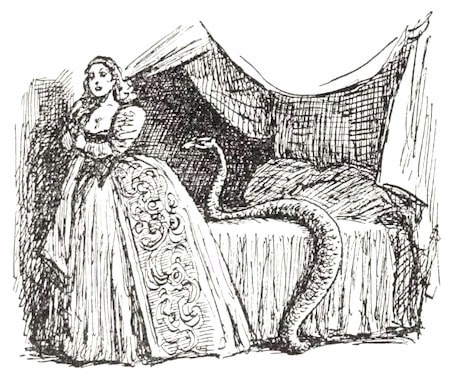
|
(Summary)
A winegrower is working in his vineyard, clearing stones, when he comes across a particularly large rock. Upon removing it, he uncovers a massive hole from which a serpent emerges, demanding to know by what right he has torn the door from its home. The winegrower attempts to apologize, but the serpent replies that it knows he has three daughters of marriageable age and demands that he hand one of them over. The winegrower returns home so distraught that, the moment his daughters see him, they ask what has happened. He recounts to them the encounter he had with the serpent that day; when he finishes, his two eldest daughters refuse to marry a serpent—even with their father's life at stake—but the youngest volunteers herself. Consequently, her father takes her by the hand and leads her to the vineyard, where the serpent awaits. The serpent invites both father and daughter to enter the hole where it lives; once inside, the winegrower and his daughter discover luxurious chambers worthy of a palace. After touring the entire dwelling, the serpent and the winegrower's daughter are wed. On their wedding night, when the young woman shows signs of apprehension at the prospect of sharing a bed with a serpent, the creature kindly explains that it can transform into a man—though only during the day or during the night, but not both—and asks her when she would like him to assume his human form. The young woman replies, "At night," whereupon the serpent sheds its skin, revealing the appearance of a handsome prince; he hangs the skin on a nail near the bed before lying down. The following morning, the prince takes down his skin, puts it on, and transforms back into a serpent. A few days later, the winegrower's daughter goes to visit her family; upon seeing how luxurious and elegant the gowns her younger sister is wearing are, her sisters are consumed by envy. The older sisters persuade the youngest to let them visit her at her palace and to allow them to spend a few days there. During their stay, the sisters bring up the subject of whether the young woman feels uncomfortable sharing a bed with a snake; the young woman, wishing to prove to them that her husband is not actually a snake but a handsome prince, leads her sisters to her bedchamber while her husband sleeps. The eldest sister, upon seeing how handsome the prince is—and consumed by rage and jealousy—burns the snakeskin. Instantly, the prince awakens, draws a magic wand, and teleports the sisters out of the castle. He then turns to his wife, reminding her that he had warned her not to let her sisters touch his snakeskin; as punishment for her disobedience, he orders her to fill seven bottles with her tears and to wear out seven pairs of iron shoes. Only then, he tells her, will she be allowed to see him again. Having said this, the prince touches his wife with the wand as well and transports her out of the castle. Months pass, and the young woman gives birth to a son. She wanders the world with her child, filling seven bottles with her tears and wearing out seven pairs of iron shoes, until—after seven long years have finally passed—she arrives in a city where a wedding is being celebrated. The young woman asks the first local she encounters who is getting married; the local replies that it is a prince who lost his wife seven years ago and is now celebrating his second marriage. Suspecting who the groom might be, the young woman positions herself and her son at the entrance of the church. The groom—who is none other than the Snake Prince—recognizes her the moment he sees her and poses a dilemma to the wedding guests: seven years ago, he lost a key, and now he has recovered it; however, he does not know whether to keep the old key or have a new one made. All the attendees advise him to keep the recovered key, and the prince takes the young woman to his palace. |
|
~ 1980 - "Beast that Took a Wife"
Folktales of Egypt Author: Hasan M. El-Shamy ISBN 9780226206257 ATU - 433A Read Here [III. Takes Based on Religious Themes][nº 20](p.125 - )(Archive) {Serpent Beast} |
1845 - "The Wild Pig / Das wilde Schwein"
Colleced by: J. W. Wolf
{Pig Beast}
Read Here [no. 3](p. 16-21)
[Germany]
Colleced by: J. W. Wolf
{Pig Beast}
Read Here [no. 3](p. 16-21)
[Germany]
1845 - "The Boys with the Golden Stars/ Die Knaben mit den goldnen Sternlein"
Colleced by: Ludwig Bechsteins
Märchenbuch. Leipzig: Hesse & Becker Verlag pp. 368-372
Read Here (Gutenberg)
{Bear Beast}
[Franconia, Germany]
Colleced by: Ludwig Bechsteins
Märchenbuch. Leipzig: Hesse & Becker Verlag pp. 368-372
Read Here (Gutenberg)
{Bear Beast}
[Franconia, Germany]
A young count overhears three girls talking, the third promising to marry the count and bear him two children with golden stars on their chests (tale type ATU 707, The Three Golden Children). The count marries the girl and she bears the children. His mother casts the children in the water, but a servant rescues them. The wife is accused of giving birth to cats and is expelled from home. The servant gives back her children and they live in solitude. Years later, she decides to seek her husband out, in Portugal. She takes her children to a castle, whose lady asks for one of her children and in return gives her a golden spinning wheel. The same thing happens in a second castle: she gives up one of her children and receives another golden trinket. She uses both to buy two nights with her husband in Portugal
1846 - "Beauty and the Beast/ La Belle et la Bête" [La Belle et la Bête - Le Chat botté] (Volume 3)
Published by Pellerin
Pellerin Factory, Printer-Bookseller, in Épinal
Read Here (Gallica)
Book Illustrations Here
{Wolf Demon Beast}
[French]
Published by Pellerin
Pellerin Factory, Printer-Bookseller, in Épinal
Read Here (Gallica)
Book Illustrations Here
{Wolf Demon Beast}
[French]
1847 - "The Little Nut Twig/ Das Nußzweiglein"
Deutsches Märchenbuch
Collected by: Ludwig Bechstein
Publisher: Verlag von Georg Wigand
Read Here (p. 81-85)(German)(Archive)
Read Here (p. 114)(German)
Read Here (Translation by D. L. Ashliman, 1998)(English)
ATU-425C
{Gift walnut twig with golden nuts}
{Bear Beast}
[German]
Deutsches Märchenbuch
Collected by: Ludwig Bechstein
Publisher: Verlag von Georg Wigand
Read Here (p. 81-85)(German)(Archive)
Read Here (p. 114)(German)
Read Here (Translation by D. L. Ashliman, 1998)(English)
ATU-425C
{Gift walnut twig with golden nuts}
{Bear Beast}
[German]
(Summary)
Differnces Beauty character asks for a twig not a rose. Beast make the father make a deal to promise to give him what ever creature that greets him when he arrives home, it's his youngets daughter. Like in Little Broomstick, the merchant tries to deceive the bear by sending another girl, but the bear discovers his scheme and the merchant's daughter is sent to the bear. After she and the bear cross twelve rooms of disgusting creatures, the bear turns into a prince.
(Story)
Once upon a time there was a rich merchant who had to travel to foreign lands on business. As he took leave of his three daughters, he said, “My dear daughters, I would gladly bring you something upon my return. Tell me what I shall bring you.”
The eldest said, “Dear father, a beautiful pearl necklace!” The second said, “I wish for a ring with a diamond stone.” The youngest nestled against her father’s heart and whispered, “For me, a lovely green walnut twig, dear father.” “Very well, my dear daughters,” said the merchant. “I shall remember it. Farewell.” The merchant traveled far and made great purchases, faithfully remembering his daughters’ wishes. A costly pearl necklace was already packed in his trunk, and an equally valuable diamond ring for the second daughter. But a green walnut twig he could find nowhere, no matter how he searched.
On his journey home he often went on foot, hoping to encounter a walnut tree along the forest paths—but in vain. He grew sad that he could not fulfill the innocent request of his youngest and dearest child. At last, as he walked sorrowfully through a dark forest, brushing past dense bushes, his hat struck a branch and it rustled as if hail had fallen upon it. Looking up, he saw a beautiful green walnut twig, from which hung a cluster of golden walnuts. Overjoyed, he reached up and broke off the splendid branch. At that very moment, a wild bear burst from the thicket and reared up growling fiercely, as if ready to tear him apart. In a terrible voice it roared, “Why have you broken my walnut twig? Why? I shall devour you!” Trembling, the merchant pleaded, “Oh dear bear, do not eat me! Let me go on my way with the walnut twig. I will give you a great ham and many sausages!” But the bear roared again, “Keep your ham and sausages! Only if you promise to give me whatever first meets you at home will I spare your life.” The merchant agreed readily, thinking of his little dog who usually ran to greet him. He would gladly sacrifice the dog to save his life. After sealing the bargain with a rough handshake, the bear returned to the thicket, and the merchant hurried home, relieved. The golden walnut twig shone proudly in his hat as he approached home.
Joyfully the youngest daughter ran to greet him. The little dog leapt after her. The older sisters and the mother followed more slowly. The merchant was horrified when he saw that the youngest daughter was the first to meet him. He withdrew sadly from her embrace and told his family what had happened. All wept and were distressed. But the youngest showed the greatest courage and resolved to fulfill her father’s promise. The mother soon devised a plan, “If the bear comes to claim his bride, we shall give him the shepherd’s daughter instead.” All agreed. The youngest carried her walnut twig with her and soon almost forgot the bear and the promise. But one day a dark carriage rattled through the street. The ugly bear stepped out and demanded fulfillment of the promise. Quickly the ugly shepherd’s daughter was dressed up and sent in the carriage. Outside, the bear laid his shaggy head in her lap and growled, “Scratch me, stroke me, Behind the ears so soft and fine, Or I shall eat you, flesh and bone!” She scratched him—but not properly. The bear realized he had been deceived and was about to devour her when she leapt from the carriage and escaped. The bear returned to the merchant’s house and demanded the true bride.
Thus the lovely maiden had to go with the hideous bridegroom. Again he laid his head in her lap and growled the same rhyme. She scratched him gently and tenderly, and it pleased him. His terrible gaze softened, and gradually she gained trust in him. The journey was swift, as though driven by a storm wind. Soon they reached a dark forest and stopped before a gloomy cave—the bear’s dwelling. He clasped her in his dreadful claws and said gently, “Here you shall live, little bride, and be happy if you behave well inside, so my wild creatures do not tear you apart.” He led her through an iron door into a room filled with poisonous creatures that hissed toward them. The bear whispered, “Do not look around! Not right, not left;
Straight ahead, and you shall have peace.” She obeyed. They passed through room after room—twelve in all—the last filled with dragons, serpents, swollen toads, basilisks, and monsters. Each time the bear repeated, “Do not look around! Not right, not left; Straight ahead, and you shall have peace.” She trembled like an aspen leaf but did not turn her head. When the twelfth door opened, dazzling light shone forth. Sweet music sounded. Joyful cries echoed everywhere. Suddenly there was a mighty thunderclap, as though heaven and earth were breaking apart. Then all was calm. The forest, the cave, the poisonous creatures, the bear—had vanished. In their place stood a magnificent castle with golden rooms and splendid servants. The bear had become a handsome young prince, lord of the castle. He embraced his dear bride and thanked her a thousand times for freeing him and his enchanted servants from the spell. The now exalted princess still wore her walnut twig at her bosom. It never withered and had become the key to her happiness. Soon her parents and siblings were summoned to live with her in splendor and comfort under the protection of the Bear Prince.
(Thank you Clark for the translation)(PT translation)
Differnces Beauty character asks for a twig not a rose. Beast make the father make a deal to promise to give him what ever creature that greets him when he arrives home, it's his youngets daughter. Like in Little Broomstick, the merchant tries to deceive the bear by sending another girl, but the bear discovers his scheme and the merchant's daughter is sent to the bear. After she and the bear cross twelve rooms of disgusting creatures, the bear turns into a prince.
(Story)
Once upon a time there was a rich merchant who had to travel to foreign lands on business. As he took leave of his three daughters, he said, “My dear daughters, I would gladly bring you something upon my return. Tell me what I shall bring you.”
The eldest said, “Dear father, a beautiful pearl necklace!” The second said, “I wish for a ring with a diamond stone.” The youngest nestled against her father’s heart and whispered, “For me, a lovely green walnut twig, dear father.” “Very well, my dear daughters,” said the merchant. “I shall remember it. Farewell.” The merchant traveled far and made great purchases, faithfully remembering his daughters’ wishes. A costly pearl necklace was already packed in his trunk, and an equally valuable diamond ring for the second daughter. But a green walnut twig he could find nowhere, no matter how he searched.
On his journey home he often went on foot, hoping to encounter a walnut tree along the forest paths—but in vain. He grew sad that he could not fulfill the innocent request of his youngest and dearest child. At last, as he walked sorrowfully through a dark forest, brushing past dense bushes, his hat struck a branch and it rustled as if hail had fallen upon it. Looking up, he saw a beautiful green walnut twig, from which hung a cluster of golden walnuts. Overjoyed, he reached up and broke off the splendid branch. At that very moment, a wild bear burst from the thicket and reared up growling fiercely, as if ready to tear him apart. In a terrible voice it roared, “Why have you broken my walnut twig? Why? I shall devour you!” Trembling, the merchant pleaded, “Oh dear bear, do not eat me! Let me go on my way with the walnut twig. I will give you a great ham and many sausages!” But the bear roared again, “Keep your ham and sausages! Only if you promise to give me whatever first meets you at home will I spare your life.” The merchant agreed readily, thinking of his little dog who usually ran to greet him. He would gladly sacrifice the dog to save his life. After sealing the bargain with a rough handshake, the bear returned to the thicket, and the merchant hurried home, relieved. The golden walnut twig shone proudly in his hat as he approached home.
Joyfully the youngest daughter ran to greet him. The little dog leapt after her. The older sisters and the mother followed more slowly. The merchant was horrified when he saw that the youngest daughter was the first to meet him. He withdrew sadly from her embrace and told his family what had happened. All wept and were distressed. But the youngest showed the greatest courage and resolved to fulfill her father’s promise. The mother soon devised a plan, “If the bear comes to claim his bride, we shall give him the shepherd’s daughter instead.” All agreed. The youngest carried her walnut twig with her and soon almost forgot the bear and the promise. But one day a dark carriage rattled through the street. The ugly bear stepped out and demanded fulfillment of the promise. Quickly the ugly shepherd’s daughter was dressed up and sent in the carriage. Outside, the bear laid his shaggy head in her lap and growled, “Scratch me, stroke me, Behind the ears so soft and fine, Or I shall eat you, flesh and bone!” She scratched him—but not properly. The bear realized he had been deceived and was about to devour her when she leapt from the carriage and escaped. The bear returned to the merchant’s house and demanded the true bride.
Thus the lovely maiden had to go with the hideous bridegroom. Again he laid his head in her lap and growled the same rhyme. She scratched him gently and tenderly, and it pleased him. His terrible gaze softened, and gradually she gained trust in him. The journey was swift, as though driven by a storm wind. Soon they reached a dark forest and stopped before a gloomy cave—the bear’s dwelling. He clasped her in his dreadful claws and said gently, “Here you shall live, little bride, and be happy if you behave well inside, so my wild creatures do not tear you apart.” He led her through an iron door into a room filled with poisonous creatures that hissed toward them. The bear whispered, “Do not look around! Not right, not left;
Straight ahead, and you shall have peace.” She obeyed. They passed through room after room—twelve in all—the last filled with dragons, serpents, swollen toads, basilisks, and monsters. Each time the bear repeated, “Do not look around! Not right, not left; Straight ahead, and you shall have peace.” She trembled like an aspen leaf but did not turn her head. When the twelfth door opened, dazzling light shone forth. Sweet music sounded. Joyful cries echoed everywhere. Suddenly there was a mighty thunderclap, as though heaven and earth were breaking apart. Then all was calm. The forest, the cave, the poisonous creatures, the bear—had vanished. In their place stood a magnificent castle with golden rooms and splendid servants. The bear had become a handsome young prince, lord of the castle. He embraced his dear bride and thanked her a thousand times for freeing him and his enchanted servants from the spell. The now exalted princess still wore her walnut twig at her bosom. It never withered and had become the key to her happiness. Soon her parents and siblings were summoned to live with her in splendor and comfort under the protection of the Bear Prince.
(Thank you Clark for the translation)(PT translation)


Enchanted Dog/Wolf Prince & Kings Daughter
Father typically a King wants to marry his 1-3 daughter(s)
Beauty character has 3 children, they dissapear
Sister get married/ goes to visit family
tell enchantment to family memeber/ burns pelt
husband disspears, wife must go find him thorugh trials
Father typically a King wants to marry his 1-3 daughter(s)
Beauty character has 3 children, they dissapear
Sister get married/ goes to visit family
tell enchantment to family memeber/ burns pelt
husband disspears, wife must go find him thorugh trials
1849 - "Wolf Prince/ Ulf-Prinsen"
Swedish Folk Tales and Adventures/ Svenska Folk-Sagor och Äfventyr
Collectors: George Stephens and Gunnar Olof Hyltén-Cavallius
Collected a Swedish tale from Södermanland
Publisher: Förste Delen. Stockholm: pa A. Bohlins Förlag
Read Here (p. 325-350.)(Gutenberg)
{Wolf Beast}
[Swedish]
Swedish Folk Tales and Adventures/ Svenska Folk-Sagor och Äfventyr
Collectors: George Stephens and Gunnar Olof Hyltén-Cavallius
Collected a Swedish tale from Södermanland
Publisher: Förste Delen. Stockholm: pa A. Bohlins Förlag
Read Here (p. 325-350.)(Gutenberg)
{Wolf Beast}
[Swedish]
Swedish folktale
A king finds a flea on his daughter's hair, fattens it and uses its hide as part of a suitor riddle. A wolf appears in court and guesses it right. However, the king tries to trick the wolf with daughters of other people, but he notices and returns. On the third time, the king relents and gives the wolf his daughter, as promised. The wolf takes the princess to its lair in the mountain, and she discovers a grand atrium by descending a staircase. The wolf and the princess live as man and wife, and she gives birth to three children in the following seven years. However, each time a human child is born (two sons and a daughter), the wolf takes the child between its teeth and takes the baby to the forest. Eventually, the princess is invited to her father's wedding to a new queen. The princess tells her new stepmother about her life with the, and the stepmother gives her a three-armed candlestick to use to spy on her wolf husband at night. The wolf husband (in human form) wakes up and laments that his wolf curse would have broken in three months, reveals that their three sisters are in his sisters' good hands, turns back into a wolf and rushes to the castle of the troll witch that cursed him. The princess goes after him and passes by the houses of her sisters-in-law, where she receives a golden distaff from the first, an apple in bright gold colour from the second, and a golden harp. The princess continues her search for her husband by following a trail of pebbles the wolf places for her. The trail stops before a grand sea that she needs to cross through. She uses the harp to tame a large gray wolf with the song and she rides the wolf across the sea. At last, the princess reaches the troll witch's castle, where she finds work in the kitchen. She uses the golden objects to bribe the troll princess (the false bride) for a night with her husband.
A king finds a flea on his daughter's hair, fattens it and uses its hide as part of a suitor riddle. A wolf appears in court and guesses it right. However, the king tries to trick the wolf with daughters of other people, but he notices and returns. On the third time, the king relents and gives the wolf his daughter, as promised. The wolf takes the princess to its lair in the mountain, and she discovers a grand atrium by descending a staircase. The wolf and the princess live as man and wife, and she gives birth to three children in the following seven years. However, each time a human child is born (two sons and a daughter), the wolf takes the child between its teeth and takes the baby to the forest. Eventually, the princess is invited to her father's wedding to a new queen. The princess tells her new stepmother about her life with the, and the stepmother gives her a three-armed candlestick to use to spy on her wolf husband at night. The wolf husband (in human form) wakes up and laments that his wolf curse would have broken in three months, reveals that their three sisters are in his sisters' good hands, turns back into a wolf and rushes to the castle of the troll witch that cursed him. The princess goes after him and passes by the houses of her sisters-in-law, where she receives a golden distaff from the first, an apple in bright gold colour from the second, and a golden harp. The princess continues her search for her husband by following a trail of pebbles the wolf places for her. The trail stops before a grand sea that she needs to cross through. She uses the harp to tame a large gray wolf with the song and she rides the wolf across the sea. At last, the princess reaches the troll witch's castle, where she finds work in the kitchen. She uses the golden objects to bribe the troll princess (the false bride) for a night with her husband.
|
~ 1862 - "The White Hound of the Mountain/ Cu ban an ’t Sleibhe"
Popular Tales of the West Highlands (Vol. IV.) Author: John Francis Campbell Colleted from: Marian Gillies Publisher: Edmonston and Dougla Comes from : from Port an long, North Uist. Read Here [119](p. 442-443)(Irish) {Hound Beast} [Scottish Gaelic, Scotland] ~ 1897 - "The White Hound of the Mountain/ Cú Bán an T-ṡleibhe" kuːbˠaːnˠənˠˈtʲlʲeːvʲə (IPA)
Journal of Celtic Philology/ Zeitschrift für celtische Philologie Taken from: Old women Daniel O' Foharta Author: Kuno Meyer Published in the academic journal Zeitschrift für celtische Philologie Read Here (p. 146–156.0)(Irish) ATU 425A {Hound Beast} [Irish]
|
|
Irish folktale
The King of Ireland has a wonderful wishing-chair near a well in his garden. One day in the absence of the King his three daughters seat themselves in the chair and call upon God and Mary and the saint of the well to grant them their wishes. The eldest daughter wishes to be married to the King of the Eastern World, the second wishes for the King of the Western World, and the youngest asks for the White Hound of the Mountain. The desired husbands claim their brides in due course. Foiled on two occasions, the White Hound threatens to destroy the King's Court if his bride be not delivered up to him. The girl leaves with her husband who is a hound by day but a man by night. She gives birth to three children-two boys and a girl-and these are carried off by a strange lady at their birth. The mother refuses to tell her relatives anything about her hus- band or the fate of her children until she is threatened with death, whereupon she reveals the secret. As a result the White Hound leaves her and takes the form of a crow. She follows him wherever he goes. She obtains a magic scissors, a comb, and a reel for winding yarn, and by the aid of these objects obtains leave to sleep with her husband on three successive nights. His enchantress, the Queen of the Black Cloak, prevents him from learning of his wife's presence, but at length, by the aid of the butler, her schemes come to nought and she is put to death. The three lost children are restored to the disenchanted White Hound and his wife; each of them has lost an eye due to their mother shedding a tear when they had been carried off from her; the eyes are restored to them. The story ends. (Summary - Béaloideas p. 171-172) |
|
~ 1950 - "The White Hound of the Mountain/ Cú Bán a' tSléiḃe" 1
“Sgéaltaí ó Thír Eóghain” In: Béaloideas 20, no. 1/2 : 6-11, 40-42. Author: Mac AirtSeán Read Here (Jstor) {Hound Beast} [Irish, Ireland] |
|
A king possesses a magical wishing chair(cathaoir a' tsóláis)., which his three daughters use to wish for husbands: the eldest desires one more beautiful than the sun, the middle daughter wants one more beautiful than the moon, and the youngest wishes for the White Hound. Eventually, all three suitors arrive to claim their brides, with the White Hound taking his through a hidden forest path. Upon reaching their castle, the White Hound offers his wife a choice between his two forms, and she opts for him to be a man by night. After they have their first son, the White Hound instructs her to leave the child outside for him to take, a pattern that continues with their second child. During her third pregnancy, he warns her to stay away from her father's castle, fearing her step-mother will force her to reveal their life together. Despite his warnings, the princess returns home, where her step-mother tortures her into revealing her secrets. Awaiting her husband's arrival, she is dismayed to find his castle in ruins. While collecting three sods from the ground, she discovers that tossing one summons her husband and their sons, who flee shortly after. In her pursuit, she is aided by an old woman who gives her magic scissors, a comb, and a box, along with a clue that her family had recently stopped there. These magical gifts help her over three visits to her father-in-law's castle, where the White Hound announces he will marry whoever can wash his bloodied shirt. However, the hen-wife's daughter takes credit for completing the task and is set to marry him instead.
Using the scissors, comb, and box, the princess successfully bribes the false bride to allow her three nights with the White Hound. Initially, he is bewitched by a sleeping potion, but on the third night, he awakens and recognizes her as his wife, thus reuniting them. |
|
~ 1962 - "The White Hound of the Mountain/ Cú Bán an t-Sléibhe" 1
"Trí Shean-Scéal". Béaloideas. 30: 135–147 Author: Séamus Ó Duilearga Read Here (Jstor) {Hound Beast} [Irish, Ireland] |
|
A widowed king with three daughters locks away a magical wishing chair while he is away. The two elder daughters wish for the most honored men to marry them, while the youngest, persuaded by her sisters, wishes for the Cú Bhán an TSléibhe (White Hound of the Mountain) to marry her. After the elder sisters' wishes are fulfilled, the White Hound comes to claim the youngest. The king attempts deception by sending a servant's daughter in her place but is thwarted. The princess chooses for the White Hound to be human at night and an animal by day. After several pregnancies, children are taken away by a dark figure from the chimney. The princess betrays her husband's trust and searches for him in Tír na Hóige, receiving magical gifts from three old ladies while caring for her children. She lives in a pigpen until she strikes a deal for her magical items with the lady of the castle and her daughter. They exchange one night with the sleeping White Hound, and after failing to wake him initially, she succeeds on the third night, allowing them to reunite. The Hound reveals the need to destroy the witches' external soul, concealed in a series of increasingly hidden locations.
|
|
~ 2024 - "The White Dog of the Valley"
The Schools’ Collection, Volume 0442 Teller of the story : Nóra Ní Shuilleabháin Collected from Garrane, County Kerry,Ireland Publisher: duchas.ie. Retrieved December 15th, 2024 Read Here (p. 070-077) {Hound Beast} [Irish, Ireland] |
|
A king and queen in Gleannscoheen have a daughter, while a prince, cursed by a witch, is compelled to steal cattle from the king. Disguised, the queen successfully tricks the prince when he seeks his bride. Eventually, the king gives the princess to the prince, who lives in an underground mansion with her. They have three sons, who are taken by a giant dog. The princess, while trying to mend a shirt, pricks her finger, and three drops of blood fall on the prince's shirt. Seeking her children, she meets a blacksmith who advises her to visit three houses, where she acquires magical gifts: a comb, an infinite thread reel, and a protective thimble. She learns of her sons’ whereabouts from a woman washing a shirt due to the witch's orders. After washing the stained shirt, the witch’s daughter discovers the gifts and tells her mother, who demands them back. In a deal, the princess trades the gifts for three nights with the witch's husband, who turns out to be the prince. Though the prince is under a sleeping draught, they finally communicate on the third night and are given hawk's eggs by a male servant. As they escape on ponies, the witch and her daughter, transformed into hawks, pursue them. The servant throws the eggs at them, killing the witches. The prince and princess reclaim their children, returning home together.
|
|
~ 2024 - "The Black Woolly Dog"
The Schools’ Collection, Volume 0449 Collected from William O' Donnell, from Coollegrean, County Kerry Publisher: duchas.ie. Collected from Garrane, County Kerry,Ireland Read Here (p. 183-189) {Hound Beast} [Irish, Ireland] |
|
A gentleman has a daughter who is looked after by a cadette and possesses a wishing chair. While her elder sisters wish for gentlemen, the youngest sister's wish results in her suitor being a black woolly dog. After a year, she returns home with the dog, now transformed into a handsome youth, and they have their first child. Over the subsequent years, they return with an increasing number of children. The girl's mother contemplates burning the youth’s cap, but he advises against it. In time, the girl seeks out her husband and follows the dog to different houses, where she discovers her children and receives magical items: a food-providing object, a pair of magical scissors, and a comb. In her journey, she attempts to reclaim her husband but loses him when he sinks into the ground. Taking refuge in a tree, she is discovered by a blacksmith and his maidservant. The blacksmith teaches her to work after he sees her torn nails. The girl accidentally uncovers a washerwoman's shirt, leading to a series of events involving a witch and the girl's attempts to reclaim her husband from her. The girl manages to negotiate a deal with the witch for three nights with her husband, during which the witch tries to keep him asleep. Ultimately, with the help of a boy, the girl confronts and defeats the witch, freeing her husband, and they unite in marriage once more.
|
1850 - "Three White Roses/ Tři bílé růže"
Moravian folktale
Author: Beneš Metod Kulda
Moravian (Czech Republic) folktale
Read Here [33.](Czech)(p. 148)
Read Here [33.](Czech)
ATU 425C
{Gift - three white roses}
{Hound Beast}
{Curse broken - stroking beast lifting his body up, skin falls off}
[Czech]
Moravian folktale
Author: Beneš Metod Kulda
Moravian (Czech Republic) folktale
Read Here [33.](Czech)(p. 148)
Read Here [33.](Czech)
ATU 425C
{Gift - three white roses}
{Hound Beast}
{Curse broken - stroking beast lifting his body up, skin falls off}
[Czech]
(Full Story)
A father had three daughters; he was a merchant, who went to the markets to sell muslin, calico, and other such goods. Whenever he went to the market, his two older daughters would always beg him to buy them some expensive dresses. But the youngest never asked her father for anything, and when her father asked her what he should buy for her, she would say that it was enough that the other two were begging, and that his wealth would not be enough for them. She was as obedient in the house as a servant girl, doing her duties and minding only her own work. The other two sisters, on the other hand, were always dressing up in those pretty, expensive dresses.The other two sisters always dressed up in those nice expensive clothes. Becuase his youngest daughter was so hardworking at every task, her father, as he was heading to the market again, asked her what she wanted, telling her to choose something she liked, which he would be happy to bring her. She replied, “Dear Father, if you want to bring me something that you like, I’ll be happy with that.”—He really wanted to hear from her what she wanted, so she would say that he would bring it to her out of love, just as he did for the others. So she asked her father for three white roses. When the father came to the market, he bought some things for his two daughters, but for the third he couldn’t find any white roses anywhere. Then he walked past a castle, an enchanted castle, and there he saw white roses growing in a flowerbed. Then he remembered again that he was supposed to bring the three white roses to his youngest daughter. He went into the garden and wanted to pick three roses. But there was a big, ugly dog standing by the rosebush, and he said nothing until the he had picked those lovely roses. As soon as he had picked them, the dog said, “Who are you going to give those roses to?” - The father said, “To my daughter!” - But the dog said, “For those roses, you must bring your daughter here, or else it will go badly for both you and your daughter!” His father was deeply saddened by this and didn’t know whether to leave with the roses or not. So night fell, and he had to stay the night in that cursed castle. After he had supper there, he walked through the rooms and found no one there, only a table set for one person with supper ready, and a bed made for one person. He stayed there for the night. In the morning, when he got up, water, a towel, breakfast—everything was prepared. After he finished breakfast, he went downstairs. The dog came up to him just as he was about to leave the castle, and said "If you don't bring your daughter back, something terrible will happen to you." But he also gave him a great deal of money. Then the father set off sadly through the vast forest on his way home. When he arrived home, he felt both joy and sorrow. He gave the two older daughters the expensive dresses, and to the youngest he gave the three roses and said, “My dearest daughter, you asked me to bring you the hardest gift of all; for those roses, you must go to that enchanted castle where I picked them in the garden. But you are young—it would be a shame for you to go; but I will go in your place.”
"Then the daughter cried out: "My dearest father, I want to go there, that will be the greatest joy for me!" - Her older sisters laughed at her and wished her well; they pretended to be crying, but they would have had to rub their eyes with onions. The father took his daughter, and they went to the castle. When they arrived there, dinner was prepared for the two of them and the beds made. They both stayed there in the room. In the morning when they got up, water, a towel and breakfast were prepared for both of them. When they had eaten, the dog came to them and said that she must stay there. The father was there with her for two days and on the third day he left. The dog gave him a lot of silver and gold. But the daughter stayed there alone. She always had food and drink ready, and there was no one in the whole castle except her and the dog. The dog came twice a day to cheer her up. When she had been there for a whole year, she begged the dog to let her go to her father while he was still alive. When the time came for him to let her go, she went to her father. In the enchanted castle she had plenty of food, drink and beautiful clothes, but nothing pleased her there and she only wanted to see her father. The dog let her stay with her father for 14 days; but warned, if those 14 days passed and she didn't come back, that it will be very bad for both her and the dog. When she came home, her father was overjoyed to see her and that she had returned to his house just as beautiful as when she had left, and he immediately asked her eagerly how she was doing there. She replied, “My dear father, I am doing well, whatever I want to eat and drink, and I have whatever clothes I want, I have as well; but I am still grateful to have seen you, father, alive. I am have to go back home in two weeks; if I do not go, I will cause harm to myself and to the animal.” Those wicked sisters of hers, wanted to cause her harm; they wanted to keep her there, to make her suffer; they held her back for a day, but they couldn’t keep her any longer; she had to depart. She returned, and when she arrived at the castle, the animal was already lying there by the bed, lifeless. When she spoke to, he did not even stir. Then she wept, wondering how she would manage, now that the animal had died for her. Then she lay down on the bed grief stricken. In the morning, when she got up, she found no food or a washbasin prepared for her. She wailed pitifully and cried, “My God, what have I done, how did I miss the day I was suppose to return!” She stood there crying, and kept stroking the animal. When she then lifted him up from the ground, his skin peeled right off, and the little dog turned into a handsome prince. He stood up and said, “My dearest, you have saved me, and now you shall be mine. I was cursed, and so was the city. Now we are all free, and you shall be queen the end of your days." Her mean sister wanted to mess with her, but so far they’ve actually been nice to her.
(Thank you DL for the translation)
A father had three daughters; he was a merchant, who went to the markets to sell muslin, calico, and other such goods. Whenever he went to the market, his two older daughters would always beg him to buy them some expensive dresses. But the youngest never asked her father for anything, and when her father asked her what he should buy for her, she would say that it was enough that the other two were begging, and that his wealth would not be enough for them. She was as obedient in the house as a servant girl, doing her duties and minding only her own work. The other two sisters, on the other hand, were always dressing up in those pretty, expensive dresses.The other two sisters always dressed up in those nice expensive clothes. Becuase his youngest daughter was so hardworking at every task, her father, as he was heading to the market again, asked her what she wanted, telling her to choose something she liked, which he would be happy to bring her. She replied, “Dear Father, if you want to bring me something that you like, I’ll be happy with that.”—He really wanted to hear from her what she wanted, so she would say that he would bring it to her out of love, just as he did for the others. So she asked her father for three white roses. When the father came to the market, he bought some things for his two daughters, but for the third he couldn’t find any white roses anywhere. Then he walked past a castle, an enchanted castle, and there he saw white roses growing in a flowerbed. Then he remembered again that he was supposed to bring the three white roses to his youngest daughter. He went into the garden and wanted to pick three roses. But there was a big, ugly dog standing by the rosebush, and he said nothing until the he had picked those lovely roses. As soon as he had picked them, the dog said, “Who are you going to give those roses to?” - The father said, “To my daughter!” - But the dog said, “For those roses, you must bring your daughter here, or else it will go badly for both you and your daughter!” His father was deeply saddened by this and didn’t know whether to leave with the roses or not. So night fell, and he had to stay the night in that cursed castle. After he had supper there, he walked through the rooms and found no one there, only a table set for one person with supper ready, and a bed made for one person. He stayed there for the night. In the morning, when he got up, water, a towel, breakfast—everything was prepared. After he finished breakfast, he went downstairs. The dog came up to him just as he was about to leave the castle, and said "If you don't bring your daughter back, something terrible will happen to you." But he also gave him a great deal of money. Then the father set off sadly through the vast forest on his way home. When he arrived home, he felt both joy and sorrow. He gave the two older daughters the expensive dresses, and to the youngest he gave the three roses and said, “My dearest daughter, you asked me to bring you the hardest gift of all; for those roses, you must go to that enchanted castle where I picked them in the garden. But you are young—it would be a shame for you to go; but I will go in your place.”
"Then the daughter cried out: "My dearest father, I want to go there, that will be the greatest joy for me!" - Her older sisters laughed at her and wished her well; they pretended to be crying, but they would have had to rub their eyes with onions. The father took his daughter, and they went to the castle. When they arrived there, dinner was prepared for the two of them and the beds made. They both stayed there in the room. In the morning when they got up, water, a towel and breakfast were prepared for both of them. When they had eaten, the dog came to them and said that she must stay there. The father was there with her for two days and on the third day he left. The dog gave him a lot of silver and gold. But the daughter stayed there alone. She always had food and drink ready, and there was no one in the whole castle except her and the dog. The dog came twice a day to cheer her up. When she had been there for a whole year, she begged the dog to let her go to her father while he was still alive. When the time came for him to let her go, she went to her father. In the enchanted castle she had plenty of food, drink and beautiful clothes, but nothing pleased her there and she only wanted to see her father. The dog let her stay with her father for 14 days; but warned, if those 14 days passed and she didn't come back, that it will be very bad for both her and the dog. When she came home, her father was overjoyed to see her and that she had returned to his house just as beautiful as when she had left, and he immediately asked her eagerly how she was doing there. She replied, “My dear father, I am doing well, whatever I want to eat and drink, and I have whatever clothes I want, I have as well; but I am still grateful to have seen you, father, alive. I am have to go back home in two weeks; if I do not go, I will cause harm to myself and to the animal.” Those wicked sisters of hers, wanted to cause her harm; they wanted to keep her there, to make her suffer; they held her back for a day, but they couldn’t keep her any longer; she had to depart. She returned, and when she arrived at the castle, the animal was already lying there by the bed, lifeless. When she spoke to, he did not even stir. Then she wept, wondering how she would manage, now that the animal had died for her. Then she lay down on the bed grief stricken. In the morning, when she got up, she found no food or a washbasin prepared for her. She wailed pitifully and cried, “My God, what have I done, how did I miss the day I was suppose to return!” She stood there crying, and kept stroking the animal. When she then lifted him up from the ground, his skin peeled right off, and the little dog turned into a handsome prince. He stood up and said, “My dearest, you have saved me, and now you shall be mine. I was cursed, and so was the city. Now we are all free, and you shall be queen the end of your days." Her mean sister wanted to mess with her, but so far they’ve actually been nice to her.
(Thank you DL for the translation)


|
~ 1959 - "Three White Roses/ Tři bílé růže"
Author: Kalábová Taťána Publisher: Mustredna Images Here |
1852 - "Beauty and the Beast"
Bo-Peep Story Books
Cinderella ;Beauty and the beast ; The Princess Rosetta ; Little Red Riding Hood ; Fair One and Golden Locks ; The Sleeping Beauty.
Edited by Madame de Chatelain
Illustrator: Alfred W. Croxall ?
Publisher: New York : Leavitt & Allen.
Read Here (Archive)
Book Illustrations Here
ATU 425C
{Demon Beast}
[English, USA]
Bo-Peep Story Books
Cinderella ;Beauty and the beast ; The Princess Rosetta ; Little Red Riding Hood ; Fair One and Golden Locks ; The Sleeping Beauty.
Edited by Madame de Chatelain
Illustrator: Alfred W. Croxall ?
Publisher: New York : Leavitt & Allen.
Read Here (Archive)
Book Illustrations Here
ATU 425C
{Demon Beast}
[English, USA]
1852 - "A Terrible Monster/ Straszny Potwór"
Legends and Folk Tales of Mazovia / Podania i baśni ludu w Mazowszu
Collected by : Roman Zmorski
Publisher: Wrocław: Zygmunta Schlettera
From from Mazovia, Poland
Read Here (P. 58-74)(Polish)
Read Here (P. 58-74)(Polish)(Wiki)
ATU-425C
{Jadwisia ; White lily/ biała liljo - Beauty name}
{Gift - blue rose}
{Beastly Beast}
{Curse broken - a kiss}
[Polish, Poland]
Legends and Folk Tales of Mazovia / Podania i baśni ludu w Mazowszu
Collected by : Roman Zmorski
Publisher: Wrocław: Zygmunta Schlettera
From from Mazovia, Poland
Read Here (P. 58-74)(Polish)
Read Here (P. 58-74)(Polish)(Wiki)
ATU-425C
{Jadwisia ; White lily/ biała liljo - Beauty name}
{Gift - blue rose}
{Beastly Beast}
{Curse broken - a kiss}
[Polish, Poland]
(Differences) **Spoilers**
The Beauty Character asks for a blue rose. This roses only grows upon a single desolate island amidst the sea, to which no ship ever sails due to treacherous rocks. The Beast Character only makes the Beauty Character stay with him a year He then tries to tell her he loves her and she laughs at him he does show back up untill her father comes to get her and take her home.
The Beast Character gives the Beauty Character a redcoral apple, who's color will change to tell if he is ill or dying. He gave her an iron ring in which to use to return to the castle.
Description of the Beast : shaggy as a bear, with twisted horns upon its head and savage fangs in its jaws—which, glaring at him with terrifying, fiery eyes, held a massive paw
"The peasant girl bends down and kisses him--
And lo and behold! The ugly dwarf,
Freed from an evil spell, transforms
Into a handsome young knight."
- A Scandinavian Ballad.
A wealthy merchant was preparing to set sail across the sea, to carry Polish wheat to distant lands where it does not grow.As he bade farewell to his two daughters before boarding—seeking to comfort them in their tears—he asked what gift from beyond the sea they might desire. — "Oh, dear father!" exclaimed the elder daughter—radiant and proud as a rose in full bloom—"bring me a beautiful string of pearls, that I may weave it into my braid." — "Very well! You shall have them," said her father. "And you, my white lily! What is it you desire from across the sea?" — "I? My father!" replied the younger daughter. "I have nothing in particular in mind that I especially crave. But if I must indeed ask you for something—I have heard it said more than once that across the sea grow blue roses that never wither—bring me, if you can find one, just such a little rose, that I may weave it into my hair." — "Very well, my dearest little rose! If I find such a rose anywhere at all, I shall pluck it for you with my own hand." And having once more kissed his daughters’ foreheads, the father boarded a large boat upon the Vistula, which soon bore him downstream toward the sea... The daughters stood for a long while upon a sandy hillock—now wiping the tears from their eyes with their handkerchiefs, now waving them in the air—until, when the boat had vanished completely from their sight behind the forest, they returned home in tears, praying to the Mother of God for a safe journey for their father. The merchant safely crossed the Vistula and the open sea, and on a distant shore, he sold his wheat for a handsome sum. Delighted with his earnings and preparing for his departure, he began to think about the gifts he had promised his daughters. The pearls were no trouble at all to procure—(for they grow on the seabed just as peas grow in our fields; one need only dive down and pluck them)—and for a mere trifle, he purchased a strand as long as a whip, with pearls as large as pigeon’s eggs. But regarding the blue rose, he inquired everywhere in vain; nowhere could he obtain one. He learned from the locals that such roses grow only upon a single desolate island amidst the sea—an island, however, to which no ship ever sails due to treacherous rocks and submerged shoals, unless driven there by sheer chance. It grieved him that he could not fulfill the request of his beloved child; yet, since there was no other remedy, he commissioned a small rose to be crafted entirely of tiny blue turquoises, with golden leaves and stems, so that she might wear it in her hair in place of the real bloom. Before long, having boarded his vessel, the merchant set sail for home. He had already safely traversed nearly half the journey when, suddenly, one evening, a fierce storm and gale erupted. All through the night, the sea tossed the frail boat about like a ball—lifting it high into the air one moment, only to plunge it toward the depths the next—while the wind, having torn the sails to shreds, drove the vessel completely off course, into utterly unknown waters. — It was not until morning that the storm finally subsided, and the overjoyed travelers found themselves in a quiet, secluded spot beside a strange shore—a place where, amidst a dark forest of firs, a massive castle rose. While the ship’s crew set about repairing the sails and masts—damaged by the night’s tempest—the merchant himself took a small skiff and rowed ashore; there, having tethered his boat to a tree on the bank, he walked straight toward the castle. As he approached, he was not a little surprised to find that no road—nor even a footpath—led to the entrance bridge through the dense, overgrown forest that hemmed it in on all sides. It struck him as even stranger when, having crossed the bridge and passed through the fortress’s gates—which stood flung wide open—he found neither guards nor a single living soul anywhere nearby. In the vast courtyard, encircled on all sides by stately buildings, he was struck with dread by the profound emptiness and deathly silence. Though it was now broad daylight, no smoke could be seen rising from any chimney, nor could a single sound be heard from anywhere—not even the faintest tap. If only a horse would neigh, a dog bark, or a rooster crow! ... But nothing! It was as if everything had perished. The stone paving of the courtyard was overgrown with tall grass and wild brambles, while ivy and bindweed, climbing high, wove themselves over the walls of the buildings, draping the doors and windows in fluttering, leafy veils. Strangest of all, despite everything, nowhere was there any sign of ruin or even the slightest damage; the entire castle seemed to stand as sturdy and sound as if it had been built only yesterday. Amidst this magnificent desolation and silence, a shiver ran down the merchant’s spine; he knew not what to do—should he stay, or should he flee? Yet, having nothing else to occupy his time throughout the long day, and having overcome his sense of dread, he resolved to explore the abandoned castle. Seeing the massive doors of the main edifice standing slightly ajar, he turned his steps toward them first.Stepping across the threshold, he found himself within a vast hall—lofty and spacious as a cathedral—illuminated by a long row of slender, multicolored windows. Its floor was paved with red stone, and its walls were faced with gray hewn blocks. Against one wall stood a fireplace—as wide as a carriage gate—flanked by heavy oak benches. In the center rose a long table, draped in a rich tapestry; at one end stood a gilded throne beneath a crimson canopy, while all around were chairs—intricately carved and upholstered in richly patterned leather. The walls, from floor to ceiling, gleamed with the luster of helmets, suits of armor, and polished shields; interspersed among them hung steel swords, spears, and massive maces studded with fearsome spikes. The vaulted ceiling once again bristled with a multitude of antlers, with the heads of wild boars, bears, and wolves, with whale jaws, and with old banners—now fallen into tatters... Having examined all this, the merchant proceeded to the inner chambers—encountering everywhere within them royal splendor and thousands of rare and precious objects. More than once, he felt tempted to take this or that item lying there unused;yet whenever he reached out his hand, something seemed to whisper in his ear to desist. After spending several hours exploring the numerous rooms, he returned once more to the great hall. Stepping inside, he beheld with no small astonishment a bright fire blazing in the hearth, and a table laden with silver goblets of wine and platters from which rose the savory steam of exquisite fish and sea-crayfish. Unsure of the meaning of this, he looked around curiously to see if anyone might enter, when suddenly his gaze fell upon a large inscription above the table: “Partake, dear guest, and fear nothing.”
— A few weeks later, the merchant’s boat docked by the green banks of the Vistula, beneath a whitewashed manor house nestled among the pines—the very place where his two longing daughters had been awaiting their father’s return.When, in response to his daughters’ inquiries, the father presented them with the promised gifts, the elder daughter took less delight in her costly pearls than did the younger in her wondrous bouquet of fragrant, fresh roses—roses of a hue never before seen—which she immediately wove into her hair. — “My dearest child,” said the merchant, observing her joy, “do not take such delight in them! Would that you had never asked for them, or that I had never found them!” And he recounted to her everything that had befallen him within the desolate castle—down to the terrible monster’s demand and the oath he had sworn. Yet, Jadwisia noticing the sudden pallor that had come over his face, he added, “Have no fear, however, that I would ever urge you to fulfill my rash oath. No! I would sooner bear the burden of my sin myself than allow you—my little angel—to fall into such terrible clutches and sadly waste a whole year of your young life in that desolate wilderness.” — But the girl, who had already resolved in her heart what she must do, threw her arms around her father’s neck, crying out: — “Do not speak so! Do not say such things, dear father! What kind of daughter would I be if I failed to fulfill your vow?… The just God, to whom I entrust myself entirely, will not suffer any harm to befall my innocence; and as for spending a year in a beautiful—albeit empty—castle, what great penance is that? Shall I not have so many exquisite things to behold, so much space to roam? I shall plant flowers, play the lute, and sing songs—and when I tire of that, the terrible monster shall simply have to jump over a stick for me!”.... Laughing and chattering thus—though God alone knew what was truly stirring within her soul—she began to urge her father to hasten their departure, seeking only to cheer him, and set about making preparations for the journey. — A few days later, all was ready, and the swift boat once again bore the merchant and his daughter toward the desolate castle.... The terrible monster, no sooner had he spied the arriving guests approaching the shore, than he advanced to meet them, coming all the way to the very gates of the castle. — Upon seeing him, the merchant’s daughter was seized by such overwhelming terror that she trembled inwardly like an aspen leaf; yet, to spare her father any further distress, she summoned every ounce of courage she could muster. — The monster thanked the merchant for keeping his word, and the young lady for her gracious arrival, solemnly assuring her that no harm whatsoever would befall her. — Saying this, he led them into a magnificent hall, where a truly royal supper already awaited them. While the merchant and his daughter refreshed themselves after their journey, their host—standing at a distance—engaged them in conversation so wise and fascinating that, listening to him, they forgot all about his terrifying appearance. — The merchant remained a guest in the castle for a whole week, resting; throughout this entire time, the fearsome monster behaved with such courtesy and gentleness that when the moment of departure arrived, the poor father—if not without a heavy heart—at least parted from his beloved daughter without any great fear, knowing he was to return for her in a year’s time. — Just as the girl had striven to maintain her composure as best she could in her father’s presence, so too, after his departure—sitting by a window that looked out upon the sea—she burst into bitter tears. — The fearsome monster then approached her humbly and spoke: — “Do not weep so, lovely maiden! And do not be angry with me that, through my doing, you must spend a year in this wilderness; it is not my fault, but rather the will of God!… A year is not an eternity; it will pass quickly! — In the meantime, this entire castle—and I myself—are at your command. — Here is a little golden bell; whenever you desire anything, ring it and speak your wish aloud, and whatever you command shall come to pass. And here is a little silver whistle; blow upon it whenever you wish for me to come to you in person. Unless it be your will, I shall never frighten you with the sight of my presence.” — “Praise be to God!” — so thought the departing girl—who could not look upon him without horror—"you won't be hearing that whistle again anytime soon!" Having wept her fill for her father, Jadwisia began to cheer herself up as best she could in her solitude. She embroidered patterned handkerchiefs, played the lute while softly singing lovely Mazovian folk songs, gathered flowers in the garden to weave into exquisite wreaths, and, while running through the forest, conversed with the chirping birds... Yet, despite all this, after a mere fortnight, she began to yearn for human conversation. The terrible monster—true enough—bore not the slightest resemblance to a human being, yet he spoke exactly like one. Bored, and feeling half-willing, half-reluctant, the girl finally mustered the courage to summon him with her silver whistle; however, she deliberately chose the hour of twilight for this, so that she might listen to him without horror, as she could not see him. The monster proved so adept at engaging her with his stories and conversation that, from then on, she summoned him every evening; and, little by little, she eventually dared to speak with him during the day—though she still kept her head averted. Within a month, she could look upon him without fear, and even invited him to sit at the table beside her. Then came the sad, dreary winter; she was forced to remain confined within the walls for days and weeks on end—and what was she to do with herself, all alone? Thus, as soon as she had dressed in the morning, she would summon the fearsome monster, Jadwisia and him spend time with each other until nightfall, when she was due to go to sleep. She bade him tell her stories—of which he knew countless —she teased him and made up with him, and played all sorts of games with him; although the frivolous thought had crossed her mind more than once to make him jump through hoops, she didn’t dare say it aloud—not because she was afraid of him, but because she didn’t wish to cause him any distress. — At last, winter passed and warm spring arrived; yet the girl had grown so accustomed to spending her entire days with the monster that she would grow cross if, on any given morning, he did not come of his own accord and she had to call for him. However pleasantly and swiftly the time passed in his company, she marked each passing day above her little bed with no less diligence, counting how many still remained until the year’s end. A year is not an eternity—and swiftly, it drew toward its close. The closer that end approached, the sadder the fearsome monster became with every passing moment; yet Jadwisia, in her own joy, failed to notice it at all. Only three days now remained until the year’s end when, having risen at the break of dawn and run out into the garden to gather flowers for her hair, she found the fearsome monster sitting sadly beneath a bush of blue roses, his shaggy muzzle streaming with tears as profuse as the morning dew. “What ails you, my fearsome monster!” she cried out, seized with pity. “What has befallen you that you weep so bitterly?… Tell me! Perhaps I can be of some help?” He lifted his head toward her in silence, gazing sadly into her eyes; at last, he answered with a sigh: “For soon you will abandon me forever—and yet I love you, Jadwisia!” At this, the flighty girl burst into such uproarious laughter that she nearly tumbled to the ground; hearing this, the monster gave a pained moan and fled to hide himself somewhere within the dense thicket. In vain did she call out to him and used her silver whistle; But he did not come—neither that day nor on any of the days that followed. It was not until the merchant’s boat appeared at the shore that the fearsome monster emerged from his hiding place to welcome and receive the guest. — On the very day of Jadwisia’s departure, the terrible monster, finding her alone in her room, spoke to her, “My lovely Jadwisia! You are traveling far away now—across the sea—so that I, poor wretch that I am, shall never see you again! Please forgive my presumption—that I, a mere monster, dared to love you—and remember me from time to time. If ever, upon remembering me, you should wish to know what has become of me here, take this red coral apple: should it turn to pale, you will know that I am ill; should it turn completely white, you will know that I am dying of love for you. And should you ever wish to visit me, simply place this iron ring upon your finger, and you will instantly find yourself upon this very shore. In the meantime, farewell! And though after your departure I shall be more wretched than I have ever been before, I thank you nonetheless for this past year, which you have brightened with your kindness!”… The girl, though she had once laughed at the monster’s love, nonetheless accepted his gifts with tears in her eyes; and, bidding him a heartfelt farewell, she promised to visit him again. After a whole long year of solitary exile, Jadwisia, having returned home, was beside herself with joy. She had to visit every familiar tree in the fields and greet it like a brother; with every magpie chattering on the fence, with every crow flying over the courtyard, she would immediately strike up a conversation. And what of her own little room—her bird, her kitten, her puppy! And her sister! And her friends! It seemed to her that she could never greet them enough, nor ever take her fill of delight. It was worth enduring a year of penance just to have a single week of such bliss afterward! But when the first moments of joyful rapture had passed, and everything once again took on an everyday air, she could not help but marvel at herself, she did not feel quite as happy in her father’s home as she had in that empty, castle overseas. She realized that time had never passed so blissfully, so pleasantly, or so swiftly in anyone’s company as it had in the company of that fearsome monster. And whenever she recalled his kindness toward her—his goodness and gentleness; his stories, sometimes merry and sometimes poignant, yet always so strangely beautiful; and those tears of his, and his hopeless love—she would often sigh deeply for the poor monster, withering away there in solitude, consumed by boredom and unrequited love. And so, time and again, she would peer into her little red coral apple to see how he fared. Each day the coral apple grew paler, and with every passing day, Jadwisia’s heart grew heavier. At last, one morning, when she opened it to look inside, she found it had turned completely white. “He is dying! Dying becuase of me!” she cried out mournfully. “Oh, wretched me!” At that moment, her gaze fell upon the iron ring hanging from a string of magnificent amber beads around her neck. With all her might, she tore the string away—sending the beads scattering in every direction—and slipped the ring onto her finger. In that instant, her vision and mind went dark; she fell into a state that was neither quite a swoon nor quite a dream—a state in which she felt herself being borne through the air by some unseen force. She knew not how long this lasted, until suddenly she awoke upon the green turf, right beneath the walls of the very castle she knew so well. Leaping to her feet, she rushed inside, crying out at the top of her lungs for the terrible monster; yet no one answered her—only the empty halls echoes her words back to her. Having searched every castle chamber in vain, she hurried out to look in the garden. And there—beneath the very same blue rose where he had once confessed his love to her—lay the poor monster: gaunt and emaciated, his eyes closed, breathless, and cold as stone. Wringing her hands in anguish, Jadwisia threw herself upon him with a piercing shriek, “Wake up! Wake up, my terrible monster!” “I am right here beside you!… Wake up, and I shall love you—I shall be yours for all my life!”… she vowed; and, in her sorrow, pressing her pale cheeks against his shaggy snout, she placed a burning kiss upon it. And then—oh, wonder of wonders!—the monster sprang to life and rose from the ground; yet he was no longer a fearsome beast, but a handsome—albeit somewhat gaunt—young man! Jadwisia, terrified by this sudden transformation, recoiled from him; but he seized her hand, and, kneeling before her, spoke, “Fear not, lovely Jadwisia! I am that very same fearsome monster—that now, through your love, was delivered from a terrible enchantment and restored as a king. If you could love me while I wore that hideous skin, then surely you can love me now, as I truly am.” And, encircling her waist with his arm, he pressed his lips to hers, kissing her endlessly in a transport of blissful rapture. Poor Jadwisia endured this patiently, moved by sheer, sincere pity: the poor king, she thought to herself, had not kissed anyone in so very long that it would be a sin to deny him now! Meanwhile, the entire castle was teeming with life and bustle. Roosters crowed in the coops, dogs howled joyfully in their kennels, horses neighed in the stables—and the courtiers, awakened from their invisible slumber, bustled about in every direction.“Behold how much good you have wrought through your sacrifice!” said the king, as he led the girl out of the garden. “But that is not all.” With these words, he led her out through the entrance gate—where, but an hour before, a wild forest had stood; now, in its place, rose a magnificent city, through whose streets jubilant crowds streamed past. Before long, the entire populace of the city—bearing banners, wreaths, drums, and trumpets—flocked to the castle courtyard to thank Jadwisia for their deliverance; they prostrated themselves at her feet, singing songs in her honor. Tears of heavenly joy flooded Jadwisia’s face; falling to her knees, she offered fervent thanks to God that, through His grace, He had allowed her to save so many people from the dominion of evil powers. The very next day, a golden royal ship sailed swiftly across the sea to fetch the merchant and his eldest daughter, bearing invitations to the wedding. And when they had arrived safe and sound—oh, what a wedding it was! For four weeks, the festivities continued—tournaments and hunts, held on both land and sea, on horseback and in strange boats that resembled dragons. And what banquets were held, day after day!… To you, who are well-fed, it is not worth the telling; and for me, who am hungry, it would be but a futile torment. The young King and Queen lived together happily for many years thereafter—and if they have not yet passed away, then surely they are still living to this very day.
(Translated by GT)(PT Translation)
The Beauty Character asks for a blue rose. This roses only grows upon a single desolate island amidst the sea, to which no ship ever sails due to treacherous rocks. The Beast Character only makes the Beauty Character stay with him a year He then tries to tell her he loves her and she laughs at him he does show back up untill her father comes to get her and take her home.
The Beast Character gives the Beauty Character a redcoral apple, who's color will change to tell if he is ill or dying. He gave her an iron ring in which to use to return to the castle.
Description of the Beast : shaggy as a bear, with twisted horns upon its head and savage fangs in its jaws—which, glaring at him with terrifying, fiery eyes, held a massive paw
"The peasant girl bends down and kisses him--
And lo and behold! The ugly dwarf,
Freed from an evil spell, transforms
Into a handsome young knight."
- A Scandinavian Ballad.
A wealthy merchant was preparing to set sail across the sea, to carry Polish wheat to distant lands where it does not grow.As he bade farewell to his two daughters before boarding—seeking to comfort them in their tears—he asked what gift from beyond the sea they might desire. — "Oh, dear father!" exclaimed the elder daughter—radiant and proud as a rose in full bloom—"bring me a beautiful string of pearls, that I may weave it into my braid." — "Very well! You shall have them," said her father. "And you, my white lily! What is it you desire from across the sea?" — "I? My father!" replied the younger daughter. "I have nothing in particular in mind that I especially crave. But if I must indeed ask you for something—I have heard it said more than once that across the sea grow blue roses that never wither—bring me, if you can find one, just such a little rose, that I may weave it into my hair." — "Very well, my dearest little rose! If I find such a rose anywhere at all, I shall pluck it for you with my own hand." And having once more kissed his daughters’ foreheads, the father boarded a large boat upon the Vistula, which soon bore him downstream toward the sea... The daughters stood for a long while upon a sandy hillock—now wiping the tears from their eyes with their handkerchiefs, now waving them in the air—until, when the boat had vanished completely from their sight behind the forest, they returned home in tears, praying to the Mother of God for a safe journey for their father. The merchant safely crossed the Vistula and the open sea, and on a distant shore, he sold his wheat for a handsome sum. Delighted with his earnings and preparing for his departure, he began to think about the gifts he had promised his daughters. The pearls were no trouble at all to procure—(for they grow on the seabed just as peas grow in our fields; one need only dive down and pluck them)—and for a mere trifle, he purchased a strand as long as a whip, with pearls as large as pigeon’s eggs. But regarding the blue rose, he inquired everywhere in vain; nowhere could he obtain one. He learned from the locals that such roses grow only upon a single desolate island amidst the sea—an island, however, to which no ship ever sails due to treacherous rocks and submerged shoals, unless driven there by sheer chance. It grieved him that he could not fulfill the request of his beloved child; yet, since there was no other remedy, he commissioned a small rose to be crafted entirely of tiny blue turquoises, with golden leaves and stems, so that she might wear it in her hair in place of the real bloom. Before long, having boarded his vessel, the merchant set sail for home. He had already safely traversed nearly half the journey when, suddenly, one evening, a fierce storm and gale erupted. All through the night, the sea tossed the frail boat about like a ball—lifting it high into the air one moment, only to plunge it toward the depths the next—while the wind, having torn the sails to shreds, drove the vessel completely off course, into utterly unknown waters. — It was not until morning that the storm finally subsided, and the overjoyed travelers found themselves in a quiet, secluded spot beside a strange shore—a place where, amidst a dark forest of firs, a massive castle rose. While the ship’s crew set about repairing the sails and masts—damaged by the night’s tempest—the merchant himself took a small skiff and rowed ashore; there, having tethered his boat to a tree on the bank, he walked straight toward the castle. As he approached, he was not a little surprised to find that no road—nor even a footpath—led to the entrance bridge through the dense, overgrown forest that hemmed it in on all sides. It struck him as even stranger when, having crossed the bridge and passed through the fortress’s gates—which stood flung wide open—he found neither guards nor a single living soul anywhere nearby. In the vast courtyard, encircled on all sides by stately buildings, he was struck with dread by the profound emptiness and deathly silence. Though it was now broad daylight, no smoke could be seen rising from any chimney, nor could a single sound be heard from anywhere—not even the faintest tap. If only a horse would neigh, a dog bark, or a rooster crow! ... But nothing! It was as if everything had perished. The stone paving of the courtyard was overgrown with tall grass and wild brambles, while ivy and bindweed, climbing high, wove themselves over the walls of the buildings, draping the doors and windows in fluttering, leafy veils. Strangest of all, despite everything, nowhere was there any sign of ruin or even the slightest damage; the entire castle seemed to stand as sturdy and sound as if it had been built only yesterday. Amidst this magnificent desolation and silence, a shiver ran down the merchant’s spine; he knew not what to do—should he stay, or should he flee? Yet, having nothing else to occupy his time throughout the long day, and having overcome his sense of dread, he resolved to explore the abandoned castle. Seeing the massive doors of the main edifice standing slightly ajar, he turned his steps toward them first.Stepping across the threshold, he found himself within a vast hall—lofty and spacious as a cathedral—illuminated by a long row of slender, multicolored windows. Its floor was paved with red stone, and its walls were faced with gray hewn blocks. Against one wall stood a fireplace—as wide as a carriage gate—flanked by heavy oak benches. In the center rose a long table, draped in a rich tapestry; at one end stood a gilded throne beneath a crimson canopy, while all around were chairs—intricately carved and upholstered in richly patterned leather. The walls, from floor to ceiling, gleamed with the luster of helmets, suits of armor, and polished shields; interspersed among them hung steel swords, spears, and massive maces studded with fearsome spikes. The vaulted ceiling once again bristled with a multitude of antlers, with the heads of wild boars, bears, and wolves, with whale jaws, and with old banners—now fallen into tatters... Having examined all this, the merchant proceeded to the inner chambers—encountering everywhere within them royal splendor and thousands of rare and precious objects. More than once, he felt tempted to take this or that item lying there unused;yet whenever he reached out his hand, something seemed to whisper in his ear to desist. After spending several hours exploring the numerous rooms, he returned once more to the great hall. Stepping inside, he beheld with no small astonishment a bright fire blazing in the hearth, and a table laden with silver goblets of wine and platters from which rose the savory steam of exquisite fish and sea-crayfish. Unsure of the meaning of this, he looked around curiously to see if anyone might enter, when suddenly his gaze fell upon a large inscription above the table: “Partake, dear guest, and fear nothing.”
— A few weeks later, the merchant’s boat docked by the green banks of the Vistula, beneath a whitewashed manor house nestled among the pines—the very place where his two longing daughters had been awaiting their father’s return.When, in response to his daughters’ inquiries, the father presented them with the promised gifts, the elder daughter took less delight in her costly pearls than did the younger in her wondrous bouquet of fragrant, fresh roses—roses of a hue never before seen—which she immediately wove into her hair. — “My dearest child,” said the merchant, observing her joy, “do not take such delight in them! Would that you had never asked for them, or that I had never found them!” And he recounted to her everything that had befallen him within the desolate castle—down to the terrible monster’s demand and the oath he had sworn. Yet, Jadwisia noticing the sudden pallor that had come over his face, he added, “Have no fear, however, that I would ever urge you to fulfill my rash oath. No! I would sooner bear the burden of my sin myself than allow you—my little angel—to fall into such terrible clutches and sadly waste a whole year of your young life in that desolate wilderness.” — But the girl, who had already resolved in her heart what she must do, threw her arms around her father’s neck, crying out: — “Do not speak so! Do not say such things, dear father! What kind of daughter would I be if I failed to fulfill your vow?… The just God, to whom I entrust myself entirely, will not suffer any harm to befall my innocence; and as for spending a year in a beautiful—albeit empty—castle, what great penance is that? Shall I not have so many exquisite things to behold, so much space to roam? I shall plant flowers, play the lute, and sing songs—and when I tire of that, the terrible monster shall simply have to jump over a stick for me!”.... Laughing and chattering thus—though God alone knew what was truly stirring within her soul—she began to urge her father to hasten their departure, seeking only to cheer him, and set about making preparations for the journey. — A few days later, all was ready, and the swift boat once again bore the merchant and his daughter toward the desolate castle.... The terrible monster, no sooner had he spied the arriving guests approaching the shore, than he advanced to meet them, coming all the way to the very gates of the castle. — Upon seeing him, the merchant’s daughter was seized by such overwhelming terror that she trembled inwardly like an aspen leaf; yet, to spare her father any further distress, she summoned every ounce of courage she could muster. — The monster thanked the merchant for keeping his word, and the young lady for her gracious arrival, solemnly assuring her that no harm whatsoever would befall her. — Saying this, he led them into a magnificent hall, where a truly royal supper already awaited them. While the merchant and his daughter refreshed themselves after their journey, their host—standing at a distance—engaged them in conversation so wise and fascinating that, listening to him, they forgot all about his terrifying appearance. — The merchant remained a guest in the castle for a whole week, resting; throughout this entire time, the fearsome monster behaved with such courtesy and gentleness that when the moment of departure arrived, the poor father—if not without a heavy heart—at least parted from his beloved daughter without any great fear, knowing he was to return for her in a year’s time. — Just as the girl had striven to maintain her composure as best she could in her father’s presence, so too, after his departure—sitting by a window that looked out upon the sea—she burst into bitter tears. — The fearsome monster then approached her humbly and spoke: — “Do not weep so, lovely maiden! And do not be angry with me that, through my doing, you must spend a year in this wilderness; it is not my fault, but rather the will of God!… A year is not an eternity; it will pass quickly! — In the meantime, this entire castle—and I myself—are at your command. — Here is a little golden bell; whenever you desire anything, ring it and speak your wish aloud, and whatever you command shall come to pass. And here is a little silver whistle; blow upon it whenever you wish for me to come to you in person. Unless it be your will, I shall never frighten you with the sight of my presence.” — “Praise be to God!” — so thought the departing girl—who could not look upon him without horror—"you won't be hearing that whistle again anytime soon!" Having wept her fill for her father, Jadwisia began to cheer herself up as best she could in her solitude. She embroidered patterned handkerchiefs, played the lute while softly singing lovely Mazovian folk songs, gathered flowers in the garden to weave into exquisite wreaths, and, while running through the forest, conversed with the chirping birds... Yet, despite all this, after a mere fortnight, she began to yearn for human conversation. The terrible monster—true enough—bore not the slightest resemblance to a human being, yet he spoke exactly like one. Bored, and feeling half-willing, half-reluctant, the girl finally mustered the courage to summon him with her silver whistle; however, she deliberately chose the hour of twilight for this, so that she might listen to him without horror, as she could not see him. The monster proved so adept at engaging her with his stories and conversation that, from then on, she summoned him every evening; and, little by little, she eventually dared to speak with him during the day—though she still kept her head averted. Within a month, she could look upon him without fear, and even invited him to sit at the table beside her. Then came the sad, dreary winter; she was forced to remain confined within the walls for days and weeks on end—and what was she to do with herself, all alone? Thus, as soon as she had dressed in the morning, she would summon the fearsome monster, Jadwisia and him spend time with each other until nightfall, when she was due to go to sleep. She bade him tell her stories—of which he knew countless —she teased him and made up with him, and played all sorts of games with him; although the frivolous thought had crossed her mind more than once to make him jump through hoops, she didn’t dare say it aloud—not because she was afraid of him, but because she didn’t wish to cause him any distress. — At last, winter passed and warm spring arrived; yet the girl had grown so accustomed to spending her entire days with the monster that she would grow cross if, on any given morning, he did not come of his own accord and she had to call for him. However pleasantly and swiftly the time passed in his company, she marked each passing day above her little bed with no less diligence, counting how many still remained until the year’s end. A year is not an eternity—and swiftly, it drew toward its close. The closer that end approached, the sadder the fearsome monster became with every passing moment; yet Jadwisia, in her own joy, failed to notice it at all. Only three days now remained until the year’s end when, having risen at the break of dawn and run out into the garden to gather flowers for her hair, she found the fearsome monster sitting sadly beneath a bush of blue roses, his shaggy muzzle streaming with tears as profuse as the morning dew. “What ails you, my fearsome monster!” she cried out, seized with pity. “What has befallen you that you weep so bitterly?… Tell me! Perhaps I can be of some help?” He lifted his head toward her in silence, gazing sadly into her eyes; at last, he answered with a sigh: “For soon you will abandon me forever—and yet I love you, Jadwisia!” At this, the flighty girl burst into such uproarious laughter that she nearly tumbled to the ground; hearing this, the monster gave a pained moan and fled to hide himself somewhere within the dense thicket. In vain did she call out to him and used her silver whistle; But he did not come—neither that day nor on any of the days that followed. It was not until the merchant’s boat appeared at the shore that the fearsome monster emerged from his hiding place to welcome and receive the guest. — On the very day of Jadwisia’s departure, the terrible monster, finding her alone in her room, spoke to her, “My lovely Jadwisia! You are traveling far away now—across the sea—so that I, poor wretch that I am, shall never see you again! Please forgive my presumption—that I, a mere monster, dared to love you—and remember me from time to time. If ever, upon remembering me, you should wish to know what has become of me here, take this red coral apple: should it turn to pale, you will know that I am ill; should it turn completely white, you will know that I am dying of love for you. And should you ever wish to visit me, simply place this iron ring upon your finger, and you will instantly find yourself upon this very shore. In the meantime, farewell! And though after your departure I shall be more wretched than I have ever been before, I thank you nonetheless for this past year, which you have brightened with your kindness!”… The girl, though she had once laughed at the monster’s love, nonetheless accepted his gifts with tears in her eyes; and, bidding him a heartfelt farewell, she promised to visit him again. After a whole long year of solitary exile, Jadwisia, having returned home, was beside herself with joy. She had to visit every familiar tree in the fields and greet it like a brother; with every magpie chattering on the fence, with every crow flying over the courtyard, she would immediately strike up a conversation. And what of her own little room—her bird, her kitten, her puppy! And her sister! And her friends! It seemed to her that she could never greet them enough, nor ever take her fill of delight. It was worth enduring a year of penance just to have a single week of such bliss afterward! But when the first moments of joyful rapture had passed, and everything once again took on an everyday air, she could not help but marvel at herself, she did not feel quite as happy in her father’s home as she had in that empty, castle overseas. She realized that time had never passed so blissfully, so pleasantly, or so swiftly in anyone’s company as it had in the company of that fearsome monster. And whenever she recalled his kindness toward her—his goodness and gentleness; his stories, sometimes merry and sometimes poignant, yet always so strangely beautiful; and those tears of his, and his hopeless love—she would often sigh deeply for the poor monster, withering away there in solitude, consumed by boredom and unrequited love. And so, time and again, she would peer into her little red coral apple to see how he fared. Each day the coral apple grew paler, and with every passing day, Jadwisia’s heart grew heavier. At last, one morning, when she opened it to look inside, she found it had turned completely white. “He is dying! Dying becuase of me!” she cried out mournfully. “Oh, wretched me!” At that moment, her gaze fell upon the iron ring hanging from a string of magnificent amber beads around her neck. With all her might, she tore the string away—sending the beads scattering in every direction—and slipped the ring onto her finger. In that instant, her vision and mind went dark; she fell into a state that was neither quite a swoon nor quite a dream—a state in which she felt herself being borne through the air by some unseen force. She knew not how long this lasted, until suddenly she awoke upon the green turf, right beneath the walls of the very castle she knew so well. Leaping to her feet, she rushed inside, crying out at the top of her lungs for the terrible monster; yet no one answered her—only the empty halls echoes her words back to her. Having searched every castle chamber in vain, she hurried out to look in the garden. And there—beneath the very same blue rose where he had once confessed his love to her—lay the poor monster: gaunt and emaciated, his eyes closed, breathless, and cold as stone. Wringing her hands in anguish, Jadwisia threw herself upon him with a piercing shriek, “Wake up! Wake up, my terrible monster!” “I am right here beside you!… Wake up, and I shall love you—I shall be yours for all my life!”… she vowed; and, in her sorrow, pressing her pale cheeks against his shaggy snout, she placed a burning kiss upon it. And then—oh, wonder of wonders!—the monster sprang to life and rose from the ground; yet he was no longer a fearsome beast, but a handsome—albeit somewhat gaunt—young man! Jadwisia, terrified by this sudden transformation, recoiled from him; but he seized her hand, and, kneeling before her, spoke, “Fear not, lovely Jadwisia! I am that very same fearsome monster—that now, through your love, was delivered from a terrible enchantment and restored as a king. If you could love me while I wore that hideous skin, then surely you can love me now, as I truly am.” And, encircling her waist with his arm, he pressed his lips to hers, kissing her endlessly in a transport of blissful rapture. Poor Jadwisia endured this patiently, moved by sheer, sincere pity: the poor king, she thought to herself, had not kissed anyone in so very long that it would be a sin to deny him now! Meanwhile, the entire castle was teeming with life and bustle. Roosters crowed in the coops, dogs howled joyfully in their kennels, horses neighed in the stables—and the courtiers, awakened from their invisible slumber, bustled about in every direction.“Behold how much good you have wrought through your sacrifice!” said the king, as he led the girl out of the garden. “But that is not all.” With these words, he led her out through the entrance gate—where, but an hour before, a wild forest had stood; now, in its place, rose a magnificent city, through whose streets jubilant crowds streamed past. Before long, the entire populace of the city—bearing banners, wreaths, drums, and trumpets—flocked to the castle courtyard to thank Jadwisia for their deliverance; they prostrated themselves at her feet, singing songs in her honor. Tears of heavenly joy flooded Jadwisia’s face; falling to her knees, she offered fervent thanks to God that, through His grace, He had allowed her to save so many people from the dominion of evil powers. The very next day, a golden royal ship sailed swiftly across the sea to fetch the merchant and his eldest daughter, bearing invitations to the wedding. And when they had arrived safe and sound—oh, what a wedding it was! For four weeks, the festivities continued—tournaments and hunts, held on both land and sea, on horseback and in strange boats that resembled dragons. And what banquets were held, day after day!… To you, who are well-fed, it is not worth the telling; and for me, who am hungry, it would be but a futile torment. The young King and Queen lived together happily for many years thereafter—and if they have not yet passed away, then surely they are still living to this very day.
(Translated by GT)(PT Translation)
1852 - "The Singing Rose/ Die singende Rose"
Children's and household tales from Tyrol/ Kinder- und Hausmärchen aus Tirol
Collected by : Ignaz Zingerle and Joseph Zingerle
Publisher: Innsbruck, Wagner
Tyrolean
ISBN: 978-1-4923-4781-1
ISBN-10 : 1492347817
ISBN-13 : 978-1492347811
Buy Here (German)(Amazon)
Read Here [30.](159)(German)
Read Here [30.](183-188)(German)(Archive)
Read Here (English)
Read Here (English) 14. (Translated by D. L. Ashliman, 1998)
ATU-425C
{Old Graybeard Man/ Beast} {Ugly Man/ Beast}
[German, Austrian]
Children's and household tales from Tyrol/ Kinder- und Hausmärchen aus Tirol
Collected by : Ignaz Zingerle and Joseph Zingerle
Publisher: Innsbruck, Wagner
Tyrolean
ISBN: 978-1-4923-4781-1
ISBN-10 : 1492347817
ISBN-13 : 978-1492347811
Buy Here (German)(Amazon)
Read Here [30.](159)(German)
Read Here [30.](183-188)(German)(Archive)
Read Here (English)
Read Here (English) 14. (Translated by D. L. Ashliman, 1998)
ATU-425C
{Old Graybeard Man/ Beast} {Ugly Man/ Beast}
[German, Austrian]
Austrian fairy tale
Once upon a time, there was a king.
He had three daughters, and all three were far more beautiful than the maidens of today, and each of them had already passed her sixteenth year. The king thought about making one of the three daughters queen, but he didn't know which one he should choose over the other two. One day, he had all three come before him and said to them: "My dear children, I am now old and frail, and every day is a gift to me. But before I die, I would like to put everything in my kingdom in order and appoint one of you as the heir to the kingdom. Go now into the wide world, and whichever of you brings back a singing rose will inherit my throne and be queen over the entire land." When the three daughters heard this, they tearfully took leave of their old father and went out into the wide world, each on a different path.
Once, it happened that the youngest and most beautiful of them had to walk through a dark fir forest. There...
Once upon a time, there was a king.
He had three daughters, and all three were far more beautiful than the maidens of today, and each of them had already passed her sixteenth year. The king thought about making one of the three daughters queen, but he didn't know which one he should choose over the other two. One day, he had all three come before him and said to them: "My dear children, I am now old and frail, and every day is a gift to me. But before I die, I would like to put everything in my kingdom in order and appoint one of you as the heir to the kingdom. Go now into the wide world, and whichever of you brings back a singing rose will inherit my throne and be queen over the entire land." When the three daughters heard this, they tearfully took leave of their old father and went out into the wide world, each on a different path.
Once, it happened that the youngest and most beautiful of them had to walk through a dark fir forest. There...
1853 - "The King's Son, Disenchanted/ El Hijo Del Rey, Desencantado"
Observations on Popular Poetry: With Examples of Catalan Ballads / Observaciones sobre la poesia popular: Con muestras de romances catalanes
Collected by: Manuel Milá y Fontanals
Publiser: Imprenta de NarcisoRamirez
Read Here [IX.](Spanish)(p. 185-186)
{Gift - marry the King's son}
{Wolf Beast}
{Curse broken - cutting his head off, dove emerges, prince comes out of an egg}
[Spanish, Iberian]
Observations on Popular Poetry: With Examples of Catalan Ballads / Observaciones sobre la poesia popular: Con muestras de romances catalanes
Collected by: Manuel Milá y Fontanals
Publiser: Imprenta de NarcisoRamirez
Read Here [IX.](Spanish)(p. 185-186)
{Gift - marry the King's son}
{Wolf Beast}
{Curse broken - cutting his head off, dove emerges, prince comes out of an egg}
[Spanish, Iberian]
(Summery)
Before a fair, a father inquires about gifts from his three daughters. The eldest requests a gold dress, the middle a silver one, and the youngest, who is least favored, wishes to marry the king's son. Angered by her request, the father orders her death, but the servants let her go in the forest instead. She encounters mysterious lights leading her to a magnificent palace where a hand serves her food and guides her to bed. The next day, she finds a lovely dress and is forbidden to enter a green wardrobe. Curiosity leads her to open it, revealing a parrot that insults her, which leaves her distressed. Following the advice of a friendly wolf, she retorts to the parrot, causing it to remain silent. Later, the wolf requests her to kill him, explaining that a dove will emerge, the king's son comes out an egg. She obeys him, freeing the prince and fulfilling her originally denied wish to marry him.
(Full Story)
A father had three daughters, whom he asked one day—before setting off for the fair—what they wished for him to bring them. The eldest asked for a golden dress; the middle daughter asked for a silver dress; and the youngest—who was the least loved—replied that she wished to marry the King's son. Everyone exclaimed, "Just look at that little upstart—wanting to marry the King's son!" The father ordered his servants to kill his youngest daughter, but, taking pity on her, they instead left her in a forest. As the girl wept alone in the woods, night fell; wondering how to find shelter, she spotted two small lights approaching her, followed by a large hand—a massive paw—beckoning her to come closer. After some hesitation, she approached timidly and found herself face-to-face with a wolf; yet, seeing that it meant her no harm, she decided to follow it. They entered a dark cave containing a passageway through which they passed, emerging into a magnificent palace adorned with gold and precious stones. A table appeared before the girl, and a disembodied hand emerged to serve her a feast of delicious delicacies. After dinner, that same hand took up a torch and escorted her to her bedchamber. The next morning, upon waking, she found a new dress laid out beside her bed; once dressed, she decided to explore the palace. Above one door, she noticed a sign that read, "Look at everything—except the green cabinet." However, curiosity compelled her to open it; inside, she found a parrot that squawked, "Go on, go on, you cheeky girl—go feed the bran to the chickens!" She immediately shut the door and did nothing but weep all day long, until night fell once more and the wolf—the creature of the two small lights—reappeared. He asked her why she was so sad, and whether she had opened the green cabinet. She replied that she had not; but the wolf pressed her further until, at last, she was forced to confess the truth. Then the wolf said to her, "Very well, listen: open it tomorrow, and when the parrot says to you, 'Walk, walk, etc.,' you must answer him, 'Hush, hush, you silly parrot! From from your skin a little dress shall be made, and from your feathers, a small pillow for our little one's cradle." She did exactly as instructed, and the parrot flew away. Afterward, the wolf said to the girl, "Very well, listen, tonight, build a good fire, kill me, and cast me into it." The girl replied that she did not wish to harm him. The wolf insisted that she do so, but instructed her to first cut open his body; from within it, a dove would emerge, and from the dove, an egg. He told her that once she had cast his body into the fire, she was to break the egg. She carried out all these instructions precisely, and from the egg emerged the King's son—who had been under an enchantment—and whom she subsequently married. One cannot help but notice the striking resemblance between the ending of this last tale and certain Northern traditions. We also provide brief summaries of the following narratives; X. A young girl allowed a cat to eat a liver she was supposed to cook, so she went to the cemetery to take the liver of a deceased person (or, alternatively, she had eaten an apple inside of which lay the skull of a deceased person). Offended by this, the deceased went to the girl's house at an hour when everyone was in bed, shouting in a hollow, mournful voice as he drew closer, "Mariela, Marieta, I am now on the first step... I am now on the second step... I am now on the first landing... I am now on the second landing... I am now at your door... I am now at the foot of your bed!" XI. A king's son, merely to mock her, tossed a small pebble into a walnut shell filled with oil that an old sorceress was carrying on her head; the prince was subsequently forced to suffer the effects of the witch's curse. XII. A girl went chasing after a ribbon that the wind had snatched from her hands, and she became lost in distant lands populated by strange men and animals. XIII. A king's son asked a girl, "Miss, oh Miss, how many leaves are on the tree?" The girl replied, "Young Sir, oh Young Sir, how many stars are in the sky?" (They were roasted later, but upon learning that the king's son intended to kill her, she placed a young lady made of sugar in the bed. The prince drew his sword and sliced off the sugar lady's nose, which fell into his mouth. Then he said, "Had I known you were so sweet, I would not have killed you." At that moment, his wife emerged, and they were reconciled. XIV. Three brothers set out to sell apples; the two eldest deceived a holy old man by telling him that their apples were—the first, stones, and the second, mice. Sure enough, the apples turned into stones and mice. The youngest brother, however, told him the truth; he found his apples greatly improved and sold them for a handsome profit. XV. A king was forced to abandon his daughters; he left each of them a ring that was destined to turn black if she committed any transgression. A son of the neighboring king entered their home one night, disguised as an old woman; but the youngest daughter—named Itomaní (Rosemary)—made him sleep on a cot fitted with a system of cords, by means of which she cast him out the window and into the rushing torrent below. Itomaní herself went to tend to his wounds, dressed as a physician, and eventually ended up marrying him. XVI. A father successively compelled his three daughters to go to the home of a giant. Upon their entry, the giant placed a small bouquet upon each girl's forehead, warning them that if it were to fall off, he would kill them. The bouquet fell from the heads of the first two sisters—and a rooster that happened to be there refused to retrieve it—but it did not fall from the head of the third sister, who subsequently killed the giant. XVII. Three girls entered a palace where an enchanted king resided. There, hands could be seen carrying lights and delicacies. The girls were free to eat of everything—save for the very fruit they desired most. The two eldest ate it, and they died. The youngest ate it as well, but it happened to be on the very day the king's enchantment was broken; for this reason, she did not die, and they were married. XVIII. A gambler lost his soul, and the one who won it ordered him to go to a golden castle containing a black hall, lit by yellow candles and guarded by two statues, which subjected the gambler to various trials. He successfully passed some of these tests with the aid of three little doves; yet, in the end, giants cast him into a fire—a blaze so immense that it burns eternally. XIX. A former servant of the wise Solomon chose to receive three pieces of advice rather than the wages owed for his services. The wise Solomon gave him a loaf of bread and the following three counsels, "If it does not burn for you, let it burn"; "Do not leave the main road to take a shortcut"; and "Whatever you wish to do today, put off until tomorrow." The first two counsels saved his life, while the third prevented him from killing his own son. This son was a cleric who sang Mass the following day; during the meal, his father brought out the loaf of bread, and upon breaking it open, he discovered inside—in the form of gold coins—the exact sum the wise Solomon had owed him. XX. As a tale of this same genre, we have heard the story of a Moorish king who received a rosebush—before it had bloomed—from a king of our own lands. Seeing only thorns, he exacted his revenge by sending back a fruit that was poisonous in his own climate, yet which—once transplanted to ours—became delicious and wholesome. Also well known is the tradition of the man who sold his shadow—the very legend upon which Chamisso’s famous tale is based. Finally, the Provençals possess—or once possessed—the tradition of a certain Brincan who visited the realm of the fairies; while the memory of the tale itself has faded in Catalonia, the accompanying saying has endured as a proverb, "He knows more than Brican"; it is evident, then, that Brincan—or Brican—acquired the gift of knowledge through his dealings with the fairies, perhaps—like others—at the cost of his happiness and his peace of mind.
Fin.
Before a fair, a father inquires about gifts from his three daughters. The eldest requests a gold dress, the middle a silver one, and the youngest, who is least favored, wishes to marry the king's son. Angered by her request, the father orders her death, but the servants let her go in the forest instead. She encounters mysterious lights leading her to a magnificent palace where a hand serves her food and guides her to bed. The next day, she finds a lovely dress and is forbidden to enter a green wardrobe. Curiosity leads her to open it, revealing a parrot that insults her, which leaves her distressed. Following the advice of a friendly wolf, she retorts to the parrot, causing it to remain silent. Later, the wolf requests her to kill him, explaining that a dove will emerge, the king's son comes out an egg. She obeys him, freeing the prince and fulfilling her originally denied wish to marry him.
(Full Story)
A father had three daughters, whom he asked one day—before setting off for the fair—what they wished for him to bring them. The eldest asked for a golden dress; the middle daughter asked for a silver dress; and the youngest—who was the least loved—replied that she wished to marry the King's son. Everyone exclaimed, "Just look at that little upstart—wanting to marry the King's son!" The father ordered his servants to kill his youngest daughter, but, taking pity on her, they instead left her in a forest. As the girl wept alone in the woods, night fell; wondering how to find shelter, she spotted two small lights approaching her, followed by a large hand—a massive paw—beckoning her to come closer. After some hesitation, she approached timidly and found herself face-to-face with a wolf; yet, seeing that it meant her no harm, she decided to follow it. They entered a dark cave containing a passageway through which they passed, emerging into a magnificent palace adorned with gold and precious stones. A table appeared before the girl, and a disembodied hand emerged to serve her a feast of delicious delicacies. After dinner, that same hand took up a torch and escorted her to her bedchamber. The next morning, upon waking, she found a new dress laid out beside her bed; once dressed, she decided to explore the palace. Above one door, she noticed a sign that read, "Look at everything—except the green cabinet." However, curiosity compelled her to open it; inside, she found a parrot that squawked, "Go on, go on, you cheeky girl—go feed the bran to the chickens!" She immediately shut the door and did nothing but weep all day long, until night fell once more and the wolf—the creature of the two small lights—reappeared. He asked her why she was so sad, and whether she had opened the green cabinet. She replied that she had not; but the wolf pressed her further until, at last, she was forced to confess the truth. Then the wolf said to her, "Very well, listen: open it tomorrow, and when the parrot says to you, 'Walk, walk, etc.,' you must answer him, 'Hush, hush, you silly parrot! From from your skin a little dress shall be made, and from your feathers, a small pillow for our little one's cradle." She did exactly as instructed, and the parrot flew away. Afterward, the wolf said to the girl, "Very well, listen, tonight, build a good fire, kill me, and cast me into it." The girl replied that she did not wish to harm him. The wolf insisted that she do so, but instructed her to first cut open his body; from within it, a dove would emerge, and from the dove, an egg. He told her that once she had cast his body into the fire, she was to break the egg. She carried out all these instructions precisely, and from the egg emerged the King's son—who had been under an enchantment—and whom she subsequently married. One cannot help but notice the striking resemblance between the ending of this last tale and certain Northern traditions. We also provide brief summaries of the following narratives; X. A young girl allowed a cat to eat a liver she was supposed to cook, so she went to the cemetery to take the liver of a deceased person (or, alternatively, she had eaten an apple inside of which lay the skull of a deceased person). Offended by this, the deceased went to the girl's house at an hour when everyone was in bed, shouting in a hollow, mournful voice as he drew closer, "Mariela, Marieta, I am now on the first step... I am now on the second step... I am now on the first landing... I am now on the second landing... I am now at your door... I am now at the foot of your bed!" XI. A king's son, merely to mock her, tossed a small pebble into a walnut shell filled with oil that an old sorceress was carrying on her head; the prince was subsequently forced to suffer the effects of the witch's curse. XII. A girl went chasing after a ribbon that the wind had snatched from her hands, and she became lost in distant lands populated by strange men and animals. XIII. A king's son asked a girl, "Miss, oh Miss, how many leaves are on the tree?" The girl replied, "Young Sir, oh Young Sir, how many stars are in the sky?" (They were roasted later, but upon learning that the king's son intended to kill her, she placed a young lady made of sugar in the bed. The prince drew his sword and sliced off the sugar lady's nose, which fell into his mouth. Then he said, "Had I known you were so sweet, I would not have killed you." At that moment, his wife emerged, and they were reconciled. XIV. Three brothers set out to sell apples; the two eldest deceived a holy old man by telling him that their apples were—the first, stones, and the second, mice. Sure enough, the apples turned into stones and mice. The youngest brother, however, told him the truth; he found his apples greatly improved and sold them for a handsome profit. XV. A king was forced to abandon his daughters; he left each of them a ring that was destined to turn black if she committed any transgression. A son of the neighboring king entered their home one night, disguised as an old woman; but the youngest daughter—named Itomaní (Rosemary)—made him sleep on a cot fitted with a system of cords, by means of which she cast him out the window and into the rushing torrent below. Itomaní herself went to tend to his wounds, dressed as a physician, and eventually ended up marrying him. XVI. A father successively compelled his three daughters to go to the home of a giant. Upon their entry, the giant placed a small bouquet upon each girl's forehead, warning them that if it were to fall off, he would kill them. The bouquet fell from the heads of the first two sisters—and a rooster that happened to be there refused to retrieve it—but it did not fall from the head of the third sister, who subsequently killed the giant. XVII. Three girls entered a palace where an enchanted king resided. There, hands could be seen carrying lights and delicacies. The girls were free to eat of everything—save for the very fruit they desired most. The two eldest ate it, and they died. The youngest ate it as well, but it happened to be on the very day the king's enchantment was broken; for this reason, she did not die, and they were married. XVIII. A gambler lost his soul, and the one who won it ordered him to go to a golden castle containing a black hall, lit by yellow candles and guarded by two statues, which subjected the gambler to various trials. He successfully passed some of these tests with the aid of three little doves; yet, in the end, giants cast him into a fire—a blaze so immense that it burns eternally. XIX. A former servant of the wise Solomon chose to receive three pieces of advice rather than the wages owed for his services. The wise Solomon gave him a loaf of bread and the following three counsels, "If it does not burn for you, let it burn"; "Do not leave the main road to take a shortcut"; and "Whatever you wish to do today, put off until tomorrow." The first two counsels saved his life, while the third prevented him from killing his own son. This son was a cleric who sang Mass the following day; during the meal, his father brought out the loaf of bread, and upon breaking it open, he discovered inside—in the form of gold coins—the exact sum the wise Solomon had owed him. XX. As a tale of this same genre, we have heard the story of a Moorish king who received a rosebush—before it had bloomed—from a king of our own lands. Seeing only thorns, he exacted his revenge by sending back a fruit that was poisonous in his own climate, yet which—once transplanted to ours—became delicious and wholesome. Also well known is the tradition of the man who sold his shadow—the very legend upon which Chamisso’s famous tale is based. Finally, the Provençals possess—or once possessed—the tradition of a certain Brincan who visited the realm of the fairies; while the memory of the tale itself has faded in Catalonia, the accompanying saying has endured as a proverb, "He knows more than Brican"; it is evident, then, that Brincan—or Brican—acquired the gift of knowledge through his dealings with the fairies, perhaps—like others—at the cost of his happiness and his peace of mind.
Fin.
|
~ 1856 - "The Disenchanted Prince/ Der entzauberte Königsshon"
Samples of Portuguese and Catalan Folk Romances/ Proben portugiesischer und catalanischer Volksromanzen Translator: Ferdinand Wolf [German] ~ 1872 - "The King's Son, Disenchanted/Lo Fill del Rey, Desencantat"
The Rondallayre: Catalan Folk Tales Collections / Lo Rondallayre: Quentos Populars Catalans Coleccionats (Vol. II) Extended and translated by: Francisco Maspons y Labrós Publisher: Barcelona: Llibrería de Álvar Verdaguer Catalan Folk tale Read Here (p. 104-110)(Google Books) [Catalan, Spain] |
|
~ 1896 - "The King's Son, Disenchanted/Lo Fill del Rey, Desencantat"
Spanish Tales/ Contes Espagnols Translator: Paul Sébillot [French, France] ~ 1950 - "The Prince Charming/ El príncep encantat"
Folk-Lore of Catalonia: Rondallística/ Folk-Lore de Catalunya: Rondallística Translator: Joan Amades Publisher: Editorial Selecta in Barcelona [80] [Occitan] |
1854 - "The Enchanted Frog/ Der verwunschene Frosch"
Fairy Tales and Legends/ Märchen und Sagen
Authors: Carl and Theodor Colshorn
Illustrator:
Collection: Märchen und Sagen
Publisher: Hannover, Verlag von Carl Rümpler
**German folktale**
ISBN: 978-1484072707
Read Here [#42](German)(p. 139-141)
Read Here [#42](139)(German)(Archive)
ATU- 440 , ATU-425C
{Gift - a three-colored rose}
{Frog Beast}
{Curse broken - took him into bed and covered him}
[Germany]
Fairy Tales and Legends/ Märchen und Sagen
Authors: Carl and Theodor Colshorn
Illustrator:
Collection: Märchen und Sagen
Publisher: Hannover, Verlag von Carl Rümpler
**German folktale**
ISBN: 978-1484072707
Read Here [#42](German)(p. 139-141)
Read Here [#42](139)(German)(Archive)
ATU- 440 , ATU-425C
{Gift - a three-colored rose}
{Frog Beast}
{Curse broken - took him into bed and covered him}
[Germany]
(Full story)
Once upon a time there was a merchant who had three daughters, but his wife was with the good Lord. One day he wanted to cross the ocean to a foreign land to fetch gold and other precious things; and he comforted his weeping children and said, “I'll bring you something beautiful too! What would you like?” The eldest asked for a silk dress; “but it must be made of three kinds of silk.” The second wished for a feather hat; “but it must have three kinds of feathers.” Finally, the youngest said, “Bring me a rose, dear father; but it must be fresh and of three colors.” The merchant promised, kissed his daughters, and set off on his journey. After arriving in the foreign land, he ordered the dress of three kinds of silk for his eldest daughter and the hat with three kinds of feathers for the second, and both were soon ready and of rare splendor. Now he sent messengers throughout the whole country to search for the three-colored rose for his youngest and dearest daughter; but they all returned empty-handed, even though the merchant had offered a large reward and even though there were more roses there than daisies in our country. Saddened, he returned home and was gloomy throughout the journey; then he came to a large garden on this side of the ocean, where there was nothing but roses and roses. He went in and searched, and behold! on a slender bush in the middle of the garden sat the three-colored rose. Full of joy, he broke it off and wanted to return; but he was spellbound, and a voice behind him called, “What are you doing in my garden?” He looked back and saw a large frog sitting on the bank of a clear pond, staring at him with its bulging eyes and saying, “You have broken my dear rose and are liable to death for it, unless you give me your youngest daughter as my wife.” The merchant was terrified and begged and pleaded, but it was all in vain, and so he finally had to decide to betroth his beloved daughter to the ugly frog. Then his feet were loosened, and he wandered freely out of the garden, but the frog called after him, “In seven days, I will come for my bride!” It was heartbreaking when the merchant gave the youngest daughter the fresh rose and told her what had happened! And when the dreadful day came, she crawled under her bed, for she did not want to go with him. But at noon a stately carriage arrived, and the frog sent his servants into the house. They went straight to the chamber, fetched the screaming maiden from under the bed, and carried her into the carriage. The horses sprang forward, and in a short time they were in the blooming rose garden. In the middle of the garden, close behind the clear pond, stood a small house; the bride was brought into the house and laid on a soft bed, while the frog jumped into the water. When it grew dark and the maiden awoke from her faint, she heard the frog singing wonderfully sweet melodies outside in the pond; and the closer midnight came, the more beautifully he sang, and it came closer and closer. At midnight, the chamber door opened, and the frog hopped onto her bed; but he had touched her heart with his sweet songs, and she took him into bed with her and covered him warmly. And the next morning, when she opened her eyes, lo and behold! The ugly frog was the most beautiful prince in the world; and he thanked her warmly and said, “You have redeemed me and are now my wife!” And they lived happily together for a long time.
(PT translation)
Once upon a time there was a merchant who had three daughters, but his wife was with the good Lord. One day he wanted to cross the ocean to a foreign land to fetch gold and other precious things; and he comforted his weeping children and said, “I'll bring you something beautiful too! What would you like?” The eldest asked for a silk dress; “but it must be made of three kinds of silk.” The second wished for a feather hat; “but it must have three kinds of feathers.” Finally, the youngest said, “Bring me a rose, dear father; but it must be fresh and of three colors.” The merchant promised, kissed his daughters, and set off on his journey. After arriving in the foreign land, he ordered the dress of three kinds of silk for his eldest daughter and the hat with three kinds of feathers for the second, and both were soon ready and of rare splendor. Now he sent messengers throughout the whole country to search for the three-colored rose for his youngest and dearest daughter; but they all returned empty-handed, even though the merchant had offered a large reward and even though there were more roses there than daisies in our country. Saddened, he returned home and was gloomy throughout the journey; then he came to a large garden on this side of the ocean, where there was nothing but roses and roses. He went in and searched, and behold! on a slender bush in the middle of the garden sat the three-colored rose. Full of joy, he broke it off and wanted to return; but he was spellbound, and a voice behind him called, “What are you doing in my garden?” He looked back and saw a large frog sitting on the bank of a clear pond, staring at him with its bulging eyes and saying, “You have broken my dear rose and are liable to death for it, unless you give me your youngest daughter as my wife.” The merchant was terrified and begged and pleaded, but it was all in vain, and so he finally had to decide to betroth his beloved daughter to the ugly frog. Then his feet were loosened, and he wandered freely out of the garden, but the frog called after him, “In seven days, I will come for my bride!” It was heartbreaking when the merchant gave the youngest daughter the fresh rose and told her what had happened! And when the dreadful day came, she crawled under her bed, for she did not want to go with him. But at noon a stately carriage arrived, and the frog sent his servants into the house. They went straight to the chamber, fetched the screaming maiden from under the bed, and carried her into the carriage. The horses sprang forward, and in a short time they were in the blooming rose garden. In the middle of the garden, close behind the clear pond, stood a small house; the bride was brought into the house and laid on a soft bed, while the frog jumped into the water. When it grew dark and the maiden awoke from her faint, she heard the frog singing wonderfully sweet melodies outside in the pond; and the closer midnight came, the more beautifully he sang, and it came closer and closer. At midnight, the chamber door opened, and the frog hopped onto her bed; but he had touched her heart with his sweet songs, and she took him into bed with her and covered him warmly. And the next morning, when she opened her eyes, lo and behold! The ugly frog was the most beautiful prince in the world; and he thanked her warmly and said, “You have redeemed me and are now my wife!” And they lived happily together for a long time.
(PT translation)
~ 1937 - "The Rosy Story"
Folklore From the Schoharie Hills
Collected by: Emelyn Elizabeth Gardner
Publisher: New York. Ann Arbor: University of Michigan press
Read Here [5.](English)(p. 118-121)
{Ellen - Beauty name]
{Gift - rose}
{Toad - Beast}
{Curse broken - burning skin}
[English, Schoharie, New York,]
Folklore From the Schoharie Hills
Collected by: Emelyn Elizabeth Gardner
Publisher: New York. Ann Arbor: University of Michigan press
Read Here [5.](English)(p. 118-121)
{Ellen - Beauty name]
{Gift - rose}
{Toad - Beast}
{Curse broken - burning skin}
[English, Schoharie, New York,]
|
(Differences) **Spoilers**
The character that demands the youngest daughter is a headless man, he also warns the Merchent he will have to pay a pentaly if he takes a rose and that no one ever picks them. The Beast however is a large toad. The toad doesn't speak but brings her food and sleeps in bed with her then disappears in the morning. Ellen is so loanly that she goes down to the garden and picks a red rose for herself and the headless man comes out asking her why she picked his roses. She tells him she misses her family and asks is she can go home to visiti them, if she promises to return. The Headless man tells her she can go to visit them if she brings the toad with her. Turns out the headless man is a witch but not the same one who cursed him that was a young witch women. |
~ 1958 - "A Bunch of Laurel Blooms for a Present"
Author: Marie Campbell
Publisher: Bloomington, Indiana University Press
Appalachian folktale
Read Here (p. 228- 230)(Archive)
ATU 425C
{Mary - Beauty name}
{Gift - laurel bloom}
{Toad Beast} {Frog Beast}
{Curse broken - burning skin}
[English, USA]
Author: Marie Campbell
Publisher: Bloomington, Indiana University Press
Appalachian folktale
Read Here (p. 228- 230)(Archive)
ATU 425C
{Mary - Beauty name}
{Gift - laurel bloom}
{Toad Beast} {Frog Beast}
{Curse broken - burning skin}
[English, USA]
|
(Differences) **Spoilers**
The Father meets an old witch when he takes the laurel blooms for his younest daughter Mary, she says the laurel belongs to her and that he must pay with his life. The Father of Mary tells the witch that the laurel blooms were for his daughter. The Witch tells him he can live if he brings his younest daughter to her. He says he would rather die but he asks if he cna at leats give the gifts to his daughter he is aloud to go and give the gifts. The Father tells his daughters what happened and Mary runs off into the night to take her father's place and save him. The witch puts her in a little house. She finds the table is set for two and a toad comes and joins her for dinner. The Toad tells her to go rest from her long journey. Later in the night the toad crawls into the bed with her. When she wakes in the morning he is gone. **spoilers** The Father meets an old witch when he takes the laurel blooms for his younest daughter Mary, she says the laurel belongs to her and that he must pay with his life. The Father of Mary tells the witch that the laurel blooms were for his daughter. The Witch tells him he can live if he brings his younest daughter to her. He says he would rather die but he asks if he cna at leats give the gifts to his daughter he is aloud to go and give the gifts. The Father tells his daughters what happened and Mary runs off into the night to take her father's place and save him. The witch puts her in a little house. She finds the table is set for two and a toad comes and joins her for dinner. The Toad tells her to go rest from her long journey. Later in the night the toad crawls into the bed with her. When she wakes in the morning he is gone. |
1854 - "The Clinking Clanking Lowesleaf / Vom klinkesklanken Löwesblatt"
Fairy Tales and Legends / Märchen und Sagen aus Hannover Hannover
Collected: Carl and Theodor Colshorn
Collected orally from Bevensen, Germany
Read Here [20.](p. 64-69)(German)(Archive)
Read Here [20.](p. 64-69)(German)(Google books)
Read Here [20.](p. 64-69)(German)
(Also in) Märchen und Sagen aus Hannover Hannover, by Carl and Theodor Colshorn (1957)
ATU 425C
{Gift - clicking clanking lowesleaf (birch leaf)}
{Hound Beast}(Black Poodle)
{Curse broken - Deny him entry into the room 3 nights in a row, when he falls asleep on the 4th night burn the skin.
[German]
Fairy Tales and Legends / Märchen und Sagen aus Hannover Hannover
Collected: Carl and Theodor Colshorn
Collected orally from Bevensen, Germany
Read Here [20.](p. 64-69)(German)(Archive)
Read Here [20.](p. 64-69)(German)(Google books)
Read Here [20.](p. 64-69)(German)
(Also in) Märchen und Sagen aus Hannover Hannover, by Carl and Theodor Colshorn (1957)
ATU 425C
{Gift - clicking clanking lowesleaf (birch leaf)}
{Hound Beast}(Black Poodle)
{Curse broken - Deny him entry into the room 3 nights in a row, when he falls asleep on the 4th night burn the skin.
[German]
(Differences) **Spoilers**
The Beauty Character's father is a king not a merchant. The Beauty Character asks for a clicking clanking lowesleaf (birch leaf) not a rose. In exchange for the leaf the Beast Character (Black Poodle) tells the King he must give him the first things that comes out of his home it's his youngest and most beloved daughter. They dress up the goose girl and giev her to the Beast Character in the King's youngest daughters place. The Beast character finds out she is not the right girl and sends her back, they then dress up broom-maker's daughter and give her to the the Beast Character in the King's youngest daughters place.
(Full Sotry)
Once upon a time there was a king who had three daughters, and the youngest was his darling. One day he wanted to go to the fair to buy something, and he asked his three daughters what he should bring them back. The first wanted a golden spinning wheel, the second a golden reel, and the third a clicking clanking lowesleaf (birch leaf). The king promised and set off. When he arrived at the market, he bought the golden spinning wheel and the golden reel, but the clicking clanking lowesleaf was nowhere to be found, and no matter how hard he tried, he could not find it. This made him very sad, for he loved his youngest daughter dearly and would have liked to make her happy. As he rode home in such a gloomy mood, he came to a large, large forest, and in the forest he came to a large birch tree, and under the birch tree lay a large black poodle. When the poodle saw how sad the king was, he asked him what was wrong. “Oh,” replied the king, “I was supposed to bring my youngest daughter, who is dearest to me, a clicking clanking lowesleaf, and I can't find it anywhere; that's why I'm sad.” “I can help you,” said the poodle; “the clicking clanking lowesleaf grows here in this tree, and if you give me the first thing that comes out of your home tomorrow, you shall have it.” At first the king did not want to, and thought about it for a long time; but finally he thought: " Well, what difference will it make, other than our dog; just promise it,“ and he promised it. Then the poodle wagged his tail, climbed the birch tree, broke off the leaf with his curly paw, and gave it to the king, saying, ”But keep your word, or else it won't end well!" The king repeated his promise, took the leaf, and rode away happily. When he was not far from home, behold, his youngest daughter ran joyfully toward him; and the king was horrified, his heart ached, and he pushed his daughter away. She wept and thought, “What does it mean that my father pushes me away?” and went upstairs and complained to her mother. Soon the king came in, gave the eldest daughter the golden spinning wheel, the middle daughter the golden reel, and the youngest daughter the clicking clanking lowesleaf, and was silent and sad. The queen asked him what was wrong and why he had pushed his youngest daughter away, but he told her nothing of the story. And he was sad and grieved and lamented all year long, and became pale and thin, so it affected him; but when the queen asked him, he shook his head or walked away. Finally, when the year was almost over, he could no longer bear it and told her about the misfortune, thinking that his wife would die of fright. She was also frightened, but quickly recovered and said, "You men think of nothing! Don't we still have the goose girl? Let's dress her up and give her to the poodle; what does a stupid poodle know about it?" And when the day came, they dressed the goose girl in their youngest daughter's clothes, so that she looked as if she had been taken out of the trunk; and they had hardly finished when he barked outside and scratched at the gate. They looked outside, and sure enough, it was him, the big black poodle. Who could have taught him arithmetic? After all, there are over three hundred days in a year, and even a human being can miscount, let alone a poodle! But he hadn't miscounted; he was there to pick up the king's daughter. The king and queen greeted him warmly and brought out the goose girl; he wagged his tail and scratched himself, lay down on his stomach, and said, "Get up, my dear, I want to take you away!"
And when she had sat down on him, he went off and ran so fast that the heath shook. Soon they came to the big, big forest, and when they reached the big birch tree, the poodle stopped to rest a little, for it was hot and there was cool shade here. All around, many daisies stretched their white heads out of the beautiful grass, and the girl thought of her parents and sighed to herself: “Oh, if only my father were here, he could easily herd the geese here, for here is beautiful, lush pasture!” Then the poodle stood up, shook himself, and said, “Who are you?” She replied, “I am a goose girl, and my father herds the geese,” and would have liked to say what the queen had commanded her to say, but under this tree no one could lie; it was impossible. Then he jumped up in front of her, looking gruesome, and said, "Get up, my dear, I want to take you back! You are not the right one, I have no use for you." But when they were not far from the royal palace, she saw the queen and realized what was going on; so she quickly took the broom-maker's daughter, dressed her in even more beautiful clothes, and when the poodle came and acted very angry, she led the broom-maker's daughter out and said,“This is the right one!” “We'll see about that,” replied the poodle, making the queen feel quite sick and the king's throat almost constrict. But the poodle wagged and scratched, lay down on its stomach, and said, "Get up, my dear, I want to take you away!" And when the broom-maker's daughter had sat down on him, he went off. Soon they came back to the big forest and the big birch tree, and as they sat there resting, the girl thought of her parents and sighed to herself, “Oh, if only my father were here, he could easily make brooms here, for there are plenty of slender twigs!” Then the poodle stood up, shook himself, and said: “Who are you?” She would have liked to lie, for the queen had ordered her to, and she was a strict mistress, but she couldn't because she was under this tree, and replied, “I am a broom-maker's daughter, and my father makes brooms.” Then he jumped in front of her like a madman and looked more than horrible, and said, "Get up, my dear, I want to take you back! You are not the right one, I have no use for you." When they returned to the royal palace, the king and queen, who had been watching from the window, saw them and wept and lamented, especially the king, for the youngest daughter was the apple of his eye. The courtiers also wailed and sobbed, and there was lamentation everywhere. But it was all to no avail; the poodle came and said, “Now give me the rights daughter, or else it won't end well!” and he said this in such a terrible voice and made such angry gestures that everyone's heart stood still and their skin shivered. And when they brought out the youngest daughter, dressed in white and pale as snow, looking as if the moon had emerged from dark clouds, the poodle realized that this was the right one and said in a caressing voice, "Get up, my dear, I want to take you away!" and ran much more gently, not stopping again under the birch tree in the large forest, but hurrying deeper and deeper into the forest until they finally came to a small house in the dark of night, where he gently laid the princess, who had fallen asleep, on a soft bed. And she continued to slumber and dream of her parents and of the strange ride, laughing and crying in her sleep; but the poodle lay down in his hut and guarded the little house and the king's daughter. When she awoke the next morning and found herself all alone, she wept and lamented greatly and wanted to flee; but she could not, for the hut was enchanted and would let anyone in, but no one could leave. There was enough food and drink there, and everything a king's daughter could wish for; but she did not want any of it and did not touch a bite. The poodle was nowhere to be seen or heard, but the birds sang sweetly, lively deer grazed all around and looked up at the princess, and the morning breeze came and curled her golden locks and poured fresh color over her face. And the princess sighed and said, “Oh, if only there were a single human being here, even if it were the most miserable and filthy beggar; I would kiss and hug her and hold her dear and precious!” “Would you really do that?” croaked a shrill voice close behind her, so that the king's daughter jumped, she was so frightened; and when she looked around, there stood a very old women with tear filled eyes,she gazed at her and said, “You called for a beggar, and here is a beggar; do not despise any beggar in the future, and listen! The poodle is an cursed prince, this hut an cursed castle, the forest a cursed city, and all the animals are cursed people. If you are a true princess and also love the poor, you can redeem everything and become rich and happy. Every morning the poodle runs away because he has to, every evening he returns home because he wants to; and at midnight he sheds his rough coat and is a proper human being. When he knocks on your chamber door, do not let him in, no matter how much he begs and pleads, not on the first night, not on the second night, and certainly not on the third night; but on the third night, when he has talked himself into exhaustion and fallen asleep, take the fur coat, light a good fire, and burn it; but first make sure to lock the chamber door tightly so that he cannot get in, and do not open it, for heaven’s sake, if you value your life, when he scratches at the door; and when you get married, say this three times, don't forget it, do you hear? Say three times, "Old tongues, old lungs!" "We'll talk again then." The princess remembered everything she said carefully, and just like that the old woman was gone. The first night, the prince begged and coaxed her to open the door; she replied, “I won't do that,” and she did not do it. The second night he begged even more sweetly; she did not answer at all, buried her head in the pillow, and did not open the door. The third night he begged so touchingly and sang such wonderfully sweet songs that she was just about to jump up and open the door when, fortunately, she remembered the old woman and her father and mother; so she quickly pulled the quilt over her head and did not open the door. The prince withdrew lamenting, but she did not listen him, and when he was asleep, she quickly stoked the fire, tiptoed out, fetched the rough skin from the corner where the poodle always laid it, locked the chamber door, and threw it into the flames. Howling, the poodle jumped up, gnawed and scratched at the door, threatened, begged, growled, howled again; but she did not open it, and he could not get in, no matter how furiously he leaped against the door. Just then the fire blazed brightly, there was a tremendous crash, as if the heavens were splitting open and and all of hell was breaking loose, and standing before her stood the most handsome prince in the world, and the hut was a magnificent castle, the forest a great city full of palaces, and the animals were all kinds of people. And when the wedding was celebrated, and the prince and princess sat at the table, and the old king and queen, where there along with the two sisters and many rich and distinguished people, the bride cried out three times, "Old tongues, old lungs!" And in came the ragged old woman. The old queen scolded her, and the two princesses joined in and wanted to chase her out; but the young queen stood up, let the old woman sit in her place st the table, eat from her plate, and drink from her cup; and when the little old woman was full, she looked at the queen and the wicked daughters, and they became crooked and lame, but the young queen blessed her, and she became seven times more beautiful, and no one ever heard or saw her again.
(Phantomstheater staff translation)
The Beauty Character's father is a king not a merchant. The Beauty Character asks for a clicking clanking lowesleaf (birch leaf) not a rose. In exchange for the leaf the Beast Character (Black Poodle) tells the King he must give him the first things that comes out of his home it's his youngest and most beloved daughter. They dress up the goose girl and giev her to the Beast Character in the King's youngest daughters place. The Beast character finds out she is not the right girl and sends her back, they then dress up broom-maker's daughter and give her to the the Beast Character in the King's youngest daughters place.
(Full Sotry)
Once upon a time there was a king who had three daughters, and the youngest was his darling. One day he wanted to go to the fair to buy something, and he asked his three daughters what he should bring them back. The first wanted a golden spinning wheel, the second a golden reel, and the third a clicking clanking lowesleaf (birch leaf). The king promised and set off. When he arrived at the market, he bought the golden spinning wheel and the golden reel, but the clicking clanking lowesleaf was nowhere to be found, and no matter how hard he tried, he could not find it. This made him very sad, for he loved his youngest daughter dearly and would have liked to make her happy. As he rode home in such a gloomy mood, he came to a large, large forest, and in the forest he came to a large birch tree, and under the birch tree lay a large black poodle. When the poodle saw how sad the king was, he asked him what was wrong. “Oh,” replied the king, “I was supposed to bring my youngest daughter, who is dearest to me, a clicking clanking lowesleaf, and I can't find it anywhere; that's why I'm sad.” “I can help you,” said the poodle; “the clicking clanking lowesleaf grows here in this tree, and if you give me the first thing that comes out of your home tomorrow, you shall have it.” At first the king did not want to, and thought about it for a long time; but finally he thought: " Well, what difference will it make, other than our dog; just promise it,“ and he promised it. Then the poodle wagged his tail, climbed the birch tree, broke off the leaf with his curly paw, and gave it to the king, saying, ”But keep your word, or else it won't end well!" The king repeated his promise, took the leaf, and rode away happily. When he was not far from home, behold, his youngest daughter ran joyfully toward him; and the king was horrified, his heart ached, and he pushed his daughter away. She wept and thought, “What does it mean that my father pushes me away?” and went upstairs and complained to her mother. Soon the king came in, gave the eldest daughter the golden spinning wheel, the middle daughter the golden reel, and the youngest daughter the clicking clanking lowesleaf, and was silent and sad. The queen asked him what was wrong and why he had pushed his youngest daughter away, but he told her nothing of the story. And he was sad and grieved and lamented all year long, and became pale and thin, so it affected him; but when the queen asked him, he shook his head or walked away. Finally, when the year was almost over, he could no longer bear it and told her about the misfortune, thinking that his wife would die of fright. She was also frightened, but quickly recovered and said, "You men think of nothing! Don't we still have the goose girl? Let's dress her up and give her to the poodle; what does a stupid poodle know about it?" And when the day came, they dressed the goose girl in their youngest daughter's clothes, so that she looked as if she had been taken out of the trunk; and they had hardly finished when he barked outside and scratched at the gate. They looked outside, and sure enough, it was him, the big black poodle. Who could have taught him arithmetic? After all, there are over three hundred days in a year, and even a human being can miscount, let alone a poodle! But he hadn't miscounted; he was there to pick up the king's daughter. The king and queen greeted him warmly and brought out the goose girl; he wagged his tail and scratched himself, lay down on his stomach, and said, "Get up, my dear, I want to take you away!"
And when she had sat down on him, he went off and ran so fast that the heath shook. Soon they came to the big, big forest, and when they reached the big birch tree, the poodle stopped to rest a little, for it was hot and there was cool shade here. All around, many daisies stretched their white heads out of the beautiful grass, and the girl thought of her parents and sighed to herself: “Oh, if only my father were here, he could easily herd the geese here, for here is beautiful, lush pasture!” Then the poodle stood up, shook himself, and said, “Who are you?” She replied, “I am a goose girl, and my father herds the geese,” and would have liked to say what the queen had commanded her to say, but under this tree no one could lie; it was impossible. Then he jumped up in front of her, looking gruesome, and said, "Get up, my dear, I want to take you back! You are not the right one, I have no use for you." But when they were not far from the royal palace, she saw the queen and realized what was going on; so she quickly took the broom-maker's daughter, dressed her in even more beautiful clothes, and when the poodle came and acted very angry, she led the broom-maker's daughter out and said,“This is the right one!” “We'll see about that,” replied the poodle, making the queen feel quite sick and the king's throat almost constrict. But the poodle wagged and scratched, lay down on its stomach, and said, "Get up, my dear, I want to take you away!" And when the broom-maker's daughter had sat down on him, he went off. Soon they came back to the big forest and the big birch tree, and as they sat there resting, the girl thought of her parents and sighed to herself, “Oh, if only my father were here, he could easily make brooms here, for there are plenty of slender twigs!” Then the poodle stood up, shook himself, and said: “Who are you?” She would have liked to lie, for the queen had ordered her to, and she was a strict mistress, but she couldn't because she was under this tree, and replied, “I am a broom-maker's daughter, and my father makes brooms.” Then he jumped in front of her like a madman and looked more than horrible, and said, "Get up, my dear, I want to take you back! You are not the right one, I have no use for you." When they returned to the royal palace, the king and queen, who had been watching from the window, saw them and wept and lamented, especially the king, for the youngest daughter was the apple of his eye. The courtiers also wailed and sobbed, and there was lamentation everywhere. But it was all to no avail; the poodle came and said, “Now give me the rights daughter, or else it won't end well!” and he said this in such a terrible voice and made such angry gestures that everyone's heart stood still and their skin shivered. And when they brought out the youngest daughter, dressed in white and pale as snow, looking as if the moon had emerged from dark clouds, the poodle realized that this was the right one and said in a caressing voice, "Get up, my dear, I want to take you away!" and ran much more gently, not stopping again under the birch tree in the large forest, but hurrying deeper and deeper into the forest until they finally came to a small house in the dark of night, where he gently laid the princess, who had fallen asleep, on a soft bed. And she continued to slumber and dream of her parents and of the strange ride, laughing and crying in her sleep; but the poodle lay down in his hut and guarded the little house and the king's daughter. When she awoke the next morning and found herself all alone, she wept and lamented greatly and wanted to flee; but she could not, for the hut was enchanted and would let anyone in, but no one could leave. There was enough food and drink there, and everything a king's daughter could wish for; but she did not want any of it and did not touch a bite. The poodle was nowhere to be seen or heard, but the birds sang sweetly, lively deer grazed all around and looked up at the princess, and the morning breeze came and curled her golden locks and poured fresh color over her face. And the princess sighed and said, “Oh, if only there were a single human being here, even if it were the most miserable and filthy beggar; I would kiss and hug her and hold her dear and precious!” “Would you really do that?” croaked a shrill voice close behind her, so that the king's daughter jumped, she was so frightened; and when she looked around, there stood a very old women with tear filled eyes,she gazed at her and said, “You called for a beggar, and here is a beggar; do not despise any beggar in the future, and listen! The poodle is an cursed prince, this hut an cursed castle, the forest a cursed city, and all the animals are cursed people. If you are a true princess and also love the poor, you can redeem everything and become rich and happy. Every morning the poodle runs away because he has to, every evening he returns home because he wants to; and at midnight he sheds his rough coat and is a proper human being. When he knocks on your chamber door, do not let him in, no matter how much he begs and pleads, not on the first night, not on the second night, and certainly not on the third night; but on the third night, when he has talked himself into exhaustion and fallen asleep, take the fur coat, light a good fire, and burn it; but first make sure to lock the chamber door tightly so that he cannot get in, and do not open it, for heaven’s sake, if you value your life, when he scratches at the door; and when you get married, say this three times, don't forget it, do you hear? Say three times, "Old tongues, old lungs!" "We'll talk again then." The princess remembered everything she said carefully, and just like that the old woman was gone. The first night, the prince begged and coaxed her to open the door; she replied, “I won't do that,” and she did not do it. The second night he begged even more sweetly; she did not answer at all, buried her head in the pillow, and did not open the door. The third night he begged so touchingly and sang such wonderfully sweet songs that she was just about to jump up and open the door when, fortunately, she remembered the old woman and her father and mother; so she quickly pulled the quilt over her head and did not open the door. The prince withdrew lamenting, but she did not listen him, and when he was asleep, she quickly stoked the fire, tiptoed out, fetched the rough skin from the corner where the poodle always laid it, locked the chamber door, and threw it into the flames. Howling, the poodle jumped up, gnawed and scratched at the door, threatened, begged, growled, howled again; but she did not open it, and he could not get in, no matter how furiously he leaped against the door. Just then the fire blazed brightly, there was a tremendous crash, as if the heavens were splitting open and and all of hell was breaking loose, and standing before her stood the most handsome prince in the world, and the hut was a magnificent castle, the forest a great city full of palaces, and the animals were all kinds of people. And when the wedding was celebrated, and the prince and princess sat at the table, and the old king and queen, where there along with the two sisters and many rich and distinguished people, the bride cried out three times, "Old tongues, old lungs!" And in came the ragged old woman. The old queen scolded her, and the two princesses joined in and wanted to chase her out; but the young queen stood up, let the old woman sit in her place st the table, eat from her plate, and drink from her cup; and when the little old woman was full, she looked at the queen and the wicked daughters, and they became crooked and lame, but the young queen blessed her, and she became seven times more beautiful, and no one ever heard or saw her again.
(Phantomstheater staff translation)
1854 - "The Bear/Der Bär"
Children's and Household Tales from Southern Germany Regensburg/ Kinder- und Hausmärchen aus Süddeutschland Regensburg
Collected: Ignaz and Josef Zingerle
Collceted from Tannheim, Austria
Read Here (p. 391-395)
ATU-425C
{Bear Beast}
[Austrian]
Children's and Household Tales from Southern Germany Regensburg/ Kinder- und Hausmärchen aus Süddeutschland Regensburg
Collected: Ignaz and Josef Zingerle
Collceted from Tannheim, Austria
Read Here (p. 391-395)
ATU-425C
{Bear Beast}
[Austrian]
In which the heroine is the eldest of the merchant's three daughters. Like in The Summer and Winter Garden and Little Broomstick, the protagonist asks for a rose in the middle of winter. Like in Zingerle's version, the Beast is a bear. A merchant has three daughters. The eldest is kind and gentle, but the two younger ones are arrogant and selfish, and they despise their older sister. One winter day, the merchant goes to the market, and before leaving, he asks his three daughters what they would like him to bring them. The two younger ones ask for very expensive things, so the eldest asks for a rose, as it is inexpensive. Ironically, when the merchant is at the market, he has no problem finding the expensive dresses that his two younger daughters had asked for, but he cannot find a rose, as it is the middle of winter. On his way home, the merchant passes by a beautiful palace he has never seen before, surrounded by a magnificent garden where the most beautiful roses bloom. When he sees the roses, the merchant gets out of his sleigh and enters the garden to pick a rose, but as soon as he picks it, he hears a voice calling his name. When he looks around, he sees a huge bear, who tells him that for entering his garden and picking one of his roses, he must pay by bringing the daughter who asked for the rose to the castle within fourteen days. The merchant, frightened and not knowing how to respond to the bear, left the garden, climbed into his sleigh, and hurried home. When he arrived home, his daughters welcomed him with great joy, but they soon noticed how gloomy and serious he was, and they asked him what was wrong. The merchant ended up telling his daughters about his encounter with the bear, and as soon as they finished listening to their father's story, the two younger daughters blamed the eldest for asking for a rose in winter. The eldest daughter, thinking that the bear might not be as bad as he seemed, packed her things after fourteen days, said goodbye to her family, and went to the bear's castle, where he was waiting for her at the entrance to the garden. The bear welcomed the young woman warmly and led her inside the castle, where he showed her the most beautiful rooms, which would be her quarters from then on. The girl was happy living in the castle with the bear, but after a while she became homesick and asked the bear to let her go and see her family. At first, the bear refuses, but after she insists, he agrees, on the condition that she return in two days. So that she could return on time, the bear took a magic ring out of a box, which the girl had to put on her finger, and she would instantly appear wherever she wanted. The girl spent the night barely able to sleep, and at midnight she put on the magic ring and instantly appeared at her father's house. The merchant was very happy to see his daughter again, and the first day of the visit passed without incident, but on the second day the girl announced that she had to return to the bear the next day, and her family began to beg her to stay one more day. They insisted so much that in the end the girl gave in, but on the third day she felt bad for not keeping her word, and at dusk she put on the ring, and when she woke up the next morning she was back in the bear's castle. The girl searched the castle for the bear, but could not find him anywhere. Finally, she thought to look in the well, and there she found him, lying dying. The girl pulled him out, stroked his fur, and told him she would never leave him again because she loved him. The bear then asked her that if she truly loved him, she must be willing to whip him until his fur came off. Horrified by the request, the girl refused, but after a while she finally agreed and whipped the bear until his fur came off. Then a handsome young man appeared, who thanked the girl for freeing him from the spell he was under, and took her as his wife.
|
~ 1869 - "The Bear Prince/Der Bärenprinz"
Children's and Household Tales from Switzerland/ Kinder- und Hausmärchen aus der Schweiz Aarau Author: Otto Sutermeister Swiss fairy tale Read Here [37.](p. 112-115)(Google Books) ATU-425C {Gift - single grape } {Beast Bear} [Swiss]
|


1854 - "King Lindworm /Kong Lindorm" or "Prince Lindworm"
Gamle danske minder i folkemunde: folkeæventyr, folkeviser...
Author: Svend Grundtvig
Kjøbenhavn, C. G. Iversen.
Read Here ; Kong Lindorm [216](p. 172–180)
Read Here ; Kong Lindorm [216](p. 172–180) (Google Books)
ATU 433B
"König Lindwurm" (German) AaTH-433, 433A-C , ATU-433B
{Serpent Beast}
[Danish]
Gamle danske minder i folkemunde: folkeæventyr, folkeviser...
Author: Svend Grundtvig
Kjøbenhavn, C. G. Iversen.
Read Here ; Kong Lindorm [216](p. 172–180)
Read Here ; Kong Lindorm [216](p. 172–180) (Google Books)
ATU 433B
"König Lindwurm" (German) AaTH-433, 433A-C , ATU-433B
{Serpent Beast}
[Danish]
Danish fairy tale
A lindworm, a "half-man, half-snake" creature, is born as a twin to a queen who, wanting to conceive, mistakenly eats both a red and a white rose as advised by an old crone. The lindworm, unlike his perfect twin, insists on finding a bride before his brother can marry. After scaring away various maidens, he eventually marries a shepherd's daughter, who, at the lindworm's request, must remove her dresses in exchange for him shedding his skin. This reveals his human form beneath the last skin. Some versions of the tale exclude the twin and alter the soothsayer's gender.
Thank you Demon
A lindworm, a "half-man, half-snake" creature, is born as a twin to a queen who, wanting to conceive, mistakenly eats both a red and a white rose as advised by an old crone. The lindworm, unlike his perfect twin, insists on finding a bride before his brother can marry. After scaring away various maidens, he eventually marries a shepherd's daughter, who, at the lindworm's request, must remove her dresses in exchange for him shedding his skin. This reveals his human form beneath the last skin. Some versions of the tale exclude the twin and alter the soothsayer's gender.
Thank you Demon
|
~ 1880 - "King Lindworm and King Trana/Kung Lindorm och Kung Trana"
Wigström, Eva. Skånska visor, sagor och sägner Authors: Eva Wigstrom collected from Landskrona, Sweeden. Publisher: Lund: fr. Berlings Boktryckeri och Stilgjuteri Read Here (p. 38-42.) ATU 433B {Serpent Beast} [Swedish, Sweden] |
|
A prince is cursed to become a lindworm at night, killing any bride he marries. A neighboring princess, despite her fears, marries him while wearing three layers of linen to break the curse. After she does, she bears a son but is falsely accused of giving birth to a puppy and is expelled. Wandering, she finds a castle where three cursed princes can be saved by a woman's woven shirts. The queen helps them, marrying the youngest, King Trana. Ultimately, she faces a choice between her new husband and the transformed King Lindworm.
|
|
~ 1897 - "King Lindworm"
The Pink Fairy Book Editor: Andrew Lang Illustrator: Henry Justice Ford From the Swedish tale Publisher: Longmans, Green, and Co., with editions appearing in both London (UK) and New York (USA) The tale was originally collected by Eva Wigström from Landskrona, Sweeden. Read Here (Gutenberg) Read Here (Archive)(p. 300-314) Book Illustrations Here ATU 433B {Serpent Beast} [English, London, UK & New York,USA] |
|
The first part of story follows the tale type very closely, with the birth of the serpent boy and the marriage with the human maiden. In the second part of the story, the (now human) King Lindorm goes to war and leaves his expecting wife in her stepmother's care. His wife gives birth to twin boys, but the evil stepmother writes to her stepson-in-law that the queen gave birth to whelps. A faithful servant of King Lindorm hides the queen and her sons in the castle, but she moves out to a hut in the forest where a man named Peter lives. By living with him, the queen discovers Peter made a pact with "The Evil One" and is supposed to meet him in a dense forest. The queen decides to rescue his contract with the help of three nuts that sprouted on her mother's grave.
|
~ 1940 - "A Whitebear walks in the forest / Hvitebjørn i skogen går"
or "Vitebjörn i skogen går" Samlade skrifter. Tredje delen: Historiegubbar på Dal Author: August Bondeson Publisher: Stockholm: Albert Bonniers Förlag Read Here (p. 46-49)(Swedish) [Swedish]
~ 1854 - "The Snake/ Die Schlange"
Alt Names "Sevenskins/de Siebenhaut" Kinder- und Hausmärchen aus Süddeutschland Authors: Ignaz Zingerle, Josef Zingerle Publisher: Erstausgabe: Regensburg , Pustet Read Here (p. 173-179)(Archive) Read Here ATU 433B {Serpent Beast} [German]
~ 1869 - "Snake-Prince and his Wife/ Уж-Царевич і Вірна Жона"
South Russian Folk Tales/ Народные южнорусские сказки , Vol. I. Kyiv: Fedorov Collected by: Ivan Rudchenko [ru] with the Read Here (p. 81-85 ) ATU 433B {Serpent Beast} [Russian, South Russian/Ukrainian]
~ 1870 - "The Story of Prince Scursuni/ Die Geschichte vom Principe Scursuni"
Sicilianische Märchen aus dem Volksmund, Part 1 Collected by: Laura Gonzenbach Publisher Wilhelm Engelmann Read Here [43.](p. 393)(Google books) ATU 433B {Serpent Beast} [German]
|

|
~ 1918 - "The Snake-Child/ Das Schlangenkind"
Griechische und Albanesische Märchen 1-2 [Vol. 2] Collected by: Johann Georg von Hahn Publisher: München/Berlin: Georg Müller, 1918 [1864]. pp. 136-145 (in German). Read Here [31.](p. 212-215)(Archive) {Serpent Beast} [German/Albanian] ~ 1922 - "The Girl and the Snake"
The Swedish Fairy Book Editor: Klara Stroebe (collected from Södermanland, Sweden) Illustrator: George Hood Translator: Frederick Herman Martens Stroebe compared it to the Danish "King Dragon" Publisher: New York: Frederick A. Stokes company Read Here (p. 60-61) ATU 433B {Serpent Beast} [NY, USA] ~ 1936 - "The Girl who took a Snake for a Husband"
Albanian Wonder Tales Author: Post Wheeler Publisher: New York: The Junior Literary Guild and Doubleday, Doran and Company, Inc. Read Here (p.163–189) ATU 433B {Serpent Beast} [ Albanian] ~ 1961 - "The Stepdaughter and the Black Serpent"
Collected from Ayșe Guldemir from Tokat, Turkey Archived in the Uysal–Walker Archive of Turkish Oral Narrative Read Here - 1990, The Art of the Turkish Tale, Volume 1, Collected by : Barbara K. Walker Read Here (p. 183-188) (English) [Turkish]
|
1855 - "Beauty and the Beast" Vol. II
Hewet’s Illuminated Household Stories, for Little Folks
Volume 7 of 10 Series
Contributor: William H. Thwaites (W.H. Thwaites)
Illustrator: William H. Thwaites (W.H. Thwaites)
Publisher: H.W. Hewet, New York
Read Here
Book Illustrations Here
{Ogre Beast}(Beastly Beast}
[English, USA]
Hewet’s Illuminated Household Stories, for Little Folks
Volume 7 of 10 Series
Contributor: William H. Thwaites (W.H. Thwaites)
Illustrator: William H. Thwaites (W.H. Thwaites)
Publisher: H.W. Hewet, New York
Read Here
Book Illustrations Here
{Ogre Beast}(Beastly Beast}
[English, USA]
1857 - "Beauty and the Beast"
Favorite Fairy Tale
Translator:
Illustrator: Gustave Doré and Other Artists (Doré never illustrated B&B); Evelyn Stuart Harrdy (Beauty and the Beast) ?
Read Here (English)(google books)
Publisher: M. A. Donohoue & Company, Chicago, New York
{Lion Beast}
[English]
Favorite Fairy Tale
Translator:
Illustrator: Gustave Doré and Other Artists (Doré never illustrated B&B); Evelyn Stuart Harrdy (Beauty and the Beast) ?
Read Here (English)(google books)
Publisher: M. A. Donohoue & Company, Chicago, New York
{Lion Beast}
[English]
Once Upon a time there lived a very rich merchant, and he had six children, three boys and three girls. The three daughters were all handsome, but particularly the youngest; indeed, she was so very beautiful that every one called her Beauty, which made her sisters very jealouse of her. She was not only handsomer that her sister, but also better tempered and more industriouse.
|
~ 1905 - "Beauty and the Beast and Other Stories"
Tom Thumb Series Author: Horace Elisha Scudder Illustrator: Evelyn Stuart Harrdy, Frances Brundage (cover) Publisher: M. A. Donohue & Co., Chicago Color illustration Here Get Here (1969) {Bear Beast} (c0ver) {Lion Beast} (illustration) [English, USA] |
"There was once a rich merchant who had six children, three boys and three girls. The yougest daughter was so beautiful that every one called her Little Beauty, which made her sisters extremely jealous." (Opening paragraph)
|


|
~ 1917 - "Beauty and the Beast"
Favorite Fairy Tale Edited and arranged by Logan Marshall Illustrator: Charles Robinson Publisher: Chicago, Philadelphia, Toronto : John C. Winston - The John C. Winstion Company Read Here (p. 109-121) Book Illustrations Here 
Book Illustrations Here
There was once a merchant who had three daughters, the youngest of who was so beautiful that everybody called he Beauty. This made the two eldest very jealous; and, as they were spiteful and bad-tempered by nature, instead of loving their younger sister, they felt nothing but envy and hatred towards her.
|
1858 - "The Scarlet Flower/ А́ленький цвето́чек/ Alen'kiy tsvetochek"
The Childhood Years of Bagrov the Grandson/ Детские годы Багрова-внука
Alt Names : The Little Scarlet Flower, The Little Red Flower
Author: Sergey Timofeevich Aksakov / Сергеем Тимофеевичем Аксаковым
Illustrator: Nikolai Bogatov
Read Here "The Little Scarlet Flower" By Sergei Aksakov; Translator: James Riordan (English)(Archive)
Read Here (Russian)(Wiki)
Book Illustrations Here
ATU- 425C
{Nastenka/Настенькой ; Anastasia/Анастасия (English) - Beauty name}
{Gift - Scarlet flower}
{Beastly Beast}
{Curse broken - could fall in love with me in my monstrous form and consent to become my wife}
[Russian, Russia]
The Childhood Years of Bagrov the Grandson/ Детские годы Багрова-внука
Alt Names : The Little Scarlet Flower, The Little Red Flower
Author: Sergey Timofeevich Aksakov / Сергеем Тимофеевичем Аксаковым
Illustrator: Nikolai Bogatov
Read Here "The Little Scarlet Flower" By Sergei Aksakov; Translator: James Riordan (English)(Archive)
Read Here (Russian)(Wiki)
Book Illustrations Here
ATU- 425C
{Nastenka/Настенькой ; Anastasia/Анастасия (English) - Beauty name}
{Gift - Scarlet flower}
{Beastly Beast}
{Curse broken - could fall in love with me in my monstrous form and consent to become my wife}
[Russian, Russia]
(Differences) **Spoilers**
The Beauty Character asks for a scarlet flower instead of a rose. The Beast Character doesn't show himself to the Beauty Character instead he writes on the wall. There is a lot more magic in this version. The Beast Character gives the The Beauty Character a maid becuase she is lonely. Later when the Beauty Character begs the Beast Character to allow her to hear him he gives in. The Beauty Character then begs the Beast Character to allow her to see him. He refuses becuase he says she will not want to be around him anymore and that would cause him to die. He eventually gives in but warns her if she can't bear to see him anymore to take the ring and go home and she wouldn't hear from him again.
(Beast Description) **Spoilers**
His arms were crooked, with beast like paws and sharp claws, his legs were like those of a horse, he had huge camel-like humps on his front and back, he was completely shaggy from head to toe; boar's tusks protruding from his mouth, a hooked nose like a golden eagle's, and eyes like those of an owl.
(Full Story)
Once upon a time, in a certain kingdom, in a certain land, there lived wealthy merchant —a man of high renown.
He possessed a vast store of riches, costly goods from overseas, pearls, precious gems, and coffers overflowing with gold and silver. This merchant had three daughters—all three of them beauties beyond compare, though the youngest was the fairest of them all. He loved his daughters more than all his wealth—more than his pearls, his precious gems, or his gold and silver hoard—for he was a widower and had no one else to cherish. He loved his elder daughters dearly, yet he loved the youngest even more, for she was the most beautiful of the three and treated him with the greatest tenderness. Now, the merchant prepared to set sail across the sea—to lands far away, to a distant kingdom in a foreign realm—to attend to his trading affairs. He gathered his beloved daughters about him and spoke, "My dear daughters, my good daughters, my beautiful daughters! I am setting out on a merchant’s journey to lands far away—to a distant kingdom in a foreign realm. Whether I shall be gone for a short time or a long one, I cannot say; but I charge you to live honestly and modestly in my absence. If you conduct yourselves with honesty and modesty while I am gone, I shall bring you back whatever gifts your hearts desire. I grant you three days to think upon this; then you shall tell me exactly what gifts you wish to receive." They pondered the matter for three days and three nights; then they came before their father, and he asked them what gifts they desired. The eldest daughter bowed low at her father’s feet and was the first to speak, "My dearest father!" "Bring me neither gold nor silver brocade, nor furs of black Siberian sable, nor pearls of the finest luster; but bring me a golden crown set with precious gems—such that the light radiating from them shines like the full moon, like the radiant sun, and that it illuminates the darkest night as brightly as the clear light of day." The honorable merchant fell deep in thought, and after a while, he spoke, "Very well, my dear daughter—my good and comely child—I shall bring you just such a crown. I know of a man across the seas who can procure it for me. It belongs to a certain foreign princess and lies hidden within a stone vault—a vault situated deep within a rocky mountain, buried three fathoms deep, secured behind three iron doors and three German locks. It will be no small task; yet for the sake of my fortune, nothing is impossible." The middle daughter bowed low at his feet and said, "My dearest father! Bring me neither gold nor silver brocade, nor furs of black Siberian sable, nor a necklace of the finest pearls, nor even a golden crown of precious gems; instead, bring me a crystal dressing-table made of Eastern crystal—whole, flawless, and pure—such that when I gaze into it, I may behold all the beauty of the world beneath the heavens; and that, as I look upon my reflection, I may never age, but rather see my maidenly beauty ever increase." The honorable merchant fell deep in thought once more; and after pondering the matter—whether for a short while or a long one—he spoke these words to her. "Very well, my dear daughter—my good and comely child—I shall procure for you just such a crystal dressing-table. It belongs to the daughter of the Persian King—a young princess of such beauty that it is beyond all telling, beyond all description, and beyond all imagining." And that toilet is interred within a tall, stone tower; it stands atop a mountain of stone—a mountain three hundred fathoms high—behind seven iron doors and seven German locks. Three thousand steps lead up to that tower, and upon every step stands a Persian warrior, day and night, with a drawn saber of tempered steel; and the keys to those iron doors are worn at the waist of the Princess herself. I know of such a man across the sea, and he shall procure that very toilet for me. Your task is heavier than your sister’s, yet for the sake of my treasury, nothing is impossible. The youngest daughter bowed down at her father’s feet and spoke, "My dearest father! Bring me neither gold nor silver brocade, nor furs of black Siberian sable, nor a necklace of the finest pearls, nor a golden crown of precious gems; nore a crystal dressing-table; instead, bring me a little scarlet flower—one than which there is nothing more beautiful in all the wide world.” The honest merchant fell into thought, pondering even more deeply than before. Whether he thought for a short time or a long one, I cannot say for certain; but having reached a decision, he kissed, caressed, and tenderly embraced his youngest—his beloved—daughter, and spoke these words, “Well, you have set me a task far heavier than your sisters’: for if one knows what to seek, surely one can find it; but how is one to find that of which one knows nothing oneself? It would be no great feat to find a little scarlet flower; but how am I to know that there is truly none more beautiful in all the wide world? I shall do my utmost, but do not hold me to account if the I can not find such a gift.” And so he bade farewell to his daughters—his fair and comely girls—sending them back to their maiden’s chambers. Then he began to make ready for his journey, for the long road that would lead him to distant lands across the sea. How long or how much time he spent in preparation, I neither know nor can say; for a tale is told quickly, but deeds take time to unfold. At last, he set forth upon his journey, upon the open road. And so the honest merchant traveled through foreign lands across the sea, through kingdoms never before seen; he sold his own wares at a threefold profit and bought foreign goods for a mere trifle; he bartered goods for goods—a trade even more advantageous—receiving in exchange a bounty of silver and gold; he loaded his ships to the brim with golden treasure and dispatched them homeward. At length, he found the cherished gift for his eldest daughter: a crown set with precious gems that shone so brightly that, even in the darkest night, they lit up the surroundings as if it were broad daylight. He found a cherished gift for his middle daughter as well: a crystal dressing table, in which was reflected all the beauty of the heavens; and gazing into it, a maiden’s beauty would not fade, but rather grow ever greater. Yet he could not find the cherished gift for his youngest, beloved daughter—the little scarlet flower, than which there was none more beautiful in all the wide world. In the gardens of tsars, kings, and sultans, he had indeed found many little scarlet flowers of such beauty that it could neither be told in a fairy tale nor described by a pen; yet no one could give him their solemn word that there was no flower more beautiful than that one in all the wide world—nor did he himself believe there was. And so he traveled along the roads and byways with his faithful servants, across shifting sands and through dense, dark forests; when, out of nowhere, he was set upon by brigands—heathen Turks and Indians. Seeing his peril to be inevitable, the honest merchant abandoned his rich caravans and his faithful retinue, and fled into the dark woods. "Let the fierce beasts tear me limb from limb," he thought, "rather than fall into the hands of these vile brigands and spend the remainder of my days in captivity and bondage." He wandered through that dense forest—untraveled and impenetrable—but the further he went, the better the path became; it was as if the trees parted before him and the thickets were giving way. He looked back—and could not even squeeze a hand through the tangle; he looked to the right—and saw only stumps and fallen logs, too dense for even a nimble hare to slip through; he looked to the left—and it was even worse. The honest merchant marveled, racking his brains yet unable to fathom what miracle was befalling him; yet he kept walking on and on, for beneath his feet lay a clear, well-trodden path. He walked all day long, from morning till evening, yet heard neither the roaring of beasts, nor the hissing of serpents, nor the hooting of owls, nor the calls of birds—it was as if everything around him had utterly perished. Then dark night descended; all around him the darkness was so thick you could not see your hand before your face, yet right beneath his feet, it remained bright as day. He walked on until nearly midnight, when suddenly he began to perceive a glow ahead of him. He thought to himself, "It seems the forest is on fire; why, then, should I walk straight into certain, inevitable death?" He tried to turned back—but found he could not proceed; he turned right, then left—but could go neither way. He ventured forward, however, and found the path clear and open. "Let me stand right here for a moment," he decided. "Perhaps the glow will shift in another direction, or move away from me entirely, or simply die out." So he stood still and waited. But it was not to be: the glow seemed to be moving directly toward him, and the area around him grew steadily brighter. He pondered the matter long and hard, and finally resolved to press onward. One cannot die two deaths, yet one death is inevitable. The merchant crossed himself and stepped forward. The further he walked, the brighter it became—until, indeed, it was as bright as broad daylight—yet he heard none of the noise or crackling of a raging fire. At last, he emerged into a wide clearing; and in the very center of that clearing stood—neither a mere house nor a simple manor, but a royal or imperial palace. It seemed entirely ablaze--impressive with silver, gold, and precious gems—glowing and radiating light, yet no actual flames were to be seen. It shone like the crimson sun itself, so dazzling that it pained the eyes to look upon it. All the windows of the palace stood wide open, and from within drifted the sounds of harmonious music—such music as he had never in his life heard before. He entered the spacious courtyard, passing through the wide, open gates. The path beneath his feet was paved with white marble, and on either side, fountains of water played—some towering high, others small and delicate. He entered the palace, ascending a staircase carpeted in crimson cloth and lined with gilded railings. He stepped into a chamber—and found no one; into a second, then a third—still no one; into a fifth, a tenth—and still, no one was to be found. Yet everywhere, the furnishings were truly regal—riches unheard of and never before seen: gold, silver, Oriental crystal, and ivory—both elephant and mammoth. The worthy merchant marveled at such untold wealth, yet he marveled even more at the absence of a host; indeed, not only was there no host, but there were no servants either—though music played on ceaselessly. At that moment, he thought to himself, "All this is fine and good, but there is nothing to eat." And instantly, a table appeared before him, lavishly set. Upon vessels of gold and silver stood sugary delicacies, foreign wines, and honeyed drinks. He took his seat at the table. without hesitation, eating and drinking his fill, for he has not tasted food in a whole day and night. The dishes are so exquisite as to defy description—so delicious, one fears one might swallow one's very tongue—and the merchant, having trudged through forests and across sandy wastes, is truly famished. He rises from the table, yet finds no one to whom he might bow, and no one to thank for the bread and salt he has shared. No sooner has he risen and cast a glance around than the table, with all its feast, vanishes as if it had never been—though the music plays on, never falling silent. The honest merchant marvels at such a wondrous miracle and such an amazing sight; he walks through the ornate chambers, admiring them, yet all the while thinking to himself, "How good it would be to catch a wink of sleep and have a good snore right now." And lo! Standing before him is a carved bed—fashioned of pure gold, resting on crystal legs, and draped with a silver canopy adorned with fringe and tassels of pearl. Upon it lies a feather mattress piled high as a mountain—soft, downy plumage, light as swan’s down.The merchant marvels at this new wonder—so fresh and so wondrous. He lies down upon the high bed, draws the silver canopy curtains shut, and finds it to be as fine and soft as if woven of silk. The chamber grows dim, as if twilight had fallen, and music begins to play as if from afar; and he thinks to himself: "Oh, if only I might see my daughters, even if only in a dream!"—and in that very instant, he falls asleep. The merchant awoke to find the sun has already had risen high above the treetops. He rouses himself, yet for a moment he cannot quite collect his wits; for all through the night, he had seen his beloved daughters in his dreams—his good and comely girls. He had seen his elder daughters—the eldest and the middle sister—and they were merry, merry indeed; yet the youngest daughter—his beloved—was sorrowful. He saw that the eldest and middle daughters had wealthy suitors and were preparing to wed without waiting for their father’s blessing; but the youngest daughter—his beloved, a beauty beyond compare—would not even hear of suitors until her dear father returned home. And so, his heart was filled with a mixture of joy and sorrow. He rose from the high bed to find his garments all laid out for him, and a fountain of water gushing into a crystal basin. He dressed, washes, and was no longer amazed by this new wonder—tea and coffee were alreadyon the table accompanied by sweet delicacies. Having prayed to God, he ate his fill, and began to walk through the chambers again, admiring them again in the light of the red sun. Everything appeared to him even more magnificent than it had the day before. Glancing through the open windows, he beheld that all around the palace were wondrous gardens—lush and fruitful—where flowers of indescribable beauty bloomed in abundance. He longed to stroll through those gardens. He descends another staircase of green marble and green malachite and copper, with gilded railings, and descends directly into verdant gardens. He stroled and admired all the ripe, rosy fruits hanging from the trees, eemingly begging to be plucked and eaten, indeed, merely looking at them made one’s mouth water; fexquisite flowers bloomed everywhere—double-petaled, fragrant, and painted in every conceivable hue. Birds of a kind never before seen flew overhead —looking as if they were wrought of gold and silver upon a background of green and crimson velvet—singing songs of paradise; fountains of water shot high into the air—so high, in fact, that one had to crane one’s neck just to gaze upon their height; and crystal-clear springs bubbled and murmured as they flowed through channels of pure crystal. The honest merchant wandered about, marveling; his eyes were dazzled by all the wonders, and he didn't know what to look at or what to listen to. Whether he had been wandering for a long time, or a short time, he could not say. For afor a tale is told quickly, but deeds take time to unfold. And suddenly he saw, on a hill covered in lush grass, a scarlet flower was blooming, of such unprecedented and unheard-of beauty that it defied description in a tale or a pen. The honest merchant’s breath caught in his throat; he approached the flower, whose fragrance wafted throughout the entire garden like a flowing stream. The merchant’s hands and feet began to tremble, and he spoke in a joyful voice, “Here is a scarlet flower, the most beautiful in the world—the very one my youngest, beloved daughter asked me to bring her.”And, having uttered these words, he stepped forward and plucked the little scarlet flower. At that very moment—though there were no clouds in the sky—lightning flashed and thunder crashed, shaking the very earth beneath his feet; and rising from the ground right before the merchant was a creature that was neither beast nor man, but some kind of monstrous—terrible and covered in fur—and it roared in a savage voice, “What have you done? How dare you pick my most beloved and sacred flower from my garden. I guarded and cherished it more closely than the apple of my eye, and found comfort every day gazing upon it, yet you have robbed me of all the joy in my life. I am the master of this palace and garden; I welcomed you as a dear guest and honored guest, fed you, gave you drink, and provided you with a bed, and this is how you repaid my kindness? Then know your bitter fate, for your transgression, you shall die an untimely death!...” The honest merchant’s teeth chattered in terror and he could hardly speak; he looked all around him and saw that from every side—from beneath every tree and bush, from the water, and from the very earth—an unholy and countless force was crawling toward him: a multitude of hideous monstrosities. He fell to his knees before the greatest Master of this realm—a shaggy, furry monstrous beast—and spoke in a voice filled with lamentation, "Oh, hail to you, noble master—beast of the forest, wonder of the sea! I know not how to address you, nor what titles to bestow! Do not destroy my Christian soul for my innocent audacity; do not command that I be cut down or executed, but grant me leave to speak a word. I have three daughters—three beautiful daughters, good and fair of face. I promised to bring each of them a gift: to my eldest daughter, a crown of precious gems; to my middle daughter, a crystal dressing-table; and to my youngest daughter, a little scarlet flower—one than which there is none more beautiful in all the wide world. For my elder daughters, I found the gifts they desired; but for my youngest daughter, I could find no such gift. Then I beheld just such a gift here in your garden—a little scarlet flower, than which there is none more beautiful in all the wide world—and I thought to myself: surely such a master—one so exceedingly wealthy, so renowned and mighty—would not begrudge a single little scarlet flower, the very one for which my youngest and dearest daughter had asked for. I confess my guilt before Your Majesty. Forgive me—foolish and simple-minded as I am—and let me return to my dear daughters, granting me this little scarlet flower as a gift for my youngest, beloved child. I will pay you whatever ransom in golden treasure you may demand." Laughter rang out through the forest like a peal of thunder, and the Beast of the Forest—that Wonder of the Sea—spoke unto the merchant, "I have no need of your golden treasure; I have more than I know what to do with already. You shall receive no mercy from me, and my faithful servants will tear you limb from limb, into tiny shreds. Yet there is one way for you to be saved. I will let you return home unharmed, I will reward you with untold riches, and I will gift you the Scarlet Flower—provided you give me your honest merchant’s word, and a written pledge signed by your own hand, that in your stead you will send me one of your daughters—your fair and comely daughters. I shall do her no harm; rather, she shall live here with me in honor and comfort, just as you yourself have lived within my palace. I have grown weary of living alone, and I desire to find myself a companion." At these words, the merchant fell to the damp earth, weeping bitter tears. Whenever he cast his gaze upon the Beast of the Forest—that Wonder of the Sea!—and thought of his own daughters, so fair and comely, he would wail all the louder in a piercing voice; for the Beast of the Forest—that Wonder of the Sea—was a a truely a terrifying sight to behold. For a long time, the honest merchant lamented and shed tears, until at last he spoke in a voice filled with sorrow, "Most noble master—Beast of the Forest, Wonder of the Sea! How am I to proceed if my daughters—my fair and comely daughters—do not wish to come to you of their own free will? Surely I cannot bind their hands and feet and send them to you by force? And by what path am they to reach you? I traveled for two whole years to get here, yet through what lands and along what roads I traveled down, I know not.” The Beast of the Forest—that Wonder of the Sea!—spoke in reply to the merchant, "I desire no bondmaiden; let your daughter come here out of love for you, of her own free will and desire. But if not one of your daughters comes of their own free will and desire, then you yourself must return; and should you fail to do so, I shall order you put to a cruel and agonizing death. As for how you are to return to me—that need not trouble you; I shall give you a ring from my own hand. For whoever places it upon their little finger of their right hand shall find themselves transported wherever they wish to be, in the mere twinkling of an eye. I grant you a respite of three days and three nights to remain at home." The merchant thought long and hard, and at last said, "It is best that If I return home to see my daughters, to give them my fatherly blessing, and if they do not wish to save me from death, then I shall prepare myself for death as a good Christian and return to face the Beast of the Forest, Wonder of the Sea" There was no deceit in his heart; and so, he spoke his thoughts aloud exactly as they were. The Beast of the Forest—that Wonder of the Sea—knew their heart already; and seeing the merchant’s honesty, he required no written bond or pledge from him, but simply removed a gold ring from his own hand and presented it to the honest merchant. No sooner had the honest merchant placed the ring upon the little finger of his right hand than he found himself standing at the gates of his own spacious courtyard. At that time, his rich caravans with their faithful servants were entering through the same gates, bringing with them three times as much treasury and merchandise as before. A great clamor and bustle arose within the house; his daughters sprang up from their embroidery frames—for they had been stitching silken kerchiefs with threads of silver and gold—and began to kiss and caress their father, calling him by every tender and affectionate name they knew; indeed, the two elder sisters fawned over him even more effusively than the youngest. Yet they could see that their father seemed somehow unhappy, and that a hidden sorrow weighed heavily upon his heart. His eldest daughters began to question him about whether he had lost his great wealth. The youngest daughter, however, cared nothing for wealth and said to her father, “I have no need of your riches father; wealth can always be acquired, but tell me what weighs upon your heart, and is causing you sorrow." Then the honest merchant spoke to his beloved daughters—so fair and comely, “I have not lost my great wealth, I have amassed three or four times its value; but I have another sorrow, and I will tell you of it tomorrow, but today we will rejoice.” He ordered that traveling chests, bound with iron, be brought forth. He pulled out for his eldest daughter a golden crown—fashioned of Arabian gold, which does not burn in fire, nor rust in water, —set with precious gems. For his middle daughter, he produced a gift: a dressing table crafted of Eastern crystal. And for his youngest daughter, he brought forth her gift: a golden pitcher holding a little scarlet flower. The elder daughters were beside themselves with joy; they carried their gifts away to their high chambers, where, in that spacious solitude, they delighted in them to their hearts' content. Only the youngest daughter—his beloved—upon seeing the little scarlet flower, began to tremble all over and wept, as if something had pierced her very heart. Then her father spoke to her in these words, The elder daughters were overjoyed; they carried their gifts up to the high chamber and enjoyed to their hearts’ content in that spacious place. But the youngest daughter, her father’s favorite, upon seeing the bright red flower, began to tremble all over and wept, as if something had pierced her heart. Then her father said to her, "Why, my dear and beloved daughter, do you not take your cherished flower?There is none more beautiful in the whole world.” The youngest daughter took the little scarlet flower—though she did so reluctantly—and, kissing her father’s hands, she wept bitter tears. Soon the elder daughters came running in; they examined their father’s gifts and could scarcely recover from their joy. Then they all took their seats at the oaken tables, spread with fine embroidered cloths, laden with sweet delicacies and honeyed drinks; and there they began to eat, drink,and relax, comforting one another with affectionate words. In the evening, many guests began to arrive, and the merchant’s house soon became packed to the brim with distinguished visitors—kinsfolk, well-wishers, and sycophant. The conversation continued until midnight, and the evening feast was such as the honest merchant had never before witnessed in his own home before. He could not fathom where they all came from; indeed, everyone marveled at it: the abundance of of the gold and silver tableware, and the exotic dishes the likes of which they had never been seen within those walls. The next morning, the merchant summoned his eldest daughter and recounted to her everything what had befallen him—every detail, word for word—and asked if she would be willing to save him from a cruel death and go to live with the Beast of the Forest, the Wonder of the Sea. The eldest daughter flatly refused, saying, "Let the daughter for whom you fetched the little scarlet flower be the one to save you father." The honest merchant then summoned his second daughter—the middle one—and told her everything that had befallen him—every detail, word for word—and asked if she would be willing to save him from a cruel death and go to live with the Beast of the Forest, the Wonder of the Sea. The middle daughter flatly refused, sayin, "Let the daughter for whom you fetched the little scarlet flower be the one to save you father." Finally, the honest merchant summoned his youngest daughter and began to tell her everything—every detail, word for word; yet before he could even finish his tale, his youngest—his most beloved—daughter fell to her knees before him and said, "Bless me, my dear father, I will go to the Beast of the Forest, the Wonder of the Sea, and live with him. It was for me that you took the little scarlet flower, then it is I who must save you." The honest merchant burst into tears; he embraced his youngest daughter—his most beloved—and said to her, “My dear, good, and comely daughter—my youngest and most beloved, may my fatherly blessing rest upon you, for you are saving your father from a cruel death, and of your own free will and desire, you are going to live a life of hardship with a fearsome beast of the forest, a monster of the sea. You will live in his palace, amidst great wealth and luxury; yet where that palace lies—no one knows or can tell, and there is no road leading to it for horseman or traveler, or for grazing beasts or migrating birds. We shall receive neither word nor letter from you, and you will hear nothing from us either. How, then, am I to live out my bitter days without ever seeing your face or hearing your tender voice again? I will be parting from you for all eternity; it is as if I were burying you alive in the ground. And the youngest daughter—the beloved one—answered her father," “Do not cry, and do not grieve, my sovereign and dearest father. My life there shall be rich and luxurious; I shall not fear the Beast of the Forest—the Monster of the Sea. I shall serve him with faith and truthfulness, fulfilling his every command; and perhaps, in time, he may even take pity upon me. Do not mourn me while I am still alive as if I were already dead; perhaps, if God wills it so, I may yet return to you one day.” The honest merchant wept and sobbed, finding no comfort in her words. Then the elder sisters—the eldest and the middle one—came running in, raising a loud lament throughout the house; for, you see, they felt a bitter pity for their youngest, beloved sister. Yet the youngest sister showed not the slightest trace of sorrow or fear; she neither wept nor sighed, but calmly prepared herself for the long, unknown journey ahead. The third day and the third night had passed, and the time had come for the honest merchant to part ways with his youngest, beloved daughter. He kissed and caressed her, showered her in bitter tears, and bestowed upon her his fatherly blessing. He drew forth the ring belonging to the Beast of the Forest, the Wonder of the Sea, from a wrought-iron trunk; he slipped the ring onto the little finger of his youngest, beloved daughter—and in that very instant, she vanished, along with all her belongings. She found herself in the palace of the Beast of the Forest, the Wonder of the Sea—within high, stone chambers—lying upon a bed of carved gold with crystal legs, atop a mattress of swan down covered with golden damask. It was as if she had never stirred from her spot, as if she had been living there for an eternity, as if she had merely lain down to rest and just now awakened. Harmonious music began to play—such music as she had never in her life heard before. She rose from the down bed and saw that all her belongings, as well as the little scarlet flower in the gilded pitcher, were right there before her, laid out and arranged upon tables of green malachite and copper; and she saw that within that chamber were many fine things and treasures of every kind. There were plenty of places to sit or lie on, many rich garments to wear, everywhere she looked there something to see or admire. One wall was entirely mirrored, another was gilded, a third was entirely silver, and the fourth was made of ivory and mammoth bone, adorned with precious gems; and she thought to herself, “This must be my bedchamber.” She wanted to explore the entire palace, so she went to look around all its high-vaulted chambers and halls, and she walked for quite some time, admiring all the wonders; each new chamber was more beautiful than the last, and all were more beautiful than the honest merchant, her dear father, had described. She took her beloved little scarlet flower from the gilded pitcher, went down into the green gardens, there the birds sang their heavenly songs to her, while the trees, bushes, and flowers waved their tops and bowed down before her; the fountains spouted water higher, and the spring streams murmured louder; and she found that high place, a hill covered with lush grass, where the honest merchant had plucked the little scarlet flower, the most beautiful in all the world. And she took that little scarlet flower from the gilded jug and wanted to plant it in its former place; but it flew out of her hands and took root on it's former stem, blooming more beautifully than before. She marveled at such a wondrous miracle, a marvelous wonder, she rejoiced over her little scarlet flower, her cherished treasure, and returned to her palace chambers; and in one of them stood a table set for a meal, and as soon as she thought: “It seems the Beast of the Forest, the Wonder of the Sea, is not angry with me, and perhaps he will be a merciful master to me,”—as so as she said this fiery words appeared on the white marble wall, “I am not your master, but your obedient servant. You are my mistress, and whatever you desire, whatever comes to your mind, I will gladly fulfill.” She read the fiery words, and they vanished from the white marble wall as if they had never been there at all. Then the thought occurred to her to write a letter to her father and send him word of her well-being. No sooner had she thought of this than she saw, lying before her, a sheet of paper, a golden quill, and an inkwell. She wrote a letter to her dear father and her beloved sisters, "Do not weep for me, do not grieve; I live in a palace with the Beast of the Forest and Wonder of the Sea, like a true princess. I neither see nor hear him myself, yet he writes to me upon the white marble wall in fiery words; he knows everything that is in my thoughts and fulfills my every wish the very instant I conceive it; moreover, he refuses to be called my master, but instead calls me his mistress." No sooner had she finished writing the letter and sealing it than it vanished from her hands and from her sight, as if it had never existed. The music began to play even more spiritedly than before; upon the table appeared sugary delicacies and honeyed drinks, served in vessels of pure red gold. She sat down at the table in high spirits, though never in her life had she dined all alone; she ate, drank, refreshed herself, and she delighted in the music. After her meal, having eaten her fill, she lay down to rest; the music began to play more softly and from a greater distance, so as not to disturb her slumber. After her nap, she woke up in high spirits and went once more to stroll through the green gardens, for she hadn’t had time before lunch to walk through even half of it or take in all their wonders. All the trees, bushes, and flowers bowed down before her, while the ripe fruit, pears, peaches, and juicy apples, seemed to fall right before her or into her mouth. After wandering for a quite some time, almost until evening, she returned to her high-vaulted chambers. There, she saw that a table had been laid, laden with sugary delicacies and honeyed drinks, all of the most finest quality. After supper, she entered the white-marble chamber where she had previously read the fiery words upon the wall; and there, on that very same wall, she saw those same fiery words again, "Is my mistress pleased with her gardens and her chambers, her meals, and with the hospitality?" And the merchant’s young daughter, a beauty beyond compare, spoke out in a voice filled with joy, "Do not call me your mistress, but rather always remain my kind master, gentle, and gracious. I will never disobey your will. I thank you for all your hospitality. Nowhere in the wide world could one find chambers more magnificent or gardens greener and prettier than yours, how could I not be content? Never in my life have I witnessed such wonders. I have yet to fully recover my senses from such marvels; my only fear is that I rest here alone, there is not a single human soul in all your high-vaulted chambers. Then, once again, fiery words appeared upon the wall, "Have no fear, my beautiful lady, you shall not rest here alone. Your own chambermaid, faithful and beloved, awaits you. Indeed, there are many human souls within these chambers, though you neither see nor hear them; yet, together with me, they watch over you day and night. We shall not let even the wind blow upon you, nor allow a single speck of dust to settle upon you." And the merchant’s young daughter, a true beauty, went to rest in her bedchamber, and there she saw her faithful and beloved maid standing by her bed, barely breathing with fear; and the maid rejoiced at the sight of her mistress, kissing her white hands and embracing her slender legs. Her mistress was just as glad to see her, and began to ask her about her dear father, her older sisters, and all her maidservants; then she started to tell her what had happened to her during that time; and so they stayed up all night an talked until dawn. And so the merchant’s young daughter, a beauty beyond compare, began to live and thrive. Every day new, magnificent luxurious outfits were prepared for her, and adornments so exquisite that their value that it defies both spoken word and words; every day there were new, extraordinary feasts and merriments: sleigh rides, outings with music on chariots without horses or harnesses through the dark forests; and those forests parted before her and made way for her, a path wide, wide, and smooth. Every day brought new, wonderful delights and merriment: sleigh rides, joyrides with music in carriages without horses or harnesses through the dark forests; and those forests parted before her, making way for a path that was wide, and smooth. And she began to occupy herself with needlework, the delicate needlework young maidens make, embroidering fine linens with silver and gold, and fringes sown with fine pearls. She began sending gifts to her dear father, and she would give the most exquisite linens to her gentle master—that Beast of the Forest, that Wonder of the Sea. And day by day, she began to visit the white marble hall more frequently, speaking tender words to her gracious master and reading his replies and greetings written in fiery letters upon the wall. Whether a little or lot of time had passed, for a tale unfolds quickly, but reality takes its time, the merchant’s young daughter, a true beauty both inside and out, began to grow accustomed to her new way of life. Nothing surprised her anymore, nor did anything frighten her anymore; invisible servants attended her, serving her things and taking them away, driving her about in chariots without horses, playing music for her, and fulfilling her every command. And she came to love her gracious master more dearly with each passing day; she saw that it was not without reason that he called her his mistress, and that he loved her more than his own self. And she longed to hear the sound of his voice, to converse with him without having to enter the white marble palace or read his fiery words upon the wall. She began to beg and plead with him; but the Beast of the Forest, the Wonder of the Sea, did not readily consent to her request, fearing his voice would frighten her. But she implored and entreated her kind master; but he was unable to refuse her, so he wrote to her one last time upon the white marble wall in letters of fire, "Today come into the green garden; sit in your favorite arbor, intertwined with leaves, branches, and flowers, and say aloud, 'Speak with me, my faithful servant.'"And shortly thereafter, the merchant’s young daughter, a beauty beyond compare, ran into the green gardens; she entered her favorite arbor, entwined with leaves, branches, and flowers, and sat upon a brocade bench. And breathlessly she spoke, for her heart beating like that of a trapped bird—she uttered these words aloud, “Have no fear, my kind and gentle lord, that your voice might frighten me; after all the kindnesses you have shown me, I would not be terrified even by the roar of a wild beast. Speak to me without fear." And she heard, as if someone had sighed behind the arbour, and a voice rang out, terrifying, wild, and booming, hoarse and raspy, and yet he spoke in a hushed tone. At first, the merchant’s young daughter, a beauty beyond compare, upon hearing the voice of a the Beast of the Forest, a the Monster of the Sea became started and alarmed; but she quickly overcame her fear and did not show that she was frightened again. Soon she began to listen to his gentle and welcoming words, his wise and sensible speech, and she listened intently and became so captivated, by them that her heart was greatly filled with joy. From very moment on, they began to converse, talking, it would seemed, nearly the whole day long, whether strolling in the green garden, riding through the dark forests, or resting within the high-vaulted chambers and halls. The merchant’s young daughter, a beauty beyond compare, only had to ask, “Are you here, my kind and beloved lord?” And the Beast of the Forest, the Wonder of the Sea, would reply, “Here I am, my beautiful mistress, your faithful servant and steadfast friend.” And she was not frightened by his wild and terrifying voice; and they would endlessly exchange tender words between eachother. Whether a little or lot of time had passed, for a tale unfolds quickly, but reality takes its time, the merchant’s young daughter, a beauty beyond compare, after sometimes longed to see with her own eyes the Beast of the Forest, the Wonder of the Sea; and she began to beg and implore him to grant her wish. He hesitated for a long time, afraid of frightening her. Indeed, he was such a terrifying creature, that words could not describe, nor a pen depict him. not only humans, but even the wild beasts of the forest would flee in terror at the very sight of him, scattering back into their dens. And the Beast of the Forest, the Wonder of the Sea said, “Do not ask, do not beg, my most beautiful mistress, my beloved beauty, to reveal to you my repulsive face, and my hideous form. You have grown accustomed to the sound of my voice; we live together in friendship and harmony, we are scarcely ever apart, and you care for me for my boundless and unspeakable love I bear for you. But were you to see me—so frightful and repulsive—you will come to hate me, wretched creature that I am; you would banish me from your sight forever, and in my separation from you, I would surely die of grief.” The merchant’s young daughter, a perfect beauty, would not listen to such words; indeed, she began to plead and beg even more fervently than before, swearing that she would not be afraid of any monster on the earth and that she would never cease to love her gracious master. And she said these words to him, “If you are an old man, then be a grandfather to me; if you are a middle-aged man, be my uncle; if you are young, be my dear brother; and while I live, be my dear friend." For a long, long time the Beast of the Forest, the Wonder of the Sea, refused to yield to such words,, yet in the end he could not resist the pleas and tears of his beloved beauty, so he said to her, "I cannot refuse you, for I love you more than myself; I will grant your wish, though I know I will ruin my happiness and die an untimely death. Come to the green garden at twilight, when the red sun sets behind the forest, and say, 'Show yourself to me, my faithful friend!'—and I will show you my repulsive face, my hideous body. And if it becomes unbearable for you to stay with me any longer, I do not wish for your captivity and eternal torment, you will find my gold ring under your pillow in your bedchamber. Put it on your right little finger, and you will find yourself with your dear father and will never hear from me again. The merchant's young daughter, a perfect beauty, was not afraid, and had great confidence in herself. At that time, without a moment's hesitation, she went into the green garden to await the appointed hour. And when the twilight came, and the red sun sank behind the forest, she said, "Show yourself to me, my faithful friend!" And from afar a Beast of the Forest, a Wonder of the Sea, appeared. It merely crossed the road and vanished into the thick bushes; The merchant's young daughter, a beauty beyond compare, was struck with pure terror, she clasped her white hands together, let out a piercing scream, and collapsed unconscious on the road. And what a terrifying creature to behold, that Beast of the Forest, that Wonder of the Sea. His arms were crooked, with beast like paws and sharp claws, his legs were like those of a horse, he had huge camel-like humps on his front and back, he was completely shaggy from head to toe; boar's tusks protruding from his mouth, a hooked nose like a golden eagle's, and eyes like those of an owl. After lying there, whether it was a short time or a long time, the merchant's young daughter, a beauty beyond compare, came to her senses and heard someone weeping beside her, shedding bitter tears and saying in a pitiful voice, full of sorrow, "You have ruined me, my beloved beauty. I shall never again see your lovely face, you will not even wish to hear me, and I am doomed to die an untimely death." She felt pitiful shame, she overcame great fear and her timid girlish heart, and spoke in a firm voice, "No, fear not, my kind and gentle master. I will no longer be frightened by your terrifying appearance. I will not part from you, nor I will forget your kindness. Show yourself to me now in the form you wore before; my initial fright was merely momentary shock.” The Beast of the Forest, and the Wonder of the Sea, then appeared to her in his terrifying, repulsive, and hideous form. He dared not approach her, no matter how earnestly she called to him. They strolled together like that until dark, engaging in the same gentle and sensible conversations as before, and the merchant’s young daughter—that that picture of beauty—felt not the slightest trace of fear. The very next day, she beheld the Beast of the Forest, and the Wonder of the Sea in the light of the bright red sun; and although at first, upon seeing him, she was frightened, she showed no outward sign of it, and her fear soon vanished completely. From that moment on, their conversations grew even more frequent than before, day after day, they remained virtually inseparable from dawn till dusk; at lunch and dinner, they feasted upon sugary delicacies and refreshed themselves with honeyed drinks; they strolled through the green gardens and too carriage rides, without the aid of horses, through the dark, deep forests. And a good deal of time passed, for a tale is told quickly, but deeds take time to unfold. Then, one day the merchant’s young daughter, a beauty beyond compare, had a dream in which she saw her father laying ill, and she was overcome by an unrelenting sorrow, and in her grief and tears, she ran to the Beast of the Forest— the Wonder of the Sea—who beheld her anguish and tears; he grew deeply distressed and began to ask: why was she was filled with such sorrow? She recounted to him her ominous dream and begged his permission to visit her dear father and her beloved sisters. And the Beast of the Forest— the Wonder of the Sea—said to her, “And why do you need my permission? You have my golden ring; put it on your little finger on your right hand, and you shall find yourself within the home of your dear father. Stay with him until you miss me, yet I must tell you this, if you do not return in excatly three days and three nights, I will be no more in this world; I will die that very moment, because I love you more than I love myself, and I cannot live without you.” She began to give him her solemn word and vows that she would return to his high-vaulted chambers and halls precisely one hour before the three days and three nights had were up. She bade farewell to her kind and gracious master, placed the golden ring upon the little finger of her right hand, and found herself in the spacious courtyard of the honest merchant—her dear father. She ascended the stairs of his stone palace; the servants and household staff came rushing out to meet her, raising a commotion and shouting joyful cries. Her beloved sisters came running, and upon seeing her, they marveled at her maidenly beauty and her royal, queenly attire, they took her by her fair white hands and led her in to her dear father, but her father lay ill, sick and sorrowful, thinking of her all day and night and shedding bitter tears. Yet, upon seeing his dearest and most beloved youngest daughter again —he was overcome with joy and was instantly restored to health by the sheer sight of her; and he marveled at her maidenly beauty and at her royal, queenly attire. They kissed and embraced for a long time, comforting one another with tender words. She told to her dear father and to her beloved elder sisters how her life with the Beast of the Forest— the Wonder of the Sea, was—telling them everything, word for word, not leaving a single detail out. The honest merchant rejoiced at the news of her rich, royal, and regal existence, and he marveled at how she had grown accustomed to gazing upon her fearsome master without fear of the Beast of the Forest— the Wonder of the Sea, for he himself, merely thinking of the creature, would tremble with dread. As for the elder sisters, hearing of their youngest sister’s untold riches and of her royal dominion over her master, whom she commanded as if he were her very slave, they were utterly consumed by envy. One day passed like a single hour; a second day passed like a fleeting minute; but on the third day, the elder sisters began to plead with their youngest sister not to return to the Beast of the Forest— the Wonder of the Sea. "Let him perish! For all we care." they tell her. "It serves him right!" But the cherished guest, the youngest sister, grew indignant with her elder sisters and spoke said to them. "If I were to repay my gentle master—for all his kindness and his ardent, ineffable love—with a cruel and violent death, then I would no longer be worthy to live upon this earth; indeed, I would deserve to be thrown to the wild beasts to be torn to pieces." And her father, an honest merchant, praised her for such noble words; and it was settled that, excatly one hour before the appointed time, his good, comely, youngest, and beloved daughter would return to the Beast of the Forest— the Wonder of the Sea. But her sisters were vexed by this, and they devised a cunning scheme—a scheme both cunning and wicked, they went and set every clock in the house back by a full hour. A deed of which neither the honest merchant nor any of his faithful servants or household staff had the slightest inkling of. And when the moment finally arrived, the merchant’s young daughter—a true beauty—felt her heart ache and tighten; it was as if something were gnawing at her, and she kept glancing at her father’s clocks—the English and the German ones—for she could scarcely wait to set out upon her distant journey. Meanwhile, her sisters talked to her, asking her about this and that, trying to delay her departure. Her heart could bear it no longer; the youngest daughter—the beloved one, a true beauty— bade farewell to the honest merchant, her dear father, and received his parental blessing. Then she bade farewell to her elder sisters—her dear companions—and to the faithful servants and household staff. And then, without waiting even a single minute for the stroke of the appointed hour, she slipped the golden ring onto the little finger of her right hand and found herself transported to the white-stone palace—to the high-vaulted chambers and halls—of the Beast of the Forest— the Wonder of the Sea. She was Astonished that he did not come to greet her, she cried out in a loud voice, “Where are you, my kind master? My faithful friend? Why dis you not come to welcome me? I have returned a full hour—and a minute to spare—before the appointed time!” There was neither answer nor greeting; a deathly silence reigned. In the green gardens, the birds sang no heavenly songs; the fountains did not play, nor did the spring waters murmur; and no music played within the high-vaulted halls. The heart of the merchant’s daughter—a beauty beyond compare—felt her heart trembled within her, for she sensed that something was wrong. She ran through the high-vaulted halls and the green gardens, calling out in a loud voice for her kind master —yet nowhere was there an answer, a greeting, or any sound of a living soul. She ran to the hill covered in lush grass where her beloved scarlet flower grew and blossomed in all its glory; and there she saw that the Beast of the Forest— the Wonder of the Sea—lay upon the hill, clutching the scarlet flower in his hideous paws. It seemed to her that he had fallen asleep while waiting for her, and was now slumbering a soundly, heavily. The merchant’s daughter—that perfect beauty—began to try and wake him gently, but he did not stir, and he did not hear her. She then tried to wake him more vigorously. She began to shake him, grabbed him by his shaggy paw—and then she saw that the Beast of the Forest— the Wonder of the Sea, lay lifeless and dead... Her bright eyes grew dim, her nimble legs gave way beneath her; she sank to her knees, clasped the head of her kind master—that hideous, repulsive head—in her fair white hands, and cried out in a heart-rending voice, “Arise! Awaken, my dearest friend! I love you as I would a long desired bridegroom!” And no sooner had she uttered these words than lightning flashed from every side, the earth shook with a mighty clap of thunder, a lightning bolt struck the grassy hill, and the merchant’s young daughter—a beauty beyond compare—fe merchant’s young daughter, a true beauty, fell to the ground unconscious. Whether she lay unconscious for a long or a short time, no one can say; but when she came to her senses, she found herself within high-vaulted hall of white marble, seated upon a golden throne studded with precious gems. Embracing her was a young prince--a beauty beyond compare himself—wearing a royal crown upon his head and clad in garments woven of gold; standing before him were her father and sisters, while all around them, kneeling a vast court, every one of them dressed in gold and silver brocade. And the young prince—a picture of beauty, wearing a royal crown upon his head—spoke to her, "You loved me, my beloved beauty, in the form of a hideous beast—you loved me for my kind soul and for the love I showed you. So love me, now, in my human form, and become my beloved bride. A evil sorceress, had a grudge against my late father, a glorious and mighty king; she stole me away while I was still a child. Through her sinister sorcery and unholy powers, she transformed me into a terrifying beast and cast a spell upon me, do that I was doomed to remain in that hideous, repulsive, and terrifying form, a horror to every human being and every living creature—until a fair maiden—of any lineage or rank could fall in love with me in my monstrous form and consent to become my wife. Only then would the spell be broken, and I would once again be restored to my true self—a young and handsome man. For exactly thirty years I lived as such a beast and a frightful apparition; I lured eleven fair maidens into my enchanted palace, and you were the twelfth. Not a single one of them loved me for my tenderness, my devotion, or my kind soul. You alone loved me, a repulsive, hideous monster, for my tenderness, my devotion, my kind soul, and the boundless and unspeakable love I have for you. And for this, you shall become the wife of a glorious king, a queen of a mighty kingdom." All present marveled at these words, and the entire royal court bowed low to the ground in reverence. The honorable merchant then bestowed his fatherly blessing upon his youngest and most beloved daughter, and upon the young prince, the rightful king. And the elder sisters, full of envy, offered their congratulations to the bride and groom, as did all the faithful servants, the great boyars, and the valiant warriors. Without a moment’s delay, they set about the merry feasting and the wedding festivities; and so they began to live happily ever after, prospering and amassing wealth. I myself was there; I drank the mead and ale—it flowed down my whiskers, but never reached my lips.
(Translated by Clark)(PT translation)
The Beauty Character asks for a scarlet flower instead of a rose. The Beast Character doesn't show himself to the Beauty Character instead he writes on the wall. There is a lot more magic in this version. The Beast Character gives the The Beauty Character a maid becuase she is lonely. Later when the Beauty Character begs the Beast Character to allow her to hear him he gives in. The Beauty Character then begs the Beast Character to allow her to see him. He refuses becuase he says she will not want to be around him anymore and that would cause him to die. He eventually gives in but warns her if she can't bear to see him anymore to take the ring and go home and she wouldn't hear from him again.
(Beast Description) **Spoilers**
His arms were crooked, with beast like paws and sharp claws, his legs were like those of a horse, he had huge camel-like humps on his front and back, he was completely shaggy from head to toe; boar's tusks protruding from his mouth, a hooked nose like a golden eagle's, and eyes like those of an owl.
(Full Story)
Once upon a time, in a certain kingdom, in a certain land, there lived wealthy merchant —a man of high renown.
He possessed a vast store of riches, costly goods from overseas, pearls, precious gems, and coffers overflowing with gold and silver. This merchant had three daughters—all three of them beauties beyond compare, though the youngest was the fairest of them all. He loved his daughters more than all his wealth—more than his pearls, his precious gems, or his gold and silver hoard—for he was a widower and had no one else to cherish. He loved his elder daughters dearly, yet he loved the youngest even more, for she was the most beautiful of the three and treated him with the greatest tenderness. Now, the merchant prepared to set sail across the sea—to lands far away, to a distant kingdom in a foreign realm—to attend to his trading affairs. He gathered his beloved daughters about him and spoke, "My dear daughters, my good daughters, my beautiful daughters! I am setting out on a merchant’s journey to lands far away—to a distant kingdom in a foreign realm. Whether I shall be gone for a short time or a long one, I cannot say; but I charge you to live honestly and modestly in my absence. If you conduct yourselves with honesty and modesty while I am gone, I shall bring you back whatever gifts your hearts desire. I grant you three days to think upon this; then you shall tell me exactly what gifts you wish to receive." They pondered the matter for three days and three nights; then they came before their father, and he asked them what gifts they desired. The eldest daughter bowed low at her father’s feet and was the first to speak, "My dearest father!" "Bring me neither gold nor silver brocade, nor furs of black Siberian sable, nor pearls of the finest luster; but bring me a golden crown set with precious gems—such that the light radiating from them shines like the full moon, like the radiant sun, and that it illuminates the darkest night as brightly as the clear light of day." The honorable merchant fell deep in thought, and after a while, he spoke, "Very well, my dear daughter—my good and comely child—I shall bring you just such a crown. I know of a man across the seas who can procure it for me. It belongs to a certain foreign princess and lies hidden within a stone vault—a vault situated deep within a rocky mountain, buried three fathoms deep, secured behind three iron doors and three German locks. It will be no small task; yet for the sake of my fortune, nothing is impossible." The middle daughter bowed low at his feet and said, "My dearest father! Bring me neither gold nor silver brocade, nor furs of black Siberian sable, nor a necklace of the finest pearls, nor even a golden crown of precious gems; instead, bring me a crystal dressing-table made of Eastern crystal—whole, flawless, and pure—such that when I gaze into it, I may behold all the beauty of the world beneath the heavens; and that, as I look upon my reflection, I may never age, but rather see my maidenly beauty ever increase." The honorable merchant fell deep in thought once more; and after pondering the matter—whether for a short while or a long one—he spoke these words to her. "Very well, my dear daughter—my good and comely child—I shall procure for you just such a crystal dressing-table. It belongs to the daughter of the Persian King—a young princess of such beauty that it is beyond all telling, beyond all description, and beyond all imagining." And that toilet is interred within a tall, stone tower; it stands atop a mountain of stone—a mountain three hundred fathoms high—behind seven iron doors and seven German locks. Three thousand steps lead up to that tower, and upon every step stands a Persian warrior, day and night, with a drawn saber of tempered steel; and the keys to those iron doors are worn at the waist of the Princess herself. I know of such a man across the sea, and he shall procure that very toilet for me. Your task is heavier than your sister’s, yet for the sake of my treasury, nothing is impossible. The youngest daughter bowed down at her father’s feet and spoke, "My dearest father! Bring me neither gold nor silver brocade, nor furs of black Siberian sable, nor a necklace of the finest pearls, nor a golden crown of precious gems; nore a crystal dressing-table; instead, bring me a little scarlet flower—one than which there is nothing more beautiful in all the wide world.” The honest merchant fell into thought, pondering even more deeply than before. Whether he thought for a short time or a long one, I cannot say for certain; but having reached a decision, he kissed, caressed, and tenderly embraced his youngest—his beloved—daughter, and spoke these words, “Well, you have set me a task far heavier than your sisters’: for if one knows what to seek, surely one can find it; but how is one to find that of which one knows nothing oneself? It would be no great feat to find a little scarlet flower; but how am I to know that there is truly none more beautiful in all the wide world? I shall do my utmost, but do not hold me to account if the I can not find such a gift.” And so he bade farewell to his daughters—his fair and comely girls—sending them back to their maiden’s chambers. Then he began to make ready for his journey, for the long road that would lead him to distant lands across the sea. How long or how much time he spent in preparation, I neither know nor can say; for a tale is told quickly, but deeds take time to unfold. At last, he set forth upon his journey, upon the open road. And so the honest merchant traveled through foreign lands across the sea, through kingdoms never before seen; he sold his own wares at a threefold profit and bought foreign goods for a mere trifle; he bartered goods for goods—a trade even more advantageous—receiving in exchange a bounty of silver and gold; he loaded his ships to the brim with golden treasure and dispatched them homeward. At length, he found the cherished gift for his eldest daughter: a crown set with precious gems that shone so brightly that, even in the darkest night, they lit up the surroundings as if it were broad daylight. He found a cherished gift for his middle daughter as well: a crystal dressing table, in which was reflected all the beauty of the heavens; and gazing into it, a maiden’s beauty would not fade, but rather grow ever greater. Yet he could not find the cherished gift for his youngest, beloved daughter—the little scarlet flower, than which there was none more beautiful in all the wide world. In the gardens of tsars, kings, and sultans, he had indeed found many little scarlet flowers of such beauty that it could neither be told in a fairy tale nor described by a pen; yet no one could give him their solemn word that there was no flower more beautiful than that one in all the wide world—nor did he himself believe there was. And so he traveled along the roads and byways with his faithful servants, across shifting sands and through dense, dark forests; when, out of nowhere, he was set upon by brigands—heathen Turks and Indians. Seeing his peril to be inevitable, the honest merchant abandoned his rich caravans and his faithful retinue, and fled into the dark woods. "Let the fierce beasts tear me limb from limb," he thought, "rather than fall into the hands of these vile brigands and spend the remainder of my days in captivity and bondage." He wandered through that dense forest—untraveled and impenetrable—but the further he went, the better the path became; it was as if the trees parted before him and the thickets were giving way. He looked back—and could not even squeeze a hand through the tangle; he looked to the right—and saw only stumps and fallen logs, too dense for even a nimble hare to slip through; he looked to the left—and it was even worse. The honest merchant marveled, racking his brains yet unable to fathom what miracle was befalling him; yet he kept walking on and on, for beneath his feet lay a clear, well-trodden path. He walked all day long, from morning till evening, yet heard neither the roaring of beasts, nor the hissing of serpents, nor the hooting of owls, nor the calls of birds—it was as if everything around him had utterly perished. Then dark night descended; all around him the darkness was so thick you could not see your hand before your face, yet right beneath his feet, it remained bright as day. He walked on until nearly midnight, when suddenly he began to perceive a glow ahead of him. He thought to himself, "It seems the forest is on fire; why, then, should I walk straight into certain, inevitable death?" He tried to turned back—but found he could not proceed; he turned right, then left—but could go neither way. He ventured forward, however, and found the path clear and open. "Let me stand right here for a moment," he decided. "Perhaps the glow will shift in another direction, or move away from me entirely, or simply die out." So he stood still and waited. But it was not to be: the glow seemed to be moving directly toward him, and the area around him grew steadily brighter. He pondered the matter long and hard, and finally resolved to press onward. One cannot die two deaths, yet one death is inevitable. The merchant crossed himself and stepped forward. The further he walked, the brighter it became—until, indeed, it was as bright as broad daylight—yet he heard none of the noise or crackling of a raging fire. At last, he emerged into a wide clearing; and in the very center of that clearing stood—neither a mere house nor a simple manor, but a royal or imperial palace. It seemed entirely ablaze--impressive with silver, gold, and precious gems—glowing and radiating light, yet no actual flames were to be seen. It shone like the crimson sun itself, so dazzling that it pained the eyes to look upon it. All the windows of the palace stood wide open, and from within drifted the sounds of harmonious music—such music as he had never in his life heard before. He entered the spacious courtyard, passing through the wide, open gates. The path beneath his feet was paved with white marble, and on either side, fountains of water played—some towering high, others small and delicate. He entered the palace, ascending a staircase carpeted in crimson cloth and lined with gilded railings. He stepped into a chamber—and found no one; into a second, then a third—still no one; into a fifth, a tenth—and still, no one was to be found. Yet everywhere, the furnishings were truly regal—riches unheard of and never before seen: gold, silver, Oriental crystal, and ivory—both elephant and mammoth. The worthy merchant marveled at such untold wealth, yet he marveled even more at the absence of a host; indeed, not only was there no host, but there were no servants either—though music played on ceaselessly. At that moment, he thought to himself, "All this is fine and good, but there is nothing to eat." And instantly, a table appeared before him, lavishly set. Upon vessels of gold and silver stood sugary delicacies, foreign wines, and honeyed drinks. He took his seat at the table. without hesitation, eating and drinking his fill, for he has not tasted food in a whole day and night. The dishes are so exquisite as to defy description—so delicious, one fears one might swallow one's very tongue—and the merchant, having trudged through forests and across sandy wastes, is truly famished. He rises from the table, yet finds no one to whom he might bow, and no one to thank for the bread and salt he has shared. No sooner has he risen and cast a glance around than the table, with all its feast, vanishes as if it had never been—though the music plays on, never falling silent. The honest merchant marvels at such a wondrous miracle and such an amazing sight; he walks through the ornate chambers, admiring them, yet all the while thinking to himself, "How good it would be to catch a wink of sleep and have a good snore right now." And lo! Standing before him is a carved bed—fashioned of pure gold, resting on crystal legs, and draped with a silver canopy adorned with fringe and tassels of pearl. Upon it lies a feather mattress piled high as a mountain—soft, downy plumage, light as swan’s down.The merchant marvels at this new wonder—so fresh and so wondrous. He lies down upon the high bed, draws the silver canopy curtains shut, and finds it to be as fine and soft as if woven of silk. The chamber grows dim, as if twilight had fallen, and music begins to play as if from afar; and he thinks to himself: "Oh, if only I might see my daughters, even if only in a dream!"—and in that very instant, he falls asleep. The merchant awoke to find the sun has already had risen high above the treetops. He rouses himself, yet for a moment he cannot quite collect his wits; for all through the night, he had seen his beloved daughters in his dreams—his good and comely girls. He had seen his elder daughters—the eldest and the middle sister—and they were merry, merry indeed; yet the youngest daughter—his beloved—was sorrowful. He saw that the eldest and middle daughters had wealthy suitors and were preparing to wed without waiting for their father’s blessing; but the youngest daughter—his beloved, a beauty beyond compare—would not even hear of suitors until her dear father returned home. And so, his heart was filled with a mixture of joy and sorrow. He rose from the high bed to find his garments all laid out for him, and a fountain of water gushing into a crystal basin. He dressed, washes, and was no longer amazed by this new wonder—tea and coffee were alreadyon the table accompanied by sweet delicacies. Having prayed to God, he ate his fill, and began to walk through the chambers again, admiring them again in the light of the red sun. Everything appeared to him even more magnificent than it had the day before. Glancing through the open windows, he beheld that all around the palace were wondrous gardens—lush and fruitful—where flowers of indescribable beauty bloomed in abundance. He longed to stroll through those gardens. He descends another staircase of green marble and green malachite and copper, with gilded railings, and descends directly into verdant gardens. He stroled and admired all the ripe, rosy fruits hanging from the trees, eemingly begging to be plucked and eaten, indeed, merely looking at them made one’s mouth water; fexquisite flowers bloomed everywhere—double-petaled, fragrant, and painted in every conceivable hue. Birds of a kind never before seen flew overhead —looking as if they were wrought of gold and silver upon a background of green and crimson velvet—singing songs of paradise; fountains of water shot high into the air—so high, in fact, that one had to crane one’s neck just to gaze upon their height; and crystal-clear springs bubbled and murmured as they flowed through channels of pure crystal. The honest merchant wandered about, marveling; his eyes were dazzled by all the wonders, and he didn't know what to look at or what to listen to. Whether he had been wandering for a long time, or a short time, he could not say. For afor a tale is told quickly, but deeds take time to unfold. And suddenly he saw, on a hill covered in lush grass, a scarlet flower was blooming, of such unprecedented and unheard-of beauty that it defied description in a tale or a pen. The honest merchant’s breath caught in his throat; he approached the flower, whose fragrance wafted throughout the entire garden like a flowing stream. The merchant’s hands and feet began to tremble, and he spoke in a joyful voice, “Here is a scarlet flower, the most beautiful in the world—the very one my youngest, beloved daughter asked me to bring her.”And, having uttered these words, he stepped forward and plucked the little scarlet flower. At that very moment—though there were no clouds in the sky—lightning flashed and thunder crashed, shaking the very earth beneath his feet; and rising from the ground right before the merchant was a creature that was neither beast nor man, but some kind of monstrous—terrible and covered in fur—and it roared in a savage voice, “What have you done? How dare you pick my most beloved and sacred flower from my garden. I guarded and cherished it more closely than the apple of my eye, and found comfort every day gazing upon it, yet you have robbed me of all the joy in my life. I am the master of this palace and garden; I welcomed you as a dear guest and honored guest, fed you, gave you drink, and provided you with a bed, and this is how you repaid my kindness? Then know your bitter fate, for your transgression, you shall die an untimely death!...” The honest merchant’s teeth chattered in terror and he could hardly speak; he looked all around him and saw that from every side—from beneath every tree and bush, from the water, and from the very earth—an unholy and countless force was crawling toward him: a multitude of hideous monstrosities. He fell to his knees before the greatest Master of this realm—a shaggy, furry monstrous beast—and spoke in a voice filled with lamentation, "Oh, hail to you, noble master—beast of the forest, wonder of the sea! I know not how to address you, nor what titles to bestow! Do not destroy my Christian soul for my innocent audacity; do not command that I be cut down or executed, but grant me leave to speak a word. I have three daughters—three beautiful daughters, good and fair of face. I promised to bring each of them a gift: to my eldest daughter, a crown of precious gems; to my middle daughter, a crystal dressing-table; and to my youngest daughter, a little scarlet flower—one than which there is none more beautiful in all the wide world. For my elder daughters, I found the gifts they desired; but for my youngest daughter, I could find no such gift. Then I beheld just such a gift here in your garden—a little scarlet flower, than which there is none more beautiful in all the wide world—and I thought to myself: surely such a master—one so exceedingly wealthy, so renowned and mighty—would not begrudge a single little scarlet flower, the very one for which my youngest and dearest daughter had asked for. I confess my guilt before Your Majesty. Forgive me—foolish and simple-minded as I am—and let me return to my dear daughters, granting me this little scarlet flower as a gift for my youngest, beloved child. I will pay you whatever ransom in golden treasure you may demand." Laughter rang out through the forest like a peal of thunder, and the Beast of the Forest—that Wonder of the Sea—spoke unto the merchant, "I have no need of your golden treasure; I have more than I know what to do with already. You shall receive no mercy from me, and my faithful servants will tear you limb from limb, into tiny shreds. Yet there is one way for you to be saved. I will let you return home unharmed, I will reward you with untold riches, and I will gift you the Scarlet Flower—provided you give me your honest merchant’s word, and a written pledge signed by your own hand, that in your stead you will send me one of your daughters—your fair and comely daughters. I shall do her no harm; rather, she shall live here with me in honor and comfort, just as you yourself have lived within my palace. I have grown weary of living alone, and I desire to find myself a companion." At these words, the merchant fell to the damp earth, weeping bitter tears. Whenever he cast his gaze upon the Beast of the Forest—that Wonder of the Sea!—and thought of his own daughters, so fair and comely, he would wail all the louder in a piercing voice; for the Beast of the Forest—that Wonder of the Sea—was a a truely a terrifying sight to behold. For a long time, the honest merchant lamented and shed tears, until at last he spoke in a voice filled with sorrow, "Most noble master—Beast of the Forest, Wonder of the Sea! How am I to proceed if my daughters—my fair and comely daughters—do not wish to come to you of their own free will? Surely I cannot bind their hands and feet and send them to you by force? And by what path am they to reach you? I traveled for two whole years to get here, yet through what lands and along what roads I traveled down, I know not.” The Beast of the Forest—that Wonder of the Sea!—spoke in reply to the merchant, "I desire no bondmaiden; let your daughter come here out of love for you, of her own free will and desire. But if not one of your daughters comes of their own free will and desire, then you yourself must return; and should you fail to do so, I shall order you put to a cruel and agonizing death. As for how you are to return to me—that need not trouble you; I shall give you a ring from my own hand. For whoever places it upon their little finger of their right hand shall find themselves transported wherever they wish to be, in the mere twinkling of an eye. I grant you a respite of three days and three nights to remain at home." The merchant thought long and hard, and at last said, "It is best that If I return home to see my daughters, to give them my fatherly blessing, and if they do not wish to save me from death, then I shall prepare myself for death as a good Christian and return to face the Beast of the Forest, Wonder of the Sea" There was no deceit in his heart; and so, he spoke his thoughts aloud exactly as they were. The Beast of the Forest—that Wonder of the Sea—knew their heart already; and seeing the merchant’s honesty, he required no written bond or pledge from him, but simply removed a gold ring from his own hand and presented it to the honest merchant. No sooner had the honest merchant placed the ring upon the little finger of his right hand than he found himself standing at the gates of his own spacious courtyard. At that time, his rich caravans with their faithful servants were entering through the same gates, bringing with them three times as much treasury and merchandise as before. A great clamor and bustle arose within the house; his daughters sprang up from their embroidery frames—for they had been stitching silken kerchiefs with threads of silver and gold—and began to kiss and caress their father, calling him by every tender and affectionate name they knew; indeed, the two elder sisters fawned over him even more effusively than the youngest. Yet they could see that their father seemed somehow unhappy, and that a hidden sorrow weighed heavily upon his heart. His eldest daughters began to question him about whether he had lost his great wealth. The youngest daughter, however, cared nothing for wealth and said to her father, “I have no need of your riches father; wealth can always be acquired, but tell me what weighs upon your heart, and is causing you sorrow." Then the honest merchant spoke to his beloved daughters—so fair and comely, “I have not lost my great wealth, I have amassed three or four times its value; but I have another sorrow, and I will tell you of it tomorrow, but today we will rejoice.” He ordered that traveling chests, bound with iron, be brought forth. He pulled out for his eldest daughter a golden crown—fashioned of Arabian gold, which does not burn in fire, nor rust in water, —set with precious gems. For his middle daughter, he produced a gift: a dressing table crafted of Eastern crystal. And for his youngest daughter, he brought forth her gift: a golden pitcher holding a little scarlet flower. The elder daughters were beside themselves with joy; they carried their gifts away to their high chambers, where, in that spacious solitude, they delighted in them to their hearts' content. Only the youngest daughter—his beloved—upon seeing the little scarlet flower, began to tremble all over and wept, as if something had pierced her very heart. Then her father spoke to her in these words, The elder daughters were overjoyed; they carried their gifts up to the high chamber and enjoyed to their hearts’ content in that spacious place. But the youngest daughter, her father’s favorite, upon seeing the bright red flower, began to tremble all over and wept, as if something had pierced her heart. Then her father said to her, "Why, my dear and beloved daughter, do you not take your cherished flower?There is none more beautiful in the whole world.” The youngest daughter took the little scarlet flower—though she did so reluctantly—and, kissing her father’s hands, she wept bitter tears. Soon the elder daughters came running in; they examined their father’s gifts and could scarcely recover from their joy. Then they all took their seats at the oaken tables, spread with fine embroidered cloths, laden with sweet delicacies and honeyed drinks; and there they began to eat, drink,and relax, comforting one another with affectionate words. In the evening, many guests began to arrive, and the merchant’s house soon became packed to the brim with distinguished visitors—kinsfolk, well-wishers, and sycophant. The conversation continued until midnight, and the evening feast was such as the honest merchant had never before witnessed in his own home before. He could not fathom where they all came from; indeed, everyone marveled at it: the abundance of of the gold and silver tableware, and the exotic dishes the likes of which they had never been seen within those walls. The next morning, the merchant summoned his eldest daughter and recounted to her everything what had befallen him—every detail, word for word—and asked if she would be willing to save him from a cruel death and go to live with the Beast of the Forest, the Wonder of the Sea. The eldest daughter flatly refused, saying, "Let the daughter for whom you fetched the little scarlet flower be the one to save you father." The honest merchant then summoned his second daughter—the middle one—and told her everything that had befallen him—every detail, word for word—and asked if she would be willing to save him from a cruel death and go to live with the Beast of the Forest, the Wonder of the Sea. The middle daughter flatly refused, sayin, "Let the daughter for whom you fetched the little scarlet flower be the one to save you father." Finally, the honest merchant summoned his youngest daughter and began to tell her everything—every detail, word for word; yet before he could even finish his tale, his youngest—his most beloved—daughter fell to her knees before him and said, "Bless me, my dear father, I will go to the Beast of the Forest, the Wonder of the Sea, and live with him. It was for me that you took the little scarlet flower, then it is I who must save you." The honest merchant burst into tears; he embraced his youngest daughter—his most beloved—and said to her, “My dear, good, and comely daughter—my youngest and most beloved, may my fatherly blessing rest upon you, for you are saving your father from a cruel death, and of your own free will and desire, you are going to live a life of hardship with a fearsome beast of the forest, a monster of the sea. You will live in his palace, amidst great wealth and luxury; yet where that palace lies—no one knows or can tell, and there is no road leading to it for horseman or traveler, or for grazing beasts or migrating birds. We shall receive neither word nor letter from you, and you will hear nothing from us either. How, then, am I to live out my bitter days without ever seeing your face or hearing your tender voice again? I will be parting from you for all eternity; it is as if I were burying you alive in the ground. And the youngest daughter—the beloved one—answered her father," “Do not cry, and do not grieve, my sovereign and dearest father. My life there shall be rich and luxurious; I shall not fear the Beast of the Forest—the Monster of the Sea. I shall serve him with faith and truthfulness, fulfilling his every command; and perhaps, in time, he may even take pity upon me. Do not mourn me while I am still alive as if I were already dead; perhaps, if God wills it so, I may yet return to you one day.” The honest merchant wept and sobbed, finding no comfort in her words. Then the elder sisters—the eldest and the middle one—came running in, raising a loud lament throughout the house; for, you see, they felt a bitter pity for their youngest, beloved sister. Yet the youngest sister showed not the slightest trace of sorrow or fear; she neither wept nor sighed, but calmly prepared herself for the long, unknown journey ahead. The third day and the third night had passed, and the time had come for the honest merchant to part ways with his youngest, beloved daughter. He kissed and caressed her, showered her in bitter tears, and bestowed upon her his fatherly blessing. He drew forth the ring belonging to the Beast of the Forest, the Wonder of the Sea, from a wrought-iron trunk; he slipped the ring onto the little finger of his youngest, beloved daughter—and in that very instant, she vanished, along with all her belongings. She found herself in the palace of the Beast of the Forest, the Wonder of the Sea—within high, stone chambers—lying upon a bed of carved gold with crystal legs, atop a mattress of swan down covered with golden damask. It was as if she had never stirred from her spot, as if she had been living there for an eternity, as if she had merely lain down to rest and just now awakened. Harmonious music began to play—such music as she had never in her life heard before. She rose from the down bed and saw that all her belongings, as well as the little scarlet flower in the gilded pitcher, were right there before her, laid out and arranged upon tables of green malachite and copper; and she saw that within that chamber were many fine things and treasures of every kind. There were plenty of places to sit or lie on, many rich garments to wear, everywhere she looked there something to see or admire. One wall was entirely mirrored, another was gilded, a third was entirely silver, and the fourth was made of ivory and mammoth bone, adorned with precious gems; and she thought to herself, “This must be my bedchamber.” She wanted to explore the entire palace, so she went to look around all its high-vaulted chambers and halls, and she walked for quite some time, admiring all the wonders; each new chamber was more beautiful than the last, and all were more beautiful than the honest merchant, her dear father, had described. She took her beloved little scarlet flower from the gilded pitcher, went down into the green gardens, there the birds sang their heavenly songs to her, while the trees, bushes, and flowers waved their tops and bowed down before her; the fountains spouted water higher, and the spring streams murmured louder; and she found that high place, a hill covered with lush grass, where the honest merchant had plucked the little scarlet flower, the most beautiful in all the world. And she took that little scarlet flower from the gilded jug and wanted to plant it in its former place; but it flew out of her hands and took root on it's former stem, blooming more beautifully than before. She marveled at such a wondrous miracle, a marvelous wonder, she rejoiced over her little scarlet flower, her cherished treasure, and returned to her palace chambers; and in one of them stood a table set for a meal, and as soon as she thought: “It seems the Beast of the Forest, the Wonder of the Sea, is not angry with me, and perhaps he will be a merciful master to me,”—as so as she said this fiery words appeared on the white marble wall, “I am not your master, but your obedient servant. You are my mistress, and whatever you desire, whatever comes to your mind, I will gladly fulfill.” She read the fiery words, and they vanished from the white marble wall as if they had never been there at all. Then the thought occurred to her to write a letter to her father and send him word of her well-being. No sooner had she thought of this than she saw, lying before her, a sheet of paper, a golden quill, and an inkwell. She wrote a letter to her dear father and her beloved sisters, "Do not weep for me, do not grieve; I live in a palace with the Beast of the Forest and Wonder of the Sea, like a true princess. I neither see nor hear him myself, yet he writes to me upon the white marble wall in fiery words; he knows everything that is in my thoughts and fulfills my every wish the very instant I conceive it; moreover, he refuses to be called my master, but instead calls me his mistress." No sooner had she finished writing the letter and sealing it than it vanished from her hands and from her sight, as if it had never existed. The music began to play even more spiritedly than before; upon the table appeared sugary delicacies and honeyed drinks, served in vessels of pure red gold. She sat down at the table in high spirits, though never in her life had she dined all alone; she ate, drank, refreshed herself, and she delighted in the music. After her meal, having eaten her fill, she lay down to rest; the music began to play more softly and from a greater distance, so as not to disturb her slumber. After her nap, she woke up in high spirits and went once more to stroll through the green gardens, for she hadn’t had time before lunch to walk through even half of it or take in all their wonders. All the trees, bushes, and flowers bowed down before her, while the ripe fruit, pears, peaches, and juicy apples, seemed to fall right before her or into her mouth. After wandering for a quite some time, almost until evening, she returned to her high-vaulted chambers. There, she saw that a table had been laid, laden with sugary delicacies and honeyed drinks, all of the most finest quality. After supper, she entered the white-marble chamber where she had previously read the fiery words upon the wall; and there, on that very same wall, she saw those same fiery words again, "Is my mistress pleased with her gardens and her chambers, her meals, and with the hospitality?" And the merchant’s young daughter, a beauty beyond compare, spoke out in a voice filled with joy, "Do not call me your mistress, but rather always remain my kind master, gentle, and gracious. I will never disobey your will. I thank you for all your hospitality. Nowhere in the wide world could one find chambers more magnificent or gardens greener and prettier than yours, how could I not be content? Never in my life have I witnessed such wonders. I have yet to fully recover my senses from such marvels; my only fear is that I rest here alone, there is not a single human soul in all your high-vaulted chambers. Then, once again, fiery words appeared upon the wall, "Have no fear, my beautiful lady, you shall not rest here alone. Your own chambermaid, faithful and beloved, awaits you. Indeed, there are many human souls within these chambers, though you neither see nor hear them; yet, together with me, they watch over you day and night. We shall not let even the wind blow upon you, nor allow a single speck of dust to settle upon you." And the merchant’s young daughter, a true beauty, went to rest in her bedchamber, and there she saw her faithful and beloved maid standing by her bed, barely breathing with fear; and the maid rejoiced at the sight of her mistress, kissing her white hands and embracing her slender legs. Her mistress was just as glad to see her, and began to ask her about her dear father, her older sisters, and all her maidservants; then she started to tell her what had happened to her during that time; and so they stayed up all night an talked until dawn. And so the merchant’s young daughter, a beauty beyond compare, began to live and thrive. Every day new, magnificent luxurious outfits were prepared for her, and adornments so exquisite that their value that it defies both spoken word and words; every day there were new, extraordinary feasts and merriments: sleigh rides, outings with music on chariots without horses or harnesses through the dark forests; and those forests parted before her and made way for her, a path wide, wide, and smooth. Every day brought new, wonderful delights and merriment: sleigh rides, joyrides with music in carriages without horses or harnesses through the dark forests; and those forests parted before her, making way for a path that was wide, and smooth. And she began to occupy herself with needlework, the delicate needlework young maidens make, embroidering fine linens with silver and gold, and fringes sown with fine pearls. She began sending gifts to her dear father, and she would give the most exquisite linens to her gentle master—that Beast of the Forest, that Wonder of the Sea. And day by day, she began to visit the white marble hall more frequently, speaking tender words to her gracious master and reading his replies and greetings written in fiery letters upon the wall. Whether a little or lot of time had passed, for a tale unfolds quickly, but reality takes its time, the merchant’s young daughter, a true beauty both inside and out, began to grow accustomed to her new way of life. Nothing surprised her anymore, nor did anything frighten her anymore; invisible servants attended her, serving her things and taking them away, driving her about in chariots without horses, playing music for her, and fulfilling her every command. And she came to love her gracious master more dearly with each passing day; she saw that it was not without reason that he called her his mistress, and that he loved her more than his own self. And she longed to hear the sound of his voice, to converse with him without having to enter the white marble palace or read his fiery words upon the wall. She began to beg and plead with him; but the Beast of the Forest, the Wonder of the Sea, did not readily consent to her request, fearing his voice would frighten her. But she implored and entreated her kind master; but he was unable to refuse her, so he wrote to her one last time upon the white marble wall in letters of fire, "Today come into the green garden; sit in your favorite arbor, intertwined with leaves, branches, and flowers, and say aloud, 'Speak with me, my faithful servant.'"And shortly thereafter, the merchant’s young daughter, a beauty beyond compare, ran into the green gardens; she entered her favorite arbor, entwined with leaves, branches, and flowers, and sat upon a brocade bench. And breathlessly she spoke, for her heart beating like that of a trapped bird—she uttered these words aloud, “Have no fear, my kind and gentle lord, that your voice might frighten me; after all the kindnesses you have shown me, I would not be terrified even by the roar of a wild beast. Speak to me without fear." And she heard, as if someone had sighed behind the arbour, and a voice rang out, terrifying, wild, and booming, hoarse and raspy, and yet he spoke in a hushed tone. At first, the merchant’s young daughter, a beauty beyond compare, upon hearing the voice of a the Beast of the Forest, a the Monster of the Sea became started and alarmed; but she quickly overcame her fear and did not show that she was frightened again. Soon she began to listen to his gentle and welcoming words, his wise and sensible speech, and she listened intently and became so captivated, by them that her heart was greatly filled with joy. From very moment on, they began to converse, talking, it would seemed, nearly the whole day long, whether strolling in the green garden, riding through the dark forests, or resting within the high-vaulted chambers and halls. The merchant’s young daughter, a beauty beyond compare, only had to ask, “Are you here, my kind and beloved lord?” And the Beast of the Forest, the Wonder of the Sea, would reply, “Here I am, my beautiful mistress, your faithful servant and steadfast friend.” And she was not frightened by his wild and terrifying voice; and they would endlessly exchange tender words between eachother. Whether a little or lot of time had passed, for a tale unfolds quickly, but reality takes its time, the merchant’s young daughter, a beauty beyond compare, after sometimes longed to see with her own eyes the Beast of the Forest, the Wonder of the Sea; and she began to beg and implore him to grant her wish. He hesitated for a long time, afraid of frightening her. Indeed, he was such a terrifying creature, that words could not describe, nor a pen depict him. not only humans, but even the wild beasts of the forest would flee in terror at the very sight of him, scattering back into their dens. And the Beast of the Forest, the Wonder of the Sea said, “Do not ask, do not beg, my most beautiful mistress, my beloved beauty, to reveal to you my repulsive face, and my hideous form. You have grown accustomed to the sound of my voice; we live together in friendship and harmony, we are scarcely ever apart, and you care for me for my boundless and unspeakable love I bear for you. But were you to see me—so frightful and repulsive—you will come to hate me, wretched creature that I am; you would banish me from your sight forever, and in my separation from you, I would surely die of grief.” The merchant’s young daughter, a perfect beauty, would not listen to such words; indeed, she began to plead and beg even more fervently than before, swearing that she would not be afraid of any monster on the earth and that she would never cease to love her gracious master. And she said these words to him, “If you are an old man, then be a grandfather to me; if you are a middle-aged man, be my uncle; if you are young, be my dear brother; and while I live, be my dear friend." For a long, long time the Beast of the Forest, the Wonder of the Sea, refused to yield to such words,, yet in the end he could not resist the pleas and tears of his beloved beauty, so he said to her, "I cannot refuse you, for I love you more than myself; I will grant your wish, though I know I will ruin my happiness and die an untimely death. Come to the green garden at twilight, when the red sun sets behind the forest, and say, 'Show yourself to me, my faithful friend!'—and I will show you my repulsive face, my hideous body. And if it becomes unbearable for you to stay with me any longer, I do not wish for your captivity and eternal torment, you will find my gold ring under your pillow in your bedchamber. Put it on your right little finger, and you will find yourself with your dear father and will never hear from me again. The merchant's young daughter, a perfect beauty, was not afraid, and had great confidence in herself. At that time, without a moment's hesitation, she went into the green garden to await the appointed hour. And when the twilight came, and the red sun sank behind the forest, she said, "Show yourself to me, my faithful friend!" And from afar a Beast of the Forest, a Wonder of the Sea, appeared. It merely crossed the road and vanished into the thick bushes; The merchant's young daughter, a beauty beyond compare, was struck with pure terror, she clasped her white hands together, let out a piercing scream, and collapsed unconscious on the road. And what a terrifying creature to behold, that Beast of the Forest, that Wonder of the Sea. His arms were crooked, with beast like paws and sharp claws, his legs were like those of a horse, he had huge camel-like humps on his front and back, he was completely shaggy from head to toe; boar's tusks protruding from his mouth, a hooked nose like a golden eagle's, and eyes like those of an owl. After lying there, whether it was a short time or a long time, the merchant's young daughter, a beauty beyond compare, came to her senses and heard someone weeping beside her, shedding bitter tears and saying in a pitiful voice, full of sorrow, "You have ruined me, my beloved beauty. I shall never again see your lovely face, you will not even wish to hear me, and I am doomed to die an untimely death." She felt pitiful shame, she overcame great fear and her timid girlish heart, and spoke in a firm voice, "No, fear not, my kind and gentle master. I will no longer be frightened by your terrifying appearance. I will not part from you, nor I will forget your kindness. Show yourself to me now in the form you wore before; my initial fright was merely momentary shock.” The Beast of the Forest, and the Wonder of the Sea, then appeared to her in his terrifying, repulsive, and hideous form. He dared not approach her, no matter how earnestly she called to him. They strolled together like that until dark, engaging in the same gentle and sensible conversations as before, and the merchant’s young daughter—that that picture of beauty—felt not the slightest trace of fear. The very next day, she beheld the Beast of the Forest, and the Wonder of the Sea in the light of the bright red sun; and although at first, upon seeing him, she was frightened, she showed no outward sign of it, and her fear soon vanished completely. From that moment on, their conversations grew even more frequent than before, day after day, they remained virtually inseparable from dawn till dusk; at lunch and dinner, they feasted upon sugary delicacies and refreshed themselves with honeyed drinks; they strolled through the green gardens and too carriage rides, without the aid of horses, through the dark, deep forests. And a good deal of time passed, for a tale is told quickly, but deeds take time to unfold. Then, one day the merchant’s young daughter, a beauty beyond compare, had a dream in which she saw her father laying ill, and she was overcome by an unrelenting sorrow, and in her grief and tears, she ran to the Beast of the Forest— the Wonder of the Sea—who beheld her anguish and tears; he grew deeply distressed and began to ask: why was she was filled with such sorrow? She recounted to him her ominous dream and begged his permission to visit her dear father and her beloved sisters. And the Beast of the Forest— the Wonder of the Sea—said to her, “And why do you need my permission? You have my golden ring; put it on your little finger on your right hand, and you shall find yourself within the home of your dear father. Stay with him until you miss me, yet I must tell you this, if you do not return in excatly three days and three nights, I will be no more in this world; I will die that very moment, because I love you more than I love myself, and I cannot live without you.” She began to give him her solemn word and vows that she would return to his high-vaulted chambers and halls precisely one hour before the three days and three nights had were up. She bade farewell to her kind and gracious master, placed the golden ring upon the little finger of her right hand, and found herself in the spacious courtyard of the honest merchant—her dear father. She ascended the stairs of his stone palace; the servants and household staff came rushing out to meet her, raising a commotion and shouting joyful cries. Her beloved sisters came running, and upon seeing her, they marveled at her maidenly beauty and her royal, queenly attire, they took her by her fair white hands and led her in to her dear father, but her father lay ill, sick and sorrowful, thinking of her all day and night and shedding bitter tears. Yet, upon seeing his dearest and most beloved youngest daughter again —he was overcome with joy and was instantly restored to health by the sheer sight of her; and he marveled at her maidenly beauty and at her royal, queenly attire. They kissed and embraced for a long time, comforting one another with tender words. She told to her dear father and to her beloved elder sisters how her life with the Beast of the Forest— the Wonder of the Sea, was—telling them everything, word for word, not leaving a single detail out. The honest merchant rejoiced at the news of her rich, royal, and regal existence, and he marveled at how she had grown accustomed to gazing upon her fearsome master without fear of the Beast of the Forest— the Wonder of the Sea, for he himself, merely thinking of the creature, would tremble with dread. As for the elder sisters, hearing of their youngest sister’s untold riches and of her royal dominion over her master, whom she commanded as if he were her very slave, they were utterly consumed by envy. One day passed like a single hour; a second day passed like a fleeting minute; but on the third day, the elder sisters began to plead with their youngest sister not to return to the Beast of the Forest— the Wonder of the Sea. "Let him perish! For all we care." they tell her. "It serves him right!" But the cherished guest, the youngest sister, grew indignant with her elder sisters and spoke said to them. "If I were to repay my gentle master—for all his kindness and his ardent, ineffable love—with a cruel and violent death, then I would no longer be worthy to live upon this earth; indeed, I would deserve to be thrown to the wild beasts to be torn to pieces." And her father, an honest merchant, praised her for such noble words; and it was settled that, excatly one hour before the appointed time, his good, comely, youngest, and beloved daughter would return to the Beast of the Forest— the Wonder of the Sea. But her sisters were vexed by this, and they devised a cunning scheme—a scheme both cunning and wicked, they went and set every clock in the house back by a full hour. A deed of which neither the honest merchant nor any of his faithful servants or household staff had the slightest inkling of. And when the moment finally arrived, the merchant’s young daughter—a true beauty—felt her heart ache and tighten; it was as if something were gnawing at her, and she kept glancing at her father’s clocks—the English and the German ones—for she could scarcely wait to set out upon her distant journey. Meanwhile, her sisters talked to her, asking her about this and that, trying to delay her departure. Her heart could bear it no longer; the youngest daughter—the beloved one, a true beauty— bade farewell to the honest merchant, her dear father, and received his parental blessing. Then she bade farewell to her elder sisters—her dear companions—and to the faithful servants and household staff. And then, without waiting even a single minute for the stroke of the appointed hour, she slipped the golden ring onto the little finger of her right hand and found herself transported to the white-stone palace—to the high-vaulted chambers and halls—of the Beast of the Forest— the Wonder of the Sea. She was Astonished that he did not come to greet her, she cried out in a loud voice, “Where are you, my kind master? My faithful friend? Why dis you not come to welcome me? I have returned a full hour—and a minute to spare—before the appointed time!” There was neither answer nor greeting; a deathly silence reigned. In the green gardens, the birds sang no heavenly songs; the fountains did not play, nor did the spring waters murmur; and no music played within the high-vaulted halls. The heart of the merchant’s daughter—a beauty beyond compare—felt her heart trembled within her, for she sensed that something was wrong. She ran through the high-vaulted halls and the green gardens, calling out in a loud voice for her kind master —yet nowhere was there an answer, a greeting, or any sound of a living soul. She ran to the hill covered in lush grass where her beloved scarlet flower grew and blossomed in all its glory; and there she saw that the Beast of the Forest— the Wonder of the Sea—lay upon the hill, clutching the scarlet flower in his hideous paws. It seemed to her that he had fallen asleep while waiting for her, and was now slumbering a soundly, heavily. The merchant’s daughter—that perfect beauty—began to try and wake him gently, but he did not stir, and he did not hear her. She then tried to wake him more vigorously. She began to shake him, grabbed him by his shaggy paw—and then she saw that the Beast of the Forest— the Wonder of the Sea, lay lifeless and dead... Her bright eyes grew dim, her nimble legs gave way beneath her; she sank to her knees, clasped the head of her kind master—that hideous, repulsive head—in her fair white hands, and cried out in a heart-rending voice, “Arise! Awaken, my dearest friend! I love you as I would a long desired bridegroom!” And no sooner had she uttered these words than lightning flashed from every side, the earth shook with a mighty clap of thunder, a lightning bolt struck the grassy hill, and the merchant’s young daughter—a beauty beyond compare—fe merchant’s young daughter, a true beauty, fell to the ground unconscious. Whether she lay unconscious for a long or a short time, no one can say; but when she came to her senses, she found herself within high-vaulted hall of white marble, seated upon a golden throne studded with precious gems. Embracing her was a young prince--a beauty beyond compare himself—wearing a royal crown upon his head and clad in garments woven of gold; standing before him were her father and sisters, while all around them, kneeling a vast court, every one of them dressed in gold and silver brocade. And the young prince—a picture of beauty, wearing a royal crown upon his head—spoke to her, "You loved me, my beloved beauty, in the form of a hideous beast—you loved me for my kind soul and for the love I showed you. So love me, now, in my human form, and become my beloved bride. A evil sorceress, had a grudge against my late father, a glorious and mighty king; she stole me away while I was still a child. Through her sinister sorcery and unholy powers, she transformed me into a terrifying beast and cast a spell upon me, do that I was doomed to remain in that hideous, repulsive, and terrifying form, a horror to every human being and every living creature—until a fair maiden—of any lineage or rank could fall in love with me in my monstrous form and consent to become my wife. Only then would the spell be broken, and I would once again be restored to my true self—a young and handsome man. For exactly thirty years I lived as such a beast and a frightful apparition; I lured eleven fair maidens into my enchanted palace, and you were the twelfth. Not a single one of them loved me for my tenderness, my devotion, or my kind soul. You alone loved me, a repulsive, hideous monster, for my tenderness, my devotion, my kind soul, and the boundless and unspeakable love I have for you. And for this, you shall become the wife of a glorious king, a queen of a mighty kingdom." All present marveled at these words, and the entire royal court bowed low to the ground in reverence. The honorable merchant then bestowed his fatherly blessing upon his youngest and most beloved daughter, and upon the young prince, the rightful king. And the elder sisters, full of envy, offered their congratulations to the bride and groom, as did all the faithful servants, the great boyars, and the valiant warriors. Without a moment’s delay, they set about the merry feasting and the wedding festivities; and so they began to live happily ever after, prospering and amassing wealth. I myself was there; I drank the mead and ale—it flowed down my whiskers, but never reached my lips.
(Translated by Clark)(PT translation)
|
~ 1938 - "The Scarlet Flower/ А́ленький цвето́чек/ Alenki Tsvetoshek"
Book after Book /КНИГА ЗА Книгой Author: Sergei Timofeevich Aksakov (S.T Aksakov) Illustrator: Konstantin Vasilyevich Kuznetsov , Konstantin Kuznetsov (Kuznetsov K. V) Publisher: Moscow: Detizdat Book Illustations Here |

|
1858 - "The Rosebud/ Růžový puk"
Vol.II of Slovak Fairy Tales and Legends/ Vol.II of Slovenské pohádky a pověsti
Collected by: Božena Němcová
Publisher: London: G. Routledge and Company, Farringon Street
Slovak folk tale
Read Here (English)(google books)
{Gift rosebud}
[Czech]
Vol.II of Slovak Fairy Tales and Legends/ Vol.II of Slovenské pohádky a pověsti
Collected by: Božena Němcová
Publisher: London: G. Routledge and Company, Farringon Street
Slovak folk tale
Read Here (English)(google books)
{Gift rosebud}
[Czech]
|
~ 1930 - "The Rose Bud"
The Shepherd and the Dragon: Fairy Tales Original Author: Bozena Nemcova Translator: Eleanor E. Ledbetter Illustrator: William Siegel Publisher: Robert M. McBride & Company Slovak folk tale Read Here (wiki)(p. 11-15) {Gift rosebud} {Curse broke - enduring patiently and suffering silently, cried “Help!”} [English] |
|
(Differences)
The Beast tells the father character that he can save his life from stealing his rose for his daughter if he gives him whatever greets him upon his return home. His youngest daughter greets him. The Beast has a black marble castle. The Beast tell's the girl "But do not say a word, even if something meets you in the eye, and is angry with you; keep still and be patient; if you endure, you will be fortunate.” She is harrsed in the middle of the night crowd of horrible rough people . She does not respond and in the morning part of the castle turns white. |
1858 - "The Story of the Beauty and the Beast"
Four and Twenty Fairy Tales: Selected from those of Perrault, and Other Popular Writers
Originally Author: Gabrielle-Suzanne Barbot de Villeneuve
Translator: J. R. Planché (James Robinson Planché)
Illustator: Corcould
Publisher: London: G. Routledge and Company, Farringon Street
Read Here (English)(google books)
Buy Here (English)(Amazon)
{Elephant w/ lion paws Beast}
[English, London, United Kingdom]
Four and Twenty Fairy Tales: Selected from those of Perrault, and Other Popular Writers
Originally Author: Gabrielle-Suzanne Barbot de Villeneuve
Translator: J. R. Planché (James Robinson Planché)
Illustator: Corcould
Publisher: London: G. Routledge and Company, Farringon Street
Read Here (English)(google books)
Buy Here (English)(Amazon)
{Elephant w/ lion paws Beast}
[English, London, United Kingdom]
Enchanted Dog or Wolf Prince
Father of Beauty character bring gifts back for daughter
Gets lost in wood/ or helps Father
Beast gets angry over stolen gift, theatens to kill or give him his daughter
Beasts brings Beauty character back to Home
Beauty character want to visits family
Sometimes human at night/ tells family about enchantment/ burn skin
Beast dies/ almost death (curse breaks)/ dissapears
+
Beauty & Beast character disapearence of children
Beauty character must go on a journey & trails to get husband & children back
Father of Beauty character bring gifts back for daughter
Gets lost in wood/ or helps Father
Beast gets angry over stolen gift, theatens to kill or give him his daughter
Beasts brings Beauty character back to Home
Beauty character want to visits family
Sometimes human at night/ tells family about enchantment/ burn skin
Beast dies/ almost death (curse breaks)/ dissapears
+
Beauty & Beast character disapearence of children
Beauty character must go on a journey & trails to get husband & children back
1860 - "The Daughter of the Skies /Nighean Righ nan Speur"
Popular Tales of the West Highland
Collected by: John Francis Campbell
informant as James MacLauchlan, a servant from Islay
Read Here
ATU - 425A
{Hound Beast}
[Scottish Gaelic]
Popular Tales of the West Highland
Collected by: John Francis Campbell
informant as James MacLauchlan, a servant from Islay
Read Here
ATU - 425A
{Hound Beast}
[Scottish Gaelic]
A tale recounts a man with daughters and many cattle and sheep, which mysteriously vanish. A dog offers to find the lost livestock in exchange for marriage to one of his daughters. The youngest daughter agrees, and after the marriage, the husband transforms into a fine man. However, during visits to her father, she stays too long and experiences a magical kidnapping of her children each time. Despite warnings from her husband about the dangers of overstaying, she attempts to return home but is thwarted by the absence of her magical horse. A series of encounters leads her to her sisters, who equip her with magical sewing tools: shears that cut on their own, a needle that sews by itself, and thread that threads the needle automatically. Upon reaching a town, she seeks work but finds the king's daughter is to be married the next day. Using her magical tools, she manages to sew overnight, which draws the attention of the royal maid. Her attempts to sleep beside the king's son are thwarted when she is thrown out each time due to a sleeping draught. On the final attempt, when she exchanges her final magical tool, the king's son hears her confessions of being the mother of his children. When the king's daughter tries to throw her out again, the prince, acknowledging her as his wife, prevents it, revealing her true identity.
~ 1862 - "Sigurd, the King's Son/ Sigurður kóngsson"
Icelandic Folktales and Fairy Tales/Íslenzkar þjóðsögur og æfintýri, 2. b. Collected /author: Jón Árnason & Guðbrandur Vigfússon Publisher: J.C.Hinrichs Adeline Rittershaus identified its origin of this story from Pastor Jón Kristjánsson, of Yztafell Read Here (Icelandic) Read Here Icelandic Folklore and Fairy Tales/Islandske folkesagn og æventyr (p. 208) (Danish)(Google Books) Read Here (p. 334-342)(Icelandic)(Archive) {Hound Beast} [Icelandic] |
|
A king and queen ruled an empire with four daughters. During a hunt, the king becomes lost and finds an abandoned house where a red-brown dog confronts him, demanding he offer what greets him first upon his return. The youngest daughter greets him, and the king, attempting to evade the dog's claim, fails. The dog, revealed to be a cursed man named Sigurd, takes the princess to his home, where she learns of his curse—he is a dog by day and a man by night, forced to marry a princess and have three children who would be taken away immediately.
After having two children, both abducted by a vulture, the princess confides in her mother about her husband's true nature. The queen gives her a flint to uncover his identity. When she sees his true form, Sigurd reveals the curse placed upon him due to his refusal to marry his stepmother's daughter. The curse demands he marries and bears children in secrecy. Desperate to save her husband, the princess embarks on a quest to stop his impending marriage to another princess. Along her journey, she encounters her children and eventually reaches Sigurd's castle after his wedding. Using gifts to secure time with him, she speaks to him for three nights, pouring out her feelings until he finally recognizes her on the third night, marking the beginning of hope for breaking the curse.
|
|
~ 1880 - "King Vollermanson/ Kung Vollermansson"
Folk poetry, ballads, legends, fairy tales, riddles, proverbs, ring dances, games and nursery rhymes/ Folkdiktning, visor, sägner, sagor, gåtor, ordspråk, ringdansar, lekar och barnvisor Author: Eva Wigström Publisher: Köbenhavn Read Here [2](p. 253-261) {Gift singing leaves} {Hound Beast} [Swedish, Sweeden]
~ 1890 - "The Dog's Bride/ Hundebruden"
Skattegraveren Collected by: Evald Tang Kristensen Publisher: Trykt hos Sjodt & Weiss, Read Here [106.](p. 136-144) (Archive) {Marie-Beauty name} {Hound Beast} [Danish, Demark]
~ 1895 - "The Small-Tooth Dog"
Household Tales and Other Traditional Remains Gathered by : Sidney Odall Addy Publisher: London D. Nutt From the village of Norton, Derbyshire (now Sheffield) Read Here [1.](p. 1-4) (Archive) Read Here [1.](p. 1-4) (Google Books) ATU 425C {Hound Beast}(Dog) {Curse broken - complementing him} [English, Derbyshire England]
~ 1895 - "The Hound's Beloved/ Hundens kjæreste"
Adventures from Jutland/ Æventyr fra Jylland Collected by: Evald Tang Kristensen Publisher: Tredje Samling. Jyske folkeminder: Tolvte Samling. Kjobehanv: C.G. Iversens boghandel (E.S. Tillge) Read Here [53.](p. 287-293)(Google books) {Gift Rose} {Hound Beast} [Danish, Demark]
~ 1898 - "Vetil, the King's Son/ Vetil kongasonur"
Faroese folk tales and fairy tales published by the Society for the Publication of Old Nordic Literature/ Færøske folkesagn og æventyr udg. for Samfund til udgivelse af gammel nordisk literatur Collected by: Jakob Jakobsen Publisher: København: S. L. Møllers bogtrykkeri Collected tale from the Skálavík, Faroe Islands Read Here [47.](p. 428-430 and 5983)(Faroese) Read Here [47.](p. 428-430 and 5983)(Faroese)(Google books) ATU- 425A {Vetil-Beast name} {Wolf Beast} [Faroese, Faroe Islands]
~ 1999 - "The Tale of the Dog Móri"
Alt Title "The Tale of the Brown-red Dog" Móri - brown-red All the World's Reward: Folktales Told by Five Scandinavian Storytellers Edited by: Reimund Kvideland & Henning K Sehmsdorf Collected from teller Herdís Jónasdóttir in Húsafell, Iceland Publisher: University of Washington Press ISBN 9780295977546 Read Here [90.](p. 282-286)(Google Books) ATU- 425 {Sigurður Beast name} {Hound Beast} [Icelandic, Iceland]
|

1863 - "Beauty and the Beast"
The Fairy Book
The Best Popular Stories Selected and Rendered Anew
Author: Dinah Maria Craik (Dinah Maria Mulock)(Miss Mulock)
Illustrators: Dinah Maria Mulock
Publisher: Macmillan & Co. London and Cambridge
Read Here (p. 67-86)(Gutenberg)
[English]
The Fairy Book
The Best Popular Stories Selected and Rendered Anew
Author: Dinah Maria Craik (Dinah Maria Mulock)(Miss Mulock)
Illustrators: Dinah Maria Mulock
Publisher: Macmillan & Co. London and Cambridge
Read Here (p. 67-86)(Gutenberg)
[English]


There was once a very rich merchant who had six children, three boys and three girls. As he was himself a man of great sense, he spared no expense for their education. The three daughters were all handsome, but particularly the youngest; indeed, she was so very beautiful that in her childhood every one called her the Little Beauty; and being equally lovely when she was grown up, nobody called her by any other name, which made her sisters very jealous of her. This youngest daughter was not only more handsome than her sisters, but also was better tempered. (Opening paragraph)
|
~ 1880 - "Beauty and the Beast"
The Fairy Book The Best Popular Stories Selected and Rendered Anew Author: Dinah Maria Craik (Dinah Maria Mulock)(Miss Mulock) Illustrators: Dinah Maria Mulock Publisher: Macmillan and Co, New York Read Here (p. 5) {Demon Beast} [English, London]
~ 1913 - "Beauty and the Beast"
The Fairy Book: the best popular fairy stories Author: Dinah Maria Mulock Craik Illustrator: Warwick Goble Publisher: Macmillan and Co. Limited, St. Martin's Street, London Read Here (p.45-60)(Archive) Read Here (Gutenberg) {Boar Beast} [London]
~ c.1915 - "Beauty and the Beast"
The Fairy Book The Best Popular Stories Selected and Rendered Anew Author: Dinah Maria Craik (Dinah Maria Mulock)(Miss Mulock) Illustrators: F. Clayton Publisher: Harper and brothers, New York, London Read Here (p. 60) {Beastly Beast} [English]
~ 1922 - "Beauty and the Beast"
The Fairy Book The Best Popular Stories Selected and Rendered Anew Author: Dinah Maria Craik (Dinah Maria Mulock)(Miss Mulock) Illustrators: Louis Rhead Publisher: Harper and brothers, New York, London Read Here (p. 49-65)(Archive) Raad Here (p. 49-118)(Archive) {Boar Beast} [English]
|


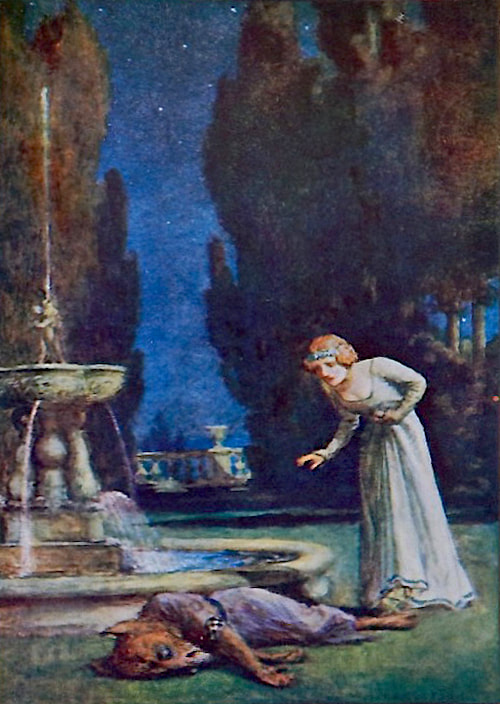


1866 - "The Prince with the Pigskin/ Der Prinz mit der Schweinshaut"
Jahrbuch für romanische und englische Sprache und Literatur (Vol 7-8)
Authors: Georg Widter; Adam Wolf
Editor : Adolf Ebert
Founded and Assication with Ferdinand Wolf
Published by : Ludwig Lemcke
Read Here [#12](p. 249–257)(google books)
{Boar Beast}
[German]
Jahrbuch für romanische und englische Sprache und Literatur (Vol 7-8)
Authors: Georg Widter; Adam Wolf
Editor : Adolf Ebert
Founded and Assication with Ferdinand Wolf
Published by : Ludwig Lemcke
Read Here [#12](p. 249–257)(google books)
{Boar Beast}
[German]
An evil sorceress curses a neighbouring king so that his wife gives birth to "a prince wearing a pigskin". He marries two princesses who insult him when he dries off his body with their bridal dress and he kills them for it. He marries the third princess, who does not seen to mind his drying off his body with her dress. This pleases the pig prince, who lets her see his true form, in exchange for her keeping the secret. When they attend a tournament the next day, the Queen Mother notices the handsome man by her daughter-in-law's side and thinks it is not her son. Soon, the queen confronts the princess, who is forced to reveal the truth to her mother-in-law and the location of the pig prince's pigskin. The queen takes the pigskin from the ashbox and burns it, causing the prince to disappear. The princess goes on a quest to rescue him, by meeting the Stella d'Oro ("Abendstern"), the Sun and the Wind. She gains from each a hazelnut, a nut and an almond. The princess hires herself as a goose herd for a second spouse, and cracks opens the nuts: she finds a dress "the colour of the Stella d'Oro" in the first; a dress the colour of the sun in the second, and "an even more beautiful dress" in the third. The princess uses the three dresses to bribe for three nights with her husband.
~ 1870 - "About King Pig/ Vom Re Porco" (No. 42, i. 291-293)
Collected by: Laura Gonzenbach
- 1870 - Laura Gonzenbach, Sicilianische Märchen. Leipzig: Engelmann. pp. 285-293.
- 2000 - Renato Aprile, Indice delle fiabe popolari italiane di magia (in Italian). Vol. 2. Leo S. Olschki. p. 689. ISBN
9788822248558.2. Leo S. Olschki. p. 689. ISBN 9788822248558.zig: Engelmann. 1870. pp. 285-293.
{Boar Beast}
[Italian , Sicily, Italy]
Collected by: Laura Gonzenbach
- 1870 - Laura Gonzenbach, Sicilianische Märchen. Leipzig: Engelmann. pp. 285-293.
- 2000 - Renato Aprile, Indice delle fiabe popolari italiane di magia (in Italian). Vol. 2. Leo S. Olschki. p. 689. ISBN
9788822248558.2. Leo S. Olschki. p. 689. ISBN 9788822248558.zig: Engelmann. 1870. pp. 285-293.
{Boar Beast}
[Italian , Sicily, Italy]
|
A queen wishes for a son, even if it is a pig, and thus one is born. Years later, the pig son wants to marry. He marries three times: the first two times, after the marriage, he plays in the mud and tries to climb onto the bride's lap, but she rejects him. On the wedding night, the pig prince takes off his skin, becomes a handsome human prince and kills his wife. With the third bride, she accepts the dirty bridegroom and her life is spared on her wedding night. She also learns her husband is an enchanted prince and must not reveal the truth to anyone. However, she tells the queen and her pig husband disappears. The princess, then, is forced to seek him out in a distant kingdom. On her journey, she meets three old hermits, who give her a hazelnut, a nut and an almond. Finally, the princess reaches the foreign queen's realm, and cracks open the hermits' presents: first, she finds a golden hen with golden chicks; next, she finds a golden toy schoolgirl and pupils; lastly, a golden eagle. The girl uses the golden objects to buy three nights in her husband's bed.
|
1866 - 'The Brown Bear of Norway"
Legendary Fictions of the Irish Celts
Collected by: Patrick Kennedy
AT- 425A
{Bear Beast}
[Irish]
Legendary Fictions of the Irish Celts
Collected by: Patrick Kennedy
AT- 425A
{Bear Beast}
[Irish]
A gentleman has three daughters, each requesting a gift before his trip: the eldest wants a golden rod, the middle one a golden hinge, and the youngest desires a flower resembling a violet. He fulfills the requirements for the first two but struggles to find the flower until he plucks it from a garden. As he mounts his horse, a voice warns him to return the first thing that greets him; he assumes it will be his dog. However, it turns out to be his youngest daughter, and he attempts to avoid the deal by sending maidservants in her place, but they are discovered. Reluctantly, he sends his daughter to a magnificent castle, where she is warned not to light anything at night. Over time, she gives birth to three sons, whom a mysterious voice takes away. As the eldest sister marries, the voice permits her to visit, urging her to listen to her father. The youngest sister similarly visits during another wedding, receiving a candle from her mother, which leads her to inadvertently light a candle and discover her husband, a cursed prince. He explains his curse and they agree to journey to the witch's castle on a glass mountain. Along the way, they stop at his siblings' homes, where she collects golden nuts, acorns, and an apple from her children. Despite her husband’s initial inability to climb the mountain with her, she engineers a way to ascend using iron tools from a blacksmith and pays the witch with her golden gifts to spend time with her husband. They devise a plan against the witch, who unwittingly condemns herself when the prince confronts her about punishment for keeping lovers apart. The prince and his wife ultimately claim the castle and live together in peace.
|
~ 1910 - "The Brown Bear of Norway"
The Lilac Fairy Book (anthology) Author: Andrew Lang Illustrator: Henry Justice Ford (H. J. Ford) Editor: Andrew Lang Publisher: Longmans, Green, and Co. From 'West Highland Tales.' Read Here (Gutenberg) AT- 425A {Bear Beast} [New York, USA] |
|
|


1867 - "The Singing, Dancing and Music-making Leaf / Vom singenden, tanzenden und musizierenden Blatte"
Alt Title: "La Foglia, Che Canta, Che Balla E Che Suona" (Italian)
Fairy Tales and Legends from Welschtirol: A Contribution to German Legend Lore/ Märchen und Sagen aus Wälschtirol, Ein Beitrag zur deutschen Sagenkunde
Collected by: Christian Schneller
From Trentino, Italy
Read Here [25.](p. 63-65) (German)(Archive)
ATU 425C
{Gift - leaf that sings, dances, and plays music}
{Serpent Beast}
{Curse broken - dance with the serpent, steps on tail rips off skin}
[German, Italy]
Alt Title: "La Foglia, Che Canta, Che Balla E Che Suona" (Italian)
Fairy Tales and Legends from Welschtirol: A Contribution to German Legend Lore/ Märchen und Sagen aus Wälschtirol, Ein Beitrag zur deutschen Sagenkunde
Collected by: Christian Schneller
From Trentino, Italy
Read Here [25.](p. 63-65) (German)(Archive)
ATU 425C
{Gift - leaf that sings, dances, and plays music}
{Serpent Beast}
{Curse broken - dance with the serpent, steps on tail rips off skin}
[German, Italy]
(Differences) **spoilers**
Different gift then typical. The Beast character demands the merchant bring the first person he encounter upon returning home in exchanged for stealing from him. Beauty character asks to return home for sisters wedding, Beast character agrees so long as she take shim with her.
(Full Story)
A good father, a merchant by trade, once spoke to his three daughters, "Dear children, I must travel to the city, and I wish to bring you back a gift. What would please you most?" Thereupon, the first asked for a beautiful dress, and the second for a lovely necklace; but the third—the youngest—said, "Dearest Father, what would please me most of all is a leaf that sings, dances, and plays music; if you were to bring me such a thing, you would be doing me a great favor." The father shrugged his shoulders, yet replied, "I shall do whatever is possible." He set out and, once in the city, purchased for his two elder daughters the gifts they had requested; however, no one could tell him where he might find the kind of leaf his youngest daughter desired. "I cannot grant her this favor this time," he said, and began his journey homeward. On the way, however, he heard the sound of exquisite music accompanied by singing; he came upon the gates of a palace, stepped inside, and found himself in a vast garden. In the very center of the garden stood a tree, every leaf of which was in dancing motion—singing and playing music in the most magnificent fashion. "So this is the music I heard," he said to himself, "and this is the very kind of leaf my daughter desires. But before I take one, surely I ought to ask for permission." He searched throughout the entire garden, yet found not a soul. Then he ascended the palace stairs; in the great hall, tables stood laden with sumptuous food and drink, yet not a living soul was to be found anywhere within the entire palace. He touched nothing, but instead returned to the garden, thinking to himself, "Since there is no one here to see me, surely I may take a single leaf." He broke off a leaf, but at that very instant, a large serpent appeared and said, "Because you have taken a leaf, I demand that you send to me, within three days, the first person you encounter upon returning home; woe betide you if you fail to do so!" The father departed with the leaf, yet he was heavy-hearted and kept thinking to himself, "Who, I wonder, will be the first to greet me at home? If only it does not turn out to be one of my own daughters!" And his premonition did not deceive him; for when he arrived home, it was his youngest daughter who first stepped forward to meet him, asking immediately, "Father, do you have the leaf?" "I have it," he replied sorrowfully, "but it will cost you dearly." He then recounted to her how he had come by the leaf and the heavy condition attached to it. The girl, however, was not at all distressed; she simply said, "I shall go—surely it will not mean my death." She took her leave at once and made her way to that palace; there, the serpent spoke to her, "Now you shall remain here with me, and you shall have everything your heart desires in abundance. But remember this, you must never do anything without first telling me and obtaining my permission." The girl gave her promise, remained in the palace, and possessed everything she could wish for. After some time, her sisters sent word that they were both to be wed on the very same day, and they invited her to attend the weddings, should it be possible for her to do so. The girl went to the serpent and said, "My two sisters have sent me word that they are to be married, and they have invited me to their weddings; I now beg you to grant me permission to go." "That you may do," replied the serpent, "but I shall come along with you." "That cannot be," the girl replied, "for you are a terrible beast and would strike fear into everyone." "I told you," the serpent retorted, "that I, too, wish to come along." At that, the girl dared not speak another word against it and simply answered, "If you so command, then it must be done." When the appointed day arrived, the serpent commanded the girl to mount its back and, in a matter of moments, carried her into her father's house. When the people saw this, they were at first terribly frightened; but as the serpent remained entirely calm and stayed constantly by the girl's side, they cast aside their apprehension and became cheerful and merry once more. After the meal, a dance was arranged. Then the serpent said to the girl, "Look, your sisters are dancing with their bridegrooms, and every dancer has his partner; only I am left alone and have no one—therefore, dance with me!" The girl replied, "You fill me with revulsion; I cannot!" "Dance with me," the serpent repeated. At last, the girl yielded; she took the serpent in her arms and danced. Yet, during the dance, she stepped so heavily upon the serpent's tail that she crushed it. The serpent gave a sudden jerk, and the girl was about to let out a scream of terror—but instead, it became a cry of wonder and joy, for the serpent had vanished, and lying in her arms was a youth of exquisite beauty. He was the son of a wealthy count and had now been freed from the magic spell. Thus, a third couple joined the other two, and after much rejoicing and festivity, the young count led his happy wife to his overjoyed parents. That is the story of the singing, dancing, and music-making Leaf. Perhaps that rare little tree still stands in the garden; and if you are good and obedient, my child—and if the Count and Countess grant you permission—you, too, may pluck a little leaf for yourself.
(Translated by PT staff)
Different gift then typical. The Beast character demands the merchant bring the first person he encounter upon returning home in exchanged for stealing from him. Beauty character asks to return home for sisters wedding, Beast character agrees so long as she take shim with her.
(Full Story)
A good father, a merchant by trade, once spoke to his three daughters, "Dear children, I must travel to the city, and I wish to bring you back a gift. What would please you most?" Thereupon, the first asked for a beautiful dress, and the second for a lovely necklace; but the third—the youngest—said, "Dearest Father, what would please me most of all is a leaf that sings, dances, and plays music; if you were to bring me such a thing, you would be doing me a great favor." The father shrugged his shoulders, yet replied, "I shall do whatever is possible." He set out and, once in the city, purchased for his two elder daughters the gifts they had requested; however, no one could tell him where he might find the kind of leaf his youngest daughter desired. "I cannot grant her this favor this time," he said, and began his journey homeward. On the way, however, he heard the sound of exquisite music accompanied by singing; he came upon the gates of a palace, stepped inside, and found himself in a vast garden. In the very center of the garden stood a tree, every leaf of which was in dancing motion—singing and playing music in the most magnificent fashion. "So this is the music I heard," he said to himself, "and this is the very kind of leaf my daughter desires. But before I take one, surely I ought to ask for permission." He searched throughout the entire garden, yet found not a soul. Then he ascended the palace stairs; in the great hall, tables stood laden with sumptuous food and drink, yet not a living soul was to be found anywhere within the entire palace. He touched nothing, but instead returned to the garden, thinking to himself, "Since there is no one here to see me, surely I may take a single leaf." He broke off a leaf, but at that very instant, a large serpent appeared and said, "Because you have taken a leaf, I demand that you send to me, within three days, the first person you encounter upon returning home; woe betide you if you fail to do so!" The father departed with the leaf, yet he was heavy-hearted and kept thinking to himself, "Who, I wonder, will be the first to greet me at home? If only it does not turn out to be one of my own daughters!" And his premonition did not deceive him; for when he arrived home, it was his youngest daughter who first stepped forward to meet him, asking immediately, "Father, do you have the leaf?" "I have it," he replied sorrowfully, "but it will cost you dearly." He then recounted to her how he had come by the leaf and the heavy condition attached to it. The girl, however, was not at all distressed; she simply said, "I shall go—surely it will not mean my death." She took her leave at once and made her way to that palace; there, the serpent spoke to her, "Now you shall remain here with me, and you shall have everything your heart desires in abundance. But remember this, you must never do anything without first telling me and obtaining my permission." The girl gave her promise, remained in the palace, and possessed everything she could wish for. After some time, her sisters sent word that they were both to be wed on the very same day, and they invited her to attend the weddings, should it be possible for her to do so. The girl went to the serpent and said, "My two sisters have sent me word that they are to be married, and they have invited me to their weddings; I now beg you to grant me permission to go." "That you may do," replied the serpent, "but I shall come along with you." "That cannot be," the girl replied, "for you are a terrible beast and would strike fear into everyone." "I told you," the serpent retorted, "that I, too, wish to come along." At that, the girl dared not speak another word against it and simply answered, "If you so command, then it must be done." When the appointed day arrived, the serpent commanded the girl to mount its back and, in a matter of moments, carried her into her father's house. When the people saw this, they were at first terribly frightened; but as the serpent remained entirely calm and stayed constantly by the girl's side, they cast aside their apprehension and became cheerful and merry once more. After the meal, a dance was arranged. Then the serpent said to the girl, "Look, your sisters are dancing with their bridegrooms, and every dancer has his partner; only I am left alone and have no one—therefore, dance with me!" The girl replied, "You fill me with revulsion; I cannot!" "Dance with me," the serpent repeated. At last, the girl yielded; she took the serpent in her arms and danced. Yet, during the dance, she stepped so heavily upon the serpent's tail that she crushed it. The serpent gave a sudden jerk, and the girl was about to let out a scream of terror—but instead, it became a cry of wonder and joy, for the serpent had vanished, and lying in her arms was a youth of exquisite beauty. He was the son of a wealthy count and had now been freed from the magic spell. Thus, a third couple joined the other two, and after much rejoicing and festivity, the young count led his happy wife to his overjoyed parents. That is the story of the singing, dancing, and music-making Leaf. Perhaps that rare little tree still stands in the garden; and if you are good and obedient, my child—and if the Count and Countess grant you permission—you, too, may pluck a little leaf for yourself.
(Translated by PT staff)
1867 - "The Rose/Die Rose"
Aberglauben aus Masuren mit einem Anhange, enthaltend: Masurische Sagen und Mährchen
Author: Max Töeppen
Publisher: Danzig, Bertling
Read Here (p. 142-145) (German)(Archive)
Read Here (German)
{Gift rose}
{Wolf Beast}{Bear Beast}
[German]
Aberglauben aus Masuren mit einem Anhange, enthaltend: Masurische Sagen und Mährchen
Author: Max Töeppen
Publisher: Danzig, Bertling
Read Here (p. 142-145) (German)(Archive)
Read Here (German)
{Gift rose}
{Wolf Beast}{Bear Beast}
[German]
A merchant had three daughters, the youngest of whom he loved especially. As he was preparing to travel across the sea to a distant land, As he was saying goodbye to his daughters, he asked them what he should bring them from the foreign land. "For me, dear father," said the eldest, "bring a dress made of sunshine," "for me," begged the second, "a golden hat," and "I beg of you," cried the youngest, "a rose; I would like to see how the roses bloom in that foreign land." The merchant promised to fulfill their wishes and set sail with a favorable wind. However, as soon as he had completed his purchases in the distant land and begun his return journey, a violent storm arose on the very first day. The ship was driven onto a rock, shattered, and all the treasures and goods sank to the bottom of the seaThe merchant, clinging to a broken plank, was washed ashore alone and thus escaped deathHe paced back and forth along the shore, lamenting the loss of his belongings, but most of all he regretted the gifts he had brought for his daughters, and that he would now be unable to bring them joy. Then, not far from where he stood, he saw a small cottage and next to it a rose bush with beautiful roses. “I see roses,” he thought to himself, “and at least I can make my dearest daughter happy,” and he went over to pick one. When he was very close to it, an ugly beast came out of the cottage, not quite a wolf and not quite a bear, but it could speak and immediately asked him who he was and what he wanted. The merchant told it how he had fared and how he regretted nothing more than the loss of the three gifts for his three daughters, and how he wanted to cut a rose from the rose bush for his youngest and most beloved daughter. The beast, as frightening as it looked, was quite amiable in nature, invited the merchant to rest in his hut for a few days, and promised to give him a rose. The merchant gratefully accepted all this, and when, after a few days, he expressed a desire to travel home, the beast said, "Here is the rose, travel safely, but after a certain time (which the beast specified), your youngest daughter must be here, otherwise it will be the end of my life and all of yours." The merchant had to promise this. When he then went to the shore to make arrangements for his departure, a ship was immediately at hand, which seemed to be intended only for him, and which he boarded at once. He soon arrived home safely and recounted his adventures. With a heavy heart, he also added what the beast had demanded of his youngest daughter. Everyone was very sad about this, only the youngest daughter herself comforted them and said: "Don't grieve, it is better that I perish alone than that all of you..." "Misfortune will strike, and perhaps nothing bad will happen to me." When the time indicated by the beast arrived, she took leave of her family and went to the shore. There, the same ship that had brought her father back was already waiting for her, and the captain called out to her: "Hurry up, miss, it's high time!" After a very swift and safe journey, she arrived at the cottage. On the shore, she was greeted by three beautiful young women dressed in black, who soon disappeared, leaving her all alone. She then went alone to the cottage, and when she entered the garden and the beast approached her, she was so frightened that she fainted. The beast was very concerned for her and fetched water to revive her, which it succeeded in doing. It also spoke kindly to her, telling her not to be afraid, that nothing would happen to her, and that she would lack nothing. She truly calmed down, and since she had everything she needed—good food and drink, good clothes, and so on—and since she could also converse with the animal, she gradually began to feel content. After a few months, however, she began to feel anxious. The animal noticed this and comforted her, assuring her that everything at home was healthy and happy, and even gave her a mirror in which she could see her family. She saw her family singing and jumping and being merry. This upset her. "They don't care about you at all," she said to herself, "and they don't even know if you're still alive." Now she didn't want to worry about them anymore, but after a couple of days, But the melancholy returned. Then the beast said, "I will send you home for a visit, but after a few days you must come back, otherwise I and all of you with me will die." And so it did; she boarded the ship and in a minute she was home. Her father and sisters were joyfully surprised and very happy to have her back, and they didn't want to let her go again, but she couldn't be persuaded to stay home, since then everyone would die. When the appointed days had passed, she went back to the shore, where the ship was already waiting, and the captain was impatiently expecting her. When she arrived, he remarked that it was actually a little late. But she boarded the ship, and in a minute she was back with the wonderful beast. It had waited for her with great anxiety and, when the right time had passed, had fainted, and so the girl found it lying on the ground. She felt very sorry for it, knelt down beside it and kissed it—and then the shaggy skin fell from its body, and before her stood a handsome prince.ut the melancholy returned. Then the beast said, "I will send you home for a visit, but after a few days you must come back, otherwise I and all of you with me will die." And so it did; she boarded the ship and in a minute she was home. Her father and sisters were joyfully surprised and very happy to have her back, and they didn't want to let her go again, but she couldn't be persuaded to stay home, since then everyone would die. When the appointed days had passed, she went back to the shore, where the ship was already waiting, and the captain was impatiently expecting her. When she arrived, he remarked that it was actually a little late. But she boarded the ship, and in a minute she was back with the wonderful beast. It had waited for her with great anxiety and, when the right time had passed, had fainted, and so the girl found it lying on the ground. She felt very sorry for it, knelt down beside it and kissed it—and then the shaggy skin fell from his body, and before her stood a handsome prince. The little cottage had transformed into a castle in the middle of a magnificent park, and everything in the castle that had been lifeless until then came alive again: the prince's parents and siblings and all the servants. The prince embraced the girl and told her that he had been under a spell, and only a kiss from a pure, innocent girl could have freed him from his hideous form. He then married the girl, and the happy couple lives to this day. (Take from Klein-Jerutten.)
(Translated by PT)
(Translated by PT)
1868 - "Little Ruby Fish/ Muchie-Lal"
Old Deccan Days: Or Hindoo Fairy Legends Current in Southern India
Author: Mary Frere
Read Here [XIX.](p. 258)(English)(Gutenberg)
ATU 433B
{Muchie Ranee/ Fish Queen- Beauty name}(He gives her)
{Muchie Rajah /The Fish Prince -Beast name}
{Fish Beast}
{Curse broken - 3 head cobra gives her three stones and tells her to throw them at the Fish Prince when he
comes after her she is to use all three and on the third tie he will turn back into a Rajah}
[English]
Old Deccan Days: Or Hindoo Fairy Legends Current in Southern India
Author: Mary Frere
Read Here [XIX.](p. 258)(English)(Gutenberg)
ATU 433B
{Muchie Ranee/ Fish Queen- Beauty name}(He gives her)
{Muchie Rajah /The Fish Prince -Beast name}
{Fish Beast}
{Curse broken - 3 head cobra gives her three stones and tells her to throw them at the Fish Prince when he
comes after her she is to use all three and on the third tie he will turn back into a Rajah}
[English]
(Summary)
Roayls Rajah and Ranee can not have a child so Ranee rasies a fish as her own calling him Muchie Rajah /The Fish Prince. He grows and grows and one days aks for a wife becuase he is laonly. But no one will marry him becuase they are afraid he will eat them. Ranee then again sends messagers out to look for a wife for her son offering gold mohurs in the place of the girl. The messnagers come across a Fakeer who lost his wife and had a daughter with her but when he remarried his new wife came with her own daughter and she hated his first daughter. So she give her to them to marry the The Fish Prince. A three headed cobra tells her to use three stones on her the Fish Prince when he comes after. She does so and on the last stone he truns back into a Rajah. He marries her and calls her Muchie Ranee/ Fish Queen. She eventually wants to go visit her father and he lets her go sayign don't be long be cause he can not live with out her. Her father is over joyed to see her but her step mother is jealous and send sher daughter to push her in the water so she can dround. The three headed cobra helps her by rescuing her and taking her back to his home a hole in the ground where he and his wife take care of her as if she is thier own and thier children play with her child, when he is born whiel she is there. The three headed cobra will not let her go unless her husband come for her however.In the meantime her step mother tried to pawn off her daughter to The Fish Prince as his wife, he fingures it out finally lets her go but goes looking for his wife. He finally finds her becuase a bangle dealer has been selling his wares to his wife for her child and when he asks what thier names are he tells him Muchie Ranee and her son Muchie-Lal. He takes her back and they live hapily ever after.
Roayls Rajah and Ranee can not have a child so Ranee rasies a fish as her own calling him Muchie Rajah /The Fish Prince. He grows and grows and one days aks for a wife becuase he is laonly. But no one will marry him becuase they are afraid he will eat them. Ranee then again sends messagers out to look for a wife for her son offering gold mohurs in the place of the girl. The messnagers come across a Fakeer who lost his wife and had a daughter with her but when he remarried his new wife came with her own daughter and she hated his first daughter. So she give her to them to marry the The Fish Prince. A three headed cobra tells her to use three stones on her the Fish Prince when he comes after. She does so and on the last stone he truns back into a Rajah. He marries her and calls her Muchie Ranee/ Fish Queen. She eventually wants to go visit her father and he lets her go sayign don't be long be cause he can not live with out her. Her father is over joyed to see her but her step mother is jealous and send sher daughter to push her in the water so she can dround. The three headed cobra helps her by rescuing her and taking her back to his home a hole in the ground where he and his wife take care of her as if she is thier own and thier children play with her child, when he is born whiel she is there. The three headed cobra will not let her go unless her husband come for her however.In the meantime her step mother tried to pawn off her daughter to The Fish Prince as his wife, he fingures it out finally lets her go but goes looking for his wife. He finally finds her becuase a bangle dealer has been selling his wares to his wife for her child and when he asks what thier names are he tells him Muchie Ranee and her son Muchie-Lal. He takes her back and they live hapily ever after.
|
~ 2011 - "The Tiger Prince/ Sher Sikander"
Folk Tales from the Deccan Author: Arifa Naeem Publisher: Sanbun Publishers Deccan tale from Deccan Plateau, southern India Read Here [5.](p. 31-37) ATU 433B {Tara - Beauty name} {Tiger/lion - Beast}(most likyly means tiger) {Curse broken - throws three stones at him} |
|
(Summary)
In a kingdom in Gulistan, King Shehriyar and Queen Tehmina suffer for not having children. One day, the queen learns of a sage that has come to their realm with the means to cure the queen's barrenness. The queen requests a meeting with the sage, who gives her an apple imbued with herbs and instructions: share the apple with her husband, a half for each of them, and plaster the royal chambers with portraits of babies, so that she opens her eyes and focuses on the human babies. After nine months, the queen, pregnant, gives birth not to a child, but to a tiger cub. King Shehriyar asks the meaning of this and discovers a tiger's head just above the images of the babies, and deduces his wife must have seen after eating the apple. The king decides to kill the tiger cub, but queen Tehmina pleads on her son's behalf to spare him, for she will raise and feed him. Thus, the tiger prince, named Sher Sikander (sher meaning 'lion' or 'tiger'), is raised by his human mother. Years later, the tiger prince asks his mother to find him a bride. A maiden is brought to him, but she is devoured on the wedding night. This goes on with several maidens, as families surrender their daughters to the tiger prince for a bag of coins. After some months of bride-killing, queen Tehmina confronts her son about his madness and makes him promise that this will be the last time. The queen increases the worth of the bride price to five bags of gold coins, to draw poor families' attention. On the outskirts of Gulistan, a poor family of three, cobbler Kabeer, wife Marsha and daughter Tara, learn of the news. Marsha, Kabeer's second wife, hates her stepdaughter Tara and convinces her husband to send her as the tiger prince's bride and receive the money to improve their poor situation. Tara discovers her father and stepmother are sending her to die at the tiger's hands, and runs away from home in tears. She takes shelter in a cave, and laments her possible fate. Suddenly, and old man appears to comfort her, and promises there is a fortunate fate for her and the tiger prince. Tara does not believe him at first, but the old man gives her three stones doused with holy water, for her to use on the tiger prince. The old man takes Tara to the palace, where she is adorned and decorated and delivered to the prince. Queen Tehmina pities her, but goes through with the marriage. In the tiger prince's chambers, the tiger prepares to jump on the girl, when Tara throws a stone at him, restoring his legs to human form, then another at his torso, and lastly the third stone at his head, turning him human permanently. Sher Sikander, now human, tells everything to Tara. The next morning, queen Tehmina goes to check on her son and finds Tara besides a youth in bed. The youth reveals he was the tiger, but has been restored to human form by Tara and the holy man's intervention. King Shehriyar and the Queen rejoice their son is human, and Sher Sikander marries Tara in a great ceremony. (wiki) |
1870 - "Fairy tale of Vasilopoulos transformed into a snake/ Παραμύθι του μεταμορφωμένου Βασιλοπούλου είς όφιν"
Author: Athanasius Sakellarios
Cypriot folktale
ATU 425C
{Serpent Beast}
[Greek]
Author: Athanasius Sakellarios
Cypriot folktale
ATU 425C
{Serpent Beast}
[Greek]
(Summary)
A merchant who lost his fortune after the death of his wife has three daughters and is left with only a farm. While living there, news arrives that some of his ships have returned, leading the merchant to go back to the port. His two eldest daughters request dresses, while the youngest, wishing for better fortune, ultimately asks for a rose. When he cannot find one to bring home, he encounters a magical palace during a storm and takes a rose, angering a snake that demands the youngest daughter in return. Upon the merchant's return, his daughters blame the youngest for the predicament due to her request. As the deadline approaches, the youngest daughter decides to fulfill the snake's demand, believing it is her responsibility. She stays at the snake's palace, where they gradually develop a bond, although she consistently refuses the snake's marriage proposal. Using a magical mirror, she learns of her father's sickness and, with the snake's help, returns home to care for him, promising to return in time. The youngest daughter eventually agrees to marry the snake, who reveals himself to be a prince cursed to this form until he finds someone willing to marry him. After the wedding announcement, the merchant's two eldest daughters are punished for their earlier actions and turned into stone columns as they arrive at the palace. The youngest daughter marries the prince, and the merchant becomes a respected figure in their new life together, celebrated for their perseverance and love.
A merchant who lost his fortune after the death of his wife has three daughters and is left with only a farm. While living there, news arrives that some of his ships have returned, leading the merchant to go back to the port. His two eldest daughters request dresses, while the youngest, wishing for better fortune, ultimately asks for a rose. When he cannot find one to bring home, he encounters a magical palace during a storm and takes a rose, angering a snake that demands the youngest daughter in return. Upon the merchant's return, his daughters blame the youngest for the predicament due to her request. As the deadline approaches, the youngest daughter decides to fulfill the snake's demand, believing it is her responsibility. She stays at the snake's palace, where they gradually develop a bond, although she consistently refuses the snake's marriage proposal. Using a magical mirror, she learns of her father's sickness and, with the snake's help, returns home to care for him, promising to return in time. The youngest daughter eventually agrees to marry the snake, who reveals himself to be a prince cursed to this form until he finds someone willing to marry him. After the wedding announcement, the merchant's two eldest daughters are punished for their earlier actions and turned into stone columns as they arrive at the palace. The youngest daughter marries the prince, and the merchant becomes a respected figure in their new life together, celebrated for their perseverance and love.
1870 - "The Black Bull of Norroway"
Popular Rhymes of Scotland
Author: Robert Chambers
Publisher: London and Edinburgh: W. & R. Chambers
Read Here (p. 95-99)
AT- 425A
{Bull Beast}
[English, Scotland]
Popular Rhymes of Scotland
Author: Robert Chambers
Publisher: London and Edinburgh: W. & R. Chambers
Read Here (p. 95-99)
AT- 425A
{Bull Beast}
[English, Scotland]
(Summary)
A washerwoman's three daughters seek fortunes on a journey, consulting a witch who instructs them to look beyond her back door. The eldest rides off with a coach-and-six, the second with a coach-and-four, while the youngest must accompany a black bull, who is gentle and kind despite her initial fear. He instructs her to eat and drink from his ears and takes her to the castles of his three brothers, each presenting her with gifts of a beautiful apple, pear, and plum to be used only in her future times of need. When they reach a valley of glass, the bull tells her to wait for his return after confronting the devil ruling the valley. She sees the sky turn blue, indicating his victory, but impatiently shifts position and finds herself left behind. She encounters a blacksmith, working there for seven years until he fulfills his promise to make her iron shoes, which allow her to escape the valley. Returning to the witch, she is tasked with washing bloody shirts belonging to a knight. Despite others' failures, she succeeds, healing her own injuries in the process. She realizes this is her first time of need and uses the apple, discovering jewelry within. She offers it to the witch's daughter to sing to the knight but is thwarted by a sleeping potion. The cycle repeats with the pear and the plum during her second and third times of need, respectively. Finally, following her third attempt, the knight awakens, learns the truth, and marries her, revealing he was the black bull. They banish the witch and her daughter, beginning a life of happiness together.
In Norroway, langsme, there lived a certain lady, and she had three dochters. The auldest o' them said to her mither: 'Mither, bake me a bannock, and roast me a collop, for I'm gaun awa' to spotch my fortune.' Her mither did sae ; and the dochter gaed awa' to an auld witch washerwife and telled her purpose. The auld wife bade her stay that day, and gang and look out o' her back-door, and see what she could see. She saw nocht the first day. The second day she did the same, and saw nocht. On the third day she looked again, and saw a coachand-six coming alang the road. She ran in and telled the auld wife what she saw. 'Aweel,' quo' the auld wife, 'yon 's for you.' Sae they took her into the coach, and galloped aff.
(Opening paragraph)
A washerwoman's three daughters seek fortunes on a journey, consulting a witch who instructs them to look beyond her back door. The eldest rides off with a coach-and-six, the second with a coach-and-four, while the youngest must accompany a black bull, who is gentle and kind despite her initial fear. He instructs her to eat and drink from his ears and takes her to the castles of his three brothers, each presenting her with gifts of a beautiful apple, pear, and plum to be used only in her future times of need. When they reach a valley of glass, the bull tells her to wait for his return after confronting the devil ruling the valley. She sees the sky turn blue, indicating his victory, but impatiently shifts position and finds herself left behind. She encounters a blacksmith, working there for seven years until he fulfills his promise to make her iron shoes, which allow her to escape the valley. Returning to the witch, she is tasked with washing bloody shirts belonging to a knight. Despite others' failures, she succeeds, healing her own injuries in the process. She realizes this is her first time of need and uses the apple, discovering jewelry within. She offers it to the witch's daughter to sing to the knight but is thwarted by a sleeping potion. The cycle repeats with the pear and the plum during her second and third times of need, respectively. Finally, following her third attempt, the knight awakens, learns the truth, and marries her, revealing he was the black bull. They banish the witch and her daughter, beginning a life of happiness together.
In Norroway, langsme, there lived a certain lady, and she had three dochters. The auldest o' them said to her mither: 'Mither, bake me a bannock, and roast me a collop, for I'm gaun awa' to spotch my fortune.' Her mither did sae ; and the dochter gaed awa' to an auld witch washerwife and telled her purpose. The auld wife bade her stay that day, and gang and look out o' her back-door, and see what she could see. She saw nocht the first day. The second day she did the same, and saw nocht. On the third day she looked again, and saw a coachand-six coming alang the road. She ran in and telled the auld wife what she saw. 'Aweel,' quo' the auld wife, 'yon 's for you.' Sae they took her into the coach, and galloped aff.
(Opening paragraph)
|
~ 1889 - "The Black Bull of Norroway"
The Blue Fairy Book Author: Andrew Lang Read Here ATU-425A [English]
~ 1894 - "The Black Bull of Norroway"
More English Fairy Tales Anglicised version Author: Joseph Jacobs Publisher: London: David Nutt Read Here [48.](p. 20-25)(Wiki) ATU-425A [English, London] |
|
In Norroway, long time ago, there lived a certain lady, and she had three daughters. The oldest of them said to her mother: "Mother, bake me a bannock, and roast me a collop, for I'm going away to seek my fortune." Her mother did so; and the daughter went away to an old witch washerwife and told her purpose. The old wife bade her stay that day, and look out of her back-door, and see what she could see. She saw nought the first day. The second day she did the same, and saw nought. On the third day she looked again, and saw a coach-and-six coming along the road. She ran in and told the old wife what she saw. "Well," quoth the old woman, "yon's for you." So they took her into the coach, and galloped off.
(Opening paragraph) |

|
~ 1918 - "The Black Bull of Norroway"
English Fairy Tales Author: Flora Annie Steel Retold Publisher: London: Macmillan Read Here (p. 144-153) ATU-425A [English] |
|
Long ago in Norroway there lived a lady who had , three daughters. Now they were all pretty, and one
night they fell a-talking of whom they meant to marry. And the eldest said, " I will have no one lower than an Earl." And the second said, "I will have none lower than a Lord." But the third, the prettiest and the merriest, tossed her head and said, with a twinkle in her eye, "Why so proud? As for me I would be content with the Black Bull of Norroway." (Opening paragraph) |
c. 1870 -1900 (Late 19th CE) - "The Donkey's Head / La Tête d'Âne"
French journal Revue de Traditions Populaires
Collected by: Alice Fermé
{Donkey Beast}
[French]
French journal Revue de Traditions Populaires
Collected by: Alice Fermé
{Donkey Beast}
[French]
A Jewish-Tunisian folktale
A poor old woman spends the night in a haunted storehouse and survives, gaining it as her home. There she meets a donkey’s head, revealed to be a sultan’s son cursed for loving a woman. At his request, the old woman arranges his marriage to the sultan’s youngest daughter by offering rich jewels. Though disappointed by the humble home, the bride soon sees the donkey’s head transform into a splendid prince, who warns her to hide his true wealth or he will vanish.
The prince later fights and wins a war for her father in disguise, but when his wife reveals his identity during the victory parade, he disappears. The princess falls gravely ill and is returned to her parents, while the old woman reappears elsewhere.
Guided by another poor woman, the princess is eventually brought to a mysterious manor where her husband is revealed again. The curse is broken, and the couple are reunited.
A poor old woman spends the night in a haunted storehouse and survives, gaining it as her home. There she meets a donkey’s head, revealed to be a sultan’s son cursed for loving a woman. At his request, the old woman arranges his marriage to the sultan’s youngest daughter by offering rich jewels. Though disappointed by the humble home, the bride soon sees the donkey’s head transform into a splendid prince, who warns her to hide his true wealth or he will vanish.
The prince later fights and wins a war for her father in disguise, but when his wife reveals his identity during the victory parade, he disappears. The princess falls gravely ill and is returned to her parents, while the old woman reappears elsewhere.
Guided by another poor woman, the princess is eventually brought to a mysterious manor where her husband is revealed again. The curse is broken, and the couple are reunited.
1870 - "The King and His Three Daughters / Errege eta bere hiru alabak"
Collected by: Wentworth Webster
Basque folktale
Read Here (Gutenberg)
ATU 425C
{Fifine - Beauty name}
{Gift - flower}
{Azor - Beast name}
{Serpent Beast}
[Basque]
Collected by: Wentworth Webster
Basque folktale
Read Here (Gutenberg)
ATU 425C
{Fifine - Beauty name}
{Gift - flower}
{Azor - Beast name}
{Serpent Beast}
[Basque]
(Differences) **Spoilers** Beauty Chracter's father is a King. When her father take the flower the BEast isnsist one of his daughts come in his stead in a years time.
(Full Story)
As is the way of the world, there was a king who had three daughters. He always brought beautiful things for his two oldest daughters. He paid no attention at all to the youngest daughter. Meanwhile, she was the most beautiful and the kindest. He was always going from fair to fair and festival to festival, and would bring something back for his two oldest daughters. He never paid any attention to the youngest daughter. Meanwhile, she was the most beautiful and kindest. One day, as he was about to leave for a festival, he said to his youngest daughter, "I've never brought you anything. So, tell me, what would you like..." She said to her father, "I don't need anything." He answers, "Well, well! I want to bring you something." She said, "Then bring me a flower." So he leaves. He goes around buying things: a hat, a beautiful piece of fabric, a necklace. He was on his way home when, he passed by and saw a magnificent palace with a beautiful garden full of flowers and said to himself, "Heavens, I forgot my daughter's gift; here there are flowers in abundance." So he takes it, and as soon as he does, a voice says to him, "Who gave you permission to take this? You have three daughters; if by the end of the year you do not come with one of them, you and your whole kingdom will be burned." So the king went home. He gave the eldest their presents and the youngest her bouquet. She thanked her father graciously. After some time the king became sad. His eldest daughter asks him what was wrong. He tells her that if one of them doesn't go to such a place before a year is out, he'll be burned. The daughter says to him, "You will be burned for it, I will not go there. Find someone else." The second one also asks him, "I find you preoccupied, Father. What's the matter?" He tells her that if one of them doesn't go to such a place before a year is out, he'll will be burned. She replies, “"You will be burned for it, do whatever you like, but I won't go.” A few days later, the youngest daughter says to him, "What's the matter, Father? Why are you so sad? Has something upset you?" He tells her that when he went to fetch her bouquet, a voice told him he needed one of his three daughters before the year was out and that he didn't know what to do. Otherwise, the voice said, he would be burned. His daughter tells him, "Father, don't worry. I will go." She set off immediately. She got into a carriage and arrived at the palace. She entered and heard music everywhere and sounds of joy. Yet she saw no one. She found her hot chocolate ready. Lunch as well. She then went to bed. Yet she still saw no one. The next morning, early, a voice said to her, “Close your eyes. I would like to be in your lap for a moment.” “Come on, come! I am not afraid.” Then a terrible serpent appeared. Even though she did not want to, the young woman flinched in fear. After that, the serpent went away, and the young woman lived there very comfortably, lacking nothing. One day, the voice asked her whether she wished to return home. She replied that she was doing well there and had no desire to leave. The voice told her that if she wished, she could go for three days. He gives her a ring and said, “If it changes, I will be in distress. If it becomes stained with blood, I will be in great danger.” The young woman went to her father’s house. Her father was very happy. Her sisters told her she must be happy there, becuase she was even more beautiful than before, and asked with whom she lived. She answered, with a serpent. They refused to believe her. The three days passed like a dream, and she forgot her serpent.
On the fourth day, she looked at the ring and saw it had changed. She touched it—and it became stained with blood. Seeing this, she ran to her father to say she had to leave. She arrived at the palace and found it sad and silent. The music was gone. Everything stood still. She called out to the serpent. His name was Azor, and the young woman’s name was Fifine. She kept calling, but Azor did not appear anywhere. After searching the whole house, she took off her shoes and went into the garden, still calling. She found a patch of ground in the garden that looked disturbed. Immediately, she made a great fire on that spot, and from it emerged Azor, the serpent. He said to her, “So—you forgot me. If you had not made this fire, I would have been finished.” Fifin tells him that she had forgotten, that the ring reminded her. Azor says to her, "I knew what would happen. That's why I gave you the ring." She comes home and finds the house in celebration as before, with music playing from all corners. After a few days, Azor says to her, "You must marry me." Fifine gives no answer. He asks her three times, and she remains completely silent each time. The whole house grows sad again, and she no longer finds food prepared for her. Once more Azor asks whether she wants to marry him. Still, she gives no answer. And so she remains in darkness for several days without eating, until she finally tells herself that, no matter the cost, she must say yes. When the serpent asks her again if she will marry him, she replies, “Not with the serpent—but with the man, yes.” As soon as she says this, the music begins again as before. Azor tells her she must go to her father’s house to speak with the priest and prepare everything needed. The next day they will be married. The girl does as she is told. She tells her father she will marry the serpent the next day and asks if he will prepare everything. Her father says yes—but he is sad. Her sisters ask who she is marrying and are astonished to hear it is a serpent. Fifine returns to her home. Azor asks her whether she prefers him to appear as a serpent on the way from the house to the church, or from the church back home. Fifine answers, “From the house to the church—as a serpent.” Azor agrees. A beautiful carriage arrives. The serpent gets in, and Fifine sits beside him. They arrive at her father’s royal house. The serpent tells her to close the doors and shutters so no one can see. Fifine says, “But they will see you when you get out.” “It doesn’t matter. Close them.” She goes to her father. Her father comes with his whole court to see the serpent. The door is opened—and everyone is astonished. In place of the serpent stands a charming young man. They then all go to the church. Afterward, they have a magnificent feast at the king’s house. But the groom tells his wife they must not celebrate too much, because they still have an important matter to complete at home. They will return later to celebrate. They go back to their home. Once there, the young man brings her a large basket containing a serpent skin and says, “You must make a great fire, and when you hear the first stroke of midnight, throw this serpent skin into the fire. It must burn completely, and you must throw the ashes outside before the twelfth stroke. If you do not do this, I will be forever unhappy.” She promises to do everything carefully. Before midnight, she prepares the fire. At the first stroke, she throws the skin into the flames and carefully stirs it until it is fully burned before the tenth stroke. She takes a shovel and throws the ashes outside just as the twelfth stroke finishes. At that moment, a terrible voice cries out, “I curse you for doing this so skillfully and carefully!” At the same time, her husband appears. She doesn’t know where he came from. Overjoyed, she embraces him, and he tells her how much good she has done, Now he has nothing to fear. If she had not done exactly as instructed, he would have remained enchanted for twenty-one more years. But now it is over, and they can return peacefully to her father’s house to celebrate. The next day they go. They celebrate joyfully. Then they return to their palace to gather their beautiful belongings, as they no longer wish to live in that remote mountain place. They load wagons with valuable things and go to live in the king’s palace. The young woman has four children: two boys and two girls. Her sisters, who are very jealous, are sent away from the house by their father. The king gives his crown to his son-in-law, who thus becomes king. And: If they lived well, they died well.
(Translated by Clark)(PT translation)
(Full Story)
As is the way of the world, there was a king who had three daughters. He always brought beautiful things for his two oldest daughters. He paid no attention at all to the youngest daughter. Meanwhile, she was the most beautiful and the kindest. He was always going from fair to fair and festival to festival, and would bring something back for his two oldest daughters. He never paid any attention to the youngest daughter. Meanwhile, she was the most beautiful and kindest. One day, as he was about to leave for a festival, he said to his youngest daughter, "I've never brought you anything. So, tell me, what would you like..." She said to her father, "I don't need anything." He answers, "Well, well! I want to bring you something." She said, "Then bring me a flower." So he leaves. He goes around buying things: a hat, a beautiful piece of fabric, a necklace. He was on his way home when, he passed by and saw a magnificent palace with a beautiful garden full of flowers and said to himself, "Heavens, I forgot my daughter's gift; here there are flowers in abundance." So he takes it, and as soon as he does, a voice says to him, "Who gave you permission to take this? You have three daughters; if by the end of the year you do not come with one of them, you and your whole kingdom will be burned." So the king went home. He gave the eldest their presents and the youngest her bouquet. She thanked her father graciously. After some time the king became sad. His eldest daughter asks him what was wrong. He tells her that if one of them doesn't go to such a place before a year is out, he'll be burned. The daughter says to him, "You will be burned for it, I will not go there. Find someone else." The second one also asks him, "I find you preoccupied, Father. What's the matter?" He tells her that if one of them doesn't go to such a place before a year is out, he'll will be burned. She replies, “"You will be burned for it, do whatever you like, but I won't go.” A few days later, the youngest daughter says to him, "What's the matter, Father? Why are you so sad? Has something upset you?" He tells her that when he went to fetch her bouquet, a voice told him he needed one of his three daughters before the year was out and that he didn't know what to do. Otherwise, the voice said, he would be burned. His daughter tells him, "Father, don't worry. I will go." She set off immediately. She got into a carriage and arrived at the palace. She entered and heard music everywhere and sounds of joy. Yet she saw no one. She found her hot chocolate ready. Lunch as well. She then went to bed. Yet she still saw no one. The next morning, early, a voice said to her, “Close your eyes. I would like to be in your lap for a moment.” “Come on, come! I am not afraid.” Then a terrible serpent appeared. Even though she did not want to, the young woman flinched in fear. After that, the serpent went away, and the young woman lived there very comfortably, lacking nothing. One day, the voice asked her whether she wished to return home. She replied that she was doing well there and had no desire to leave. The voice told her that if she wished, she could go for three days. He gives her a ring and said, “If it changes, I will be in distress. If it becomes stained with blood, I will be in great danger.” The young woman went to her father’s house. Her father was very happy. Her sisters told her she must be happy there, becuase she was even more beautiful than before, and asked with whom she lived. She answered, with a serpent. They refused to believe her. The three days passed like a dream, and she forgot her serpent.
On the fourth day, she looked at the ring and saw it had changed. She touched it—and it became stained with blood. Seeing this, she ran to her father to say she had to leave. She arrived at the palace and found it sad and silent. The music was gone. Everything stood still. She called out to the serpent. His name was Azor, and the young woman’s name was Fifine. She kept calling, but Azor did not appear anywhere. After searching the whole house, she took off her shoes and went into the garden, still calling. She found a patch of ground in the garden that looked disturbed. Immediately, she made a great fire on that spot, and from it emerged Azor, the serpent. He said to her, “So—you forgot me. If you had not made this fire, I would have been finished.” Fifin tells him that she had forgotten, that the ring reminded her. Azor says to her, "I knew what would happen. That's why I gave you the ring." She comes home and finds the house in celebration as before, with music playing from all corners. After a few days, Azor says to her, "You must marry me." Fifine gives no answer. He asks her three times, and she remains completely silent each time. The whole house grows sad again, and she no longer finds food prepared for her. Once more Azor asks whether she wants to marry him. Still, she gives no answer. And so she remains in darkness for several days without eating, until she finally tells herself that, no matter the cost, she must say yes. When the serpent asks her again if she will marry him, she replies, “Not with the serpent—but with the man, yes.” As soon as she says this, the music begins again as before. Azor tells her she must go to her father’s house to speak with the priest and prepare everything needed. The next day they will be married. The girl does as she is told. She tells her father she will marry the serpent the next day and asks if he will prepare everything. Her father says yes—but he is sad. Her sisters ask who she is marrying and are astonished to hear it is a serpent. Fifine returns to her home. Azor asks her whether she prefers him to appear as a serpent on the way from the house to the church, or from the church back home. Fifine answers, “From the house to the church—as a serpent.” Azor agrees. A beautiful carriage arrives. The serpent gets in, and Fifine sits beside him. They arrive at her father’s royal house. The serpent tells her to close the doors and shutters so no one can see. Fifine says, “But they will see you when you get out.” “It doesn’t matter. Close them.” She goes to her father. Her father comes with his whole court to see the serpent. The door is opened—and everyone is astonished. In place of the serpent stands a charming young man. They then all go to the church. Afterward, they have a magnificent feast at the king’s house. But the groom tells his wife they must not celebrate too much, because they still have an important matter to complete at home. They will return later to celebrate. They go back to their home. Once there, the young man brings her a large basket containing a serpent skin and says, “You must make a great fire, and when you hear the first stroke of midnight, throw this serpent skin into the fire. It must burn completely, and you must throw the ashes outside before the twelfth stroke. If you do not do this, I will be forever unhappy.” She promises to do everything carefully. Before midnight, she prepares the fire. At the first stroke, she throws the skin into the flames and carefully stirs it until it is fully burned before the tenth stroke. She takes a shovel and throws the ashes outside just as the twelfth stroke finishes. At that moment, a terrible voice cries out, “I curse you for doing this so skillfully and carefully!” At the same time, her husband appears. She doesn’t know where he came from. Overjoyed, she embraces him, and he tells her how much good she has done, Now he has nothing to fear. If she had not done exactly as instructed, he would have remained enchanted for twenty-one more years. But now it is over, and they can return peacefully to her father’s house to celebrate. The next day they go. They celebrate joyfully. Then they return to their palace to gather their beautiful belongings, as they no longer wish to live in that remote mountain place. They load wagons with valuable things and go to live in the king’s palace. The young woman has four children: two boys and two girls. Her sisters, who are very jealous, are sent away from the house by their father. The king gives his crown to his son-in-law, who thus becomes king. And: If they lived well, they died well.
(Translated by Clark)(PT translation)
|
~ 1879 - "Beauty and the Snake" or "Beauty and the Beast"
Basque Legends Collected by : Wentworth Webster Basque version of Beauty and the Beast Publisher: Griffith and Farran Read Here (English) Read Here [82.](p. 167)(English)Gutenberg) Read Here (p. 167)(English)(Archive) ATU 425C {Fifine-Beauty} {Gift -flower} {Serpent Beast} {Azor-Beast name} [France (Basque) , London] |
|
A King's daughter named Fifine who is promised to a serpent named Azor by years end, after her father steals a magical flower. Azor, a cursed serpent beast.
The story as told among the Basques relates that a king on leaving home asked his three daughters what he would bring them. The youngest asked for a flower. When plucking the flower in a garden the king heard a voice asking what he was doing, and telling him he must bring one of his daughters within the year or he and his kingdom would be burned.The youngest daughter went, slept in the castle all night, but saw no one. In the morning a voice said, " Shut your eye"s ; I wish to place my head on your knees." The voice was that of an enormous serpent, but the girl was not hurt, and continued to live happily. One day she was allowed to go home for three days, and was given a ring which would tell her the condition of her serpent lover. On the fourth day she found it blood-red, and hurried off. The serpent was nowhere to be found. At last she discovered him, and he asked her to be his wife. She agreed, and on the way to her father's palace the serpent was changed into a beautiful youth, who gave the girl a serpent's skin, and bade her burn it before the clock had ceased striking at midnight or he would be miserable ever after. She performed this duty successfully, and a voice was heard saying, "I curse your cleverness and what you have done." (Summary from The childhood of fiction, a study of folk tales and primitive thought, 1905, IX. Beast-Marriages: Beauty and the Beast, by J. A. MacCulloch, p. 253) It's clear this version inspired Disney's Beauty and the Beast. |
1871 - "The Sad One/ El tristón"
Alt Title: "Lo trist", "The Gloomy Lad"
Lo Rondallayre: Quentos Populars Catalans vol. 1
Author: Francisco Maspons y Labrós
Read Here (Gutenberg)
{Ugly man Beast}
[Spanish]
Alt Title: "Lo trist", "The Gloomy Lad"
Lo Rondallayre: Quentos Populars Catalans vol. 1
Author: Francisco Maspons y Labrós
Read Here (Gutenberg)
{Ugly man Beast}
[Spanish]
(Story)
A father, when going to the fair, asked each of his three daughters what they wanted him to bring them, and the eldest asked for a gold bracelet, the middle one a diamond ring and the youngest a coral necklace. The man went and when he got there he bought the order for the first two, but with the hustle and bustle of the fair and the delay that was happening he did not remember the little girl's necklace, until he turned around, he did not make it back in time. That is why he became very sad, when a very ugly man, like no other he had ever seen, appeared to him. He had seven nostrils and seven mouths (?),
and who was always sad, which is why they called him the "Lo Trist" The Sad One. The man wanted to console the father and offered him a coral necklace as he asked, if in return he would promise to give one of his daughters, he agreed. He soon regretted it and would have regretted it every time he did it, he would have felt a great pain in his stomach that wouldn't go away until he returned again to try to fulfill his promise. He arrived at his house where all the girls were already waiting for him and he gave each one their gift, but he became very sad that the eldest girl could not help but ask him the reason for his sadness. The father explained and said that one of them would have to go, but the eldest did not want to go. The sadness continued, deeper every day and the middle one asked the cause, but when she knew that one of them had to go with the Sad one, she did not want to go either. Therefore, when the sadness grew worse in their father, the youngest daughter saw that her sisters had not been able to take it away from him, she left, and as soon as she learned of the cause, she immediately told her father to accompany her to find the man who was the cause of his sadness. They both went together, father and daughter, until they were in a forest, in which the father in a certain place struck a stone three times and on the third it opened, and out appeared the Sad One who was terrified just to see him, but the girl gave her word and with that saved her father's life, so without any doubt, saying goodbye to him, she went inside the rock. She immediately saw a palace and beautiful gardens and forests full of flowers and birds of all kinds, The Sad One showed them to her, thanked her very much for the favor she had done hime and told her that here she would find everything whenever she wished and that everything was at her will; that she would not see him except when she wished to see him, for which she had no choice but to call him; and he disappeared. And you see here that in that solitude the girl was walking one day through the gardens, she saw that the water of a stream that passed there, instead of being beautiful and clear as always, was all turbulent and dirty. She was very surprised and she caled The Sad One, told him that it was because her father was sick. The girl begged him to let her go and see him, but The Sad One, for fear that she would not return, did not want to give her permission, until finally, after her prayers and tears, he agreed, setting a condition that as soon as she heard the bell in her room, she would need to return immediately. The father was ill, but when he saw the girl his joy was so great that it was no longer sick and joy returned to the house, but one day the bell was heard and the girl, with much sorrow for her father and sisters, returned to the palace where she lived. But after a while, walking through the same garden, she saw that the birds were all sad and none of them sang, she called out to The Sad One and he told her that her father was ill again; She asked him for permission to go and he granted her permission on the condition that she return as soon as she heard the bell. Her father was ill, he was gradually getting better and when he did, the bell rang and the girl had no other choice, with enough sympathy from her home to return to the palace where she lived. And when she was there, one day while walking she saw that all the trees had dry and dead leaves, she asked The Sad One why this was happening in spring and he told her that it was because her father was sick again with a serious illness. The girl asked him to go and he granted her permission on the condition that she return as soon as she heard the bell. The father was very ill, so the illness was bad but now that the girl was ther with him and she loved him, when her father was convalescent and almost well, the father and sisters began to feel sorry for when she had to go back and to beg her not to do it even if she heard the bell ring. The thing is that one day she head it ring it and the girl really wanted to go, but they begged her so much that she decided to stay: the next morning the bell rang again and the girl with tears in her eyes, begged them to let her go, but the father was so sad and asked her so earnestly that she could not do it, and on the third day it rang again but with such a dead and sad sound, that the girl started to run away very quickly without saying anything to those in charge. She arrived at the palace all dazed and began to call out to The Sad One, she looked everywhere, but he did not answer, she ran through all the rooms, the forest, the garden and there she found, in a corner of it she saw some roses, which were the ones he loved the most, all wilted and fallen, and you see here that she plucked one of them, when immediately she saw The Sad One who appeared to her in the form of a handsome man and who explained to her how he had almost died because of her late return that by wicked magic he was enchanted in his palace, and that by plucking the rose so dear to him she had disenchanted him, and for the gratitude to her for her in leaving sister and parents, from that hour onward she would be his princess, since he was the king's son and he was taking her as his wife.
A father, when going to the fair, asked each of his three daughters what they wanted him to bring them, and the eldest asked for a gold bracelet, the middle one a diamond ring and the youngest a coral necklace. The man went and when he got there he bought the order for the first two, but with the hustle and bustle of the fair and the delay that was happening he did not remember the little girl's necklace, until he turned around, he did not make it back in time. That is why he became very sad, when a very ugly man, like no other he had ever seen, appeared to him. He had seven nostrils and seven mouths (?),
and who was always sad, which is why they called him the "Lo Trist" The Sad One. The man wanted to console the father and offered him a coral necklace as he asked, if in return he would promise to give one of his daughters, he agreed. He soon regretted it and would have regretted it every time he did it, he would have felt a great pain in his stomach that wouldn't go away until he returned again to try to fulfill his promise. He arrived at his house where all the girls were already waiting for him and he gave each one their gift, but he became very sad that the eldest girl could not help but ask him the reason for his sadness. The father explained and said that one of them would have to go, but the eldest did not want to go. The sadness continued, deeper every day and the middle one asked the cause, but when she knew that one of them had to go with the Sad one, she did not want to go either. Therefore, when the sadness grew worse in their father, the youngest daughter saw that her sisters had not been able to take it away from him, she left, and as soon as she learned of the cause, she immediately told her father to accompany her to find the man who was the cause of his sadness. They both went together, father and daughter, until they were in a forest, in which the father in a certain place struck a stone three times and on the third it opened, and out appeared the Sad One who was terrified just to see him, but the girl gave her word and with that saved her father's life, so without any doubt, saying goodbye to him, she went inside the rock. She immediately saw a palace and beautiful gardens and forests full of flowers and birds of all kinds, The Sad One showed them to her, thanked her very much for the favor she had done hime and told her that here she would find everything whenever she wished and that everything was at her will; that she would not see him except when she wished to see him, for which she had no choice but to call him; and he disappeared. And you see here that in that solitude the girl was walking one day through the gardens, she saw that the water of a stream that passed there, instead of being beautiful and clear as always, was all turbulent and dirty. She was very surprised and she caled The Sad One, told him that it was because her father was sick. The girl begged him to let her go and see him, but The Sad One, for fear that she would not return, did not want to give her permission, until finally, after her prayers and tears, he agreed, setting a condition that as soon as she heard the bell in her room, she would need to return immediately. The father was ill, but when he saw the girl his joy was so great that it was no longer sick and joy returned to the house, but one day the bell was heard and the girl, with much sorrow for her father and sisters, returned to the palace where she lived. But after a while, walking through the same garden, she saw that the birds were all sad and none of them sang, she called out to The Sad One and he told her that her father was ill again; She asked him for permission to go and he granted her permission on the condition that she return as soon as she heard the bell. Her father was ill, he was gradually getting better and when he did, the bell rang and the girl had no other choice, with enough sympathy from her home to return to the palace where she lived. And when she was there, one day while walking she saw that all the trees had dry and dead leaves, she asked The Sad One why this was happening in spring and he told her that it was because her father was sick again with a serious illness. The girl asked him to go and he granted her permission on the condition that she return as soon as she heard the bell. The father was very ill, so the illness was bad but now that the girl was ther with him and she loved him, when her father was convalescent and almost well, the father and sisters began to feel sorry for when she had to go back and to beg her not to do it even if she heard the bell ring. The thing is that one day she head it ring it and the girl really wanted to go, but they begged her so much that she decided to stay: the next morning the bell rang again and the girl with tears in her eyes, begged them to let her go, but the father was so sad and asked her so earnestly that she could not do it, and on the third day it rang again but with such a dead and sad sound, that the girl started to run away very quickly without saying anything to those in charge. She arrived at the palace all dazed and began to call out to The Sad One, she looked everywhere, but he did not answer, she ran through all the rooms, the forest, the garden and there she found, in a corner of it she saw some roses, which were the ones he loved the most, all wilted and fallen, and you see here that she plucked one of them, when immediately she saw The Sad One who appeared to her in the form of a handsome man and who explained to her how he had almost died because of her late return that by wicked magic he was enchanted in his palace, and that by plucking the rose so dear to him she had disenchanted him, and for the gratitude to her for her in leaving sister and parents, from that hour onward she would be his princess, since he was the king's son and he was taking her as his wife.
1872 - "The Enchanted Pig/ Porcul cel fermecat"
Legends or Romanian Fairy-Tales/ Legende sau basmele românilor
Author: Petre Ispirescu
Read Here
{Pig Beast}
[Romanian] nische Märchen
Legends or Romanian Fairy-Tales/ Legende sau basmele românilor
Author: Petre Ispirescu
Read Here
{Pig Beast}
[Romanian] nische Märchen
|
Tale orally dates from c.1838-1847
A forbidden prophecy reveals that a king’s youngest daughter is destined to marry a pig. When the prophecy comes true, she reluctantly weds him and discovers he becomes a kind man each night. Acting on a witch’s advice, she breaks the spell too soon, and he vanishes, telling her she must wear out three pairs of iron shoes to find him. She journeys through the realms of the Moon, Sun, and Wind, wearing out her shoes and gathering magical bones. At last, she reaches her husband’s hidden castle, sacrifices her little finger to reach him, and breaks the curse. He is revealed as a prince enchanted by a witch, and together they return home, reunited. |
|
~ 1882 - "The Enchanted Pig/ Das verzauberte Schwein"
German Folk Tales from the Saxon Land in Transylvania/ Deutsche Volksmärchen aus dem Sachsenlande in Siebenbürgen Author: Josef ltrich Publisher: Wien: Verlag von Carl Graeser Romanian Folk tale Read Here [ .]p. 43-44 ) {Pig Beast} [German]
|
|
|

|
~ 1896 - "The Enchanted Hog / Porcul cel fermecat"
Turkish Fairy Tales and Folk Tales Collected by: Ignácz Kúnos Translator: Robert Nisbet Bain Read Here (pp. 222-243)(English)(Google Books) Read Here (pp. 222-243)(English)(Archive) {Hog Beast} [Hungarian/ English]
|
|
~ 1917 - "The Enchanted Pig"
The Foundling Prince & Other Tales Author: Julia Collier Harris Translated from "the Roumanian of Petre Ispirescu" Boston and New York Houghton Mifflin Company. 1917. pp. 27-52 Read Here (Archive) {Pig Beast} [New York, USA] |
|
~ 1924 - "The Prince with a pig's head/ Le prince à tête de cochon"
Romanian Tales Transposed into French/ Contes Roumains transposés au français Translator: Nicolae Iorga Published: Paris: Gambé Editeur Read Here (p. 119-126) {Pig Beast} [French] ~ 1928 - "The Pig Husband / Soțul porc"
Verzeichnis der rumânischen Mărchen und Mărchenvarianten. Nach dem System der Mărchentypen Antti Aarnes Author: Adolf Schullerus Translator: Publisher: Helsinki: Academia Scientiarum Fennica Romanian Fairttale Read Here (p. 41–42) {Pig Beast} [Romanian German] ~ 2008 - "The Enchanted Pig"
Red Fairy Book Original Author: Gabrielle-Suzanne de Villeneuve Edited by: Andrew Land Illustrator: Niroot Puttapipat Intro: Marina Waner Publisher: The Folio Society (Original: Longmans, Green and Co. 1890) Read Here (p. 111) {Pig Beast} [English, London] 
|


|
~ c. 1870 -1900 (Late 19th CE) - "The Story of King Pig/ U Purcellu"
L'histoire du Roi-Porc Collected by: Ghjuvan Ghjaseppiu Franchi Corsican fairy tale ATU - 425A {Pig Beast} [Corsican] |
|
A childless king and queen miraculously have a son, but he is born a pig and raised as a prince. When grown, the pig prince demands a wife, killing two brides who insult him. The miller’s youngest daughter treats him kindly, breaking part of his curse: at night he becomes a handsome man, though he must wear his pigskin by day. When the queen and princess secretly burn the pigskin to free him, the spell backfires. The prince turns into a green bird and vanishes, telling his wife she must endure an impossible quest to find him again. She journeys across the world, wearing out iron shoes and staffs, aided by hermits and magical nuts. At last, she reaches a distant palace where the prince is about to marry another. After trading magical treasures for nights in the castle and calling out to him, the couple reunite. The prince is freed from his forced engagement, and they return home together, restored at last.
|
~ 1901 - "King Pig"
The Italian Novelists: The facetious nights of Straparola (vol. 1)
Collected by: Giovanni Francesco Straparola
Translated by: W. G. Waters (English)
Publisher: (London: Privately printed for members of the Society of Bibliophiles
Read Here (night 2, tale 1)(English)(p. 133-150)
{Pig Beast}
[Italian, Italy]
The Italian Novelists: The facetious nights of Straparola (vol. 1)
Collected by: Giovanni Francesco Straparola
Translated by: W. G. Waters (English)
Publisher: (London: Privately printed for members of the Society of Bibliophiles
Read Here (night 2, tale 1)(English)(p. 133-150)
{Pig Beast}
[Italian, Italy]
~ 1905 - "The Pigboy/ Disznóficzkó"
Székelyföldi gyüjtés
Collected by: Oszkár Mailand
Publisher: (Népköltési gyüjtemény 7. kötet). Budapest: Az Athenaeum Részv.-Társulat Tulajdona.
Hungarian fairy tale
From Szováta, in Székely
Read Here [3.](p. 394-412 and 573)
ATU - 425A
{Pig Beast}
[Hungarian]
Székelyföldi gyüjtés
Collected by: Oszkár Mailand
Publisher: (Népköltési gyüjtemény 7. kötet). Budapest: Az Athenaeum Részv.-Társulat Tulajdona.
Hungarian fairy tale
From Szováta, in Székely
Read Here [3.](p. 394-412 and 573)
ATU - 425A
{Pig Beast}
[Hungarian]
|
(Summary)
An old woman earns her living by spinning. She spins threads of gold, silver and diamond, and gives to the queen. Later, the old woman's pig son tells her to go to the royal couple and ask for the princess's hand in marriage. The king hears the marriage proposal, but first orders tasks for his daughter's suitor: to break a rock, build a vineyard, and have freshly squeezed wine and a bowl of grapes on the king's table by morning. The pigboy summons all devils and people from hell and fulfills the task. The next task is to build a diamond road between the king's palace and the pigboy's house, with many fruitful trees along the path, in many states of ripening, and a diamond well in the middle of the road. The pig suitor fulfills the task and marries the princess in church. The princess goes to the old woman's poor house and is given a bed of straw to lie on. That night, the pig suitor becomes a prince and tells his wife not to reveal the secret for three more days. They spend the night together and she is pregnant. On the third night, the princess tells her mother-in-law that the pig becomes a prince. While the couple are asleep, the old woman takes the pigskin and tosses it in the oven. The man awakens and waits by the door for his wife to awaken. After she does, he goes to embrace her, and places two iron rings around her belly, which he explains will only come off when he touches her again. Then he becomes a dove and flies away. The princess asks her father to commission iron shoes and iron canes, and begins her quest. She passes by the Holy Monday (Szent-Hétfő), Holy Tuesday (Szent-Keddhez), Holy Wednesday (Szent-Szereda), Holy Thursday (Szent-Csütörtök), Holy Friday (Szent-Pentek), Holy Saturday (Szent-Szombat) and Holy Sunday (Szent-Vasárnap) - which are referred to as male entities in this tale -, but only Holy Sunday, by summoning all devils of the world, has any idea about her husband's location. The little devil takes the princess to a valley, and tells her husband is sleeping in a diamond palace down in the valley. The princess enters the palace and goes to his room: he sleeps chained with a golden chain to the golden bed. The princess cries out to him and he awakens. He embraces her, the iron rings come off of her body and she gives birth to a golden-haired boy. Then they turn into three doves, fly up to the sky and become a star. (Wiki) |
|
~ 1914 - "The Green Pig / A Zöld Disznó"
Collected by: Arnold Ipolyi Hungarian Fairy Tales Read Here ATU-425C {Pig Beast} [Hungarian] |
|
~ 1941 - "Green Pig / Zöld disznó"
Tengöri hereberi atyámuram. Palásti Annuska meséi. Katona Imre csongrádi népmesegyűjtése Collected by: Collected from a teller named Palásti Annuska in Csongrád Hungarian Fairy Tales Read Here (Hungarian)(p. 116-122 (text), 339) {Pig Beast} [Hungarian]
~ 1952 - "The Pig King / Disznyókirály"
Moldavian Csángó folktales and conversations/ Moldvai csángó népmesék és beszélgetések Collected by: Lajos Hegedűs Collected from a Csangó source in Gajcsána Read Here (p. 268–272)(Hungarian) {Pig Beast} [Hungarian]
~ 1985 - "The Green Pig / A zöld disznó"
Fótonfót király Collected by: Simonits Mária Hungarian Fairy Tales Read Here Fótonfót király (1985)(Hungarian) ATU-425C {Pig Beast} [Hungarian] |
|
Once upon a time, somewhere beyond the Old Perenci Sea, there was a king. He had a son, but he was very wicked, because he could do anything he could think of. He wandered the dark forest forever, killing birds and wild animals, and once he even shouted at a mother who was gathering sticks, saying that she would die a terrible death, "Get out of my forest at once! I will make dogs drink your blood if you don't get out of here at once!" And she tried to appease him with entreaties. "Good prince, I haven't had a heater for seven days, I'm dying of the cold! You won't use this stick for anything anyway." He even beat him for it. "Well, prince, may God beat you! You will roam your forest in the form of a green pig until a princess kisses you!" And listen to the miracle: the prince is shaken, and as he is, he turns into a hideous green pig, the palace into a huge pigsty, all the gold into straw! And the neighboring king had a very beautiful daughter, whom her father loved more than anyone else. She was also an only child, like the evil prince, but she was all goodness. And yet no one ever refused her any of her requests. Once she asked her father to let her go for a ride in the dark forest, and the king agreed to that. He signaled to the coachman, "Jóska! Shut up the four gray ones!" Then the carriage jolted loudly in the forest. Jóska beat the four horses, but they couldn't even move the carriage. It was impossible to get out, the mud had come up to the carriage door, and they got stuck in a puddle. You have to sit and wait until the mud dries. Suddenly the king hears a loud clang, and as he looks out the carriage window, he is given his rifle. The others, the valet, and the coachman are also just waiting for a signal. But the princess also notices the green pig and begins to beg, "Father! Don't shoot it! Maybe he can help us!" The pig doesn't even see the rifles, he heads straight for the carriage, and starts to squeal at him from a long way off, "Squeal, squeal, my dear king! I'll pull the carriage out if you give me your daughter to be my wife!" The king almost died a horrible death. "Give her to you?! I'd rather buy a coachman and a rider and have them come here!" Then, more wisely, he began to bargain, "I will give you half my kingdom!" But the green pig didn't bargain. "All right", the king finally said, "we can't stay here in the puddle." The green pig pushed the carriage onto the road, the gray horses galloped away. They laughed loudly in the carriage, "This one won't catch up with us either!" But they thought wrong, because the pig went into the barn, pulled out the wheelbarrow, and set off, squealing loudly, "whee, whee, whee, where are you going with my wife!" And so he went, squealing, until he reached the castle gate. The coachman locked the gate tightly, but the green pig began to knock. "My lord king, open the gate, let me take my wife!""My daughter, you must go," said the king, "he King's word is sacred, and I foolishly promised you to him. But never fear, I will free you from him!" The green pig put the princess in the cart and set off through the forest with her. "Whee, whee, whee, I'm taking a wife.They stopped at the barn with the wheelbarrow. "Ruff ruff ruff, my dear wife, time to get out of the carriage, we're at home in the palace! "They went in and sat down on the straw. "Ruff ruff ruff, my dear wife, make a bed for us!" The princess cried and cried, but the green pig kept saying, "Ruff ruff ruff, make a bed for us, my dear wife!" She couldn't stand it any longer, she jumped up and arranged the straw, the green pig lay down, and she covered her with him with her lace shawl. She thought that if she fell asleep, he would run away from her. But he kept saying, "Rof rof rof, kiss me, my dear wife!" Until the pig leaned over and kissed her passionately, but the poor girl fainted from the horror. She woke up to find everything around her shining and laying in the gold bed, was a beautiful prince smiling next to her. "You thought you were lying in the pigsty, next to the green pig, didn't you?"He told her how he had become a green pig, how he had vowed never to do evil again. He rang the bell, telling them to harness the four white horses to the carriage, to take the princess to his father-in-law, and not to mourn her any longer. They galloped so fast that the ground sparkled under their horseshoes! "They are not receiving guests, the whole country is mourning." said Jóska, the coachman. But the princess cried out, "Look, Jóska, isn't it me you're mourning? Take me to my father!" There was great joy! Alas, the king was in a very bad mood, poor thing! But when he saw his dear daughter, he didn't know what to do with his joy. "Where did the green pig go?" "He is standing outside, waiting for you to call him in." "He can wait!" cried the King. "But he's not a pig anymore, he's a prince. Call a priest to marry us!" The king was happy, and so were the two countries, that things had turned out so happily. Everyone ate and drank for three days. Jóska the coachman was so full of the artichokes from the lagzin that he hasn't been able to think about food since. That's it, run away with him!
|
1875 - "The Dragon and the Maiden/ O Smoku i Pannie"
Complete Works: Krakowskie I-IV/ Dzieła Wszystkie: Krakowskie cz. I-IV
Author: Henryk Oskar Kolberg
From Kraków, Poland
Read Here [19.](p. 47-48)(Polish)(Google books)
Read Here [19.](p. 47-48)(Polish)
ATU-425C
{Basia Beauty- name}
{Dragon Beast}
[Polish, Poland]
Complete Works: Krakowskie I-IV/ Dzieła Wszystkie: Krakowskie cz. I-IV
Author: Henryk Oskar Kolberg
From Kraków, Poland
Read Here [19.](p. 47-48)(Polish)(Google books)
Read Here [19.](p. 47-48)(Polish)
ATU-425C
{Basia Beauty- name}
{Dragon Beast}
[Polish, Poland]
(Differences) **Spoilers**
Stepmother and two stepsisters
(Story)
There was a merchant who had two daughters and one from his first wife, her name was Basia. One day he was about to go on a journey, and he asked his daughters, "What would you like me to bring you back? One asked for a red scarf, and the other for gold-embroidered shoes; finally, he went to Basia and asked, “What would you like me to bring you?” But she said, "And what would I need when people don't see ever me? ... Perhaps a fragrant flower you find there." He went and bought everything, but forgot about Basia flower. He rides on, and a terrible night falls. It was dark, cold, and he was hungry. Suddenly, he sees a light flickering in the distance. He looks, and there's a beautiful palace; he thinks to himself, "Maybe they would give me some food there." He entered the first room, and there are painted windows and walls, and a table full of food. He goes to the field, and there are his horses are in the stable, already eating, hay up to their waists. He comes back, and the bed is made up; everything is there, only there where no people anywere. He wakes up and thinks to himself, “I should see what the garden is like.” He sees that it is full of beautiful flowers of various colors; he takes a knife and cuts one of them, because he remembers that Basia asked him for a flower. Then a terrible dragon comes out from under the hill and says, "How dare you pick my flowers? But don't be afraid, because I know it's for your daughter; take it to her, on the condition that she comes here herself in a month; and give her this box." And he gave her a box containing golden clothes. When he arrived home, the merchant gave each of his daughters what was intended for them. But the stepmother said, "You must have brought this box for my daughters too; you must have made a mistake when you gave it to Basia." So she took the gift from her and divided it all so that she only got an old dress. The father felt sorry for poor Basia; but what could he do when he himself was terribly afraid of his spiteful wife? And so Basia went to the palace alone. She arrived in the evening and was immediately served a delicious dinner and given everything she needed. But at midnight, someone called out, “Are you asleep, Basia?” She was terribly afraid, because she saw a horrible dragon in front of her, but she said, “No, I'm not afraid!” “Well, if you're not afraid, then sleep with me.” And so it was for one night. In the morning she goes to the garden, but sees no one there; only on a hill does she notice a hideous man lying, hunchbacked, rough skined like a frog, and he calls out, "Water, miss!" So she ran to the well, and having nothing to carry it in, she brought the water in her shoe and refreshed him. Then he rose as a handsome prince, and with him all the flowers; for they were soldiers who had been cursed for being terribly evil to people, like a Tatar tsar. She had broken the spell, and following him, she became queen.
(Thank you for the translation Clark)(PT translation)
Stepmother and two stepsisters
(Story)
There was a merchant who had two daughters and one from his first wife, her name was Basia. One day he was about to go on a journey, and he asked his daughters, "What would you like me to bring you back? One asked for a red scarf, and the other for gold-embroidered shoes; finally, he went to Basia and asked, “What would you like me to bring you?” But she said, "And what would I need when people don't see ever me? ... Perhaps a fragrant flower you find there." He went and bought everything, but forgot about Basia flower. He rides on, and a terrible night falls. It was dark, cold, and he was hungry. Suddenly, he sees a light flickering in the distance. He looks, and there's a beautiful palace; he thinks to himself, "Maybe they would give me some food there." He entered the first room, and there are painted windows and walls, and a table full of food. He goes to the field, and there are his horses are in the stable, already eating, hay up to their waists. He comes back, and the bed is made up; everything is there, only there where no people anywere. He wakes up and thinks to himself, “I should see what the garden is like.” He sees that it is full of beautiful flowers of various colors; he takes a knife and cuts one of them, because he remembers that Basia asked him for a flower. Then a terrible dragon comes out from under the hill and says, "How dare you pick my flowers? But don't be afraid, because I know it's for your daughter; take it to her, on the condition that she comes here herself in a month; and give her this box." And he gave her a box containing golden clothes. When he arrived home, the merchant gave each of his daughters what was intended for them. But the stepmother said, "You must have brought this box for my daughters too; you must have made a mistake when you gave it to Basia." So she took the gift from her and divided it all so that she only got an old dress. The father felt sorry for poor Basia; but what could he do when he himself was terribly afraid of his spiteful wife? And so Basia went to the palace alone. She arrived in the evening and was immediately served a delicious dinner and given everything she needed. But at midnight, someone called out, “Are you asleep, Basia?” She was terribly afraid, because she saw a horrible dragon in front of her, but she said, “No, I'm not afraid!” “Well, if you're not afraid, then sleep with me.” And so it was for one night. In the morning she goes to the garden, but sees no one there; only on a hill does she notice a hideous man lying, hunchbacked, rough skined like a frog, and he calls out, "Water, miss!" So she ran to the well, and having nothing to carry it in, she brought the water in her shoe and refreshed him. Then he rose as a handsome prince, and with him all the flowers; for they were soldiers who had been cursed for being terribly evil to people, like a Tatar tsar. She had broken the spell, and following him, she became queen.
(Thank you for the translation Clark)(PT translation)
1875 - "Beauty and the Beast" : An Old Tale New-Told
Author: E. V. B. (Eleanor Vere Boyle)
Illustrator: Eleanor Vere Boyle
Publisher: London: Sampson Low, Marston, Low, and Searle, CROWN BUILDINGS, 188, FLEET STREET
Read Here (Author/illustrator: Boyle) (Archive)
Read Here (Author: Boyle w/ random Illustrators) (Gutenberg)
Book Illustrations Here
{Saber-toothed panther Beast}{Walrus Beast}
[London, England]
Author: E. V. B. (Eleanor Vere Boyle)
Illustrator: Eleanor Vere Boyle
Publisher: London: Sampson Low, Marston, Low, and Searle, CROWN BUILDINGS, 188, FLEET STREET
Read Here (Author/illustrator: Boyle) (Archive)
Read Here (Author: Boyle w/ random Illustrators) (Gutenberg)
Book Illustrations Here
{Saber-toothed panther Beast}{Walrus Beast}
[London, England]

1875 - "The Empress Rosina/ Rosina Imperatrice"
Alt Name: "Rusina ‘Mperatrici"
Sicilian fairy tales, short stories and folk tales (vol 1) / Fiabe, novelle e racconti popolari siciliani (Volume Primo)
Author: Giuseppe Pitrè
Publisher: Palermo: Luigi Pedone Lauriel Italian fairy tale
Read Here [XXXIX. / 39.](p. 350-356)(Google Books)
Read Here [XXXIX. / 39.](p. 564-569)
ATU-425C
{Rosina/Rusina Beauty- name}
{Gift rose}
{Beastly Beast}
{Curse broken - agrees to mary}
[Sicilian, Italy]
Alt Name: "Rusina ‘Mperatrici"
Sicilian fairy tales, short stories and folk tales (vol 1) / Fiabe, novelle e racconti popolari siciliani (Volume Primo)
Author: Giuseppe Pitrè
Publisher: Palermo: Luigi Pedone Lauriel Italian fairy tale
Read Here [XXXIX. / 39.](p. 350-356)(Google Books)
Read Here [XXXIX. / 39.](p. 564-569)
ATU-425C
{Rosina/Rusina Beauty- name}
{Gift rose}
{Beastly Beast}
{Curse broken - agrees to mary}
[Sicilian, Italy]
(Full Story)
Once upon a time there was a merchant, and this merchant had three daughters, the youngest was the best of all and was called Rusina, but her sisters called her "barn-mouse/muzzu di stadda", and they always made him look bad. He fell in love with fortune, and the father retired with all three to the countryside. He received news that already a ship of his had been saved, and his cargo had fallen on him. He gets dressed and leaves. The eldest daughter says: - "Father, while you are gone, bring me a beautiful dress." The second, "Father, me too" The youngest, "Father, I do not want anything, only a rose." The father left, but when he sat down, there were so many debts to pay that not a single cent was left; in fact, he was still in debt. He set off walking; on the road when he saw a little flower, he and he saw a rose bush, he said, "If I can't bring dresses for my older daughters, at least I can bring a rose to Rusina." And he ripped one off. Suddenly he sees a monster appear and he falls down, "How did you have the courage to take this rose?" And the merchant tells him the whole story, that his daughter Rusina wanted him to bring her a rose. "Listen," the monster tells him, "I will wait for you eight days, in eight days time, I want your daughter Rosina to come here, and this will be your fortune." Then the merchant went upstairs, into the palace, and what did he see? A nice table set, he eats, the bed was made, and he goes to bed. The next day as soon as he wakes up, he finds on the table a nice sum of money, gets up, gets on his horse, and leaves. He arrives at the house, and gives the rose to Rusina. - "And nothing for us?" say and his two older daughters. "Nothing, my children, because I had no money then." "Look! He thought of the stable, and nothing for us!..." The father showed them the money, and told them the story of the monster. "Do you want to go, Rusina, to the monster?" "Go to the door!" the sisters say. Rusina, happily, said, "Come on, my father." And they left. When they arrived there they saw the horses being unloaded, and they saw them being brought into the stable. They climb up the stairs; the table is set, they eat and lie down, the father in one bed, the daughter on another. Her father stayed three days; at the end of three days, he asked his daughter for leave and left with a suitcase full of gold coins. On his way he sees the monster on the stairs, "I thank you for bringing her to me; (says the monster) And don't doubt, that your daughter will be treated well here."Rusina was happy in that palace. She opened a book and read, 'Rusina the Empress.' She opened the wardrobe, and it 'Rusina the Empress.' She always took a beautiful dress and she heard 'Rusina the Empress', always Rusina the Empress. In the evening he saw a small door open, and the monster appeared and asked her: "Beautiful Rusina, do you lack anything?" She said to him with a certain grace, "Nothing; I have reason to thank you." Every night the monster appeared to her, and they made conversation. The monster says to the girl, "You should know, Rosina! Your big sister is getting married. Would you like to go?" "Yes, I'd like to go." "I'll send you there, but under these conditions? You go and see them, and then you come back to your home." The next day; chambermaids, creepy servants, did her hair, and dressed her in a beautiful dress; she gets into a grand gala carriage, and departs, and the carriages of the ladies of the Court follow close behind. They go to her sister's wedding. As soon as everyone see this lady enter with such an entourage, they were stunned. She didn't say who she was; she just sat down. She attended the wedding, and when it was over, she got into a carriage and left. The others were left wondering who this lady could have been. She goes back to her home. That evening the monster appears to her and says "Did you have fun, Rusina?" "Very much!" She says. After days "You should know, Rosina! Your middle sister is getting married. Would you like to go?" "If you send me." He has another beautiful dress prepared for her, better than the first. The chambermaids, dressed her helped her get into a carriage, and goes to her father's house. All gathered to see this lady, and the little show her admirers put on for her, with the bows and curtsies...The party ended, and she went back to her home. That evening the monster appeared to her and said "Did you have fun, Rusina?" "Very much!" She says. He made it perfectly clear to her, "Rosina, will you marry me?" "I would like you as a friend, but for husband, no..." Then she thought to herself, "But Oh! He's lifted my family out of poverty, he doesn't let me want for anything, he loves me, and I tell him…" Then she look at him, and that's how I treat him?! And why shouldn't I take him as my husband?! He does look ugly. Suddenly the monster let's out a sigh. "Why are you sighing?" Rosina asks. "And why should I tell you? If I tell you, it'll be like a stab in the heart." "No, if that's why, I want to know." "Your father is sick. Would you like to go see him?" "If you let me go." "I will let you go, but behold I'll give you this ring. If you don't come back within nine days, you will find me dying, and if you look at this ring, and the stone turns black. If you don't come, I will die." Then he took a cane, and with the tip of the cane he threw the ring to her, and she put it on her finger. The next day she finds the carriage ready and she departs. As she reaches the house, she finds her father closer to death then alive. The poor daughter couldn't hold back; she blurted out, "My dear father!" And as soon as the sisters heard this, "Ah! you are our sister” and they embraced her. The father opened his eyes but in vain, the daughter embraced him; and two days later the father passed away. The sisters did not want to let her go back anymore. She told them that she had to go back, but they said no, and to go to bed. When nine days had passed, she looked at the ring, and saw it had turned black as pitch. She got out of bed, get dressed, and left. The carriage was ready, she got into the carriage; and departed. She reached the palace and saw that the monster was slowly twisting itself around the rosebush, dead... With great patience, she manages to remove the thorns from the rosebush so as not to hurt him any further, she took a certain ointment, and began to apply it to the whole monster, and she did it with the precision of a physician. The next day she came down again, and she applied it once more, and for four days she did the same thing every day. On the fourth day the monster appeared behind the little gate. "Do you see, Rusina? Because of you I was dying. Now will you take me as your husband?" She, blurted out, "Never!" The girl saw the monster and he said "Rosina, would you take me for a husband?" The girl said the same thing, "I would like you as a friend, but for husband, no..." He then closed the little door and went away. The little door opened again and a handsome young man appears, very handsome. He says "Rosina, will you be my wife?" The girl says "No, I will not, I would take the one who has done me and my family so much good; but I won't marry you." "But I'm a handsome young man, that's a shame." "No I do not want to marry you." "Ah! No? Good evening then!" He slams the door and leaves. Then the monster appears to her, "Let me be," says Rusina; "just now a handsome young man appeared to me and asked, 'Will you marry me?' I told him to go away! I'd rather marry the monster."
"Will you tell me, Rusina? What was he like? Handsome?" the monster asks. "Handsome, yes." "Didn't he look like me?" "No, he was a handsome young man; you're ugly." "What if you were to meet him again, would you know him?" "Yes, I would know him; but I'm not marring him.""Would you marry me?" "Yes, I would marry you..." "You are serious? You would take me for your husband?!" "Yes, I am serious! I will taking you for my husband!.." And as soon as she says that, the monster begins to shed its skin, and in an instant it becomes a handsome young man, even more beautiful than the first. Immediately the great great servants arrive: the grand Lordship, Knights, ladies of court, half the world. The palace was all lit up, which was the Emperor's palace, and the monster was the Emperor in person. A royal chapel was opened and they were married. He began to reign as Emperor, and she as Empress and so on. They remained happy and content. And there was gnashing of teeth.
(Thank you Clark for translation)(PT Translation)
Once upon a time there was a merchant, and this merchant had three daughters, the youngest was the best of all and was called Rusina, but her sisters called her "barn-mouse/muzzu di stadda", and they always made him look bad. He fell in love with fortune, and the father retired with all three to the countryside. He received news that already a ship of his had been saved, and his cargo had fallen on him. He gets dressed and leaves. The eldest daughter says: - "Father, while you are gone, bring me a beautiful dress." The second, "Father, me too" The youngest, "Father, I do not want anything, only a rose." The father left, but when he sat down, there were so many debts to pay that not a single cent was left; in fact, he was still in debt. He set off walking; on the road when he saw a little flower, he and he saw a rose bush, he said, "If I can't bring dresses for my older daughters, at least I can bring a rose to Rusina." And he ripped one off. Suddenly he sees a monster appear and he falls down, "How did you have the courage to take this rose?" And the merchant tells him the whole story, that his daughter Rusina wanted him to bring her a rose. "Listen," the monster tells him, "I will wait for you eight days, in eight days time, I want your daughter Rosina to come here, and this will be your fortune." Then the merchant went upstairs, into the palace, and what did he see? A nice table set, he eats, the bed was made, and he goes to bed. The next day as soon as he wakes up, he finds on the table a nice sum of money, gets up, gets on his horse, and leaves. He arrives at the house, and gives the rose to Rusina. - "And nothing for us?" say and his two older daughters. "Nothing, my children, because I had no money then." "Look! He thought of the stable, and nothing for us!..." The father showed them the money, and told them the story of the monster. "Do you want to go, Rusina, to the monster?" "Go to the door!" the sisters say. Rusina, happily, said, "Come on, my father." And they left. When they arrived there they saw the horses being unloaded, and they saw them being brought into the stable. They climb up the stairs; the table is set, they eat and lie down, the father in one bed, the daughter on another. Her father stayed three days; at the end of three days, he asked his daughter for leave and left with a suitcase full of gold coins. On his way he sees the monster on the stairs, "I thank you for bringing her to me; (says the monster) And don't doubt, that your daughter will be treated well here."Rusina was happy in that palace. She opened a book and read, 'Rusina the Empress.' She opened the wardrobe, and it 'Rusina the Empress.' She always took a beautiful dress and she heard 'Rusina the Empress', always Rusina the Empress. In the evening he saw a small door open, and the monster appeared and asked her: "Beautiful Rusina, do you lack anything?" She said to him with a certain grace, "Nothing; I have reason to thank you." Every night the monster appeared to her, and they made conversation. The monster says to the girl, "You should know, Rosina! Your big sister is getting married. Would you like to go?" "Yes, I'd like to go." "I'll send you there, but under these conditions? You go and see them, and then you come back to your home." The next day; chambermaids, creepy servants, did her hair, and dressed her in a beautiful dress; she gets into a grand gala carriage, and departs, and the carriages of the ladies of the Court follow close behind. They go to her sister's wedding. As soon as everyone see this lady enter with such an entourage, they were stunned. She didn't say who she was; she just sat down. She attended the wedding, and when it was over, she got into a carriage and left. The others were left wondering who this lady could have been. She goes back to her home. That evening the monster appears to her and says "Did you have fun, Rusina?" "Very much!" She says. After days "You should know, Rosina! Your middle sister is getting married. Would you like to go?" "If you send me." He has another beautiful dress prepared for her, better than the first. The chambermaids, dressed her helped her get into a carriage, and goes to her father's house. All gathered to see this lady, and the little show her admirers put on for her, with the bows and curtsies...The party ended, and she went back to her home. That evening the monster appeared to her and said "Did you have fun, Rusina?" "Very much!" She says. He made it perfectly clear to her, "Rosina, will you marry me?" "I would like you as a friend, but for husband, no..." Then she thought to herself, "But Oh! He's lifted my family out of poverty, he doesn't let me want for anything, he loves me, and I tell him…" Then she look at him, and that's how I treat him?! And why shouldn't I take him as my husband?! He does look ugly. Suddenly the monster let's out a sigh. "Why are you sighing?" Rosina asks. "And why should I tell you? If I tell you, it'll be like a stab in the heart." "No, if that's why, I want to know." "Your father is sick. Would you like to go see him?" "If you let me go." "I will let you go, but behold I'll give you this ring. If you don't come back within nine days, you will find me dying, and if you look at this ring, and the stone turns black. If you don't come, I will die." Then he took a cane, and with the tip of the cane he threw the ring to her, and she put it on her finger. The next day she finds the carriage ready and she departs. As she reaches the house, she finds her father closer to death then alive. The poor daughter couldn't hold back; she blurted out, "My dear father!" And as soon as the sisters heard this, "Ah! you are our sister” and they embraced her. The father opened his eyes but in vain, the daughter embraced him; and two days later the father passed away. The sisters did not want to let her go back anymore. She told them that she had to go back, but they said no, and to go to bed. When nine days had passed, she looked at the ring, and saw it had turned black as pitch. She got out of bed, get dressed, and left. The carriage was ready, she got into the carriage; and departed. She reached the palace and saw that the monster was slowly twisting itself around the rosebush, dead... With great patience, she manages to remove the thorns from the rosebush so as not to hurt him any further, she took a certain ointment, and began to apply it to the whole monster, and she did it with the precision of a physician. The next day she came down again, and she applied it once more, and for four days she did the same thing every day. On the fourth day the monster appeared behind the little gate. "Do you see, Rusina? Because of you I was dying. Now will you take me as your husband?" She, blurted out, "Never!" The girl saw the monster and he said "Rosina, would you take me for a husband?" The girl said the same thing, "I would like you as a friend, but for husband, no..." He then closed the little door and went away. The little door opened again and a handsome young man appears, very handsome. He says "Rosina, will you be my wife?" The girl says "No, I will not, I would take the one who has done me and my family so much good; but I won't marry you." "But I'm a handsome young man, that's a shame." "No I do not want to marry you." "Ah! No? Good evening then!" He slams the door and leaves. Then the monster appears to her, "Let me be," says Rusina; "just now a handsome young man appeared to me and asked, 'Will you marry me?' I told him to go away! I'd rather marry the monster."
"Will you tell me, Rusina? What was he like? Handsome?" the monster asks. "Handsome, yes." "Didn't he look like me?" "No, he was a handsome young man; you're ugly." "What if you were to meet him again, would you know him?" "Yes, I would know him; but I'm not marring him.""Would you marry me?" "Yes, I would marry you..." "You are serious? You would take me for your husband?!" "Yes, I am serious! I will taking you for my husband!.." And as soon as she says that, the monster begins to shed its skin, and in an instant it becomes a handsome young man, even more beautiful than the first. Immediately the great great servants arrive: the grand Lordship, Knights, ladies of court, half the world. The palace was all lit up, which was the Emperor's palace, and the monster was the Emperor in person. A royal chapel was opened and they were married. He began to reign as Emperor, and she as Empress and so on. They remained happy and content. And there was gnashing of teeth.
(Thank you Clark for translation)(PT Translation)
|
~ 1875 - "The King of Portugal/ Lu Re Partugallu" (Noto)
Sicilian fairy tales, short stories and folk tales (vol 1) / Fiabe, novelle e racconti popolari siciliani (Volume Primo) Collected by: Giuseppe Pitré. Read Here (p. 570-571) ATU-425C {Elisabetta/Elizabeth - Beauty name} {Beastly Beast) [Sicilian, Italian]
~ 1875 - "The Fable of Fortunata/ La Favula di Furtunata" (Acireale)
Sicilian fairy tales, short stories and folk tales (vol 1) / Fiabe, novelle e racconti popolari siciliani (Volume Primo) Collected by: Giuseppe Pitré From Acitana Northern Sicily, italy Read Here (p. 571) ATU-425C {Fortunata - Beauty name} {Beastly Beast) [Sicilian, Italian] |
|
(Story)
A magician gives Fortunata's father, a beautiful girl, a pair of spurs to hasten her return home. The merchant has three daughters Rosina, Angelica, and Fortunata, only the latter goes to live with the monster, who asks her for three days: "Fortunata, will you marry me?" She remains perplexed and silent, but on the third day, going down into the garden, she finds him on the ground, under the rose bush, near death. Taking pity on him, she says, "Get up, I will marry you!" The spell is broken, and the monster becomes a handsome young man. (Thank you Clark for the translation)(PT Translation) |
|
~ 1870 - "Zafarana"
Sicilian fairy tales (Vol 1)/ Sicilianische Märchen (Vol 1) Originally Collected by: Laura Gonzenbach Publisher: Leipzig, W. Engelmann Sicilian variant Read Here [9.](p. 47-57)(German)(Archive) Read Here [9.](p. 47-57)(German)(Google books) (1999)(English/Italian)( Luisa Rubini) Beautiful Angiola: The Lost Sicilian Folk and Fairy Tales of Laura Gonzebach (2005)(English by Jack Zipes) Read Here The Robber with a Witch's Head [29.](p.142)(2004)(English translation by Jack Zipes) ATU-425C {Zafarana - Beauty name} {Gift regards to the son of the King} {Ugly man Beast) [German, Germany]
~ 1875 - "Billina" (Cianciana)
Sicilian fairy tales, short stories and folk tales (vol 1) / Fiabe, novelle e racconti popolari siciliani (Volume Primo) Collected by: Giuseppe Pitré From Acitana Northern Sicily, Italy Read Here (p. 571-572) ATU-425C {Billina - Beauty name} {Beastly Beast) [Sicilian, Italy] |
|
A merchant is forced to throw away his merchandise three times. The monster/beast is a magician who had been cursed by a fairy who said, "If ever there is a woman who tells me with her mouth that she wants me for a husband, this enchantment will never end." I have been here for eighteen years, and I am the son of the Emperor of China.
|
|
~ 1875 - "Bellindia"
Italian Folk Tales/Novelline popolari italiane Author: Domenico Comparetti Publisher: E. Loescher Read Here [LXIV./ 64. ](p. 274-280)(Italian)(Archive) {Bellindia - Beauty name} {Gift Rose bush} {Ugly man Beast} {Curse Broken - agree to marry him} [Italian, Italy] |
|
(Full Story)
Once upon a time there was a merchant from Livorno who had three daughters, and their names were Assunta, Carolina, and the youngest, Bellindia: but she was different from the others, because the first two were ambitious, while she, kept very much to herself and always took care of the household chores. One day the merchant came home in despair and said to his daughters, "You must know what's happened. There's some bad news I must tell you. The ship has been lost with all the merchandise, and we are ruined." Upon hearing this bad news, Assunta and Carolina were moved to tears; but Bellindia said, "If that's the case, we'll do as best we can, father! Don't be confused; there's a remedy for everything, except death." Since, therefore, because of the loss of the ship, they were no longer as rich as before, they all went to live in a little house outside the city gates; but Bellindia's sisters could not accept the fact that they could not give vent to her ambition, even though they were almost always doing nothing, and all the hard work and cooking fell to Bellindia. Several months passed, when one morning the merchant was returning from Livorno, and he was happier than usual. He said, "You must know daughters, there is some very good news. The ship isn't completely lost, but it arrived in port with half a cargo." The girls were all consoled by their father's words. The merchant said, "Tomorrow I'll return to Livorno to collect what's on the ship . What do you want me to bring you as a present, daughters?" Assunta said: "Bring me, father, a beautiful silk dress the color of air." "I want one as well," said Carolina, "a peach color." But Bellindia remained silent and didn't ask anything; but finally, when her father asked, she said: "I'd like you to bring me a beautiful rose bush." "Her father began to laugh, and her sisters called her a fool and a foolish, and mocked her as much as they could; but she said, "If you want to bring it to me, Father, I'd like nothing but a rose bush." The next day the merchant went to Livorno and had all his belongings given to him and stored in a warehouse; and then, after choosing clothes for his older daughters, he thought better of taking nothing to Bellindia, because he didn't want to go mad looking for the rose bush. And when evening came, he hired a horse, so as not to make the journey on foot, and went out of the doors to return home. He walked there absent-mindedly, not paying attention to the horse; so that all of a sudden he realized he had lost his way and found himself in the dark in the middle of a wood; and the more he tried to get out, the more he became entangled among the trees. By dint of wandering, half desperate, he came to a garden and at the end he saw a large palace full of lights. The merchant then thought of going to the palace and asking where he was: he went down to the square, but there wasn't a living soul in sight; He goes to the main door, goes up the stairs, enters a hall, but it seemed to be an uninhabited palace. The merchant stood there, not knowing what to do. When he saw through a door that a table was set in a living room, he noticed that he was very hungry. The smell of the food drew him in, so he sat down in the living room and began to eat with great appetite. It was a marvel, because they took away his empty plates and put back full ones, but there was no one to see who was serving them. After he had eaten to his heart's content, the merchant decided to look for a room to sleep in. When he found one, which was easy, he undressed and, throwing himself into bed, fell asleep like a log. When morning came, the merchant, barely awake, said to himself, "It's time to go and see how I can find my home again." No sooner said than done, he got up and went down to the garden to get his horse, and found that they had put it in a stable and looked after and groomed, but very well indeed. He was there about to mount it, when, turning his eyes at random, he saw at the end of an avenue a large shed full of beautiful rose bushes. He said, "Oh! since I happen to be here, I'll even please Bellindia." And he went to that shed and with his hands he pruned a bush; but all of a sudden there was a great crash and a magician appeared, as ugly and terrible as the devil. At this sight the frightened merchant began to tremble; says the magician, with two glassy eyes that seemed to be blazing with fire: "You rascal! After all the good I've done for you, having been served to the nines in my palace, you have the audacity to come and spoil my roses! But the punishment is death." The merchant then apologized and asked for forgiveness, and told him that his daughter Bellindia wanted the rose bush, and that it was she who had taken such a fancy. The magician says, "Well! If what you're telling me is true, I won't harm you now. Go home with the rose bush; but bring your daughter here to stay with me in a week, otherwise you'll have bad luck. Be sure to obey me." And having said these words, the magician disappeared. The merchant, imagine with what courage!, having found his way by magic, arrives home and tells his daughters what had happened. Assunta and Carolina began to scold Bellindia for her tantrums; but she said, "I did the wrong; so I'll go to the magician and you'll all be happy." When the eight days appointed by the magician had passed, the merchant left home with Bellindia and took her to the palace. They found everything ready, and, going up the stairs, above a door was written, "Bellindia's Apartment." There was absolutely nothing missing; only there was not a living soul to be seen anywhere." The merchant was completely dismayed at having to leave his daughter there alone in the hands of that wicked magician, and didn't know how to leave here there; but Bellindia told him so many things, and that she wasn't afraid, that the merchant finally decided to return home. They hugged each other and Bellindia promised to write to her father to let him know her news often. After several months, Bellindia received a letter from her father, telling him about her sister Assunta's marriage to a rich carpenter, and that he wanted her to come home to the wedding celebrations. At dinner, Bellindia asked the magician for permission to make the journey. The magician said, "Go ahead, but make sure you return within a week, otherwise you'll find me dead. And this is a ring I'm giving you, and when the stone turns cloudy, you can tell me I'm sick. Run immediately to the palace and then take whatever you want to bring as a gift to your sister, and put everything in a trunk that will be at the foot of her bed. But remember, you must be here in a week." Bellindia said, "Don't worry, I'll be back in a week." So Bellindia took a trunk and filled it with silk dresses, fine linens, jewels, and money, and placed it at the foot of the bed, as the magician had told her. In the morning, when she awoke, she found herself at her father's house, trunk and all. They gave him a great welcome at first; but when her sisters heard that she was so happy and rich that she lacked for nothing, resentment began to gnaw at her, and he managed to steal the magician's ring away from her under the pretext of keeping it on his finger for a while. Bellindia was half desperate, because she couldn't see the ring's stone, and when the seventh day came, she cried and prayed so much that her father told her sisters to give him the ring back immediately; and she barely had it in her hand, realizing that the stone had become very cloudy. so the next day, in the morning, she wanted to leave, and her father took her back to the palace and left her there alone. At dinnertime, the nuigo didn't appear, and Bellindia was lost in thought, looking everywhere for him and calling out to him; but no one answered. At dinnertime, however, he appeared, and his face showed the sorcerer he had suffered. He said: "Know, Bellindia, that I have been ill and on the point of dying; and if you had delayed any longer, you would certainly have found me dead. Do you no longer love me?" "Yes, I do," Bellindia replied. "And would you marry me?" "Oh! Not that." A few more months passed, and here was another letter from Bellindia's father, who was marrying the other sister, and inviting her to the festivities. This time, too, Bellindia obtained the usual permission from the sorcerer, and he gave her the ring with the stone, and told her to be sure to return punctually if she wanted to find him alive. The fact is that the next day Bellindia was at her father's house with a trunk full of gifts for her sister's bride; and when they saw her, the sisters went to meet Bellindia, but with a feigned smile, because they were consumed by hatred, and the older sister was even more spiteful and angry, because her carpenter husband beat her every day for her bad behavior. Bellindia told her sisters what had happened to her from staying too long the other time and said she wanted to return to the palace soon to see her magician, who treated her so well. However, the sisters, hearing this talk, got it into their heads that something bad had happened to him, and with an excuse, they took away his ring, and wouldn't give it back until the end of the eight days, when the stone had completely blackened. At that sight, Bellindia felt faint, and the next morning she wanted to leave at all costs; and the sisters were all happy to see her in despair, because they believed that the wizard had certainly died and that his well-being was over. When Bellindia arrived at the palace, the magician could not see him either at lunch or dinner; so he began to look for him everywhere, and going here and there, he found him in the garden, stretched out at full length under the rose shed, looking as if he were dead. Bellindia, in despair, threw herself upon him and embraced him, kissing him, crying, and lamented that it was her fault that this misfortune had happened to him; she said: "Now there is no more good for me! My poor lover! If you were alive, I would marry you at once to make you happy." At these words the magician stood up, as if he had nothing else, and from an ugly and terrible man he suddenly became a very handsome young man. He said: "Thank you, my Bellindia." Know that I am a king's son and was enchanted by a fairy, so that I could not regain my form until I found a girl who told me to marry, ugly as I was. Now, therefore, you will be my bride and queen with me." Bellindia was completely stunned and could not understand her joy. They sent for the merchant and his eldest daughters, and the wedding was celebrated with great rejoicing; but Carolina and Assunta were turned away, as punishment for the hatred they had for their sister. They were so saddened by their rage that they both fell dead. But Bellindia and her husband went to the royal palace and remained there happily ever after, and if they live to see their happiness, it will surely last. (Montale) (Translated by GT) (PT translation) |
|
~ 1880 - "Bellindia"
Sixty Popular Tales from Montale/ Sessanta novelle popolari montalesi Recorded by: Gherardo Nerucci Publisher: Florence, Successori Le Monnier Italian fairy tale Told by, widow Luisa Ginanni **This version inspired Calvino's version** **Same as Domenico Comparetti** Collected from the Pistoia District, Tuscany Italy Read Here [16., XVI.](p. 128-133)(Italian)(Wiki) Read Here [16., XVI.](p. 128-133)(Italian)(Archive) Read Here (Modern Italian translation) ATU-425C {Gift Rose} {Bellindia Beauty- name} {Ugly man Beast} [Italian, Italy] |
|
(Full Story)
Once upon a time there was a merchant from Livorno who had three daughters, and their names were Assunta, Calorina, and the youngest, Bellindia. But this one was different from the other two, because they were all ambitious, while she, on the other hand, kept to herself and always took care of the household chores. One day the merchant came home in despair and said to his daughter, "My Daughters, you must know, there's some bad news, I must tell you. The ship with all its merchandise has been lost, and we're ruined." Upon hearing this bad news, Assunta and Calorina began to cry; but Bellindia said, "If that is the case, bad luck! Patience, and we'll get by as best we can. Don't be defeated just yet; there is a remedy for everything, except death."Due to the loss of the ship, they were no longer as rich as before, they all went to live in a little house outside the city gates. Bellindia's sisters could not accept the fact that they could no longer pursue their ambitions, becuase they almost always sat idle, and all the hard work and cooking fell to poor Bellindia. Several months passed, when one morning they saw the merchant returning from Livorno, and he was happier than usual. He said, "My daughters, You must know. There is some very good news. The ship was not completely lost after all, and has arrived at the port with half its cargo." The girls were all consoled by their father's words. The merchant said: "Tomorrow I'll return to Livorno to get what I have left in the warehouse. What do you want me to bring you as a gift, daughters?" Assunta says, "Bring me, father, a beautiful silk dress the color of air." "I want one instead," said Calorina, "the color of a peach." But Bellindia remained silent and asked for nothing. Finally, when her father asked her, she said, "I'd like you to bring me just a beautiful rose bush." Her father began to laugh, and her sisters called her a fool and mocked her as much as they could; but she said, "If you want to bring it to me, father, I'd like just a rose bush." The next day the merchant went to Livorno and had all his belongings given to him, which he locked up in a warehouse; and then, after choosing the dresses for his older daughters, he decided to not bring Bellindia anything, because he didn't want to go crazy looking for a rose bush; and when evening came; and when evening came, he hired a horse, so as not to have to make the journey on foot, and went out the gates to return home. The merchant wandered along absent-mindedly, not paying attention to his horse, until suddenly he realized he had lost his way and found himself in the dark in the middle of a forest, and the more he tried to escape, the more he became entangled among the trees. After wandering around in desperation, the merchant reached a garden and saw a large palace at the end, all lit up with lights.The merchant then decided to go to the palace to find out what place he was in, so he went down to the square, where there was not a single living soul in sight. So he went to the gate, climbed the stairs, and entered a large hall; but the palace seemed completely uninhabited. The merchant stood there in that deserted place, not knowing what to do; when, through a door, he saw that there was a table set in the living room, and since he was very hungry, the smell of the food attracted him, and he sat down and began to eat with great appetite. And indeed there were wonders in that palace, for the merchant's empty plates were taken away and he was immediately given another full one, yet no one was seen serving it to him. And after he had eaten as well as he wanted, the merchant looked for a room to sleep in, and when he found one, which was easy for him, he stripped completely and, throwing himself into bed, fell asleep in the middle of the night like a dormouse. Then morning came, barely awake, the merchant said to himself, "It's time to go and see if I can find my way home." No sooner had he said the, he got up and went down to the garden to get his horse, and finds that his horse was put into the stable and looked after and even groomed, he was well taken care of. He was about to mount the horse saddle, when the merchant, turning his eyes at random, saw at the end of an avenue a large building made of a beautiful rose bushes. "Oh!" he says, "since there is so many rose I will have a chance to get her gift and also please Bellindia. And he goes straight to that building, and with his hands he plucks a part of the rose branch. And oh mercy! All of a sudden a great crash is heard, and a Magician appears, as ugly and terrible as the devil hiimself. At this sight, the frightened merchant began to tremble; and the Magician cried out, with two glassy eyes that seemed to be blazing with fire, "You fiend! After all the good I've done for you, having been served to like a king in my palace, you still have the audacity to come and destory my roses! The punishment for this theft is death." The merchant then apologized and asked for forgiveness, and told him that he only wanted the rose bush for his daughter Bellindia, it was a whim of hers, because she had fondness for them. The Magician said: "Well! If what you tell me is true, I will not harm you now. Go home with the rose bush; but in a week's time, bring your daughter here to stay with me, otherwise you will have very bad luck. And be sure to obey me." And with these words, the Magician disappeared. The merchant—with what courage he had!—found his way back by magic,arrived home and told his daughters what had happened to him. Assunta and Calorina began to scold Bellindia for her stupid whims; but she said, "I did the harm; So I will go to the Magician and I want you all to be happy. And when the eight days appointed by the Magician had passed, the merchant left home with Bellindia and took her to the palace, where they found everything ready, and, while going up the stairs, above a door was written, 'Bellindia's Apartment.' Everything she could have possibly need was provided; only there was not a living soul to be seen anywhere. The merchant was completely dismayed at having to leave his daughter there alone in the hands of that ugly Magician, and did not know how he was going to leave; but Bellindia reassured him so many times and said that she was not at all afraid, that the merchant reluctantly decided to return home. They embraced, and Bellindia promised to write to her father often to let him know she was alright. Left alone in the palace, Bellindia began to wander around, and when it was time for dinner, she went into the living room where the table was set. While she was eating, she heard a great racket, so much so that poor Bellindia was terrified, and the Magician appeared before her. He said: "Don't be frightened you have no reason to be suspicious, Bellindia. I just want to know if you love me?" Bellindia replied, "Yes, I do." The Wizard said, "But would you marry me?" "Oh! Not that!" the girl said quickly. And then the Wizard disappeared. And every day at dinner time he would ask the same thing of her, and so through constant contact, Bellindia no longer feared the Wizard, and began to really love him; but she always said no to marrying him. After several months, Bellindia received a letter from her father, who wrote about the marriage of his sister Assunta with a rich carpenter, and that he wanted her to come home for the wedding celebrations. So at dinner Bellindia asked the Wizard's permission to make the trip; And the Wizard said to him, "Go ahead, but if you don't return within a week, you will find me dead." And this is a ring I am giving you, and when the stone turns cloudy, it means I'm sick. So leave quickly. In the meantime, take from the palace whatever you like to bring as a gift to your sister, and put everything in a trunk at the foot of your bed tonight. But remember, you must be here in a week." Bellindia reassures him and says, "Do not worry, I will be back in a week." So Bellindia took a trunk and filled it with silk dresses, fine linens, jewels, and money, and placed it at the foot of her bed, as the Wizard had told her, and in the morning, when she awoke, she found herself with the trunk and everything at her father's house. They gave him a great welcome at first; but when her sisters heard that she was so happy and rich, and that she lacked for nothing, their hatred began to gnaw at them, and one even managed to take the Magician's ring away from her with the excuse of wanting to wear it on her finger for a little while. Bellindia was concerned and desperate, because she couldn't see the stone in the ring, and when the seventh day came, she cried and prayed so much that her father ordered her sisters to give her the ring back at once; and as soon as she had it in her hand, she saw that the stone had become very cloudy; so the next morning, she wanted to leave as soon as possible, and her father took her back to the palace and left her there alone as usual. At dinnertime, the Magician didn't appear, and Bellindia was lost in thought, looking everywhere for him, and trying to call him, but no one answered. However, the next night at dinner, the Magician came, and you could see in his face that he had suffered. He said, "Know, Bellindia, that I have been ill and almost died; And if you had delayed any longer, you would certainly have found me dead. Oh! Do you not love me anymore?" "Yes, I do," she replied. "And would you marry me?" asked the Magician. "Oh! Not that!" said Bellindia. Another two months passed, and then another letter from Bellindia's father, informing her that her other sister was also getting married and inviting her to the festivities. This time, too, Bellindia aslo receieved the usual permission from the Wizard, and he gave her the ring with the stone, and told her to be sure to return on time if she wanted to find him alive. The next day Bellindia found herself at her father's house with a trunk full of gifts for her newlywed sister; and when the sisters saw her, they went to meet Bellindia, but with a feigned smiles, because they were consumed with hatred, and the older sister was even more spiteful and angry, because her carpenter husband beat her every day for her bad behavior. Bellindia told her sisters what had happened because she had stayed too long the last time, and said that she wanted to return to the palace as soon as possible to see her Magician again. But the sisters, hearing this talk, got it into their heads that something bad might happen, and with some excuse they took the ring, and they didn't want to give it back until the end of eight days, when the stone had completely blackened. When Bellindia saw it she felt faint, and she wanted to leave the veyr next morning; and her sisters were all happy to see her in despair, because they believed that the Magician had died for sure, and that would be the end of her good fortune. W01hen Bellindia arrived at the palace, she did not see the Magician at dinner or at supper; so she began searching everywhere, wandering here and there, finally finding him in the garden, stretched out beneath the rose building, looking as if he were dead. Bellindia, in despair, threw herself upon him, and there she hugged and kissed him, weeping, and lamented that it was her fault that this misfortune had happened to him. She said, "Now there is no good for me anymore! Poor my love! If you were alive, I would marry you immediately to make you happy." At these words, the Magician stood up, which was all he could do, and he suddenly transformed from an ugly and terrible Magician to a very handsome young man. He said, "Thank you, my Bellindia.Know that I am the son of a King and was enchanted by a Fairy, so that I could not recover my confidence until I found a girl who would agree to marry me being as ugly as I was. Bellindia, together with her husband, went to their kingdom and lived there happily ever after, and if they live thus, their happiness will last forever. (Translated by GT)(PT Translation) |
|
~ 1883 - "Bellindia"
Alt Title: Bellindia or The Golden Carnation Abruzzo Customs and Traditions (Vol 3)/ Usi e costumi abruzzesi (Volume Terzo) Recorded by: Antonio De Nino Publisher: Firenze: Tipografia di G. Barbèra 1 Abruzzian folktale , Eastern Italy Read Here [XXIX./ 29.](p. 161-166)(Italian)(Archive) ATU-425C {Gift golden carnation} {Bellindia - Beauty Name} {Ugly man Beast} [Italian, Italy] |
|
(Differences) **Spoilers**
Instead of a seeing it on a magic mirror, or knowing about it because the Beast tells her, here Bellinda knows what happens in her father's house because in the garden there is a tree called the Tree of Weeping and Laughter, whose leaves turn upwards when there is joy in her family, and they drop when there is sorrow. (Summery) A merchant sets out on a journey and two of his daughters ask him for very special gifts, but the youngest, Bellindia, has no special requests and only after her father's insistence asks for a golden carnation. The father buys clothes for his daughters but only remembers the carnation halfway on the return journey. Just as he thinks about it, he sees a garden full of every kind of flower and picks a golden carnation, but a hideous, chained wizard appears and demands an explanation. The merchant tells him that the carnation is for his daughter, so the wizard threatens to ruin his family if he doesn't bring Bellinda to him within three days. The merchant refuses to hand over Bellinda, but she has no problem and convinces him to take her to the wizard. In the castle, they find lunch ready, but after eating, the wizard appears and sends the merchant away. Bellinda is initially very distressed, but the wizard has made her mistress of the palace and she lacks nothing. On the second day, the wizard has lunch with her, then shows her the garden and teaches her all the virtues of plants, including those of the weeping tree and the rice tree: when the leaves point upward, everyone laughs in Bellinda's house; if they point downward, everyone cries. Bellinda spends a lot of time in the monster's castle, tending the garden and raising birds. The wizard often keeps her company, but he is always chained. One day, she sees the weeping tree and the rice tree with its leaves higher than usual, and the wizard explains to her that one of her sisters is getting married. Bellinda wants to go, so the wizard gives her a ring: if the gem turns toward the palm of her hand, it means the wizard is grieving for her. Bellinda promises to return in three days and reaches home in a few minutes in the wizard's carriage. Bellinda stays with her family for three days and then returns to the wizard. The same thing happens again when the other sister marries, but this time Bellinda forgets to look at the stone on the third day and realizes too late that it has turned. When she returns to the palace, she sees the wizard, all wasted but alive. Much later, the tree's leaves are drooping because Bellinda's father is dying, so she leaves again, cares for her father for three days, and he feels better. However, Bellinda takes off her ring to wash her hands and only remembers it days later. Since the stone turns toward the palm, she rushes back to the wizard and finds him on the floor in the palace, dying. She apologizes for being late, but he can't say anything. Bellinda then kisses him, and he suddenly rises, breaks his chains, and becomes a handsome young man. In fact, he is a prince, and it was the fairies who made him so ugly until a beautiful girl kissed him. Bellinda and the prince get married and invite her family, but her sisters envy her so much that when they cross the palace gates they turn into marble columns. |
~ 1882 - "Belinda and the Monster/ Belinda e il mostro"
The Newspaper for Children/ Il Giornale per i bambini (magazine) : The Fairy/La Fata
# 39 (28 settembre 1882), p. 611-612
# 40 (5 ottobre 1882), p. 629-631
# 42 (19 ottobre 1882), p. 658-659
{Belinda -Beauty Name}
{Gift - some roses}
{Beastly - Beast}
{Curse Broken - maiden consented to marry me}
Read Here (p. 221)
The Newspaper for Children/ Il Giornale per i bambini (magazine) : The Fairy/La Fata
# 39 (28 settembre 1882), p. 611-612
# 40 (5 ottobre 1882), p. 629-631
# 42 (19 ottobre 1882), p. 658-659
{Belinda -Beauty Name}
{Gift - some roses}
{Beastly - Beast}
{Curse Broken - maiden consented to marry me}
Read Here (p. 221)
|
(Full Story)
Once upon a time, there was a wealthy merchant who had six children—three sons and three daughters. Being a very wise man, he spared neither expense nor effort to provide them with a good education. The three daughters were very beautiful, especially the youngest, whom everyone had called Belinda since she was a little girl. She was as good-natured as she was beautiful, and her sisters grew jealous of her whenever they heard her praised by everyone. Belinda was not only more beautiful than her sisters, but she also possessed a finer character; for they took great pride in their beauty and their social standing, carried themselves with great haughtiness, and refused to visit the daughters of other merchants, wishing to associate only with people of quality. Every day they attended balls, entertainments, and promenades, and they mocked their youngest sister, who spent her time reading and doing needlework. It was well known that these young women would make excellent matches, as wealthy merchants had already asked for their hands in marriage; yet the two eldest sisters always replied that, for their part, they would marry no one less than a duke—or, at the very least, an earl. Belinda, too, received even more offers than her sisters; but she would reply that she was deeply grateful to those who sought her hand, yet she wished to remain with her father for a few more years, as she felt she was still too young to marry. Suddenly, a devastating financial loss wiped out the merchant's entire fortune, leaving him with nothing but a small country cottage. After this misfortune, he wept bitterly and said, "My children, we must retreat to our little house in the countryside; there, we shall have to find a way to work, for we no longer have any means of subsistence." His two eldest daughters replied that they did not know how to work, and that they wished to remain in the city, since there were so many young men there who would be delighted to marry them, even without a single penny of dowry. But they were sorely mistaken; when their suitors learned of their father's financial ruin, they remarked, "Those girls were so haughty, and boasted so often of their wealth, that it serves them right to learn a lesson. Let us see if they remain so proud while living amidst the cows and sheep." Everyone, however, felt compassion for poor Belinda, for she was gentle by nature and courteous to all. Upon learning of her misfortune, several gentlemen offered to marry her, despite her poverty. Belinda declined their offers, explaining that she could not bear to abandon her father during such a sorrowful time. At first, Belinda wept and gave way to despair; but before long, she said to herself, "Despairing will solve nothing; I shall see if I can find happiness in spite of my fate." When they moved into the cottage, the merchant and his three children set about digging and sowing the fields and the garden. Belinda, too, took up her share of the work. She rose every morning at four o'clock to light the fire, clean the house, and prepare breakfast for the entire family. At first, these chores seemed arduous to her; but gradually she grew accustomed to them and performed them with cheerfulness. Moreover, the work proved immensely beneficial to her health. Once her chores were finished, she would amuse herself by reading, playing music, or singing while she spun thread. The two older sisters, however, did not know how to pass the time. They had breakfast in bed and did not rise until ten o'clock. Almost every day they went for a stroll, but they grew tired immediately; often, sitting in the shade of a tree, they would long for their carriages and elegant gowns. They would say to anyone who would listen: "What a foolish girl our little sister is, to be content with the life she leads!" But their father thought very differently; he deeply loved and admired the gentle nature of his youngest daughter. After the family had lived in this manner for a year, the merchant received news by letter that one of his ships—which he had believed lost—had safely entered port. This news filled the two older daughters with joy, for they believed that the meager life they had been leading would finally come to an end, and that they would regain all the fine things to which they were accustomed. When their father had to set out on a journey to the port where the ship lay at anchor, the two older sisters begged him to bring them back dresses, hats, rings, and every sort of ornament. Belinda, however, asked for nothing, thinking that the riches contained within the ship would not be sufficient to purchase everything her sisters desired. "Belinda," said the merchant, "why do you ask nothing of me? What shall I bring you, my dear?" "Since you are kind enough to think of me, dear father," she replied, "I would be quite content if you brought me some roses, for there are none in our garden." She said this so as not to offend her sisters; yet, deep down, Belinda desired neither roses nor anything else. Had she admitted that she had no wish at all, the others would have assumed she was merely trying to ingratiate herself with her father. The merchant bade everyone farewell and set out on his journey; but when he reached the port where his ship lay anchored, so many people vied for his cargo that, after enduring much hardship, he departed to return home just as poor as he had been before. Some thirty miles from his little cottage, as he reflected upon the joy with which he had parted from his children, he was overcome with grief and lost his way in a dark forest. It was raining and snowing, and the wind blew so fiercely that it seemed it might unseat him from his horse at any moment. Night fell, and he feared he would perish—whether from cold, from hunger, or by being torn apart by the wolves he could hear howling all around him. At last, he found himself at the entrance of a long avenue, and at its far end, he saw a light shining. He immediately headed toward it, and as he drew near, he caught sight of a magnificent palace, fully illuminated. The bronze gate stood wide open, leading into a lovely courtyard where the merchant saw not a living soul. There were beautiful stables there; in one of them, he tethered his poor horse—exhausted by fatigue and hunger—and, without a second thought, gave it oats and hay. Then he stepped out and entered a vast, empty antechamber. From there, he proceeded into a beautiful dining hall where a cheerful fire was glowing. The table was laid with excellent dishes, though there was but a single plate and set of cutlery. He approached the fire to dry off the snow and water, reasoning that the master of the house—or perhaps one of the servants, who surely could not be long in appearing—would forgive him for the liberty he was taking. But he waited a good while, and still, no one came. Finally, the clock struck eleven; feeling faint with hunger, he refreshed himself with a chicken and two glasses of wine, though he trembled with fear as he ate and drank. The clock then struck twelve; mustering his courage, he decided it would be best to look through the rest of the palace to see if anyone was about. He opened the door at the far end of the hall and stepped into a beautiful, spacious bedroom; being utterly exhausted, he closed the door behind him, undressed, and lay down to sleep. It was ten o'clock the next morning when he opened his eyes, and he was greatly surprised to find a fresh set of clothes laid out for him, replacing his own garments, which were soiled and worn. "I am certain," he said to himself, "that this palace belongs to a benevolent fairy who has taken pity on my misfortunes." He looked out the window, and instead of seeing the forest blanketed in snow as it had been the evening before, he beheld beautiful trees adorned with every manner of flower. Returning to the hall where he had dined the previous evening, he found the table set for breakfast. "Truly, good fairy," exclaimed the merchant, "I am deeply grateful for the kindness you have shown me!" And after having eaten his fill, he took his hat to go to the stable and visit his horse; but as he passed by a blooming rosebush, he remembered that Belinda had asked him to bring her some roses, and he plucked a sprig. At that very instant, he heard a great noise and saw approaching him a beast of such hideous appearance that it was terrifying merely to look at it. “Ungrateful man!” said the beast in a fearsome voice. “I saved your life by welcoming you into my palace, and in return, you steal my roses—the very things I cherish above all else. But you shall be punished for your transgression; you will die within a quarter of an hour.” The merchant fell to his knees and, clasping his hands together, pleaded: “Sir, I humbly beg your forgiveness. I did not mean to offend you by plucking roses for one of my daughters, who had asked me for them. Do not kill me, my lord!” “I am no lord, but a beast,” the monster retorted. “I detest flattery, and you will not succeed in swaying me in the slightest. You mentioned that you have daughters. I will spare your life, provided that one of them comes here to die in your stead. If not, you must promise to return yourself within three months, to meet your death in whatever manner I choose.” The good man had no intention of sacrificing one of his daughters to save his own life; however, he reasoned that by accepting the monster’s proposal, he would at least have the chance to see them again. Thus, he gave his promise, adding that he would return as soon as he possibly could. “But,” said the beast, “I do not wish for you to return home empty-handed. Go back to the room where you slept; there you will find a basket. Fill it with whatever pleases you most, and take it home with you.” Having spoken these words, the monster vanished. Left alone, the good merchant began to contemplate his impending death—for he would not break the promise he had made to the Beast—yet he found solace in the thought that he would not leave his family destitute. He returned to the room and found little piles of coins scattered here and there. He filled his basket to the brim, closed it, mounted his horse, and left the palace—just as wretched as he had been joyful upon entering it. The horse took a path through the forest, and within a few hours, they arrived at the merchant's home. His daughters ran out to meet him, but instead of embracing them with joy, he could not hold back his tears upon seeing them. He held the branch of roses in his hand, and as he handed it to Belinda, he said,"Take it; yet you cannot imagine how dearly it has cost your poor father." He then recounted everything he had seen and heard within the monster's palace. The two elder sisters began to weep and reproach Belinda, who was—as they claimed—the cause of their father's death. "Look at her!" the sisters cried. "It is all her pride's fault! Couldn't she have asked for something simple, like the things we wanted? But no—Miss High-and-Mighty simply must distinguish herself from everyone else! To think that she is the cause of Father's death, and yet she doesn't shed a single tear!" "It would be useless for me to weep," Belinda replied, "for my father shall not die. The monster said he would be content to take one of his daughters in his stead; I shall sacrifice myself—happy to prove my devotion to the best of fathers." "But, little sister," the three brothers exclaimed in unison, "that shall not happen! We will go in search of that monster; either he shall die, or we shall die." "You cannot hope to kill him," said the merchant, "for he is all-powerful. Yet poor Belinda must not be sacrificed. I am old and cannot hope to live much longer; I would gladly give him the few remaining years of my life for the sake of my children." "No, Father!" exclaimed Belinda. "It would be futile for you to go to the monster; you could not stop me from following you. Though I am young, I am not attached to life, and I would sooner be devoured by the monster than die of grief over having lost you." The merchant tried in vain to sway Belinda’s resolve, but she remained unshakable. Her sisters, meanwhile, rejoiced inwardly; they were jealous of the affection that everyone showed her. The merchant, on the other hand, was deeply distressed at the thought of losing his daughter and no longer gave a thought to the basket filled with gold; yet that evening, to his utter astonishment, he found it sitting right beside his bed. He said nothing of the riches he now possessed to his two eldest daughters, knowing full well that they would have wanted to return to the city; instead, he confided his secret to Belinda. She, in turn, informed him that during his absence, two gentlemen had called upon them and had become enamored of her sisters. Belinda then implored her father to give them in marriage immediately, for she was gentle by nature and took pleasure in seeing others happy. The three months passed all too quickly, and then the merchant and Belinda set out on their journey toward the Beast’s palace. The sisters had rubbed their eyes with onions so as to shed copious tears; the merchant and his sons, however, wept in earnest. Only Belinda’s eyes remained dry. Within a few hours, they arrived at the palace, and the horse made its own way to the stable where it had rested the first time. The merchant and Belinda headed toward the dining hall and found the table laden with exquisite dishes and set for two. The father had little appetite, but Belinda—who was better able to master her grief—sat down at the table and tried to console and distract her father by telling him she was certain the Beast intended to fatten her up before eating her; otherwise, he would not have prepared such delicious fare. As they sat there at dinner, they heard a tremendous noise, and the poor old man began to bid his daughter farewell, for he knew the Beast was about to arrive. The moment Belinda saw the monster, she was terrified, yet she managed to master her fear. The monster approached her, looked her over from head to toe, and asked in a terrible voice whether she had come in her father's stead. "Yes!" Belinda replied. "You are a good girl, and I am deeply grateful to you." The reply was so courteous that it surprised Belinda and gave her courage. But she lost it again when the monster, addressing her father, told him that he wished him to depart the very next morning and never return to the palace. "Good night, Merchant. Good night, Belinda." "Good night, Beast," she replied as the monster left the room. "My dear daughter," said the merchant, kissing her, "I am half-dead with dread at the thought of having to leave you with that terrible Beast; go now, and I shall remain here instead." "No," said Belinda resolutely, "I will never do that; you must return home tomorrow morning." Midway through the day, she found the table beautifully set for her alone, and during the meal, a fine, invisible orchestra played. But when she was about to sit down for dinner, she heard the commotion the monster was making and could not summon enough self-control to keep from trembling. “Belinda, would you grant me permission to join you for dinner?” “Do as you please,” she replied, frightened. “You must not answer me like that,” said the monster. “You alone are in command here; if you cannot bear the sight of me, simply say so, and I shall vanish instantly. But tell me, Belinda—do I not seem terribly ugly to you?” “Yes, yes, you are,” she replied—for she could not tell a lie—“but I believe, you are very kind.” “It is true, I am kind,” the monster replied, “but besides being ugly, I am also very stupid. I know full well that I am a true beast.” “There are many stupid people who do not realize it.” Upon hearing these courteous words, the Beast seemed utterly delighted and replied gently, “Would you allow me to wait upon you at the table? You will see that you shall want for nothing. Everything you see here belongs to you, and it would distress me if you were in need of anything.” “You are very kind—so kind, in fact, that it make one forget your ugliness,” said Belinda earnestly. “Yes!” replied the Beast happily. “I hope I have a good nature, but I remain, after all, a monster.”“There are many monsters that look like humans; out of the two, it is far better to possess a human heart and the form of a beast.” "I’d like to thank you, Belinda, but I can’t think of anything to say that would please you" the Beast replied in a sorrowful voice; and he appeared so unhappy and gentle that Belinda—who possessed the kindest heart in the world—ceased to be afraid. She dined with great appetite, conversing in her own affectionate and graceful manner; but just as the Beast was about to leave, she became terrified once again when she suddenly heard him ask, "Belinda, will you marry me?" Then Belinda felt she had to tell the truth, for her father had told her that the Beast loved hear the truth spoken. So she answered in a firm voice, "No, Beast." The monster however did not fly into a rage; he merely looked sorrowful and departed from her presence. But once Belinda was alone, she began to feel pity for him. "What a pity," she exclaimed, "that his appearance is so frightening; he seems to be such a kind soul!" Belinda spent three months in the palace, and she was very content there. The Beast would come to keep her company every evening at dinnertime; his conversation was not particularly witty, but it revealed an ever-growing kindness. Instead of trembling at the idea of the monster’s arrival every night, she would constantly check the clock to see how long remained until nine o'clock—the hour at which he paid her his visit. The only thing she disliked was being asked every night if she wanted to marry him and having to say no. Finally, one evening, Belinda said to the monster, "I am truly sorry that you compel me so often to refuse your offers. I wish I could love you enough to marry you, but I must tell you that I do not believe I would be happy. However, I would very much like to remain your friend; please try to be content with that." "I have to be content with this, because I know full well how frightening I am, but I love you more than I do myself. I am happy that you are willing to stay with me; promise me, Belinda, that you will never leave me.” Belinda longed to make that promise, and her heart ached for him; but that very day, she had gazed into the magic mirror—in which she looked so often—and beheld her poor father, dying of grief at having lost her. “Alas!” she cried. “I have longed to see my father again for so long that I feel my heart is breaking.” "I’d rather mine was breaking, Belinda,” replied the beast. “I’ll send you back to your father’s house, but if you stay there, this poor beast will die of grief.” "No!" Belinda exclaimed. "I love you too much to be the cause of your death. I promise to return in a week. You know my sisters got married, my brothers have gone off to serve in the army, so my father is alone. Let me stay with him for a week." "Belinda, you will be at his side tomorrow morning, only do not forget your promise. Whenever you wish to return, you need only place your ring upon the table when you go to bed. Good night, Belinda." The Beast vanished as he uttered those words, and Belinda went to bed, distressed at seeing him in such pain. Upon waking the next morning, she found herself in her father's house. She rang the bell situated beside her bed, and a maid appeared; yet, the moment she caught sight of Belinda, she let out a scream. The merchant came rushing in, and upon seeing his daughter, he kissed her—kissing her again and again, a thousand times over. Finally, Belinda remembered that she had no clothes to wear; but the maid told her that, in the very next room, she had just discovered a large basket filled with magnificent gowns, embroidered in gold and adorned with pearls. Belinda thanked the Beast in her heart and put on the simplest gown she could find. As for the others, she instructed the maid to put them away, for she wished to give them to her sisters. But no sooner had she uttered these words than the basket vanished. Her father remarked that perhaps it would have been better had she kept them for herself; and immediately, they saw the basket reappear exactly where it had stood before. Once Belinda was dressed, the maid came to inform her that her sisters had arrived with their husbands to pay a visit. They did not live happily with the gentlemen they had married. The eldest sister's husband was very handsome, but also exceedingly vain; from morning till night, he thought of nothing but himself, and thus had no time to spare for his wife's beauty. The second sister had married a man of great learning, yet he employed his vast knowledge for no other purpose than to torment and offend his friends—and, most of all, his wife. The two sisters were on the verge of bursting with spite when they saw Belinda, dressed like a princess and more beautiful than ever. They paid no heed to all the kindness she showed them; rather, they were most vexed to hear that she was living happily in the Beast’s palace. Those envious creatures went out into the garden to vent their rage. “Who knows why that little wisp of a girl should be luckier than us—we, who are far more beautiful than she is!” “Sister,” said the elder, “I have an idea. Let’s keep her here longer than the time the Beast allotted her. When she returns to the palace, he will be so furious that he might well cast her out on the spot.” “Well thought out,” replied the other, “but to keep her here, we must pretend to be very kind.” Both sisters went back inside to join her and feigned such deep affection that Belinda could not help but cry out for joy. When the week had come to an end, the two sisters feigned such sorrow at losing her that she agreed to stay for one more week. Yet, throughout that entire time, Belinda trembled at the thought of the pain she was causing the poor Beast, for she loved him sincerely and longed for his company. Among all the people of high standing she met, she found no one as good, loving, attentive, and kind as the monster. On the tenth night she spent at the villa, she dreamt she was in the palace garden; the Beast lay upon a patch of grass, and with his dying breath, he reminded her of her promise. Belinda woke up in terror and burst into tears. "I am truly wicked," she said, "for causing such suffering to the poor monster who showed me such kindness. Why do I not marry him? I am certain I would be happier with him than my sisters are with their husbands. He must not suffer on my account any longer; otherwise, I would be tormented by remorse for the rest of my life." She rose, placed the ring upon the table, and then returned to her bed, where she immediately fell asleep. Upon waking the next morning, she realized with joy that she was back in the Beast’s palace. She dressed with great care, wishing to please the monster, and it seemed to her that time had never moved so slowly. At last, the clock struck nine, but the monster did not appear! Belinda, distraught, fearing that she had caused his death, she ran frantically from one room to another, crying out, "Beast! Dear Beast!", but she received no answer. Suddenly, she recalled her dream; she hurried out into the garden, and there, upon the lawn, she saw the monster lying near the fountain, appearing as if dead. Forgetting his hideousness, she threw herself to the ground beside him to feel if his heart was still beating, and, weeping and sobbing, she sprinkled water upon his face. The Beast opened his eyes. "You had forgotten your promise, Belinda, and I wished to die, for I could not go on living without you. I was slowly killing myself by refusing all food; yet now I shall die content, for I was able to see you one last time." “No, my dear beast,” exclaimed Belinda in despair, "you must not die; you must live so you can marry me. I thought I felt only friendship for you, but I feel true affection." The moment Belinda uttered those words, the palace lit up from top to bottom; cries of joy and music were heard on every side, but Belinda paid no heed, for she was so overcome with emotion. Finally, she buried her face in her hands and wept for joy. When she looked around her, the Beast had vanished. In his place, she saw a handsome prince kneeling before her, thanking her with the tenderest words for having freed him from the enchantment. "But where is my poor monster? I want only him," said Belinda, sobbing. "I am the monster," replied the prince. "An evil fairy had condemned me to take the form of a beast and forbade me from showing any sign of reason or intelligence until a beautiful maiden consented to marry me. You alone, dear Belinda, did not judge me by my appearance or by the qualities of my mind. You valued only my heart; and it belongs to you for the rest of your life." Belinda, filled with wonder yet happy, allowed the prince to escort her to his palace, where she found her father and sisters—brought there by the good fairy who had appeared to her in a dream on the very first night she had spent in the palace. "Belinda," said the fairy, "you have chosen wisely, and you are rewarded; a good heart is worth more than beauty or wit. As for you, ladies," she added, turning toward the sisters, "I know of all your wicked deeds; yet there is no punishment harsher for you than knowing your sister is happy. You shall be turned into statues and placed at the gates of Belinda’s palace; but if you repent of your faults, you may once again become women. I fear, however, that you will remain statues forever." (Translated by Clark)(PT Translation) |
|
(Full Story)
Once upon a time, there was a father so rich that he had three daughters. Since these three girls were three ladies, their father had taught them that they lacked nothing. They went to school, knew all the leading lords of the village, and were well-liked and respected by everyone. He says that these girls were all three beautiful, but the most beautiful, especially, was so beautiful that around the village they called her Bellinda. In fact, besides being beautiful, she was so good-natured and charitable, I needn't even tell you. The other two sisters, on the other hand, were so proud, stubborn, and spiteful that they made everyone angry. And then they were so envious of Bellenda, because she was more beautiful than themselves, that they would have killed her, if they had been able. When they smoked beautiful things, all the richest merchants in the country came to ask for her as brides; but they all scornfully sent them away. "We'll never marry a merchant." Bellinda, on the other hand, told her with kindness, "I can't marry because I'm too young; when I'm older, we'll be able to talk about it." But the proverb say, "As long as there are teeth in the mouth,you never know what's going to happen." And so it is that her father is starting to get into trouble. One day, so many troubles, so many troubles, that of all the riches he had, all he had left was a small house in the country. And if he tried to camp the best way, he had to retreat with the whole family, and work the land like any peasant. Imagine the faces the two older daughters made when they realized they had to go to that life. She says, "Well, my father, we aren't coming to the vineyard; we're staying here in the village; thank God, we have nice gentlemen to take us for brides." Oh yes, go and take the gentlemen! When they heard that they were left in the green, they all shrieked, especially those who had asked for them as brides. Indeed, they even said, "That's fine! The accused will learn how to live. They'll let go of some of their pride." But as much as the two eldest were happy to see her beggarly, they were equally sorry for poor Bbellinda, who was so good-natured and had never been fussy. In fact, two or three young men were begging her for a bride, beautiful as she was, without a peep. But she didn't want to know anything about it, because, as she told them, she wanted to be of help to her father, now that he needed not to be abandoned.In fact, when we settled in the vineyard, she got up early, did the housework, prepared lunch for her sisters and father, so much so that she never had a moment's idleness. The other two sisters, however, got up around ten o'clock and there was no chance of them getting up at all; in fact, they always had it with that peasant girl, as they called her, Bellinda, who had quickly become accustomed to living the dog's life. For a while, things went badly. And the poor father, who was dying like a dog, the longer he stayed, the more he loved that poor girl Bellinda, who was his only help. So, as I was saying, things were going badly; how one day, when it's not even a day, a letter arrived at the father, telling him that a ship loaded with merchandise had arrived in the village, bound for linen. Imagine the joy of the girls when they heard that news! At times they went crazy. They were already thinking that soon they would return to their village as rich as before. When they saw that their father was leaving, they crowded around him, and everyone said to him, "Bring me a nice windbreaker; bring me a beautiful, fashionable dress; bring me a nice little umbrella; bring me a nice hat." Bellinda, on the other hand, asked for nothing. Her father then asked her:, "And you, my Bellinda, you didn't ask me for anything?" And she then replied, "If you want to bring something bring me a beautiful rose bush; since we don't have anyhere." The father left and arrived in town; but when he got there to get the things that belonged to him, several merchants instead gave good reason, that the merchandise was all theirs. In fact, they took it away, and the old man, after having taken so much trouble, was forced to return home with nothing. And so he set off again. He walked, and walked, because it was getting dark; he arrives in a thicket, and lost his way. By evening it started snowing so much, and the wind was blowing so terribly, that the merchant feared he would die! Imagine that poor fellow! He was cold and starving so much that he took shelter under a tree in a cave that was being over taken by wolves, and every now and then he heard howls from all sides. While he was lying there, he opened his eyes carefully to see if he could figure out where he was when he saw the light from afar. He approached slowly, towards that side, and saw a beautiful building all lit up. He thanked God for the help he needed, and headed straight in. He goes up the stairs, enters a room, not finding a living soul; go here, turn there, the same. Then, since he was soaked wet, and there was a beautiful fire pit there, they put it to rest. He said, he says: "Someone will come forward." But wait, wait, he couldn't see a soul. So, since there was a beautiful table set with all sorts of goodies, they sat down to eat. An hour passed, another hour passed, midnight struck, and no one was in sight. What did he do? He took the light, went into another room, and what did he find? He found a completely made-up hat. Then, since he was dead tired, he took off his clothes and went to sleep. In the morning, as soon as he got up, imagine how he looked, seeing next to his bed a new, new hat, which was sitting there on a chair, all ready and waiting! He got dressed, went up the stairs, and found himself in a lovely garden full of flowers and roses that were so beautiful. Then he remembered that Bellinda had asked so nicely to bring her a rose bush. In fact, he picked out one that seemed to him to be the most beautiful and tore it from the ground. But he hadn't finished tearing it up when, from under the bushes, a shriek was heard, and a monster appeared before him that was so ugly that it made him shudder like a mouce before a cat. He said, "Who taught you your manners, you dirty peasant? Was it not enough that I sheltered you and clothed you, that you ruined the best rose bush I have in my garden? Your time has come. I'll give you a quarter of an hour to prepare to die! And then you will die. Then that poor old man fell on his knees and begged him to forgive him for the love of God, because he had innocently torn the rose to bring it to his daughter who had asked for it. When the monster heard of his daughter, he said to him, "If you have a daughter and this daughter wants to take your place and be sacrificed instead of you, then bring her here and I'll kill her instead of you. But in case your daughter doesn't want to come in your place, then I'll give you three months to return. Then go away and go home and remember to be a gentleman and keep your promise." But before that poor man had left, the monster told him go up to the palace, and to fill a chest that was there with all the jewels, gold, and brocade clothes that he could find, and that he would then take care of getting them back to his home. In fact, the merchant packed in a chest as much riches as he could, and then set out on his way home. Once he arrived, the girls greeted him with excitement. As soon as he saw them, he could not take it any longer, and burst into tear. Then he gave Bellinda the rose plant and recounted in detail all the misfortune that had befallen him. He, on the other hand, as soon as he saw her around him, could no longer hold back, and burst into tears, which I cannot describe to you. Then he gave Bellinda the rose plant and recounted in detail all the misfortune that had befallen him. He, on the other hand, as soon as he saw her around him, could no longer hold back, and burst into tears, which I cannot describe to you. Then he gave Bellinda the rose plant and recounted in detail all the misfortune that had befallen him. As soon as the two older sisters heard it, they began to insult Bellinda, saying, "Here she is the great one! She just had to ask for a rose plant, instead of asking for what we had asked for. And now our poor father will pay for your gift with his life!" Bellinda responded to her father, "Did the monster not say that if I go there in your place, I can save you? All right then, I'll go and sacrifice myself for you." And no matter how much her father and her sisters (who were doing it on purpose), tried to persuade her, she wouldn't listen, she dug her heels in and insisted on leaving. The next morning, in fact, father and daughter got up and were about to set off on thier way, but before leaving the house, however, the father found at the foot of the bed that chest with all those riches he had packed, that the monster had sent to him. He, without saying anything to the two older daughters took it and hid it under the bed. When the father and daughter arrived at the monster's palace, they found it brightly lit; they went up the stairs, and on the first floor they found a table full of delicacies, set for two. Even though they weren't hungry, they still sat down and ate a little something. When they had finished eating, they suddenly heard a loud noise like a thunderclap, and the monster appeared. Bellinda, upon seeing that he was so ugly, was cautious. But, little by little, she gathered courage. And when the monster asked her is she had come of her own free will, she answered him, that yes she had. Then the monster commanded her father to leave immediately, and never set foot in his palace again. The poor father, overcome with grief, gave his daughter one last kiss, and as if he had a hundred thorns in his heart, he went home and weeping, moving even the stones to pity. The monster then bid goodnight to Bellinda and then left. She then undressed and went to bed, and as soon as she fell asleep, she dreamed of a beautiful lady who said to her,"Take courage, my daughter. The good deed you have done in saving your father's life will be rewarded."In the morning, a little more relieved, she got up from bed and looked around the entire whole palace.When she opened a door and found writing on a sign 'Bellinda's apartment' She entered furious and quickly, and was stunned when she saw all the great beauties that were inside. And wherever she turned her eyes she saw written,"The Queen is fair; whatever you want, you will have." Then she said, "I know what I would like to see that my poor fathe, who knows how distressed he is! She hadn't even finished speaking, when a mirror that hung over the fireplace, she first saw her house, and then her father, who arrived there in deep sorrow. Then the sisters wept a lot, but you could see on their faces that they were happy that Bellinda had stayed at the monster's house. Then everything disappeared, and Bellinda sat down to lunch. That evening, as soon as she had sat down to dinner, the usual noise was heard, and the monster appeared. He said to her, "Will you allow me to keep you company while you eat?" Bellinda, very politly replied, "You are the master here." But he said to her, "You are mistress here as much as I am master. The whole palace and everything inside belongs to you. Tell me the truth," he then said to her. Am I really that ugly?" And she, "It is true, you are ugly, but the good heart you have makes you beautiful." Then he said to her, "Beautiful Bellinda, would you marry me?" She trembled from head to toe, and didn't know how to respond; she thought, if I say no, who knows how he will handle it? Enough, then she took courage and replied, "If I have to tell you the truth, I do not feel it proper to marry you." The monster, without saying another word, said "good night", and sighed. The fact is that Bellinda had been staying in that palace for three months; and, as usual, she saw the monster every evening, who repeated the same question to her, would she marry him, and then he would go away, sighing. So much so that Bellinda had become so accustomed to it that if she hadn't seen him one evening, she would have been upset. Once, while thinking about her father, she looked in the mirror and saw him lying at the foot of the bed, because of the great pain he suffered for having left his daughter in that way and never to see her again. It was then she said to the monster, "Would you do me a great favor?"And he answered, "Ask me, please, it would be my pleasure." And then she asked if he would allow herto leave for a few days to go to her house to see her father who was very ill. He said to her, "Go ahead, stay with him; in the meantime, I will die of grief because I can no longer see you." Then Bellinda replied that if he let her go home, he should not fear; because she would return immediately after eight days. "Because," Bellinda said to him, "both of my sisters are married, and my father is left alone like a dog; at least if I go, I'll keep him company for a few days." The monster told her it was a good year and weather, but that she should come back soon. In fact, he took a ring from his finger, gave it to Bellinda, and said, "Put on this ring, and on the day you decide to return again, before you go to bed, take it off and put it on the nightstand, and you will find yourself here immediately." Then she says, "Goodbye." He his two eyes almost human like a calf, and sighing loudly, he went away. Bellinda was so moved to see him upset in that way that she started to cry. Before going to bed, she took off his ring and placed it on the table, and in the morning, when he woke up, she found himself at his father's house. Imagine the joys of that poor old man! They embrassed, kissed and told each other all the pains they had gone through since they had seen each other last. The sisters, who had learned that Bellinda had returned home, come to visit her. And when they saw her all dressed in brocade, they were so angry and envious they almost burst. Especially since they had learned that the monster treated Bellinda like a queen. And since she told them that in eight days she had to retrun to palace of the monster, otherwise he would die of grief, they agreed for them to hold her back by force as much as they could, with many grimaces and caresses, so that it would happen to him. In fact, if they gathered around poor Bellinda and begged and sighed, In fact, they gathered around poor Bellinda, and with all their praying and sighing, that a seagull, who could hardly believe his eyes when he saw the sisters being so caring, fell into the net, and stayed there. It had been ten days since she had come to stay with her father, when one night she thought she saw in a dream the monster lying on the ground in the middle of the garden, half-dead, because of the great sorrow he suffered, since eight days had passed and he had not seen her again. She then woke up, took the ring off her finger, placed it on the little nightstand, and fell back asleep. In the morning, as soon as she woke up, she found herself in the monster’s castle. She brushed her hair, put on a beautiful dress—in short, she made herself look as beautiful as she could—and went to find the monster. But no matter how much she searched, and no matter where he looked, she couldn't find him anywhere. She began to call out, screaming and crying, but no one answered; then she remembered the dream, ran into the garden, and found the monster near the fountain, his arm stretched as if to take a drink of the water. She approached him, called out, and when she could hear his heart pounding, she took some water and splashed it on his temples and snout. He then opened his eyes and said, “You forgot to come back, and since the eighth day passed, I didn't see you and I thought you were not coming back, so, I haven't eaten, or put a single crumb of bread in my mouth, and now I will die, but I’m happy because I was able to see you one last time." “No, my dear monster,” she said to him, “you must live, and you will live to be my husband.” She hadn’t even finished saying those words when, all of a sudden, the whole palace lit up, and songs and sounds could be heard from every corner. Bellinda stood there, dazed; but then she turned around again toward the monster; but the monster had vanished, and in his place stood a handsome young man, a fine young fellow, who stepped forward and said to her, "Thank you so much for freeing me from that spell." Bellinda stood there dumbfounded and said, "But I want the monster." Then the handsome young man dropped to one knee and said, “Here is the monster.” I was to remain a monster until a beautiful young woman told me she would marry me. And no one, better than you, could give me this great consolation. Bellinda took the young man’s hand (who, they say, was a great king, the richest in the world) and the two of them walked off toward the palace. They hadn’t taken ten steps when, lo and behold, Bellinda found herself embraced by her father and her sisters. And just as they were arguing, there appeared the fairy—the one Bellinda had seen in her dream—who said to her: “Bellinda, at last you will receive the reward you have earned.” From today onward, you will be the greatest queen on earth, because your husband is the greatest ruler in the world." Then she turned to Bellinda’s two sisters and said to them, "And you two, who have always been and will always be spiteful, envious, and heartless, will be turned into two statues, and you’ll stand here and there at the gate of the queen’s palace." Having said this, she slammed the door, and all at once they found themselves in the king’s kingdom. And Bellinda got married, and they lived happily ever after. The alley is narrow, the avenue is wide, take the story however you like. (Translated by Clark)(PT translation) |
|
~ 1956 - "Belinda and the Monster/ Belinda e il Mostro"
Alt Title: "Bellinda e il Mostro" Italian fairy tales/ Fiabe italiane Author: Italo Calvino Publisher: Einaudi **Nerucci's version inspired Calvino's** Traditional Italian folk tale from Tuscany Read Here [59.](p. 197-202) ATU-425C {Bellinda Beauty-name} {Gift Rose} {Beastly Beast} [Italian, Italy] |
|
(Summary)
A merchant from Livorno has three daughters: Assunta, Carolina and Bellinda. The girls have many admirers, but the older ones are too superb and Bellinda is too young. The merchant, however, goes to ruin and is forced to retire to a house in the countryside. Bellinda works at home and in the vineyard, while her sisters do not respect her much because she has adapted to that humble life. One day the father returns to Livorno because a lost shim has arrived at the port. Assunta immediately asks him for an air-colored dress and Carolina a peach-colored dress, but Bellinda only asks for a rose. In Livorno the merchant's creditors appropriate the goods and the merchant can only buy clothes for his daughters. Returning home the merchant gets lost in the forest full of wolves and under the snow, but finds a deserted and illuminated building where it is ready to eat and a place to sleep. The next morning the merchant sees a flower rose in the garden and takes a rose for Bellinda, but a scary monster appears who reproaches him for stealing a rose after the hospitality he had offered him. The merchant explains that the rose is for his daughter Bellinda, so the monster tells him to bring him the girl: he will make her live like a queen in that palace, but if the merchant did not obey he would persecute his family. The merchant is scared and accepts, then the monster makes him fill a chest of wealth that he will find at home. The merchant returns to his daughters and tells what happened to him. Assunta and Carolina are resentful, but Bellinda is willing to go to the monster. The father goes to sleep and hides under the bed the trunk that he had filled with riches so that his daughters don't know anything about it. The next day the merchant takes Bellinda to the monster, who gives him more gold and forbids him to return to the palace, assuring him that Bellinda will not miss anything. The girl explores the palace and discovers apartments and wonders prepared just for her. In the evening the monster has dinner with Bellinda and she praises his kind soul, but when he asks her to marry him she has to admit that she doesn't feel like accepting. The monster is sad but he doesn't take it. Three months pass and every evening Bellinda refuses the monster's proposal, but she got used to him and is happy to see him at dinner. The monster teaches her the virtues of the plants in the garden and one day shows her the tree of the crying and the rice: when the leaves point high in Bellinda's house we laugh, and when they point down instead we cry. One day Bellinda sees all the leaves of the tree straight up and the monster reveals to her that Assunta is getting married. Bellinda would like to go and the monster gives her eight days and a ring: if the stone turns dark it will mean that the monster is sick and Bellinda will have to return to him immediately, but if he was late he would die. Bellinda prepares the wedding gift and puts it in a trunk at the foot of her bed: the next morning she wakes up at her father's house with the trunk and everyone is happy to see her again, but when the sisters discover her fortunes they are resentful and hide Bellinda's ring. On the seventh day the father forces his daughters to return it but Bellinda the stone of the ring is cloudy and Bellinda immediately returns to the monster. The monster is late at the palace and Bellinda is very worried, but then he arrives even if he doesn't seem very healthy. Bellinda didn't want to afflict him and says she loves him, even if not enough to marry him. Two months pass and the tree in the garden indicates that Carolina is getting married. Also this time Bellinda goes to the wedding and the sisters hide the ring for her, and when Bellinda recovers it the stone is cloudy. At the palace the Monster does not appear for a whole day and when it shows up it is weaker than before. Many months later the tree has all the dry leaves down because Bellinda's father is dying. The monster lets her go home, and when the merchant sees that Bellinda is there to assist him, he begins to feel better and regains his strength. The sisters make the ring disappear again and when Bellinda finds it the stone is almost all black. She immediately returns to the monster, but the building is dark and seems abandoned. Bellinda finds the monster almost dead in the rose bush and she begs him not to die saying that if he lived she would marry him. The palace then lights up and instead of the monster a beautiful young man appears: he is a king condemned to remain a monster until a girl had loved him despite everything. The king brings Bellinda's family to the palace and marries her making her queen, but Assunta and Carolina envy her so much that they turn into statues. |
|
~ 1877 - "Zelinda and the Monster/ Zelinda e il Mostro"
The Florentine Novellaja Fairy Tales and Short Stories Taken in Shorthand in Florence from the Popular Dictation/ La Novellaja Fiorentina Fiabe E Novelline Stenografate In Firenze Dal Dettato Popolare Collected by: Vittorio Imbriani Italian folktale Read Here [XXVI.](p. 319-327)(Italian)(Gutenberg) ATU-425C {Zelinda - Beauty name} {Dragon Beast) [Italian] |
|
(Full Story)
Once upon a time there was a poor man who had three daughters. The youngest, was the most beautiful and the most well-mannered and sweet-natured, was hated greatly by the other two sisters, but on the other hand her father was very fond of her. Now it happened that in a nearby village, precisely in the month of January, there was a fair; to which the poor man went to buy provisions to support his family, each of the daughters asked him to bring them a little present. Rosina wanted a dress, Marietta a shawl, and Zelinda was content with a rose. The next day, in Bruzzolo, the poor man set out on his journey. And when he arrived at the fair, and having bought the provisions, it was easy for him to find the dress for Rosina and the shawl for Marietta; but, however much he tried to look for them, he did not succeed in finding the rose for Zelinda. However, eager to please his dear daughter, he set out again at random through the surrounding countryside, and, walking along, he came to a beautiful garden; and as the gate was open, he entered straightway. The garden was laden with every sort of flower, and in a corner there stood a bush of beautiful, brightly colored roses. There did not seem to be a living soul in the garden from whom he could ask if he could be given or if he could buy a rose; so the poor man, stretching out his hand to the bush, and picked a rose for his Zelinda. Mercy! for scarcely had he picked the flower, when from within the bush, a great noise emited with flames, a terrifying monster in the form of a dragon appeared, who, yelled at the top of it's loungs, and it said, "Rash fellow, what have you done? You must die immediately, since you had the audacity to touch and ruin my rose bush." The poor man, more than half dead with fear, began to cry, bowing down in submition, he asked forgiveness for the mistake he had made, and began to tell the story of why he had picked the rose. And then he said, "Let me go. I have a family; and if I am not there, it is all over for them and it is perdition for us all."But the enraged Monster replied, "One must die. Either bring me the one who wanted the rose; or, if not, I will kill you this very moment." In vain the poor man begged and begged again, the Monster did not give him the chance to leave, until after the poor man had promised with an oath to return with his daughter. Imagine with what heart the poor man returned home! He gave the gifts to his daughters; but with a face so distorted with sadness that they asked him urgently if some misfortune had happened to him. Finally, the poor man, tearfully, told them the story of his journey and on what terms he had been able to return them; and said: "It must be that I or Zelinda have to be eaten by the Monster." Then the other two sisters berated Zelinda: "Be careful," they said, "the simpering, and capricious one! She, will go to the Monster, she who wanted the rose. Father must stay with us." And Zelinda said, "It is only right that whoever did the damage pays for it. I will go. Yes, Father, take me to the garden, and let it be God's will!" After various disagreements and bickering, it was decided that Zelinda would go to the Monster's garden and be left there alone. And so it was; she set out the next day with her father, they reached the garden at dusk. Within that pleasant place, as usual, they saw no living soul; but they observed a large, illuminated palace with doors wide open. The two travellers entered the atrium; and immediately four marble statues moved from their pedestals to light up the stairs to a room, where in the centre was a table laid out with every delicacy. The two, feeling hungry, sat down; and, having satisfied themselves, the same statues, with the lights, led them into two beautiful rooms, where they went to bed and slept soundly all night. At sunrise, Zelinda and her father also rose, and were served breakfast by invisible hands. Then, having gone down to the garden, they set out together to search for the Monster; and, having reached the rose bush, behold, he appeared out of it in all his ugliness and terribleness. Zelinda turned pale with fear and her legs trembled. The Monster said to the poor man, after having stared at Zelinda with two fiery eyes, "All right: you have kept your promise. Now go away, old man; and leave the girl here alone." The poor man felt himself dying of fear; and Zelinda was no less distressed. But, no matter how many prayers they offered, the Monster remained as hard as a rock; so the poor man had to go away, abandoning his daughter, his dear Zelinda, to the Monster's discretion. When the Monster was alone with Zelinda, he began to be gentle to her and caress and coax her; and he worked so hard at this that he succeeded in making himself lovable to her. He left her wanting for nothing. And every day, talking to her in the garden, he asked her, "Do you love me? Do you want to become my wife?"—But the girl answered, "Sir, I love you, yes, but I will never become your wife." And the Monster seemed very sad; and redoubled his caresses and kindnesses; and, sighing in his own way, he said, "And yet, if you were to marry me, something very wonderful would happen. But I cannot tell you until you want to be my wife." Zelinda, although she was not dissatisfied there, still did not want to marrying the Monster, because he was too ugly and bestial. And so when ever the Monster asked her she always had the same answer ready. One day, the Monster called her quickly and said to her, "Listen, Zelinda, if you do not consent to marry me, it is decreed that I will kill your father, he is already ill and at the end of his life and you will never be able to see him again. Look, if I tell the truth." And, taking out an enchanted mirror, the Monster made Zelinda see her father dying on the bed in the room of her house. Then Zelinda, completely desperate and out of her mind with grief, cried out, "May my father live and I be able to embrace him again. Yes, I promise you that I will be your faithful wife in every way and immediately." No sooner had Zelinda uttered these words than the Monster suddenly transformed himself into a very handsome young man. The girl was astonished; and the young man, taking her by the hand, said to her, "Dear Zelinda, know that I am the son of the King of the Pomarance (is a town in Tuscany). An old witch, cursed me, reduced me to a Monster; and condemned me to remain in that rose bush in this shape, until a beautiful girl consented to become my wife. By your grace, Zelinda, here I am again as I was before. Now let us go to your father, who has already recovered his health; and then we will celebrate the wedding, having obtained the consent of the King of Pomarance." Zelinda and the young man left the garden on horseback; and, when they had seen Zelinda's father again, they all went together to the Kingdom of Pomarance, where the King, at the sight of his son, almost fell dead from joy. The young man told the King what he had happened. But, at the news of the marriage arranged between his son and Zelinda, the King was greatly troubled; and he protested that, however much he owed the girl for the liberation of her son, he could not consent to that request, because for a long time before he had pledged his word as King, that his son should marry the daughter of the King of Prussia. And there was no way to change him from that decision, despite the prayers and tears of the lovers. So, seeing no other remedy, the young man and Zelinda decided to run away together during the night. And, disguised as beggars, they slipped out of the palace on foot, stealthily, and set out for the countryside. Zelinda and her husband, after having traveled at random for a whole day, entered a forest at dusk and got lost. They looked this way and that, but could not find the way out; and were on the point of despair and giving themselves up for lost and dead, when in the distance they saw a small light. They groped their way there, until they reached the door of a cave and knocked on it with their knuckles. After a few moments, a woman with two pig's tusks protruding from her lips appeared at a window and cried out in a hoarse, raucous voice: "Who are you? What do you want at this hour?" The son of the King of the Pomarances said,“We are two poor people, husband and wife; and we have lost our way in this forest. Please give us shelter for the night and a little bread, for we are tired.”—“Oh! wretched people!”—cried the fanged woman,—“where have you ended up! This is the Ogre's house; and I am his wife. Run away, but quickly, for he will return any moment. And if he hears you and finds you, it will be the end for you; he will devour you both alive in one fell swoop.”—“Where could we go?”—said the young man, “See that you hide us in some hidden place, and tomorrow we will go away without being seen or heard.”—And the Ogress said, “What do you think! At the door, on the inside, there is a golden cage, all crammed with bells; and in it is a little bird, which plays the spy and flutters; and in the stable there is a horse with a bell, which does the same. If any Christian enters the house, the Ogre laughs at him at once, because the beasts with their bells and the little devil with his songs, neighs, wings and hoofs, alert him always. And then the Ogre searches everywhere; and for whoever he finds, there is no escape."—"So it is,"—responded the young man,—"dead as dead, open the door and let us come in, come what may."—The Ogress, realizing that the two did not want to leave, and eager to do them a little good, went up the stairs to open the door for them; and while she was unlocking the bolts and unchaining the door, a wrinkled old woman appeared outside to Zelinda and her husband and quickly said to them, "Take this cotton, these sweets and these cakes. When you are inside, plug all the Ogre's bells with cotton; when he is in bed and sleeping. Run away and steal the cage with the little bird. When you are in the middle of the forest, kill the little bird and cut open its head. In its head there is an egg. Break it with a stone; for if the egg is broken, the Ogre will die, for the enchantment of his life is there in the egg." Having said this, he disappeared. Meanwhile the door was open; and the Ogress, having brought in the lost ones, led them into the kitchen, fed them as best she could and then put them to sleep in the horse's manger and covered them with straw and hay to hide them from the Ogre. Those wretched creatures were thinking of doing what the wrinkled old woman had warned them about, when suddenly the Ogre appeared, and the little bird began singing and shaking its cage; and the horse neighed and jumped around, rattling its bell. The Ogre, suspicious, especially since he had a sharp nose, began sniffing around, muttering between his teeth, "Mucci, mucci!" "I smell the stench of little Christians. Either there are some, or there have been some here, Or there are some hiding." Then, turning to his wife, he said, "Wife, there's human flesh, isn't there? Where have you put them?" And the Ogre, playing innocent says, "What? You've been drinking tonight, husband, you've got fleas in your nose. Go, go to bed." The Ogre was not at all convinced and frowned at the Ogre's words. He stood between the two and then said, "I'm tired and I don't want to start yelling now. Tomorrow I'll search the house thoroughly; and if I find human flesh, I'll eat it for breakfast." The Ogre went to bed and after a while was snoring so loudly that he could be heard a mile away. Very softly, the son of the King of the Pomarances and Zelinda got up; and, throwing the cakes to the horse and the sweets to the bird, to keep them quiet, they plugged all the bells in the cage and on the horse with cotton wool. Then, without thinking of anything else, eager as they were to escape, they opened the door with some difficulty and, grabbing the cage, ran off into the forest. When the cage was outside the doorway, the Ogre woke up with a jolt and shouted, "They're taking my life away!" and, jumping off the bed, ran after the fugitives. And, since he had long legs and a good sense of smell, he soon caught up with them; so that the frightened ones abandoned the cage. The Ogre then contented himself with taking the cage again and felt his strength, which was beginning to ebb, returning; and, coming to in the cave, he closed it with great care. Meanwhile the fugitives had sat down, panting from all the runing. And behold, the same wrinkled old woman, halfway shady and half-surly, reappeared and said, "Oh, you fools, you didn't know what was best for you! If the Ogre was dead, all his treasures (and they belong to many) would have become yours. Come on! Go back tonight to the Ogre and do what you haven't done." The two didn't feel inclined to try again. But the old woman told them so many lies that in the evening they knocked on the cave door again; and, after the usual ceremonies of the Ogress, who didn't recognize them as the ones from the previous evening, they entered. But, to go back a step, it is important to know that the old woman had given the son of the King of the Pomarances a small bottle containing a liquor that, when smelled by whoever held it, made the Ogre's nose dull. Once the two spouses had settled into their usual place, they heard the Ogre return, sniffing and muttering the same song as before; then he said to his wife: "This time, wife, I won't be such a fool. Give me a light. I want to search carefully before I go to bed. And if there are any Christians, I'll gobble them up in two bites." After a while, the Ogre came to the stable; but the young man sniffed the bottle, so that the Ogre lost his way; and, discovering nothing, he thought it best to go to bed. When he was asleep and snoring, the two spouses, using the same diligence as the previous night, took the cage off the nail and set off into the forest; with the Ogre following, bellowing behind them. But the young man, having taken the bird out, smashed its head with a stone, so that the Ogre fell to the ground dead as a stick, and it was done, the Ogre was dead. Afer this happened, Zelinda and her companion returned to the cave; and, loading all the treasure onto the Ogre's horse, they set out for the Kingdom of Pomarance. Once there, they presented themselves to the King, who received them very happily; and, beholding the great riches they had acquired, he consented to the marriage of Zelinda to his son. And the spouses lived together for a long time and happily; and there in the Kingdom. They enjoyed themselves and sat back, And they gave me nothing. (Translated by GT)(PT Translation) |
|
|
~ 1895 - "The Story of Zelinda and the Monster or Beauty and the Beast"
Author: Mary Caroline Milbanke (née Stuart-Wortley), Countess Lovelace Illustrator: Mary Stuart Wortley Retelling from old Italian version and done into pictures Publisher: London, J.M. Dent & Company New York, Frederick A. Stokes Company Taken from an old Italian version First Edition Buy on AbeBooks Here Book Illustrations Here ATU-425C {Zelinda - Beauty name} {Pan Beast} [English, London, England] |

|
1877 - "The Ugly Beast/ Det grimme Dyr"
Danish Folklore/ Danske Folkeminder
Collected by: Jens Nielsen Kamp
From Duro in Issefjorden
Danish folktale
Read Here [270](p. 90-92)(German)
ATU 425C
{Gift - prettiest tree he could find along his way}
{Beastly Beast}
{Curse broken - love him and kiss him}
[Danish]
Danish Folklore/ Danske Folkeminder
Collected by: Jens Nielsen Kamp
From Duro in Issefjorden
Danish folktale
Read Here [270](p. 90-92)(German)
ATU 425C
{Gift - prettiest tree he could find along his way}
{Beastly Beast}
{Curse broken - love him and kiss him}
[Danish]
(Differences) **spoilers**
The Beast character comes to the Beauty character's house and strait asks her to kiss him. When she refuses he asks if she will sit on his back, she agrees and he runs back to his castle, where he tells her that's his castle then asks again if she will kiss him her answer is always you are so ugly. The Beast character tells the Beauty character that her sister are getting married where she laments why is he telling her when she cna not go home. He then tells her she can go home only she isn't aloud to spend the night and must come back or else he will die.
(Full Story)
Once upon a time, there was a man named Wand who had three daughters. It so happened that the man was going to the market one day, and he asked his daughters what he should bring them back as a gift. The eldest daughter said she would very much like a gold watch and asked her father to finally buy one for her. He promised to do so. The second daughter had always wanted a gold necklace, and he would have to buy that for her as well. Yes, the father thought, he could certainly afford it. “But you, my youngest daughter,” said the father, "don't you have anything at all you wish for?" Well, she did, but she cared neither for gold nor silver; she wanted the prettiest tree he could find on his way. - The father thought that was a strange wish, but he promised that she, too, would get her wish. Then the man went to the market, and he bought both a gold watch and a gold necklace for his two eldest daughters; but only when he was on his way home did he think of what he had promised his youngest daughter. He looked wherever he went to see if he could find a pretty little tree for her; but all the trees he found by the way were either too big, or not pretty at all, and he thought to himself that it would not be as easy as he had thought to fulfill his daughter's strange wish. But as he road on along the road, he spotted a garden by the side of the road. He felt he had never seen it before, no matter how many times he had traveled that same road. Here, he thought, he might be able to find a really nice little tree for his daughter, so he got out of the wagon and walked over. In the middle of the garden, he saw a lovely little tree, the prettiest he had seen in a long time. "So he pulled it up"; but just as he was about to leave the garden again, a hideous beast came charging toward him. It was a truly ugly beast, covered in scales from head to toe and with seven large horns on its head. The beast shouted at the man, "How dare you go into my garden and take the most beautiful tree from there!" The man apologized as best he could and said that it was for his youngest daughter, and that he wanted to make her happy. "Then," said the ugly beast, "I must have the first living thing that greets you when you return home"- The man thought about it; the first thing that used to greet him when he returned home was his old dog, which was so old that it probably only have had one tooth in his mouth, and he had thought of parting with it. The man thought that he beast could gladly have if he could bring the tree for his daughter. The man then set off with the beautiful little tree and returned happily at his home. But the first thing that met him there was his youngest daughter. She came running towards him and asked if he had the pretty little tree for her. He told her he did, and she was so happy at the sight of the lovely tree. The two eldest daughters were given the gold watch and the gold chain, but he did not tell them anything about what had happened to him, although he was so sorry that he had to trade his youngest daughter to the ugly beast. The next evening, at seven o'clock, they heard some noises at the gate. The man wanted to go out to see who it was who had come to the farm so late and who was knocking so loudly; but before he knew it, his youngest daughter had already run out to meet the stranger. When she opened the door, the ugly beast was standing there, and she was truly terrified. "Will you want to kiss me?" asked the beast. "No, how could I kiss you, when you are so ugly!"cried the little girl. "Would you like to sit on my back?" asked the animal again. No, she didn't want to do that either; but when the beast begged her so much, she finally agreed. - Then the Beast ran off with her as fast as it could. At long last, they entered the lovely garden where the man had taken the pretty little tree; there stood a large and magnificent castle. "That's mine!" cried the Beast, pointing to the castle, “and this is where we shall live. Will you kiss me now?” “No, how can I kiss you, when you’re so ugly and have seven horns on your forehead!” she replied again. So the Beast went away sadly, and she did not see him again for many days. A long time passed; one day passed like the other for her, but she longed greatly to see her friends and her parents. Then, finally, one day the Beast came to her and told her that her eldest sister was to be married. “Oh, what is the use of telling me that? I can’t go home anyway!” she said. “Oh,” said the Beast, “you can, if you really want to, but you must not stay overnight at your home, or it will be the death me.” She promised that she wouldn't, and the Beast showed her a room that was full of the most splendid garments, from which she could take whatever she wanted. Finally, he gave her a ring, and if she placed it on the table and wished to go home, she would be transported to her parent's home in an instant. Once again the Beast warned her not to be tempted to stay overnight. So she returned to her father’s farm, and there was no end to the joy at home at seeing her again; especially her father was happy to see her still alive. Everyone was amazed at the splendid clothes she was wearing and asked her about everything. They especially pestered her to stay home a little longer, but she said she could not. However, as it was heading towards evening, they had nevertheless persuaded her to stay a little into the evening, and when it had become dark, they wanted to convince her to stay the night. She was almost ready to give in, but then she thought of the Beast, so she put the ring on the table and wished to go home. In an instant she was home, and the Beast was happier than she had ever seen him. Some time later, the Beast came to her again and told her that her second-eldest sister was getting married. "Oh, what is the use of telling me that? I can’t go home anyway!” she said. “Oh, if you really wanted to, you certainly can go,” said the Beast. But she had to promise not to stay overnight again. The Beast then gave her a key and showed her a room where there were even more magnificent garments than in the previous one. There she could take whatever she wanted; but she had to remember not to stay overnight.When she returned home, there was, of course, great joy at seeing her, and everyone wanted to know how the ugly beast had treated her. When evening came, they said she really ought to stay a little longer, for now she had no more sisters to be married off, and so she might never come home again. She also felt that it was so hard to leave home forever, and so she let herself be persuaded to stay the night. However when she went to lay down, she lay awake for a long time, unable to sleep, for she was thinking of the beast, who longed for her, and when she finally fell asleep, she had a dream. She dreamed that she was back home in the garden, looking for the Beast, and finally she found him; laying under a bush and was dead. She wept, and she kissed and stroked him, which she had never done before, but he remained dead. Im grief she burst into tears in her sleep and woke up suddenly. She immediately grabbed the ring, placed it on the table, and wished to go home. When she arrived at the castle, she called out to the beast both upstairs and downstairs, but he did not answer. So she ran down into the garden, and there she found the ugly beast lying under a bush dead. She cried as she had never cried before, and threw herself upon him, stroking, and kissing him. And then he came to life; the ugly beast became the most beautiful prince she had ever seen. He then told her that he had been cursed by an evil witch and could not be saved unless a maiden would love him and kiss him, ugly as he was. They then became husband and wife and lived happily ever after for many years in the castle in the lovely garden.
(Translated by Clark)(PT Translation)
The Beast character comes to the Beauty character's house and strait asks her to kiss him. When she refuses he asks if she will sit on his back, she agrees and he runs back to his castle, where he tells her that's his castle then asks again if she will kiss him her answer is always you are so ugly. The Beast character tells the Beauty character that her sister are getting married where she laments why is he telling her when she cna not go home. He then tells her she can go home only she isn't aloud to spend the night and must come back or else he will die.
(Full Story)
Once upon a time, there was a man named Wand who had three daughters. It so happened that the man was going to the market one day, and he asked his daughters what he should bring them back as a gift. The eldest daughter said she would very much like a gold watch and asked her father to finally buy one for her. He promised to do so. The second daughter had always wanted a gold necklace, and he would have to buy that for her as well. Yes, the father thought, he could certainly afford it. “But you, my youngest daughter,” said the father, "don't you have anything at all you wish for?" Well, she did, but she cared neither for gold nor silver; she wanted the prettiest tree he could find on his way. - The father thought that was a strange wish, but he promised that she, too, would get her wish. Then the man went to the market, and he bought both a gold watch and a gold necklace for his two eldest daughters; but only when he was on his way home did he think of what he had promised his youngest daughter. He looked wherever he went to see if he could find a pretty little tree for her; but all the trees he found by the way were either too big, or not pretty at all, and he thought to himself that it would not be as easy as he had thought to fulfill his daughter's strange wish. But as he road on along the road, he spotted a garden by the side of the road. He felt he had never seen it before, no matter how many times he had traveled that same road. Here, he thought, he might be able to find a really nice little tree for his daughter, so he got out of the wagon and walked over. In the middle of the garden, he saw a lovely little tree, the prettiest he had seen in a long time. "So he pulled it up"; but just as he was about to leave the garden again, a hideous beast came charging toward him. It was a truly ugly beast, covered in scales from head to toe and with seven large horns on its head. The beast shouted at the man, "How dare you go into my garden and take the most beautiful tree from there!" The man apologized as best he could and said that it was for his youngest daughter, and that he wanted to make her happy. "Then," said the ugly beast, "I must have the first living thing that greets you when you return home"- The man thought about it; the first thing that used to greet him when he returned home was his old dog, which was so old that it probably only have had one tooth in his mouth, and he had thought of parting with it. The man thought that he beast could gladly have if he could bring the tree for his daughter. The man then set off with the beautiful little tree and returned happily at his home. But the first thing that met him there was his youngest daughter. She came running towards him and asked if he had the pretty little tree for her. He told her he did, and she was so happy at the sight of the lovely tree. The two eldest daughters were given the gold watch and the gold chain, but he did not tell them anything about what had happened to him, although he was so sorry that he had to trade his youngest daughter to the ugly beast. The next evening, at seven o'clock, they heard some noises at the gate. The man wanted to go out to see who it was who had come to the farm so late and who was knocking so loudly; but before he knew it, his youngest daughter had already run out to meet the stranger. When she opened the door, the ugly beast was standing there, and she was truly terrified. "Will you want to kiss me?" asked the beast. "No, how could I kiss you, when you are so ugly!"cried the little girl. "Would you like to sit on my back?" asked the animal again. No, she didn't want to do that either; but when the beast begged her so much, she finally agreed. - Then the Beast ran off with her as fast as it could. At long last, they entered the lovely garden where the man had taken the pretty little tree; there stood a large and magnificent castle. "That's mine!" cried the Beast, pointing to the castle, “and this is where we shall live. Will you kiss me now?” “No, how can I kiss you, when you’re so ugly and have seven horns on your forehead!” she replied again. So the Beast went away sadly, and she did not see him again for many days. A long time passed; one day passed like the other for her, but she longed greatly to see her friends and her parents. Then, finally, one day the Beast came to her and told her that her eldest sister was to be married. “Oh, what is the use of telling me that? I can’t go home anyway!” she said. “Oh,” said the Beast, “you can, if you really want to, but you must not stay overnight at your home, or it will be the death me.” She promised that she wouldn't, and the Beast showed her a room that was full of the most splendid garments, from which she could take whatever she wanted. Finally, he gave her a ring, and if she placed it on the table and wished to go home, she would be transported to her parent's home in an instant. Once again the Beast warned her not to be tempted to stay overnight. So she returned to her father’s farm, and there was no end to the joy at home at seeing her again; especially her father was happy to see her still alive. Everyone was amazed at the splendid clothes she was wearing and asked her about everything. They especially pestered her to stay home a little longer, but she said she could not. However, as it was heading towards evening, they had nevertheless persuaded her to stay a little into the evening, and when it had become dark, they wanted to convince her to stay the night. She was almost ready to give in, but then she thought of the Beast, so she put the ring on the table and wished to go home. In an instant she was home, and the Beast was happier than she had ever seen him. Some time later, the Beast came to her again and told her that her second-eldest sister was getting married. "Oh, what is the use of telling me that? I can’t go home anyway!” she said. “Oh, if you really wanted to, you certainly can go,” said the Beast. But she had to promise not to stay overnight again. The Beast then gave her a key and showed her a room where there were even more magnificent garments than in the previous one. There she could take whatever she wanted; but she had to remember not to stay overnight.When she returned home, there was, of course, great joy at seeing her, and everyone wanted to know how the ugly beast had treated her. When evening came, they said she really ought to stay a little longer, for now she had no more sisters to be married off, and so she might never come home again. She also felt that it was so hard to leave home forever, and so she let herself be persuaded to stay the night. However when she went to lay down, she lay awake for a long time, unable to sleep, for she was thinking of the beast, who longed for her, and when she finally fell asleep, she had a dream. She dreamed that she was back home in the garden, looking for the Beast, and finally she found him; laying under a bush and was dead. She wept, and she kissed and stroked him, which she had never done before, but he remained dead. Im grief she burst into tears in her sleep and woke up suddenly. She immediately grabbed the ring, placed it on the table, and wished to go home. When she arrived at the castle, she called out to the beast both upstairs and downstairs, but he did not answer. So she ran down into the garden, and there she found the ugly beast lying under a bush dead. She cried as she had never cried before, and threw herself upon him, stroking, and kissing him. And then he came to life; the ugly beast became the most beautiful prince she had ever seen. He then told her that he had been cursed by an evil witch and could not be saved unless a maiden would love him and kiss him, ugly as he was. They then became husband and wife and lived happily ever after for many years in the castle in the lovely garden.
(Translated by Clark)(PT Translation)
1877 - "The Most Beautiful One/ Die Schönste"
Greek Fairy Tales, Legends, and Folk Songs/ Griechische Märchen, Sagen und Volkslieder
Translator: Bernhard Schmidt
Publisher: Teubner
Greek tale - "The Most Beautiful/I kallísti/ Η καλλίστη" from Kallipolis "Beautiful city"
From the island of Zákynthos in Western Greece
Read Here [10.](p. 88-91)(German)(Google Books)
ATU 425C
{Most Beautiful/Die Schönste - Beauty name}
{Gift - Rose}
{Serpent Beast}
{Curse broken - A girl who was as beautiful as the fairy to love him}
[German / Greek]
Greek Fairy Tales, Legends, and Folk Songs/ Griechische Märchen, Sagen und Volkslieder
Translator: Bernhard Schmidt
Publisher: Teubner
Greek tale - "The Most Beautiful/I kallísti/ Η καλλίστη" from Kallipolis "Beautiful city"
From the island of Zákynthos in Western Greece
Read Here [10.](p. 88-91)(German)(Google Books)
ATU 425C
{Most Beautiful/Die Schönste - Beauty name}
{Gift - Rose}
{Serpent Beast}
{Curse broken - A girl who was as beautiful as the fairy to love him}
[German / Greek]
(Differences) **Spoilers**
Turned into a serpent by a nereid whom he rejected
(Full story)
Once upon a time, there lived a king who had three daughters. All three were dear to him, but he loved the youngest more than the other two because she was the most beautiful. One day, the king intended to go to war against an enemy country to conquer it and take possession of his own king's castles. Before he went to war, he asked his daughters what he should bring them back when he returned victorious from the campaign. The eldest said, "Dear Father, I wish for a bracelet of pure gold." The second said, "Bring me a beautiful veil." But the third and youngest said, "I desire no treasures; I only wish for a rose." Then the king went to war; and after he had defeated the enemy, he remembered the gifts for his eldest and middle daughters, but he forgot the one for his youngest because it was so insignificant. On his return to his kingdom, he also had to cross a sea. So he boarded the ships with his victorious troops; but scarcely had they sailed a short distance when the entire sea turned to stone, and the ships came to a standstill. The king could not comprehend this miracle. After a while, however, he said: 'Perhaps this misfortune befell us because I forgot to give my most beautiful daughter a gift.' He therefore returned to the conquered land, went to the garden of the royal palace, looked all around, and sought a beautiful rose for his youngest daughter. There were countless roses there, but one was the most beautiful of all. He approached it to cut it. But just as he laid his hand on it, he heard a voice from the earth speaking to him: 'Do not cut me down, or if you do, promise me that you will send your youngest daughter here for such and such a long time.' The king promised this and cut the rose. Thereupon, he set off for home again, found the sea this time in its usual state, arrived home, and presented his daughters with the gifts they had requested. When he gave the youngest the rose, he also immediately told her the condition under which he had cut it. She accepted the condition, and after only a few days, she traveled to the country from which her father had brought the rose. Upon arriving there, she went into the castle garden, strolled through it, and admired all the beautiful flowers and ripe fruits that could be found there. And she shone like a nera, so that the whole garden glowed with her beauty. But as evening approached, she grew anxious; she searched for a person, but no one was to be seen anywhere. After nightfall, she decided to go to the palace to which the garden belonged. So she went up the stairs, walked through a series of rooms, and searched for a person. But there, too, no one appeared. She went further and came to a magnificent chamber where a table was laden with fresh food. Being hungry, she sat down and ate. After finishing her meal, she noticed a second chamber next door, furnished with very fine furniture and a beautifully made bed. There she lay down and slept. The next morning she got up, went into the garden, stayed there until noon, and then, feeling hungry, went to the same chamber where she had eaten the day before. After spending the afternoon again in the garden and later having her supper, she went to sleep. At midnight, she heard a plaintive, touching voice at the door of her bedchamber, calling out: 'Open it for me, don't you pity me?' But she did not open it, for she was afraid. The following night she heard the same voice again, this time calling out: 'Let me in, I won't hurt you. I love you as the apple of my eye.' So she opened the door, believing that some unfortunate person was seeking refuge with her. But when she opened it, what did she see? A large, terrible snake, hissing as it crawled towards her. The princess was frozen with terror at this sight, but the snake spoke to her: 'Do not be afraid, dear girl, I will not harm you. I love you.' Then the snake went away again, but from then on it came back every night and gradually became so familiar with the girl that, lacking any other companion, she played with it without fear and caressed it. Having gained courage, Princess Muth one day asked the snake if she could return to her father and stay with him for a certain number of days. The snake granted her request but added, "If you stay away longer, you will not find me when you return." So the princess departed for home. Her leave came to an end, but she did not return to the snake. Her sisters, who hated her, begged their father to force her to return. The father was saddened by this and had no desire to send his most beautiful daughter away again; but she, seeing how much her sisters hated her, returned voluntarily, albeit with a heavy heart, to the deserted land. She went back into the garden, stayed there for a considerable time, then went to the castle and went to sleep that evening, but the snake did not appear again, neither that night nor in the nights that followed. The princess was very saddened by the loss of her only companion. And one day she wept so bitterly that her tears heated her cheeks, and she was obliged to go to a nearby well to wash herself. There she suddenly saw the snake in the well's basin, but it was half-dead. Overcome with pity, she stretched out her hands and took the snake from the basin. It remained motionless, however. After the girl had tended to and caressed it for some time, she suddenly heard a terrible crack: the snake burst open, and before the princess could recover from her astonishment, she suddenly found herself in the arms of a handsome young man, who spoke to her: 'Do not be afraid, I will explain everything to you. Once a Neraid/ Fairy loved me so intensely that she desired me as her husband.' But since I refused to cooperate, she transformed me into a snake, cursed me, and said, "You shall remain a snake until another lover is found for you who is as beautiful as I am." I didn't hope to find another like her; but you are just as beautiful.' Then he took her by the hand and led her into the castle. And now the maiden noticed that everywhere above the palace doors it was written: 'The Castle of the Fairest'; and she realized that she was the fairest. The young man then took her as his wife, and you can imagine the rest.
Turned into a serpent by a nereid whom he rejected
(Full story)
Once upon a time, there lived a king who had three daughters. All three were dear to him, but he loved the youngest more than the other two because she was the most beautiful. One day, the king intended to go to war against an enemy country to conquer it and take possession of his own king's castles. Before he went to war, he asked his daughters what he should bring them back when he returned victorious from the campaign. The eldest said, "Dear Father, I wish for a bracelet of pure gold." The second said, "Bring me a beautiful veil." But the third and youngest said, "I desire no treasures; I only wish for a rose." Then the king went to war; and after he had defeated the enemy, he remembered the gifts for his eldest and middle daughters, but he forgot the one for his youngest because it was so insignificant. On his return to his kingdom, he also had to cross a sea. So he boarded the ships with his victorious troops; but scarcely had they sailed a short distance when the entire sea turned to stone, and the ships came to a standstill. The king could not comprehend this miracle. After a while, however, he said: 'Perhaps this misfortune befell us because I forgot to give my most beautiful daughter a gift.' He therefore returned to the conquered land, went to the garden of the royal palace, looked all around, and sought a beautiful rose for his youngest daughter. There were countless roses there, but one was the most beautiful of all. He approached it to cut it. But just as he laid his hand on it, he heard a voice from the earth speaking to him: 'Do not cut me down, or if you do, promise me that you will send your youngest daughter here for such and such a long time.' The king promised this and cut the rose. Thereupon, he set off for home again, found the sea this time in its usual state, arrived home, and presented his daughters with the gifts they had requested. When he gave the youngest the rose, he also immediately told her the condition under which he had cut it. She accepted the condition, and after only a few days, she traveled to the country from which her father had brought the rose. Upon arriving there, she went into the castle garden, strolled through it, and admired all the beautiful flowers and ripe fruits that could be found there. And she shone like a nera, so that the whole garden glowed with her beauty. But as evening approached, she grew anxious; she searched for a person, but no one was to be seen anywhere. After nightfall, she decided to go to the palace to which the garden belonged. So she went up the stairs, walked through a series of rooms, and searched for a person. But there, too, no one appeared. She went further and came to a magnificent chamber where a table was laden with fresh food. Being hungry, she sat down and ate. After finishing her meal, she noticed a second chamber next door, furnished with very fine furniture and a beautifully made bed. There she lay down and slept. The next morning she got up, went into the garden, stayed there until noon, and then, feeling hungry, went to the same chamber where she had eaten the day before. After spending the afternoon again in the garden and later having her supper, she went to sleep. At midnight, she heard a plaintive, touching voice at the door of her bedchamber, calling out: 'Open it for me, don't you pity me?' But she did not open it, for she was afraid. The following night she heard the same voice again, this time calling out: 'Let me in, I won't hurt you. I love you as the apple of my eye.' So she opened the door, believing that some unfortunate person was seeking refuge with her. But when she opened it, what did she see? A large, terrible snake, hissing as it crawled towards her. The princess was frozen with terror at this sight, but the snake spoke to her: 'Do not be afraid, dear girl, I will not harm you. I love you.' Then the snake went away again, but from then on it came back every night and gradually became so familiar with the girl that, lacking any other companion, she played with it without fear and caressed it. Having gained courage, Princess Muth one day asked the snake if she could return to her father and stay with him for a certain number of days. The snake granted her request but added, "If you stay away longer, you will not find me when you return." So the princess departed for home. Her leave came to an end, but she did not return to the snake. Her sisters, who hated her, begged their father to force her to return. The father was saddened by this and had no desire to send his most beautiful daughter away again; but she, seeing how much her sisters hated her, returned voluntarily, albeit with a heavy heart, to the deserted land. She went back into the garden, stayed there for a considerable time, then went to the castle and went to sleep that evening, but the snake did not appear again, neither that night nor in the nights that followed. The princess was very saddened by the loss of her only companion. And one day she wept so bitterly that her tears heated her cheeks, and she was obliged to go to a nearby well to wash herself. There she suddenly saw the snake in the well's basin, but it was half-dead. Overcome with pity, she stretched out her hands and took the snake from the basin. It remained motionless, however. After the girl had tended to and caressed it for some time, she suddenly heard a terrible crack: the snake burst open, and before the princess could recover from her astonishment, she suddenly found herself in the arms of a handsome young man, who spoke to her: 'Do not be afraid, I will explain everything to you. Once a Neraid/ Fairy loved me so intensely that she desired me as her husband.' But since I refused to cooperate, she transformed me into a snake, cursed me, and said, "You shall remain a snake until another lover is found for you who is as beautiful as I am." I didn't hope to find another like her; but you are just as beautiful.' Then he took her by the hand and led her into the castle. And now the maiden noticed that everywhere above the palace doors it was written: 'The Castle of the Fairest'; and she realized that she was the fairest. The young man then took her as his wife, and you can imagine the rest.
|
~ 1989 - "The Dragon of the Rosebush/ Der Drache vom Rosenstrauch"
Fairy tales from a foreign homeland/ Märchen aus der fremden Heimat Translator: Marina Thudichum Publisher: Herder Verlag ISBN 10: 3451206463 ISBN 13: 9783451206467 Read Here [ .](p. ) ATU-425C {Gift Rose} {Dragon Beast} [German] 
|
|
~ 1924 - "The Wild Beast of the Rose-Bush/ La fiera del rosal"
Spanish Popular Tales, Stanford University Press/ Cuentos Populares Españoles Stanford University Press Author: Sir Aurelio Macedonio Espinosa, (Aurelio M. Espinosa) **Spanish tale from the municipality of Almenar, in Soria** Read Here [131.](p. 404) Read Here Cuentos Populares Expanoles [131.](p. 271) ATU-425C {Gift rose} {Beastly Beast} (Curse broken - girl agrees to marry) [Spanish, Spain] |
|
(Changes)
The Beauty character is the daughter of a king instead of a merchant (Whole story) There once was a king who had three daughters. One day, he had to undertake a very long journey to a distant city, so he asked his daughters what they would like him to bring them. The eldest asked him to bring her a dress, and the second asked for a shawl. But the youngest said to him, "Father, I would like you to bring me a rose." So the king set off and arrived at the capital. On his way back, he bought the dress and the shawl for his two eldest daughters. However, he searched frantically for a rose for the youngest, but he could not find one anywhere. And so, he began his journey home without it. On the road leading back to his palace, he came upon a garden filled with rose bushes and an abundance of flowers. He exclaimed, "Why, look! I have finally found the rose for my daughter!" He dismounted his horse to go and pick a rose. There were many to choose from, and he selected a particularly beautiful one. But as he cut it, a fearsome Beast suddenly appeared and said to him, "Sir, who gave you permission to cut that rose?" The king replied, "Allow me to explain. I am a king, and I have three daughters. I have just returned from a journey, and I asked my daughters what gifts they wished for. My two eldest daughters asked for a dress and a shawl, which I purchased in the capital. But my youngest daughter begged me to bring her a rose; I could not find one anywhere in the capital, and that is why I entered this garden to pick one." The Beast said to him, "Very well. Take the rose with you; however, you must return here tomorrow accompanied by that youngest daughter of yours. If you fail to do so, it will cost you your life. And so, the king departed for his home. When he arrived, he presented his daughters with their gifts, but then he retreated to his private chambers, filled with deep sorrow. And the youngest daughter entered his chambers and asked him why he was so sad. And her father said to her, "Oh, my daughter, if only you knew my sorrow!" And the daughter told him to share his sorrow with her. And he said, "Well, look here, my daughter, I could not find the rose in the capital. But on my way back, I found it in a garden. Yet when I plucked it, a beast emerged and told me that I must take you there tomorrow." And the daughter said to him, "Do not grieve, Father, for I will go with you." And the next day, the father took two horses, and they set off toward the beast palace. They arrived at the garden where the father had plucked the rose, but they found no one there. Then they noticed that there stood a palace nearby, so they entered. Inside, there was no one to be found. They came upon a table laden with the most delicious delicacies and sat down to eat. When they had finished their meal, they went out to take a stroll through the garden, yet still, they encountered no one. Later that afternoon, they returned to the palace and entered the dining hall; there, the table was set once again with the finest and most delicious dishes. Night fell, and they discovered several rooms furnished with beds for sleeping. They entered and slept, having seen no one at all. The following morning, they rose to find breakfast already prepared, and they ate. After breakfast, the father said to his daughter, "Well, my daughter, I must now take my leave. I must leave you here." And he departed. She remained behind, weeping and filled with deep anguish, for she did not know what fate awaited her. Once her father had gone, she went out to take a walk through the garden. She wandered round and round, pacing back and forth, until the beast finally emerged and spoke to her, "Do not be frightened; I wish for you to marry me. Give me your word that you will become my wife. The young woman did not wish to give her word, but in the end, she consented. The Beast then led her to the table to dine. She was served every delicacy imaginable, yet the girl saw no one else present. And so, she took both her lunch and her supper. After dinner, the door to her bedchamber opened; she entered and lay down to sleep. The next day, the young woman rose and found a handsome prince waiting for her in the dining hall. She was greatly astonished and asked him who he was. He replied, “I am your Beast—the very one you promised to marry. I was under an enchantment until I found someone to wed.” And she threw her arms around him, and right then and there, they made arrangements to get married. She accepted everything he proposed, and they got married. And they lived happily ever after. As for me, they didn't give me any—simply because they didn't want to. Instead, they gave me a little doll made of tallow; but since it was summer, it melted away. (Translated by Clark)(PT translation) |
|
~ 1940 - "The Dragon of the Rosebush/ Der Drache vom Rosenstrauch"
Spanish and Portuguese fairy tales/ Spanische und Portugiesische Märchen Translator: Harri Meier Read Here [19.](p. 100) ATU-425C {Gift Rose} {Dragon Beast} [German, Germany] ~ 1940 - "The Beast of the Rose Bush/ La fiera del rosal"
Spanish Popular Tales, Stanford University Press/ Cuentos Populares Españoles Stanford University Press Collected by: Jr. Aurelio Macedonio Espinosa From Sepúlveda, Segovia Read Here ( p. 240-243) ATU-425C {Gift white flower} {Beast} [Spanish] |
|
~ 1993 - "The Dragon of the Rosebush/ Der Drache vom Rosenstrauch"
Fairy Tales from Italy, Spain, and Portugal/Märchen aus Italien Spanien und Portugal Translator: Ursula Rauch Introduction by: Karl Rauch Illustrator: Sabine Wilharm Read Here [ .](p. 216- 218) ATU-425C {Gift Rose} {Dragon Beast} [German] |
|
(Story)
Once upon a time, there lived a king who had three daughters. One day, he had to travel a long way to a city and asked his daughters what he should bring them back. The eldest said she wanted a dress, and the second a cloak. The youngest said to him, "Papa, I want you to bring me a rose." So the king set off and arrived in the big city. On his return, he bought the dress and the cloak for his two older daughters. But no matter how hard he searched for a rose for the youngest, he couldn't find one. And so he had to leave without a rose. On his way home, he passed a garden full of rose bushes, and he thought to himself, "Ah, I've finally found the rose for my daughter!" He dismounted his horse to pick a rose. There were many roses there, and he chose a very beautiful one. But as he cut it, a dragon emerged and said to him, “Lord, who gave you permission to cut this rose?” And the king replied, “You shall hear. I am king and have three daughters. I have returned from a journey from which I was to bring something back for my daughters. The two eldest asked me for a dress and a cloak, which I bought in the city. But my youngest daughter wished for a rose from me, and I could not find one in the city; so I entered this garden to pick it.” And the dragon said, “That is fine. Take the rose, but you must come here tomorrow with your youngest daughter. Otherwise, it will cost you your life.” Then the king went home. And when he arrived, he gave his daughters their gifts and retired to his chambers, very sad. Then his youngest daughter came to him and asked him why he was so sad. And the father said to her, “Oh, my dear daughter, if you only knew my sorrow!” And the daughter begged him to tell her his troubles. And he said, “Well then, dear daughter, listen: I couldn’t find the rose in the city. On my return, I found it in a garden. And when I cut it off, a dragon came out and told me that I must take you to him tomorrow.” And the daughter said, “Don’t worry about that, Father, for I will go with you.” And the next morning, the father took two horses, and they set off to find the dragon. And they came to the garden where the father had cut the rose, but they found no one there. And they saw a castle and went inside. But there was no one there either. And they found a table laden with the finest food, and they sat down and ate. And when they had eaten, they went into the garden and took a walk, and found no one there either. Toward evening, they returned to the castle and entered the dining hall, where once again the most beautiful and delicious food was laid out on the table. Night fell, and they saw several rooms with made beds. They entered and slept without seeing anyone. The next day, they awoke to find breakfast already prepared, and they ate. After breakfast, the father said to his daughter, "Well, my dear daughter, now I must go. I'm leaving you here." And he left. She remained behind and began to cry with fear, because she didn't know what would happen to her. After her father had left, she went for another walk in the garden. She walked back and forth and back and forth and all around until the dragon appeared and said to her, "Do not be afraid, for I want you to marry me. Give me your word that you will marry me." The young girl was reluctant to give him her word, but finally, she agreed. And then the dragon led her to the table. They served them everything, without the girl seeing anyone. So she drank coffee in the afternoon and ate supper. After supper, the door to her bedroom opened, and she went in and went to sleep. The next morning, the young girl got up and found a handsome prince waiting for her in the dining room. She was quite surprised and asked him who he was. He said, "I am your dragon, to whom you promised to entrust yourself. I was enchanted until I found someone who would marry me." She hugged and kissed him, and they talked about their wedding. She agreed to everything he suggested, and they were married. They were very happy and ate lots of partridges. They didn't give me any, because they didn't want me to. They gave me a little doll made of butter, but since it was summer, it melted. (Translated by GT)(PT Transition) |
1877 - "The Enchanted Rose Tree/ La Rosa Fatata"
Alt titel "La Rosa Encantada" "Enchanted Rose-Tree"
Roman Legends: A Collection of the Fables and Folk-lore of Rome
Collected by: Rachel Busk (Rachel Harriette Busk)
Publisher: Estes and Lauriat
**Italian folktale**
Read Here (p. 115)(English)(Archive)
ATU 425C
{Gift - Rose Tree}
{Beastly Beast}
{Curse broken - never abandon him again}
[Italian, Italy]
Alt titel "La Rosa Encantada" "Enchanted Rose-Tree"
Roman Legends: A Collection of the Fables and Folk-lore of Rome
Collected by: Rachel Busk (Rachel Harriette Busk)
Publisher: Estes and Lauriat
**Italian folktale**
Read Here (p. 115)(English)(Archive)
ATU 425C
{Gift - Rose Tree}
{Beastly Beast}
{Curse broken - never abandon him again}
[Italian, Italy]
(Differences) **Spoilers**
The Beauty Character does not have any sisters.
(Summary)
Before setting off on a journey, a merchant asks his daughter what she would like him to bring her; the daughter asks only for a rose—a gift the father finds far too simple, yet one he resolves to obtain nonetheless. During his travels, the merchant searches for a rose for his daughter, but none seem to his liking—until, back in his own city, he notices a garden he had never observed before, filled with the most exquisite flowers. Judging this garden to be the ideal place to find the rose for his daughter, the merchant enters. In the center of the garden stands a manor; the merchant enters it and discovers a table laden with the most delicious pasta dishes. A disembodied voice invites him to sit and eat. The merchant eats until he is fully sated, then returns to the garden in search of the rose. When he finds one and attempts to pluck it, a hideous monster suddenly appears before him, enraged that the merchant would attempt to steal his roses as repayment for the hospitality he had offered. The merchant tried to offer his apologies, explaining that the rose was intended for his daughter; the moment the monster heard him mention that he had a daughter, he proposed a bargain: the merchant could leave with the rose, but within three days, he would have to bring his daughter to the garden. The merchant accepts the deal, and three days later, he returns to the manor with his daughter, where they both take up residence. Father and daughter live there for eight days, wanting for nothing, until one day they hear a voice telling the merchant that he must leave—leaving his daughter behind, all alone. As soon as the merchant had departed, the monster appeared; he proved so kind and gentle toward the young woman that, as time passed, she came to enjoy his company. Yet she also missed her friends, and so, one day, she asked him for permission to go and visit them. The monster, who could refuse her nothing, granted her permission, but asked that she return after eight days; otherwise, he would perish of grief. Before she departed, he gave her a magic mirror that would show her his condition at any moment. The young woman returned to her father's home, and the eight days flew by. When the time was up, she looked into the mirror and saw the monster lying moribund in the garden. Terrified by the image she saw, she rushed back to the garden, where she found him in the very state the mirror had shown her. Fortunately, upon her return, the monster revived; and when she asked him if he had fallen into such a state simply because she had left, he explained that it was because he feared she would not return. The young woman then vowed that she would never abandon him again; and as she uttered these words, the monster transformed into a handsome prince, the casino into a palace, the garden into an entire kingdom, and every single rosebush within it into a city.
The Beauty Character does not have any sisters.
(Summary)
Before setting off on a journey, a merchant asks his daughter what she would like him to bring her; the daughter asks only for a rose—a gift the father finds far too simple, yet one he resolves to obtain nonetheless. During his travels, the merchant searches for a rose for his daughter, but none seem to his liking—until, back in his own city, he notices a garden he had never observed before, filled with the most exquisite flowers. Judging this garden to be the ideal place to find the rose for his daughter, the merchant enters. In the center of the garden stands a manor; the merchant enters it and discovers a table laden with the most delicious pasta dishes. A disembodied voice invites him to sit and eat. The merchant eats until he is fully sated, then returns to the garden in search of the rose. When he finds one and attempts to pluck it, a hideous monster suddenly appears before him, enraged that the merchant would attempt to steal his roses as repayment for the hospitality he had offered. The merchant tried to offer his apologies, explaining that the rose was intended for his daughter; the moment the monster heard him mention that he had a daughter, he proposed a bargain: the merchant could leave with the rose, but within three days, he would have to bring his daughter to the garden. The merchant accepts the deal, and three days later, he returns to the manor with his daughter, where they both take up residence. Father and daughter live there for eight days, wanting for nothing, until one day they hear a voice telling the merchant that he must leave—leaving his daughter behind, all alone. As soon as the merchant had departed, the monster appeared; he proved so kind and gentle toward the young woman that, as time passed, she came to enjoy his company. Yet she also missed her friends, and so, one day, she asked him for permission to go and visit them. The monster, who could refuse her nothing, granted her permission, but asked that she return after eight days; otherwise, he would perish of grief. Before she departed, he gave her a magic mirror that would show her his condition at any moment. The young woman returned to her father's home, and the eight days flew by. When the time was up, she looked into the mirror and saw the monster lying moribund in the garden. Terrified by the image she saw, she rushed back to the garden, where she found him in the very state the mirror had shown her. Fortunately, upon her return, the monster revived; and when she asked him if he had fallen into such a state simply because she had left, he explained that it was because he feared she would not return. The young woman then vowed that she would never abandon him again; and as she uttered these words, the monster transformed into a handsome prince, the casino into a palace, the garden into an entire kingdom, and every single rosebush within it into a city.
1878 - "The Cursed Prince/ Заклятый царевичъ"
Proceedings of the Ethnographic-Statistical Expedition to the Western Russian Region/ Труды этнографическо-статистической экспедиции в Западно-Русский Край (TOM 2)
Publisher: St. Petersburg
M. Drohychyn, Kobrinsk district, Grodno
Read Here [136.](p. 444-445)(Archive)
{Gift - beautiful flower}
{Serpent Beast}
{Curse broken - cutting open his skin}
[Ukrainian , Ukraine]
Proceedings of the Ethnographic-Statistical Expedition to the Western Russian Region/ Труды этнографическо-статистической экспедиции в Западно-Русский Край (TOM 2)
Publisher: St. Petersburg
M. Drohychyn, Kobrinsk district, Grodno
Read Here [136.](p. 444-445)(Archive)
{Gift - beautiful flower}
{Serpent Beast}
{Curse broken - cutting open his skin}
[Ukrainian , Ukraine]
(Differences) **Spoilers**
Beauty Character has both parents. The Beast show her a magic devan to use to transport her to her parents' house. The parents end up dying, and the Beast gives her and apple to revive them.
(Full Story)
The mother had three daughters, and they were so beautiful, so beautiful. When the father was about to set out on a journey, the daughters asked her, the eldest asked for expensive gifts, the second asked for expensive gifts, and the youngest asked for a beautiful flower. Expensive gifts were bought for his eldest daughter and his second daughter, but for the youngest, whom he loved very much, he bought nothing. The two older sisters were happy, but the youngest cried because her father didn’t want to buy her anything. He set out on the road a second time; again, the older daughters asked him for expensive gifts, and the youngest asked for a flower. The gentleman walked and walked, and there he saw a palace; but that palace was enchanted. Near the palace stood a pillar, and on the pillar was a cage. The gentleman wandered through the palace—there was no one there. He climbed up the pillar and took the flower. Then a serpent appeared, “Well,” he said, "take this flower with you, and bring your youngest daughter back. If you don't bring her here, I'll kill you.." He went home and told them what had happened. Everyone was crying, and the youngest daughter said, "What can we do! You will have to take me there." And they did as the snake had said, he took his youngest daughter to the palace. When they arrived, a sign on the palace read,"Everything a girl could ever want." They went into the second room, everything she could possibly want was there, the tea was already brewing, but no one was around. The father said goodbye to her and went on his way. She stayed behind. When he came back, she was so afraid of him, so afraid. He spoke, “Don’t be afraid of anything.” At first she was afraid of him, but little by little she got used to him. So she began to ask to go home to her parents; he was silent, then said, "Here, stand on this divan and say, 'Take me to my father.'" And he added "don't kiss anyone, and don't ask anyone anything. And be sure to keep your eyes on this ring. If it begins the sweat, then leave at once and return immediately.” She stood on the divan, and it flew away, transporting her home. There they gave her much advice, but she was so happy, she forgot about the ring. Water had already begun to run from it, yet they would not let her leave. Then she stood on the divan and flew back. When she arrived at the palace, she searched for him, but he was nowhere to be found. She cried and cried. Then something came out of the pond it was him, and he said to her, “Do not cry, and I will tell you something!” “No, no,” she said, “I will not cry.”
She cried and cried. When the he came, he start to scold her, and says, "You won't cry, when I tell you?" "No. no", she says, "I won't." When she looked into the mirror, shows her father and mother laying on the ground dead. So she fell to her knees in grief. He showed her a mirror, and when she looked into the it, she saw that her father and mother were lying dead. She immediately fell to her knees in grief. Then he said to her, “Here, take this little apple; fly to your father and mother, rub them with this apple, and they will come back to life. Only don’t kiss them, and don’t ask them anything. And be sure to look at your ring; if it begins to sweat, then leave at once and return immediately.” She stood on the sofa, said to him: “Take me to my father,” and the sofa flew away. She came, and they were dead. She rubbed them with the apple, and they came back to life. She was so happy, she sat there and didn’t see that the ring was leaking; water was already flowing out... When she saw it, she was so frightened, she flew to the palace. - She searched everywhere—but found no trace of him. She went to the pond, and cried and cried. Then she saw something was moving. "Cut this skin off me," it said. For a long time she did not want to, but then she cut his skin open. Out of that skin came a handsome, a very handsome prince. He kissed her at once and married her. They brought her father and mother to live with them in that palace, and they lived there happily.”
(Translated by Clark)(PT translation)
Beauty Character has both parents. The Beast show her a magic devan to use to transport her to her parents' house. The parents end up dying, and the Beast gives her and apple to revive them.
(Full Story)
The mother had three daughters, and they were so beautiful, so beautiful. When the father was about to set out on a journey, the daughters asked her, the eldest asked for expensive gifts, the second asked for expensive gifts, and the youngest asked for a beautiful flower. Expensive gifts were bought for his eldest daughter and his second daughter, but for the youngest, whom he loved very much, he bought nothing. The two older sisters were happy, but the youngest cried because her father didn’t want to buy her anything. He set out on the road a second time; again, the older daughters asked him for expensive gifts, and the youngest asked for a flower. The gentleman walked and walked, and there he saw a palace; but that palace was enchanted. Near the palace stood a pillar, and on the pillar was a cage. The gentleman wandered through the palace—there was no one there. He climbed up the pillar and took the flower. Then a serpent appeared, “Well,” he said, "take this flower with you, and bring your youngest daughter back. If you don't bring her here, I'll kill you.." He went home and told them what had happened. Everyone was crying, and the youngest daughter said, "What can we do! You will have to take me there." And they did as the snake had said, he took his youngest daughter to the palace. When they arrived, a sign on the palace read,"Everything a girl could ever want." They went into the second room, everything she could possibly want was there, the tea was already brewing, but no one was around. The father said goodbye to her and went on his way. She stayed behind. When he came back, she was so afraid of him, so afraid. He spoke, “Don’t be afraid of anything.” At first she was afraid of him, but little by little she got used to him. So she began to ask to go home to her parents; he was silent, then said, "Here, stand on this divan and say, 'Take me to my father.'" And he added "don't kiss anyone, and don't ask anyone anything. And be sure to keep your eyes on this ring. If it begins the sweat, then leave at once and return immediately.” She stood on the divan, and it flew away, transporting her home. There they gave her much advice, but she was so happy, she forgot about the ring. Water had already begun to run from it, yet they would not let her leave. Then she stood on the divan and flew back. When she arrived at the palace, she searched for him, but he was nowhere to be found. She cried and cried. Then something came out of the pond it was him, and he said to her, “Do not cry, and I will tell you something!” “No, no,” she said, “I will not cry.”
She cried and cried. When the he came, he start to scold her, and says, "You won't cry, when I tell you?" "No. no", she says, "I won't." When she looked into the mirror, shows her father and mother laying on the ground dead. So she fell to her knees in grief. He showed her a mirror, and when she looked into the it, she saw that her father and mother were lying dead. She immediately fell to her knees in grief. Then he said to her, “Here, take this little apple; fly to your father and mother, rub them with this apple, and they will come back to life. Only don’t kiss them, and don’t ask them anything. And be sure to look at your ring; if it begins to sweat, then leave at once and return immediately.” She stood on the sofa, said to him: “Take me to my father,” and the sofa flew away. She came, and they were dead. She rubbed them with the apple, and they came back to life. She was so happy, she sat there and didn’t see that the ring was leaking; water was already flowing out... When she saw it, she was so frightened, she flew to the palace. - She searched everywhere—but found no trace of him. She went to the pond, and cried and cried. Then she saw something was moving. "Cut this skin off me," it said. For a long time she did not want to, but then she cut his skin open. Out of that skin came a handsome, a very handsome prince. He kissed her at once and married her. They brought her father and mother to live with them in that palace, and they lived there happily.”
(Translated by Clark)(PT translation)
1879 - "The Bear Bride/ Bjørnebruden"
Folk tales, collected and published for preschool and home/ Folke-aeventyr, samlede og udgivne forskolen og hjemmet
Collected and edited by: Klaus Berntsen
Danish folktale
Read Here [22.](p. 152)(Google Books)
ATU 425C
{Gift -beautiful rose}
{Bear Beast}
{Curse broken - love him so much that she was willing to leave everything behind and live with him}
[Danish]
Folk tales, collected and published for preschool and home/ Folke-aeventyr, samlede og udgivne forskolen og hjemmet
Collected and edited by: Klaus Berntsen
Danish folktale
Read Here [22.](p. 152)(Google Books)
ATU 425C
{Gift -beautiful rose}
{Bear Beast}
{Curse broken - love him so much that she was willing to leave everything behind and live with him}
[Danish]
Once upon a time, there was a merchant who had six children: three sons and three daughters. He ran a large business, so there was much to do both inside and outside the home. As soon as his sons grew up, they had to help him with the business, which they were happy to do. His wife had died, and his daughters were to run the household, which they did in name, though in reality only the youngest was of any use; for the two eldest were frivolous girls who cared for nothing but dressing up, going into town to visit their friends, and spreading gossip. They were very strict about this, and everyone they knew had to put up with it, but their youngest sister was the main target of their malicious gossip. They constantly teased her, saying she was a real homebody who would rather stay home and slave away than go out with them and have fun. The youngest sister, however, paid no mind to any of it; but she thought that since their mother was dead, their father might well need her help, and she would rather stay home with him than go to live with strangers. “Oh, you’re such a fool,” they sneered at her, “you will never amount to anything but hard work and drudgery." Some time passed; but then one day the merchant received the news that a large trading house, from which he got all his goods, had gone bankrupt. He was then forced to pay the estate his entire debt at once, and he was not prepared for to do this, so he too had to declare bankruptcy; all his property was sold, and he had nothing left but a small farm out in the country, which had belonged to his deceased wife. He had to move there. His sons were now married, so they stayed in the city, , but his youngest daughter went with him, since she thought he might need her help more than ever; and the two eldest—well, they had to come along too, for they didn’t want to stay in the city and work, and their father couldn’t afford to keep them there for their pleasure. So they had to go along, and they did so with sour faces; but out in the country there was no one they wanted to associate with, soo they took all their bitterness out on their younger sister, you can imagine. When a year had thus passed, the merchant received a message one day from an old man with news that a ship was anchored down at the harbor, carrying some goods on board, which friends wanted to give to the merchant. The merchant was the one who was happy; he immediately got ready to travel to the city for the gifts, but before he left he asked his youngest daughter - for she was the one he loved most of all his children - if there was anything he could buy for her and take home with him. She tells him there is nothing she wanted; "but if you see a beautiful rose, please bring it back, for I love beautiful roses so much.” Her father promised he would not forget, and with that he set off. When he arrived in town, however, he saw to his sorrow that the gift his friends had intended to delight him with was now, as a farmer, of no use to him at all. Grieving over this, he left rode home immediately and completely forgot to look for the roses. But when he had gone a short distance on the way home, he remembered what he had promised his daughter, and became even more sorrowful at the thought that, on top of everything else, he would be disappointing his beloved daughter. As he rode along, lost in these dark thoughts and pondering how he might bring a rose home to her, suddenly a bear stood before him. Poor man! He was truly terrified, for he thought his life was about to be over; but the bear said him not to be afraid: “I know what you’re worried about; you were supposed to get your youngest daughter a rose, and you’ve forgotten; I’ll get that rose for you, but on the condition that your daughter comes back here to me; I’ll take good care of her. Now you can decide for yourself,” added the Bear; “but I’ll tell you this: things won’t go well for you if you don’t agree to my proposal. The man did not know at the moment what to do; but at last he accepted the rose and promised that he or his daughter would come back to the bear the next day. So the bear left, and the merchant rode home deep in thought, but determined to go to the Bear himself to rescue his daughter. But when he came home, his daughter could see that something was wrong with him, and she kept pestering him until he told her how he had fared with the bear. She was very saddened to hear this and then said she would willingly go; she was young and healthy, and the bear would probably be good to her. Her father eventually gave in with a heavy heart, day he accompanied his daughter to the bear’s castle, which lay deep within a great forest, to the left of the road, as he had said. When they were close enough to see the castle, father and daughter said goodbye to each other; he went home with heavy thoughts to sit and mourn his beloved daughter—she walked toward the castle, which she reached toward evening. It was magnificent and lovely; all around was a garden, and in this garden grew many of the lovely flowers that the Bear had given her father to bring home to her. She now entered the castle and went from one magnificent hall to another, but she saw no people at all, and the cear did not show himself either. In one of the castle’s halls, a table was set with all manner of delicious dishes, and since she was very hungry, she plucked up her courage and sat down at the table. When she had satisfied her hunger, she went on, and finally came into a chamber where there was a made-up bed. She went to bed, as it was late and she was tired, fell asleep, and slept until the break of day. When she went out into the garden that morning, she met the cear, who welcomed her very kindly and told her not to be afraid of anything, he would protect her, and she could take whatever she wanted from the castle— the only thing she couldn't do was, she must not leave the castle. She promised that she would not, and so things went very well for a long time, and the bear grew kinder to her with each passing day, so that she came to love him very much. But as she happily walked along with him in the garden, she began to think of her dear father, who must have been sitting at home worrying about her, and she felt such a longing to see him, just to tell him how well she was doing. And soon, she longed so much that she couldn’t help but ask the Bear if she might go home to her dear father and check on him. He answered "Yes, you can go, as long as you promise to come back; for if you do not come back, I shall be utterly miserable." She promised this both with her hand and her words, and then she was allowed to go. And her old father was overjoyed when he saw her, for he had thought he would never see her again. He asked about how she had fared with the Bear. When she had told him everything, she had to leave again and returned to the castle toward evening.The next morning, she went out into the garden again, as she usually did, to meet the bear, but he was nowhere to be found. Instead, a young, handsome man, dressed like the most charming prince, came up to her; he greeted her so kindly and told her that he was the bear, now freed from the chains of a spell. Many years ago, he had been bewitched by a troll to become a bear, until a young woman came along who loved him so much that she was willing to leave everything behind and live with him. And that was exactly what she had done, and so she had to become his queen; for he himself was a prince, and the castle was his. And of course she said "yes" —as we can well imagine—no objection to that, and in no time her dear father was brought up to the castle. There they celebrated the wedding in joy and merriment; but the two eldest daughters were not there—they sat out in the countryside sulking, and there they may well be allowed to remain.
(Translated by Clark)(PT Translation)
(Translated by Clark)(PT Translation)
1879 - "The Beautiful Girl/ A Bella-menina"
Alt Name: "The Beautiful-girl"
Portuguese Folk Tales/Contos populares portuguezes
Collected by: Francisco Adolfo Coelho
Publisher: Lisbon: P. Plantier
**Similar to Beaumont**
From Ourilhe, Portugal
Read Here [XXIX](Portuguese)(p. 69-71)(Archive)
Read Here [XXIX](Portuguese)(p. 69-71)(Wiki)
ATU 425C
{Gift - beautiful flower}
{Bella-Menina - Beauty name}
{Serpent Beast}? possibly {Insect or beetle Beast)
[Portuguese, Portugal]
Alt Name: "The Beautiful-girl"
Portuguese Folk Tales/Contos populares portuguezes
Collected by: Francisco Adolfo Coelho
Publisher: Lisbon: P. Plantier
**Similar to Beaumont**
From Ourilhe, Portugal
Read Here [XXIX](Portuguese)(p. 69-71)(Archive)
Read Here [XXIX](Portuguese)(p. 69-71)(Wiki)
ATU 425C
{Gift - beautiful flower}
{Bella-Menina - Beauty name}
{Serpent Beast}? possibly {Insect or beetle Beast)
[Portuguese, Portugal]
(Full Story)
There was a man who lived in a city and engaged in maritime trade; eventually, however, he fell into ruin after losing his ships at sea. He was deeply grieved, for he could no longer maintain the standard of living he had enjoyed in the town. He owned some small plots of land in a village, so he said to his wife and daughters: "We have no choice but to move to our little plots in the village; if we continue to live here with less dignity than before, we will become the laughingstock of our enemies." His wife and one of his daughters accepted this fate, but the other two daughters began to weep bitterly. And so, they left. The one who had gone willingly was the youngest, named Bella-menina; she sang often, did the cooking, and went barefoot to gather fodder for the livestock, while the others would shut themselves away in their room and do nothing but weep. Whenever their father went away on a trip, the older daughters would invariably ask him to bring them back some gift, whereas the youngest never asked for anything. Then, one day, a letter arrived from a friend stating that some ships were approaching—news of their arrival had reached him—and urging the man to go and inspect them. The man set out, accompanied by a servant, to inquire about these ships. As he was leaving, his older daughters told him that if the ships turned out to be his, he must bring them back the specific items they had requested. Then he turned to the youngest and asked: "Now, everyone else has asked me to bring them something; are you the only one who asks for nothing?" "I, too, shall ask you for something, Father: wherever you happen to see the most beautiful garden, bring me back the most beautiful flower to be found there." The father departed and eventually reached a city, where he discovered that the ships were not his after all; thus, he turned to leave with his purse empty. He arrived at a mountain just as night was falling; spotting a light in the distance, he headed toward it in the hope of finding someone who might offer him shelter. He arrived there and saw a large house; he knocked at the door, but no one answered. He knocked again, yet still, no one spoke to him. So he said to his servant: "Go around to the lower entrance and see if you can spot anyone." The servant went and returned: "I see many lights burning inside, and horses eating—with fodder ready to be put out for them—but I see no one." Then the man ordered the horse to be stabled, and they entered the kitchen. They found food there, and since their hunger was considerable, they ate their fill. Just then, something came moving through the house making a great racket—like chains being dragged across the floor—and presently, a crawling creature approached them and said: "Good evening." Terrified, they sprang to their feet and replied: "We came here only because we could find neither shelter nor food anywhere else; we meant no harm to anyone." "Stay where you are, and eat." The creature lingered for a moment, then said to them: "Now, go and get some rest; I, too, shall retire to my lair." And with that, it began to drag itself across the kitchen floor and departed. The next day, the man went out into the garden—the most beautiful he had ever seen—and said to himself: "Since I cannot take back any gifts for my older daughters, I will at least take this flower for my little Beauty..." He was just in the act of cutting the flower when the creature suddenly sprang upon him: "Ah, you thief! After I welcomed you into my home, you come here to steal my very sustenance—for I live on nothing but roses!" The man replied: "I was indeed in the wrong; I admit it. But I have a daughter back home who asked me to bring her the most beautiful flower I could find on my journey. Since I could bring nothing else to my other daughters, I wanted at least to bring her this flower. However, if you wish to keep it, let it remain here." "No, take it; and if you bring that daughter of yours here to me, you shall become rich." The man set off and arrived home deeply distressed at having brought nothing back for his other daughters and at having failed to find his ships; he took the flower and gave it to Bella-menina. As soon as the daughter saw the flower, she said: "Oh, what a beautiful flower! Where did you find it, Father?" The father told her what he had seen, and the daughter said: "Oh, Father, I want to go see it." "Mind you, the beast speaks, and he also said that he wanted to see you." "Well, then, let's go." And so they went. As soon as the daughter saw the beast, she said: "Oh, Father, I want to stay here with this beast, for he is very handsome." The father felt a pang of sorrow, but he left her there. After some time had passed, she said: "Oh, my little beast! Won't you let me go see my parents?" And he answered her: "No; you shall not go there for now; your father will come here." The father came and said to the beast: "I would like to take the girl back with me." "Do not take the girl away from me, or else I shall die; instead, go over to that door there, open it, and take from it whatever riches you desire, and use them to marry off your daughters." "Which man did you desire the most?" One day, the beast said to the Fair Maiden: "Your eldest sister is about to get married; would you like to see her?" "I would." "Go over there and open that door." She went and saw her sister approaching with her fiancé and their parents. "Now, let me go see my brother-in-law." "I would let you—I truly would—but you would not return." "I promise I will return! Just grant me three days: I can reach them in a day and a half, and return here in another day and a half." "If you do not return within these three days, you will find me dead when you come back." She went; at the end of the three days, she returned—though she arrived just a little bit later than the allotted time. She went into the garden and found him lying there as if dead. She approached him and cried out: "Oh, my poor little beast!"(“meu bichinho” literal meanings, it can literally mean a "little bug," "small creature," or "little beast”) and began to weep. He slumped over, and she said: "The poor dear is dead; I shall give him a little kiss." And she gave him a kiss, but the creature turned into a handsome young man. He was an enchanted prince who was there, and he married her.
(Translated by Clark)(PT Translation)
There was a man who lived in a city and engaged in maritime trade; eventually, however, he fell into ruin after losing his ships at sea. He was deeply grieved, for he could no longer maintain the standard of living he had enjoyed in the town. He owned some small plots of land in a village, so he said to his wife and daughters: "We have no choice but to move to our little plots in the village; if we continue to live here with less dignity than before, we will become the laughingstock of our enemies." His wife and one of his daughters accepted this fate, but the other two daughters began to weep bitterly. And so, they left. The one who had gone willingly was the youngest, named Bella-menina; she sang often, did the cooking, and went barefoot to gather fodder for the livestock, while the others would shut themselves away in their room and do nothing but weep. Whenever their father went away on a trip, the older daughters would invariably ask him to bring them back some gift, whereas the youngest never asked for anything. Then, one day, a letter arrived from a friend stating that some ships were approaching—news of their arrival had reached him—and urging the man to go and inspect them. The man set out, accompanied by a servant, to inquire about these ships. As he was leaving, his older daughters told him that if the ships turned out to be his, he must bring them back the specific items they had requested. Then he turned to the youngest and asked: "Now, everyone else has asked me to bring them something; are you the only one who asks for nothing?" "I, too, shall ask you for something, Father: wherever you happen to see the most beautiful garden, bring me back the most beautiful flower to be found there." The father departed and eventually reached a city, where he discovered that the ships were not his after all; thus, he turned to leave with his purse empty. He arrived at a mountain just as night was falling; spotting a light in the distance, he headed toward it in the hope of finding someone who might offer him shelter. He arrived there and saw a large house; he knocked at the door, but no one answered. He knocked again, yet still, no one spoke to him. So he said to his servant: "Go around to the lower entrance and see if you can spot anyone." The servant went and returned: "I see many lights burning inside, and horses eating—with fodder ready to be put out for them—but I see no one." Then the man ordered the horse to be stabled, and they entered the kitchen. They found food there, and since their hunger was considerable, they ate their fill. Just then, something came moving through the house making a great racket—like chains being dragged across the floor—and presently, a crawling creature approached them and said: "Good evening." Terrified, they sprang to their feet and replied: "We came here only because we could find neither shelter nor food anywhere else; we meant no harm to anyone." "Stay where you are, and eat." The creature lingered for a moment, then said to them: "Now, go and get some rest; I, too, shall retire to my lair." And with that, it began to drag itself across the kitchen floor and departed. The next day, the man went out into the garden—the most beautiful he had ever seen—and said to himself: "Since I cannot take back any gifts for my older daughters, I will at least take this flower for my little Beauty..." He was just in the act of cutting the flower when the creature suddenly sprang upon him: "Ah, you thief! After I welcomed you into my home, you come here to steal my very sustenance—for I live on nothing but roses!" The man replied: "I was indeed in the wrong; I admit it. But I have a daughter back home who asked me to bring her the most beautiful flower I could find on my journey. Since I could bring nothing else to my other daughters, I wanted at least to bring her this flower. However, if you wish to keep it, let it remain here." "No, take it; and if you bring that daughter of yours here to me, you shall become rich." The man set off and arrived home deeply distressed at having brought nothing back for his other daughters and at having failed to find his ships; he took the flower and gave it to Bella-menina. As soon as the daughter saw the flower, she said: "Oh, what a beautiful flower! Where did you find it, Father?" The father told her what he had seen, and the daughter said: "Oh, Father, I want to go see it." "Mind you, the beast speaks, and he also said that he wanted to see you." "Well, then, let's go." And so they went. As soon as the daughter saw the beast, she said: "Oh, Father, I want to stay here with this beast, for he is very handsome." The father felt a pang of sorrow, but he left her there. After some time had passed, she said: "Oh, my little beast! Won't you let me go see my parents?" And he answered her: "No; you shall not go there for now; your father will come here." The father came and said to the beast: "I would like to take the girl back with me." "Do not take the girl away from me, or else I shall die; instead, go over to that door there, open it, and take from it whatever riches you desire, and use them to marry off your daughters." "Which man did you desire the most?" One day, the beast said to the Fair Maiden: "Your eldest sister is about to get married; would you like to see her?" "I would." "Go over there and open that door." She went and saw her sister approaching with her fiancé and their parents. "Now, let me go see my brother-in-law." "I would let you—I truly would—but you would not return." "I promise I will return! Just grant me three days: I can reach them in a day and a half, and return here in another day and a half." "If you do not return within these three days, you will find me dead when you come back." She went; at the end of the three days, she returned—though she arrived just a little bit later than the allotted time. She went into the garden and found him lying there as if dead. She approached him and cried out: "Oh, my poor little beast!"(“meu bichinho” literal meanings, it can literally mean a "little bug," "small creature," or "little beast”) and began to weep. He slumped over, and she said: "The poor dear is dead; I shall give him a little kiss." And she gave him a kiss, but the creature turned into a handsome young man. He was an enchanted prince who was there, and he married her.
(Translated by Clark)(PT Translation)
1879 - "The Rose/ La Rosa"
Mantuan Fairy Tales/ Fiabe mantovane
Collected by: Isaia Visentini
Italian fairy tale
Read Here [24](p. 126-131)(Google books)
ATU-425C
{Gift rose}
{Serpent Beast}
[Italian, Italy]
Mantuan Fairy Tales/ Fiabe mantovane
Collected by: Isaia Visentini
Italian fairy tale
Read Here [24](p. 126-131)(Google books)
ATU-425C
{Gift rose}
{Serpent Beast}
[Italian, Italy]
(Full Story)
A merchant had three daughters. One day, having to go to the city on business, he asked what gift he could bring them. The two eldest immediately asked for a beautiful dress, and the youngest was content with a rose. Upon returning home, when he was already nearing it, he remembered the rose, and almost went back to the city for it, because he had forgotten to buy it. Yet he thought, "I'll remember another time." When he got home, he gave the dresses to the two eldest, and told the youngest that he had forgotten the rose. She was saddened, and had to peacefully put up with the ridicule of her sisters. After some time, the merchant had to go to the city again. As he left, his youngest daughter urged him to remember the rose if he loved her. But this time too, whether it was errands or something else, he was not far from home when his daughter's warning came to mind. Overwhelmed, he stopped and considered whether he should return to the city for the rose or continue straight on. And then he saw a magnificent palace in the middle of the countryside. He went toward it, entered, and no one stopped him, and he did not hear a word. He reached a hall and saw a table set with every kind of food and wine. He was hungry, tired from the journey, and sat down to eat and drink cheerfully. Meanwhile, evening had come, and since there were rooms with splendid prepared beds, he decided to spend the night there too. And so he did. In the morning, he woke up early and went to the window, where he saw a beautiful garden. He goes for a walk. There were all sorts of lovely flowers in the garden, including a magnificent rose bush. 'This is my chance', says the merchant to himself. He goes to the rosebush and picks a rose. He had barely picked it when he heard a voice, "Why do you pick my roses?" The merchant looked from side to side, but saw no one. Yet he replied, "You will excuse me; I would gladly pay you for it." "Well," resumed the voice, "since you are willing to pay me for the rose, I want you to bring me one of your daughters." The poor father, hearing such a strange request, was astonished. He left and, returning home, gave the rose to his daughter. However, he appeared so sad that his daughters were would not leave his side till they learned the reason. Finally, compelled by their entreaties, he told them that he had found a palace, that he had heard a voice, which asked for nothing but one of his daughters. The eldest, hearing this, burst out laughing and said, "If that's all the trouble, I'll go there myself and see this enchanted palace." She had hardly spoken these words when the rumble of a carriage was heard. The eldest girl had mounted it, and the horses galloped away. The carriage stopped in front of the enchanted palace. The young girl disembarked the carriage, entered, and saw rooms furnished with truly royal luxuries. And the curious thing was that the table was laden with steaming food, yet not a soul was in sight. Undaunted, she sat down at the table, ate and drank merrily, awaiting what would happen. Toward evening, she heard a voice; it seemed to come from the window. The voice said, "Beautiful young woman, allow me to spend a little time with you." The young girl looked up and saw a hideous snake at the window, looking at her piteously. Annoyed, she replied: "Go to hell, you ugly snake. What do you think? You're coming to keep me company?" As soon as she had said these words, the palace disappeared, and the young girl found herself in the middle of the deserted countryside. Not knowing what else to do, she returned home and told her father and sisters what had happened to her. Her father was beside himself with grief, and said, "I knew it would turn out like this, that rose alone will be the cause of all my troubls." Another of the daughters says to her father, "If you let me, I want to go to the enchanted palace." With these words, a carriage arrives. The young girl mounts it and off she goes. She reaches the palace, enters, and finds everything beautiful barely imaginable. The tables are set; all that remains is to sit down. The young girl eats, drinks, and waits. In the evening, a voice from the window is heard, "Beautiful young woman, allow me to spend a little time with you." "Come in," replies the young girl, without raising her eyes. The window opens, and a hideous snake enters the room, writhing and approaching the young girl. Frightened, she moves away and shouts, "Go to hell, you ugly snake, you frighten me!" Immediately, the palace disappears, and she finds herself in the middle of the countryside. She returns home and recounts what has happened to her. Her father despairs and say, "I imagined it would turn out like this. This rose already causing so much trouble." The youngest says, "Well, let me go; my sisters have had a great time, so I will too." Her father begs and implores her not to, because misfortune will befall her. But the carriage is already ready. The girl leaves, and everything is the same like her sisters before. She finds herself in the enchanted palace; she eats, drinks, and waits for evening. Evening comes, and the same voice makes itself heard. The girl replies, "Come in, you lovely snake, your company is dear to me." The window opens, and the snake approaches the girl and begins to talk to her. A few hours pass in this way, at the end of which the snake says to the girl, "Now I must go. I thank you for your kindness. You alone were not disgusted by my ugliness. See you tomorrow." And so every day the snake came to visit the girl, and by now she had become so accustomed to its fine words that she eagerly awaited the moment when it would come. She says to him "Listen, dear snake; last night I had a dream that frightens me. I thought I saw my poor father, gravely ill, longing to see me. If you would allow me to go and see him." The snake replied, "Go ahead, because you're good natured. However, since some misfortune might befall me in your absence, keep this ring. As long as you see it as it is, it means I'm well. If, however, you see it turning black and ugly, it means I'm in grave danger. Then leave immediately, and I'm sure you will save me." The girl promises, took the ring, and left. When she arrived home, she found her father truly ill, just as she had dreamed. But at the first sight of her, he immediately recovered. The girl looked at the ring every day, and one day it seemed to her that it was starting to turn black. She immediately ran to her father and begged him to allow her to return to the enchanted palace, because surely some misfortune had befallen the snake. Her father begged her not to leave; but the carriage was already ready, and the girl arrived at the palace. Everything is as it was before, only the snake was missing; she calls to it in vain; he doesn't appear. Sorrowfully, she goes down into the garden, strains her ears, and thinks she hears a groan. She went to the place from which the lament was coming and saw the poor snake stretched out, almost dead, emitting pitiful moans. The young woman bent down and saw a needle stuck in the dying snakes head. This must be the cause him to die, she thought, and without wasting a moment, she pulled it out. And behold, the snake suddenly transformed into a beautiful young man. All that had previously been enchantment disappeared; the palace was still there, but everywhere were servants and women, busying themselves. The young man threw himself at his liberator's feet, saying, "You have saved me from certain death, sweet girl. A magician, my enemy, had reduced me to the state you saw me in. I am the son of a king, and if it pleases you, I will make you my wife." The young woman was very happy, and, having sent for her father and sisters, they celebrated a splendid wedding. And the father continued to say, "How crazy I was to believe that that rose would bring me trouble." Now I realize instead that it was a source of joy and happiness.
(Translated by GT)(PT translation)
A merchant had three daughters. One day, having to go to the city on business, he asked what gift he could bring them. The two eldest immediately asked for a beautiful dress, and the youngest was content with a rose. Upon returning home, when he was already nearing it, he remembered the rose, and almost went back to the city for it, because he had forgotten to buy it. Yet he thought, "I'll remember another time." When he got home, he gave the dresses to the two eldest, and told the youngest that he had forgotten the rose. She was saddened, and had to peacefully put up with the ridicule of her sisters. After some time, the merchant had to go to the city again. As he left, his youngest daughter urged him to remember the rose if he loved her. But this time too, whether it was errands or something else, he was not far from home when his daughter's warning came to mind. Overwhelmed, he stopped and considered whether he should return to the city for the rose or continue straight on. And then he saw a magnificent palace in the middle of the countryside. He went toward it, entered, and no one stopped him, and he did not hear a word. He reached a hall and saw a table set with every kind of food and wine. He was hungry, tired from the journey, and sat down to eat and drink cheerfully. Meanwhile, evening had come, and since there were rooms with splendid prepared beds, he decided to spend the night there too. And so he did. In the morning, he woke up early and went to the window, where he saw a beautiful garden. He goes for a walk. There were all sorts of lovely flowers in the garden, including a magnificent rose bush. 'This is my chance', says the merchant to himself. He goes to the rosebush and picks a rose. He had barely picked it when he heard a voice, "Why do you pick my roses?" The merchant looked from side to side, but saw no one. Yet he replied, "You will excuse me; I would gladly pay you for it." "Well," resumed the voice, "since you are willing to pay me for the rose, I want you to bring me one of your daughters." The poor father, hearing such a strange request, was astonished. He left and, returning home, gave the rose to his daughter. However, he appeared so sad that his daughters were would not leave his side till they learned the reason. Finally, compelled by their entreaties, he told them that he had found a palace, that he had heard a voice, which asked for nothing but one of his daughters. The eldest, hearing this, burst out laughing and said, "If that's all the trouble, I'll go there myself and see this enchanted palace." She had hardly spoken these words when the rumble of a carriage was heard. The eldest girl had mounted it, and the horses galloped away. The carriage stopped in front of the enchanted palace. The young girl disembarked the carriage, entered, and saw rooms furnished with truly royal luxuries. And the curious thing was that the table was laden with steaming food, yet not a soul was in sight. Undaunted, she sat down at the table, ate and drank merrily, awaiting what would happen. Toward evening, she heard a voice; it seemed to come from the window. The voice said, "Beautiful young woman, allow me to spend a little time with you." The young girl looked up and saw a hideous snake at the window, looking at her piteously. Annoyed, she replied: "Go to hell, you ugly snake. What do you think? You're coming to keep me company?" As soon as she had said these words, the palace disappeared, and the young girl found herself in the middle of the deserted countryside. Not knowing what else to do, she returned home and told her father and sisters what had happened to her. Her father was beside himself with grief, and said, "I knew it would turn out like this, that rose alone will be the cause of all my troubls." Another of the daughters says to her father, "If you let me, I want to go to the enchanted palace." With these words, a carriage arrives. The young girl mounts it and off she goes. She reaches the palace, enters, and finds everything beautiful barely imaginable. The tables are set; all that remains is to sit down. The young girl eats, drinks, and waits. In the evening, a voice from the window is heard, "Beautiful young woman, allow me to spend a little time with you." "Come in," replies the young girl, without raising her eyes. The window opens, and a hideous snake enters the room, writhing and approaching the young girl. Frightened, she moves away and shouts, "Go to hell, you ugly snake, you frighten me!" Immediately, the palace disappears, and she finds herself in the middle of the countryside. She returns home and recounts what has happened to her. Her father despairs and say, "I imagined it would turn out like this. This rose already causing so much trouble." The youngest says, "Well, let me go; my sisters have had a great time, so I will too." Her father begs and implores her not to, because misfortune will befall her. But the carriage is already ready. The girl leaves, and everything is the same like her sisters before. She finds herself in the enchanted palace; she eats, drinks, and waits for evening. Evening comes, and the same voice makes itself heard. The girl replies, "Come in, you lovely snake, your company is dear to me." The window opens, and the snake approaches the girl and begins to talk to her. A few hours pass in this way, at the end of which the snake says to the girl, "Now I must go. I thank you for your kindness. You alone were not disgusted by my ugliness. See you tomorrow." And so every day the snake came to visit the girl, and by now she had become so accustomed to its fine words that she eagerly awaited the moment when it would come. She says to him "Listen, dear snake; last night I had a dream that frightens me. I thought I saw my poor father, gravely ill, longing to see me. If you would allow me to go and see him." The snake replied, "Go ahead, because you're good natured. However, since some misfortune might befall me in your absence, keep this ring. As long as you see it as it is, it means I'm well. If, however, you see it turning black and ugly, it means I'm in grave danger. Then leave immediately, and I'm sure you will save me." The girl promises, took the ring, and left. When she arrived home, she found her father truly ill, just as she had dreamed. But at the first sight of her, he immediately recovered. The girl looked at the ring every day, and one day it seemed to her that it was starting to turn black. She immediately ran to her father and begged him to allow her to return to the enchanted palace, because surely some misfortune had befallen the snake. Her father begged her not to leave; but the carriage was already ready, and the girl arrived at the palace. Everything is as it was before, only the snake was missing; she calls to it in vain; he doesn't appear. Sorrowfully, she goes down into the garden, strains her ears, and thinks she hears a groan. She went to the place from which the lament was coming and saw the poor snake stretched out, almost dead, emitting pitiful moans. The young woman bent down and saw a needle stuck in the dying snakes head. This must be the cause him to die, she thought, and without wasting a moment, she pulled it out. And behold, the snake suddenly transformed into a beautiful young man. All that had previously been enchantment disappeared; the palace was still there, but everywhere were servants and women, busying themselves. The young man threw himself at his liberator's feet, saying, "You have saved me from certain death, sweet girl. A magician, my enemy, had reduced me to the state you saw me in. I am the son of a king, and if it pleases you, I will make you my wife." The young woman was very happy, and, having sent for her father and sisters, they celebrated a splendid wedding. And the father continued to say, "How crazy I was to believe that that rose would bring me trouble." Now I realize instead that it was a source of joy and happiness.
(Translated by GT)(PT translation)
1880 - "The Great Beast."
The Folk-Lore Record. Vol. 3, No. 1 "Stories from Mentone"
Author: J. B. Andrews
Read Here (p. 47-48)
Buy Here (Amazon)(English translation Heiner's Beauty and the Beast Tales From Around the World collection of stories)
ATU-425C
{Gift - rose }
{Beastly Beast}
{Curse broken - Beauty character agrees to become his wife}
[French, France]
The Folk-Lore Record. Vol. 3, No. 1 "Stories from Mentone"
Author: J. B. Andrews
Read Here (p. 47-48)
Buy Here (Amazon)(English translation Heiner's Beauty and the Beast Tales From Around the World collection of stories)
ATU-425C
{Gift - rose }
{Beastly Beast}
{Curse broken - Beauty character agrees to become his wife}
[French, France]
A merchant, who had three daughters, being about to set forth on a long voyage, asked each of them what present she would like him to bring back for her. The eldest wished a bonnet, the second a gown, and the youngest only a rose. He went on his journey, and, his business done, he started on his way home. Passing one night through a wood he lost his way, and after wandering for a long while his horse became so jaded that he could go no further. Seeing a garden hard by he went near, and found the gate wide open, but he could find no living being. He entered, and beheld within a beautiful palace. Having put his horse in the stable, which seemed to have been made ready for him, he then turned his steps towards the palace. It was open and entirely deserted, though a bed was ready-made, and a splendid dinner set out. He began to dine, and was deftly served by unseen hands. Immediately after eating, overcome by fatigue, he went at once to bed and soon fell soundly asleep until the morning, in spite of his uneasiness at his strange surroundings. When he had arisen his breakfast was given him, and his horse cared for in the same mysterious way. The morning being fine, he started early on his journey, and he crossed the garden without seeing a soul, and marvelling greatly at what had befallen him. Just before reaching the gate, his eye was caught by the sight of a rose of singular beauty. Recalling his daughter's wish, he picked it, when at once sprang up before him a dreadful monster, who, in great wrath threatened him with death for having stolen the loveliest and rarest ornament of his garden. "I never dreamt I was doing so much harm," said the frightened merchant, and he recounted to him the wish of his daughter. The beast seemed interested, asked many questions about her, and at last said that though he had been robbed of what was most dear to him he would pardon him if the daughter was given to him. "Begone," said he, "but return within three days or you shall all die." The father felt forced to promise, but when he reached home he had not the heart to tell her the wretched lot that awaited her. Seeing him always sad she questioned him, and ended by knowing all; and, as two days were already gone, and the palace far away, she unselfishly begged him to start at once. Hastening, with all speed, they reached the palace of the beast when but a few minutes were left of the third day, and found him in a pitiable state, half dead. They set to work to nurse him, and when he had rallied the merchant tore himself away from his daughter with sad forebodings. Two years passed, during which she lived in the palace, seeing the beast daily, when one day, after much urging, she besought the beast to give her leave to pay a short visit to her family, whom she had not since seen. "Remain but three days," said the beast, " or you will find me dead." She came back the third day, but by ill luck so late that she found the beast dying. So good had he been to her that she had become very fond of him, and she was overwhelmed with remorse at the evil she had unwillingly done him. She tended him lovingly, and, when he had come to himself, spoke tender words to him, promising never again to leave him, and even to become his wife. No sooner had she said this than the beast turned into a young and handsome prince; for it was this promise that he had to await. They were married at once, and ever after lived happily together.
1880 - "The Three Roses/ Trojruža"
Popular Slovak Legends (Third Volume)/ Prostonárodné slovenské povesti (Tretí zväzok)
Author: Pavol Dobšinský
Publisher:
Slovak Tale
Read Here
ATU-425C
{Gift - father to come home safe, then when pressed three roses on one stem}
{Bear Beast}
{Curse broken - a kiss}
[Slovak, Slovakia]
Popular Slovak Legends (Third Volume)/ Prostonárodné slovenské povesti (Tretí zväzok)
Author: Pavol Dobšinský
Publisher:
Slovak Tale
Read Here
ATU-425C
{Gift - father to come home safe, then when pressed three roses on one stem}
{Bear Beast}
{Curse broken - a kiss}
[Slovak, Slovakia]
(Full Story)
A wealthy merchant set out to buy goods in distant, faraway lands—far across the sea. "My dear children, what shall I bring you? Tell me, choose something for yourselves!" he said to his three daughters when he was ready to set off. The two older ones knew immediately what to choose and asked for expensive dresses and gold rings, the likes of which they did not have at home. Only the youngest, always quiet and gentle as a lamb, remained silent. "Well, what would you like? Just tell me!" repeated her father. "Oh, my dear father," said the youngest, "just come home safe and sound from across the sea, and I will be most grateful." But her father would not leave her until she told him what she wanted him to bring her. "Well, if it must choose," she said at last, "then so be it. If you see three roses blooming on one stem somewhere, bring them to me! That will be my dearest wish." Her older sisters laughed at her for asking for something from faraway lands that she could find at home, but her father promised to do so and said goodbye to his daughters. He successfully traded in overseas countries. Ships filled with many goods and expensive merchandise carried him back to his family's shores. He did not take his eyes off the precious gifts for his two older daughters, wanting to protect them from even the slightest damage so that they would bring great joy at home. He was only a little sad that he did not bring anything like that for his youngest daughter; for in all of overseas, he could not find what she wanted: three roses blooming on a single stem. But everything was about to take a different turn. They were already near the shore where the ships were to dock when suddenly a great storm broke out. The ships and their precious cargo were scattered to the winds; the merchant was thrown onto the deserted rocks. He was lucky to still have enough strength to get up and flee to the deserted mountain, because the waves would have swept him off those rocks back into the sea, which was so rough and stormy. He wandered through the deserted mountain and the black night and got quite lost. Only then did he see something in front of him when the thunder flashed. He finally reached a deserted castle. "And now I leave it to God whether it is good or bad, I'm just going inside, because I'm about to die." He approached the gate, where a guard stood. He waited for the guard to call out to him, but nothing happened. He approached the guards, who were stone. Everything in the castle was deserted and stone. But in one room, there was a light. He enters, and there is a table set for one and a bed made up. As soon as he steps inside, something rattles inside the window, "This is for you; eat, drink, lie down, and rest!" He looked around to see what it could be, but there was no further sound. He took courage, made himself comfortable, lay down, and slept peacefully. The sun was already peeking cheerfully through the windows when our merchant awoke from his sleep. The table was set for him again. He refreshed himself and set out to find someone in the castle to at least thank them and then continue on his way. But everything there was deserted and petrified, just as before. Only in front of the castle was there a beautiful garden, blooming with delightful flowers. He hurried there to find someone who tended the flowers. He searched the entire garden and found not a soul. He was about to leave. Then he saw a bush of lovely roses in front of him, and in the middle of it stood a thick stem, from which three thinner stems grew, each with a rosebud, just about about to bloom. "Ah," he said to himself, "three beautiful roses, for my youngest daughter. Even if I have to go home empty-handed, at least she will get what she asked for." And so he picked the stem with the three lovely roses.
But then, as if lightning had struck with loud thunder, someone roared behind him. He turned around—and nearly fell over in shock. Standing before him was a huge beast—a bear with a gaping mouth. It put its paw on his shoulder and said, "You won't leave here alive! How dare you pick what isn't yours?" The frightened merchant barely managed to explain why and for what purpose he had picked the rose. "Since that is the reason," muttered the bear, "and you have such a daughter, I will let you leave alive, but only if you promise to bring her to me as my wife in a week." He wanted to escape the bear's claws alive, and so he had no choice but to promise his daughter to him. And he promised. He arrived home safely. But his two older daughters did not even want to look at their father, who had returned with nothing but a stem, like a beggar, and their dreams of gifts from halfway around the world were dashed. But the youngest daughter ran happily to meet her father, welcomed him, kissed him warmly, and said, "I am grateful for the roses, and I would have been grateful for anything you would have brought me. But I am most grateful for your health; as long as you are here with me, dear father! It doesn't matter that we have become poor, for God will help us!" But when her dear father saw how they were glaring at him and turning away from him, when he thought about how unkindly he was being treated, how she was the only one still clinging to him, he began to feel so sad that it was beyond words. The more he withdrew, the more affectionate she became towards him, asking him to tell her what was troubling him. But he said nothing for a long time, because he thought she would die of grief when she heard about the monster he had promised her to. But a week passed and nothing changed, either he would perish, or he would tell her the truth. He told her everything. But she was not even surprised and said strangely, "He is also God's creation, why wouldn't I go with him? And I myself am to blame for your grief, why did I ask for roses?" Her father was a little calmer now, but the two of them began to mock her for what she had done, and all for vain roses! She didn't care, she got ready and her father took her to the enchanted castle. He waited a day, then two, for the bear to appear, but nothing happened. He had to leave her there in God's care. She also waited to see if she would meet someone, but the castle was deserted. Everything she could possibly desire appeared for her of its own accord, but there was not a soul to be seen. On the third day, she went into the garden and walked among the beautiful roses. Suddenly there was a clap of thunder, and a huge bear stood before her. She trembled all over. But the bear spoke kindly to her, "Welcome, my dear, welcome! Would you live here with me?"
"Why wouldn't I," she said, "you are also one of God's creation!" So the bear walked around her in a friendly manner, he led her around the whole garden while talking to her gently. But then it thundered again, and the bear disappeared. Every day after that, she went down to the garden to see him, and she didn't imagine how attached she would become to him, that she couldn't be without him. But then something happened. One day, there was no sign of the bear. She searched and searched for him, but in the whole wilderness, only the mountains echoed her cries. One day passed, then another, and the girl began to feel very sad. On the third day, she decided to search every corner. She walked through the entire castle—only stone pillars remained. She walked through the entire garden—only wilted flowers remained. Once more, she went to the place where she had first met him. She arrived at the roses—and there lay her dear bear, stretched out, not moving, and not breathing. "Oh, my dear bear, what has happened to you? Oh, how good you were to me!" She talked to him and cried over him. Then she covered him with roses, as if for a funeral, and wanted to leave. But she says, “I’m not going until I have kissed him at least once.” And she kissed him. Suddenly there was a terrible clap of thunder, the earth shook, and she was so frightened that she didn't know what to do with herself. Only when she opened her eyes did she see a handsome young man standing before her, saying, "Don't be afraid, my dear, it's all right now; you have freed me!" And here he told her everything, how he had been turned into a bear and all his subjects turned to stone, until such a beautiful girl came along to free them. Now the living subjects from the castle came out to welcome them as their king and queen. They went straight to her father in his proud carriage, and he thanked God that everything had turned out well. The older, proud girls were bursting with venom and envy that the youngest had won the handsome man with the roses. There was then much merriment in the enchanted castle—merriment and joy for many times to come!
(Thank you DL for the translation)
A wealthy merchant set out to buy goods in distant, faraway lands—far across the sea. "My dear children, what shall I bring you? Tell me, choose something for yourselves!" he said to his three daughters when he was ready to set off. The two older ones knew immediately what to choose and asked for expensive dresses and gold rings, the likes of which they did not have at home. Only the youngest, always quiet and gentle as a lamb, remained silent. "Well, what would you like? Just tell me!" repeated her father. "Oh, my dear father," said the youngest, "just come home safe and sound from across the sea, and I will be most grateful." But her father would not leave her until she told him what she wanted him to bring her. "Well, if it must choose," she said at last, "then so be it. If you see three roses blooming on one stem somewhere, bring them to me! That will be my dearest wish." Her older sisters laughed at her for asking for something from faraway lands that she could find at home, but her father promised to do so and said goodbye to his daughters. He successfully traded in overseas countries. Ships filled with many goods and expensive merchandise carried him back to his family's shores. He did not take his eyes off the precious gifts for his two older daughters, wanting to protect them from even the slightest damage so that they would bring great joy at home. He was only a little sad that he did not bring anything like that for his youngest daughter; for in all of overseas, he could not find what she wanted: three roses blooming on a single stem. But everything was about to take a different turn. They were already near the shore where the ships were to dock when suddenly a great storm broke out. The ships and their precious cargo were scattered to the winds; the merchant was thrown onto the deserted rocks. He was lucky to still have enough strength to get up and flee to the deserted mountain, because the waves would have swept him off those rocks back into the sea, which was so rough and stormy. He wandered through the deserted mountain and the black night and got quite lost. Only then did he see something in front of him when the thunder flashed. He finally reached a deserted castle. "And now I leave it to God whether it is good or bad, I'm just going inside, because I'm about to die." He approached the gate, where a guard stood. He waited for the guard to call out to him, but nothing happened. He approached the guards, who were stone. Everything in the castle was deserted and stone. But in one room, there was a light. He enters, and there is a table set for one and a bed made up. As soon as he steps inside, something rattles inside the window, "This is for you; eat, drink, lie down, and rest!" He looked around to see what it could be, but there was no further sound. He took courage, made himself comfortable, lay down, and slept peacefully. The sun was already peeking cheerfully through the windows when our merchant awoke from his sleep. The table was set for him again. He refreshed himself and set out to find someone in the castle to at least thank them and then continue on his way. But everything there was deserted and petrified, just as before. Only in front of the castle was there a beautiful garden, blooming with delightful flowers. He hurried there to find someone who tended the flowers. He searched the entire garden and found not a soul. He was about to leave. Then he saw a bush of lovely roses in front of him, and in the middle of it stood a thick stem, from which three thinner stems grew, each with a rosebud, just about about to bloom. "Ah," he said to himself, "three beautiful roses, for my youngest daughter. Even if I have to go home empty-handed, at least she will get what she asked for." And so he picked the stem with the three lovely roses.
But then, as if lightning had struck with loud thunder, someone roared behind him. He turned around—and nearly fell over in shock. Standing before him was a huge beast—a bear with a gaping mouth. It put its paw on his shoulder and said, "You won't leave here alive! How dare you pick what isn't yours?" The frightened merchant barely managed to explain why and for what purpose he had picked the rose. "Since that is the reason," muttered the bear, "and you have such a daughter, I will let you leave alive, but only if you promise to bring her to me as my wife in a week." He wanted to escape the bear's claws alive, and so he had no choice but to promise his daughter to him. And he promised. He arrived home safely. But his two older daughters did not even want to look at their father, who had returned with nothing but a stem, like a beggar, and their dreams of gifts from halfway around the world were dashed. But the youngest daughter ran happily to meet her father, welcomed him, kissed him warmly, and said, "I am grateful for the roses, and I would have been grateful for anything you would have brought me. But I am most grateful for your health; as long as you are here with me, dear father! It doesn't matter that we have become poor, for God will help us!" But when her dear father saw how they were glaring at him and turning away from him, when he thought about how unkindly he was being treated, how she was the only one still clinging to him, he began to feel so sad that it was beyond words. The more he withdrew, the more affectionate she became towards him, asking him to tell her what was troubling him. But he said nothing for a long time, because he thought she would die of grief when she heard about the monster he had promised her to. But a week passed and nothing changed, either he would perish, or he would tell her the truth. He told her everything. But she was not even surprised and said strangely, "He is also God's creation, why wouldn't I go with him? And I myself am to blame for your grief, why did I ask for roses?" Her father was a little calmer now, but the two of them began to mock her for what she had done, and all for vain roses! She didn't care, she got ready and her father took her to the enchanted castle. He waited a day, then two, for the bear to appear, but nothing happened. He had to leave her there in God's care. She also waited to see if she would meet someone, but the castle was deserted. Everything she could possibly desire appeared for her of its own accord, but there was not a soul to be seen. On the third day, she went into the garden and walked among the beautiful roses. Suddenly there was a clap of thunder, and a huge bear stood before her. She trembled all over. But the bear spoke kindly to her, "Welcome, my dear, welcome! Would you live here with me?"
"Why wouldn't I," she said, "you are also one of God's creation!" So the bear walked around her in a friendly manner, he led her around the whole garden while talking to her gently. But then it thundered again, and the bear disappeared. Every day after that, she went down to the garden to see him, and she didn't imagine how attached she would become to him, that she couldn't be without him. But then something happened. One day, there was no sign of the bear. She searched and searched for him, but in the whole wilderness, only the mountains echoed her cries. One day passed, then another, and the girl began to feel very sad. On the third day, she decided to search every corner. She walked through the entire castle—only stone pillars remained. She walked through the entire garden—only wilted flowers remained. Once more, she went to the place where she had first met him. She arrived at the roses—and there lay her dear bear, stretched out, not moving, and not breathing. "Oh, my dear bear, what has happened to you? Oh, how good you were to me!" She talked to him and cried over him. Then she covered him with roses, as if for a funeral, and wanted to leave. But she says, “I’m not going until I have kissed him at least once.” And she kissed him. Suddenly there was a terrible clap of thunder, the earth shook, and she was so frightened that she didn't know what to do with herself. Only when she opened her eyes did she see a handsome young man standing before her, saying, "Don't be afraid, my dear, it's all right now; you have freed me!" And here he told her everything, how he had been turned into a bear and all his subjects turned to stone, until such a beautiful girl came along to free them. Now the living subjects from the castle came out to welcome them as their king and queen. They went straight to her father in his proud carriage, and he thanked God that everything had turned out well. The older, proud girls were bursting with venom and envy that the youngest had won the handsome man with the roses. There was then much merriment in the enchanted castle—merriment and joy for many times to come!
(Thank you DL for the translation)
1881 - "Beauty and the Horse/ Skjønhed' og Hesten"
Æventyr fra Jylland, anden samling
Author: Evald Tang Kristensen
Publisher: Kjøbenhavn, K.Schønberg
Read Here [51.](p. 335–340)(Danish)
{Horse Beast}
[Danish]
Æventyr fra Jylland, anden samling
Author: Evald Tang Kristensen
Publisher: Kjøbenhavn, K.Schønberg
Read Here [51.](p. 335–340)(Danish)
{Horse Beast}
[Danish]
(Differences) **Spoilers**
Close to Beaumont's version the the change that the Prince is an enchanted horse.
(Summary)
Once there was a merchant so enormously wealthy that he was known as one of the richest traders anywhere. He had three daughters, the youngest named Beauty. One day he received a letter from a business associate abroad urging him to come at once, as another merchant connected to them was about to go bankrupt. The merchant prepared to travel. His two elder daughters asked him to bring them fine clothes and ornaments, but Beauty asked for nothing; she only wept, fearing her father might never return. The older sisters pretended to cry by rubbing onions in their eyes, but Beauty’s sorrow was sincere.
When the merchant arrived, instead of receiving money as expected, he was badly beaten and barely escaped with his life. Forced to return home empty-handed, he lost his way in the dark and eventually saw a light in the distance. Following it, he discovered a beautiful palace that appeared deserted. Inside, he found food laid out and a comfortable bed prepared. His horse was well cared for with plenty of oats. Grateful and exhausted, he ate and slept. The next morning the same mysterious hospitality continued. Before leaving, he wandered into the garden and picked a lovely flower for Beauty. Instantly, a horse appeared, accusing him of repaying kindness with theft and demanding his life in return. When the merchant explained the flower was for his daughter Beauty, the horse declared that he must instead bring Beauty to the palace—or die. To save himself, the merchant promised.
At home, Beauty willingly agreed to go in order to save her father. Together they returned to the palace, where once again food and beds were prepared. After a sorrowful farewell, the merchant departed, leaving Beauty behind. Each day at noon the horse visited her, speaking kindly and allowing her to wander freely through the palace and gardens. Though lonely, she gradually grew fond of him. One day she expressed concern about her father. The horse told her of a magical mirror in which she could see whatever she thought of. Looking into it, she saw her father grieving while her sisters sang and danced carelessly.
Later, she saw in the mirror that her father had fallen gravely ill. Distressed, she begged the horse to let her visit home to nurse him. The horse agreed on the condition that she return within three days and strictly keep her promise. Using the enchanted mirror placed under her pillow, she wished herself home. Her father recovered quickly under her care, and persuaded by his affection, she stayed longer than promised. After several days, she looked again in the mirror and saw the horse lying near death in the garden.
Horrified at breaking her word, Beauty immediately wished herself back to the palace. She found the horse barely alive. In despair she begged forgiveness. The horse asked whether she would promise to remain with him forever. At first she hesitated at the thought of living with a horse, but seeing him about to die, she declared that she would stay with him always. The moment she spoke, the enchantment was broken: the horse transformed into a handsome prince.
The prince explained that his wicked stepmother had bewitched him and his entire kingdom, turning him into a horse until a pure-hearted maiden would willingly choose him despite his appearance. Now that Beauty had freely promised to stay with him, the spell was lifted and the kingdom restored. He asked Beauty to marry him, and she gladly agreed. Her father was invited to live with them at the palace, and a great wedding was celebrated. Beauty and the prince lived long and happily together.
(Thank you Clark for the summary)
Close to Beaumont's version the the change that the Prince is an enchanted horse.
(Summary)
Once there was a merchant so enormously wealthy that he was known as one of the richest traders anywhere. He had three daughters, the youngest named Beauty. One day he received a letter from a business associate abroad urging him to come at once, as another merchant connected to them was about to go bankrupt. The merchant prepared to travel. His two elder daughters asked him to bring them fine clothes and ornaments, but Beauty asked for nothing; she only wept, fearing her father might never return. The older sisters pretended to cry by rubbing onions in their eyes, but Beauty’s sorrow was sincere.
When the merchant arrived, instead of receiving money as expected, he was badly beaten and barely escaped with his life. Forced to return home empty-handed, he lost his way in the dark and eventually saw a light in the distance. Following it, he discovered a beautiful palace that appeared deserted. Inside, he found food laid out and a comfortable bed prepared. His horse was well cared for with plenty of oats. Grateful and exhausted, he ate and slept. The next morning the same mysterious hospitality continued. Before leaving, he wandered into the garden and picked a lovely flower for Beauty. Instantly, a horse appeared, accusing him of repaying kindness with theft and demanding his life in return. When the merchant explained the flower was for his daughter Beauty, the horse declared that he must instead bring Beauty to the palace—or die. To save himself, the merchant promised.
At home, Beauty willingly agreed to go in order to save her father. Together they returned to the palace, where once again food and beds were prepared. After a sorrowful farewell, the merchant departed, leaving Beauty behind. Each day at noon the horse visited her, speaking kindly and allowing her to wander freely through the palace and gardens. Though lonely, she gradually grew fond of him. One day she expressed concern about her father. The horse told her of a magical mirror in which she could see whatever she thought of. Looking into it, she saw her father grieving while her sisters sang and danced carelessly.
Later, she saw in the mirror that her father had fallen gravely ill. Distressed, she begged the horse to let her visit home to nurse him. The horse agreed on the condition that she return within three days and strictly keep her promise. Using the enchanted mirror placed under her pillow, she wished herself home. Her father recovered quickly under her care, and persuaded by his affection, she stayed longer than promised. After several days, she looked again in the mirror and saw the horse lying near death in the garden.
Horrified at breaking her word, Beauty immediately wished herself back to the palace. She found the horse barely alive. In despair she begged forgiveness. The horse asked whether she would promise to remain with him forever. At first she hesitated at the thought of living with a horse, but seeing him about to die, she declared that she would stay with him always. The moment she spoke, the enchantment was broken: the horse transformed into a handsome prince.
The prince explained that his wicked stepmother had bewitched him and his entire kingdom, turning him into a horse until a pure-hearted maiden would willingly choose him despite his appearance. Now that Beauty had freely promised to stay with him, the spell was lifted and the kingdom restored. He asked Beauty to marry him, and she gladly agreed. Her father was invited to live with them at the palace, and a great wedding was celebrated. Beauty and the prince lived long and happily together.
(Thank you Clark for the summary)
|
~ 1884 - "Beauty and the Horse"
Danish Fairy and Folk Tales Author/Translator: Jens Christian Bay Collection From the Danish of Svend Grundtvig, E.T. Kristensen Ingvor Bondesen, and L. Budde Svend Hersleb Grundtvig and others Publisher : New York and London Happer & Brothers Publishers Read Here (English)(Wiki) Read Here (English)(Archive) Read Here (English)(Google Books) ATU 425C {Horse Beast} [English]
|

1882 - "The White Wolf/ Apė baltaji viłką"
Lithuanian Folk Songs and Tales from Prussian and Russian Lithuania/ Litauische Volkslieder und Mcercken
aus dent preussichen und dent russischen Litauen
Author: August Leskien and Karl Brugman
Publisher: Strassburg, K.J. Trübner
Read Here [5.](p. 167)(Lithuanian)(Archive)
{Gift live flowers}
{Wolf Beast}(white)
[Lithuanian]
Lithuanian Folk Songs and Tales from Prussian and Russian Lithuania/ Litauische Volkslieder und Mcercken
aus dent preussichen und dent russischen Litauen
Author: August Leskien and Karl Brugman
Publisher: Strassburg, K.J. Trübner
Read Here [5.](p. 167)(Lithuanian)(Archive)
{Gift live flowers}
{Wolf Beast}(white)
[Lithuanian]
(Differcnes) **Spoiler**
Unhappy ending
(Full Story)
There was a king who had three daughters: the first one was beautiful, the second one was more beautiful, the third the youngest was the most beautiful of all. The father wanted to go to Vilnius (Capital of Lithuania) to find a servant, to feed the pigs, and to clean and wash everything. The youngest and most beautiful said: “Father, I don't need a servent, I can look after everything myself. When you go to Vilnius, bring me back a live flower. And he went to Vilnius, for the first he bought a dress for, the second he bought an expensive hat, and for the third he searched all over the city, he searched all the shops, but he couldn't find any fresh flowers. They went home through the forest. There were three or four miles from his home, when they saw a wolf was sitting on the road, holding a basket of fresh flowers in its mouth.The king said to his servant: "Get out of the carriage, take the basket of fresh flowers and bring it here, I need them for my daughter. The wolf spoke and said: “My dear King, I will give you the fresh flowers in the bakset, for your daughter.” The king said: “What do you want? I will shower you with money.” The wolf replied: “I do not want your money, I only want you to promise me that I can have whatever comes to greet you first upon your arrival home.” The king thought about it: ‘Let us go home, we'll be greeted by either a beast or a bird first.’ “I promise.” And so he drove to his manor, but nothing greeted him. Then he drove to the castle, and there the youngest daughter came to greet them. The father began to cry bitterly. The daughter said, ‘Father, why are you crying so bitterly? He replied, “We made a promise to the white wolf that what ever was first greeted us upon our arrival home must got with the white wolf: if he comes to the castle in three days, you will have to go with him.” In three days the wolf came to the manor and whistled: “Open up and give me what you promised.” They opened the gate for him. The wolf said: “Come here, my dear, I will carry you to my home.” And he took her to the place where the white wolf was sitting with the basket of fresh flowers, and said: “Let’s rest” They sat down to rest. He said, “What would your father do to have this forest?” She said, “My father is poor, I cut trees and make rafts, to sell them, so I have enough to live on.” The wolf said: “This is not correct, he lied to me - Come with me, I will carry you back to the castle from where I took you from.” And he took her back to the castle and said: “Give me the correct one, the real daughter or I will come back with a storm, and I will tear down all the walls and towers, and your life will be ruined.” The father cried and said: “My child, you must go, for we promised you to the white wolf.” And so she got dressed, took her fresh flowers, tied them up and carried them with her. The white wolf said "Let's go." And white wolf took her to the place where he was sitting with the basket of fresh flowers. The white wolf asked her, "What would your father do if he had these things around us?” The girl said, “My father would cut down trees, build houses, and make rafts, my father is rich, and will be even richer now.” He said, “That is correct. Come with me, I'll carry you to my home. He took her to his castle: it was beautiful, well-built and well-furnished. The girl said: 'The castle is beautiful and you are handsome, but my father and mother are far away. He said: "We will go to your parents in a year.” When half a year had passed, the white wolf came and said: “My dear, get ready for a celebration, for your sister is getting married. I will take you there. But when I come to take you, don't listen to your father or mother. When I whistle, then you must leave your food and drink and come to me; but when I leave, if you are not there, you will not find your way back through the forest. So he took her to the wedding, but he returned home and left her there. As evening fell, he came. The wolf whistled from path, and she left her food and drink and went to him and sat down beside him and took her back to his castle. They spent another half a year together then the wolf came, said: “My dear, let us go to your parents' home: your middle sister is getting married; But now let us both go and spend the night. But that wolf was a handsome gentleman, dressed only in a wolf's skin. And so they both went to the wedding and stayed the night. When everyone had gone to bed, he took her to the bedchambers and laid her down. But the queen saw that he had taken off his wolf skin and that he was a handsome young man. So the queen ordered her maids to light the fire and throw the wolf skin into it. But before they could throw the coat into the fire, the young man rushed out of the room with a storm and went back to his castle, and he left her. She tried to walk along the path, but could not find the way. She walked for half a mile, then came to a small hill in the middle of the forest. She went inside: an old man wind was sitting there, reading. She asked him, “Wind, have you seen a white wolf?" He looked up and said, "I have been blowing on the skin all night, and I just came home, but I haven’t seen anything” Even if she had to go a hundred miles, she would. She went to the stars and said, "Stars, have you seen a white wolf?" They said, "We shone all night, but we didn't see anything." He gave her a piece of bread, saying that she had walked a hundred miles. She went to the moon and said, "Moon, have you seen a white wolf?” The moon said, "I shone all night, and just came home, but I haven't seen any white wolf.” He gave her a coin because she had traveled four hundred miles. Then she went to the sun and said, ‘”Sun, have you seen a white wolf?” He said, “I have, but your white wolf is preparing for another wedding: he has already chosen a bride and she is serving him.
(this section badly translated) Then he said: Go along the glass wall, you will find a forge. Wash your hands. And then hammer four nails into it. And put four feet on a plank. And he gave her a rope to climb down the wall and go down into that mansion. He gave her a four-wheeled cart: she walked five hundred miles. He also gave her a spiningwheel and a knife. The knife she could cut rotten wood with and gold shards would fall from it and the spiningwheel: when she spun it, it would make gold threds. She went to the hill descended into that masion.(end of section) They welcomed her with open arms and gave her a place to stay. After looking over all her work, she sat down at the spinning wheel. But she did not show her face, covered from head to toe so that they would not recognize her. Her husband was not at home, so she went to the second farm. She was spinning at the wheel when the second girl came to her and said,”Hey, give me that wheel.” She says, “If you let the groom's sleep here tonight, I'll give you the spiningwheel.” She says, I'll let him,” but she goes to the market to buy the best drink for the groom. She went to the city the dto buy a lttle wine for the gentleman. And the second girl gave it to him to drink and put him to bed and let the old women lei down with him on the bed. And when she came to the bed, she told him the story of their lives, how she had three sisters, she was the youngest and most beautiful; how she promised to marry a white wolf; how she gone to he sister wedding, one sister was there, the other two were there; how her mother told the girl to burn the wolf skin in the fire, but the young man left with a storm and wind and left her alone; how she went to the forest, approached the wind, approached the stars, approached the moon; how she went and found the sun; how the sun says that it saw, but the white wolf had already preparing to marry another, and gave him a rope to climb four steps over the glass mountain: how then she let herself into that manor, and in that second let her lie down in the groom's bed. The white wolf, who did not sleep at night, heard her talking. In the morning, the women asked him “Listen, what did that old woman talk about last night after you went to bed?” Then he understood this was his firts wife and he was betrayed. He waited patiently and he gathered all the kings. He said, "Now listen, all you kings, to what I am going to say: I lost the key to my chest, so I had a new one made, and now I have found the old one. Which one is better?” To which all the kings said, "The old one is better than the new one." He said, "My first wife is better than my second wife.” So now he called his second wife and said, “Go away, my dear, my first wife has come looking for me. I didn't think she would come to me. Now she is mine, and it is yours, Go away, retrun to your father.”
(Tranlsated by PT)
Unhappy ending
(Full Story)
There was a king who had three daughters: the first one was beautiful, the second one was more beautiful, the third the youngest was the most beautiful of all. The father wanted to go to Vilnius (Capital of Lithuania) to find a servant, to feed the pigs, and to clean and wash everything. The youngest and most beautiful said: “Father, I don't need a servent, I can look after everything myself. When you go to Vilnius, bring me back a live flower. And he went to Vilnius, for the first he bought a dress for, the second he bought an expensive hat, and for the third he searched all over the city, he searched all the shops, but he couldn't find any fresh flowers. They went home through the forest. There were three or four miles from his home, when they saw a wolf was sitting on the road, holding a basket of fresh flowers in its mouth.The king said to his servant: "Get out of the carriage, take the basket of fresh flowers and bring it here, I need them for my daughter. The wolf spoke and said: “My dear King, I will give you the fresh flowers in the bakset, for your daughter.” The king said: “What do you want? I will shower you with money.” The wolf replied: “I do not want your money, I only want you to promise me that I can have whatever comes to greet you first upon your arrival home.” The king thought about it: ‘Let us go home, we'll be greeted by either a beast or a bird first.’ “I promise.” And so he drove to his manor, but nothing greeted him. Then he drove to the castle, and there the youngest daughter came to greet them. The father began to cry bitterly. The daughter said, ‘Father, why are you crying so bitterly? He replied, “We made a promise to the white wolf that what ever was first greeted us upon our arrival home must got with the white wolf: if he comes to the castle in three days, you will have to go with him.” In three days the wolf came to the manor and whistled: “Open up and give me what you promised.” They opened the gate for him. The wolf said: “Come here, my dear, I will carry you to my home.” And he took her to the place where the white wolf was sitting with the basket of fresh flowers, and said: “Let’s rest” They sat down to rest. He said, “What would your father do to have this forest?” She said, “My father is poor, I cut trees and make rafts, to sell them, so I have enough to live on.” The wolf said: “This is not correct, he lied to me - Come with me, I will carry you back to the castle from where I took you from.” And he took her back to the castle and said: “Give me the correct one, the real daughter or I will come back with a storm, and I will tear down all the walls and towers, and your life will be ruined.” The father cried and said: “My child, you must go, for we promised you to the white wolf.” And so she got dressed, took her fresh flowers, tied them up and carried them with her. The white wolf said "Let's go." And white wolf took her to the place where he was sitting with the basket of fresh flowers. The white wolf asked her, "What would your father do if he had these things around us?” The girl said, “My father would cut down trees, build houses, and make rafts, my father is rich, and will be even richer now.” He said, “That is correct. Come with me, I'll carry you to my home. He took her to his castle: it was beautiful, well-built and well-furnished. The girl said: 'The castle is beautiful and you are handsome, but my father and mother are far away. He said: "We will go to your parents in a year.” When half a year had passed, the white wolf came and said: “My dear, get ready for a celebration, for your sister is getting married. I will take you there. But when I come to take you, don't listen to your father or mother. When I whistle, then you must leave your food and drink and come to me; but when I leave, if you are not there, you will not find your way back through the forest. So he took her to the wedding, but he returned home and left her there. As evening fell, he came. The wolf whistled from path, and she left her food and drink and went to him and sat down beside him and took her back to his castle. They spent another half a year together then the wolf came, said: “My dear, let us go to your parents' home: your middle sister is getting married; But now let us both go and spend the night. But that wolf was a handsome gentleman, dressed only in a wolf's skin. And so they both went to the wedding and stayed the night. When everyone had gone to bed, he took her to the bedchambers and laid her down. But the queen saw that he had taken off his wolf skin and that he was a handsome young man. So the queen ordered her maids to light the fire and throw the wolf skin into it. But before they could throw the coat into the fire, the young man rushed out of the room with a storm and went back to his castle, and he left her. She tried to walk along the path, but could not find the way. She walked for half a mile, then came to a small hill in the middle of the forest. She went inside: an old man wind was sitting there, reading. She asked him, “Wind, have you seen a white wolf?" He looked up and said, "I have been blowing on the skin all night, and I just came home, but I haven’t seen anything” Even if she had to go a hundred miles, she would. She went to the stars and said, "Stars, have you seen a white wolf?" They said, "We shone all night, but we didn't see anything." He gave her a piece of bread, saying that she had walked a hundred miles. She went to the moon and said, "Moon, have you seen a white wolf?” The moon said, "I shone all night, and just came home, but I haven't seen any white wolf.” He gave her a coin because she had traveled four hundred miles. Then she went to the sun and said, ‘”Sun, have you seen a white wolf?” He said, “I have, but your white wolf is preparing for another wedding: he has already chosen a bride and she is serving him.
(this section badly translated) Then he said: Go along the glass wall, you will find a forge. Wash your hands. And then hammer four nails into it. And put four feet on a plank. And he gave her a rope to climb down the wall and go down into that mansion. He gave her a four-wheeled cart: she walked five hundred miles. He also gave her a spiningwheel and a knife. The knife she could cut rotten wood with and gold shards would fall from it and the spiningwheel: when she spun it, it would make gold threds. She went to the hill descended into that masion.(end of section) They welcomed her with open arms and gave her a place to stay. After looking over all her work, she sat down at the spinning wheel. But she did not show her face, covered from head to toe so that they would not recognize her. Her husband was not at home, so she went to the second farm. She was spinning at the wheel when the second girl came to her and said,”Hey, give me that wheel.” She says, “If you let the groom's sleep here tonight, I'll give you the spiningwheel.” She says, I'll let him,” but she goes to the market to buy the best drink for the groom. She went to the city the dto buy a lttle wine for the gentleman. And the second girl gave it to him to drink and put him to bed and let the old women lei down with him on the bed. And when she came to the bed, she told him the story of their lives, how she had three sisters, she was the youngest and most beautiful; how she promised to marry a white wolf; how she gone to he sister wedding, one sister was there, the other two were there; how her mother told the girl to burn the wolf skin in the fire, but the young man left with a storm and wind and left her alone; how she went to the forest, approached the wind, approached the stars, approached the moon; how she went and found the sun; how the sun says that it saw, but the white wolf had already preparing to marry another, and gave him a rope to climb four steps over the glass mountain: how then she let herself into that manor, and in that second let her lie down in the groom's bed. The white wolf, who did not sleep at night, heard her talking. In the morning, the women asked him “Listen, what did that old woman talk about last night after you went to bed?” Then he understood this was his firts wife and he was betrayed. He waited patiently and he gathered all the kings. He said, "Now listen, all you kings, to what I am going to say: I lost the key to my chest, so I had a new one made, and now I have found the old one. Which one is better?” To which all the kings said, "The old one is better than the new one." He said, "My first wife is better than my second wife.” So now he called his second wife and said, “Go away, my dear, my first wife has come looking for me. I didn't think she would come to me. Now she is mine, and it is yours, Go away, retrun to your father.”
(Tranlsated by PT)
|
~ 1887 - "The White Wolf/ Le Loup blanc "
Contes populaires de Lorraine. Paris: F. Vieweg, (1880) 1887. p. 215-217. Author: Emmanuel Cosquin From Lorraine , France Read Here (Archive)(French) ATU-425C {Gift Singing Rose} {White Wolf Beast} [French/ Lorraine France] |
|
(Full Story)
Once upon a time, there was a man who had three daughters. One day, he told them he was going on a trip. "What will you bring me back?" asked the eldest. "Whatever you want." "Well then! Bring me back a beautiful dress." "And what do you want?" said the father to the middle daughter. "I would like a dress too." "And you, my child?" he said to the youngest, the one of the three he loved best. "I don't want anything," she replied. "What do you mean, nothing?" "No, Father." "I must bring something back for your sisters; I don't want you to be the only one without anything." "Well then! I would like to have the talking rose." "The talking rose?" cried the father, "where can I find it?" "Yes, Father, that's the rose I want; don't come back without it." The father set off. He had no trouble obtaining beautiful dresses for his eldest daughters; but everywhere he inquired about the talking rose, he was told he was joking, and that there was nothing like it in the world. "Yet," said the father, "if this rose didn't exist, how could my daughter have asked me for it?" Finally, one day he came upon a beautiful castle, from which a murmur of voices was coming; he listened closely and heard people talking and singing. After circling the castle several times without finding the entrance, he finally discovered a door and entered a courtyard in the middle of which stood a rosebush covered in roses: these were the roses he had heard speaking and singing. "At last," he said, "I have found the talking rose!" And he quickly picked one of the roses. Immediately a white wolf rushed at him, shouting: "Who has Immediately, a white wolf rushed at him, shouting, "Who gave you permission to enter my castle and pick my roses? You will be punished with death: all who enter here must die." "Let me go," said the poor man; "I will return the talking rose to you." "No, no," replied the white wolf, "you will die." "Alas!" said the man, "how wretched I am! My daughter asks me to bring her the talking rose, and when I finally find it, I must die!" "Listen," continued the white wolf, "I will spare you, and what's more, I will allow you to keep the rose, but on one condition: that you bring me the first person you meet on your way home." The poor man promised and set off again for his country. The first person he saw on his way home was his youngest daughter. "Ah!" “My daughter,” he said, “what a sad journey!” “Didn’t you find the talking rose?” she asked him. “I found it, but to my misfortune. I picked it in the castle of a white wolf. I must die.”“No,” she said, “I don’t want you to die. I would rather die for you.” She repeated this so many times that at last he said to her, “Well, my daughter, learn what I wanted to hide from you. I promised the white wolf I would bring him the first person I met on my way home. It was on this condition that he spared my life.” “Father,” she said, “I am ready to go.” So the father set off with her for the castle. After several days of walking, they arrived there in the evening, and the white wolf soon appeared. The man said to her, “This is the first person I met on my way home. It is my daughter, the one who asked for the talking rose.” “I will not harm you,” said the white wolf; “but you must tell no one anything you have seen or heard. This castle belongs to fairies (is enchanted); all of us who live here are fairies (enchanted); I am condemned to be a white wolf all day long. If you keep the secret, you will be well rewarded.” The girl and her father entered a room where a good meal was being served; they sat down to eat, and soon, as night fell, they saw a handsome lord enter: it was the same one who had first appeared in the form of the white wolf. "You see," he told them, "what is written on the table: 'Here, no speaking is allowed.'" They both promised once again to say nothing. The girl had been in her room for some time when she saw the handsome lord enter. She was very frightened and cried out loudly. He reassured her and told her that if she followed his instructions, he would marry her, she would be queen, and the castle would belong to her. The next day, he resumed his white wolf form, and the poor child wept as she heard his howls. After spending the following night at the castle, the father returned home. The young girl stayed at the castle and soon grew to love it: she found everything she could possibly desire; she heard musical performances every day; nothing was overlooked to entertain her. However, her mother and sisters were deeply worried. They kept saying to each other, "Where is our poor child? Where is our sister?" Upon his return, the father initially refused to say anything about what had happened; finally, however, he yielded to their entreaties and told them where he had left his daughter. One of the two eldest sisters went to her sister and asked her what had happened. The girl resisted for a long time, but her sister pressed her so hard that she revealed her secret. Immediately, terrible howls were heard. The girl jumped up in terror. No sooner had she left than the white wolf fell dead at her feet. Then she understood her mistake. But it was too late, and she was unhappy for the rest of her life. (Translated by GT)(PT Translation) |
|
~ 2013 - "The White Wolf"
Beauty and the Beast Tales From Around the World" (Surlalune Fairy Tale) Nashville: SurLaLune Press with CreateSpace Editor: Heidi Anne Heiner Publisher : Nashville: SurLaLune Press with CreateSpace Annotated ISBN-10 : 1469970449 ISBN-13 : 978-1469970448 Buy Here (Amazon) {White Wolf Beast} [English] |
1882 - "The Maiden and the Beast / A menina e o bicho"
Alt Title: "The Girl and the Beast/La niña y el bicho"
Stories, Portuguese Fairy Tales/ Cuentos de hadas portugueses
Collected by : Zófimo Consiglieri Pedroso
Portuguese folktale
Read Here (Wiki)(Portuguese)
Read Here [X.](p. 41-45)(Archive)(English tranlsation)
Read Here [X.](p. 41-45)(1882)(Wiki)(English tranlsation)
ATU 425C
{Gift- a slice of cockroach from a green meadow}
{Voice Beast}{Beastly Beast}
{Broken cruse - he dies}
[Portuguese, Portugal]
Alt Title: "The Girl and the Beast/La niña y el bicho"
Stories, Portuguese Fairy Tales/ Cuentos de hadas portugueses
Collected by : Zófimo Consiglieri Pedroso
Portuguese folktale
Read Here (Wiki)(Portuguese)
Read Here [X.](p. 41-45)(Archive)(English tranlsation)
Read Here [X.](p. 41-45)(1882)(Wiki)(English tranlsation)
ATU 425C
{Gift- a slice of cockroach from a green meadow}
{Voice Beast}{Beastly Beast}
{Broken cruse - he dies}
[Portuguese, Portugal]
(Differences) **spoilers**
Gift isn't a rose, Beauty Character asks for a slice of cockroach from the green meadow. It also has an unhappy ending. In this version the Beauty Character is detained by her whicked sisters, who steal her ring and refuse to wake her when the horse comes to bring her back to the castle and by the time she retruns to the Beast's castle he is dieing and in his last dying breath he says to her, "Go away, you tyrant, for you could have broken my spell! Now you will be the most wretched girl in the world, you and your sisters." and he promtply dies. The Beauty Character goes home and greatly distressed, weeping and she stopes eating, she soon dies too and the sisters are for ever troubled by everything they caused.
(Summary)
A man has three daughters whom he loves very much, but the one he loves most is the youngest. Before leaving for a fair, he asks each of them what they would like him to bring back. The eldest asks for boots and a hat, the middle daughter asks for a dress and a shawl, but when he asks the youngest, she simply replies that she will be satisfied if her father returns safe and sound. The father insists that she ask for something as well, like her sisters, and after much insistence she finally asks for the first thing that comes to mind: a slice of cockroach from a green meadow. Even so, her father promises he will bring it to her.
At the fair, the man buys the boots for his eldest daughter and the dress and shawl for the middle one, but no matter how much he searches, he cannot find the slice of cockroach from the green meadow. Very saddened—especially because it is his youngest daughter he loves most—he begins the journey home. Along the way he sees a light in the distance, and since night has fallen, he follows it until he reaches a cabin, where he meets a shepherd. He asks the shepherd whether he might find shelter for the night in a palace he can see in the distance. Although the shepherd warns him that no one seems to live there and that people are afraid to approach it, the man goes anyway. When he arrives, he finds no one there, but everything inside is lit and a table is set. Suddenly he hears a voice telling him he may spend the night in the castle, and that the next morning he will find on the table the slice of cockroach from the green meadow that his daughter asked for. This makes the man very happy, but his joy is short-lived when the voice adds that in three days he must return to the castle with his daughter, so that she may remain there. The man eats, goes to bed, and in the morning finds the requested slice exactly as promised. He takes it and returns home. His two eldest daughters ask what he has brought them, while the youngest only asks whether he had a good journey. He tells her he feels both happy and sad. He gives her the slice and explains the mysterious voice’s demand. After hearing the story, the girl tells her father not to worry, for she is willing to go to the castle. Three days later, the father brings his daughter to the enchanted palace. Inside everything is lit, the table is set, and two beds are prepared for them. The voice tells them that, so the girl may better adapt to living there, her father may stay with her for the first three days. After those three days, he returns home, leaving his youngest daughter apparently alone. But the girl soon discovers she is not truly alone, for the voice speaks with her every day. One day she hears a bird singing, and the voice explains that it is because her eldest sister is about to marry, and asks if she would like to attend the wedding. She says yes and promises to return. The voice gives her a ring and tells her that in three days a white horse will come to her father’s house to fetch her. The horse will knock three times: the first time for her to prepare, the second to say goodbye, and the third to leave. If she is not mounted by the third knock, the horse will depart without her. She attends the wedding and stays three days. On the third day the white horse appears and knocks three times. Despite her sisters urging her to remain, she returns to the enchanted castle.
Later she again hears the bird sing, and the voice tells her her middle sister is to be married. She asks to attend this wedding as well, and the voice allows her to go under the same conditions. Everything happens as before, and after three days she faithfully returns. After some time, she hears the bird again, but now its song is sad and mournful. The voice tells her this means her father is dying. She begs to go home to bid him farewell. This time the voice hesitates, fearing her sisters will not allow her to return, but at last gives permission. She arrives in time to say goodbye to her dying father before he passes away. But the voice’s fears prove true: her sisters, not wanting her to return to the enchanted castle, give her sleeping medicine before bed. When the white horse arrives and knocks three times, they allow it to leave without her while she lies asleep. When she wakes, she does not realize that her sisters have stolen the ring from her. Only when they casually mention the white horse does she understand what has happened. Fearing the worst, she demands her ring back and runs to the enchanted castle, which she finds completely dark. In the garden she finds a huge creature lying in the grass, dying. Before it dies, it curses her and her sisters. Realizing that the creature has died because she did not return in time, the girl goes back to her sisters’ house, takes to her bed, and refuses to eat. A few days later she too dies, and her sisters spend the rest of their lives in poverty and misery.
Gift isn't a rose, Beauty Character asks for a slice of cockroach from the green meadow. It also has an unhappy ending. In this version the Beauty Character is detained by her whicked sisters, who steal her ring and refuse to wake her when the horse comes to bring her back to the castle and by the time she retruns to the Beast's castle he is dieing and in his last dying breath he says to her, "Go away, you tyrant, for you could have broken my spell! Now you will be the most wretched girl in the world, you and your sisters." and he promtply dies. The Beauty Character goes home and greatly distressed, weeping and she stopes eating, she soon dies too and the sisters are for ever troubled by everything they caused.
(Summary)
A man has three daughters whom he loves very much, but the one he loves most is the youngest. Before leaving for a fair, he asks each of them what they would like him to bring back. The eldest asks for boots and a hat, the middle daughter asks for a dress and a shawl, but when he asks the youngest, she simply replies that she will be satisfied if her father returns safe and sound. The father insists that she ask for something as well, like her sisters, and after much insistence she finally asks for the first thing that comes to mind: a slice of cockroach from a green meadow. Even so, her father promises he will bring it to her.
At the fair, the man buys the boots for his eldest daughter and the dress and shawl for the middle one, but no matter how much he searches, he cannot find the slice of cockroach from the green meadow. Very saddened—especially because it is his youngest daughter he loves most—he begins the journey home. Along the way he sees a light in the distance, and since night has fallen, he follows it until he reaches a cabin, where he meets a shepherd. He asks the shepherd whether he might find shelter for the night in a palace he can see in the distance. Although the shepherd warns him that no one seems to live there and that people are afraid to approach it, the man goes anyway. When he arrives, he finds no one there, but everything inside is lit and a table is set. Suddenly he hears a voice telling him he may spend the night in the castle, and that the next morning he will find on the table the slice of cockroach from the green meadow that his daughter asked for. This makes the man very happy, but his joy is short-lived when the voice adds that in three days he must return to the castle with his daughter, so that she may remain there. The man eats, goes to bed, and in the morning finds the requested slice exactly as promised. He takes it and returns home. His two eldest daughters ask what he has brought them, while the youngest only asks whether he had a good journey. He tells her he feels both happy and sad. He gives her the slice and explains the mysterious voice’s demand. After hearing the story, the girl tells her father not to worry, for she is willing to go to the castle. Three days later, the father brings his daughter to the enchanted palace. Inside everything is lit, the table is set, and two beds are prepared for them. The voice tells them that, so the girl may better adapt to living there, her father may stay with her for the first three days. After those three days, he returns home, leaving his youngest daughter apparently alone. But the girl soon discovers she is not truly alone, for the voice speaks with her every day. One day she hears a bird singing, and the voice explains that it is because her eldest sister is about to marry, and asks if she would like to attend the wedding. She says yes and promises to return. The voice gives her a ring and tells her that in three days a white horse will come to her father’s house to fetch her. The horse will knock three times: the first time for her to prepare, the second to say goodbye, and the third to leave. If she is not mounted by the third knock, the horse will depart without her. She attends the wedding and stays three days. On the third day the white horse appears and knocks three times. Despite her sisters urging her to remain, she returns to the enchanted castle.
Later she again hears the bird sing, and the voice tells her her middle sister is to be married. She asks to attend this wedding as well, and the voice allows her to go under the same conditions. Everything happens as before, and after three days she faithfully returns. After some time, she hears the bird again, but now its song is sad and mournful. The voice tells her this means her father is dying. She begs to go home to bid him farewell. This time the voice hesitates, fearing her sisters will not allow her to return, but at last gives permission. She arrives in time to say goodbye to her dying father before he passes away. But the voice’s fears prove true: her sisters, not wanting her to return to the enchanted castle, give her sleeping medicine before bed. When the white horse arrives and knocks three times, they allow it to leave without her while she lies asleep. When she wakes, she does not realize that her sisters have stolen the ring from her. Only when they casually mention the white horse does she understand what has happened. Fearing the worst, she demands her ring back and runs to the enchanted castle, which she finds completely dark. In the garden she finds a huge creature lying in the grass, dying. Before it dies, it curses her and her sisters. Realizing that the creature has died because she did not return in time, the girl goes back to her sisters’ house, takes to her bed, and refuses to eat. A few days later she too dies, and her sisters spend the rest of their lives in poverty and misery.
1882 - "Beauty and the Beast"
The Book Of Fables And Folk Stories
Author: Horace E. Scudder (Horace Elisha Scudder)
Publisher: Boston And New York Houghton Mifflin Company
Buy Here (p. 112-123)(1882)(Gutenberg)
Read Here (p. 112-123)(1919)(Archive)
ATU 425C
{Bear Beast}
[English, NY, USA]
The Book Of Fables And Folk Stories
Author: Horace E. Scudder (Horace Elisha Scudder)
Publisher: Boston And New York Houghton Mifflin Company
Buy Here (p. 112-123)(1882)(Gutenberg)
Read Here (p. 112-123)(1919)(Archive)
ATU 425C
{Bear Beast}
[English, NY, USA]

Beauty and the Beast
I. Beauty and her Sisters. p. 112
II. The Beast at Home p. 116
III. Beauty Goes to the Beast p. 119
IV. The Charm is Broken p. 123
I. Beauty and her Sisters. p. 112
II. The Beast at Home p. 116
III. Beauty Goes to the Beast p. 119
IV. The Charm is Broken p. 123
"There was once a rich merchant who had six children, three sons and three daughters. He loved them more then he loved all his riches, so that he was always seeking to make them happy and wise.
The daughters were very pretty; but the yougest was more then pretty - she was beautiful. As every one called her Little Beauty when she was a child, and she became more lovely every year, the name grew up with her, so that she had no other then just - Beauty.
(Opening paragraph)
The daughters were very pretty; but the yougest was more then pretty - she was beautiful. As every one called her Little Beauty when she was a child, and she became more lovely every year, the name grew up with her, so that she had no other then just - Beauty.
(Opening paragraph)

1883-1886 - "Belindu The Monster/ Belindu Lu Mostru"
Alt name: The Story of Belindu the monster/ La Rundalja de Belindu lu mostru
Archivio Glottologico Italiano
Collected by: Pier Enea Guarnerio
Collected from shepherds and farmers
Read Here [I.](p. 298)(Algherese)
Buy Sardegna, 2020, 2. The story of Belindu the monster/ La rundalja de Belindu lu mostru
ATU 425C
{Maria - Beauty Name}
{Belindu - Beast Name}
[Algherese, Catalan dialect of Alghero, Sardinia]
Alt name: The Story of Belindu the monster/ La Rundalja de Belindu lu mostru
Archivio Glottologico Italiano
Collected by: Pier Enea Guarnerio
Collected from shepherds and farmers
Read Here [I.](p. 298)(Algherese)
Buy Sardegna, 2020, 2. The story of Belindu the monster/ La rundalja de Belindu lu mostru
ATU 425C
{Maria - Beauty Name}
{Belindu - Beast Name}
[Algherese, Catalan dialect of Alghero, Sardinia]
(Full Story)
Once upon a time there were husband and wife, and they had three daughters all beautiful. The father seemed to be ill-fated, he had gone bankrupt and was living very poorly. The youngest daughter would go pick flowers, make bouquets and sell them at the the market. One day this little girl went out to go pick flowers, she walking on and on, and before she knew it night had fallen. "Then she saw a big palace; she drew near and saw that the gate was open and said: 'I will take refuge in here until daybreak,' because she had gotten lost." After, seeing or hearing no one, she went upstairs and found the door open; she saw the room was very well arranged and beautifully furnished. she entered another and saw a beautiful room well set up with a beautiful bed, and thus she found twelve rooms well prepared." She went upstairs and found the door open. She saw that the room that was very well arranged and beautifully furnished. She entered another room and saw a an ever more fine chamber, just as lovly furnished, with a beautiful bed, and she found two more well-furnished rooms. She was glad to find a lovely bed to rest in, but she was hungry, since she hadn't eaten anythign all day. Finally, she entered another room and saw a table nicely set for a meal. In the middle of the table was a silver tureen, with silver plates, cups, and utensils also made of silver. It was truly a princely feast. She removed the tureen lid and found a delicious soup; afterward there was a chicken and sweet dishes. She ate until she was satisfied and drank good wine, without ever seeing anyone, and always thinking of her family, from whom she had been separated. Afterward, tired from walking all day, she lay down to sleep. The next day she got up and found a basin with water to wash herself, breakfast ready, and a cloth with many works embroidered in gold and silver. She saw a window and opened it, since she did not know where she was, and she saw a beautiful garden. “Ah! what beautiful flowers!” she said. Then she added, “If only I could go down and pick some!” But since the garden was below, she had to look for the door. After searching through all the rooms, she finally found it. Then she went down into the garden and made gathered flowers to make herself a large bouquet. While she was making the bouquet, she saw a great monster lying on the ground, all chained up, and she was terribly frightened. But it said to her: “Do not be afraid, you will lack for nothing here.”
Then she said to him, “I want to go home to my family.” He replied, “I cannot take you to your family, but I will give you this diamond, and with it you can see everything that happens in your family’s home.” She took the diamond and saw her father, her mother, and her sisters crying over her absence. Every day she found her bed made, lunch prepared, at night dinner was also set; and in the morning breakfast ready. She lacked nothing and lived like a princess. Morning and evening she would look at what her family was doing, and she would go down to the garden to talk with the monster, who was called Belindu.
One day she got up, went to the window with the diamond to look at her family, and she saw at her home the doctor was going in and out, and her sisters were crying. She hurried down to the garden and told Belindu that at her father’s house someone was very ill, that her sisters were weeping, and that the doctor was coming and going. Then she said to him, “Let me go.” But he answered: “If I let you go, you will not return.” After much pleading from her, he finally said, “I will give you a little horse that will carry you to your home, but after three days, you must return.” She prepared to go to her father’s house, and he gave her a small box of sweets and said to her, “Look, this box of sweets is to feed the little horse that will carry you to your father’s house. During the three days you are at your father’s house, do not forget to feed him the sweets.” He also gave her a purse of money to give to her family. When she went down the stairs, she found the little horse ready, standing there, which carried her to her father’s house. Her father was lying in bed, dying, but as soon as the whole family saw her, they threw themselves upon her with joy. “Ah! my sister! My Maria! My daughter!” Everyone, even her father, embraced her.
Then her father said to her, “My daughter, thank goodness that I had the pleasure of seeing you again before I die, for I have wept for you so much, thinking you were dead.” Then she told him everything that had happened to her. After telling him everything, she went down to give the sweets to the horse. The next day, after so much happiness, the father said to his daughter: “Come, my daughter, give me one last embrace, for I am departing for the other world.” And he died in his daughter’s arms. The next day they gave him a fine burial. She left the purse of money and said, “My mother, I must go, for I cannot stay more than three days.” The mother said, “My daughter, stay!” Her sisters were crying, but there was no way to make her stay. She fed the sweets to the little horse and set off again to return to the palace of Belindu, the monster. It was night; she found dinner prepared and the bed made. The next day Belindu the monster came to her, and she said to him, “You see, Belindu, I told you I would return after three days, and came back.” And Belindu said to her, “This time you kept your promise.” And so she lacked nothing and she lived like a queen, but she was saddened to always be alone. A half a year passed, with her living this life and looking into the diamond every day at her mother’s house. One day she saw her sisters crying and the doctor coming and going. She began to cry and went to Belindu and said, “Let me go, for there is someone who is ill.” And he said, “If you go, you will not return.” She replied, You will see that just like last time, when I returned after the third day, I will return this time as well.” After she pleaded with him, he finally said yes. He gave her another little box of sweets to feed the little horse and another purse of money. She mounted the horse and went to her mother, whom she found dying. She threw herself into her mother’s arms, and her mother said to her, “I have only a few moments left to live, but I will die happy, for I have seen you again.” Shortly afterward, her mother died. She and her sisters began to weep, “Oh, my sister! we will not see you again; now we have neither father nor mother.” Then the sisters said to her, “Do not go away anymore, so that we may stay together.” Three days passed, and she had forgotten to feed the little horse. After the three days had passed, she went to the stable and no longer found the little horse, for it had gone back to Belindu, the monster. Then she said, “My sisters, let me go.” She said goodbye and set out on foot. Walking and walking, night fell; after so much walking, she found Belindu’s palace—but the door was closed. She began to knock, crying out, “My Belindu, open the door for me!” until the door opened. She went upstairs and found neither dinner prepared nor the bed made. Then she began to weep, saying, “My Belindu, come out!” After calling so much, she said: “Just come out, my Belindu, and I will marry you!” Then she heard the rattling of chains, and it was he entering her room. He said to her, “Now my punishment has ended. I am a king’s son, and this palace was enchanted. My enchantment could not be broken until a maiden said that she would marry me. Now you must take off this skin that I wear; you must take it to the garden far away and burn it so that I do not smell the odor."
After she removed the skin from him, he went into a fountain of water and came out a handsome young man, as beautiful as a jewel. Maria, after burning the skin, went to Belindu the monster, and saw this handsome young man, who said to her, “You are my wife.” Then that place transformed into a royal court, with pages, guards, and ladies of the court as beautiful as the sun. They dressed her in velvet like a queen, and the chaplain of the court married them. After three days of wedding celebrations, they went by carriage to fetch her sisters, whom they brought to the court with them. The two sisters were married—one to a count, the other to a marquis—and they all lived together always happy and content.
(Translated by Clark) (PT Translation)
Once upon a time there were husband and wife, and they had three daughters all beautiful. The father seemed to be ill-fated, he had gone bankrupt and was living very poorly. The youngest daughter would go pick flowers, make bouquets and sell them at the the market. One day this little girl went out to go pick flowers, she walking on and on, and before she knew it night had fallen. "Then she saw a big palace; she drew near and saw that the gate was open and said: 'I will take refuge in here until daybreak,' because she had gotten lost." After, seeing or hearing no one, she went upstairs and found the door open; she saw the room was very well arranged and beautifully furnished. she entered another and saw a beautiful room well set up with a beautiful bed, and thus she found twelve rooms well prepared." She went upstairs and found the door open. She saw that the room that was very well arranged and beautifully furnished. She entered another room and saw a an ever more fine chamber, just as lovly furnished, with a beautiful bed, and she found two more well-furnished rooms. She was glad to find a lovely bed to rest in, but she was hungry, since she hadn't eaten anythign all day. Finally, she entered another room and saw a table nicely set for a meal. In the middle of the table was a silver tureen, with silver plates, cups, and utensils also made of silver. It was truly a princely feast. She removed the tureen lid and found a delicious soup; afterward there was a chicken and sweet dishes. She ate until she was satisfied and drank good wine, without ever seeing anyone, and always thinking of her family, from whom she had been separated. Afterward, tired from walking all day, she lay down to sleep. The next day she got up and found a basin with water to wash herself, breakfast ready, and a cloth with many works embroidered in gold and silver. She saw a window and opened it, since she did not know where she was, and she saw a beautiful garden. “Ah! what beautiful flowers!” she said. Then she added, “If only I could go down and pick some!” But since the garden was below, she had to look for the door. After searching through all the rooms, she finally found it. Then she went down into the garden and made gathered flowers to make herself a large bouquet. While she was making the bouquet, she saw a great monster lying on the ground, all chained up, and she was terribly frightened. But it said to her: “Do not be afraid, you will lack for nothing here.”
Then she said to him, “I want to go home to my family.” He replied, “I cannot take you to your family, but I will give you this diamond, and with it you can see everything that happens in your family’s home.” She took the diamond and saw her father, her mother, and her sisters crying over her absence. Every day she found her bed made, lunch prepared, at night dinner was also set; and in the morning breakfast ready. She lacked nothing and lived like a princess. Morning and evening she would look at what her family was doing, and she would go down to the garden to talk with the monster, who was called Belindu.
One day she got up, went to the window with the diamond to look at her family, and she saw at her home the doctor was going in and out, and her sisters were crying. She hurried down to the garden and told Belindu that at her father’s house someone was very ill, that her sisters were weeping, and that the doctor was coming and going. Then she said to him, “Let me go.” But he answered: “If I let you go, you will not return.” After much pleading from her, he finally said, “I will give you a little horse that will carry you to your home, but after three days, you must return.” She prepared to go to her father’s house, and he gave her a small box of sweets and said to her, “Look, this box of sweets is to feed the little horse that will carry you to your father’s house. During the three days you are at your father’s house, do not forget to feed him the sweets.” He also gave her a purse of money to give to her family. When she went down the stairs, she found the little horse ready, standing there, which carried her to her father’s house. Her father was lying in bed, dying, but as soon as the whole family saw her, they threw themselves upon her with joy. “Ah! my sister! My Maria! My daughter!” Everyone, even her father, embraced her.
Then her father said to her, “My daughter, thank goodness that I had the pleasure of seeing you again before I die, for I have wept for you so much, thinking you were dead.” Then she told him everything that had happened to her. After telling him everything, she went down to give the sweets to the horse. The next day, after so much happiness, the father said to his daughter: “Come, my daughter, give me one last embrace, for I am departing for the other world.” And he died in his daughter’s arms. The next day they gave him a fine burial. She left the purse of money and said, “My mother, I must go, for I cannot stay more than three days.” The mother said, “My daughter, stay!” Her sisters were crying, but there was no way to make her stay. She fed the sweets to the little horse and set off again to return to the palace of Belindu, the monster. It was night; she found dinner prepared and the bed made. The next day Belindu the monster came to her, and she said to him, “You see, Belindu, I told you I would return after three days, and came back.” And Belindu said to her, “This time you kept your promise.” And so she lacked nothing and she lived like a queen, but she was saddened to always be alone. A half a year passed, with her living this life and looking into the diamond every day at her mother’s house. One day she saw her sisters crying and the doctor coming and going. She began to cry and went to Belindu and said, “Let me go, for there is someone who is ill.” And he said, “If you go, you will not return.” She replied, You will see that just like last time, when I returned after the third day, I will return this time as well.” After she pleaded with him, he finally said yes. He gave her another little box of sweets to feed the little horse and another purse of money. She mounted the horse and went to her mother, whom she found dying. She threw herself into her mother’s arms, and her mother said to her, “I have only a few moments left to live, but I will die happy, for I have seen you again.” Shortly afterward, her mother died. She and her sisters began to weep, “Oh, my sister! we will not see you again; now we have neither father nor mother.” Then the sisters said to her, “Do not go away anymore, so that we may stay together.” Three days passed, and she had forgotten to feed the little horse. After the three days had passed, she went to the stable and no longer found the little horse, for it had gone back to Belindu, the monster. Then she said, “My sisters, let me go.” She said goodbye and set out on foot. Walking and walking, night fell; after so much walking, she found Belindu’s palace—but the door was closed. She began to knock, crying out, “My Belindu, open the door for me!” until the door opened. She went upstairs and found neither dinner prepared nor the bed made. Then she began to weep, saying, “My Belindu, come out!” After calling so much, she said: “Just come out, my Belindu, and I will marry you!” Then she heard the rattling of chains, and it was he entering her room. He said to her, “Now my punishment has ended. I am a king’s son, and this palace was enchanted. My enchantment could not be broken until a maiden said that she would marry me. Now you must take off this skin that I wear; you must take it to the garden far away and burn it so that I do not smell the odor."
After she removed the skin from him, he went into a fountain of water and came out a handsome young man, as beautiful as a jewel. Maria, after burning the skin, went to Belindu the monster, and saw this handsome young man, who said to her, “You are my wife.” Then that place transformed into a royal court, with pages, guards, and ladies of the court as beautiful as the sun. They dressed her in velvet like a queen, and the chaplain of the court married them. After three days of wedding celebrations, they went by carriage to fetch her sisters, whom they brought to the court with them. The two sisters were married—one to a count, the other to a marquis—and they all lived together always happy and content.
(Translated by Clark) (PT Translation)
|
~ 2010 - "Belindu The Monster/ Belindu Il Mostro"
Alt title: The Fairy Tale of Belindu the Monster/ La Fiaba di Belindu il Mostro Collected by: Pier Enea Guarnerio Collected from shepherds and farmers Read Here The Fairy Tale of Belindu the Monster/ La Fiaba di Belindu il Mostro (Italian) Read Here ATU 425C {Maria - Beauty name} {Belindu - Beast name} {Beastly Beast} [Italian] |
|
(Full Story)
Once upon a time there was a husband and wife, and they had three daughters, all beautiful maidens. The father was a merchant, but he had gone bankrupt and was not doing very well. The youngest daughter would go pick flowers, make bouquets and sell them. One day this little girl went out to go pick flowers, she walking on and on, straying futher and further, and before she knew it night had fallen. Then she saw a large palace; she approached it and since the main gate was open, she said to herself, "I will take shelter here until daybreak," because she was lost. Since no one was there, she went upstairs and found the door open, and saw that there was a beautiful and well-furnished room; she entered through another door and found another room furnished far more magnificently than the first; she entered another and saw a beautiful, well-furnished room with a lovely bed and then she found twelve more well-furnished rooms all equally furnished. She was glad to have found a fine bed where she could rest, but she was hungry, because she hadn't eaten anything all day. Finally, she entered a room where she saw a table set for a meal; in the center of the table was a silver tureen, flanked by silver plates, cups and silver cutlery. It was truly a princely feast. She removed the lid of the tureen and found a delicious soup, then there was a chicken and an platter of sweet delicacies. She ate enough to fill himself, and drank fine wine , yet she saw no one, she was crying a lot due to her separation from her family, because she had lost her way. Then, weary from having walked all day, she went to bed. The next morning she got up and found a basin with water for washing, breakfast was laid out, and a basket filled with various embroidery projects just started—intricate works in gold and silver. She spotted a window and opened it—for she did not know what lay beyond—and beheld the most beautiful garden."Oh! what lovely flowers!" she exclaimed. "If only I could go down and gather them!" Since this was the palace garden, she began to search for the door to it. Finally, after wandering through every room, she found it. Then he went down to the garden and began gathering flowers to make a bouquet. While she was arranging the flowers, she spotted a huge monster chained to the ground—a sight that gave her quite a fright. He spoke to her, saying, "Do not be afraid; you shall want for nothing here." Then she said to him, "I would like to return to my family." He answered, "I cannot take you back to your family, with it, you will be able to see everything that is happening back home with your family.” She took the diamond and saw her father, mother and sisters all crying over her absence. Every day she found the bed made, lunch set out; and by nightfall, dinner was ready as well. She lacked for nothing; she truely lived like a princess. Morning and evening she watched what her family was doing, and she would go down into the garden to speak with the monster, whose name was Belindu. One day he got up, went to the window with the diamond to look at her family, and saw that signs of mourning had been hung in her home, and that her sisters were weeping. She went down to the garden and told Belindu that someone at her father’s house was ill, that the sisters were crying, and that there were signs of mourning. And then she said to him, "Let me go." But he answered, "If you go, you will not return." But after much pleading from her, he said to her, "I will give you a little horse that will take you to your home, but you must return after three days. She prepared to set off for her father’s house, and he gave her a box of sugared almonds, saying, "Look, this box of sugared almonds is to feed the little horse, who is taking you to your father's house for these three days, don't forget to feed him." Then he gave her a purse of gold for her family. When she went downstairs, she found the horse ready to carry her home. Her father lay in bed, dying, yet her whole family rushed out to meet her, throwing their arms around her neck with joy, "Oh! My sister! My Maria! My daughter!" And then her father came and embraced her. Then her father said to her, "My daughter, thank goodness that I had the pleasure of seeing you again before I died, because I had mourned you as though you were dead.” So she told him everything that had happened to her. When she had finished telling him everything, she went down to give the sugared almonds to the horse. The next day, after such great joy, her father said to his daughter, “Come, my daughter, give me one last embrace, for I am departing for the other world.” And he died in his daughter's arms. The next day, she commissioned a beautiful tomb, gave her family the purse of gold, and said, “Mother, I must make haste to depart, for I cannot stay longer than three days.” The mother replied, "My daughter, stay!" The sisters were crying, but there was no way to make her stay. She fed the sugared almonds to her horse and returned to knock at the great gate of the monster Belindu’s palace. It was night, and she found the dinner prepared and the bed made. The next day, the monster Belindu came upstairs, and she said to him, "You see, Belindu? I told you I would return after the third day, and here I am now.” Belindu said to her,“This time, my girl, you kept your promise." She lacked nothing; her life was like that of a queen, but she was lonely because she was always alone. A year had now passed since she had begun living this life, and she spent every day gazing in the diamond at her mother’s house. One day, she saw the sisters weeping and the signs of mourning. She burst into tears and went to Belindu, "Let me go" she begged him. “Someone in my family is ill.” He answered, "If you go, you will not return.”She replied, "You will see that just like last time, when I returned after the third day, I will return this time as well.” After much pleading, he finally agreed. He gave her another box of sugar candies to feed the little horse, and gave her another bag of gold. She mounted her horse and rode to her mother, whom she found on her deathbed. She threw herself into her mother's arms, who said to her, "I have but little time left to live, yet I die content, for I have seen you once more." A few hours later, her mother passed away. She was with her sisters, who began to weep, Oh, my sister! Do not leave us; now we have neither father nor mother left." The sisters said to her, "You cannot leave us, for we—your sisters—would be left all alone." Three days had passed, and she had forgotten to feed the little horse. After leaving him without food for three days, she went to the stable but could no longer find the little horse, for he had departed to join the monster Belindu. Then she said, "My sisters, let me go." In despair, she set out on foot. She walked and walked until night fell; after traveling for a long time, she found Belindu’s palace, but the great gate was closed. So she began to knock, crying out, “My Belindu, open the gate for me!” And finally, the great gate opened. She went upstairs but found neither supper nor a bed ready. Then she began to weep and call out, saying, "My Belindu, come out!" After weeping and calling out for so long, she cried, “Just come out, my Belindu, and I will marry you!”Then a great noise of the clanking of chains was heard; it was he coming up the stairs. When he stood before her, he said, "Now my punishment is over. I am a king's son, and this palace has an enchanted court: my enchantment could not be broken until a maiden declared that she wanted to marry me. Now you must remove this skin that covers me, carry it out to the garden, and burn it—for I cannot do so myself.” Once she had removed the skin from his body, he immersed himself in a fountain of water and emerged a young man as beautiful as a jewel. When Maria had burned the skin, she went to the monster Belindu and beheld this handsome young man, who said to her, “You are my bride.” Then the palace transformed into a royal court, complete with pages, guards, and court ladies as beautiful as the sun. They then dressed her in velvet like a queen, and the court chamberlain presided over the solemn wedding festivities. After the three days of celebration had passed, they traveled by carriage to fetch her sisters, who came to the court to join her. The two sisters were married—one to a count, the other to a marquis—and they all remained together, living happily ever after. (Translated by Clark) (PT Translation) |
1883 - "Owl Husband"
Author: Charles G. Leland (Charles Godfrey Leland)
Publisher :
Passamaquoddy story
Read Here (Needs orginal source)
[Native American]
Author: Charles G. Leland (Charles Godfrey Leland)
Publisher :
Passamaquoddy story
Read Here (Needs orginal source)
[Native American]
1884 - "Beauty and the Beast : a novel"
Author: Henrietta Keddie, Sarah Tytler (written under her pseudonym)
Publisher : London, Chatto and Windus
ISBN-10 : 1021112100
ISBN-13 : 978-1021112101
Read Here (Archive)
Buy Here (Amazon)
[London]
Author: Henrietta Keddie, Sarah Tytler (written under her pseudonym)
Publisher : London, Chatto and Windus
ISBN-10 : 1021112100
ISBN-13 : 978-1021112101
Read Here (Archive)
Buy Here (Amazon)
[London]

Relive the classic fairy tale of Beauty and the Beast through the enchanting retelling of Sarah Tytler. Follow Beauty as she discovers the true nature of the Beast and learns the power of love and compassion. With beautiful illustrations and a heartwarming story, this book is perfect for readers of all ages.
This work has been selected by scholars as being culturally important, and is part of the knowledge base of civilization as we know it.
This work is in the "public domain in the United States of America, and possibly other nations. Within the United States, you may freely copy and distribute this work, as no entity (individual or corporate) has a copyright on the body of the work.
Scholars believe, and we concur, that this work is important enough to be preserved, reproduced, and made generally available to the public. We appreciate your support of the preservation process, and thank you for being an important part of keeping this knowledge alive and relevant.
This work has been selected by scholars as being culturally important, and is part of the knowledge base of civilization as we know it.
This work is in the "public domain in the United States of America, and possibly other nations. Within the United States, you may freely copy and distribute this work, as no entity (individual or corporate) has a copyright on the body of the work.
Scholars believe, and we concur, that this work is important enough to be preserved, reproduced, and made generally available to the public. We appreciate your support of the preservation process, and thank you for being an important part of keeping this knowledge alive and relevant.
1885 - "Beauty and the Beast"
Illustrator: Iacob Adrian
Publisher and author : Peter G. Thomson
Condensed
Read Here (Archive)
Read Here (Gutenberg)
Book Illustrations Here
{Boar Beast}
[Cincinnati, Ohio, American]
Illustrator: Iacob Adrian
Publisher and author : Peter G. Thomson
Condensed
Read Here (Archive)
Read Here (Gutenberg)
Book Illustrations Here
{Boar Beast}
[Cincinnati, Ohio, American]

There was once a merchant who had been very rich at one time, but who, having had heavy losses, was compelled to retire to a little cottage in the country; where he lived with his three daughters. The two elder ones were very much discontented at their poverty, and were always grumbling and making complaints. But the youngest one, who was called Beauty, and who was as amiable as she was handsome, tried all she could to comfort her father and make his home happy. (Opening paragraph)
1886 - "The Prince Bear/ El príncipe oso"
Folk Tales of Extremadura, Volume 1/ Cuentos populares de Extremadura, Volume 1
Collected by: Sergio Hernández de Soto
Spanish folktale
From Extremadura Spain
**similar introduction as in Beaumont's and Villeneuve's versions**
Read Here [VIII.](p. 118-121)(Spanish)(Google Books)
Read Here [VIII.](p. 118-121)(Spanish)(Wiki)
{Lily Beauty-name}
{Gift - A lily}
{Bear Beast}
{Curse Broken - restoring the lily the father took}
[Spanish]
Folk Tales of Extremadura, Volume 1/ Cuentos populares de Extremadura, Volume 1
Collected by: Sergio Hernández de Soto
Spanish folktale
From Extremadura Spain
**similar introduction as in Beaumont's and Villeneuve's versions**
Read Here [VIII.](p. 118-121)(Spanish)(Google Books)
Read Here [VIII.](p. 118-121)(Spanish)(Wiki)
{Lily Beauty-name}
{Gift - A lily}
{Bear Beast}
{Curse Broken - restoring the lily the father took}
[Spanish]
(Changes) **Spoilers**
The heroine's father loses his fortune after a shipwreck. When the merchant has the chance to recover his wealth, he asks his daughters what gift they want from his travels. The heroine asks for a lily. When the merchant finds a lily, a bear appears, saying that his youngest daughter must come to the garden because only she can repair the damage the merchant has caused. His youngest daughter seeks the bear and finds him lying on the ground, wounded. The only way to heal him is by restoring the lily the father took, and when the girl restores it, the bear turns into a prince.
The heroine's father loses his fortune after a shipwreck. When the merchant has the chance to recover his wealth, he asks his daughters what gift they want from his travels. The heroine asks for a lily. When the merchant finds a lily, a bear appears, saying that his youngest daughter must come to the garden because only she can repair the damage the merchant has caused. His youngest daughter seeks the bear and finds him lying on the ground, wounded. The only way to heal him is by restoring the lily the father took, and when the girl restores it, the bear turns into a prince.
|
~ 1920 - "The Lily and the Bear"
Tales of Enchantment from Spain Translator: Elsie Spicer Eells Publisher: New York: Harcourt, Brace and Company (p. 109.) {Lily Beauty-name} {Bear Beast} [English] |
|
(Changes) **Spoilers**
Reason why the youngest daughter asks her father for a lily, since according to her they already have many roses in the garden, but she has never had a lily. Another detail is that the older sister asks for a pink dress, when in the original text Hernández de Soto does not specify the color of the dress that she asks her father. |
1886 - "Beauty and the Beast"
Gordon Browne series of Old Fairy Tale
Author: Laura E. Richards (Laura Elizabeth Howe Richards)
Illustrator: Gordon Browne
Publisher: Blackie and Son, London, Glasgow, Edinburgh & Dublin
Retelling
Buy Here (Amazon)
Read Here
Book Illustrations Here
{Bird Beast}{Wolf Beast}
[English, London]
Gordon Browne series of Old Fairy Tale
Author: Laura E. Richards (Laura Elizabeth Howe Richards)
Illustrator: Gordon Browne
Publisher: Blackie and Son, London, Glasgow, Edinburgh & Dublin
Retelling
Buy Here (Amazon)
Read Here
Book Illustrations Here
{Bird Beast}{Wolf Beast}
[English, London]

Book Illustrations Here
Long, long ago, there lived in the kingdom of Rigdom Funnidos a rich merchant who had three fair daughters. The oldest was tall and stately, the second was slight and graceful, but the third was more beautiful than both theothers put together, or that any one else in the world. The eldest daugter was called Superba the second was called Gracilia, but the youngest was called only Beauty, for there was no other name that was good enough for her. (Opening paragraph)
1889 - "Beauty and the Beast/ La belle et la bête"
Contes ligures: traditions de la Rivière, Volume 17
Collected: James Bruyn Andrews
Heard from: Raffaele Giannetti in San Martino d'Albaro
Genovese folktale
Read Here (p.59)(p. 283-286)(Archive)
Read Here (p.59)(p. 283-286)(Google Books)
{Délinda - Beauty name}
{Gift rose}
{Beastly Beast}
[Genovese/ Genoa]
Contes ligures: traditions de la Rivière, Volume 17
Collected: James Bruyn Andrews
Heard from: Raffaele Giannetti in San Martino d'Albaro
Genovese folktale
Read Here (p.59)(p. 283-286)(Archive)
Read Here (p.59)(p. 283-286)(Google Books)
{Délinda - Beauty name}
{Gift rose}
{Beastly Beast}
[Genovese/ Genoa]
(Full story)
Once upon a time, there lived a merchant with three daughters. The first two were plain, but the third, on the contrary, was strikingly beautiful; her name was Delinda. One day, the merchant received news that all his wealth was lost, and he felt it necessary to leave to see for himself if what he was told was true. Before setting out, though unhappy, he said to his eldest daughter, "Tell me what you want me to bring you; if I find that I haven't lost everything, I will grant your wish." She, being ambitious, replied, "I would like a beautiful diamond necklace." The second, when questioned, asked for a beautiful hairpin. The third asked only for a rose. "This is not the time to spend," she said, "Besides, I love flowers." Upon reaching his destination, he found—sure enough—that all was lost; then, sad and wretched, he set out on the journey back home. After walking on and on, as evening fell, he saw a light glimmering in the distance and headed toward it. As he drew closer, he realized that what he had at first taken for a small cottage was, in fact, a large and beautiful palace. He called out, but no one answered. He entered, yet saw no one. In a grand hall, laid out upon a fine tablecloth, he found a meal already served; he sat down and ate. He explored the palace and discovered a bedchamber with a bed fully made up; weary as he was—and telling himself that the worst that could happen was for them to kill him—he lay down and fell asleep. The next morning, he explored the palace once more and still found no one; yet, in the hall, the table was set for breakfast. He ate his meal and went down into the garden, where he found a horse, fully saddled and ready for a long journey. As he mounted the horse, he spotted a rosebush; he plucked a single rose from it for his daughter. Instantly, the clanking of chains rang out, and a monster appeared before the terrified merchant's eyes. "Is this how you show me your gratitude?" said the monster. "I have done everything in my power to make your stay in this palace a pleasant one, yet you pluck my roses! Who is it for?" — "Who is it for?" asked the merchant. "For my youngest daughter," he replied; "I meant no harm." "Very well, then; your daughter must come and live here. Here is a ring; if you have not brought her to me within ten days, you shall die!" The merchant bowed to the monster and departed, pledging to bring his daughter at the appointed time—though he secretly vowed to himself that he would do no such thing. Upon returning home, he told his daughters that his entire fortune was, in truth, lost; then, turning to Délinda, he said: "Here is the rose I promised you—but it has cost me dearly!" Délinda insisted on knowing everything; her father recounted the whole story, adding: "I will not take you to the monster, for if you were to see him, you would surely die of fright." Five days had passed, and the merchant had already ceased to dwell on the promise he had made, when he felt a sudden, sharp prick from the ring upon his finger—so intense was the pain that he fainted. Délinda understood what was happening and said to her father: "You know that I have a fondness for beasts; take me to the monster—surely he will do me no harm. I will not have you die!" And so, the merchant led his daughter to the monster, who asked for her hand in marriage. The father was utterly repulsed by the prospect of such a union; But Délinda consented, and the monster showed himself to be most solicitous in his efforts to make this union less burdensome and easier for her to bear. She truly lived like a princess; and her father—who visited her often and always found her cheerful and happy—could scarcely believe his eyes. One day, however, as Délinda was stroking the monster’s head, her hand encountered something hard; the monster spoke to her, saying: "Remove this pin for me—oh, if only you could do it!" Délinda managed to pull out the pin, and imagine her astonishment when she beheld standing before her the most handsome young man one could ever hope to see. Filled with joy and happiness, they sent for her father, and on that blissful day, they all celebrated together with a grand feast.
(Translated by Clark)(PT tranlsation)
Once upon a time, there lived a merchant with three daughters. The first two were plain, but the third, on the contrary, was strikingly beautiful; her name was Delinda. One day, the merchant received news that all his wealth was lost, and he felt it necessary to leave to see for himself if what he was told was true. Before setting out, though unhappy, he said to his eldest daughter, "Tell me what you want me to bring you; if I find that I haven't lost everything, I will grant your wish." She, being ambitious, replied, "I would like a beautiful diamond necklace." The second, when questioned, asked for a beautiful hairpin. The third asked only for a rose. "This is not the time to spend," she said, "Besides, I love flowers." Upon reaching his destination, he found—sure enough—that all was lost; then, sad and wretched, he set out on the journey back home. After walking on and on, as evening fell, he saw a light glimmering in the distance and headed toward it. As he drew closer, he realized that what he had at first taken for a small cottage was, in fact, a large and beautiful palace. He called out, but no one answered. He entered, yet saw no one. In a grand hall, laid out upon a fine tablecloth, he found a meal already served; he sat down and ate. He explored the palace and discovered a bedchamber with a bed fully made up; weary as he was—and telling himself that the worst that could happen was for them to kill him—he lay down and fell asleep. The next morning, he explored the palace once more and still found no one; yet, in the hall, the table was set for breakfast. He ate his meal and went down into the garden, where he found a horse, fully saddled and ready for a long journey. As he mounted the horse, he spotted a rosebush; he plucked a single rose from it for his daughter. Instantly, the clanking of chains rang out, and a monster appeared before the terrified merchant's eyes. "Is this how you show me your gratitude?" said the monster. "I have done everything in my power to make your stay in this palace a pleasant one, yet you pluck my roses! Who is it for?" — "Who is it for?" asked the merchant. "For my youngest daughter," he replied; "I meant no harm." "Very well, then; your daughter must come and live here. Here is a ring; if you have not brought her to me within ten days, you shall die!" The merchant bowed to the monster and departed, pledging to bring his daughter at the appointed time—though he secretly vowed to himself that he would do no such thing. Upon returning home, he told his daughters that his entire fortune was, in truth, lost; then, turning to Délinda, he said: "Here is the rose I promised you—but it has cost me dearly!" Délinda insisted on knowing everything; her father recounted the whole story, adding: "I will not take you to the monster, for if you were to see him, you would surely die of fright." Five days had passed, and the merchant had already ceased to dwell on the promise he had made, when he felt a sudden, sharp prick from the ring upon his finger—so intense was the pain that he fainted. Délinda understood what was happening and said to her father: "You know that I have a fondness for beasts; take me to the monster—surely he will do me no harm. I will not have you die!" And so, the merchant led his daughter to the monster, who asked for her hand in marriage. The father was utterly repulsed by the prospect of such a union; But Délinda consented, and the monster showed himself to be most solicitous in his efforts to make this union less burdensome and easier for her to bear. She truly lived like a princess; and her father—who visited her often and always found her cheerful and happy—could scarcely believe his eyes. One day, however, as Délinda was stroking the monster’s head, her hand encountered something hard; the monster spoke to her, saying: "Remove this pin for me—oh, if only you could do it!" Délinda managed to pull out the pin, and imagine her astonishment when she beheld standing before her the most handsome young man one could ever hope to see. Filled with joy and happiness, they sent for her father, and on that blissful day, they all celebrated together with a grand feast.
(Translated by Clark)(PT tranlsation)
1889 - "Rose"
Journal of American Folk-Lore (vol. 2, no. 6) (July - September, 1889)
Collected by: W.W. Newell
Obtainted from Cambridge, Mass, from recitation of Mary Brown, who heard it in New Brunswick from a women of Irish heritage, born in province.
Read Here (p. 213-214.)(English)(Google Books)
{Rose - Beauty name}
{Gift - rose}
{Lion - Beast}
{Curse broken - agree to marry}
[English, Canadian]
Journal of American Folk-Lore (vol. 2, no. 6) (July - September, 1889)
Collected by: W.W. Newell
Obtainted from Cambridge, Mass, from recitation of Mary Brown, who heard it in New Brunswick from a women of Irish heritage, born in province.
Read Here (p. 213-214.)(English)(Google Books)
{Rose - Beauty name}
{Gift - rose}
{Lion - Beast}
{Curse broken - agree to marry}
[English, Canadian]
(Full Story)
Once upon a time there was a widower with one daughter, and he married a widow with two daughters, each of whom was older than his own daughter Rose. The two elder daughters were all for balls and parties. Little Rose had to do all the work, and when they went to a party she was obliged to help them dress, brush, and comb their hair, and never was allowed to go herself. She never complained, but was very kind to her father, and always prepared his meals. Once it was necessary for him to go on a long journey. He asked each of his daughters what he should bring them for a present. The elder daughters wanted silk dresses, jewelry, and all that was rare. Little Rose stood by, not saying a word. Her father asked: "Little Rose, what can I bring for you?" "Nothing, father, but a rose." And she kissed her father, and bade him good-by. "Rose, I shall bring you a rose, the very prettiest I can get, if it should cost me my life." After he got to his journey's end, he came to a splendid palace. The house was empty, but all in order. His breakfast was ready, but he could see no one. He stayed all night, in the morning went into the garden, and oh, the beautiful rose! After he plucked the rose, and had gone a few steps, a great lion met him, frothing at the mouth, and told him, "For this rose you shall die." The father said that he had a very beautiful daughter at home, whose name was Rose, and that, as he was leaving, he promised to bring her a rose; and he pleaded, "If you will only let me go home to my little daughter to bid her farewell." So the lion let him go home, on condition that he was to return. And as he came home Rose was looking out of the window and saw her father coming, and ran to meet him. "What," she said, "father, what makes you look so sad?" "Nothing, my child, except that I have plucked a rose, and for this rose I must die." "No, father, you shall not go back and die for the rose, but I will go back and ask to have you pardoned." So she went to the palace. As she entered it seemed to her that everything which her eyes fell on seemed to say, "Welcome, Beauty!" Even on her cup and saucer, and on every piece of furniture in her chamber were the words, "Welcome, Beauty!" She went out to find the lion, and said that she had come to ask him to forgive her father, and that the rose was for her. But the lion said he would not do it unless she would promise to be his wife. Her father was very dear to her, yet she did not want to marry a lion. The lion gave her a beautiful gold ring, and told her that whenever she wanted to see her father she was to lay the ring on her table before going to sleep, and wish to see her father, and she would be at home in the morning. Her father was now getting old, and she grieved for him. At night she laid her ring on the table, at the same time making a wish that she would like to see her father. The next morning she found herself with her father, whom she found much changed. His hair had turned white from grief at the thought of losing his Rose, or having her marry the lion. That night she laid her ring on the table, and wished herself back at the palace. The palace was more beautiful than before, and the table all ready. On every plate were the words, "Welcome, Beauty!" On the first morning she went out into the garden. The poor lion was lying very sick, and she looked at him. "Oh, I cannot bear to see my poor lion die; what am I to do?" Finally, she said that she could not bear it any longer, and she called out, "I will be your wife." With those words a beautiful young prince suddenly stood before her. So they were married, and he sent for her father, and the stepsisters who had been so cruel to her were made servants to stand at the post of the gate before the palace, and all the people were happy.
Once upon a time there was a widower with one daughter, and he married a widow with two daughters, each of whom was older than his own daughter Rose. The two elder daughters were all for balls and parties. Little Rose had to do all the work, and when they went to a party she was obliged to help them dress, brush, and comb their hair, and never was allowed to go herself. She never complained, but was very kind to her father, and always prepared his meals. Once it was necessary for him to go on a long journey. He asked each of his daughters what he should bring them for a present. The elder daughters wanted silk dresses, jewelry, and all that was rare. Little Rose stood by, not saying a word. Her father asked: "Little Rose, what can I bring for you?" "Nothing, father, but a rose." And she kissed her father, and bade him good-by. "Rose, I shall bring you a rose, the very prettiest I can get, if it should cost me my life." After he got to his journey's end, he came to a splendid palace. The house was empty, but all in order. His breakfast was ready, but he could see no one. He stayed all night, in the morning went into the garden, and oh, the beautiful rose! After he plucked the rose, and had gone a few steps, a great lion met him, frothing at the mouth, and told him, "For this rose you shall die." The father said that he had a very beautiful daughter at home, whose name was Rose, and that, as he was leaving, he promised to bring her a rose; and he pleaded, "If you will only let me go home to my little daughter to bid her farewell." So the lion let him go home, on condition that he was to return. And as he came home Rose was looking out of the window and saw her father coming, and ran to meet him. "What," she said, "father, what makes you look so sad?" "Nothing, my child, except that I have plucked a rose, and for this rose I must die." "No, father, you shall not go back and die for the rose, but I will go back and ask to have you pardoned." So she went to the palace. As she entered it seemed to her that everything which her eyes fell on seemed to say, "Welcome, Beauty!" Even on her cup and saucer, and on every piece of furniture in her chamber were the words, "Welcome, Beauty!" She went out to find the lion, and said that she had come to ask him to forgive her father, and that the rose was for her. But the lion said he would not do it unless she would promise to be his wife. Her father was very dear to her, yet she did not want to marry a lion. The lion gave her a beautiful gold ring, and told her that whenever she wanted to see her father she was to lay the ring on her table before going to sleep, and wish to see her father, and she would be at home in the morning. Her father was now getting old, and she grieved for him. At night she laid her ring on the table, at the same time making a wish that she would like to see her father. The next morning she found herself with her father, whom she found much changed. His hair had turned white from grief at the thought of losing his Rose, or having her marry the lion. That night she laid her ring on the table, and wished herself back at the palace. The palace was more beautiful than before, and the table all ready. On every plate were the words, "Welcome, Beauty!" On the first morning she went out into the garden. The poor lion was lying very sick, and she looked at him. "Oh, I cannot bear to see my poor lion die; what am I to do?" Finally, she said that she could not bear it any longer, and she called out, "I will be your wife." With those words a beautiful young prince suddenly stood before her. So they were married, and he sent for her father, and the stepsisters who had been so cruel to her were made servants to stand at the post of the gate before the palace, and all the people were happy.
1890 - "The Feather of Bright Finist the Falcon"
Myths and Folk-tales of the Russians, Western Slavs, and Magyars
Translator: Jeremiah Curtin
Russian Folktale, from Vologda
Publisher: Boston: Little, Brown and Company
Read Here (p. 47-58)
{Gift - Red flower}
{Bright Finist the Falcon - Beast name}
{Bird Beast}(Falcon)
{Curse broken - Beauty Chracter goes on a trail and journey}
[Russian, English, London]
Myths and Folk-tales of the Russians, Western Slavs, and Magyars
Translator: Jeremiah Curtin
Russian Folktale, from Vologda
Publisher: Boston: Little, Brown and Company
Read Here (p. 47-58)
{Gift - Red flower}
{Bright Finist the Falcon - Beast name}
{Bird Beast}(Falcon)
{Curse broken - Beauty Chracter goes on a trail and journey}
[Russian, English, London]
(Summary)
In this version, the third daughter asks for a red flower, which acts as the object that summons "Bright Finist the Falcon of Flowery Feathers". Her father finds the flower and gives it to his third daughter, with a reminder that the flower was a wedding gift from Finist himself. That night, the girl is visited by Finist, who flies in through her window. At dawn, before he departs, Finist gives the girl one of his feathers. At three consecutive Sundays, the girl's family goes to mass, and she, at home, uses Finist's feather to create beautiful dresses for her to go to church with. The sisters overhear a secret conversation between the lovers and place knives by the window. Finist flies in, hurts his foot, and rushes back to his kingdom. After days of his absence, the girl decides to go after him. On her journey, the heroine learns that Finist has been betrothed to a Tsar's daughter, and meets three Baba Yagas in their chicken-legged huts. Each Baba Yaga gives the heroine a gift: the first, a golden hammer and diamond nails; the second, a golden plate with a diamond ball; and the third, her quick steed. The heroine uses the gifts to buy three nights with her husband from the Tsar's daughter (the false bride) (Wiki)
In this version, the third daughter asks for a red flower, which acts as the object that summons "Bright Finist the Falcon of Flowery Feathers". Her father finds the flower and gives it to his third daughter, with a reminder that the flower was a wedding gift from Finist himself. That night, the girl is visited by Finist, who flies in through her window. At dawn, before he departs, Finist gives the girl one of his feathers. At three consecutive Sundays, the girl's family goes to mass, and she, at home, uses Finist's feather to create beautiful dresses for her to go to church with. The sisters overhear a secret conversation between the lovers and place knives by the window. Finist flies in, hurts his foot, and rushes back to his kingdom. After days of his absence, the girl decides to go after him. On her journey, the heroine learns that Finist has been betrothed to a Tsar's daughter, and meets three Baba Yagas in their chicken-legged huts. Each Baba Yaga gives the heroine a gift: the first, a golden hammer and diamond nails; the second, a golden plate with a diamond ball; and the third, her quick steed. The heroine uses the gifts to buy three nights with her husband from the Tsar's daughter (the false bride) (Wiki)
|
~ 1941 - "Fetist - Bright Falcon/ Фетист-Ясный Сокол"
Tales of I. F. Kovalev: Chronicles (book 11) / Сказки И. Ф. Ковалёва Летописи : Книга одиннадцатая. Запис. и комм. Гофман Э.,Минц С. Ред. Ю. М. Соколов Collected by: Ivan F. Kovalev Recorded and annotated by: E. Hoffman & S. Mints Edited by: Yu. M. Sokolov. Here [13.][323 , classification](p. 106-111)(Google Books) |
|
(Summary)
A man has three beautiful daughters. One day, he has to go to the fair in a distant town, and asks his daughters what presents he can bring them: the elder two wish for nice clothes, while the youngest, Masha, keeps her peace. Their father insists she asks for something, and she requests a scarlet flower. The man then departs and buys the clothes for his elder daughters, but cannot seem to find the scarlet flower. On the journey back, he helps an old man on the road and tells him about his problem. The old man produces a scarlet flower and gives the man, but with a condition: Masha must marry the old man's son, since the flower is a betrothal gift to whichever girl requests it. The man takes in this information, and returns home to deliver the gifts to his daughters. The elder two admire their dresses and mock Masha. Later, the family goes to church and leave Masha at home. The girl stays in her room and admires the scarlet flower, when she waves it and suddenly a falcon flies in through the window, falls to the ground, and becomes a human prince. They introduce themselves: Masha says she is Marya Ivanova, and the prince says he is Fetist, the Bright Falcon, who can be summoned to his bride by simply waving the flower. After three months of secret meetings, Masha asks Fetist about his background: for refusing to marry a sorceress, he was cursed into falcon form for three years, and Masha has to keep him a secret, so the curse can be lifted after the appointed time. At that precise moment, Masha's family has come back home, and Fetist flies away as a falcon, which is heard by the elder sisters. The girls ask her cadette about a stranger in their house, and notice Fetist's feather in the ground. Later, Masha's father tries to have a frank conversation with her, saying she spends too much time in her room, and, after he brought the flower, they had never seen her fiancée. Masha then blabs about her secret lover Fetist, and the man, in falcon form, appears by her window. Fetist admonishes her about telling their secret, when he had but a week left, and, if Masha wishes to see him again, she will have to wear out iron boots and an iron cane. Fetist departs, and leaves Masha to her fate. After a period of grief, Masha decides to search for Fetist: her father gives her his blessings, she commissions from a blacksmith the iron equipments, and begins her journey. She reaches a deep forest, and meets a very old Baba Yaga in her spinning chicken-legged hut. After spending a night there, the first Baba Yaga gives Masha a ball she has to throw and follow to her elder sister, and bids her trade Masha's scarlet flower with the second Baba Yaga. Masha follows her instructions and meets the second Baba Yaga, who gives her a pipe to use if the third Baba Yaga forces Masha on some tasks, and directs her there. Masha reaches the third Baba Yaga sister, named Yaga Yagshina, and is made to herd her stallions for three days. As soon as each day dawns, the stallions scatter through the forest, but Masha uses the pipe to herd them back, by summoning bees (on the first day), wasps (on the second day) and strands of wool (on the third day) that sting the horses to draw them back to Masha's position. For this, Yaga Yagishina rewards Masha with a gilded plate with earrings and three golden apples, and points Masha to a crystal palace in a clearing where the sorceress that cursed Fetist lives, and Masha is to use the objects to trade for three nights with Fetist. Yaga Yagshina also gives her a ball for her to Masha to throw and follow to reach the sorceress's palace. The girl does and reaches the crystal palace, where Fetist is, and notices her iron equipments are worn down. Following Yaga Yagshina's advice, Masha takes out the golden objects and bribes the sorceress for an hour with Fetist each night (the earring for the first; the golden apples for the second, and the golden plate for the third). However, Fetist lies asleep for the whole of three nights, since the sorceress gave him a sleeping potion. On the third night, however, Masha's tears fall on Fetist's cheek and touches his heart, managing to awake him. Fetist opens his eyes and recognizes his bride Masha, then dismisses the sorceress. At last, the couple returns to their homeland and marry in a grand feast. (Wiki) |
1890 - "Beauty and the Beast"
Author: Constance Haslewood
Illustrator: Constance Haslewood
Chromolith at Haarlem
Lithographer: Emrik & Binger
Publisher: White and Allen, London and New York
21st Berners Street London
Read Here
Book Illustrations Here
{Bear Beast}{Wolf Beast}
[English, London]
Author: Constance Haslewood
Illustrator: Constance Haslewood
Chromolith at Haarlem
Lithographer: Emrik & Binger
Publisher: White and Allen, London and New York
21st Berners Street London
Read Here
Book Illustrations Here
{Bear Beast}{Wolf Beast}
[English, London]

1890 - "The Tale of the Hoodie / Ursgeul na Feannaig"
Popular Tales of the West Highlands V1, by Alexander Garner
Collected by: John Francis Campbell
Collected by: Hector MacLean in Islay from an informant named Ann MacGilvray, a "Cowal woman"
Scotish fairy tale
Read Here (Archive)
AT- 425
{Crow Beast}
[Scottish Gaelic]
Popular Tales of the West Highlands V1, by Alexander Garner
Collected by: John Francis Campbell
Collected by: Hector MacLean in Islay from an informant named Ann MacGilvray, a "Cowal woman"
Scotish fairy tale
Read Here (Archive)
AT- 425
{Crow Beast}
[Scottish Gaelic]
(Summary)
A farmer's three daughters are courted by a hoodie crow. The two elder sisters reject him due to his ugliness, but the youngest accepts, finding him attractive. After marriage, the crow presents her with a choice: he can be a crow by day and a man by night, or vice versa. She opts for the former, resulting in her husband being a handsome man at night.
They have a son, but soon, their child goes missing, and this pattern repeats for two years with two more children being taken. The hoodie crow leads her and her sisters to a different home, where she realizes she has forgotten her coarse comb. This causes her husband to transform back into a crow and flee, but she pursues him.
During her quest, she finds temporary shelter with a woman and her son. The woman advises her to catch the crow if he enters her room at night. However, she fails to stay awake and only manages to grab a feather when he drops a ring on her hand. The woman informs her that the crow has flown over the hill of poison and provides guidance on crafting horseshoes to follow him.
Dressed as a man, she visits a smithy and learns to make the horseshoes. Successfully crossing the dangerous hill, she reaches a town where her husband is set to marry the daughter of a nobleman. A cook tasks her with preparing the wedding feast, and she includes the ring and feather in the broth. Upon discovering these, her husband demands to meet the cook, ultimately deciding to marry her instead. They then retrieve their three sons from where they had been taken.
A farmer's three daughters are courted by a hoodie crow. The two elder sisters reject him due to his ugliness, but the youngest accepts, finding him attractive. After marriage, the crow presents her with a choice: he can be a crow by day and a man by night, or vice versa. She opts for the former, resulting in her husband being a handsome man at night.
They have a son, but soon, their child goes missing, and this pattern repeats for two years with two more children being taken. The hoodie crow leads her and her sisters to a different home, where she realizes she has forgotten her coarse comb. This causes her husband to transform back into a crow and flee, but she pursues him.
During her quest, she finds temporary shelter with a woman and her son. The woman advises her to catch the crow if he enters her room at night. However, she fails to stay awake and only manages to grab a feather when he drops a ring on her hand. The woman informs her that the crow has flown over the hill of poison and provides guidance on crafting horseshoes to follow him.
Dressed as a man, she visits a smithy and learns to make the horseshoes. Successfully crossing the dangerous hill, she reaches a town where her husband is set to marry the daughter of a nobleman. A cook tasks her with preparing the wedding feast, and she includes the ring and feather in the broth. Upon discovering these, her husband demands to meet the cook, ultimately deciding to marry her instead. They then retrieve their three sons from where they had been taken.
1890 - “The Bear and the Three Sisters / S’urzu e is tres sorris”
Alt Title : "L’orso e le tre sorelle"
Popular Sardinian Folktales / Novelline popolari Sarde
Author: Francesco Mango
From Palermo, island of Sicily, Italy
Sardinian folktale
Read Here [IX.](p. 38-41)(Google Books)
ATU 425C
{Gift - rose}
{Bear Beast}
[Sardinia]
Alt Title : "L’orso e le tre sorelle"
Popular Sardinian Folktales / Novelline popolari Sarde
Author: Francesco Mango
From Palermo, island of Sicily, Italy
Sardinian folktale
Read Here [IX.](p. 38-41)(Google Books)
ATU 425C
{Gift - rose}
{Bear Beast}
[Sardinia]
(Full Story)
Once upon a time there was a merchant who had three daughters. He had to leave, and asked his daughters what they wanted him to bring. The eldest wanted a dress, the second a little hat, and the third a rose. And he left. When he arrived where he had to go, after buying goods for the store, he bought the dress and the little hat, but he could not find the rose, and did not know what to do. While passing through a garden, he saw a rose, and since he hadn't seen anyone, he entered and cut the rose. Immediately a Bear appeared, and asked him, "Why did you cut the rose?" "I cut it, because my daughter had asked me to, and since I didn’t see anyone anywhere, I saw this one, no one was there to ask, so I cut it." And the Bear said, "I forgive you, but with one condition, that you bring your daughter to me." "Very well," the man replied, and he departed; he set out on his journey and returned to his home. When he arrived, his daughters asked him if he had remembered what they had asked of him. They replied that they had, and he gave the dress to the eldest, the little hat to the second, and the rose to the youngest. However, the father said to her, "I will give you the rose, but you must come to the place where I took it from." He told her the whole story, and the daughter said that she would indeed go with him. He took her by the hand, set off with his daughter to take her to where the Bear lived, and left her there; then the father returned to his own home. She lived well there and had servants to attend to her; and three months passed. One day she felt sad—she was on the verge of tears—and the Bear asked her what was troubling her. She replied, "I had a dream that my father was very ill." And the Bear said, "Do you wish to go and visit him?" She answered that she did. "Go, but do not stay longer than eight days; otherwise, you will find me dead." "I promise you," she said, "that I will not stay away longer than that." She took a servant for company and left. Upon arriving, she found her sick father, and she did not stay eight days; within these eight days her father improved, and she wanted to leave; the nurses wouldn't let her go, but made her wait another two days. She couldn't bear to stay any longer, and she left with the servant. When she arrived, she found the Bear dead, she began to cry, and scream, in despair; eventually he revived, and he was no longer a Bear, but a handsome young man, he was an enchanted king. Then he said to her, "I am happy becuase you have broken the curse, now I will write a letter to your father, and you sisters and father will come to us."After writing it, her father came, and they got married.
(Translation by Clark)(PT Translation)
Once upon a time there was a merchant who had three daughters. He had to leave, and asked his daughters what they wanted him to bring. The eldest wanted a dress, the second a little hat, and the third a rose. And he left. When he arrived where he had to go, after buying goods for the store, he bought the dress and the little hat, but he could not find the rose, and did not know what to do. While passing through a garden, he saw a rose, and since he hadn't seen anyone, he entered and cut the rose. Immediately a Bear appeared, and asked him, "Why did you cut the rose?" "I cut it, because my daughter had asked me to, and since I didn’t see anyone anywhere, I saw this one, no one was there to ask, so I cut it." And the Bear said, "I forgive you, but with one condition, that you bring your daughter to me." "Very well," the man replied, and he departed; he set out on his journey and returned to his home. When he arrived, his daughters asked him if he had remembered what they had asked of him. They replied that they had, and he gave the dress to the eldest, the little hat to the second, and the rose to the youngest. However, the father said to her, "I will give you the rose, but you must come to the place where I took it from." He told her the whole story, and the daughter said that she would indeed go with him. He took her by the hand, set off with his daughter to take her to where the Bear lived, and left her there; then the father returned to his own home. She lived well there and had servants to attend to her; and three months passed. One day she felt sad—she was on the verge of tears—and the Bear asked her what was troubling her. She replied, "I had a dream that my father was very ill." And the Bear said, "Do you wish to go and visit him?" She answered that she did. "Go, but do not stay longer than eight days; otherwise, you will find me dead." "I promise you," she said, "that I will not stay away longer than that." She took a servant for company and left. Upon arriving, she found her sick father, and she did not stay eight days; within these eight days her father improved, and she wanted to leave; the nurses wouldn't let her go, but made her wait another two days. She couldn't bear to stay any longer, and she left with the servant. When she arrived, she found the Bear dead, she began to cry, and scream, in despair; eventually he revived, and he was no longer a Bear, but a handsome young man, he was an enchanted king. Then he said to her, "I am happy becuase you have broken the curse, now I will write a letter to your father, and you sisters and father will come to us."After writing it, her father came, and they got married.
(Translation by Clark)(PT Translation)
c. 1890 - “La Belle et la Bête”
Engraving of Quinn imagery
French School
Ref Images Here
Book Illustration Here
{Beastly Beast}
[French]
Engraving of Quinn imagery
French School
Ref Images Here
Book Illustration Here
{Beastly Beast}
[French]
1891 - “Of the Beautiful Child/ Van het Schoon Kind”
Tales of the Flemish People, Retold, Volume 3/ Vertelsels van her Vlaamsche Volk , naverhaald Deel 3
Collected by: Amaat Joos
Read Here [nº 54](p. 169-176)
{Gift bush of trembling roses}
{Schoon Kind - Beauty name}
{Beastly Beast}
{Breaks curse - delivered by the hands of a princess.}
[Flemish]
Tales of the Flemish People, Retold, Volume 3/ Vertelsels van her Vlaamsche Volk , naverhaald Deel 3
Collected by: Amaat Joos
Read Here [nº 54](p. 169-176)
{Gift bush of trembling roses}
{Schoon Kind - Beauty name}
{Beastly Beast}
{Breaks curse - delivered by the hands of a princess.}
[Flemish]
(Differences)
Father is a King, Beast's has rooms where in one everything is silver, another gold a third, everything was made of diamond. The Beasr stands in the coner of the room and sighs. The Beauty character sits and watches a fish pond, the Beast fallows her everywhere and watches her. The Beauty character doesn't go home instead she has a nightmare where the Beast is dying in the pond. She wakes to not being able to find him. She finds that her nightmare is true and she has to save him from drowning. She request to get her father consent for her and the prince ot get marries.
(Full Story)
In days of old, there once lived a king who had three daughters, the youngest of whom was so perfectly formed that throughout the entire realm she was known as "the Beautiful Child." She possessed the finest virtues, purest of heart and was distinguished above all by her love for children. One day, her father had to embark on a long journey. "“Children,” he said, “I must go far, far away; when I return, I would like to bring you a gift. What do you wish for?” “Father, a gown with a silver background and golden flowers,” said the eldest. “You shall have it. And you?” he asked the second. "A gown like my sister’s.
"Granted. And you?" he said to the youngest. "Father, if you please, a bush of wild roses." "If I can find some, I’ll bring them to you. And now, my children, farewell; behave yourselves while I’m away, and don’t forget your father in your prayers.
He spurred his horse and rode on. The three daughters stood watching him, weeping, until he disappeared from their sight.
After eight days of traveling, the king had concluded all his affairs and returned to his land.First, however, he would have to find the gifts he had promised his daughters. He came upon a large city and rode into it. He didn’t have to search long for the fabrics for the two eldest daughters: the material was for sale in various shops. But how does one find roses growing on a bush?... He let his horse trot freely ahead and looked around everywhere in the meantime, but it was a lost cause: no one had, no one knew of trembling roses. What was worse, with all that searching, evening had fallen, and alas! only now did he realize that he had lost his way and was standing in the wilderness. What was he to do? "I shall ride on," he thought; "surely I shall come across a house somewhere." And indeed! Some time later, he stood before a sturdy castle. "Here," he mused, "I shall ask permission to spend the night."He rang the bell; instantly, the heavy gate swung open of its own accord. He rode into the courtyard and led his horse to the stable, which stood empty. Not a living soul was to be seen, yet the horse was unsaddled and tethered.What manner of spirit, then, dwelt in this place? He entered a spacious hall; there, a meal stood ready for him upon the table, steaming hot. Later, he wandered through the castle; there was no one to be seen or heard. In a beautiful bedroom, a bed had been made. “I am tired,” the prince thought, “I will rest here.” After a short while, he fell asleep and enjoyed a peaceful night... The sun peeked through the windows. The king rose, dressed, and went to see his horse: in the blink of an eye, it had been saddled by an invisible hand. Before he could mount it, he noticed, to his great joy, a bush of trembling roses in one of the parks. He rushed over and pulled up the bush. Good heavens! Just as he was about to mount his horse, a hideous monster stood before him. “You are going to die,” it said. “Die?” said the king in astonishment, reaching for his weapons. “Defend yourself as much as you like; you cannot escape me. You must die!” “And why?” “Because you stole that rosebush.” "What harm was there in that? What harm is there in taking what belongs to another?..." The king realized he was doomed. “I shall die,” he said, “but let me first say goodbye to my daughters; I will go to greet them and return here.” "I grant you this; but know well that you shall not escape me so easily, for I will follow you into the darkest and most hidden of hideouts. Mount your horse this very instant." The king obeyed without delay, spurred his horse into a gallop, and arrived at his palace two days later. How overjoyed the daughters were to see their father once again! "And do you have our gifts, Father?" "Yes, my children." First, the clothes were brought out. "How magnificent!" cried the two eldest. "Thank you, dearest Father!" "And my roses, Father?" asked the youngest. "I have those, too. Look!..." But," sighed the king, "they will cost me my life." "Your life!" cried the beautiful girl. The father then began to tell them everything. Naturally, the joy vanished, and instead of cries of joy, nothing could be heard throughout the palace but sobbing and weeping. "No, Father, cried the beautiful child at last, that misfortune is coming upon you because of me; you must not die; I will sacrifice myself in your place." " That cannot be; that shall not be, my child." "If I am not permitted to die in your place, then I shall at least I will go with you and die alongside you. Life without you would be not worth living to me." "Ah, my sweet child! What a struggle!" "Oh Father—please ask the monster, if I may take your place. You would make me truly happy if you could do this."
After much hesitation, the king finally decided to ask the monster to let his daughter take his place. The request was indeed granted. Immediately, the daughter leaped onto her horse, cheering, while her father and sisters bid her farewell, weeping... The princess, constantly pursued by the monster, arrived at the castle: the door opened of its own accord. She led her horse into the stable; instantly, it was unsaddled. She made her way through the castle's chambers; once again, the doors opened of their own accord. She led her horse into the stable; it was instantly unsaddled. She made her way through the castle's chambers; once again, the doors opened of their own accord. But who could possibly recount the wonders she beheld? In one room, everything was silver; in another, everything was gold; in a third, everything seemed made of diamond; a; and in every room, the words were inscribed upon the wall: "All this belongs to the beautiful child." At last, weary and dazzled by all she had seen, she wished to retire for the night. She prayed fervently to be delivered from all danger and then lay down to sleep, full of trust; but suddenly, she caught sight of the monster standing in a corner of the room. Would it do her harm? It did nothing but sigh... Gradually, the princess felt her fear subside, and at last, she drifted into a sweet slumber. Early in the morning, she awoke and went into the dining hall; the finest delicacies were laid out on the table, and she ate of them with great relish. Afterward, she wished to explore the courtyards and parks. Oh! Here, too, everything was magnificent once again: there was no wondrous flower that did not waft its fragrance all around, nor any exotic tree that did not display its blossoms and foliage for admiration. And at the entrance to each individual garden, inscribed in gleaming letters, stood the words: "All this is for the beautiful child." Although the monster followed her everywhere, it never caused her the slightest harm; thus, the princess came to believe that it would not kill her after all. After a fortnight's stay at the castle, she had grown completely accustomed to the monster's presence and no longer felt the any fear for it. One day, she sat for a long time by the pond, finding pleasure in watching the fish dart about; not far from her, the monster sat sighing heavily—just as it always did in that spot... That evening, the princess prayed more fervently than ever to be delivered from her wretched plight. She then retired to bed, but soon fell prey to a cruel dream. She saw the monster lying in the pond, on the verge of drowning; it struggled with all its might to reach the shore, but—no matter how it thrashed and sighed and moaned—it was lost: it was doomed to perish. The princess, filled with sudden dread, started awake; and, seeing that the monster was not standing in its usual corner, she feared that her dream might well have come true.She rose and walked toward the pond. Yes, it was just as she had feared: the monster was thrashing wildly in the water, wailing in a manner that would have moved even hearts of stone. Do you imagine the princess was glad to see her enemy in peril? ... No; she felt pity for him and resolved to save him. But how? ... By casting stones into the pond, she stirred the water and thus enabled the monster to reach the bank. She rushed forward, seized him, and pulled him ashore. He was saved. But who can describe her astonishment when, all at once, the monster transformed into a young prince who fell to his knees before her! ... "Thank you—a thousand times, thank you, noble princess!" he cried out. "I was cursed to live here alone as a monster, and could only be delivered by the hands of a princess. And now—now I am free! Now I go to claim my inheritance: my father's kingdom—a kingdom I would gladly share with you, should you so desire." "Prince," she replied, "I do desire it; yet I would prefer to seek my father's consent first." Quickly, the horses were saddled, and off they rode! The King wept tears of joy when he beheld his beloved daughter once more—a daughter he had long believed to be dead—and he gave his immediate consent to her marriage. The rescued prince became a mighty king; the beautiful maiden, a wealthy queen; and ... then came a toad that hopped onto a clod, and there my story ends.
(Translated by Clark(PT Translation)
Father is a King, Beast's has rooms where in one everything is silver, another gold a third, everything was made of diamond. The Beasr stands in the coner of the room and sighs. The Beauty character sits and watches a fish pond, the Beast fallows her everywhere and watches her. The Beauty character doesn't go home instead she has a nightmare where the Beast is dying in the pond. She wakes to not being able to find him. She finds that her nightmare is true and she has to save him from drowning. She request to get her father consent for her and the prince ot get marries.
(Full Story)
In days of old, there once lived a king who had three daughters, the youngest of whom was so perfectly formed that throughout the entire realm she was known as "the Beautiful Child." She possessed the finest virtues, purest of heart and was distinguished above all by her love for children. One day, her father had to embark on a long journey. "“Children,” he said, “I must go far, far away; when I return, I would like to bring you a gift. What do you wish for?” “Father, a gown with a silver background and golden flowers,” said the eldest. “You shall have it. And you?” he asked the second. "A gown like my sister’s.
"Granted. And you?" he said to the youngest. "Father, if you please, a bush of wild roses." "If I can find some, I’ll bring them to you. And now, my children, farewell; behave yourselves while I’m away, and don’t forget your father in your prayers.
He spurred his horse and rode on. The three daughters stood watching him, weeping, until he disappeared from their sight.
After eight days of traveling, the king had concluded all his affairs and returned to his land.First, however, he would have to find the gifts he had promised his daughters. He came upon a large city and rode into it. He didn’t have to search long for the fabrics for the two eldest daughters: the material was for sale in various shops. But how does one find roses growing on a bush?... He let his horse trot freely ahead and looked around everywhere in the meantime, but it was a lost cause: no one had, no one knew of trembling roses. What was worse, with all that searching, evening had fallen, and alas! only now did he realize that he had lost his way and was standing in the wilderness. What was he to do? "I shall ride on," he thought; "surely I shall come across a house somewhere." And indeed! Some time later, he stood before a sturdy castle. "Here," he mused, "I shall ask permission to spend the night."He rang the bell; instantly, the heavy gate swung open of its own accord. He rode into the courtyard and led his horse to the stable, which stood empty. Not a living soul was to be seen, yet the horse was unsaddled and tethered.What manner of spirit, then, dwelt in this place? He entered a spacious hall; there, a meal stood ready for him upon the table, steaming hot. Later, he wandered through the castle; there was no one to be seen or heard. In a beautiful bedroom, a bed had been made. “I am tired,” the prince thought, “I will rest here.” After a short while, he fell asleep and enjoyed a peaceful night... The sun peeked through the windows. The king rose, dressed, and went to see his horse: in the blink of an eye, it had been saddled by an invisible hand. Before he could mount it, he noticed, to his great joy, a bush of trembling roses in one of the parks. He rushed over and pulled up the bush. Good heavens! Just as he was about to mount his horse, a hideous monster stood before him. “You are going to die,” it said. “Die?” said the king in astonishment, reaching for his weapons. “Defend yourself as much as you like; you cannot escape me. You must die!” “And why?” “Because you stole that rosebush.” "What harm was there in that? What harm is there in taking what belongs to another?..." The king realized he was doomed. “I shall die,” he said, “but let me first say goodbye to my daughters; I will go to greet them and return here.” "I grant you this; but know well that you shall not escape me so easily, for I will follow you into the darkest and most hidden of hideouts. Mount your horse this very instant." The king obeyed without delay, spurred his horse into a gallop, and arrived at his palace two days later. How overjoyed the daughters were to see their father once again! "And do you have our gifts, Father?" "Yes, my children." First, the clothes were brought out. "How magnificent!" cried the two eldest. "Thank you, dearest Father!" "And my roses, Father?" asked the youngest. "I have those, too. Look!..." But," sighed the king, "they will cost me my life." "Your life!" cried the beautiful girl. The father then began to tell them everything. Naturally, the joy vanished, and instead of cries of joy, nothing could be heard throughout the palace but sobbing and weeping. "No, Father, cried the beautiful child at last, that misfortune is coming upon you because of me; you must not die; I will sacrifice myself in your place." " That cannot be; that shall not be, my child." "If I am not permitted to die in your place, then I shall at least I will go with you and die alongside you. Life without you would be not worth living to me." "Ah, my sweet child! What a struggle!" "Oh Father—please ask the monster, if I may take your place. You would make me truly happy if you could do this."
After much hesitation, the king finally decided to ask the monster to let his daughter take his place. The request was indeed granted. Immediately, the daughter leaped onto her horse, cheering, while her father and sisters bid her farewell, weeping... The princess, constantly pursued by the monster, arrived at the castle: the door opened of its own accord. She led her horse into the stable; instantly, it was unsaddled. She made her way through the castle's chambers; once again, the doors opened of their own accord. She led her horse into the stable; it was instantly unsaddled. She made her way through the castle's chambers; once again, the doors opened of their own accord. But who could possibly recount the wonders she beheld? In one room, everything was silver; in another, everything was gold; in a third, everything seemed made of diamond; a; and in every room, the words were inscribed upon the wall: "All this belongs to the beautiful child." At last, weary and dazzled by all she had seen, she wished to retire for the night. She prayed fervently to be delivered from all danger and then lay down to sleep, full of trust; but suddenly, she caught sight of the monster standing in a corner of the room. Would it do her harm? It did nothing but sigh... Gradually, the princess felt her fear subside, and at last, she drifted into a sweet slumber. Early in the morning, she awoke and went into the dining hall; the finest delicacies were laid out on the table, and she ate of them with great relish. Afterward, she wished to explore the courtyards and parks. Oh! Here, too, everything was magnificent once again: there was no wondrous flower that did not waft its fragrance all around, nor any exotic tree that did not display its blossoms and foliage for admiration. And at the entrance to each individual garden, inscribed in gleaming letters, stood the words: "All this is for the beautiful child." Although the monster followed her everywhere, it never caused her the slightest harm; thus, the princess came to believe that it would not kill her after all. After a fortnight's stay at the castle, she had grown completely accustomed to the monster's presence and no longer felt the any fear for it. One day, she sat for a long time by the pond, finding pleasure in watching the fish dart about; not far from her, the monster sat sighing heavily—just as it always did in that spot... That evening, the princess prayed more fervently than ever to be delivered from her wretched plight. She then retired to bed, but soon fell prey to a cruel dream. She saw the monster lying in the pond, on the verge of drowning; it struggled with all its might to reach the shore, but—no matter how it thrashed and sighed and moaned—it was lost: it was doomed to perish. The princess, filled with sudden dread, started awake; and, seeing that the monster was not standing in its usual corner, she feared that her dream might well have come true.She rose and walked toward the pond. Yes, it was just as she had feared: the monster was thrashing wildly in the water, wailing in a manner that would have moved even hearts of stone. Do you imagine the princess was glad to see her enemy in peril? ... No; she felt pity for him and resolved to save him. But how? ... By casting stones into the pond, she stirred the water and thus enabled the monster to reach the bank. She rushed forward, seized him, and pulled him ashore. He was saved. But who can describe her astonishment when, all at once, the monster transformed into a young prince who fell to his knees before her! ... "Thank you—a thousand times, thank you, noble princess!" he cried out. "I was cursed to live here alone as a monster, and could only be delivered by the hands of a princess. And now—now I am free! Now I go to claim my inheritance: my father's kingdom—a kingdom I would gladly share with you, should you so desire." "Prince," she replied, "I do desire it; yet I would prefer to seek my father's consent first." Quickly, the horses were saddled, and off they rode! The King wept tears of joy when he beheld his beloved daughter once more—a daughter he had long believed to be dead—and he gave his immediate consent to her marriage. The rescued prince became a mighty king; the beautiful maiden, a wealthy queen; and ... then came a toad that hopped onto a clod, and there my story ends.
(Translated by Clark(PT Translation)
1891-1897 - "Beauty and the Beast"
Santa Claus Series (McLoughlin Bro)
Author: Charles Perrault; Iacob Adrian (sometimes credited to)
Publisher New York : McLoughlin Bro's Collection internetarchive
Read Here (Archive)
Buy Here (Amazon)
Book Illustrations Here
{Ape Beast}{Ogre Beast}{Beastly Beast}
[English]
Santa Claus Series (McLoughlin Bro)
Author: Charles Perrault; Iacob Adrian (sometimes credited to)
Publisher New York : McLoughlin Bro's Collection internetarchive
Read Here (Archive)
Buy Here (Amazon)
Book Illustrations Here
{Ape Beast}{Ogre Beast}{Beastly Beast}
[English]

1891 - "Beauty and the Beast"
A Long Time Ago - Favourite Stories Retole by Mrs. Oscar Wilde
Artist: Mrs. Oscar Wilde (Constance Mary Wilde)
Illustrator: Eddie J. Andrews and R.A. Bell
Publisher: London and New York: Ernest Nister and E.P. Dutton & Co
[English]
A Long Time Ago - Favourite Stories Retole by Mrs. Oscar Wilde
Artist: Mrs. Oscar Wilde (Constance Mary Wilde)
Illustrator: Eddie J. Andrews and R.A. Bell
Publisher: London and New York: Ernest Nister and E.P. Dutton & Co
[English]

1892 - "A Chinese Beauty and the Beast"
Fairy tales in other lands
Author: Julia Goddard
Chinese Tale
Publisher: ufdc.ufl.edu. London: Cassell & Company
Read Here [I.](p. 9-)(English)
{Pearl of the Sea - Beauty name}
{Gift chip of The Great Wall of Chin}
{Chang Beast name}
{Ugly man Beast}(Tatars combined with Mantchoo, Mongol, eye blaze, tetth glittered, lips and nose thick, misshapen and huge limbs)
(Curse Broken - woman consented to live with him in the Great Wall}
[English]
Fairy tales in other lands
Author: Julia Goddard
Chinese Tale
Publisher: ufdc.ufl.edu. London: Cassell & Company
Read Here [I.](p. 9-)(English)
{Pearl of the Sea - Beauty name}
{Gift chip of The Great Wall of Chin}
{Chang Beast name}
{Ugly man Beast}(Tatars combined with Mantchoo, Mongol, eye blaze, tetth glittered, lips and nose thick, misshapen and huge limbs)
(Curse Broken - woman consented to live with him in the Great Wall}
[English]
(Differences) **Spoilers**
1892 - "Rozina"
Maud Humphrey's book of fairy tales
Collected by: Gerrit Jacob Boekenoogen
Read Here ()
ATU 425C
{Rozina - Beauty name}
{Gift rose}
{Beastly Beast}
[Dutch]
Maud Humphrey's book of fairy tales
Collected by: Gerrit Jacob Boekenoogen
Read Here ()
ATU 425C
{Rozina - Beauty name}
{Gift rose}
{Beastly Beast}
[Dutch]
(Full story)
In a trading city in France, there once lived a wealthy merchant—a widower—with his three daughters. The two eldest, Louise and Irma, were the spitting image of their late mother. They were exceedingly vain, selfish, greedy, and lazy. The youngest was a girl of fifteen named Rozina. With her extraordinary beauty, she surpassed her two less attractive sisters. She possessed a slender, graceful figure, long blonde curls, bright, kindly blue eyes, and a small mouth framed by coral-red lips, revealing teeth as white as pearls. Yet she distinguished herself even more through her sweetness of character than through her beauty. Like her father, she was gentle, modest, diligent, and kind to everyone—especially to those in distress or in need. Consequently, she was loved far more than her sisters by her father and by all who crossed her path. This, however, greatly vexed her older sisters. They treated Rozina with constant disdain, mocked her piety—dismissing it as mere hypocrisy—and tormented her in every conceivable way. The poor girl endured all this with patience, hoping that through her own goodness, she might one day transform them and lead them to a change of heart. On one occasion, the father had to travel abroad on business and asked each of his daughters what she would like him to bring back for her. Louise requested a silk gown, while Irma asked for a velvet cloak trimmed with fur."And what shall I bring back for you, Rozina?""Oh, dearest Father, I am in need of nothing; yet, if you truly wish to give me a gift, I would most love a rose—my favorite flower—for they no longer bloom here. Perhaps you might find one there." The father took a warm farewell of his daughters and departed. A week later, having concluded his business, he purchased the silk and velvet garments. However, he could no longer procure a rose. On his return journey to the city—which in those days was still undertaken by stagecoach—he had himself dropped off near the great forest that lay adjacent to the city. Thereupon, he alighted from the coach and proceeded through the forest on foot. It was still early and quite bright—only five o'clock in the afternoon. Deep in thought, he failed to notice that he had strayed from the main road—which led straight to the city—and had instead taken a side path, wandering deep into the forest. Only now did he realize his error; yet, unable to find the main road again, he was lost. Suddenly, he caught sight of a magnificent, grand palace of white marble lying before him, set amidst sprawling flower gardens and parks—parks where ponds flowed, fountains sprang forth, and life-sized statues of white marble stood placed among the tall trees and shrubbery. He opened the tall iron gate and stepped into the flower garden. Filled with admiration, he cast a fleeting glance over everything as he passed by, ascended the palace’s high, broad steps of white marble, and proceeded through the front portico toward the main entrance—a gate made of iron and entirely gilded. He knocked, but no one came; after a long wait, he decided to enter, for the gate was unlocked. Inside, he first entered a large vestibule, followed by a wide, spacious corridor—both likewise fashioned from white marble—where, just as in the front portico, beautiful plants and flowers were arranged on either side. He opened a heavy cedar door and stepped into a grand, gilded hall, richly furnished and adorned with precious paintings and mirrors. It appeared to be a dining hall, for the table was set for a single person, laden with various dishes, preserves, bottles of champagne, and other delicacies. Everything he had witnessed thus far seemed utterly magical to him; indeed, it felt as though he had found himself in an earthly paradise. Yet it surprised him that no one had appeared yet; indeed, he did not even catch sight of the fairy whom he imagined to be the owner of it all. As he had grown weary and hungry, he sat down and ate with hearty appetite. Afterward—for it was only six o'clock—he made his way into the flower garden in search of roses. He passed by the pond, upon which two magnificent white swans glided. Resting in the water, too, was an elegant pleasure boat, complete with oars. A bridge spanned the pond, which was quite wide. He crossed it and took a seat on a bench shaded by tall beech trees. Once rested, he continued his stroll; here, he came upon a towering rock set within a large pond, from which a waterfall cascaded. Proceeding further, he discovered a water basin teeming with goldfish. The park and flower garden also featured densely overgrown arbors and broad, leafy avenues. He walked down one such avenue and arrived at a lake containing a small island, upon which stood a crystal summer pavilion surrounded by beautiful flowerbeds. By means of a small boat moored nearby, he was able to row out to the island. He retraced his steps back the way he had come, for evening was beginning to fall—though it remained quite light, and the moon was already rising. Leaving the park, he returned to the flower garden and paused to admire the conservatories, which housed a multitude of exotic plants and flowers. He had little time left to fully savor all this beauty; with his thoughts returning once more to the rose, he stepped out of the conservatories and back into the garden proper. Having passed by many exquisite plants and flowerbeds, he looked around in search of roses. His mind was filled with the memory of all the beauty he had witnessed. Although he had merely skimmed through everything described here from beginning to end—and indeed had not even seen a quarter of the beautiful, sprawling pleasure gardens—he did so because time was running short and he longed to return home. Upon reaching the rose bushes, he saw—alas—but few blooms; yet those that were there were of a singularly beautiful variety and exuded a fragrant scent. He plucked a large, beautiful rose. However, no sooner had he plucked it and taken it in hand than he heard a terrifying roar and saw a dark figure emerging from the palace and advancing toward him. As it drew nearer, he beheld a colossal, utterly hideous monstrosity. The man stood rooted to the spot in terror, unable to flee from the monster. Ceasing his roaring, he spoke angrily: "What an ungrateful wretch you are! Is this how you behave after enjoying so much kindness here? Must you now pluck this beautiful rose—one of the very few I possess? Why do you do this, you ingrate? As punishment, you must now remain here for the rest of your life!" At last, the man—still trembling with fear—managed to utter a word. He fell to his knees before the monster, begged for forgiveness, and confessed why he had plucked the rose: namely, for his daughter, Rozina. Once he had confessed everything, the monster replied: "Now that you have confessed everything so candidly—showing deep remorse, and given that you plucked it not out of malice but for the sake of another—I am willing to set you free. However, it is on one condition: that upon your return home, you send the very first person among your household who comes to meet you back here to me. That person must then remain here in your stead; and although they shall lead a good life here, they must never again be allowed to leave." The merchant paused to think... He was accustomed—whenever he returned from a journey—to having his faithful dog be the first to come and greet him; for this reason, he gave his word that he would fulfill the promise. Once the poor man had recovered from his shock and found himself back in the forest, he could no longer discern any trace of the castle; instead, he observed with astonishment that he was walking along the familiar, broad road leading to the city. As he drew near his home, he saw—oh, the horror!—not his faithful dog, but his beloved daughter, Rozina, coming out to meet him first. He turned pale and was overcome with profound sorrow. After having warmly embraced him, Rozina asked what was the matter with him and whether the journey had made him ill. The father replied kindly that he was not ill, but that something particularly unpleasant had befallen him—a story he would recount once he had rested a little. After his two eldest daughters had welcomed their father, they received the exquisite garments; so beautiful and costly were they that they surpassed the expectations of both. Consequently, they thanked their father most heartily for them, and only then did they notice how pale and sorrowful he looked, prompting them to ask the reason for his distress as well. The merchant then recounted everything that had befallen him in the enchanted palace, and subsequently handed the fateful rose to his youngest daughter. She was seized with intense dread at the thought of having to part from her beloved father and spend the rest of her life living alone with such a monster; yet the thought that she might serve as a sacrifice for her dear father—whom she loved so deeply—and that by willingly going she would save his life, prevailed within her good heart. She accepted the rose and resolved to depart the very next evening, though she wept silently at the thought of the impending farewell to her loved ones. The sisters had listened to it all with indifference. They were greatly astonished by that magnificent enchanted palace and the beautiful pleasure gardens; yet, they were overjoyed that neither of them had met the fate of having to remain there forever. For a single day, they might have liked to visit and see everything, but as it stood, it was just as well. The farewell between father and daughter the following day was heart-rending, and tears were shed once again. Her sisters, however, bade Rozina a very casual farewell, wishing her well and hoping she would find contentment in her solitude. In their hearts, they were actually glad that Rozina was leaving them; after all, their own beauty would no longer be overshadowed by anyone, and they would be free to act and do as they pleased, since their father was too preoccupied with his business affairs to concern himself much with them. Rozina departed sorrowfully, following the same broad path through the forest that her father had taken, and likewise found herself standing suddenly before the enchanted palace. She opened the gate and stepped inside, walked through the magnificent flower garden, ascended the white marble steps, and passed through the gallery to the gilded iron gate; she opened it and thus entered the same brightly lit, gilded dining hall. She was pleasantly surprised to see her name—"Rozina"—inscribed in elegant golden letters on every plate and platter; she marveled that her arrival here had been anticipated, and also that no monster had yet appeared. She partook of the delicious food, and when she had finished, she rested for a while. She heard the clock strike seven. Suddenly, she heard a roar—like that of a bull—echoing through the corridors. Doors were flung open, and finally, it reached the dining-room door; this, too, was opened, and the hideous monster revealed itself to her gaze. The poor girl recoiled in terror, trembling and weeping with fear. Yet the monster spoke kindly to her: "Do not be afraid, Rozina; no harm shall befall you. I may be ugly, but I am not malicious by nature. You must surely be weary; come with me, and I shall show you to your bedchamber. To help you feel at home here, I have already ensured that your name appears on all the plates and cups, so that—now that you are here—you may regard everything as your own." Rozina thereupon assured the monster that she had found everything most agreeable, and thanked him for all his kindness. She then followed the monster, though still with a shudder. He ascended a broad flight of white marble stairs. Everywhere—on the staircase and along the corridor—lay thick, heavy carpets adorned with floral patterns. Upon reaching the top, the monster opened the gilded door to the bedroom and said: "I hope this room will please you, Rozina; you will find here everything you require for your toilette. I also wish you a good night's rest." With that, the monster departed, having first placed the golden candlestick—still lit—upon the mahogany table. Rozina now looked around the room; never had she seen such a beautiful bedroom—much less possessed one herself. The wallpaper was gilded, and all the furniture—the chairs and divans—were upholstered in light-blue silk, as were the bed curtains. The bedstead was crafted from precious mahogany, and the bedding and sheets were made of the finest fabric. The mirror, in which she could view herself from head to toe, was large and wide, and its frame was solid gold; likewise, the frames of the exquisite paintings hanging on the walls were made of gold. She noticed another door; opening it, she stepped into a boudoir. This room was entirely draped in soft rose-pink fabric and contained one of the most magnificent dressing tables she had ever laid eyes upon. There was also a wardrobe; she looked inside and let out a cry of surprise at the sight of all the beautiful, exquisite garments—clothing against which Rozina’s own simple yet neat attire stood in stark contrast. She tried one of the dresses on. It fit her perfectly. There also lay many jeweled ornaments—bracelets, rings, earrings, and the like. Rozina would have thought that all these things belonged to a princess, had she not known that they had all been bestowed upon her. Within the boudoir, there was yet another door leading to a bathroom; she inspected it and found that it, too, contained everything she could possibly need. After having viewed and admired it all, she retired to rest. She slept soundly, for she was very weary, and she dreamed of goddesses and magical fairies. In the morning, she awoke to find that the sun was already streaming through the windows. She dressed herself in the exquisite garments; as she left the room, she noticed—only now—that above the doors of all three chambers, the name "Rozina" was inscribed in golden letters. She felt a pang of pity for the hideous monster and marveled at his kindness toward her. Descending to the dining hall, she found that breakfast was already laid out—once again, a spread of equal richness and abundance. After breakfast, she ventured out into the parks and gardens. Everything she beheld there appeared infinitely more beautiful to her than her father had described. After taking a long stroll—pausing occasionally to rest upon a mossy bench or within a leafy arbor—she decided to explore the interior of the palace. The first hall beyond the dining room was fashioned of silver, furnished with magnificent pieces upholstered in lustrous, gold-sheened brown satin. Opposite this lay a hall of solid gold—even the floor and ceiling were of gold; here, the golden furnishings were upholstered in cherry-red velvet. The third hall sparkled and shimmered with diamonds and precious gems. The fourth hall was a ballroom, flanked by small, furnished side chambers; by sliding aside the precious tapestries that served as doors, one could re-enter the ballroom from these rooms. She passed through many more halls, all of which seemed to vie with one another in their display of costly furnishings, decorations, paintings, and the like. Finally, she arrived at a crystal garden-hall filled with exotic plants; in its center stood a water basin containing a fountain that diffused a fragrant perfume. Rozina dipped her delicate handkerchief into the water; it acquired such a delightful scent—far surpassing any perfume to be found back in the city—that it left them all completely in the shade. She now returned to the dining hall, for it had already grown to be midday. Dinner was already laid out; to Rozina, it seemed a truly royal banquet—so vast was the array of dishes, preserves, jellies, pastries, desserts, and fine wines of every variety. The tables and all the dishes were adorned with beautiful fresh flowers—bouquets, floral baskets, and similar arrangements. After dinner, Rozina ventured into the park toward the ponds, intending to visit the crystal pavilion situated on the small island. There, she spotted an elegant boat lying at the water's edge, upon which her own name was inscribed. The boat was equipped with no oars; instead, golden ribbons were attached to its prow. Upon each ribbon was depicted a silver swan—a sign by which she understood that she was to harness the two white swans she saw gliding upon the water before the vessel. She did so. The creatures obeyed willingly and, drawing the boat along, glided majestically toward the island. Rozina, in her magnificent attire of light-blue silk studded with diamonds—and possessed, moreover, of a slender and extraordinary beauty—resembled, in the boat drawn by two swans, a wondrously beautiful water-nymph gliding toward her watery palace. When this boat trip had come to an end, she went to the stables, which were likewise a beautiful, large building. There, she found many fine breeds of horses, along with a lovely pony. She thought up a name for the little creature and called it out of its stall. It came willingly toward her and neighed cheerfully. There were also many carriages of every description, but one in particular—graceful in its design—seemed perfectly suited for two people. This carriage was also the most magnificent of the lot, for it was made of gold inlaid with diamonds. Her name, too, was inscribed upon it—on this carriage alone—with the letters formed from precious gems. Rozina could not admire it enough. She harnessed the snow-white pony to it. The pony seemed to know the way well, and Rozina had no need to use a whip. She drove nearly all the way around the estate; but as evening fell, and being a young woman who always liked to keep things orderly, she decided to head back. Just as on the previous evening, a rich and lavish supper awaited her. Rozina reflected upon all the beauty and splendor she had witnessed. Indeed, she was beginning to find her stay here so agreeable—and was enjoying herself so thoroughly—that she would no longer care to return to the world of men, provided only that her father were with her to keep her company and share in her solitude. She resolved, too—now that she was here—to make as little use as possible of the magnificent halls, save for her own private chambers. Yet, she found her greatest pleasure in the fresh, open air. When she could take carriage rides, boat trips, and engage in so many other outdoor diversions, she felt infinitely freer and more cheerful than she ever did within those glittering yet solitary halls. The monster had told her to visit him alone every evening at seven o'clock—so as not to be a burden to her—and to take his leave again whenever she wished to retire for the night. Overwhelmed by the many kindnesses lavished upon her, Rozina had become completely reconciled to the monster's ugliness; she resolved, moreover, to speak to him with greater kindness, for she certainly did not wish to be thought of as an ungrateful girl. And so, at seven o'clock that evening, the monster arrived; he spoke to her with his customary kindness and asked how she was enjoying her stay. Rozina thereupon recounted all the beautiful things she had seen; she could not find words enough to express how lovely she found it all, and she thanked the monster most sincerely for it. To this, he replied: "It gives me great pleasure to know that you find everything so beautiful and that you are enjoying yourself so thoroughly here. Rozina, now that you are here, you must regard everything as your own; indeed, I appoint you queen over it all. You shall lack for neither the most exquisite garments nor the finest jewels; yet, in return for all this, I would like to ask something of you." "Speak," said the girl; "I will help you with it, if I can." Thereupon the monster asked: "Rozina, would you be willing to become my wife?" Rozina was unpleasantly surprised by this question—one she had not even remotely anticipated. To marry this hideous monster? No! She could not do it; the very thought repelled her. Indeed, it pained her deeply to have to refuse this request. Yet, she added that she would think it over. The monster bade her good night and departed. In this manner, Rozina spent her days; yet every evening, the monster would ask the very same question—to which she invariably gave a negative answer—and, upon receiving it, the monster would always walk away in sadness. After she had been there for fourteen days, she longed to know how everyone at home was faring. That evening, she mentioned this to the monster, who told her that, if she wished to know, she could look into the large mirror in her bedroom upstairs. Upon going to bed, she gazed into it and saw that her father—though he looked sorrowful—and her sisters were all doing well; thank God! A few days later, however, she saw her father—whom she had always seen looking sorrowful over her in the mirror—now lying ill in bed. He lay there looking terribly forlorn, attended only by a maidservant. She did not see her two eldest sisters anywhere nearby; they had not changed for the better in the slightest, harbored little love for their father, and were instead attending various amusements in the city. Seeing all this, Rozina wept aloud and yearned deeply to go and nurse her father for a while. That evening, at seven o'clock, the monster arrived as usual and asked once again: "Rozina, will you become my wife?" Rozina replied that she would think it over, but recounted what she had seen in the mirror that morning. The monster said: "Yes, you may go and tend to your dear father, but you must not stay longer than seven days. By then, your father will be cured once more. But if you stay longer, Rozina, I shall die of grief." The latter promised to comply with everything strictly and retired to rest. How astonished she was when, upon waking the next morning, she realized that she was sleeping in her own familiar room back home. She could hardly believe her eyes and rubbed them vigorously. Her magnificent attire from the previous day, adorned with precious gems, lay draped over a chair in the room. She put it on and went downstairs. At first, everyone thought they were beholding a princess and marveled at the beautiful garments, yet they could scarcely believe that it was Rozina. She embraced her father warmly and likewise welcomed her sisters. The latter were somewhat more cordial and friendly toward Rozina—particularly after she had recounted everything and explained that she was permitted to stay for only seven days. She then gave the most exquisite jewels—those attached to her gown—to her sisters; both admired the beautiful gifts and were overjoyed with delight. Thus, Rozina enjoyed a more pleasant life in the household than she had ever known before. Her beloved father recovered visibly—a recovery he attributed to the presence of his Rozina. The week seemed to have flown by; with heavy hearts, everyone contemplated her departure the following day. Her father, finding it difficult to part with his daughter again so soon, asked her to stay just a few days longer; but the good monster would hear nothing of the sort. Rozina succumbed to the temptation and consented. On the eighth day, she had already stayed longer than usual. That night, she dreamt of the magic palace. She heard a dreadful moaning, crying out for help. She ran to the flower garden—from where the sound originated—and saw the poor monster lying on the ground, dying, struck by an arrow in the heart. The girl was so violently startled by this that she awoke. She dressed herself and recounted the dream to her father; he replied: "Rozina, I, too, believe that it is true, and therefore I give you my full permission to go and set the poor monster free." They embraced one another warmly, and Rozina set out on her way. Once again, she suddenly found herself standing before the magic palace. She rushed immediately to the garden, and indeed, the good monster lay there dying; she saw no arrow, but rather a gaping wound near his heart, from which blood was flowing. As he lay dying, the monster spoke: "Rozina, look... this wound... you have inflicted upon me... through your... disobedience... and ingratitude... and now... I must die... farewell, dear Rozina..." The monster twisted in convulsions; the death throes had begun... Rozina could bear to watch no longer; she burst into tears, begged forgiveness for her disobedience, and cried out—filled with pity and despair: "I do not want you to die on my account! Tell me how I may yet help you; I will do anything for you—you who have always shown me such kindness." The monster looked at her with a gaze both pleading and hopeful as he said: "The only way to save me is if you are willing to marry me." Rozina then replied: "If this is the only means by which I can save you and demonstrate my gratitude, then I most willingly consent to marry you." And behold...! No sooner had she spoken those words than the dying monster vanished, and in his place stood before her a handsome, slender prince, clad in magnificent silks and damasks trimmed with ermine, and sparkling with diamonds and precious gems. Upon his head, he wore a magnificent cap studded with jewels, from which beautiful plumes hung down. Rozina had stepped back a few paces in sheer admiration, but the Prince took her gently by the hand and spoke: "Dearest Rozina, I thank you a thousand times for saving me from death. Some time ago, an evil fairy transformed me into a monster. I was not to regain my human form until a woman could be found who was willing to marry me while I was still a monster. With those words, she vanished. You can imagine what a sorrowful life I led thereafter, convinced that no woman would ever consent to marry me in such a guise—until you, dear Rozina, agreed to do so." Rozina was now overjoyed by this turn of events and loved the good Prince with all her heart. She even went to fetch her father and both sisters, to whom she recounted the entire story. However, scarcely had the four of them returned to the castle when the evil fairy suddenly appeared; she transformed the two vain daughters—Louize and Irma—into two marble pillars supporting the front portico, condemned to stand there forever as punishment. The evil fairy then befriended the Prince and the entire family. A magnificent wedding celebration followed, lasting for three whole days. A grand ball was held—a truly lavish affair, accompanied by exquisite music. Present at this celebration were the father, the Prince, and his bride, Rozina—who, resplendent in her beauty and magnificence, reigned as the Queen of the Ball. Among the invited guests were the evil fairy, a host of beautiful goddesses and fairies, and all the nobles and princes of the realm. One was nearly blinded by the sheer splendor and brilliance of everyone's magnificent costumes. Never before could anyone recall such a magnificent wedding ever having been celebrated. The prince and his beautiful wife—together with his father-in-law—lived happily and contentedly, loving one another deeply, in perpetual prosperity and peace within the enchanted palace.
(Translated by GT)(PT translation)
In a trading city in France, there once lived a wealthy merchant—a widower—with his three daughters. The two eldest, Louise and Irma, were the spitting image of their late mother. They were exceedingly vain, selfish, greedy, and lazy. The youngest was a girl of fifteen named Rozina. With her extraordinary beauty, she surpassed her two less attractive sisters. She possessed a slender, graceful figure, long blonde curls, bright, kindly blue eyes, and a small mouth framed by coral-red lips, revealing teeth as white as pearls. Yet she distinguished herself even more through her sweetness of character than through her beauty. Like her father, she was gentle, modest, diligent, and kind to everyone—especially to those in distress or in need. Consequently, she was loved far more than her sisters by her father and by all who crossed her path. This, however, greatly vexed her older sisters. They treated Rozina with constant disdain, mocked her piety—dismissing it as mere hypocrisy—and tormented her in every conceivable way. The poor girl endured all this with patience, hoping that through her own goodness, she might one day transform them and lead them to a change of heart. On one occasion, the father had to travel abroad on business and asked each of his daughters what she would like him to bring back for her. Louise requested a silk gown, while Irma asked for a velvet cloak trimmed with fur."And what shall I bring back for you, Rozina?""Oh, dearest Father, I am in need of nothing; yet, if you truly wish to give me a gift, I would most love a rose—my favorite flower—for they no longer bloom here. Perhaps you might find one there." The father took a warm farewell of his daughters and departed. A week later, having concluded his business, he purchased the silk and velvet garments. However, he could no longer procure a rose. On his return journey to the city—which in those days was still undertaken by stagecoach—he had himself dropped off near the great forest that lay adjacent to the city. Thereupon, he alighted from the coach and proceeded through the forest on foot. It was still early and quite bright—only five o'clock in the afternoon. Deep in thought, he failed to notice that he had strayed from the main road—which led straight to the city—and had instead taken a side path, wandering deep into the forest. Only now did he realize his error; yet, unable to find the main road again, he was lost. Suddenly, he caught sight of a magnificent, grand palace of white marble lying before him, set amidst sprawling flower gardens and parks—parks where ponds flowed, fountains sprang forth, and life-sized statues of white marble stood placed among the tall trees and shrubbery. He opened the tall iron gate and stepped into the flower garden. Filled with admiration, he cast a fleeting glance over everything as he passed by, ascended the palace’s high, broad steps of white marble, and proceeded through the front portico toward the main entrance—a gate made of iron and entirely gilded. He knocked, but no one came; after a long wait, he decided to enter, for the gate was unlocked. Inside, he first entered a large vestibule, followed by a wide, spacious corridor—both likewise fashioned from white marble—where, just as in the front portico, beautiful plants and flowers were arranged on either side. He opened a heavy cedar door and stepped into a grand, gilded hall, richly furnished and adorned with precious paintings and mirrors. It appeared to be a dining hall, for the table was set for a single person, laden with various dishes, preserves, bottles of champagne, and other delicacies. Everything he had witnessed thus far seemed utterly magical to him; indeed, it felt as though he had found himself in an earthly paradise. Yet it surprised him that no one had appeared yet; indeed, he did not even catch sight of the fairy whom he imagined to be the owner of it all. As he had grown weary and hungry, he sat down and ate with hearty appetite. Afterward—for it was only six o'clock—he made his way into the flower garden in search of roses. He passed by the pond, upon which two magnificent white swans glided. Resting in the water, too, was an elegant pleasure boat, complete with oars. A bridge spanned the pond, which was quite wide. He crossed it and took a seat on a bench shaded by tall beech trees. Once rested, he continued his stroll; here, he came upon a towering rock set within a large pond, from which a waterfall cascaded. Proceeding further, he discovered a water basin teeming with goldfish. The park and flower garden also featured densely overgrown arbors and broad, leafy avenues. He walked down one such avenue and arrived at a lake containing a small island, upon which stood a crystal summer pavilion surrounded by beautiful flowerbeds. By means of a small boat moored nearby, he was able to row out to the island. He retraced his steps back the way he had come, for evening was beginning to fall—though it remained quite light, and the moon was already rising. Leaving the park, he returned to the flower garden and paused to admire the conservatories, which housed a multitude of exotic plants and flowers. He had little time left to fully savor all this beauty; with his thoughts returning once more to the rose, he stepped out of the conservatories and back into the garden proper. Having passed by many exquisite plants and flowerbeds, he looked around in search of roses. His mind was filled with the memory of all the beauty he had witnessed. Although he had merely skimmed through everything described here from beginning to end—and indeed had not even seen a quarter of the beautiful, sprawling pleasure gardens—he did so because time was running short and he longed to return home. Upon reaching the rose bushes, he saw—alas—but few blooms; yet those that were there were of a singularly beautiful variety and exuded a fragrant scent. He plucked a large, beautiful rose. However, no sooner had he plucked it and taken it in hand than he heard a terrifying roar and saw a dark figure emerging from the palace and advancing toward him. As it drew nearer, he beheld a colossal, utterly hideous monstrosity. The man stood rooted to the spot in terror, unable to flee from the monster. Ceasing his roaring, he spoke angrily: "What an ungrateful wretch you are! Is this how you behave after enjoying so much kindness here? Must you now pluck this beautiful rose—one of the very few I possess? Why do you do this, you ingrate? As punishment, you must now remain here for the rest of your life!" At last, the man—still trembling with fear—managed to utter a word. He fell to his knees before the monster, begged for forgiveness, and confessed why he had plucked the rose: namely, for his daughter, Rozina. Once he had confessed everything, the monster replied: "Now that you have confessed everything so candidly—showing deep remorse, and given that you plucked it not out of malice but for the sake of another—I am willing to set you free. However, it is on one condition: that upon your return home, you send the very first person among your household who comes to meet you back here to me. That person must then remain here in your stead; and although they shall lead a good life here, they must never again be allowed to leave." The merchant paused to think... He was accustomed—whenever he returned from a journey—to having his faithful dog be the first to come and greet him; for this reason, he gave his word that he would fulfill the promise. Once the poor man had recovered from his shock and found himself back in the forest, he could no longer discern any trace of the castle; instead, he observed with astonishment that he was walking along the familiar, broad road leading to the city. As he drew near his home, he saw—oh, the horror!—not his faithful dog, but his beloved daughter, Rozina, coming out to meet him first. He turned pale and was overcome with profound sorrow. After having warmly embraced him, Rozina asked what was the matter with him and whether the journey had made him ill. The father replied kindly that he was not ill, but that something particularly unpleasant had befallen him—a story he would recount once he had rested a little. After his two eldest daughters had welcomed their father, they received the exquisite garments; so beautiful and costly were they that they surpassed the expectations of both. Consequently, they thanked their father most heartily for them, and only then did they notice how pale and sorrowful he looked, prompting them to ask the reason for his distress as well. The merchant then recounted everything that had befallen him in the enchanted palace, and subsequently handed the fateful rose to his youngest daughter. She was seized with intense dread at the thought of having to part from her beloved father and spend the rest of her life living alone with such a monster; yet the thought that she might serve as a sacrifice for her dear father—whom she loved so deeply—and that by willingly going she would save his life, prevailed within her good heart. She accepted the rose and resolved to depart the very next evening, though she wept silently at the thought of the impending farewell to her loved ones. The sisters had listened to it all with indifference. They were greatly astonished by that magnificent enchanted palace and the beautiful pleasure gardens; yet, they were overjoyed that neither of them had met the fate of having to remain there forever. For a single day, they might have liked to visit and see everything, but as it stood, it was just as well. The farewell between father and daughter the following day was heart-rending, and tears were shed once again. Her sisters, however, bade Rozina a very casual farewell, wishing her well and hoping she would find contentment in her solitude. In their hearts, they were actually glad that Rozina was leaving them; after all, their own beauty would no longer be overshadowed by anyone, and they would be free to act and do as they pleased, since their father was too preoccupied with his business affairs to concern himself much with them. Rozina departed sorrowfully, following the same broad path through the forest that her father had taken, and likewise found herself standing suddenly before the enchanted palace. She opened the gate and stepped inside, walked through the magnificent flower garden, ascended the white marble steps, and passed through the gallery to the gilded iron gate; she opened it and thus entered the same brightly lit, gilded dining hall. She was pleasantly surprised to see her name—"Rozina"—inscribed in elegant golden letters on every plate and platter; she marveled that her arrival here had been anticipated, and also that no monster had yet appeared. She partook of the delicious food, and when she had finished, she rested for a while. She heard the clock strike seven. Suddenly, she heard a roar—like that of a bull—echoing through the corridors. Doors were flung open, and finally, it reached the dining-room door; this, too, was opened, and the hideous monster revealed itself to her gaze. The poor girl recoiled in terror, trembling and weeping with fear. Yet the monster spoke kindly to her: "Do not be afraid, Rozina; no harm shall befall you. I may be ugly, but I am not malicious by nature. You must surely be weary; come with me, and I shall show you to your bedchamber. To help you feel at home here, I have already ensured that your name appears on all the plates and cups, so that—now that you are here—you may regard everything as your own." Rozina thereupon assured the monster that she had found everything most agreeable, and thanked him for all his kindness. She then followed the monster, though still with a shudder. He ascended a broad flight of white marble stairs. Everywhere—on the staircase and along the corridor—lay thick, heavy carpets adorned with floral patterns. Upon reaching the top, the monster opened the gilded door to the bedroom and said: "I hope this room will please you, Rozina; you will find here everything you require for your toilette. I also wish you a good night's rest." With that, the monster departed, having first placed the golden candlestick—still lit—upon the mahogany table. Rozina now looked around the room; never had she seen such a beautiful bedroom—much less possessed one herself. The wallpaper was gilded, and all the furniture—the chairs and divans—were upholstered in light-blue silk, as were the bed curtains. The bedstead was crafted from precious mahogany, and the bedding and sheets were made of the finest fabric. The mirror, in which she could view herself from head to toe, was large and wide, and its frame was solid gold; likewise, the frames of the exquisite paintings hanging on the walls were made of gold. She noticed another door; opening it, she stepped into a boudoir. This room was entirely draped in soft rose-pink fabric and contained one of the most magnificent dressing tables she had ever laid eyes upon. There was also a wardrobe; she looked inside and let out a cry of surprise at the sight of all the beautiful, exquisite garments—clothing against which Rozina’s own simple yet neat attire stood in stark contrast. She tried one of the dresses on. It fit her perfectly. There also lay many jeweled ornaments—bracelets, rings, earrings, and the like. Rozina would have thought that all these things belonged to a princess, had she not known that they had all been bestowed upon her. Within the boudoir, there was yet another door leading to a bathroom; she inspected it and found that it, too, contained everything she could possibly need. After having viewed and admired it all, she retired to rest. She slept soundly, for she was very weary, and she dreamed of goddesses and magical fairies. In the morning, she awoke to find that the sun was already streaming through the windows. She dressed herself in the exquisite garments; as she left the room, she noticed—only now—that above the doors of all three chambers, the name "Rozina" was inscribed in golden letters. She felt a pang of pity for the hideous monster and marveled at his kindness toward her. Descending to the dining hall, she found that breakfast was already laid out—once again, a spread of equal richness and abundance. After breakfast, she ventured out into the parks and gardens. Everything she beheld there appeared infinitely more beautiful to her than her father had described. After taking a long stroll—pausing occasionally to rest upon a mossy bench or within a leafy arbor—she decided to explore the interior of the palace. The first hall beyond the dining room was fashioned of silver, furnished with magnificent pieces upholstered in lustrous, gold-sheened brown satin. Opposite this lay a hall of solid gold—even the floor and ceiling were of gold; here, the golden furnishings were upholstered in cherry-red velvet. The third hall sparkled and shimmered with diamonds and precious gems. The fourth hall was a ballroom, flanked by small, furnished side chambers; by sliding aside the precious tapestries that served as doors, one could re-enter the ballroom from these rooms. She passed through many more halls, all of which seemed to vie with one another in their display of costly furnishings, decorations, paintings, and the like. Finally, she arrived at a crystal garden-hall filled with exotic plants; in its center stood a water basin containing a fountain that diffused a fragrant perfume. Rozina dipped her delicate handkerchief into the water; it acquired such a delightful scent—far surpassing any perfume to be found back in the city—that it left them all completely in the shade. She now returned to the dining hall, for it had already grown to be midday. Dinner was already laid out; to Rozina, it seemed a truly royal banquet—so vast was the array of dishes, preserves, jellies, pastries, desserts, and fine wines of every variety. The tables and all the dishes were adorned with beautiful fresh flowers—bouquets, floral baskets, and similar arrangements. After dinner, Rozina ventured into the park toward the ponds, intending to visit the crystal pavilion situated on the small island. There, she spotted an elegant boat lying at the water's edge, upon which her own name was inscribed. The boat was equipped with no oars; instead, golden ribbons were attached to its prow. Upon each ribbon was depicted a silver swan—a sign by which she understood that she was to harness the two white swans she saw gliding upon the water before the vessel. She did so. The creatures obeyed willingly and, drawing the boat along, glided majestically toward the island. Rozina, in her magnificent attire of light-blue silk studded with diamonds—and possessed, moreover, of a slender and extraordinary beauty—resembled, in the boat drawn by two swans, a wondrously beautiful water-nymph gliding toward her watery palace. When this boat trip had come to an end, she went to the stables, which were likewise a beautiful, large building. There, she found many fine breeds of horses, along with a lovely pony. She thought up a name for the little creature and called it out of its stall. It came willingly toward her and neighed cheerfully. There were also many carriages of every description, but one in particular—graceful in its design—seemed perfectly suited for two people. This carriage was also the most magnificent of the lot, for it was made of gold inlaid with diamonds. Her name, too, was inscribed upon it—on this carriage alone—with the letters formed from precious gems. Rozina could not admire it enough. She harnessed the snow-white pony to it. The pony seemed to know the way well, and Rozina had no need to use a whip. She drove nearly all the way around the estate; but as evening fell, and being a young woman who always liked to keep things orderly, she decided to head back. Just as on the previous evening, a rich and lavish supper awaited her. Rozina reflected upon all the beauty and splendor she had witnessed. Indeed, she was beginning to find her stay here so agreeable—and was enjoying herself so thoroughly—that she would no longer care to return to the world of men, provided only that her father were with her to keep her company and share in her solitude. She resolved, too—now that she was here—to make as little use as possible of the magnificent halls, save for her own private chambers. Yet, she found her greatest pleasure in the fresh, open air. When she could take carriage rides, boat trips, and engage in so many other outdoor diversions, she felt infinitely freer and more cheerful than she ever did within those glittering yet solitary halls. The monster had told her to visit him alone every evening at seven o'clock—so as not to be a burden to her—and to take his leave again whenever she wished to retire for the night. Overwhelmed by the many kindnesses lavished upon her, Rozina had become completely reconciled to the monster's ugliness; she resolved, moreover, to speak to him with greater kindness, for she certainly did not wish to be thought of as an ungrateful girl. And so, at seven o'clock that evening, the monster arrived; he spoke to her with his customary kindness and asked how she was enjoying her stay. Rozina thereupon recounted all the beautiful things she had seen; she could not find words enough to express how lovely she found it all, and she thanked the monster most sincerely for it. To this, he replied: "It gives me great pleasure to know that you find everything so beautiful and that you are enjoying yourself so thoroughly here. Rozina, now that you are here, you must regard everything as your own; indeed, I appoint you queen over it all. You shall lack for neither the most exquisite garments nor the finest jewels; yet, in return for all this, I would like to ask something of you." "Speak," said the girl; "I will help you with it, if I can." Thereupon the monster asked: "Rozina, would you be willing to become my wife?" Rozina was unpleasantly surprised by this question—one she had not even remotely anticipated. To marry this hideous monster? No! She could not do it; the very thought repelled her. Indeed, it pained her deeply to have to refuse this request. Yet, she added that she would think it over. The monster bade her good night and departed. In this manner, Rozina spent her days; yet every evening, the monster would ask the very same question—to which she invariably gave a negative answer—and, upon receiving it, the monster would always walk away in sadness. After she had been there for fourteen days, she longed to know how everyone at home was faring. That evening, she mentioned this to the monster, who told her that, if she wished to know, she could look into the large mirror in her bedroom upstairs. Upon going to bed, she gazed into it and saw that her father—though he looked sorrowful—and her sisters were all doing well; thank God! A few days later, however, she saw her father—whom she had always seen looking sorrowful over her in the mirror—now lying ill in bed. He lay there looking terribly forlorn, attended only by a maidservant. She did not see her two eldest sisters anywhere nearby; they had not changed for the better in the slightest, harbored little love for their father, and were instead attending various amusements in the city. Seeing all this, Rozina wept aloud and yearned deeply to go and nurse her father for a while. That evening, at seven o'clock, the monster arrived as usual and asked once again: "Rozina, will you become my wife?" Rozina replied that she would think it over, but recounted what she had seen in the mirror that morning. The monster said: "Yes, you may go and tend to your dear father, but you must not stay longer than seven days. By then, your father will be cured once more. But if you stay longer, Rozina, I shall die of grief." The latter promised to comply with everything strictly and retired to rest. How astonished she was when, upon waking the next morning, she realized that she was sleeping in her own familiar room back home. She could hardly believe her eyes and rubbed them vigorously. Her magnificent attire from the previous day, adorned with precious gems, lay draped over a chair in the room. She put it on and went downstairs. At first, everyone thought they were beholding a princess and marveled at the beautiful garments, yet they could scarcely believe that it was Rozina. She embraced her father warmly and likewise welcomed her sisters. The latter were somewhat more cordial and friendly toward Rozina—particularly after she had recounted everything and explained that she was permitted to stay for only seven days. She then gave the most exquisite jewels—those attached to her gown—to her sisters; both admired the beautiful gifts and were overjoyed with delight. Thus, Rozina enjoyed a more pleasant life in the household than she had ever known before. Her beloved father recovered visibly—a recovery he attributed to the presence of his Rozina. The week seemed to have flown by; with heavy hearts, everyone contemplated her departure the following day. Her father, finding it difficult to part with his daughter again so soon, asked her to stay just a few days longer; but the good monster would hear nothing of the sort. Rozina succumbed to the temptation and consented. On the eighth day, she had already stayed longer than usual. That night, she dreamt of the magic palace. She heard a dreadful moaning, crying out for help. She ran to the flower garden—from where the sound originated—and saw the poor monster lying on the ground, dying, struck by an arrow in the heart. The girl was so violently startled by this that she awoke. She dressed herself and recounted the dream to her father; he replied: "Rozina, I, too, believe that it is true, and therefore I give you my full permission to go and set the poor monster free." They embraced one another warmly, and Rozina set out on her way. Once again, she suddenly found herself standing before the magic palace. She rushed immediately to the garden, and indeed, the good monster lay there dying; she saw no arrow, but rather a gaping wound near his heart, from which blood was flowing. As he lay dying, the monster spoke: "Rozina, look... this wound... you have inflicted upon me... through your... disobedience... and ingratitude... and now... I must die... farewell, dear Rozina..." The monster twisted in convulsions; the death throes had begun... Rozina could bear to watch no longer; she burst into tears, begged forgiveness for her disobedience, and cried out—filled with pity and despair: "I do not want you to die on my account! Tell me how I may yet help you; I will do anything for you—you who have always shown me such kindness." The monster looked at her with a gaze both pleading and hopeful as he said: "The only way to save me is if you are willing to marry me." Rozina then replied: "If this is the only means by which I can save you and demonstrate my gratitude, then I most willingly consent to marry you." And behold...! No sooner had she spoken those words than the dying monster vanished, and in his place stood before her a handsome, slender prince, clad in magnificent silks and damasks trimmed with ermine, and sparkling with diamonds and precious gems. Upon his head, he wore a magnificent cap studded with jewels, from which beautiful plumes hung down. Rozina had stepped back a few paces in sheer admiration, but the Prince took her gently by the hand and spoke: "Dearest Rozina, I thank you a thousand times for saving me from death. Some time ago, an evil fairy transformed me into a monster. I was not to regain my human form until a woman could be found who was willing to marry me while I was still a monster. With those words, she vanished. You can imagine what a sorrowful life I led thereafter, convinced that no woman would ever consent to marry me in such a guise—until you, dear Rozina, agreed to do so." Rozina was now overjoyed by this turn of events and loved the good Prince with all her heart. She even went to fetch her father and both sisters, to whom she recounted the entire story. However, scarcely had the four of them returned to the castle when the evil fairy suddenly appeared; she transformed the two vain daughters—Louize and Irma—into two marble pillars supporting the front portico, condemned to stand there forever as punishment. The evil fairy then befriended the Prince and the entire family. A magnificent wedding celebration followed, lasting for three whole days. A grand ball was held—a truly lavish affair, accompanied by exquisite music. Present at this celebration were the father, the Prince, and his bride, Rozina—who, resplendent in her beauty and magnificence, reigned as the Queen of the Ball. Among the invited guests were the evil fairy, a host of beautiful goddesses and fairies, and all the nobles and princes of the realm. One was nearly blinded by the sheer splendor and brilliance of everyone's magnificent costumes. Never before could anyone recall such a magnificent wedding ever having been celebrated. The prince and his beautiful wife—together with his father-in-law—lived happily and contentedly, loving one another deeply, in perpetual prosperity and peace within the enchanted palace.
(Translated by GT)(PT translation)
|
~ 2000 - "Rozina"
De magische vlucht : Nederlandse volksverhalen Collected by: Theo Meder Collected originally by G. J. Boekenoogen (Gerrit Jacob Boekenoogen) 1892, sent to by Mrs. M. R. van der Veer from Driebergen (province of Utrecht) From Driebergen (Dutch province of Utrecht) Publisher: Amsterdam : B. Bakker Read Here [8.](p. 54-65) (Archive) ATU 425C {Rozina - Beauty name} {Gift rose} {Beastly Beast} {Break cure - consent to marry} [Dutch] |
|
(Translated by GT)(PT translation)
In a trading city in France, there once lived a wealthy merchant—a widower—with three daughters. The two eldest, Louise, aged eighteen, and Irma, aged seventeen, were the spitting image of their late mother. They were exceedingly vain, selfish, stingy, and lazy. The youngest was a girl of fifteen, named Rozina. With her extraordinary beauty, she surpassed her two less attractive sisters. She possessed a slender, graceful figure, long blonde curls, bright, kind blue eyes, and a small mouth framed by coral-red lips, revealing teeth as white as pearls. Yet, she excelled even more through her sweetness of character than through her beauty. Like her father, she was gentle, modest, diligent, and kind to everyone—especially to those in distress or in need. Consequently, she was loved by her father—and by all who knew her—far more than her sisters were. This, however, greatly displeased her older sisters. They treated Rozina with constant disdain, mocked her piety—which they labeled mere hypocrisy—and teased her endlessly in every conceivable way. The poor girl endured all of this with patience, hoping that through her own goodness, she might one day change their hearts and lead them to repentance. On one occasion, the father had to travel away on business and asked each daughter what he should bring back for her. Louise requested a silk gown, while Irma asked for a velvet cloak trimmed with fur. "And what shall I bring back for you, Rozina?" "Oh, dear father, I need nothing at all; but if you truly wish to give me a gift, then I would most love to have a rose—my favorite flower—for they no longer bloom here. Perhaps you might find one over there." The father bade his daughters a warm farewell and set off. A week later, his business was concluded, and he purchased the garments of silk and velvet. But a rose, he could not find anywhere. On his return journey to the city—which in those days was still undertaken by stagecoach—he had himself dropped off near the great forest that bordered the city. Thereupon, he alighted from the carriage and proceeded through the woods on foot. It was still early—the light was bright, and the hour was barely five in the afternoon. Deep in thought, he failed to notice that he had strayed from the main road—the one that led straight to the city—and had instead taken a side path that wound deep into the forest. Only now did he realize his error; yet he could no longer find the main road and had become lost. Suddenly, he espied before him a magnificent, grand palace of white marble, set amidst vast flower gardens and parks—landscapes where ponds flowed, fountains sprang forth, and life-sized statues of white marble stood placed among the tall trees and shrubbery. He opened the tall iron gate and stepped into the flower garden. Filled with admiration, he cast a fleeting glance over everything as he passed by, then ascended the high, broad marble steps of the palace and proceeded through the front portico toward the main entrance—a gate crafted of iron and entirely gilded. He knocked, but no one came; and after a long wait, he decided to enter through the gate, which he found to be unlocked. Upon entering, he first found himself in a large vestibule, and subsequently in a wide, spacious corridor—both likewise fashioned from white marble—where many beautiful plants and flowers were arranged on either side, just as in the front gallery. He opened a heavy cedar door and stepped into a grand, gilded hall, richly furnished and adorned with precious paintings and mirrors. It appeared to be a dining hall, as the table was set for exactly one person; laid out upon it were various dishes, preserves, bottles of champagne, and the like. Everything he had seen thus far struck him as utterly enchanting, and he felt as though he had found himself in an earthly paradise. Yet he was surprised that no one had yet appeared—indeed, he saw no sign even of the fairy to whom he assumed all this belonged. As he had grown weary and hungry himself, he sat down and ate with hearty appetite. Afterward—since it was only six o'clock—he made his way into the flower garden in search of roses. He walked past the pond, upon which two magnificent white swans were gliding. Resting in the water, too, was an elegant pleasure boat, complete with oars. Spanning the pond—which was quite wide—stood a bridge. He crossed it and seated himself on a bench shaded by tall beech trees. Once rested, he continued his stroll; he now spotted a high rock rising from a large pond, from which a waterfall cascaded. Walking further on, he came upon a water basin filled with goldfish. The park and the flower garden also featured dense, leafy arbors and broad, shady avenues. He walked down an avenue and arrived at a lake containing a small island, upon which stood a crystal summer pavilion surrounded by exquisite flowerbeds. Using a small boat moored nearby, he was able to row out to the island. He retraced his steps back the way he had come as evening began to fall—though it was still quite light, and the moon was already rising. Leaving the park, he returned to the flower garden and paused to admire the conservatories, which housed a wealth of exotic plants and flowers. He had little time left to truly savor all this beauty; yet, with his thoughts turning once more to the roses, he stepped back out into the garden proper. Walking past many lovely, elegant flowerbeds and ornamental plants, he scanned his surroundings in search of roses. He was filled with the wonder of all the beauty he had witnessed—even though he had merely passed through everything described here in a fleeting glance, from beginning to end, and had not yet seen even a quarter of these vast, magnificent pleasure gardens. As time was running short and he longed to return home, he reached the rose garden and observed that there were not many roses to be found; yet those that were there belonged to a particularly exquisite variety and exuded a delightful fragrance. He plucked a beautiful, large rose. But no sooner had he plucked them and held them in his hand than he heard a terrible roar and saw a black figure emerging from the palace and advancing toward him. As the figure drew closer, he beheld a truly hideous, massive monstrosity. The man stood rooted to the spot with terror, unable to flee from the monster. The creature ceased its roaring and spoke in a furious voice: "You ungrateful wretch! Is this how you behave after enjoying so much kindness here? Must you, of all things, pluck this beautiful rose—one of the very few I possess? Why have you done this, you ingrate? As punishment, you must remain here for the rest of your life!" At last, the man—still trembling with fear—managed to utter a word. He fell to his knees before the monster, begging for forgiveness, and confessed the true reason he had plucked the rose: namely, for his daughter, Rozina. Once he had confessed everything, the monster replied: "Now that you have confessed everything so candidly, and show such deep remorse—and also because you did not pluck it out of malice, but for the sake of another—I am willing to set you free. However, it comes with a condition: upon your return home, you must send the very first member of your household who comes to greet you back here to me. That person must then remain here in your stead—and though they shall lead a comfortable life here, they may never again depart from this place." The merchant thought for a moment... He was accustomed—whenever he went on a journey—to his faithful dog being the very first to come out and greet him; for this reason, he vowed to honor his promise. When the poor man, having recovered from his fright, found himself back in the forest, he could no longer discern any trace of the castle; instead, he observed with astonishment that he was walking upon the familiar, broad road leading to the city. Upon drawing near to his home, he beheld—oh, the horror!—not his faithful dog, but his daughter Rozina, who was the first to come out to meet him. He turned pale and became deeply sorrowful. After having embraced him warmly, Rozina asked what was troubling him and whether he had fallen ill during his journey. Her father replied kindly that he was not ill, but that something particularly unpleasant had befallen him—a matter he would recount once he had rested a little. After his two eldest daughters had welcomed their father, they received the exquisite garments he had brought; these gifts surpassed all their expectations, so beautiful and costly were they. Both daughters thanked their father most heartily for them, and only then did they notice how pale and sorrowful he appeared; they, too, inquired as to the reason for his distress. Thereupon, the merchant recounted everything that had befallen him within the enchanted palace, and subsequently handed the fateful rose to his youngest daughter. She was seized with profound terror at the thought of having to part from her beloved father and of having to spend the rest of her life living alone with such a monster; yet, the realization that she might serve as a sacrifice for her dear father—whom she loved so deeply—and that, by going willingly, she would spare his life, soon prevailed within her good and noble heart. She accepted it and was prepared to depart the following evening, though she wept silently at the thought of the approaching farewell to her kin. Her sisters had listened to it all with indifference. They were greatly astonished by that magnificent enchanted palace and the beautiful pleasure gardens, yet were overjoyed that neither of them had met the fate of having to remain there forever. They might have liked to visit for a day to see it all, but as it stood, things were just fine. The farewell between father and daughter the following day was heart-rending, and many tears were shed. Her sisters, however, bade Rozina a quite casual farewell, wishing her well and hoping she would find contentment in her solitude. In their hearts, they were actually glad that Rozina was leaving them; after all, their beauty would no longer be overshadowed by anyone, and they would be free to act and do as they pleased, since their father was too preoccupied with his business affairs to concern himself much with them. Rozina departed sorrowfully and followed the same broad path through the forest that her father had taken; she, too, suddenly found herself standing before the enchanted palace. She opened the gate and stepped inside, walked through the magnificent flower garden, ascended the white marble stairs, and passed through the gallery toward the gilded iron gate; she opened it and thus entered the very same brightly lit dining hall. She was pleasantly surprised when she saw her name--ROZINA—written in elegant golden letters on every plate and platter; she marveled that her arrival was already known here, and also that no monster had yet appeared. She partook of the delicious food, and when she had finished, she rested for a while. She heard the clock strike seven. Suddenly, she heard a roar—like that of a bull—echoing through the corridors. Doors were flung open, and finally, the sound reached the dining hall door; it opened, and the hideous monster revealed itself to her sight. The poor girl recoiled in terror, trembling and weeping with fear. But the monster spoke to her kindly: "Do not be afraid, Rozina; no harm shall befall you. I may be ugly, but I am not malicious by nature. You must surely be weary; come with me, and I will show you to your bedroom. To help you feel at ease here, I had already arranged for your name to be inscribed on all the plates and cups, so that you might now regard everything here as your own." Rozina thereupon assured the monster that she had found all of this very touching, and she thanked him for his kindness. She then followed the monster, though still with a shudder. He ascended the broad, white marble staircase. Thick, floral-patterned, heavy carpets were laid everywhere—on the stairs and in the hallway. In the hallway, the Beast opened the gilded door to the bedroom and said: "I hope this room will please you, Rozina; you will find everything you need for your toilette here, and I also wish you a good night's rest." With that, the Beast departed, having first placed the golden candlestick— still lit—upon the mahogany table. Rozina now looked around the room; she had never seen such a beautiful bedroom before—let alone ever possessed one. The wallpaper was gilded; all the furniture—the chairs and divans—were upholstered in light-blue silk, as were the bed curtains, and the sheets were of the finest fabric. The mirror, in which she could view herself from head to toe, was large and wide, and its frame was solid gold—and the frames, too, of the precious paintings hanging there were made of gold. She noticed another door, opened it, and stepped into a boudoir. This room was entirely draped in light pink, and it held one of the most exquisite dressing tables she had ever seen. There was also a wardrobe; she looked inside and let out a cry of surprise when she beheld all those magnificent, fine garments—beside which Rozina’s own simple but neat clothing stood in stark contrast. She tried something on. It suited her perfectly. There, too, lay a multitude of jewels and ornaments— bracelets, rings, earrings, and so forth. Rozina would have thought that all these things belonged to a princess, had she not known that they had all been bestowed upon her. In the boudoir, there was yet another door leading to a bathroom, which she inspected and which, too, contained everything she needed. After having seen and admired everything, she went to bed. She slept soundly, for she was very weary, and she dreamed of goddesses and fairies. In the morning, she awoke and saw that the sun was already shining through the windows. She dressed herself in the exquisite garments and set out; and as she left the room, she noticed—only now—that above the doors of the three chambers, the name ROZINA was inscribed in golden letters as well. She felt pity for the hideous monster and marveled at his kindness toward her. She went downstairs. In the dining hall, breakfast was already laid out—once again just as lavish and abundant as before. After breakfast, she ventured out into the parks and gardens. Everything she saw there appeared infinitely more beautiful to her than her father had described. After taking a long stroll—pausing every now and then to rest on a bench or in a gazebo—she decided to explore the interior of the palace. The first hall—situated next to the dining hall—was crafted of silver, furnished with pieces exquisitely upholstered in lustrous, gold-threaded satin. Opposite this lay a hall of solid gold—even the floor and ceiling were of gold; here, the golden furnishings were upholstered in cherry-red velvet. The third hall sparkled with diamonds and precious gems. The fourth hall was a ballroom, flanked by small, furnished adjoining chambers from which one could re-enter the ballroom through ornate, sliding wall panels that served in place of doors. She passed through many more halls, all of which seemed to vie with one another in the richness of their furnishings, decorations, paintings, and other adornments. Finally, she arrived at a crystal garden hall filled with exotic plants; in its center stood a water basin containing a fountain that diffused a delightful, fragrant scent. Rozina dipped her fine handkerchief into it; it now bore such a delightful scent that all the perfumes back in the city paled in comparison. She now returned to the dining hall, as it had already become midday. Dinner was already laid out; to Rozina, it seemed like a royal banquet: so many dishes—confitures, jellies, tarts, desserts, and fine wines of every variety. The tables and all the dishes were adorned with fresh, beautiful flowers—bouquets, floral baskets, and the like. After dinner, Rozina went out into the park toward the ponds, wishing to visit the little island and the crystal pavilion situated there. There, she spotted an elegant boat lying at the water's edge, bearing her name. The boat had no oars, but attached to its prow were golden ribbons. Upon each ribbon was depicted a silver swan, from which she understood that she was to harness the two white swans drifting on the water to pull it. She did so. The creatures obeyed willingly, drawing the boat majestically toward the island. Rozina—clad in magnificent attire of light-blue silk studded with diamonds, and possessed of a slender, extraordinary beauty—seemed, as she sat in the boat drawn by the two swans, like a wondrously beautiful water-nymph gliding toward her water-palace. When this boat trip had come to an end, she made her way to the stables—likewise a beautiful, grand building. There, she found many magnificent breeds of horses, along with a sweet little pony. She thought up a name for the little creature and called it out of its stall. It came toward her quite willingly, neighing cheerfully. Furthermore, there were carriages of every description, but one in particular seemed perfectly suited for two people, with a front design of exquisite elegance. This carriage was also the most valuable of the lot, for it was crafted of gold and inlaid with diamonds. Her name, too, was inscribed upon it—on this carriage alone—with the letters formed entirely of precious gems. Rozina could not admire it enough. She harnessed the snow-white pony to it. The pony seemed to know the way well, and Rozina had no need to use a whip. She drove nearly the entire perimeter of the estate, but as evening began to fall, she—who always preferred to conduct her affairs with perfect order—decided to head back. Just as on the previous evening, a rich and lavish supper awaited her once again. Rozina reflected upon all the beauty and splendor she had witnessed. Indeed, she was beginning to find her surroundings so delightful—and was enjoying herself so thoroughly—that she would not have minded in the least if she were never to return to the world of men, provided only that her father could be there with her to keep her company and share in her solitude. She resolved that, now that she was here, she would make as little use as possible of the opulent halls—save for her own private chambers. Yet, she found her greatest pleasure in the freedom of the open air. When she could take carriage rides, boat trips, and so many other excursions, she felt infinitely freer and more cheerful than she ever did within those magnificent, yet solitary, halls. The monster visited her every evening at seven o'clock—and at that time only—so as not to be a burden to her, and would then depart once she wished to retire. Thanks to the many gifts with which she had been showered, Rozina had become entirely reconciled to the monster's ugliness; she also resolved to speak to him more kindly, for she did not wish to be thought of as an ungrateful girl. And so, at seven o'clock that evening, the monster arrived; speaking to her with his customary kindness, he asked how she was enjoying her stay. Rozina thereupon recounted all the beautiful things she had seen; she could not stop marveling at how lovely she found everything, and she thanked the monster most sincerely for it all. He replied, "It gives me great pleasure to know that you find everything so beautiful and that you are enjoying yourself so much here. Rozina, now that you are here, you must consider everything as your own; I appoint you queen over it all. You shall lack neither the most exquisite garments nor the finest jewels; yet, in return for all this, I would like to ask something of you." "Speak," said the girl; "I will help you if I can." The monster then asked: "Rozina, would you consent to become my wife?" Rozina was unpleasantly surprised by this question, for it had not crossed her mind—not even remotely—to marry this hideous monster. No! She could not do it; the very thought repelled her. Indeed, it caused her great distress to have to refuse this request. However, she added that she would like to think it over. The monster bade her goodnight and departed. In this manner, Rozina spent her days; yet every evening, the monster would ask the very same question—to which she invariably gave a negative answer—whereupon the monster would always depart once more, looking sorrowful. After she had been there for fourteen days, she longed to know how everyone back home was faring. That evening, she confided this to the monster, who told her that if she wished to know, she could see for herself in the large mirror located upstairs in her bedroom. When she went to bed, she looked into it and saw that her father—though he appeared sorrowful—and her sisters were all—thank God!—doing well. After a few days, however, she saw her father (whom she had, after all, repeatedly seen looking sorrowful over her in the mirror) now lying ill in bed. He lay there looking utterly forlorn, attended only by a servant girl. She saw neither of her two eldest sisters by his side; they had not changed for the better in the slightest, harbored little love for their father, and spent their time constantly seeking amusement in the city. Upon seeing all this, Rozina wept aloud and fervently longed to be allowed to nurse her father for a while. That evening at seven o'clock, the monster arrived as usual and asked once again: "Rozina, will you become my wife?" Rozina replied that she would think it over, but proceeded to tell him about what she had seen in the mirror that morning. The monster said, "Yes, you may go and nurse your dear father, but you must not stay away for longer than seven days. By then, your father will be healed again. But if you stay longer, Rozina, then I shall die of grief." She promised to observe everything strictly and went to bed. How astonished she was when, upon waking the next morning, she realized that she had slept in her own familiar room at home. She could hardly believe her eyes and rubbed them vigorously. Her magnificent gown, adorned with the gemstones from the previous day, lay draped over a chair in the room. She put on the clothes and went downstairs. At first, everyone thought they were beholding a princess and admired the exquisite attire, yet they could scarcely believe that it was Rozina. She embraced her father warmly and likewise greeted her sisters. They were somewhat more cordial and friendly toward Rozina than usual—especially after she had told them everything, and revealed that she was permitted to stay for only seven days. Afterward, she gave the finest jewels—those attached to her gown— to her sisters; both admired the beautiful gifts and were overjoyed with delight. Thus, Rozina led a more pleasant life in this house than she had ever known before. Her beloved father recovered noticeably—a recovery he attributed to the presence of his Rozina. The week flew by; with sadness, everyone contemplated her departure the following morning. Her father-- finding it difficult to part with his daughter again so soon—asked her to stay just a few days longer; surely the kind monster would hardly notice the difference. Rozina succumbed to the temptation and consented. She had already stayed for eight days when, that night, she dreamt of the magic palace. She heard a call for help, accompanied by a dreadful moaning. She ran to the flower garden—whence the sound came—and saw the poor monster lying on the ground, dying, struck in the heart by an arrow. The girl was so violently startled by this that she awoke. She dressed herself and recounted the dream to her father, who thereupon said: "Rozina, I, too, believe it to be true; you must go and set the poor monster free." They embraced each other warmly, and Rozina set out on her way. Once again, she suddenly found herself standing before the enchanted palace. She rushed immediately to the garden, and there, sure enough, the good monster lay dying; she saw no arrow, but rather a gaping wound near his heart, from which blood was flowing. As he lay dying, the monster spoke, "Rozina, look... this wound... you have inflicted upon me... through your... disobedience... and ingratitude... and now... I must die... farewell, dear Rozina..." The monster writhed in convulsions; the death throes had begun... Rozina could bear to watch no longer; she burst into tears, begged forgiveness for her disobedience, and cried out in a voice filled with pity and despair, "I cannot bear for you to die through my fault! Tell me, how can I still help you? I would do anything for you; you have been so good to me." The monster looked at her with a gaze both pleading and hopeful as he said, "The only way to save me is for you to consent to marry me." Rozina then replied: "If this is truly the only way I can save you and show my gratitude, then I would be more than happy to marry you." And lo...! No sooner had she spoken those words than the dying monster vanished, and in his place stood before her a handsome, slender prince, clad in magnificent silks and damasks trimmed with ermine, and sparkling with diamonds and precious gems. Upon his head, he wore a magnificent cap studded with jewels, from which hung beautiful plumes. Rozina had stepped back a few paces in sheer admiration, but the Prince took her hand with gentle grace and spoke, "Dearest Rozina, I thank you a thousand times for saving me from death. Long ago, an evil fairy transformed me into a monster. I could only regain my human form if a woman were to be found who would consent to marry me while I was still a monster. With that, the fairy vanished. You can well imagine what a sorrowful life I led thereafter; I believed that no woman would ever be willing to marry me in such a guise. Until you, dear Rozina, gave your consent." Rozina was now overjoyed by these events and loved the good Prince with all her heart. She went to fetch her father and both her sisters and told them everything. But scarcely had all four returned to the castle when the evil fairy suddenly appeared; she transformed the two vain daughters—Louise and Irma—into two marble pillars, which were made to support the front portico, condemned to stand there forever as punishment. The evil fairy then reconciled herself withthe Prince and the entire family. A magnificent wedding was celebrated, lasting for three whole days. A grand ball was held, a truly resplendent affair accompanied by exquisite music. Present at this celebration were the father, and the Prince with his bride, Rozina—who was the undisputed Queen of the Ball, so radiantly did she shine with splendor and beauty. Among the invited guests were the evil fairy, as well as many beautiful goddesses and fairies, and all the nobles and princes of therealm. One was nearly blinded by the sheer magnificence and brilliance of everyone's attire. No one could ever recall having celebrated such a magnificent wedding. The prince and his beautiful wife—together with his father-in-law—lived happily and contentedly, loving one another dearly, in perpetual prosperity and peace within the enchanted palace. (Translated by GT)(PT translation) |
|
~ 2007 - "Rozina"
The Flying Dutchman and other folktales from the Netherlands Collected by: Gerrit Jacob Boekenoogen (G. J. Boekenoogen) Illustrator: Minke Priester Publisher: Westport and London: Libraries Unlimited Dutch folktale Read Here [Part 2: Tales of Magic](English)(p.29-37) ATU 425C {Rozina - Beauty name} {Gift rose} {Beastly Beast} [English] |
|
(Diffarences)
The Beast tells the Father of Rozina that who ever greets him first when he returns home can tale his place. He believes it will be his dog and agrees. Rozina is the first to greet him. Rozina returns to the castle without her father. |
1892 - "Beauty and the Beast"
Maud Humphrey's book of fairy tales
Author: Maud Humphrey
Illustrator: Maud Humphrey
Publisher: [New York] Frederick A. Stokes company
Read Here (Archive)
[English, NY]
Maud Humphrey's book of fairy tales
Author: Maud Humphrey
Illustrator: Maud Humphrey
Publisher: [New York] Frederick A. Stokes company
Read Here (Archive)
[English, NY]
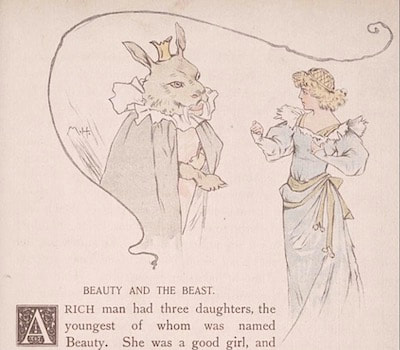
1895 - "Beauty and the Beast"
A Book of fairy tales
Retold: S. Sabine Gould
Illustrator: A. J. Gaskin
London: Methuen
Read Here (Archive)(p. 79)
[English, London, England]
A Book of fairy tales
Retold: S. Sabine Gould
Illustrator: A. J. Gaskin
London: Methuen
Read Here (Archive)(p. 79)
[English, London, England]


1895 - "King Iguana/ Ma Kolano o Kariànga (Galela)"
Alt title: "Koning Leguaan" (Dutch)
Bijdragen tot de Taal-, Land- en Volkenkunde van Nederlandsch-Indië (45 Vol)
Collected by: H. van Dijken and M. J. van Baarda:
Publisher:
Sourced from the island of Halmahera.
Indonesian folktale in the Galela language
Read Here [42.](p. 270-274)
ATU 425A
{Lizard Beast} (Iguana)
[Galela / German / Germany]
Alt title: "Koning Leguaan" (Dutch)
Bijdragen tot de Taal-, Land- en Volkenkunde van Nederlandsch-Indië (45 Vol)
Collected by: H. van Dijken and M. J. van Baarda:
Publisher:
Sourced from the island of Halmahera.
Indonesian folktale in the Galela language
Read Here [42.](p. 270-274)
ATU 425A
{Lizard Beast} (Iguana)
[Galela / German / Germany]
A couple has an iguana for a son. One day, the lizard passes by a lake where four women are bathing and falls in love with one of them. He tries to woo the maiden by knocking down some flowers from a tjampaka tree, but her sisters shoo him away. The iguana returns home and asks his mother to woo the maiden on his behalf. The woman goes and tries to talk about her son's proposal, but they rebuff her by throwing ashes. Defeated, the woman returns home with no positive answer, so her son decides to try it himself. He goes to his intended's house as an iguana, then enters her room. He takes off the reptile disguise and becomes a youth. At night, his bride pretends to be asleep, takes the iguana skin and burns it. The next morning, the now human iguana warns his bride against having done so, since sorrow and trouble will follow her decision.At any rate, he exits his bride's room as a man clad in fine garments, to the three sisters' delight and jealousy, who then decide to get rid of their cadette and marry the youth. Later, he goes on a boat trip to get a dowry for her, but gives her an areca nut and a rooster's egg before he leaves, which she hides in her sarong. After he goes away, the three sisters try to invite the maiden to go out with her on some activities (a pretext to kill her): first, to cut firewood for barrels. The elder sisters guide the cadette to the forest, shove her into a pit, then go back home. Her parents ask where their youngest daughter is, and go to the pit to rescue her.
Next, the three sisters invite her to pick up leaves atop a mountain. The maiden decides to join her sisters and climbs up the mountain with them. Up there, there is also a swing that they use for a little play. The elders play in the swing, then the youngest. As she is on the swing, the others cut off the rope and the maiden flies off to the middle of the sea. The areca nut and the rooster's egg then sink a bit into the water, when out of the areca nut a tree sprouts and a rooster hatches out of the egg, which starts to crow. As some ships pass them by, the rooster asks the ships if King Iguana is coming soon; the captains of the first two ships say he is coming after them. After the third ship passes, the rooster is told King Iguana is on that ship. Thus, the bird takes the maiden on its wings and flies to King Iguana's ship. After it lands, King Iguana admonishes his wife for burning his skin, but hides her in a gond box. King Iguana disembarks and visits his sisters-in-law. He tells them he brought them a present: two chests, just lying on the beach. The three sisters-in-law, hoping to find something precious inside, run to the beach and open up the chests in a hurry. Inside, only needles and knives, which spring out of the chests and kill the envious sisters.
Next, the three sisters invite her to pick up leaves atop a mountain. The maiden decides to join her sisters and climbs up the mountain with them. Up there, there is also a swing that they use for a little play. The elders play in the swing, then the youngest. As she is on the swing, the others cut off the rope and the maiden flies off to the middle of the sea. The areca nut and the rooster's egg then sink a bit into the water, when out of the areca nut a tree sprouts and a rooster hatches out of the egg, which starts to crow. As some ships pass them by, the rooster asks the ships if King Iguana is coming soon; the captains of the first two ships say he is coming after them. After the third ship passes, the rooster is told King Iguana is on that ship. Thus, the bird takes the maiden on its wings and flies to King Iguana's ship. After it lands, King Iguana admonishes his wife for burning his skin, but hides her in a gond box. King Iguana disembarks and visits his sisters-in-law. He tells them he brought them a present: two chests, just lying on the beach. The three sisters-in-law, hoping to find something precious inside, run to the beach and open up the chests in a hurry. Inside, only needles and knives, which spring out of the chests and kill the envious sisters.
|
~ 1886 - "The Jealous Sisters / De Negen Zusters"
Land- En Volkenkunde Van Nederlandsch Indië - Mededeelingen: Tijdschrift voor Zendingswetenschap : Alfoersche Vertelsels en Raadsels Collected by: N. P Wilken Collected from a Leonese Original story Read Here [30](Dutch)(p. 295–298) [Dutch] |
|
~ 1907 - "The Tale of the Monkey / Verhaal van den Aap" (Dutch)(Groep III. - told by T. Diën)
Alt Title: "Kakua an doro' i Wolai" (Batak Simalungun) Tontemboansche Teksten (Vol. 1) Collected by: J. A. T. Schwarz (Johannes Albert Traugott Schwarz) Collected from a Tomtenboan told by Thomas Dien Publisher: E. J. Brill Read Here [16.](Batak Simalungun)(p. 23–26) Read Here [16.](Dutch)(p. 23–26) ATU 440 {Monkey Beast} [Batak Simalungun / Dutch] |
|
~ 1922 - "The Tale of the Monkey / Verhaal van den Aap"
Malaiische Märchen aus Madagaskar und Insulinde Author: Paul Hambruch Publisher: Jena: Eugen Diederich Original story Read Here [26](German)(p. 94–98) ATU - 433C, ATU - 433B {Monkey Beast} [Dutch , German] |
|
(Summary)
In this tale, an old woman has a monkey for a son. One day, the monkey asks his mother to give him a sleeping mat so he can sunbathe. Despite warning him about standing so close to people, she attends his request. He spends his days on the mat on his porch, when he sights the eldest princess passing by to bathe, then an idea forms in his head: he will marry the princess. The monkey asks his mother to woo the eldest princess for him, but she questions how a girl can marry an animal. After some insistence, the woman goes to the palace and tells the king about her son's proposal. The king calls his eldest daughter to ask her about a possible marriage to a monkey. The girl refuses, and so do the other princesses, save the youngest, who accepts the proposal. The woman reports back to her son, and the monkey asks to be taken to the princess's palace so they can bathe together. It happens so: as soon as the monkey meets his fiancée, he takes off the monkey skin, becomes a handsome prince, then utters an incantation to summon fine garments for themselves, so they can present themselves before the king. The royal couple is impressed by their appearance, and the king asks his future son-in-law where the wedding will take place. The monkey replies it will happen soon, after he provides a house for themselves. He summons a large house with a spell and marries the princess. Some time later, the monkey, now in human form, is set to go on a journey, and warns his wife not to go swinging with her elder sisters, then gives her a betel nut and a rooster's egg, for her to place one on the other, so that a rooster will hatch and alert the prince with its crowing. After he departs, the princess's elder sisters conspire to kill her, and invite her to play on a swing by the beach. As the princess is swinging, her elder sisters push her so hard she falls into the ocean. Realizing she is in danger, she cracks open the egg and places the rooster on the betel nut. The rooster begins to crow and alerts the prince, who hears the noise and makes a turn to rescue his wife. He finds her with the rooster and the betel nut, hides her in a basket, then sails back home. After arriving, he sees that his eldest sister-in-law is there instead of his wife, and asks his father-in-law if his wife is really in the house. The king answers that the monkey's wife is indeed there (despite it being a lie), and the youngest princess rises out of the basket. The monkey prince then assumes the throne and makes his family-in-law his slaves. (Wiki) |
|
~ 1973 - "Ringkitan and Kusoi / Si Ringkitan dan Kusoi"
Alt Title: "Ringkitan and the Cuscus" Indonesische Märchen Collected by: Ernst Ulrich Kratz Indonesian Fairy Tales, Sulawesi Read Here [50](p. 227–237) ISBN 9783424004809 {Ringkitan - Beauty name} {Kusoi - Beast name} {Cuscus Beast} (undescribed creature) [German] |
|
(Summary)
A fisherman lives in Minahasa with his nine daughters, Ringkitan the youngest and the most beautiful. The girls' parents want to see them married to suitable husbands, but no person seems good enough. One day, however, an animal called cuscus appears to court the girls: the eight elders refuse to marry it, save for Ringkitan. The girl and the cuscus marry, despite the endless mocking by her sisters and their village. Ringkitan's marriage is still a happy one, although she does not know what her husband does for a living, since he leaves in the morning and returns at night. One morning, she decides to trail behind him and follows him to the forest. The cuscus hides behind some bushes, takes off his animal skin and hides it under some bushes, becomes a human male and joins with other men on a fishing boat. Ringkitan is happy to learn her husband's secret, and, after assuring he is indeed a human underneath the cuscus skin, decides to release him from his disguise. Some days later, while he goes to the fishing trip, Ringkitan hides the cuscus skin and waits for her husband's return to fetch his skin. He notices that Ringkitan is in the bushes with his skin, and she reveals she wants to have him human at all times, which he agrees to. He also tells her his real name: Kusoi. Ringkitan is even happier than before, but her elder sisters, after learning their brother-in-law is human after all, decide to get rid of Ringkitan. Later, Kusoi departs on a long business trip, and Ringkitan's sisters wait for the perfect moment to put their plan into action. After news of Kusoi's return reach their ears, the elder sisters invite their cadette to come play with them and swing in some tree branches near the seashore. The sisters, with evil intent, push her so hard she swings over the tree branches and her hair entangles between the branches. Ringkitan pleads for her sisters to help her, but they abandon her to her fate. The girl then notices a line of ships (a wooden boat, a more ornate wooden boat, a copper boat, a silver boat, and finally a golden boat) sailing nearby and sings some verses to draw their attention. Each of them replies that Kusoi is coming, and the man himself appears on the golden boat. He stops by the tree and rescues her down from it, and asks her how she ended up there. Ringkitan is glad to see her husband again and explains her elder sisters tried to kill her. Kusoi then plans to teach his sisters-in-law a lesson: he hides Ringkitan in a trunk and arrives home, where he asks where his wife is. The sisters pretend they saw her at the seashore. Kusoi then invites people to tell about his adventures on the open sea, and tells them he rescued a woman atop a tree near the seashore. The sisters start to fidget, fearing for their brother-in-law's story, until he bids some servants bring Ringkitan in, dresses in fine garments. He introduces the newcomer as his wife Ringkitan, and says he will not punish her pursuers. At the end of the tale, Ringkitan forgives her elder sisters for their misdeeds. |
|
~ 1904 - "Princess Gulungi-luri / Ngo Pitiri-Gulungi-luri"
Alt Title: "Prinses Gulungi-luri" (Dutch) Contributions to the Linguistics, Geography, and Ethnology of the Dutch East Indies / Bijdragen tot de Taal-, Land- en Volkenkunde van Nederlandsch-Indië (Vol 56) : HET LÒDA'SCH, in vergelijking met het Galėla'sch dialect op Halmaheira. GEVOLGD: DOOR: LÒDA'SCHE TEKSTEN EN VERHALEN Collected by: M. J. Van Baarda Read Here [17] (p. 453–454)(Jstor) ATU 425A , ATU 433B {Lizard Beast} [Loda /Dutch]
~ 1924 - "The Lizard with the Seven Skins / El lagarto de las siete camisas"
Alt Title: "Young María and the Lizard Prince / La joven María y el príncipe lagarto" Spanish Folktales / Cuentos Populares Españole (Vol. II.) Collected by: Aurélio M. Espinosa Publisher: Stanford University Press Spanish folktale from Cuenca Read Here [130.](p. 267-271)(Spanish)(Google Books) ATU 425A , ATU 433B {Lizard Beast} [Spanish] |
|
This tale, a queen desires a child, even if it is a lizard. Her wish is granted, and she gives birth to a lizard. Each time a wet nurse tries to feed him, he bites them, causing the royal couple to seek a new caregiver. Eventually, they find a girl named Mariquita, who is hired to suckle the lizard prince using iron breasts filled with milk. As the lizard prince grows up, he wishes to marry. He marries Mariquita's sisters, but when they fall asleep waiting for him, he kills them. However, Mariquita stays awake and discovers that beneath the lizard skin, he is a handsome prince. He warns her not to touch the seven lizard skins he sheds. Mariquita reveals the prince's secret to the queen, and they decide to burn the lizard skins. The queen asks Mariquita to leave the door open, which allows her to see her son's true form. Later that night, Mariquita burns the skins, but in the morning, the prince scolds her for losing them. He tells her that if she wants to find him again, she must wear seven pairs of iron shoes and embark on a journey with their unborn child to the Castillo de Irás y No Volverás. After giving birth to a boy, they both wait until he is old enough to travel in pursuit of the lizard prince. Together, they start their long journey, and after exhausting six pairs of the iron shoes, they reach the home of an old lady who provides three nuts for Mariquita to open in times of dire need. Eventually, they arrive at a castle belonging to the mother of eagles, who brings them the royal eagle to gather information about the Castillo. The eagle agrees to help them and flies them to their destination. Upon reaching the Castillo, Mariquita opens the first nut, revealing a golden loom. The local princess's maidservant sees it and informs the princess, who wants it for herself. Mariquita trades the loom for a night with the prince. However, the princess's maidservant gives the lizard prince a sleeping potion, making him unable to wake up during Mariquita’s first visit. Consequently, she and her son are kicked out in the morning. Still determined, Mariquita opens the second nut, obtaining a golden spindle, which she trades for a second night with the prince. Again, she fails to wake him due to the sleeping potion. After this, a servant warns the prince about the princess's trickery. Mariquita then opens the last nut to find a little golden egg. She trades this with the princess, who is reluctant to let a stranger into her husband’s room. Nevertheless, she gives him another drink, but he spills it and pretends to sleep. On her third visit, Mariquita cries over him, and he wakes up to embrace her. The next morning, the prince gathers his court and mentions that he lost a key. They advise him to keep the first one he crafted. He then decides to leave with Mariquita and their son. The princess's father announces that since his daughter and the prince did not spend the night together, she is free to marry another.
|
|
~ 1991 - "The Lizard King / El Rey Lagarto"
Traditional Tales from León / Cuentos tradicionales de León (Vol. II) Collected by: Julio Camarena Collected from a Leonese Read Here [334.] (p. 223-228)(Spanish) {Lizard Beast} [Spanish, Spain] |
|
A king and queen pray for a child and are granted a son who is a lizard, with a blue head and a green body. As he matures, the lizard prince, named Rey Lagarto, asks his mother for a bride, threatening to kill the queen if she does not help him. The queen brings three brides for him. The first two brides reject him on their wedding nights, leading to their deaths. The queen then finds the youngest sister, who does not reject Rey Lagarto. He reveals that he is cursed and must travel to the Castillos de África to break the spell before disappearing. Determined to find him, the girl sets off on a journey, buying a pair of shoes for her travels. She first arrives at the house of the Moon, who cannot direct her but gives her golden apples. Next, she visits the house of the Sun, who also does not know the way but gifts her golden pears. Finally, she meets the Aire and learns the location of the Castillos in a thick forest. The Aire’s mother provides her with a golden spinning wheel and fuse. The Aire carries her to her destination, where she finds the Castillos de África. The girl trades her golden items for nights with Rey Lagarto: the spinning wheel and fuse on the first night, the golden apples on the second, and the golden pears on the third. However, Rey Lagarto is under a sleeping potion during the first two nights and only wakes when he hears his wife’s lament on the third night. They then return to his homeland together.
|
|
~ 1991 - "The Tailor's Daughters / Las Hijas Del Sastre"
Traditional Tales from León / Cuentos tradicionales de León (Vol. I.) Collected by: Julio Camarena Read Here [96.] (p. 194-198)(416-417 (classification) {Kapapitoe , Kapapitu - Beauty Name} {Lizard Beast} {Curse Broken } [Spain] |
|
(Differences) **Spoilers**
Simular to the "The Pig King / Disznyókirály" 1952 with a Gypsy curing the prince |
|
(Differences) **Spoilers**
Old women raises a Lizard as a son. When he becomes an adult, he wishes to marry and asks his mother to ask a women who has seven sisters, for one of them to marry him, the youngest agrees. She treats him well, but her sisters treat him terribly. |
c. 1895 - "Beauty and the Beast" (Number 1481)
Father Tuck's Nursery Series
Author: Grace C. Floyd
Illustrator: Frances Brundage
Publisher: Raphael Tuck & Sons,
Amsterdam, H.J.W. Becht
Book Illustrations Here
{Bear Beast}
[English]
Father Tuck's Nursery Series
Author: Grace C. Floyd
Illustrator: Frances Brundage
Publisher: Raphael Tuck & Sons,
Amsterdam, H.J.W. Becht
Book Illustrations Here
{Bear Beast}
[English]

|
~ c. 1895 - "Beauty and the Beast" (Number 1519)
Father Tuck's Nursery Series (Untearable Linen Series) Author: Grace C. Floyd Illustrator: Frances Brundage Publisher: Raphael Tuck & Sons, London, Paris, NewYork Ref Here (tuckdbephemera.org) Book Illustrations Here {Bear Beast} [English] 
~ c. 1895 - "Beauty and the Beast" (Number 7150)
Father Tuck's Nursery Series (Untearable Linen) Author: Grace C. Floyd Illustrator: M.B. Bowley Publisher: Raphael Tuck & Sons, London, Paris, Berlin, New York, Montroal Illustration ref Here (tuckdbephemera.org) Book Illustrations Here {Bear Beast} [English, London, England]
~ 1907-1910 - "Beauty and the Beast" Panorama Book (Number 7007)
Father Tuck's Panorama Series Author: Raphael Tuck Illustrator: Publisher: New York: Raphael Tuck & Sons Illustration ref Here (More images)(tuckdbephemera.org) Info Here Book Illustrations Here {Bear Beast} [English]
~ 1910 - "Beauty and the Beast" Panorama Book (Number 4573)
Father Tuck's Happy Hour Author: Nora Hopper Publisher: London-paris-new York. Info Here (tuckdbephemera.org) Book Illustrations Here {Bear Beast} [English, UK] 🌹🌹🌹🌹🌹 PT Copy
|


|
1897- "Beauty and the Beast"
The Ideal Fairy Tales
Author: Charles Perrault
Publisher: McLoughlin Bros, NY
Book Illustrations Here
{Boar Beast}
[English, NY, USA]
🌹🌹🌹🌹🌹
PT Copy
The Ideal Fairy Tales
Author: Charles Perrault
Publisher: McLoughlin Bros, NY
Book Illustrations Here
{Boar Beast}
[English, NY, USA]
🌹🌹🌹🌹🌹
PT Copy

Other stories
Sleeping Beauty
Cinderella or The little Glass Slipper
Puss and Boots
Sleeping Beauty
Cinderella or The little Glass Slipper
Puss and Boots
Once upon a time, in a country a long way from here, there stood a flourishing city, full of commerce; and in that city lived a merchant so lucky in all his ventures that it seemed as if fortune waited on his wishes. But while enormously rich, he had a very long family of six sons and six daughters; and as yet not one of them was settled in life. The boys were too young to go out in the world; and the girls, who had everything at home the heart could desire, were in no hurry to risk a change by choosing a husband, although many rich and noble suitors paid court to them. (Opening paragraph)
1898 - "Beauty and the Beast/ Vakurleikin og beistið"
Faroese Folklore and Adventures/ Færøske folkesagn og æventyr
Collected by: Jakob Jakobsen
Read Here [48.](p. 480-482)(Archive)
ATU- 425A
{Gift - apple}
{Troll Beast}
{Curse broken - agrees to marry him}
[Faroese, Faroe Islands]
Faroese Folklore and Adventures/ Færøske folkesagn og æventyr
Collected by: Jakob Jakobsen
Read Here [48.](p. 480-482)(Archive)
ATU- 425A
{Gift - apple}
{Troll Beast}
{Curse broken - agrees to marry him}
[Faroese, Faroe Islands]
(Differences) **Spoilers**
The Beauty character asks for an apple instead of a rose. Beast is a troll. He has a room with a magic mirror that shows you what ever you want to see.
(Full Story)
Once upon a time there was a great merchant who had a voyaged around the world. One day, when the ships had returned home, and he was about to leave to visit them, he asked his daughters - there were three - what each one wished him to bring back for them, whatever they wanted. The two older sisters each wished for a dress, and the youngest for an apple. He soon was able to get the dress, but he could find no apples. Saddneded by this, he went to go home. On the way he found a lone house and entered it; food was set out on the table, but there is no one there to serve him. He is hungry and so he sits down to eat. When he gets up again, he is looking out the window into a garden, where a tree stands with many apples on them. He goes upstairs and takes one to carry to his daughter. Now it seems to him that everything —mountains and houses alike—should have fallen on top of him; when a troll comes at him and is so nasty that he figures it's more than enough, the he had already has eaten his fill, the he went and stole an apple too. The merchant tells of his youngest daughter's wish and offers to give the apple back to the troll. But the troll says no, that it only wants his daughter in exchange for the apple. The man must agree and go home with the apple, even more sad than before he got it. He tells his daughter everything that has happened; but she asks him not to worry - that she will go to the troll. So he took her to the troll, just as the troll had asked. She and her father felt that everything was going to work out for her, when suddenly the troll arrived; he was very kind to her and asked her to marry him. But she told him she didn't want to. Every evening the troll brought it up, that she should take it for her husband; but she kept refusing. There was a chamber with a mirror in it; whoever looked into that mirror could se anythign they wished. One day, as she went to look in this mirror, she saw her father lying sick with grief. In the evening, when the troll came, she was grieve sticken. "You must have been looking in the mirror today." says the troll, "but you must not grieve, for you will be allowed to go home to visit your father and tell him that you are well; however, you must hurry back." She says she will. The troll still asks her to marry him as every night before; but she refuses. Another day, as she looks in the mirror, she sees the sisters preparing for a wedding, when the troll comes home in the evening, she is sitting there again so sad. "Don't be sad you will be allowed to go to the wedding", the troll says, "but like last time you must come back as soon as you can, and stay only as long as the feast lasts." She promises and then goes home to her sisters' wedding. But at home she lets herself be persuaded to stay longer than she has promised the troll, and one night after the wedding is over, she dreams that the troll has died of grief for her; he was laying streatched out outside by a log in the garden. In the morning she hurries away as quickly as she can, back to the troll's home, and sits down at the table as she hopes he will come, she waits, but the troll does not come to her. So she goes down to the garden to look for what she dreamed, and there he lies, outside by a log, dead becuase of her not returning. The says to herself that if he was alive, I would have taken him for my husband, because he has been so kind to me. In the same instant she spoke these words, he rose up alive and was human; he had been transformed so that he could not become human again until a maiden promised to marry him, but no maiden would consent, because he was so ugly and invisible--and he couldn't say that this was his punishment, because then the curse would not be broken. In the same trick, as she has spoken this word, he rises alive and is a natural person; he had been transformed so that he could not come to be a man again until a girl promised to have him for a man, and in that no girl would agree, because he was so ugly and invisible - and he couldn't say that this was his punishment, because then the curse would be broken. He told her he was the son of a king, but was called “beistið" (the beast) because he was transformed into a troll. And she was called “vakurleikin" (The Beauty) So they both got married and lived happily in the same houses.
(Translated by Clark)(PT translation)
The Beauty character asks for an apple instead of a rose. Beast is a troll. He has a room with a magic mirror that shows you what ever you want to see.
(Full Story)
Once upon a time there was a great merchant who had a voyaged around the world. One day, when the ships had returned home, and he was about to leave to visit them, he asked his daughters - there were three - what each one wished him to bring back for them, whatever they wanted. The two older sisters each wished for a dress, and the youngest for an apple. He soon was able to get the dress, but he could find no apples. Saddneded by this, he went to go home. On the way he found a lone house and entered it; food was set out on the table, but there is no one there to serve him. He is hungry and so he sits down to eat. When he gets up again, he is looking out the window into a garden, where a tree stands with many apples on them. He goes upstairs and takes one to carry to his daughter. Now it seems to him that everything —mountains and houses alike—should have fallen on top of him; when a troll comes at him and is so nasty that he figures it's more than enough, the he had already has eaten his fill, the he went and stole an apple too. The merchant tells of his youngest daughter's wish and offers to give the apple back to the troll. But the troll says no, that it only wants his daughter in exchange for the apple. The man must agree and go home with the apple, even more sad than before he got it. He tells his daughter everything that has happened; but she asks him not to worry - that she will go to the troll. So he took her to the troll, just as the troll had asked. She and her father felt that everything was going to work out for her, when suddenly the troll arrived; he was very kind to her and asked her to marry him. But she told him she didn't want to. Every evening the troll brought it up, that she should take it for her husband; but she kept refusing. There was a chamber with a mirror in it; whoever looked into that mirror could se anythign they wished. One day, as she went to look in this mirror, she saw her father lying sick with grief. In the evening, when the troll came, she was grieve sticken. "You must have been looking in the mirror today." says the troll, "but you must not grieve, for you will be allowed to go home to visit your father and tell him that you are well; however, you must hurry back." She says she will. The troll still asks her to marry him as every night before; but she refuses. Another day, as she looks in the mirror, she sees the sisters preparing for a wedding, when the troll comes home in the evening, she is sitting there again so sad. "Don't be sad you will be allowed to go to the wedding", the troll says, "but like last time you must come back as soon as you can, and stay only as long as the feast lasts." She promises and then goes home to her sisters' wedding. But at home she lets herself be persuaded to stay longer than she has promised the troll, and one night after the wedding is over, she dreams that the troll has died of grief for her; he was laying streatched out outside by a log in the garden. In the morning she hurries away as quickly as she can, back to the troll's home, and sits down at the table as she hopes he will come, she waits, but the troll does not come to her. So she goes down to the garden to look for what she dreamed, and there he lies, outside by a log, dead becuase of her not returning. The says to herself that if he was alive, I would have taken him for my husband, because he has been so kind to me. In the same instant she spoke these words, he rose up alive and was human; he had been transformed so that he could not become human again until a maiden promised to marry him, but no maiden would consent, because he was so ugly and invisible--and he couldn't say that this was his punishment, because then the curse would not be broken. In the same trick, as she has spoken this word, he rises alive and is a natural person; he had been transformed so that he could not come to be a man again until a girl promised to have him for a man, and in that no girl would agree, because he was so ugly and invisible - and he couldn't say that this was his punishment, because then the curse would be broken. He told her he was the son of a king, but was called “beistið" (the beast) because he was transformed into a troll. And she was called “vakurleikin" (The Beauty) So they both got married and lived happily in the same houses.
(Translated by Clark)(PT translation)
1899 - "Shah Bender/ Şah Bender/ Шаһ Бäндäр (Kazakh)"
Proben der volkslitteratur der türkischen stämme (Vol 8)
Author: Ignác Kúnos
Publisher: Mundarten der Osmanen. St. Petersburg: Commissionäre der Kaiserlichen akademie der wissenschaften: Eggers et co
Read Here [8. /VIII](Turkish_(p. 215-222)
{Donkey Beast}
[Turkish]
Proben der volkslitteratur der türkischen stämme (Vol 8)
Author: Ignác Kúnos
Publisher: Mundarten der Osmanen. St. Petersburg: Commissionäre der Kaiserlichen akademie der wissenschaften: Eggers et co
Read Here [8. /VIII](Turkish_(p. 215-222)
{Donkey Beast}
[Turkish]
(Summary)
three princesses cast their lot with apples in a contest to choose their husbands. The youngest princess throws her apple, and it lands near a donkey. She marries the donkey, who subsequently reveals that he is a prince named Shah Bender and warns her not to reveal their secret. The following day, he participates in his father-in-law's tournament as a mysterious knight and defeats his opponents. Out of pride, the princess informs her family that the mysterious knight is her husband, and he vanishes.
(Wiki)
three princesses cast their lot with apples in a contest to choose their husbands. The youngest princess throws her apple, and it lands near a donkey. She marries the donkey, who subsequently reveals that he is a prince named Shah Bender and warns her not to reveal their secret. The following day, he participates in his father-in-law's tournament as a mysterious knight and defeats his opponents. Out of pride, the princess informs her family that the mysterious knight is her husband, and he vanishes.
(Wiki)
|
~ 1903 - "Shah Bender"
Tyrkiske Folkeeventyr Translator: Johannes Østrup Read Here [9](p. 91–94) ATU 425B {Donkey Beast} [Danish] ~ 1970 - "The Padishah's Youngest Daughter and Her Donkey-Skull Husband"
Uysal–Walker Archive of Turkish Oral Narrative Translator: Published by: From oral tradition storyteller Niyâzi Çam in Bursa Province Turkish fairy Read Here [805.](p. 20-40] ATU 425B {Donkey Beast} [English] |
|
(Summary)
The story follows a princess who marries a youth magically concealed within a donkey skull. After breaking his trust, she loses him and embarks on a perilous journey to his mother’s home, where she is subjected to a series of arduous tasks to reclaim him. (Wiki) |
|
~ 1993 - "The Padishah's Youngest Daughter and Her Donkey-Skull Husband"
The Art of the Turkish Tale. Volume 2 Author: Barbara K. Walker Turkish fairy Publisher: Texas Tech University Read Here (p. 193) ISBN 9780896722286 ATU 425B {Donkey Beast} [English] |
1900 - "Beauty and the Beast"
Illustartor: Charles Robinson - Tales of Passed Times - The Temple Classics For Young People
Orginal Author: Gabrielle-Suzanne de Villeneuve
Author: Charles Perrault
Illustrator: Charles Robinson
Publisher: J.m. Dent & Company, Aldine House, Bedford Street, Covent Garden.
Read Here (p. 109-131)
{Beast}
[English, London]
Illustartor: Charles Robinson - Tales of Passed Times - The Temple Classics For Young People
Orginal Author: Gabrielle-Suzanne de Villeneuve
Author: Charles Perrault
Illustrator: Charles Robinson
Publisher: J.m. Dent & Company, Aldine House, Bedford Street, Covent Garden.
Read Here (p. 109-131)
{Beast}
[English, London]

There was once a merchant, who was very, very rich. He had six children, three boys and three girls, and as he was a man of good sense, he spared no expense in order that they might be well educated, and gave them masters of every kind. His daughters were all beautiful, but his youngest one was especially admired, and from the time she was a small child, had been only known and spoken of as "Beauty." The name remained with her as she grew older, which gave rise to a great deal of jealousy on the part of her sisters. The young girl was not only more beautiful than they were, but also kinder and more amiable. The elder daughters gave themselves great airs, for they were overweeningly proud of being so rich, and would not condescend to receive visits from the daughters of other merchants, as they only cared for the society of people in high position. Not a day passed that they did not go to a ball, or a theatre, or for a drive or walk in a fashionable part of the town, and they made fun of their sister, who spent a great part of her time in study. The girls received many offers of marriage from well-to-do merchants, as they were known to be rich, but the two elder ones replied, that they did not intend to marry anyone, unless a duke or an earl could be found for a husband.
(Opening paragraph)
(Opening paragraph)
|
~ 1910 - "Beauty and the Beast"
The Big Book of Fairy Tales Original Author: Gabrielle-Suzanne de Villeneuve Author: Charles Perrault Illustrator: Charles Robinson Publisher: H.M. Caldwell Company 1911 Edition illustrations Here - Editor: Walter Jerrold ; London: Blackie & Son [English] |
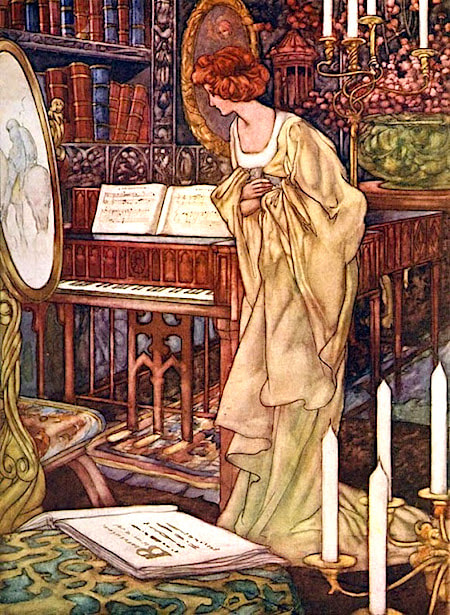
1900 - "Beauty and the Beast"
The Santa Claus Story Book
Original Author: Gabrielle-Suzanne Barbot de Villeneuve ?
Author: McLoughlin Bro's
Illustrator: M.A. Donohue & Co. ?
Publisher: New York : McLoughlin Bro's
Read Here (p. 84-104)(Archive)
Book Illustrations Here
{Boar Beast}
[English, NY, USA]
The Santa Claus Story Book
Original Author: Gabrielle-Suzanne Barbot de Villeneuve ?
Author: McLoughlin Bro's
Illustrator: M.A. Donohue & Co. ?
Publisher: New York : McLoughlin Bro's
Read Here (p. 84-104)(Archive)
Book Illustrations Here
{Boar Beast}
[English, NY, USA]
1900 - "The Golden Bird"
The Journal of American Folklore.
Collected by: Fanny Dickerson Bergen
Correspondent Mrs. Amanda M. Thrush, Plymouth
Read Here (p. 231–232)
{Gift golden bird}
{Bird Beast}(golden)
{Curse broken - agreeing to marry him}
[English, Ohio USA]
Folklorist Fanny Dickerson Bergen published a fragmentary variant from Ohio, with the title The Golden Bird, which is the object the youngest daughter asks for
Bergen, Fanny D. (July 1900). "The Golden Bird". The Journal of American Folklore. 13 (50): 231–232.
The Journal of American Folklore.
Collected by: Fanny Dickerson Bergen
Correspondent Mrs. Amanda M. Thrush, Plymouth
Read Here (p. 231–232)
{Gift golden bird}
{Bird Beast}(golden)
{Curse broken - agreeing to marry him}
[English, Ohio USA]
Folklorist Fanny Dickerson Bergen published a fragmentary variant from Ohio, with the title The Golden Bird, which is the object the youngest daughter asks for
Bergen, Fanny D. (July 1900). "The Golden Bird". The Journal of American Folklore. 13 (50): 231–232.
1900 - "Beauty and the Beast/ La fiera y la bella"
Traditional Asturian Tales/ Cuentos Tradicionales Asturianos
Collected by: Constantino Cabal
Publisher: Madrid, Voluntad
Read Here (p. 66-71)(Spanish)(Archive)
ATU 425C
{Gift rose}
{Bella Beauty name}
{Bear Beast}(gray)
[Spanish]
Traditional Asturian Tales/ Cuentos Tradicionales Asturianos
Collected by: Constantino Cabal
Publisher: Madrid, Voluntad
Read Here (p. 66-71)(Spanish)(Archive)
ATU 425C
{Gift rose}
{Bella Beauty name}
{Bear Beast}(gray)
[Spanish]
(Story)
Well, you should know that this was a merchant who went bankrupt, and his daughters—so lovely and sweet—after adorning themselves with priceless jewels, had to wear calico. But the merchant was unexpectedly informed that one of the steamers he thought was lost was about to arrive at the nearby port, and all his hopes were reborn; he took leave of his family with more joy than sorrow, and asked his daughters, "Let's see what you want me to bring you." The first replied, "A luxurious dress." And the second, "Another dress just like it." The third looked at him with great affection, and after a moment of silence, said to him in this way, "Don't bring me anything..." But the father insisted, said yes... And she was content with a rose, "Since you insist, bring me a rose..." After several days of travel, the merchant arrived at the port; the steamship he had been told about had not yet arrived, and once again its course was unknown. All the hopes he had awakened died again, and the merchant renounced the fabrics his daughters had asked for with tears in their eyes... He left at night, left the city, and set off across the countryside; he longed to reach his home quickly, hoping for some solace. He met a man on the road, watering his garden at night, and asked him for directions. The man told him, "Go this way, and when you reach the woods, turn left."
But he was so lost in thought and so consumed by his sorrow that, instead of skirting the edge of the woods, he went right into them and became lost. The dark, deep forest seemed to embrace him. Suddenly, a storm broke out, and the woods were filled with flashes of lightning and noises; it was as if everything around the merchant trembled. But he saw a small light, made his way toward it, and found a palace of extraordinary beauty. He knocked twice, and no one appeared. He entered and found a manger full of straw, which was the greatest pleasure for his horse. He then peered down a staircase, all of marble and gold, and it led him to a room, in the center of which he saw a table laden with exquisite delicacies. A lantern illuminated the room. The merchant knocked again, and there was no answer; then, driven by hunger, he sat down at the table and dined to his heart's content. When he finished, he said, "Ah, if only I had coffee..." Another lantern appeared at the back of the room, and a mysterious hand approached the table and served coffee. After drinking it, the merchant wanted to sleep. The lantern on the table began to move, inviting him to follow it, and in this way they arrived at the bedroom. The merchant lay down and slept peacefully; the next morning he found breakfast on the table: he took a bunch of keys, opened a door, went down to the garden, and shouted with joy, because the garden was full of roses. 'Ah' the merchant said to himself, 'at least
I can give the rose as a gift to my youngest daughter...' And he set about looking for the prettiest rose. As he cut it, he heard a noise as loud as if a mountain had been toppled, and then a voice said to him, "I could never have imagined such ingratitude... I could never have imagined that you would steal my most cherished possession in return for the hospitality you received in my palace!" The merchant knelt, and without seeing who was speaking to him, replied, "Oh, sir, I beg your forgiveness... I took the rose because my youngest daughter asked me to, and I love her very much." The one who spoke to the merchant was a gray-furred bear with kind eyes and enormous size. And the bear answered thus, "The punishment I impose on you is that you give me one of your daughters to live by my side." The merchant offered to hand it over, compelled by fear. And the bear led him to a room, ordered him to load as much gold as his horse could carry, then led him to the forest, and showed him the way home. When he found himself before his daughters, the merchant's sorrow increased; he threw the gold into the room, hid his head in his hands, turned to the wall, and began to weep inconsolably. His daughters surrounded him with love. "But what's wrong? You're rich again!" And he told them the story. The eldest replied, "Don't be afraid, my father, I will go." And the second said, "No, don't let her, I will go." But the third stopped her,"The rose was for me, and I must save our father." And it was the third sister who said goodbye to her sisters. She said goodbye at the palace, for they had accompanied her there. The merchant's daughters were all generous, like lights. The youngest went up to the palace and found hangings of branches, full of carnations, laid out to receive her; she found a magnificent table; she found a sumptuous bed... But she also found a deep and silent loneliness everywhere. Until, on the second day, she heard a noise and the bear came out. "Do you love me, my beautiful one?" the bear asked her. And she said sincerely, "No, I don't love you." The bear roared and left. The girl's smallest whims were fulfilled as if by a miracle in the palace in the forest. The jewels she desired, the flowers she longed for, the delicacies she asked for... appeared before her eyes, without anyone bringing them. Time passed, the bear returned and asked her again, "And now, do you love me?" And the girl answered honestly, "No, I don't love you." The bear roared and left. And the girl could see that she was constantly surrounded by great adoration in the palace. Music was played for her, perfumes were laid out, and flowers were scattered. And one day in the dining room, she saw the bear slowly enter, pass slowly by her side, and go down to the garden. She followed him with interest and saw him throw himself into the pond, looking at her sadly. The girl felt sorry for him and ran to the bank and held out her hand to the bear.
And when the bear gave her his paw, he asked her again, "And now, do you love me?" And the girl answered, "Yes, I love you now..." The bear jumped out of the water and instantly became a prince. He was a gallant and powerful prince, whom a witch's envy had transformed into a bear with a curse. And as soon as she regained her senses, the prince spoke to her of his love, his tenderness, his gratitude to the merchant's daughter, and made her a queen of his kingdom; the queen's sisters and father sat beside her, and they were filled with happiness for the rest of their days.
(Translated by GT)(PT translation)
Well, you should know that this was a merchant who went bankrupt, and his daughters—so lovely and sweet—after adorning themselves with priceless jewels, had to wear calico. But the merchant was unexpectedly informed that one of the steamers he thought was lost was about to arrive at the nearby port, and all his hopes were reborn; he took leave of his family with more joy than sorrow, and asked his daughters, "Let's see what you want me to bring you." The first replied, "A luxurious dress." And the second, "Another dress just like it." The third looked at him with great affection, and after a moment of silence, said to him in this way, "Don't bring me anything..." But the father insisted, said yes... And she was content with a rose, "Since you insist, bring me a rose..." After several days of travel, the merchant arrived at the port; the steamship he had been told about had not yet arrived, and once again its course was unknown. All the hopes he had awakened died again, and the merchant renounced the fabrics his daughters had asked for with tears in their eyes... He left at night, left the city, and set off across the countryside; he longed to reach his home quickly, hoping for some solace. He met a man on the road, watering his garden at night, and asked him for directions. The man told him, "Go this way, and when you reach the woods, turn left."
But he was so lost in thought and so consumed by his sorrow that, instead of skirting the edge of the woods, he went right into them and became lost. The dark, deep forest seemed to embrace him. Suddenly, a storm broke out, and the woods were filled with flashes of lightning and noises; it was as if everything around the merchant trembled. But he saw a small light, made his way toward it, and found a palace of extraordinary beauty. He knocked twice, and no one appeared. He entered and found a manger full of straw, which was the greatest pleasure for his horse. He then peered down a staircase, all of marble and gold, and it led him to a room, in the center of which he saw a table laden with exquisite delicacies. A lantern illuminated the room. The merchant knocked again, and there was no answer; then, driven by hunger, he sat down at the table and dined to his heart's content. When he finished, he said, "Ah, if only I had coffee..." Another lantern appeared at the back of the room, and a mysterious hand approached the table and served coffee. After drinking it, the merchant wanted to sleep. The lantern on the table began to move, inviting him to follow it, and in this way they arrived at the bedroom. The merchant lay down and slept peacefully; the next morning he found breakfast on the table: he took a bunch of keys, opened a door, went down to the garden, and shouted with joy, because the garden was full of roses. 'Ah' the merchant said to himself, 'at least
I can give the rose as a gift to my youngest daughter...' And he set about looking for the prettiest rose. As he cut it, he heard a noise as loud as if a mountain had been toppled, and then a voice said to him, "I could never have imagined such ingratitude... I could never have imagined that you would steal my most cherished possession in return for the hospitality you received in my palace!" The merchant knelt, and without seeing who was speaking to him, replied, "Oh, sir, I beg your forgiveness... I took the rose because my youngest daughter asked me to, and I love her very much." The one who spoke to the merchant was a gray-furred bear with kind eyes and enormous size. And the bear answered thus, "The punishment I impose on you is that you give me one of your daughters to live by my side." The merchant offered to hand it over, compelled by fear. And the bear led him to a room, ordered him to load as much gold as his horse could carry, then led him to the forest, and showed him the way home. When he found himself before his daughters, the merchant's sorrow increased; he threw the gold into the room, hid his head in his hands, turned to the wall, and began to weep inconsolably. His daughters surrounded him with love. "But what's wrong? You're rich again!" And he told them the story. The eldest replied, "Don't be afraid, my father, I will go." And the second said, "No, don't let her, I will go." But the third stopped her,"The rose was for me, and I must save our father." And it was the third sister who said goodbye to her sisters. She said goodbye at the palace, for they had accompanied her there. The merchant's daughters were all generous, like lights. The youngest went up to the palace and found hangings of branches, full of carnations, laid out to receive her; she found a magnificent table; she found a sumptuous bed... But she also found a deep and silent loneliness everywhere. Until, on the second day, she heard a noise and the bear came out. "Do you love me, my beautiful one?" the bear asked her. And she said sincerely, "No, I don't love you." The bear roared and left. The girl's smallest whims were fulfilled as if by a miracle in the palace in the forest. The jewels she desired, the flowers she longed for, the delicacies she asked for... appeared before her eyes, without anyone bringing them. Time passed, the bear returned and asked her again, "And now, do you love me?" And the girl answered honestly, "No, I don't love you." The bear roared and left. And the girl could see that she was constantly surrounded by great adoration in the palace. Music was played for her, perfumes were laid out, and flowers were scattered. And one day in the dining room, she saw the bear slowly enter, pass slowly by her side, and go down to the garden. She followed him with interest and saw him throw himself into the pond, looking at her sadly. The girl felt sorry for him and ran to the bank and held out her hand to the bear.
And when the bear gave her his paw, he asked her again, "And now, do you love me?" And the girl answered, "Yes, I love you now..." The bear jumped out of the water and instantly became a prince. He was a gallant and powerful prince, whom a witch's envy had transformed into a bear with a curse. And as soon as she regained her senses, the prince spoke to her of his love, his tenderness, his gratitude to the merchant's daughter, and made her a queen of his kingdom; the queen's sisters and father sat beside her, and they were filled with happiness for the rest of their days.
(Translated by GT)(PT translation)
1900 - "Beauty and the Beast"
Strong's Comic Nursery Tales:
Original Author: Gabrielle-Suzanne Barbot de Villeneuve
Author: Iacob Adrian ?
Illustrator: Thomas W. Strong (Engraved)
Engraved & Published by: T. W. Strong Collection 98 Nassau St. New York
Read Here (Archive)
Buy Here (Amazon)
[English, NY, USA]
Strong's Comic Nursery Tales:
Original Author: Gabrielle-Suzanne Barbot de Villeneuve
Author: Iacob Adrian ?
Illustrator: Thomas W. Strong (Engraved)
Engraved & Published by: T. W. Strong Collection 98 Nassau St. New York
Read Here (Archive)
Buy Here (Amazon)
[English, NY, USA]

ISBN: 1507893108
ISBN13: 9781507893104
ISBN13: 9781507893104
A Punch and Judy style art
1903 - "Old Man Coyote, the Young Man and Two Otter Sisters"
Traditions Of The Crows (Vol. II, No. 6) : Field Columbian Museum
Publication 85 Anthropological Series Vol. II, No. 6
Author: S. C. Slmms
Assistant Curator, Division Of Ethnology.
Publisher: George A. Dorsey Curator of Department. Chicago, U. S.
Read Here [15.](p. 297-299)
{ Beast}
[English]
Traditions Of The Crows (Vol. II, No. 6) : Field Columbian Museum
Publication 85 Anthropological Series Vol. II, No. 6
Author: S. C. Slmms
Assistant Curator, Division Of Ethnology.
Publisher: George A. Dorsey Curator of Department. Chicago, U. S.
Read Here [15.](p. 297-299)
{ Beast}
[English]
Involves human-animal unions with otters or other beings, tests of endurance, and transformation or tragedy. Emphasizes taboo-breaking and nature spirits.
1903 - "Beauty and the Beast"
Mother Goose Series
Author: Henry Altemus
Illustrator:
Publisher: A. L. Burt Company, New York
Philadelphia Hentry Altemus Company
Read Here (p. )
{Boar Beast}
[English]
Mother Goose Series
Author: Henry Altemus
Illustrator:
Publisher: A. L. Burt Company, New York
Philadelphia Hentry Altemus Company
Read Here (p. )
{Boar Beast}
[English]

1903
|
~ 1905-1911- "Beauty and the Beast"
Mother Goose Series Author: Henry Altemus Illustrator: Robert Anning Bell and Frances Brundage Publisher: A. L. Burt Company, New York Philadelphia Hentry Altemus Company {Boar Beast} [English] 
1905-1911
|

1906- "Beauty and the Beast"
Author: Amy Steedman
Illustrator: Paul Woodroffe
Publisher: London: TC & EC Jack, n.d.
Read Here (p. 90-104)
{Pan Beast}{Demon Beast}
[English]
Author: Amy Steedman
Illustrator: Paul Woodroffe
Publisher: London: TC & EC Jack, n.d.
Read Here (p. 90-104)
{Pan Beast}{Demon Beast}
[English]

There was once upon a time a Merchant who had three beautiful daughters. But though the two eldest were very lovely, the youngest, who was called Beauty, was the fairest of all. For besides being beautiful she had a kind, gentle heart, which shone out of her eyes and made her always look happy and bright. The elder sisters were selfish and discontented, and only cared for jewels and fine clothes. So it was no wonder that the father loved his youngest daughter best. (Opening paragraph)
1907 - "Beauty and the Beast"
Illustrator: Bowley?
Publisher: Valentine & Sons, London, Dundee (Scotland) , Montreal
**Strangely looks like a Tuck book, with a Bowley sister who might have done the art on the cover*
{Bear Beast} (Cover) {Lion Beast} (Illustrations)
Book Illustrations Here
[English, Scotland]
Illustrator: Bowley?
Publisher: Valentine & Sons, London, Dundee (Scotland) , Montreal
**Strangely looks like a Tuck book, with a Bowley sister who might have done the art on the cover*
{Bear Beast} (Cover) {Lion Beast} (Illustrations)
Book Illustrations Here
[English, Scotland]

1908 - "The Three Roses/ Tři růže"
Tales of Kladské, Volumes 1-2/ Povídky kladské, Volumes 1-2
Compiled by: Josef Stefan Kubín
Czech folk tale
Read Here (p. 130- )(Google Books)
{Marinka - Beauty name}
{Gift - three roses.}
{Serpent Beast} (basilisk)
{Curse broken - rock him on her lap for 3 hours every day for 3 days, cutting off his twice}
[Czech]
Tales of Kladské, Volumes 1-2/ Povídky kladské, Volumes 1-2
Compiled by: Josef Stefan Kubín
Czech folk tale
Read Here (p. 130- )(Google Books)
{Marinka - Beauty name}
{Gift - three roses.}
{Serpent Beast} (basilisk)
{Curse broken - rock him on her lap for 3 hours every day for 3 days, cutting off his twice}
[Czech]
(Differences) **spoilers**
The Beauty character's parent is a mother not a father and she is the one who picks the rose and makes the deal with the Beast.
(Full Story)
There was a mother, and she had three daughters. There was a fair in a nearby town, and she was so poor that she had to go there, and what should she bring them? Well, the daughters asked for this and that, and what was the best, to buy them. But you know how imaginative women are. So they asked for enough, and she asks the third daughter, "And what about you, nothing?" "I don't want anything, but is you wish, bring me three roses." And if she gets it, it wouldn't be much more. So when the woman knew, she went to the lovely fair. She bought everything she could, put the hay on her back, and then she went home. But now night came upon her, the dear mother got lost, and she didn't knwo where to go. So she walked for a long time through those woods, until she was completely lost, but then she came to a castle, which she hadn't known there was such a thing there. There was a big garden, and in it there were so many roses, a painter could have captured them all, and they were all smiling at her. So she immediately remembered her youngest daughter, how she wanted roses like that, and how she’d completely forgotten about her. Well, as they say old people are old! She thought to herself. There are plenty of roses here; I’ll just pick three. So she went into the lovely garden. She picked the roses, but then a basilisk came rushing at her and said she would have to give him the girl in exchange for the roses. Mom was terrified and wanted to throw the flowers away. But the basilisk said that wouldn’t do any good, and that he’d tear her to pieces otherwise. So she had to give him the girl.What could she do, so she went home, brought the three roses, and said to the dear daughter,“I’ve brought you these roses, but they’ve cost me dearly. You must go to that castle over there to get them, and I don’t even know if you’ll ever make it back.” But Marinka didn’t seem to mind at all; she said she’d go. So her mother took her to the lovely castle. There she had everything she wanted, whatever she could think of. Then the basilisk appeared and said that Marinka she had to rock him on her lap for three hours every day. What could she do? She had to comply, so the dear basilisk silthered over to her, and she rocked him for three hours, then he silthered away. And the next day he came back, and the day after that, and so on for three days in a row. On the third day, the basilisk pointed at dear Marinka and told her to cut off his head. Well, she wasn’t the type to do such things; she couldn’t bring herself to do it. But the basilisk flew into a rage at her, threatening to tear her to pieces. So what could she do? She went and cut off his head. But now, as the head rolled to the ground, a huge snake emerged from the basilisk’s body, hissing horribly, and demanded that she cut off his head as well. Marinka didn’t hesitate, and she quickly cut it off. And the snake was holding a golden key to that castle in its mouth, and now it turned into a handsome young man, and he spoke to her sweetly: “This castle is mine. I have no choice—since you’ve freed me, I’ll take you as my wife.” And so And so there was immediately a grand wedding at the lovely, there were as many servants and courtiers as one could imagine, everyone plaid music and danced, but it was a land made of paper, and I fell through it and ended back here!
(Translated by anonymous)(PT translation)
The Beauty character's parent is a mother not a father and she is the one who picks the rose and makes the deal with the Beast.
(Full Story)
There was a mother, and she had three daughters. There was a fair in a nearby town, and she was so poor that she had to go there, and what should she bring them? Well, the daughters asked for this and that, and what was the best, to buy them. But you know how imaginative women are. So they asked for enough, and she asks the third daughter, "And what about you, nothing?" "I don't want anything, but is you wish, bring me three roses." And if she gets it, it wouldn't be much more. So when the woman knew, she went to the lovely fair. She bought everything she could, put the hay on her back, and then she went home. But now night came upon her, the dear mother got lost, and she didn't knwo where to go. So she walked for a long time through those woods, until she was completely lost, but then she came to a castle, which she hadn't known there was such a thing there. There was a big garden, and in it there were so many roses, a painter could have captured them all, and they were all smiling at her. So she immediately remembered her youngest daughter, how she wanted roses like that, and how she’d completely forgotten about her. Well, as they say old people are old! She thought to herself. There are plenty of roses here; I’ll just pick three. So she went into the lovely garden. She picked the roses, but then a basilisk came rushing at her and said she would have to give him the girl in exchange for the roses. Mom was terrified and wanted to throw the flowers away. But the basilisk said that wouldn’t do any good, and that he’d tear her to pieces otherwise. So she had to give him the girl.What could she do, so she went home, brought the three roses, and said to the dear daughter,“I’ve brought you these roses, but they’ve cost me dearly. You must go to that castle over there to get them, and I don’t even know if you’ll ever make it back.” But Marinka didn’t seem to mind at all; she said she’d go. So her mother took her to the lovely castle. There she had everything she wanted, whatever she could think of. Then the basilisk appeared and said that Marinka she had to rock him on her lap for three hours every day. What could she do? She had to comply, so the dear basilisk silthered over to her, and she rocked him for three hours, then he silthered away. And the next day he came back, and the day after that, and so on for three days in a row. On the third day, the basilisk pointed at dear Marinka and told her to cut off his head. Well, she wasn’t the type to do such things; she couldn’t bring herself to do it. But the basilisk flew into a rage at her, threatening to tear her to pieces. So what could she do? She went and cut off his head. But now, as the head rolled to the ground, a huge snake emerged from the basilisk’s body, hissing horribly, and demanded that she cut off his head as well. Marinka didn’t hesitate, and she quickly cut it off. And the snake was holding a golden key to that castle in its mouth, and now it turned into a handsome young man, and he spoke to her sweetly: “This castle is mine. I have no choice—since you’ve freed me, I’ll take you as my wife.” And so And so there was immediately a grand wedding at the lovely, there were as many servants and courtiers as one could imagine, everyone plaid music and danced, but it was a land made of paper, and I fell through it and ended back here!
(Translated by anonymous)(PT translation)
|
~ 1917 - "The Three Roses"
Czech Folk Tales Original author: Josef Štefan Kubín Translated by: Josef Baudiš Read Here (p 123-126)(English)(Google Books) {Mary - Beauty name} {Gift - three roses} {Serpent Beast} (basilisk) {Curse broken - nurses him on her lap 3 days, cutting off his twice}*why the change from rocking on lap to nursing who knows* [English] |
1908 - "Beauty and the Beast"
The Old Nursery Stories
Author: E. Nesbit
Illustrator: William Henry Margetson
Publisher : London Henery Friwds and Hodder & Stoughton
(p. 24)
Book Illustration Here
The Old Nursery Stories
Author: E. Nesbit
Illustrator: William Henry Margetson
Publisher : London Henery Friwds and Hodder & Stoughton
(p. 24)
Book Illustration Here

~ 1981 - "Beauty and the Beast"
The Old Nursery Stories
Author: E. Nesbit
Illustrator: Faith Jasques
Publisher: Knight Books
Read Here (p. 25-40) (Archive)
Book Illustration Here
The Old Nursery Stories
Author: E. Nesbit
Illustrator: Faith Jasques
Publisher: Knight Books
Read Here (p. 25-40) (Archive)
Book Illustration Here
1908 - "Beauty and the Beast"
Fairy Tales (Vol. 1)
The Open Rad Library of Juvenile Literature
Compiled/edited by: Marion Florence Lansing M.A.
Illustrator: Charles Copeland
Publisher: Boston, New York [etc.] Ginn and company
Read Here (p. 86-107)(Archive)
Book Illustrations Here
{Demon Beast}
[English, USA]
Fairy Tales (Vol. 1)
The Open Rad Library of Juvenile Literature
Compiled/edited by: Marion Florence Lansing M.A.
Illustrator: Charles Copeland
Publisher: Boston, New York [etc.] Ginn and company
Read Here (p. 86-107)(Archive)
Book Illustrations Here
{Demon Beast}
[English, USA]

1909 - "The River Snake"
Folklore of the Santal Parganas
Author: Cecil Henry Bompas , P. O Bodding (Paul Olaf
Publisher: London
Folklore of the Kolhan
Read Here [1.](p. 452-453)(Archive)
ATU 433A
[English]
Folklore of the Santal Parganas
Author: Cecil Henry Bompas , P. O Bodding (Paul Olaf
Publisher: London
Folklore of the Kolhan
Read Here [1.](p. 452-453)(Archive)
ATU 433A
[English]
Once upon a time a certain woman had been on a visit to a distant village. As she was going home she reached the bank of a flooded river. She tried to wade across but soon found that the water was too deep and the current too strong. She looked about but could see no signs of a boat or any means of crossing. It began to grow dark, and the woman was in great distress at the thought that she would not be able to reach her home. While she thus stood in doubt, suddenly out of the river came a great snake and said to her, "Woman, what will you give me if I ferry you across the river?" She answered, "Snake, I have nothing to give you." The snake said, "I cannot take you across the river unless you promise to give me something." Now the woman at the time was pregnant and not knowing what else to do, she promised that when her child was born, if it were a daughter she would marry her to the river snake, and if it were a son that, when the boy grew up he should become the juri or "name friend" of the snake. The woman swore to do this with an oath, and the snake took her on his back and bore her safely across the flooded stream. The woman safely reached her home, and in a little time a daughter was born to her. Years passed away, and the woman forgot all about the snake and her oath. One day she went to the river to fetch water, and the snake came out of the stream and said to her, "Woman, where is the wife whom you promised to me?" The woman then remembered her oath, and going back to her house she returned to the river with her daughter. When the girl came to the bank of the river, the snake seized her and drew her underneath the water, and her mother saw her no more. The girl lived with the snake at the bottom of the river, and in the course of years bore him four snake sons. Afterwards the girl remembered her home, and one day she went to visit her mother. Her brothers when they came home were astonished to see her and said, "Sister, we thought that you were drowned in the river." She answered, "No, I was not drowned, but I am married and have children." The brothers said, "Where is this brother-in-law of ours?" Their sister said, "Go to the river and call him." So they went to the river and called, and the snake came up out of the water and went to their house with them. Then they welcomed the snake and gave him great quantities of rice beer to drink. After drinking this the snake became sleepy and coiling himself in great coils went to sleep. Then the brothers who did not like a snake brother-in-law took their axes and cut off the head of the snake while he slept, and afterwards their sister lived in their house.
1909 - "The Caterpillar Boy"
Folklore of the Santal Parganas
Author: Cecil Henry Bompas , P. O Bodding (Paul Olaf
Publisher: London
Read Here [LXXV.](p. 227-232)(Archive)
ATU 433C
[English]
Folklore of the Santal Parganas
Author: Cecil Henry Bompas , P. O Bodding (Paul Olaf
Publisher: London
Read Here [LXXV.](p. 227-232)(Archive)
ATU 433C
[English]
1910 - "Beauty and the Beast/ La Belle et le Bête"
Les plus jolis contes de fées for elementary classes in French
Author: Jules Lazare
Publisher: Topics Fairy tales Publisher Boston, New York [etc.] Ginn & Company
Read Here (p. 59-70)(Archive)
[French]
Les plus jolis contes de fées for elementary classes in French
Author: Jules Lazare
Publisher: Topics Fairy tales Publisher Boston, New York [etc.] Ginn & Company
Read Here (p. 59-70)(Archive)
[French]

1910 - "Beauty and the Beast"
Journeys Through Bookland (Vol 2)
Author: Charles H. Sylvester
Publisher: Bellows-Reeve Company, Chicago
Book Illustrations Here
[English, USA]
Journeys Through Bookland (Vol 2)
Author: Charles H. Sylvester
Publisher: Bellows-Reeve Company, Chicago
Book Illustrations Here
[English, USA]
1910 - "Beauty and the Beast"
(Pink Book for Young People) Cinderella and Other Fairy Tales / (Les Livres Roses Pour La Jeunesse) Cendrillon et
autres contes de fées
Adapter: Mademoiselle Latappy
Publisher: Larousse (Paris)
Read Here (p. 13-25)(Archive)
Book Illustrations Here
{Ape Beast}
[French, Paris, France]
(Pink Book for Young People) Cinderella and Other Fairy Tales / (Les Livres Roses Pour La Jeunesse) Cendrillon et
autres contes de fées
Adapter: Mademoiselle Latappy
Publisher: Larousse (Paris)
Read Here (p. 13-25)(Archive)
Book Illustrations Here
{Ape Beast}
[French, Paris, France]

|
Il y avait une fois un riche marchand qui avait trois filles; toutes trois étaient très belles, mais surtout la cadette, si bien que tout le monde l'appelait la Belle. Ceci donnait beaucoup de jalousie à ses sœurs qui lui faisaient cabir toutes sortes de mauvais traitements.
(Opening paragraph) |
Once upon a time, there was a rich merchant who had three daughters; all three were very beautiful, but especially the youngest, so much so that everyone called her Belle. This made her sisters very jealous, and they treated her very badly.
(Opening paragraph) |
1910 - "Beauty and the Beast" : The Sleeping Beauty and Other Tales from the old French
Retelling of Beaumont mixed with Villeneuve Author: Sir Arthur Quiller-Couch
Illustrator: Edmund Dulac
New York: Hodder & Stoughton
Hodder & Stoughton
Read Here (Archive)
Read Here (.73)(Gutenberg)
Book Illustrations Here
{Ogre Beast}
[English]
🌹🌹🌹🌹🌹
Retelling of Beaumont mixed with Villeneuve Author: Sir Arthur Quiller-Couch
Illustrator: Edmund Dulac
New York: Hodder & Stoughton
Hodder & Stoughton
Read Here (Archive)
Read Here (.73)(Gutenberg)
Book Illustrations Here
{Ogre Beast}
[English]
🌹🌹🌹🌹🌹
Once upon a time, in a country a long way from here, there stood a flourishing city, full of commerce; and in that city lived a merchant so lucky in all his ventures that it seemed as if fortune waited on his wishes. But while enormously rich, he had a very long family of six sons and six daughters; and as yet not one of them was settled in life. The boys were too young to go out in the world; and the girls, who had everything at home the heart could desire, were in no hurry to risk a change by choosing a husband, although many rich and noble suitors paid court to them. (Opening paragraph)
|
~ 1991 - "Beauty and the Beast"
Retold: Arthur Quiller-Couch Illustrator: Edmund Dulac Publisher: Gramercy Buy Here (Reprint)(Fully illustrated)(Amazon) {Ogre Beast} [English] |

Print length : 64 pages
ISBN-10 : 0517066300 ISBN-13 : 978-0517066300 |
1910 - "Beauty and the Beast"
Old Fairy Tales' Favourite Fairy Stories
Retold by : Edric Vredenburg
Illustrator: A.L. Bowley
Publisher: Raphael Tuck
Old Fairy Tales' Favourite Fairy Stories
Retold by : Edric Vredenburg
Illustrator: A.L. Bowley
Publisher: Raphael Tuck
|
~ 1905-1920 - "Beauty and the Beast"
Tuck's Playtime Series book Retold by : Edric Vredenburg Illustrator: A.L. Bowley (Ada Leonora Bowley) & Sophia May Bowley (Sister) Publisher: Raphael Tuck and Sons Ref Illustrations Here Book Illustrations Here {Bear Beast} [English, London] 1910 - "Beauty and the Beast"
Favourite Fairy Stories Retold by : Edric Vredenburg Illustrator: A.L. Bowley (Ada Leonora Bowley) Publisher: Raphael Tuck and Sons Book Illustrations Here {Bear Beast} [English, London] |
|
c. 1920 - "Beauty and the Beast"
Fairytale Gems Illustrator: Jennie Harbour Publisher: Raphael Tuck Part of an eight tales set: The Goose Girl, Red Riding Hood, The Beautiful Princess, Beauty and the Beast, The Sleeping Beauty, The Magic Mirror, Cinderella, and Snow-White and Rose-Red. [English, London, England] 
|
|
1920 - "Beauty and the Beast"
My Book of Favourite Fairy Tales Retold by : Edric Vredenburg Illustrator: Jennie Harbour Edited By Capt. Edric Vredenburg Raphael Tuck &. Sons. Ltp Publishers In Their Majesties The King & Queen Read Here (109)(Gutenberg) Book Illustrations Here {Beastly Beast} [English, England] 
|
1910 - "Beauty and the Beast And Other Stories"
Retold by :
Illustrator: J. Watson Davis , (John Watson Davis)
Publisher: A.L. Burt Company N.Y.
(p. 1)
Book Illustrations Here
{Buffalo Beast}
[English, NY, USA]
Retold by :
Illustrator: J. Watson Davis , (John Watson Davis)
Publisher: A.L. Burt Company N.Y.
(p. 1)
Book Illustrations Here
{Buffalo Beast}
[English, NY, USA]

1911 - "Beauty and the Beast"
The now-a-days fairy book
Retelling
Author: Anna Alice Chapin
Illustrator: Jessie Willcox Smith
Publisher: New York, Dodd, Mead and company
Read Here [Chapter Eight](p. 66-76)(Archive)
{Ape Beast}
[English, USA]
The now-a-days fairy book
Retelling
Author: Anna Alice Chapin
Illustrator: Jessie Willcox Smith
Publisher: New York, Dodd, Mead and company
Read Here [Chapter Eight](p. 66-76)(Archive)
{Ape Beast}
[English, USA]

A retelling with a child Saidie who thinks her stuffed ape is an ungly Beast.

1911 - "The Three Daughters of King O'Hara"
Myths and Folk-lore of Ireland
Collected by : Jeremiah Curtin
Publisher: Boston: Little, Brown, and Company
Read Here (Wiki) pp. 50-63
ATU 425A
{Hound Beast}
[English, USA]
Myths and Folk-lore of Ireland
Collected by : Jeremiah Curtin
Publisher: Boston: Little, Brown, and Company
Read Here (Wiki) pp. 50-63
ATU 425A
{Hound Beast}
[English, USA]
Irish fairy tale
A king had three daughters, each of whom wished for a husband using a magical cloak of darkness. The oldest chose the handsomest man, the second sister chose the next best, while the youngest wished for a dog. The king was enraged upon his return, particularly at the wish for the dog. The husbands of the two oldest sisters transformed into seals at night; the youngest's husband transformed from a dog by day to a man at night. The youngest bore three children, but her husband warned her not to weep for them. When a crow took her first two sons, she did not cry, but when her daughter was taken, a single tear was shed, leading her husband to become angry.
The king invited them to his home, and the queen discovered the youngest sister’s husband was not a seal. In her anger, she burned the dog’s skin, leading him to leave her. She pursued him, receiving magical gifts from three different houses along the way: scissors to turn rags into gold cloth, a comb for healing, and a whistle to summon birds. Her husband was cursed by the Queen of Tír na nÓg and needed to marry her. The youngest sister used her gifts to help others and learn about her husband’s curse.
The princess learned that only her husband could defeat the queen by cutting down a holly tree that guarded his heart. After trading her gifts for nights with her husband, she left a letter explaining her plan. He read it, cut down the holly tree, leading to a series of events where the creatures guarding the queen's life were captured. Finally, the queen was killed when her heart was crushed. The princess and her husband ultimately lived happily in Tír na nÓg.
A king had three daughters, each of whom wished for a husband using a magical cloak of darkness. The oldest chose the handsomest man, the second sister chose the next best, while the youngest wished for a dog. The king was enraged upon his return, particularly at the wish for the dog. The husbands of the two oldest sisters transformed into seals at night; the youngest's husband transformed from a dog by day to a man at night. The youngest bore three children, but her husband warned her not to weep for them. When a crow took her first two sons, she did not cry, but when her daughter was taken, a single tear was shed, leading her husband to become angry.
The king invited them to his home, and the queen discovered the youngest sister’s husband was not a seal. In her anger, she burned the dog’s skin, leading him to leave her. She pursued him, receiving magical gifts from three different houses along the way: scissors to turn rags into gold cloth, a comb for healing, and a whistle to summon birds. Her husband was cursed by the Queen of Tír na nÓg and needed to marry her. The youngest sister used her gifts to help others and learn about her husband’s curse.
The princess learned that only her husband could defeat the queen by cutting down a holly tree that guarded his heart. After trading her gifts for nights with her husband, she left a letter explaining her plan. He read it, cut down the holly tree, leading to a series of events where the creatures guarding the queen's life were captured. Finally, the queen was killed when her heart was crushed. The princess and her husband ultimately lived happily in Tír na nÓg.
1912 - "Beauty and the Beast"
Blackie's Popular Fairy Tales
Illustrator: John Hassall
Publisher: Blackie and Son Limited London Glasgow and Bombie
Ref Images Here
Book Illustrations Here
{Bear Beast}
[English, London]
Blackie's Popular Fairy Tales
Illustrator: John Hassall
Publisher: Blackie and Son Limited London Glasgow and Bombie
Ref Images Here
Book Illustrations Here
{Bear Beast}
[English, London]

|
~ 2013 - "Beauty and the Beast and Other Stories"
Author: Anon Illustrator: John Hassall Buy Here (Rerelase)(Amazon) Publisher : Pook Press Print length : 26 pages ISBN-10 : 1473307058 ISBN-13 : 978-1473307056 {Bear Beast} [English] |
1914 - "Beauty and the Beast"
The Old Fairy Tales
Originally by Jeanne-Marie Leprince de Beaumont
Adapter anonymous
Illustrator: Henry Matthew Brock ( H. M. Brock)
Simplified version
Buy Here (rerelease) (Amazon)
Book Illustrations Here
{Lion Beast}
[English, London, England]
The Old Fairy Tales
Originally by Jeanne-Marie Leprince de Beaumont
Adapter anonymous
Illustrator: Henry Matthew Brock ( H. M. Brock)
Simplified version
Buy Here (rerelease) (Amazon)
Book Illustrations Here
{Lion Beast}
[English, London, England]
1915 - "Beauty and the Beast"
Fairy Tales
Editor: Harry Golding
Illustrator: Margaret W. Tarrant
Publisher: Ward, Lock and Co., Limited, London
Buy Here (Amazon)
Book Illustrations Here
{Ogre Beast}
[London]
Fairy Tales
Editor: Harry Golding
Illustrator: Margaret W. Tarrant
Publisher: Ward, Lock and Co., Limited, London
Buy Here (Amazon)
Book Illustrations Here
{Ogre Beast}
[London]
1916 - "The Bear Who Married A Woman"
Tsimshian mythology
Author: Franz Boas
Publisher:
**The Tsmimshian Indians (located coastal regions of British Columbia & southern Alaska)
Read Here [26.](26.)(p. 192)
{Bear Beast}
[English]
Tsimshian mythology
Author: Franz Boas
Publisher:
**The Tsmimshian Indians (located coastal regions of British Columbia & southern Alaska)
Read Here [26.](26.)(p. 192)
{Bear Beast}
[English]
(Full Story)
Once upon a time there lived a widow of the tribe of the Gispaxlâ'ts. Many men tried to marry her daughter, but she declined them all. The mother said, "When a man comes to marry you, feel of the palms of his hands. If they are soft, decline him. If they are rough, accept him." She meant that she wanted to have for a son-in-law a man skillful in building canoes. Her daughter obeyed her commands and refused the wooings of all young men. One night a youth came to her bed. The palms of his hands were very rough, and therefore she accepted his suit. Early in the morning, however, he had suddenly disappeared, even before she had seen him. When her mother arose early in the morning and went out, she found a halibut on the beach in front of the house, although it was midwinter. The following evening the young man came back, but disappeared again before the dawn of the day. In the morning the widow found a seal in front of the house. Thus they lived for some time. The young woman never saw the face of her husband; but every morning she found an animal on the beach, every day a larger one. Thus the widow came to be very rich. She was anxious to see her son-in-law, and one day she waited until he arrived. Suddenly she saw a red bear emerge from the water. He carried a whale on each side, and put them down on the beach. As soon as he noticed that he was observed, he was transformed into a rock, which may be seen up to this day. He was a supernatural being of the sea.
Once upon a time there lived a widow of the tribe of the Gispaxlâ'ts. Many men tried to marry her daughter, but she declined them all. The mother said, "When a man comes to marry you, feel of the palms of his hands. If they are soft, decline him. If they are rough, accept him." She meant that she wanted to have for a son-in-law a man skillful in building canoes. Her daughter obeyed her commands and refused the wooings of all young men. One night a youth came to her bed. The palms of his hands were very rough, and therefore she accepted his suit. Early in the morning, however, he had suddenly disappeared, even before she had seen him. When her mother arose early in the morning and went out, she found a halibut on the beach in front of the house, although it was midwinter. The following evening the young man came back, but disappeared again before the dawn of the day. In the morning the widow found a seal in front of the house. Thus they lived for some time. The young woman never saw the face of her husband; but every morning she found an animal on the beach, every day a larger one. Thus the widow came to be very rich. She was anxious to see her son-in-law, and one day she waited until he arrived. Suddenly she saw a red bear emerge from the water. He carried a whale on each side, and put them down on the beach. As soon as he noticed that he was observed, he was transformed into a rock, which may be seen up to this day. He was a supernatural being of the sea.
~ 2008 - "The Woman Who Married A Bear"
Author: James, Elizabeth
Read Here (Archive)
Buy Here (Amazon)
ISBN-10 : 192701865X
ISBN-13 : 978-1927018651
[English]
Author: James, Elizabeth
Read Here (Archive)
Buy Here (Amazon)
ISBN-10 : 192701865X
ISBN-13 : 978-1927018651
[English]
|
An arrogant young girl who insults the bears must face the consequences: punishment from the bears themselves. This retelling of an ancient West Coast First Nations’ tale about a young woman’s intimate encounter with the bears chronicles her transformative experiences. Detailed watercolor illustrations convey the spectacular natural beauty of the Pacific West Coast, from its misty seashores to its wildflower-filled meadows and icy mountain peaks. Both story and pictures teach children the importance of respecting and honoring nature and animals.
|
Son born a dog/ enchanted
Old Couple/ widow wants a child, prays/ wishes to have children
Say would like a child even if it looks like a dog
Child is born looking like a dog
Dog child maturity and asks for a wife
Kills the first 2 wives, 3 one makes it through the night
Wife tells parents' handsom at night
Burns fur coat, husband vanishes/ runs off
Wife typically had to do trials to get husband back
Old Couple/ widow wants a child, prays/ wishes to have children
Say would like a child even if it looks like a dog
Child is born looking like a dog
Dog child maturity and asks for a wife
Kills the first 2 wives, 3 one makes it through the night
Wife tells parents' handsom at night
Burns fur coat, husband vanishes/ runs off
Wife typically had to do trials to get husband back
1917- "Dog Son/ Пеный Альке/ Penyy Alke"
Alt Name "Dog Son/ Собачий сын" (The tale was later republished as)
Lappish Fairy Tales/ Лопарские сказки (in Russian)
Author: N. Briskin/ Н. Брискин
Publisher: Arkhangelsk
Read Here [4.](Russian)(p. 4)
{Dog Beast}
[Saami/ Russian]
Alt Name "Dog Son/ Собачий сын" (The tale was later republished as)
Lappish Fairy Tales/ Лопарские сказки (in Russian)
Author: N. Briskin/ Н. Брискин
Publisher: Arkhangelsk
Read Here [4.](Russian)(p. 4)
{Dog Beast}
[Saami/ Russian]
Sámi Fairytale
An old man and an old woman lived together from youth to old age, and they had no children. They mourned, saying that God hadn't given us a human child in our old age, so at least he'd given us a dog's child—a puppy. And then the old woman "got carried away" and gave birth to a puppy—a little dog. This puppy grew up to be a respectable little thing, running around and doing all sorts of things. When it grew up, it said to its father and mother,"I need to get married; find me a bride."
They lived in a dugout. The father went, found a bride, and brought her to his son. The father and mother made a bed and put the newlyweds to bed.
In the morning, the father and mother got up, and the mother said, "We need to wake the newlyweds."
She went to wake them and saw the young woman's head lying under the barn, torn off. And the mother said to her son,"Go, son, lunch is ready."
The son came, had lunch and said to his father,"Go, father, find me another bride, I don't like this one."
The old man went to the same matchmaker and won another daughter.
The matchmaker gave him the other daughter as well.
The old man brought the bride, they had dinner again, and the newlyweds went to bed.
In the morning, they came to wake him, and the second bride's head had also been torn off and was lying under the barn.
The mother said to her so,"Go, have lunch son.
The son went, ate, and said to his father, "Go, find me another bride, one I like."
The old man went to ask his son to marry the girl again, and the girl said to the neighbors:
He tore off the head of his first wife, he tore off the head of his second wife too, and how am I going to live with a dog?
"Cut off the Viscachas rodent," he says, "tie it up, then come home, clean out all the trash and the bedding of the Viscachas you bring. Then he'll come and hunt a lot of deer, we'll cook the meat, and you'd better pet him and feed him."
The girl did just that, cutting up the Viscachas and making a bed in the dugout. The groom arrived, bringing the meat. They began to eat dinner. The girl ate, fed him, and petted him, he petted her too, and then they made a bed and went to bed.
The mother laments that this wife's head will also be torn off. In the morning, they come to wake the newlyweds, and the young woman wakes up cheerful. They lived like that for about a year, and then the mother-in-law asks her daughter-in-law.
"Why do you love him? He's a dog, after all."
"If you only saw him," the daughter-in-law replies, "without his dog clothes, he's very handsome."
"Put his dog fur coat on the blanket," the mother said. "I might steal it." Then, when the newlyweds went to bed, the son took off the dog fur coat, and the daughter-in-law took it and placed it on the blanket.
That night, the mother-in-law stole the fur coat, went and lit a fire, and threw the skin into it.
When the skin began to burn, the son woke up and said, "What an evil spirit has come upon us." He realized that his fur coat was missing. He looked around, but the coat was gone. He ran out of the dugout and shouted, "Forgive me, but the only time you've seen me is when you don't know how to live with me."
And he ran away and is still running.
An old man and an old woman lived together from youth to old age, and they had no children. They mourned, saying that God hadn't given us a human child in our old age, so at least he'd given us a dog's child—a puppy. And then the old woman "got carried away" and gave birth to a puppy—a little dog. This puppy grew up to be a respectable little thing, running around and doing all sorts of things. When it grew up, it said to its father and mother,"I need to get married; find me a bride."
They lived in a dugout. The father went, found a bride, and brought her to his son. The father and mother made a bed and put the newlyweds to bed.
In the morning, the father and mother got up, and the mother said, "We need to wake the newlyweds."
She went to wake them and saw the young woman's head lying under the barn, torn off. And the mother said to her son,"Go, son, lunch is ready."
The son came, had lunch and said to his father,"Go, father, find me another bride, I don't like this one."
The old man went to the same matchmaker and won another daughter.
The matchmaker gave him the other daughter as well.
The old man brought the bride, they had dinner again, and the newlyweds went to bed.
In the morning, they came to wake him, and the second bride's head had also been torn off and was lying under the barn.
The mother said to her so,"Go, have lunch son.
The son went, ate, and said to his father, "Go, find me another bride, one I like."
The old man went to ask his son to marry the girl again, and the girl said to the neighbors:
He tore off the head of his first wife, he tore off the head of his second wife too, and how am I going to live with a dog?
"Cut off the Viscachas rodent," he says, "tie it up, then come home, clean out all the trash and the bedding of the Viscachas you bring. Then he'll come and hunt a lot of deer, we'll cook the meat, and you'd better pet him and feed him."
The girl did just that, cutting up the Viscachas and making a bed in the dugout. The groom arrived, bringing the meat. They began to eat dinner. The girl ate, fed him, and petted him, he petted her too, and then they made a bed and went to bed.
The mother laments that this wife's head will also be torn off. In the morning, they come to wake the newlyweds, and the young woman wakes up cheerful. They lived like that for about a year, and then the mother-in-law asks her daughter-in-law.
"Why do you love him? He's a dog, after all."
"If you only saw him," the daughter-in-law replies, "without his dog clothes, he's very handsome."
"Put his dog fur coat on the blanket," the mother said. "I might steal it." Then, when the newlyweds went to bed, the son took off the dog fur coat, and the daughter-in-law took it and placed it on the blanket.
That night, the mother-in-law stole the fur coat, went and lit a fire, and threw the skin into it.
When the skin began to burn, the son woke up and said, "What an evil spirit has come upon us." He realized that his fur coat was missing. He looked around, but the coat was gone. He ran out of the dugout and shouted, "Forgive me, but the only time you've seen me is when you don't know how to live with me."
And he ran away and is still running.
|
~ 1990 - "Dog Son/ Собачий сын"
Seven-year-old archer/ Семилетний стрелок из лука Translator: E. Ya. Patsya/ Е.Я Пация Publisher: Мурманск: Мурманское книжное издательство {Dog Beast} [Russian] |
|
A poor widow living in the churchyard of Pazretsky, lamenting her old age and loneliness, finds an abandoned sieidi in the forest and prays for a son. Her prayer is answered with the birth of a boy who has a human face but animal skin. He supports her by hunting game. When he requests a bride, the widow searches for a suitable girl, but her tests turn two daughters from an old couple into stone for lack of obedience. The youngest daughter succeeds by pretending to sleep, meeting her dog husband. However, the widow is skeptical about her daughter-in-law, leading to a deal where the girl reveals her husband transforms into a human at night. The widow revives the two stone sisters but burns the dogskin, causing her son to lament his lost form and vanish, leaving instructions for his wife to find him after completing arduous tasks. The girl successfully fulfills these tasks and ultimately locates her husband, who has forgotten her to marry another. By trading combs obtained from various helps, she manages to reconcile with her husband and return to his mother, while the second wife’s greed leads her to toss the combs into the sea, resulting in sea urchins.
|
|
~ 1931- "A Dog's Tale/ Koiran satu"
Alt Title "Tale about a Dog" Skolt and Kola Lapp fairy tales/ Koltan- ja kuolanlappalaisia satuja Translated & Collected by: T. I. Itkonen Publisher: Budapest, Európa Könyvkiadó Tale collected in Ter Sámi (Easternmore of the Sámi lanuages) titled "ṕi̯e̯ańna̯i màinɐ̃s" Translated into Hungarian "The Tale about a Dog/ Mese a kutyáról" Read Here (Ter Sámi [2.]"ṕi̯e̯ańnª̯i màinɐ̃s" Koiran satu/ Finish)(p. 170-175) AaTh 425b {Dog Beast} [Finish/Ter Sámi] |
|
(Story translated by Phantomstheater)
An old woman and an old man lived together in a hut, but they had no children. One day they said, "If only we could have a child like a dog." Then they had a son, who looked just like a dog, with a dog's snout and all. They lived and were happy, but then the son disappeared. They cried because the son had just been born and now he has disappeared. Then he appeared again, having been out hunting for meat. The son said, "Father, make the soup, I brought the meat." They thanked him because he brought meat. They cooked their meal and ate. Then he told his father, "Father, make a place to store the meat."He told his mother, "Mother, go and get me a wife." She said, "Son, I don't know where to find one. Though there is a woman near by with three daughters, I shall go there." So the old woman went to fetch a wife. She went to the woman who had three daughters. They said, "Why have you comet?" She said, "Let one of your daughter come with me, back to my hut and be my maid." The mother said to her eldest daughter to go with her and be a maid. And so the eldest daughter left. They started walking back. They walked back to the woman's hut. The old woman started to folded the blankets to put them away. And the girl said "I'll fold them when we get closer to the hut."And so they walked home and she folded the blank closer to home. The old woman told her to clean up the mess in the hut. The girl cleans up the mess but says, "What is this, it smells like dog poop?" The old woman says, "It is just human." So the girl cleaned up the mess and arranged the blankets. The old woman and the old man said, "We must make soup, he is coming back from the forest." So the girl made soup, and when the soup was ready, someone knocked on the hut's door. The old woman said, "He is coming back from the forest." The girl opened the door and said,"No one is there, only a dog." The old woman said, "Let him in, let him in the hut." The girl then let him in the hut. Give him food." But he was angry because the girl called him a dog, and he put his tail between his legs. Then they began to eat, but the girl gave only bones to the dog. Then the woman said, "Why don't you let him sit at the table? Then he moved closer and they ate and finished their meal. The old woman and the old man said, "Go to the barn and sleep. They went. Then he began to play with his wife. The girl asked, "What kind of games are you playing, dog?:" Then he got angry, bit at his wife's breasts, he threw her down from the barn and went to sleep by himself. The girl breathed her last. Then he ordered his father to bury the deceased girl in the ground. He did. He ordered his mother to bring him, another wife back. The old woman went to the other woman who lived near by again. She asks, "Why have you come?" "I came because your daughter misses her life, and she misses her sisters." The old woman said, "Well then let the middle daughter go." She said, "Why shouldn't I go to my sister?" So they left, as they walked ; the old woman said that she had to fold some blankets, here is a beautiful one. The girl said, "I'll do it closer to the hut." They walked along and the girl folded the blankets. They went to the hut. The old woman told her to clean up the mess, and the girl cleaned up the mess; she said, like her sister, "What is this, it smells like dog poop?" "It is just human." And then the girl arranged the blankets. The old woman ordered that soup to be made again. They made some soup. They cooked it, and began to beg for it to be ready. The man came back from the forest. The old woman said, "His is coming back from the forest." The girl said, "Only the dog came." Then he got angry and looked at her with a frown. They ladled their soup into bowls and began to eat again. The man did not come near, but remained angry. The girl gave him some bones. The old woman asked, "Why don't you come over here to the end of the table?" Then he moved nearer and they ate their meal. Then the old man and woman told them to go to sleep in the barn. They went. Then the he started playing with his wife; he bit her, and a wound appeared. The girl said. "What kind of games are you playing, dog? The he bit her again, threw her down from the barn, and went to sleep by himself. He slept, woke up, and told his father to bury the body. He said to his mother: "She did not become a wife. Go and fetch a third wife." The mother went to that woman again. She asked,"Why have you come?" "I have come because her younger sister was bored; there must be a third person. The old woman said: Are you going, youngest daughter? I am going. So they started walking. The old woman said," I came because her sisters miss her, there needs to be a third person." The Women said, "Are you leaving, youngest daughter?" "I am leaving." The youngest said. So they went for a walk. The old woman said, "Fold the blankets." The girl folded them, as the old woman had instructed. They went to the hut. The old woman said, "clean up the hut." She cleaned without saying anything. "Put on the soup, he is coming home." She put on the soup; it began to boil and cook. And he came, and knocked. The girl looked through the crack in the door and said, "The man is here." The dog began to rejoice at being called a man, and wagged his tail becuase he was pleased. They ladled their soup into bowls and began to eat. She moved closer and they ate together. When they finished eating they were told to go to the barn again. They went and lay down. The dog played, with the girl and she was happy and laughed: "ho-ho-ho, ho-ho-ho." Then they laied down to sleep. The dog took off his fur and inside was a beautiful man. The wife woke up and saw it; She told the old women that when he took off his coat, the man was so beautiful. The old told her to say while he was sleeping. "I'm cold, my feet are freezing. Cover my feet with that coat." She said so and the man took off his coat and covered her feet. Then he went to sleep. The wife pushed the coat out with her feet. The man was already asleep and didn't hear. The old women took the fur coat and set it on fire. The man who was sleeping soundly, suddenly woke up, and said, "What's going on? Why does my fur coat smell?" The wife said, "I have it as a blanket over my feet." But the man did not believe it, he jumped up, sniffed the air and said, "You will not find me until three years have passed. If you use up three iron shoes and three iron rods and three balls of netting, then you will find me." The man said this and left. Leaving his wife behind. She untied the ball of netting: wherever the ball goes, she will fallow. She put on the iron shoes, put a stick in her hand and equipped with thease things, she set out on a journey. A year passed, and the shoes were broken. The iron rod wore down to the hand, the ball of netting ran out of its base. A hut came into view and he said,"Turn the door toward me, the windows toward the forest." The hut turned around and she went straight into the cottage. There was a woman there alone. She asked, "Where are you going?" She answered, "I went to look for my husband. Do you know where my husband is?" "My middle sister probably knows, but I do not.." She left there, brought another pare of iron shoes, took a different iron rod, and a different ball of netting. The ball of netting went out ahead again, and she followed it. Forward again. She walked and walked, till her shoes wore out and the iron rod broke; then again she found a hut. She said the same thing, "Turn the door toward me, the windows toward the forest." She went into the hut. The old woman is tall, apparently sweeping the stove with her broom, picking up coals with her tongue. She asks, "Where are you going?" "I went to look for my husband. Do you know where he is?" “My younger sister knows, but I do not know.” She got ready and and left again. She went on her way, till the third year was over. Then another hut came into view again. She said, "Turn the door toward me, the windows toward the forest." Then she went inside the hut; there was a tall old woman. she asked her, “Do you know where my husband is?” “I know and he has a Söjätär (powerful malevolent ogress acts as a destructive force, sometimes portrayed as a "goddess of snakes" or a "goddess of death) as his wife and he already has children." The wife said, "I should go to bed with my husband." The old women advised her, gave her a beautiful comb, and said, "When you go, comb your hair and the Söjätär will ask for your comb. So she went to the Söjätär's hut. She began to comb her hair; the Söjätär noticed that the comb was beautiful and said, "My husband, my husband, buy me the comb." "I will not sell it. But if your husband takes me to bed, I will give you the comb." He took her to bed. But the man did not turn his eyes toward her. So they slept and woke up. The wife went back to the old woman. The old woman asked, "Did they take you?" She said, "Yes, they did" "Did the man turn his eyes toward you?" "No not yet." The old woman said, "I will give you spinning wheel and a spindle, with silk thread and a gold bobbin. When you start spinning, the Söjätär will asked again to buy it. The wife went there again. She began to spin, spinning away. The Söjätär asked. "My husband, my husband, I must buy that." The wife said, "I will not sell it. But if you husband takes me to bed with him, then I will give it to you." The man took her to bed again, but he still did not turn his eyes twords her. They woke up, and the wife went to the old woman a third time. The old woman asked, "Did he turn his eyes toward you?" "No, he did not turn his eyes twords me yet." The old woman said, "I will give you a gold ring. When you go, start looking at it and drop it on the floor. Then she will notice it and want to buying it." The wife went back there. She took the ring off from her finger and dropped it on the floor. The old woman noticed and wanted to buy the ring. The wife said, "I won't sell it. But if you husband takes me to bed with him, I will give it to you." The Söjätär let let him and they went to bed. They started to go to sleep and the man kept his eyes on his first wife. Then the Söjätär woke up, screamed, and split in two, so frightened was she. The couple woke up, got up, and killed all of the Söjätär's children. Then the Söjätär woke up, screamed, and split in two, so frightened was she. The couple woke up, got up, and killed all of the Söjätär's children. They both went to the old woman who had advised the wife on how to get her husband back. The old woman gave them a large chest with sings. They sat down inside the chest, and flew away with them in it, and came back. The old woman and the old man are in the hut, the fire has gone out on the stove, but there is fire at the tip of the spindle and the mouse is blowing on the fire. They said, "Don't blow it out." The mouse said, "I'll blow on it, I'll blow on it." The old woman and the old man thought, "Aren't our children coming?" They did come with their coffins; they had fire at the tip of the spindle, and the mouse blew on the fire. The ones who came were ahead, got fire from it, and the old man and the old woman recovered. They are still alive there. They came with chests; they had fire at the tip of their spindles, and the mouse blew the fire. The newcomers caught up with them, got the fire from them, and the old man and woman recovered. They are still alive in that hut today. (PT translation) |
|
~ 1959 - "The Hunter in the Dog's Skin/ Охотник в собачьей шкуре"
Saami Fairy Tales/ Саамские сказки /Saamskie skazki Author: A. Ermolov Publisher: Murmansk: Murmansk Book Publishing House/Мурманск: Мурманское книжное издательство Read Here (p. 67-69)(Russian) {Katerina - Beauty name} {Dog Beast} [Russian, Saami Russia] |
|
An old man and an old woman lived together, and they had no children. One day they said: — If only we had a son with a dog's nose. And, indeed, a boy was born with a dog's nose and in a dog's skin. He grew up and started going hunting. He went hunting for a long time, and one day he returned and said to his father: — Bring me a bride, father, I want to get married. And he went hunting again. And the old man went to find a bride. He brought a bride and said to her: the groom will soon return from hunting. The hunter returned. They started eating. The girl ate the meat herself, and threw bones to him, like to a dog. After they ate, the groom and the bride went to sleep. He grabbed the bride, tore her apart and threw her under the barn. In the morning, he said to his father: — I will go hunting, and you bring me another bride. The old man brought another bride. The son returned from hunting. They sat down at the table. The girl ate the meat herself, and threw bones to him. After they ate, the groom and the bride went to the barn to sleep. And this bride groom also tore apart and threw the pieces under the barn. In the morning he said to the old man: — I will go hunting, and you bring me a new bride. The old man brought a third bride. The son returned from hunting. They started eating. The girl ate herself and gave him meat. They ate and went to the barn to sleep. At night, the son took off his skin, and stood before the girl as a handsome man— there was no one more handsome in the world. And in the morning the old woman looked: both were alive. She learned that without the dog's skin her son was handsome, and she said to her daughter-in-law: — When he falls asleep, take his skin and put it near the door, and I will burn it at night. The old woman did just that – she burned it. When the skin was burning, the son woke up and said: — What a bad smell... He looked around, but the skin was gone. He jumped out of the barn and said to his wife: — Until you wear out three pairs of iron heels on your journey, and three iron buttons melt in your mouth, and you wear out three iron staffs – you will not see me. The blacksmith forged three pairs of iron heels, three iron buttons, and three iron staffs. The woman put on the shoes with iron heels, put an iron button in her mouth, took an iron staff in her hands, and set off on her journey. She walked and walked, wore out the iron heels, wore out the iron staff, and the iron button melted in her mouth. She saw a hut in the forest, spinning around.
She said to the hut: — Turn your window to the forest, and your door to me! The hut turned its window to the forest and its door to her. She entered the hut and asked: — Has anyone passed by? They answered her there: — No, we haven't seen anyone, we only heard something, like the wind rustling. And they gave her copper hangers - olki and a copper comb - chogk: — Take them, they will come in handy. The woman put on another pair of shoes with iron heels, put another iron button in her mouth, took another iron staff in her hands, and went on her way. She walked and walked, and then she saw a hut in the forest, spinning around. She said to the hut: — Turn your window to the forest, and your door to me! She entered the hut and asked: — Have you seen a hunter? They answered her there: — No, we haven't seen him, he didn't pass by us. And they gave her silver hangers and a silver comb: — Take them, they will come in handy. She put on a third pair of iron heels, put a third iron button in her mouth, took a third iron staff in her hands, and went on. She walked and walked and saw a hut in the forest, spinning around. She said to the hut: — Turn your window to the forest, and your door to me! She entered the hut and asked: — Have you seen a hunter? They gave her golden hangers and a golden comb and said: — When you come to the graveyard to the last hut, you will see beautiful Katerina and your husband. They will be playing ball. And you put up the copper hangers and comb your braids. When the ball lands on your lap, don't give it back, say: "Let beautiful Katerina sleep at night by the door on the threshold." The woman did just that. She put up the copper hangers, spread her hair on the hangers, like fishing nets are hung. The ball landed on her lap. Beautiful Katerina took him in and let the woman stay the night. The woman lay down by the threshold and cried until nightfall. The next morning, beautiful Katerina went out into the street again to play ball with her husband. And the woman set up silver hangers and began to comb her hair with a silver comb through them. The ball landed on her knees again. Katerina agreed to let her stay the night, and the woman gave her the ball. The woman cried until midnight. On the third morning, beautiful Katerina and her husband started playing ball again. And the woman set up golden hangers and began to comb her hair with a golden comb through them. This time she agreed to give the ball to beautiful Katerina, and she let her stay the night. The woman cried all night. Beautiful Katerina saw this, jumped out of bed, grabbed a box with needles, threads, beads, and various colored scraps of fabric, and ran to the sea. She ran to the seashore, took the box in her hand and threw it into the sea, saying: — It spun, it twirled, it rolled to the sea, and turned into seashells. Everything that was in the box scattered across the seabed and turned into seashells, shells, stars, and corals. Beautiful Katerina ran away, and the husband and wife returned home and began to live together. (Google Translate) |
|
~ 1962 - "The Tale of the Little Dog/ Собачья сказка"
Alt Named "A Dogs Tale" Collected by: Vladimir V. Charnolusky / Владимир Владимирович Чарнолуский Fairytale from the Sami people (indigenous people who live in Sápmi, today located in large northern parts of Norway, Sweden, Finland, and of the Kola Peninsula in Russia.), Retold by Kuropteva Varvara Ivanovna (1927) Read Here (Russian)(Author: Karel Čapek/ Карел Чапек ; Transator D. Gorbov/ Д. Горбова) Read Here (English)(Author: Karel Čapek/ Карел Чапек ; Transator D. Gorbov/ Д. Горбова) Read Here (Russian)(Author: Karel Čapek/ Карел Чапек ; Transator D. Gorbov/ Д. Горбова) Read Here (English)(Author: Karel Čapek/ Карел Чапек ; Transator D. Gorbov/ Д. Горбова) {Dog Beast} [Russian, Saami Russia] |
|
Saami Fairy Tales
An old woman, desiring a son, gives birth to a dog, who assists his elderly parents. When the dog wishes to marry, they arrange a marriage with a human girl, but the first bride is terrified and is killed by him. The second bride treats the dog kindly and discovers that he transforms into a handsome man at night. After the dog's mother promises to burn the dogskin, he escapes when the skin is lost. The girl embarks on a three-year search, guided by an old sorceress who provides magical combs. Using these combs, she cleverly negotiates for nights to spend with her husband. Eventually, her tears reveal her identity, leading to a reunion, and Ulitta, the rival, flees, leaving the couple to return to his parents. |
|
~ 1961 - "Dog Skin/ Собачья шкура"
Samples of Saami Speech/ Образцы саамской речи (language and folklore Kola Peninsula (Kildin and Iokanga dialects) Translated & Collected by: Kert Georgy Martynovitch/ Керт Георгий Мартынович Sami tale from Lovozero, Russia titled "p'ennɛ tor̩r̩k" Publisher: Izd-vo Akademii nauk SSSR Read Here (p. 56-59 ; Saami text for tale nr. 19), (p.59-61 ;Russian translation) {Dog Beast} [Russian, Lovozero Russia] |
|
In this tale, an old couple long to have a son, and the old woman wishes they could have a son with human face and dogskin, thus one is born to them. Time passes, and the dog son asks his parents to find him a bride, from one of three sisters of a neighbour. The first daughter is welcomed by the old couple, and she hears a dog barking, which the old couple explain is her bridegroom. They sit to eat, and the girl gives only bones to the dog son. In retaliation, he kills the elder girl, and requests another wife: the girl's middle sister, who suffers the same fate after she gives bones to the dog. Finally, the third sister goes to the old couple's house and is told of the dog son. They sit to eat, and she shares meat and bread with him. In return, the dog son takes his bride to the barn and removes the dogskin, becoming a handsome youth to sleep beside her. They live like this for a while, until the bride decides to take the dogskin and burn it. The dog son smells the burning and laments that his bride destroyed it, since he would have become human in three years time. He then says she will only find him after she wears down three pairs of iron shoes, three walking canes made of iron, and melting three pewter discs in her mouth, then vanishes. After wearing down the iron garments, she reaches a big city and finds him among some ball players. They kick the ball so hard it falls next to the bride. She takes the ball and promises to return it if he allows her to sleep in his bedroom for one night. It happens again the next day, when she offers to sleep by the foot of his bed, and the day after, when she offers to sleep behind him, and pours out her woes to make him remember her. She does on the third night, and he recognizes her. Now reunited, they have a child together, and return to the dog son's parents.
|
|
~ 1959 - "Hunter in Dog Skin/ Охотник в собачьей шкуре"
Sami Tales/ Саамские сказки Translated & Collected by: A. Ermolov Publisher: Мурманск: Мурманское книжное издательство Read Here (p. 67-69)(Russian) {Dog Beast} [Russian, Saami]
~ 1961 - "Beautiful Katerina/ Прекрасная Катерина/ Prekrasnaya Katerina"
Samples of Saami Speech/ Образцы саамской речи (language and folklore Kola Peninsula (Kildin and Iokanga dialects) Translated & Collected by: Georgy Martynovitch Kert/ Георгий Мартынович Керт Translated into Russian as "Beautiful Katerina/ Прекрасная Катерина/ Prekrasnaya Katerina" Publisher: Izd-vo Akademii nauk SSSR A Sami tale, sourced from Teriberka with the title "mod'žes' Katren" Read Here (p. 151-154; Saami text for tale no. 39),(p. 154-158; Russian translation) {Katerina - Beauty name} {Dog Beast} [Russian, Teriberka Russia] |
|
In this story, an elderly couple yearns for a son with a dog's nose, and their wish is eventually granted. Over the years, their son gradually transforms into a dog. When the dog later requests a bride, the father finds a girl for him. In a twist, the dog sheds his canine skin to reveal a handsome young man dressed in a red shirt, with black hair and a white face, and they spend the night together. The following morning, the father, disguised in the dog's skin, faces questions from the mother about her son, who is, as the girl assures her, human. However, the mother secretly steals and burns the dog skin while her son sleeps, leading him to flee in despair upon sensing the smoke. The girl pursues him, receiving guidance from three old women with advice and gifts. Following their counsel, she confronts a woman named Beautiful Katerina at a city ball, bargaining for her husband’s loyalty by withholding the ball. After successfully securing a night with her husband, Katerina transforms into a stingray and her sewing box turns into sand. The couple eventually has a son and returns to the old couple's home, where they live until the parents pass away, ending their story in ashes and peat.
|
|
~ 1980 - "Beautiful Katerina/ Красивая Катерина/ Krasivaya Katerina"
Saami Fairy Tales/ Саамские сказки Compiled by: E. Ya. Patsya Edited by: G. M. Kert. Murmansk: Kn. Publishing House Read Here (p. 231-234)(Russian text for tale nr. 144), 297 {Dog Beast} [Russian] |
|
In a tale of longing and transformation, an elderly couple deeply mourns their childlessness until they wish for a unique offspring, resulting in the birth of a son with a dog snout and a sheep's coat. This animal son embarks on a quest to establish a family, leading to the old man finding him a bride. However, after several brides are brought home, he kills each one after they provide him with bones to eat, a result of his animalistic nature. Eventually, a third girl comes into his life, who survives the night and learns the truth about her husband: when he sheds his animal skin, he transforms into a handsome man adorned in a bright red shirt. The old woman devises a plan to make her son human forever by advising the girl to hide his animal skin and burn it. Their scheme succeeds, but the man reveals that he can only be found after his wife endures a long journey, involving three pairs of iron shoes and canes, and melting three tin discs in her mouth. As she embarks on this arduous quest, the girl encounters three spinning huts, where each woman aids her by providing a copper hanger, a silver comb, and a golden comb. They share that her husband is now living with another named Katerina in a nearby city. Once there, the girl employs a clever tactic involving a ball game to gain proximity to him. Despite several attempts to make him recognize her, he remains oblivious until she weeps, staining his shirt with her tears, prompting a moment of recognition. Meanwhile, Katerina, who witnesses their reunion, attempts to sabotage their bond by disposing of sewing utensils to enchant the sea. Ultimately, the girl and her husband return to live with the old couple, finally achieving the happiness they all sought.
|
1918 - "Beauty and the Beast"
Mother's Nursery Tales
Author: Katharine Pyle
Illustrator: Katharine Pyle
Publisher: E. P. DUTTON & COMPANY
Read Here (p. 31-46)
Book Illustrations Here
{Ogre Beast}
[English, USA]
Mother's Nursery Tales
Author: Katharine Pyle
Illustrator: Katharine Pyle
Publisher: E. P. DUTTON & COMPANY
Read Here (p. 31-46)
Book Illustrations Here
{Ogre Beast}
[English, USA]

Book Illustrations Here
1920 - "Beauty and the Beast"
Fairy tales everyone should know
Author: Anna Tweed
Illustrator: Maginel Wright Enright
Publisher: Springfield, Mass., Milton Bradley Company
Read Here [XIII](p. 188-206)(Archive)
{Wolf Beast}
[English, USA]
Fairy tales everyone should know
Author: Anna Tweed
Illustrator: Maginel Wright Enright
Publisher: Springfield, Mass., Milton Bradley Company
Read Here [XIII](p. 188-206)(Archive)
{Wolf Beast}
[English, USA]
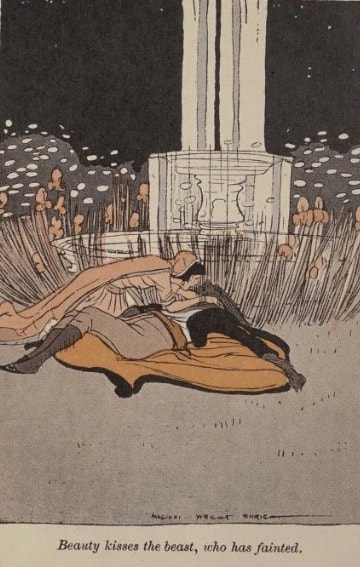
1924 - "The Beast of the Rose Bush/ La fiera del rosal"
Cuentos Populares Españoles
Collected by: Aurelio Macedonio Espinosa Sr
Spanish folktale from the municipality of Almenar, in Soria
Spanish fairy tales, Castilian fairy tales
p. 271-273
ATU-425C
{Gift Rose}
{Beastly Beast}
{Breaks curse - marry him}
[Spanish]
Cuentos Populares Españoles
Collected by: Aurelio Macedonio Espinosa Sr
Spanish folktale from the municipality of Almenar, in Soria
Spanish fairy tales, Castilian fairy tales
p. 271-273
ATU-425C
{Gift Rose}
{Beastly Beast}
{Breaks curse - marry him}
[Spanish]
(Summery)
A king has three daughters, and before leaving for the city, he asks each of them what they want him to bring back. The eldest asks for a dress, the middle daughter a shawl, and the youngest a rose. In the city, the king has no trouble finding gifts for his two eldest daughters, but he can't find a rose. On his way back, he passes a garden full of rosebushes and decides to pick a rose for his youngest daughter. The king dismounts his horse and, after admiring the roses, chooses the one he considers the most beautiful. As soon as he picks it, a wild beast appears and asks him whose permission it is to pick his roses. The king explains everything, and the beast decides to let him go with the rose, but in return, he must return the next day with his youngest daughter. When the king returns to his castle, he distributes the gifts among his daughters and retires to his chambers. Seeing how sad he looks, the youngest daughter approaches him and asks him the reason for his sadness. The king tells her about the deal he made with the wild beast. The princess, after hearing the whole story, tells her father not to worry, because she will go with him. So, the next morning, the king and his daughter go to the garden, but when they arrive, they find no one there. Not wanting to wait outside, father and daughter go inside and find a table set with the most exquisite delicacies. Since they don't see anyone else, they sit down to eat, and when they finish, they go back out into the garden for a walk, but they don't meet anyone. At nightfall, they go back inside and find the table set again. They sit down to dinner, and when they finish, they get up and find rooms prepared for them, with freshly made beds, and they go to sleep in them, still without having seen anyone. The next day, they get up, have breakfast, and after finishing, the king leaves, leaving his daughter alone in the castle. To avoid feeling lonely inside the castle, the princess goes for a walk in the garden, where she finally encounters the beast, who asks her to promise to marry him. At first, she refuses, but in the end, she agrees. The beast takes her inside the castle, where they sit at the table and invisible servants serve them dinner. When they finish eating, the princess goes to bed, and the next morning, when she goes to breakfast, she sees not the beast sitting at the table, but a handsome prince, whom she asks who he is. The prince replies that he was the beast, and that because she had agreed to marry him, he had broken the spell that had held him captive. The prince and princess are married and live happily ever after.
A king has three daughters, and before leaving for the city, he asks each of them what they want him to bring back. The eldest asks for a dress, the middle daughter a shawl, and the youngest a rose. In the city, the king has no trouble finding gifts for his two eldest daughters, but he can't find a rose. On his way back, he passes a garden full of rosebushes and decides to pick a rose for his youngest daughter. The king dismounts his horse and, after admiring the roses, chooses the one he considers the most beautiful. As soon as he picks it, a wild beast appears and asks him whose permission it is to pick his roses. The king explains everything, and the beast decides to let him go with the rose, but in return, he must return the next day with his youngest daughter. When the king returns to his castle, he distributes the gifts among his daughters and retires to his chambers. Seeing how sad he looks, the youngest daughter approaches him and asks him the reason for his sadness. The king tells her about the deal he made with the wild beast. The princess, after hearing the whole story, tells her father not to worry, because she will go with him. So, the next morning, the king and his daughter go to the garden, but when they arrive, they find no one there. Not wanting to wait outside, father and daughter go inside and find a table set with the most exquisite delicacies. Since they don't see anyone else, they sit down to eat, and when they finish, they go back out into the garden for a walk, but they don't meet anyone. At nightfall, they go back inside and find the table set again. They sit down to dinner, and when they finish, they get up and find rooms prepared for them, with freshly made beds, and they go to sleep in them, still without having seen anyone. The next day, they get up, have breakfast, and after finishing, the king leaves, leaving his daughter alone in the castle. To avoid feeling lonely inside the castle, the princess goes for a walk in the garden, where she finally encounters the beast, who asks her to promise to marry him. At first, she refuses, but in the end, she agrees. The beast takes her inside the castle, where they sit at the table and invisible servants serve them dinner. When they finish eating, the princess goes to bed, and the next morning, when she goes to breakfast, she sees not the beast sitting at the table, but a handsome prince, whom she asks who he is. The prince replies that he was the beast, and that because she had agreed to marry him, he had broken the spell that had held him captive. The prince and princess are married and live happily ever after.
|
|
~ 1987 - "The Beast of the Garden/ La fiera del jardín"
Folk tales from Castile and León (Vol 1)/ Cuentos populares de Castilla y León (Vol 1) Author: Aurelio Macedonio Espinosa Jr. From municipality of Sepúlveda, in Segovia Read Here [111.](p. 240-243) {Gift - white flower} {Beastly Beast} {Curse broken - true love, reviving him with water} [Spanish, Spain] |
|
(Full story)
There was a gentleman who was left a widower with one daughter. He entered into a second marriage with another woman, who had two daughters of her own. Now, his own daughter was very beautiful, while his new wife—and her two daughters as well—were very ugly. Consequently, they were consumed by envy of her. The time for the annual fair arrived, and the father was preparing to attend. He called his daughters to him. "Listen here. I am setting off for the fair. What would you like me to bring you back?" One of his stepdaughters replied, "For me, a handkerchief—the most beautiful one you can find." "And for me, the finest fabric for a dress," said the other. Then the father turned to his own daughter, "Come here, my child. And what about you? What would you like me to bring you?" "For me, Father, a white flower." The father looked at her in bewilderment, "My dear girl, what on earth would you do with a white flower? Your stepsisters have asked for sensible things: one wants a handkerchief, the other, fabric for a dress. You, too—ask me for whatever your heart desires! But a white flower... What possible use could you have for a white flower?" His daughter simply replied, "Father, I have already made my request: a white flower." And so, the father departed for the fair. When the time came for him to return home, he purchased the fabric for one stepdaughter and the handkerchief for the other; yet, he completely forgot about the white flower for his own daughter. As he was making his way back home, he came across a garden. Suddenly, he spotted a white flower—and instantly remembered his promise. The good gentleman clambered over the garden wall to pluck one. But just as he was cutting the bloom, a fearsome Beast appeared before him and demanded, "Who gave you permission to do that?" The man explained the situation—telling the Beast the whole story regarding his daughters. The Beast then informed him that he was permitted to take the flower; however, he must return to that very spot within three days so that the Beast could take his life for having had the audacity to trespass into the garden to pluck it. He went home and gave each daughter her gift. And to his daughter, he said, "Here, my daughter, is the white flower you asked for—the very one that will cost me my life." And he told her everything that had happened to him. Her stepsisters immediately began to scold her, saying, "Couldn't you have asked Father for anything other than a flower—something that would cost him his life? Can't you see how the rest of us asked for sensible things—one of us a dress, and another a scarf? But you—why on earth did you ask for a flower? You could just as easily have asked for something else!" "I will not allow my father to give up his life for my sake," the daughter declared. "When the day comes for him to go, I will go with him, and I will take his place." At last, the appointed time arrived, and they set out on their journey. No sooner had they reached the garden than the Beast appeared before them. "I have come to fulfill the promise I made to you," the father said. "But my daughter has come with me... My daughter has come along, and she says that instead of taking my life, you should take hers instead."The Beast spoke to her, "Child, do you come willingly to give up your life for your father?" "Yes, sir."Three times he repeated the question. And each time, he told her, "Do not call me 'sir'; call me 'Beast'."With that, she told her father to leave. And she remained behind. The Beast led her to a room. She could not see who brought her food; she was served all the finest delicacies in the world, yet she never saw who placed the dishes before her or who cleared them away. Night fell, and he led her to a room furnished with a magnificent bed and a rack for hanging her clothes. She lay down and spent the night alone. When the time came to get dressed the next morning, she went to fetch her clothes; but her own garments were no longer on the rack—instead, she found a set of beautiful new clothes, made of the finest materials. They lived together—she and the Beast—and they loved each other like siblings. Then, one day, the Beast asked her, "My dear, would you marry me?"And she replied, "Oh, Beast, you are so ugly!" "Am I really that ugly?" "Yes, Beast, you are very ugly." And so, some time passed. The Beast kept her company in the garden, and whenever her meals—breakfast, lunch, or dinner—were served, he would join her to keep her company. After they had spent some time together and had grown comfortable with one another, she said to the Beast, "If you wish—and if it pleases you—I will write to my parents so they know that I am not dead, that I am alive and well, and that you treat me very kindly. And, if you like, I can tell them that they are welcome to come visit me sometime, or that I might go visit them." As it happened, her parents were planning their annual pig slaughter, so they wrote to the Beast asking if he would be willing to let their daughter go home for the occasion. The Beast said to the young woman, "You may write back and tell them yes. Just have them send word to you on the day of the slaughter so you can go." The day finally arrived, and they sent word for her to come home for the slaughter. The Beast prepared a trunk filled with magnificent clothes and finery for her to take along, so she could show her parents just how well he treated her. Well, as soon as she arrived, she opened the trunk to show them its contents. She began to say, "This dress is for you," she said to one of them. And to the other, "This one is for you." And suddenly, the trunk vanished. Then she said, "I cannot give them to you after all, for the Beast does not wish for me to give them away." And the trunk reappeared. She packed the clothes away once more. And so her father's pig slaughter passed, and then an aunt of hers held a slaughter as well. They wanted her to stay on, but she insisted that she could not—that the Beast had granted her permission only to visit her parents. Finally, however, they persuaded her, and she stayed. And so, the Beast began to pine away, for she had not returned when he had commanded her to do so. He grew so sorrowful that he lay dying beside a fountain in the garden. At last, she returned. She entered the garden, but the Beast did not appear to welcome her. She went to her room; yet that day, no one brought her any food. And the Beast did not reveal himself to her. She began to search for him throughout the garden, and she found him lying at the foot of a fountain, on the verge of death. She began to sprinkle him with water and say, "Do not die, my Beast, for now I truly love you." She repeated these words several times. Thanks to her efforts in reviving him with water, he came to his senses. And instead of a beast, he transformed into a very handsome gentleman. Then the wedding took place, and they were married. And nothing else happened. (Translation by Clark)(PT translation) |
1920 - "Beauty and the Beast"
Author: Elizabeth Tyler Wolcott
Illustrator: Elizabeth Tyler Wolcott
Publisher: The National Child Welfare Association
National Child Welfare Association
{Ogre Beast}
[English, USA]
Author: Elizabeth Tyler Wolcott
Illustrator: Elizabeth Tyler Wolcott
Publisher: The National Child Welfare Association
National Child Welfare Association
{Ogre Beast}
[English, USA]

1925 - "The Enchanted Prince /El Príncipe Encantado"
Porto Rican Folk-Lore; Folk-Tales (Continued) III. Cuentos de Encantamiendo”. In: The Journal of American Folklore 38
Collected : J. Alden Mason & Aurelio M. Espinosa
Puerto Rico folktale,
Read Here [no. 150](p. 608–610)
ATU 425 , ATU 425A, ATU 425B
{Alejandrina - Beauty name}
{Bird Beast}
[English, Puerto Rico]
Porto Rican Folk-Lore; Folk-Tales (Continued) III. Cuentos de Encantamiendo”. In: The Journal of American Folklore 38
Collected : J. Alden Mason & Aurelio M. Espinosa
Puerto Rico folktale,
Read Here [no. 150](p. 608–610)
ATU 425 , ATU 425A, ATU 425B
{Alejandrina - Beauty name}
{Bird Beast}
[English, Puerto Rico]
(Summary)
A girl named Alejandrina has a widowed father that remarries. His new wife has two daughters and she mistreats Alejandrina. One day, her father has to go on a trip, and asks what he can bring them when he returns. His step-daughters ask for dress and a sombrero, while Alejandrina asks for "three roses of Alexandría". Her father loses his way, and an old woman directs him to a garden where he can find the three roses. Alejandrina is given the roses and puts them in a vase. Suddenly, a little bird comes to her and begs her to talk to him. Meanwhile, Alejandrina's step-mother goes to the palace and lies to the king that she boasted she can wash the clothes of the entire army in one night. The king summons Alejandrina and orders her to fulfill the task. The little bird helps her. Next, the step-mother lies that she can find the prince's lost baby blanket. The little bird also produces the blanket. Lastly, the step-mother lies that Alejandrina can find the king's lost ring. Alejandrina goes back home and dresses in black garments. The little bird asks her what is wrong, and the girl tells him she is grieving. The little bird becomes a prince, takes Alejandrina to his father, the king, and marries her. (Wiki)
A girl named Alejandrina has a widowed father that remarries. His new wife has two daughters and she mistreats Alejandrina. One day, her father has to go on a trip, and asks what he can bring them when he returns. His step-daughters ask for dress and a sombrero, while Alejandrina asks for "three roses of Alexandría". Her father loses his way, and an old woman directs him to a garden where he can find the three roses. Alejandrina is given the roses and puts them in a vase. Suddenly, a little bird comes to her and begs her to talk to him. Meanwhile, Alejandrina's step-mother goes to the palace and lies to the king that she boasted she can wash the clothes of the entire army in one night. The king summons Alejandrina and orders her to fulfill the task. The little bird helps her. Next, the step-mother lies that she can find the prince's lost baby blanket. The little bird also produces the blanket. Lastly, the step-mother lies that Alejandrina can find the king's lost ring. Alejandrina goes back home and dresses in black garments. The little bird asks her what is wrong, and the girl tells him she is grieving. The little bird becomes a prince, takes Alejandrina to his father, the king, and marries her. (Wiki)
|
~ 1952 - "Green Bird, Branch of Love/ Pájaro Verde, Ramo de Amor"
Archivos venezolanos de folklore. Vol. 2. Publisher: Instituto de Antropología e Historia, Universidad Central de Venezuela Venezuelan tale Read Here (p. 366-367)(Google Books) {Rosenda - Beauty name} {Pájaro Verde - Beast name} {Gift - three white flowers} {Bird Beast}(Green) [Venezuelan] |
|
(Summary)
A rich man loses his ships, leaving him only one. He plans to go on a business trip, and asks his three daughters where he can get them: the elder asks for a dress, the middle one for a pair of shoes, and the youngest for three white flowers. He searches high and low and finally finds a bush of white flowers. He leans down to get some, and a voice tells him to get only three, and his daughter has but to burn each of them and call for "Pájaro Verde, Ramo de Amor". Rosenda, the man's youngest daughter, gets the flowers and burns one of them; a little bird comes to talk to her, but she remains silent. Rosenda burns the remaining flowers and the bird comes, but she says no word to him. The next morning, her father expels her from home and she has to sell bread for a living, until one day the queen buy some from her and invites her to come to the castle with her. However, a jealous Black slave begins to spread lies about Rosenda: first, the black slave tells the king she can gather all the clothes in the kingdom, wash and iron them. Next, she says Rosenda can get him a plate with tears from all the snakes in the world. Rosenda summons Pájaro Verde to help her in each task. Thirdly, the black slave lies to the king that Rosenda boasted she could get him the "caja de títeres" (box of puppets). Rosenda then summons Pájaro Verde to help her. He comes and, despite her not talking to him, gives her instructions: she is to walk down a certain path until she finds a horse eating bones, and not far behind a dog eating hay; she is give them the correct fodder, then she will come to a house with a fallen door she is to fix, and inside the keeper of the box. Rosenda takes the box with her, despite the keeper commanding the door and the animals to stop her. Lastly, the black slave lies that Rosenda can make the puppets sing and dance for the king. Pájaro Verde comes in and tells her what to do: the monarchs shall walk through the corridor holding candles; Rosenda is to hold one also, next to the window. That same night, they do as the bird instructed. Pájaro Verde perches by the window and says Rosenda's candle looks sad, and she answers that its holder is. The puppets sing and dance; Pájaro Verde turns into a human prince and marries Rosenda. (Wiki) |
|
~ 1985 - "The King's Three Daughters/ Las tres hijas del rey"
Cultura Tradicional Popular Guajira Informant : Juan José Argote Fuentes From Barrancas, La Guajira, in La Guajira Department Collector: Clarivel Ochoa Colombian tale Read Here (ID: 85-41-C. pp. 11-12 (A-Side), 13-14 (B-Side), pp. 11-14) Archived in the Manuel Zapata Olivella Collection of Vanderbilt University Special Collections {Dalsa - Beauty name} {Bird Beast} (Green) |
|
(Summary)
A king has three daughters, Antonia, Cristina and Dalsa. A green bird ("pájaro verde") falls in love with Dalsa and visits her in their garden. One of Dalsa's sisters goes to the king and lies that Dalsa boasted she could wash clothes from the entire city with one bar of soap. Dalsa summons the green bird, who fulfills the task for her. Next, her sister lies that she can go to where God lives and bring back some toys. Dalsa begs for the green bird's help. The green bird comes to her and tells her what she is to do: she must go where God is, enter a escaparate ("cabinet"), get a "cajetilla" ("little box"), and not open it. Dalsa gets the box and escapes with it, but she opens it and "huesitos" ("little bones") jump out of it. She cries for the green bird to help her, he comes and picks up the bones back into the box. Dalsa delivers the little box to her father. Lastly, her sister Cristina declares she wants to marry green bird. Their marriage is arranged and they walk to church, while Dalsa trails behind them with a candle. She says the light of her candle is like her heart, the green bird overhears it and marries Dalsa. |
1925 - "The Black Hand/ La Mano Negra"
Asturian stories: collected from the oral tradition/ Cuentos asturianos: recogidos de la tradición oral
Collected : Aurelio de Llano Roza de Ampudia
Heard it from a 45-year-old shepherdess named Griselda Sánchez, a resident of Tanda, in the municipality of Ponga
Spanish folktale
Read Here [2.](p. 19-22)(Google books)
ATU 425C
{Black Shadow Beast}
[Argentinian Spanish, Argentina]
Asturian stories: collected from the oral tradition/ Cuentos asturianos: recogidos de la tradición oral
Collected : Aurelio de Llano Roza de Ampudia
Heard it from a 45-year-old shepherdess named Griselda Sánchez, a resident of Tanda, in the municipality of Ponga
Spanish folktale
Read Here [2.](p. 19-22)(Google books)
ATU 425C
{Black Shadow Beast}
[Argentinian Spanish, Argentina]
(Summary)
A man has a large family and doesn't earn enough to support them, so one day he sets out to see if he can find a better job and earn more money. Along the way, he meets a gentleman who, after learning of the man's situation, asks him to take stock of everything he owns: his wife, about to have another child; six children; a cow, a sow, and a dog, all also pregnant. The gentleman offers him all the money he wants if the man agrees to give him the first offspring born in his house. The man does the math and concludes that the sow will be the first to give birth, so he has no problem accepting the deal. But when he returns home, laden with money, he discovers that his wife has already given birth, and therefore he will have to hand over his son to the gentleman. When the day arrives to deliver the boy, the man takes his son, who has grown up to become a gallant young man, at the agreed point, a black hand appears, which takes the boy to an enchanted castle. In the castle, the boy doesn't see anyone during the day except the Black Hand who brings him there, who serves him his meals. But every night he notices someone getting into his bed, whom he can't see because he can't turn on any light. One day he asks the Black Hand for permission to visit his parents, and the Hand grants it, but on the condition that he not hug or kiss anyone, and that no one could hug or kiss him either. The boy goes home and doesn't let anyone touch him, but during a moment when he lets his guard down, his grandmother approaches him from behind and kisses him. Before leaving, his grandmother gives him some matches so he can light them and see who is getting into his bed every night. When he returns to the castle, at first everything seems normal, and that night, when he notices someone has gotten into his bed again, the boy lights the matches and discovers a beautiful young woman lying beside him. The girl wakes up and tells him that the boy was about to break the spell, but because of the kiss his grandmother had given him, they were now even more enchanted than before. The young man asks if there isn't any way to fix it, and the girl replies that there is a certain seven-headed serpent that, if you kill it and remove the ball from the largest of its heads, you will be able to break the spell. The boy sets off in search of the snake, and along the way he meets an elephant, a lion, a pigeon and an ant, who are trying to divide the remains of a donkey between them, but they cannot agree. To quiet the discussion, they ask the boy to divide it between them, and the young man gives the hindquarters to the elephant, the forequarters to the lion, the belly to the pigeon and the head to the ant. In thanks, the elephant gives the boy a hair from his head and tells him that if he ever needs it, he just has to say "God and elephant" and he will become one. The lion gives him a hair from his head, and when he wants to become a lion, he will only have to say "God and lion", and he will become one. The dove gives him one of his feathers, so that when he wants to become a feather, he only has to say "God and dove". And the ant, as he can't give him hair or feathers, gives him one of his legs, and every time he wants to become an ant, he will only have to say "God and ant". And to recover his human form, the only thing he needs to do is say "God and man". The young man arrives at the village where the snake lives and asks if any of the houses need a servant. They tell him that yes there is one where the owner has a very large flock of sheep and needs someone to take them out to pasture. The servant goes to the house, and the owner hires him, but warns him that there is a meadow where he must never take the sheep, because that is where the snake lives. The young man leads the flock to the meadow where the snake lives, and as soon as he leaves, he transforms into a lion and then an elephant. He kills the snake and retrieves the ball. The lad returns with the entire flock, to the surprise of all the villagers, and tells his master that he has to leave to attend to some matter. The lad puts on his Sunday best, and once he has left the village, he transforms into a dove and flies to the castle. But all the doors and windows are locked, so to gain entry, he transforms into an ant and slips under the door. When he reaches the girl's room, he returns to human form, and after asking him if he got the ball, she tells him that to break the spell, he only has to throw the ball at the black hand. Once the spell is broken, the lad and the girl get married and stay to live in the castle.
A man has a large family and doesn't earn enough to support them, so one day he sets out to see if he can find a better job and earn more money. Along the way, he meets a gentleman who, after learning of the man's situation, asks him to take stock of everything he owns: his wife, about to have another child; six children; a cow, a sow, and a dog, all also pregnant. The gentleman offers him all the money he wants if the man agrees to give him the first offspring born in his house. The man does the math and concludes that the sow will be the first to give birth, so he has no problem accepting the deal. But when he returns home, laden with money, he discovers that his wife has already given birth, and therefore he will have to hand over his son to the gentleman. When the day arrives to deliver the boy, the man takes his son, who has grown up to become a gallant young man, at the agreed point, a black hand appears, which takes the boy to an enchanted castle. In the castle, the boy doesn't see anyone during the day except the Black Hand who brings him there, who serves him his meals. But every night he notices someone getting into his bed, whom he can't see because he can't turn on any light. One day he asks the Black Hand for permission to visit his parents, and the Hand grants it, but on the condition that he not hug or kiss anyone, and that no one could hug or kiss him either. The boy goes home and doesn't let anyone touch him, but during a moment when he lets his guard down, his grandmother approaches him from behind and kisses him. Before leaving, his grandmother gives him some matches so he can light them and see who is getting into his bed every night. When he returns to the castle, at first everything seems normal, and that night, when he notices someone has gotten into his bed again, the boy lights the matches and discovers a beautiful young woman lying beside him. The girl wakes up and tells him that the boy was about to break the spell, but because of the kiss his grandmother had given him, they were now even more enchanted than before. The young man asks if there isn't any way to fix it, and the girl replies that there is a certain seven-headed serpent that, if you kill it and remove the ball from the largest of its heads, you will be able to break the spell. The boy sets off in search of the snake, and along the way he meets an elephant, a lion, a pigeon and an ant, who are trying to divide the remains of a donkey between them, but they cannot agree. To quiet the discussion, they ask the boy to divide it between them, and the young man gives the hindquarters to the elephant, the forequarters to the lion, the belly to the pigeon and the head to the ant. In thanks, the elephant gives the boy a hair from his head and tells him that if he ever needs it, he just has to say "God and elephant" and he will become one. The lion gives him a hair from his head, and when he wants to become a lion, he will only have to say "God and lion", and he will become one. The dove gives him one of his feathers, so that when he wants to become a feather, he only has to say "God and dove". And the ant, as he can't give him hair or feathers, gives him one of his legs, and every time he wants to become an ant, he will only have to say "God and ant". And to recover his human form, the only thing he needs to do is say "God and man". The young man arrives at the village where the snake lives and asks if any of the houses need a servant. They tell him that yes there is one where the owner has a very large flock of sheep and needs someone to take them out to pasture. The servant goes to the house, and the owner hires him, but warns him that there is a meadow where he must never take the sheep, because that is where the snake lives. The young man leads the flock to the meadow where the snake lives, and as soon as he leaves, he transforms into a lion and then an elephant. He kills the snake and retrieves the ball. The lad returns with the entire flock, to the surprise of all the villagers, and tells his master that he has to leave to attend to some matter. The lad puts on his Sunday best, and once he has left the village, he transforms into a dove and flies to the castle. But all the doors and windows are locked, so to gain entry, he transforms into an ant and slips under the door. When he reaches the girl's room, he returns to human form, and after asking him if he got the ball, she tells him that to break the spell, he only has to throw the ball at the black hand. Once the spell is broken, the lad and the girl get married and stay to live in the castle.
|
~ 1946 - "The Black Hand/ La Mano Negra"
Spanish fairy tales/ Cuentos de hadas españoles Collected : Jr. Aurelio Macedonio Espinosa Spanish folktale from the Tudanca Valley, in Santander Publisher: Espasa-Calpe Argentina Buy Here (Amazon) ATU 425C {Gift Rose} {Bear Beast} [Argentinian Spanish, Argentina] |
|
(Full Story)
A father who has three daughters asks them before going on a trip what they want him to bring, and while the two eldest ask for dresses and cloths, the youngest and most beautiful of the three only asks for a rose. The father sets off and arrives at a castle, where he sees the door is open and enters. Inside, the father sees pots, but when he tries to open them to see what's inside, a black hand appears and takes them away. He also sees food laid out on the table, but when he tries to eat it, the same black hand appears and takes it away as well. Despite this, the man stays in the castle and, after finding a bed made, goes to sleep and spends the night there undisturbed. The next morning, the man looks out from a balcony and sees a rose in the garden so beautiful that he goes down to pick it. But just as he is about to break the stem, he is struck by a blow. An enormous bear appears before him, and the man asks it to let him pick the rose, which is for his youngest daughter. The bear then asks the father how many daughters he has, and the father tells him he has three and what each one had asked for. The bear then agrees to let the man take the rose, but only if he then brings his youngest daughter to the castle to live with him. So that the man returns home with only the rose for his youngest daughter, the bear provides him with cloth and dresses for his two older daughters. The man returns home and divides the gifts among his three daughters, but the youngest notices he is sad and asks him why. The father tells her everything, and she agrees to go live in the castle with the bear. Upon arriving at the castle, the father and the girl are greeted by the bear, and at nightfall, after the father has left, the girl gets into bed. When she sees the bear about to get into the same bed, she tells him not to, that she is very afraid, so the bear doesn't. The same thing happens the second night, but on the third night the bear explains to the girl that he was an enchanted prince, and asks her if she wants to marry him. She says yes, and the bear transforms into a handsome prince, who explains that he had been turned into a bear and that if he hadn't found someone willing to marry him within seven years, he would have remained a bear forever. And the girl and the prince were married. (Translated by GT)(PT Translation) |
1927 - "The merchant and his three daughters/ De koopman en zijn drie dochters"
The Flemish Story Treasure (Vol 2)/De Vlaamsche vertelschat (Deel 2)
Collected by: Victor de Meyere
From Wuustwezel, province of Antwerp
Read Here [CXI.](p. 139-147)(Flemish)
ATU 425C
{Gift red rose}
{Beastly Beast}
{Curse broken - Agrees to marry, and a kiss}
[Flemish Dutch]
The Flemish Story Treasure (Vol 2)/De Vlaamsche vertelschat (Deel 2)
Collected by: Victor de Meyere
From Wuustwezel, province of Antwerp
Read Here [CXI.](p. 139-147)(Flemish)
ATU 425C
{Gift red rose}
{Beastly Beast}
{Curse broken - Agrees to marry, and a kiss}
[Flemish Dutch]
(Differences) **Spoilers**
Closer to Beaumont's plot, the merchant's youngest daughter staying one day more at her family's home and soon returning to the Beast's palace. When she returns, she fears something bad has happened to him. This one is one of the few versions in which the merchant accompanies his daughter back to the Beast's castle. (Wiki)
(Full Story)
Once upon a time there was a merchant who was as rich as the water is deep. He had three daughters; the two eldest were proud and haughty, while the youngest was humility itself. While the two older daughters constantly went to balls and festivities, the youngest devoted herself exclusively to works of charity. One day the merchant had to undertake a long journey. Before leaving, he asked his three children what he should bring them back. The eldest daughter asked for a golden crown, the second for a diamond bracelet. “And you?” the merchant asked his youngest daughter.“You need not spend anything on me, father,” she said. “But if you wish to bring me something, then on your return pluck a beautiful red rose along the way. If you bring me that, I shall be overjoyed.” “I shall do so.” And the merchant departed. The journey lasted long. Instead of settling his affairs in a few weeks, he was gone for three long months. It pained him deeply to be away from his children so long. At last he began his return journey. He traveled from city to city and village to village without staying longer than necessary. In the last city he visited, he bought the golden crown and the diamond bracelet. The rose for his youngest daughter, he thought, he could pluck somewhere along the road. But once on his way, he saw no roses growing anywhere.
On the second-to-last evening of his journey, he took a detour hoping to find a rose. Night fell, and a storm suddenly broke out. Lost and anxious, he spurred his horse forward. Then before him in the darkness rose a brilliantly illuminated castle. He rode toward it. When he rang the bell, the door opened by itself. His horse was unsaddled by invisible hands and led to the stable. In the dining hall stood a delicious supper. He ate and then went to a prepared bedroom. “I shall find a rose in the garden tomorrow,” he thought, and slept soundly. The next morning he walked in the castle garden and saw a large bush of red roses. He plucked the most beautiful one — and at once the ground split open before him and a hideous beast sprang up.
“Ungrateful man,” said the beast in a hollow voice. “I gave you shelter in my castle. I saved you from storm and danger. I gave you food and drink, and now you pluck my most beautiful rose — all my love in this world. Therefore you must die.” The merchant begged forgiveness. He explained that he meant no harm, that his daughter had asked for a red rose, and that he had acted without ill intent. If he must die, he begged leave to return home for a few weeks to settle his affairs. The beast agreed — but only if the merchant’s youngest daughter would take his place as prisoner. After three months, they would decide which of them must die. The merchant gave his word and returned home in great sorrow. He gave his eldest daughter the golden crown, the second the diamond bracelet, and the youngest the plucked rose. “Yes, child,” he said, “that rose will cost me my life.” He told them what had happened. The two older sisters scolded the youngest, saying their father must die because of her whim. But the youngest said firmly, “No. Father shall not die. Tomorrow I will go to the beast. I will ask forgiveness. If I do not obtain it, I will die in his place.” The next morning she and her father went to the castle. Again invisible hands opened the doors and prepared everything. The beast appeared. Though frightening at first, it spoke gently and kindly. It said it would decide after three months. The father eventually left, and the daughter remained. Each day the beast kept her company and spoke kindly — like a well-mannered gentleman. One day it even asked if she would marry him. To save her father, she promised she would. That same evening she saw in a magical mirror that her father had fallen seriously ill. She asked permission to return home for eight days to care for him. The beast allowed it but warned her she must return after eight days or he would not survive. She promised. At home, her father improved when he saw her. The days passed quickly. On the eighth day, her sisters persuaded her to stay one more day. The next morning she felt terrible anxiety and hurried back to the castle. It was dark and silent. They found the beast lying in the garden, apparently dead, holding a rose in his mouth. She wept bitterly. The beast stirred weakly and said, “Why did you stay away so long? Now I must die. Only a kiss from you can save me.” She threw herself upon him and kissed him again and again. Suddenly he rose and transformed into a handsome prince. “My savior! My bride!” he cried. “It was foretold that I would remain a beast until a maiden who wished to be my bride would give me a kiss of love.” Servants reappeared, celebrations followed, and soon there was a grand wedding — and what happened then would take far too long to tell.
(Thank you Clark for the translation)(PT translation)
Closer to Beaumont's plot, the merchant's youngest daughter staying one day more at her family's home and soon returning to the Beast's palace. When she returns, she fears something bad has happened to him. This one is one of the few versions in which the merchant accompanies his daughter back to the Beast's castle. (Wiki)
(Full Story)
Once upon a time there was a merchant who was as rich as the water is deep. He had three daughters; the two eldest were proud and haughty, while the youngest was humility itself. While the two older daughters constantly went to balls and festivities, the youngest devoted herself exclusively to works of charity. One day the merchant had to undertake a long journey. Before leaving, he asked his three children what he should bring them back. The eldest daughter asked for a golden crown, the second for a diamond bracelet. “And you?” the merchant asked his youngest daughter.“You need not spend anything on me, father,” she said. “But if you wish to bring me something, then on your return pluck a beautiful red rose along the way. If you bring me that, I shall be overjoyed.” “I shall do so.” And the merchant departed. The journey lasted long. Instead of settling his affairs in a few weeks, he was gone for three long months. It pained him deeply to be away from his children so long. At last he began his return journey. He traveled from city to city and village to village without staying longer than necessary. In the last city he visited, he bought the golden crown and the diamond bracelet. The rose for his youngest daughter, he thought, he could pluck somewhere along the road. But once on his way, he saw no roses growing anywhere.
On the second-to-last evening of his journey, he took a detour hoping to find a rose. Night fell, and a storm suddenly broke out. Lost and anxious, he spurred his horse forward. Then before him in the darkness rose a brilliantly illuminated castle. He rode toward it. When he rang the bell, the door opened by itself. His horse was unsaddled by invisible hands and led to the stable. In the dining hall stood a delicious supper. He ate and then went to a prepared bedroom. “I shall find a rose in the garden tomorrow,” he thought, and slept soundly. The next morning he walked in the castle garden and saw a large bush of red roses. He plucked the most beautiful one — and at once the ground split open before him and a hideous beast sprang up.
“Ungrateful man,” said the beast in a hollow voice. “I gave you shelter in my castle. I saved you from storm and danger. I gave you food and drink, and now you pluck my most beautiful rose — all my love in this world. Therefore you must die.” The merchant begged forgiveness. He explained that he meant no harm, that his daughter had asked for a red rose, and that he had acted without ill intent. If he must die, he begged leave to return home for a few weeks to settle his affairs. The beast agreed — but only if the merchant’s youngest daughter would take his place as prisoner. After three months, they would decide which of them must die. The merchant gave his word and returned home in great sorrow. He gave his eldest daughter the golden crown, the second the diamond bracelet, and the youngest the plucked rose. “Yes, child,” he said, “that rose will cost me my life.” He told them what had happened. The two older sisters scolded the youngest, saying their father must die because of her whim. But the youngest said firmly, “No. Father shall not die. Tomorrow I will go to the beast. I will ask forgiveness. If I do not obtain it, I will die in his place.” The next morning she and her father went to the castle. Again invisible hands opened the doors and prepared everything. The beast appeared. Though frightening at first, it spoke gently and kindly. It said it would decide after three months. The father eventually left, and the daughter remained. Each day the beast kept her company and spoke kindly — like a well-mannered gentleman. One day it even asked if she would marry him. To save her father, she promised she would. That same evening she saw in a magical mirror that her father had fallen seriously ill. She asked permission to return home for eight days to care for him. The beast allowed it but warned her she must return after eight days or he would not survive. She promised. At home, her father improved when he saw her. The days passed quickly. On the eighth day, her sisters persuaded her to stay one more day. The next morning she felt terrible anxiety and hurried back to the castle. It was dark and silent. They found the beast lying in the garden, apparently dead, holding a rose in his mouth. She wept bitterly. The beast stirred weakly and said, “Why did you stay away so long? Now I must die. Only a kiss from you can save me.” She threw herself upon him and kissed him again and again. Suddenly he rose and transformed into a handsome prince. “My savior! My bride!” he cried. “It was foretold that I would remain a beast until a maiden who wished to be my bride would give me a kiss of love.” Servants reappeared, celebrations followed, and soon there was a grand wedding — and what happened then would take far too long to tell.
(Thank you Clark for the translation)(PT translation)
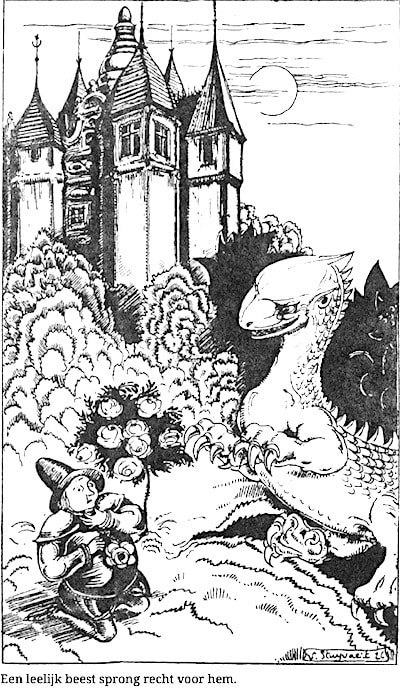
1927 - "Beauty and the Beast/ La Belle et la Bête"
Author: Henry Dérieux
Edited by: Arthème Fayard et Cie Edit
Reimagining
Read Here (p. 122)(Gallica)
[French]
Author: Henry Dérieux
Edited by: Arthème Fayard et Cie Edit
Reimagining
Read Here (p. 122)(Gallica)
[French]
He blends classical and romantic styles, his prose work in this novel explored themes of the supernaturaland the psychological. His version is often cited in academic studies regarding the evolution of the "Beauty and the Beast" myth in 20th-century French literature, predating the famous Jean Cocteau film adaptation by nearly two decades. Dérieux is a sophisticated reimagining that shifts the traditional fairy tale toward a psychological and atmospheric novel. While maintaining the core narrative—a daughter’s sacrifice for her father and her subsequent confinement in a monster's castle—Dérieux infuses the story with the melancholy and stoicism characteristic of his own experiences as a WWI veteran. His version emphasizes the interiority of the characters, focusing less on magical spectacle and more on the emotional weight of their isolation. In this adaptation, the Beast is portrayed with a tragic depth that reflects Dérieux's frequent literary themes of suffering and the struggle with fate. The relationship between Belle and the Beast is built through quiet, tense interactions that explore the boundaries of fear and compassion. Dérieux uses his background as a poet to describe the enchanted estate not just as a setting, but as a symbolic landscape of the soul, where the physical monstrousness of the Beast serves as a mirror for broader human anxieties. The novel concludes by reinforcing the theme of redemption, but it does so through a lens of spiritual and philosophical maturity rather than a simple "happily ever after." By the time the transformation occurs, the focus has shifted entirely to the moral transformation of Belle, who must overcome her own prejudices to see the beauty within. This 1927 work remains a significant bridge between the original 18th-century tales and the modern, more symbolic interpretations that followed in French cinema and literature.
1929 - "The Piqued Buffalo-Wife"
Tales of the North American Indians
Author: Stith Thompson
Wissler and Duvall
Blackfoot tale
Read Here [Chapter VI : Animal Wives And Husbands][LVII.](p. 94-103)(English)
{Beastly Beast}
[English]
Tales of the North American Indians
Author: Stith Thompson
Wissler and Duvall
Blackfoot tale
Read Here [Chapter VI : Animal Wives And Husbands][LVII.](p. 94-103)(English)
{Beastly Beast}
[English]
(Summary)
A man who takes advantage of a buffalo-cow trapped in mire. The buffalo-cow later bears him a son and takes on human form, but her frustration and eventual return to her herd explain the spiritual and precarious relationship between humans and buffalo.
(Full Story)
Once a young man went out and came to a buffalo-cow fast in the mire. He took advantage of her situation. After a time she gave birth to a boy. When he could run about, this boy would go into the Indian camps and join in the games of the children, but would always mysteriously disappear in the evening. One day this boy told his mother that he intended to search among the camps for his father. Not long after this he was playing with the children in the camps as usual, and went into the lodge of a head man in company with a boy of the family. He told this head man that his father lived somewhere in the camp and that he was anxious to find him. The head man took pity on the boy, and sent out a messenger to call into his lodge all the old men in the camp. When these were all assembled and standing around the lodge, the head man requested the boy to pick out his father. The boy looked them over and then told the head man that his father was not among them. Then the head man sent out a messenger to call in all the men next in age but, when these were assembled, the boy said that his father was not among them. Again the head man sent out the messenger to call in all the men of the next rank in age. When they were assembled, the boy looked them over as before, and announced that his father was not among them. So once again the head man sent out his messenger to call in all the young unmarried men of the camp. As they were coming into the head man's lodge, the boy ran to one of them and, embracing him, said, "Here is my father." After a time the boy told his father that he wished to take him to see his mother. The boy said, "When we come near her, she will run at you and hook four times, but you are to stand perfectly still." The next day the boy and his father started out on their journey. As they were going along, they saw a buffalo-cow which immediately ran at them as the boy had predicted. The man stood perfectly still, and at the fourth time, as the cow was running forward to hook at him, she became a woman. Then she went home with her husband and child. One day shortly after their return, she warned her husband that whatever he might do he must never strike at her with fire. They lived together happily for many years. She was a remarkably good woman. One evening when the husband had invited some guests, and the woman expressed a dislike to prepare food for them, he became very angry and, catching up a stick from the fire, struck at her. As he did so, the woman and her child vanished, and the people saw a buffalo cow and calf running from the camp. Now the husband was very sorry and mourned for his wife and child. After a time he went out to search for them. In order that he might approach the buffalo without being discovered, he rubbed himself with filth from a buffalo-wallow. In the course of time he came to a place where some buffalo were dancing. He could hear them from a distance. As he was approaching, he met his son, who was now, as before, a buffalo-calf. The father explained to the boy that he was mourning for him and his mother and that he had come to take them home. The calf-boy explained that this would be very difficult, for his father would be required to pass through an ordeal. The calf-boy explained to him that, when he arrived among the buffalo and inquired for his wife and son, the chief of the buffalo would order that he select his child from among all the buffalo-calves in the herd. Now the calf-boy wished to assist his father, and told him that he would know his child by a sign, because, when the calves appeared before him, his own child would hold up its tail. Then the man proceeded until he came to the place where the buffalo were dancing. Immediately he was taken before the chief of the buffalo-herd. The chief required that he first prove his relationship to the child by picking him out from among all the other calves of the herd. The man agreed to this and the calves were brought up. He readily picked out his own child by the sign. The chief of the buffalo, however, was not satisfied with this proof and said that the father could not have the child until he identified him four times. While the preparations were being made for another test, the calf-boy came to his father and explained that he would be known this time by closing one eye. When the time arrived, the calves were brought as before, and the chief of the buffalo directed the father to identify his child, which he did by the sign. Before the next trial the calf-boy explained to his father that the sign would be one ear hanging down. Accordingly, when the calves were brought up for the father to choose, he again identified his child. Now, before the last trial, the boy came again to his father and notified him that the sign by which he was to be known was dancing and holding up one leg. Now the calf-boy had a chum among the buffalo-calves, and when the calves were called up before the chief so that the father might select his child, the chum saw the calf-boy beginning to dance holding up one leg, and he thought to himself, "He is doing some fancy dancing." So he, also, danced in the same way. Now the father observed that there were two calves giving the sign, and realized that he must make a guess. He did so, but the guess was wrong. Immediately the herd rushed upon the man and trampled him into the dust. Then they all ran away except the calf-boy, his mother, and an old bull. These three mourned together for the fate of the unfortunate man. After a time the old bull requested that they examine the ground to see if they could find a piece of bone. After long and careful search they succeeded in finding one small piece that had not been trampled by the buffalo. The bull took this piece, made a sweat-house, and finally restored the man to life. When the man was restored, the bull explained to him that he and his family would receive some power, some head-dresses, some songs, and some crooked sticks, such as he had seen the buffalo carry in the dance at the time when he attempted to pick out his son. The calf-boy and his mother then became human beings, and returned with the man. It was this man who started the Bull and the Horn Societies, and it was his wife who started the Matoki.
A man who takes advantage of a buffalo-cow trapped in mire. The buffalo-cow later bears him a son and takes on human form, but her frustration and eventual return to her herd explain the spiritual and precarious relationship between humans and buffalo.
(Full Story)
Once a young man went out and came to a buffalo-cow fast in the mire. He took advantage of her situation. After a time she gave birth to a boy. When he could run about, this boy would go into the Indian camps and join in the games of the children, but would always mysteriously disappear in the evening. One day this boy told his mother that he intended to search among the camps for his father. Not long after this he was playing with the children in the camps as usual, and went into the lodge of a head man in company with a boy of the family. He told this head man that his father lived somewhere in the camp and that he was anxious to find him. The head man took pity on the boy, and sent out a messenger to call into his lodge all the old men in the camp. When these were all assembled and standing around the lodge, the head man requested the boy to pick out his father. The boy looked them over and then told the head man that his father was not among them. Then the head man sent out a messenger to call in all the men next in age but, when these were assembled, the boy said that his father was not among them. Again the head man sent out the messenger to call in all the men of the next rank in age. When they were assembled, the boy looked them over as before, and announced that his father was not among them. So once again the head man sent out his messenger to call in all the young unmarried men of the camp. As they were coming into the head man's lodge, the boy ran to one of them and, embracing him, said, "Here is my father." After a time the boy told his father that he wished to take him to see his mother. The boy said, "When we come near her, she will run at you and hook four times, but you are to stand perfectly still." The next day the boy and his father started out on their journey. As they were going along, they saw a buffalo-cow which immediately ran at them as the boy had predicted. The man stood perfectly still, and at the fourth time, as the cow was running forward to hook at him, she became a woman. Then she went home with her husband and child. One day shortly after their return, she warned her husband that whatever he might do he must never strike at her with fire. They lived together happily for many years. She was a remarkably good woman. One evening when the husband had invited some guests, and the woman expressed a dislike to prepare food for them, he became very angry and, catching up a stick from the fire, struck at her. As he did so, the woman and her child vanished, and the people saw a buffalo cow and calf running from the camp. Now the husband was very sorry and mourned for his wife and child. After a time he went out to search for them. In order that he might approach the buffalo without being discovered, he rubbed himself with filth from a buffalo-wallow. In the course of time he came to a place where some buffalo were dancing. He could hear them from a distance. As he was approaching, he met his son, who was now, as before, a buffalo-calf. The father explained to the boy that he was mourning for him and his mother and that he had come to take them home. The calf-boy explained that this would be very difficult, for his father would be required to pass through an ordeal. The calf-boy explained to him that, when he arrived among the buffalo and inquired for his wife and son, the chief of the buffalo would order that he select his child from among all the buffalo-calves in the herd. Now the calf-boy wished to assist his father, and told him that he would know his child by a sign, because, when the calves appeared before him, his own child would hold up its tail. Then the man proceeded until he came to the place where the buffalo were dancing. Immediately he was taken before the chief of the buffalo-herd. The chief required that he first prove his relationship to the child by picking him out from among all the other calves of the herd. The man agreed to this and the calves were brought up. He readily picked out his own child by the sign. The chief of the buffalo, however, was not satisfied with this proof and said that the father could not have the child until he identified him four times. While the preparations were being made for another test, the calf-boy came to his father and explained that he would be known this time by closing one eye. When the time arrived, the calves were brought as before, and the chief of the buffalo directed the father to identify his child, which he did by the sign. Before the next trial the calf-boy explained to his father that the sign would be one ear hanging down. Accordingly, when the calves were brought up for the father to choose, he again identified his child. Now, before the last trial, the boy came again to his father and notified him that the sign by which he was to be known was dancing and holding up one leg. Now the calf-boy had a chum among the buffalo-calves, and when the calves were called up before the chief so that the father might select his child, the chum saw the calf-boy beginning to dance holding up one leg, and he thought to himself, "He is doing some fancy dancing." So he, also, danced in the same way. Now the father observed that there were two calves giving the sign, and realized that he must make a guess. He did so, but the guess was wrong. Immediately the herd rushed upon the man and trampled him into the dust. Then they all ran away except the calf-boy, his mother, and an old bull. These three mourned together for the fate of the unfortunate man. After a time the old bull requested that they examine the ground to see if they could find a piece of bone. After long and careful search they succeeded in finding one small piece that had not been trampled by the buffalo. The bull took this piece, made a sweat-house, and finally restored the man to life. When the man was restored, the bull explained to him that he and his family would receive some power, some head-dresses, some songs, and some crooked sticks, such as he had seen the buffalo carry in the dance at the time when he attempted to pick out his son. The calf-boy and his mother then became human beings, and returned with the man. It was this man who started the Bull and the Horn Societies, and it was his wife who started the Matoki.
1929 - "What happened when : Beauty and the Beast , Lived Happy Ever After"
What happened after stories
Author: Patten Beard
Illustrator : W. Heath Robinson
Read Here (secret ten)(p. 94-103)(Archive)
Book Illustrations Here
{Beastly Beast}
[Slovak]
What happened after stories
Author: Patten Beard
Illustrator : W. Heath Robinson
Read Here (secret ten)(p. 94-103)(Archive)
Book Illustrations Here
{Beastly Beast}
[Slovak]

1930 - "The Rose Bud/ Růžový lístek"
Slovak folk version of the tale
retold in Czech by Božena Němcová
Illustrator : W. Heath Robinson
Translated to English by Eleanor Ledbetter
Read Here (English)(11-15)(Wiki)
{Beastly Beast}
{Gift - a single rose}
{Curse broken - Beauty goes thorugh trials enduring patiently and suffering silently}
{Beastly Beast}
[Slovak]
Slovak folk version of the tale
retold in Czech by Božena Němcová
Illustrator : W. Heath Robinson
Translated to English by Eleanor Ledbetter
Read Here (English)(11-15)(Wiki)
{Beastly Beast}
{Gift - a single rose}
{Curse broken - Beauty goes thorugh trials enduring patiently and suffering silently}
{Beastly Beast}
[Slovak]
(Differences) **spoilers**
In exchanged for the merchant stealing the Beast character's rose he tells merchant the he must bring what ever comes to greets him first when he return home. Beast character lives in a black marble castle. Beauty character has to go through trials and endure. As she does the castle starts to turn white. She doesn't ask to go home to her father nor does she come back late.
(Summary)
A father merchant travels away and asks his daughters what gifts they desire. While the older sisters ask for material luxuries, the youngest daughter asks only for a rosebud. While searching for the rose, the father enters a mysterious, magical garden. He finds the perfect rosebud, but picking it angers the owner of the estate a monster/enchanted creature. To pay for the rose, the father must promise to return with the first thing that greets him at home, which turns out to be his youngest daughter.
Life at the Palace: The daughter goes to live with the creature in a magnificent palace. Despite his appearance, she discovers his kindness. Through her compassion and eventual love, the daughter breaks the curse. The creature is transformed back into a handsome prince, and the story concludes with their marriage.
In exchanged for the merchant stealing the Beast character's rose he tells merchant the he must bring what ever comes to greets him first when he return home. Beast character lives in a black marble castle. Beauty character has to go through trials and endure. As she does the castle starts to turn white. She doesn't ask to go home to her father nor does she come back late.
(Summary)
A father merchant travels away and asks his daughters what gifts they desire. While the older sisters ask for material luxuries, the youngest daughter asks only for a rosebud. While searching for the rose, the father enters a mysterious, magical garden. He finds the perfect rosebud, but picking it angers the owner of the estate a monster/enchanted creature. To pay for the rose, the father must promise to return with the first thing that greets him at home, which turns out to be his youngest daughter.
Life at the Palace: The daughter goes to live with the creature in a magnificent palace. Despite his appearance, she discovers his kindness. Through her compassion and eventual love, the daughter breaks the curse. The creature is transformed back into a handsome prince, and the story concludes with their marriage.
1931 - "Beauty and the Beast/ A Bela e a Fera"
Collected by: Lindolfo Gomes
Publisher: São Paulo: Melhoramentos
Collected from a lady from Cataguases
Read Here (p. 185-188)(Portuguese)
ATU 425C
{Beauty/Bela - Beauty name}
{Gift - be safe and sound when pressed a beautiful rose}
{Beastly Beast}
{Curse broken - kiss}
[Portuguese/ Brazilian]
Collected by: Lindolfo Gomes
Publisher: São Paulo: Melhoramentos
Collected from a lady from Cataguases
Read Here (p. 185-188)(Portuguese)
ATU 425C
{Beauty/Bela - Beauty name}
{Gift - be safe and sound when pressed a beautiful rose}
{Beastly Beast}
{Curse broken - kiss}
[Portuguese/ Brazilian]
(Differences) **spoilers**
The Beauty Character has both parents. The Beast Character has a servant presumed human it doesn't say other wise. The Beast Character tells the Merchant he has to give him the first living creature that greets him at home. When the Beauty Character says she wants to see her father again the Beast Character won't let her go, instead he brings her father to the castle. The father asks ot have his daughter back and the Beast Character says not for all the riches in the world. However the Beast Character says he can visit hsi daughter when ever he wishes. The Beast Character tells the Beauty Character that her eldest sister has just been married, he allows her to go home to visit. The Beauty Character sets the stay as three days not the beast he consents. He tells her not to take the ring he gives her off or she will forget him. The sister takes it and tells her husband, who makes her return it to Beauty.
(Full Story)
Once upon a time, there was a wealthy merchant who had three daughters, each more beautiful than the last. Eventually, he fell into poverty and went to live far from the city, where he could hide the shame of his destitution. The older daughters were deeply saddened by this, for they could no longer sustain the life of luxury they so cherished. The youngest, whose name was Beauty/Bela, accepted her lot with grace and did everything in her power to comfort her elderly father.As it happened, the merchant received news of a profitable venture in a distant land; and so, to try his luck once more, he set out for that place. As he bade his daughters farewell, he asked them what gifts they would like him to bring back, should his business prove successful. The eldest said she wanted a magnificent piano; the middle daughter asked for a silk gown; and the youngest replied that she desired nothing at all—save that he return safe and sound, and grant her his blessing. The father—for this was the daughter he cherished most—urged Beauty to choose a gift for herself as well. And so the young woman said, "Very well, Father, I ask only that you bring me the most beautiful rose from the most beautiful garden you can find." The merchant departed, but his business affairs did not go as he had hoped. He was making his way home, weary and dejected, on a pitch-black night—having all but given up hope of finding a place to rest—when, deep within a forest, he spied a multitude of lights shining brightly. He made his way toward them. It was a magnificent castle. He knocked on the door for a long time, "Hello, anyone home?" - and no one answered. Seeing this, he went inside and searched the whole house, but found no one there.
Finally, he saw a uniformed servant appear, who told him that dinner was on the table. The he went to the dining room and found a perfect banquet there. He ate with appetite. But he did not see the servant again until the servant came to tell him it was time to sleep, then showing him the most beautiful room imaginable. He was very amazed by everything he saw and found it all very mysterious; but, in short, he was tired and sleepy. He fell asleep dreaming of his daughter Beauty. In the morning he got up, ready to continue his journey. He went out to the courtyard to get his horse, but when he saw the castle garden, he immediately remembered Beauty's request, and seeing the most beautiful rose his eyes had ever beheld, he went to pick it. When he held it in his hands, thinking of the joy it would bring to his daughter - suddenly a monster appeared, a horrible beast, saying these words, "Ah! wretch! In return for having sheltered you in my palace, you come to steal my sustenance! Don't you know that I feed only on roses?!" "That I didn't know," replied the merchant, very vexed. "I made a mistake, I confess. But I wanted to take this flower to my youngest daughter, who asked me for the most beautiful rose I could find as a keepsake. I can, however, return it. Here it is." "No; take the flower, but on the condition that you bring me the first creature you see upon your arrive to your house when you return." Having no other choice, the merchant accepted the imposed condition and left with the flower. On the way, he pondered the matter, yet he was certain that everything would turn out well, for the one who always came out to greet him was the little dog of the house. But this time, it did not happen so. Upon his arrival, the first creature he spotted was his daughter Beauty; he handed her the rose, recounting everything that had befallen him and lamenting his misfortune. "Don’t worry about that, Father, for I shall go, and surely the Beast will take pity on us." The very next day, they set off for the castle, where events unfolded just as they had before. When, in the morning, the young woman plucked another rose, the beast appeared; yet she began to admire his beauty and gently caresed him. The beast was appeased, and when the hour of departure arrived, the merchant bade a tearful farewell to his daughter, who remained there to live. Some time later, Beauty expressed a desire to see her father again, but the Beast would not consent to her leaving the premises. Instead, he sent for the old man, who arrived in the blink of an eye. He spent a few days there, and when the time came for him to return home, he asked the Beast to give the girl back to him. The Beast replied that not for all the riches in the world would he give her back, though the merchant was welcome to come and visit his daughter whenever he pleased. As for money, that was no object; he need only go to the treasury and take whatever riches he desired. The merchant returned home a wealthy man. Some time later, the Beast approached the young woman and said to her, "Your eldest sister has just been married." "How do you know this?" Beauty asked. "Would you like to see her?" "Yes, indeed I would." Beauty said. The Beast led her to an enchanted chamber and showed her a mirror, wherein she beheld her sister, arm in arm with her groom, standing alongside their parents and guests. Beauty then asked, with great gentleness, is he would allow her to go home. And the Beast replied, "If I were to let you go, you would never return." The young woman swore she would not be so ungrateful and promised to return after three days. The Beast consented but said to her, "If you do not return within three days, you will find me dead. Take this ring and do not remove it from your finger, for if you take it off, you will forget me." And so the young woman departed, visited her family, told her sisters everything that had transpired, and told them that she felt happy. Her sisters, out of jealousy, hid the ring from her on the night of the third day, and she remembered the Beast no more. The poor creature, as Beauty gradually forgot him, grew increasingly despondent. The married sister confessed to her husband what she had done to her sister, and he—being an upright man—compelled her to return the ring to her sister. No sooner said than done. As soon as the ring was back on her finger, Beauty remembered everything once again. She set off without delay and arrived at the castle exactly three and a half days after she had departed. She searched for the beast through every room, calling out his name many times, but she did not see him again until, at last, she came upon him—nearly dead—lying amidst the grass in the garden. She assumed he was dead, and since she cared for him so deeply, she wanted to kiss him. When she kissed him, the Beast suddenly transformed into a handsome prince. He had been under a spell. With that kiss, Beauty had broken the enchantment, and the prince took her as his bride.
(Translated by Clark)(PT translation)
The Beauty Character has both parents. The Beast Character has a servant presumed human it doesn't say other wise. The Beast Character tells the Merchant he has to give him the first living creature that greets him at home. When the Beauty Character says she wants to see her father again the Beast Character won't let her go, instead he brings her father to the castle. The father asks ot have his daughter back and the Beast Character says not for all the riches in the world. However the Beast Character says he can visit hsi daughter when ever he wishes. The Beast Character tells the Beauty Character that her eldest sister has just been married, he allows her to go home to visit. The Beauty Character sets the stay as three days not the beast he consents. He tells her not to take the ring he gives her off or she will forget him. The sister takes it and tells her husband, who makes her return it to Beauty.
(Full Story)
Once upon a time, there was a wealthy merchant who had three daughters, each more beautiful than the last. Eventually, he fell into poverty and went to live far from the city, where he could hide the shame of his destitution. The older daughters were deeply saddened by this, for they could no longer sustain the life of luxury they so cherished. The youngest, whose name was Beauty/Bela, accepted her lot with grace and did everything in her power to comfort her elderly father.As it happened, the merchant received news of a profitable venture in a distant land; and so, to try his luck once more, he set out for that place. As he bade his daughters farewell, he asked them what gifts they would like him to bring back, should his business prove successful. The eldest said she wanted a magnificent piano; the middle daughter asked for a silk gown; and the youngest replied that she desired nothing at all—save that he return safe and sound, and grant her his blessing. The father—for this was the daughter he cherished most—urged Beauty to choose a gift for herself as well. And so the young woman said, "Very well, Father, I ask only that you bring me the most beautiful rose from the most beautiful garden you can find." The merchant departed, but his business affairs did not go as he had hoped. He was making his way home, weary and dejected, on a pitch-black night—having all but given up hope of finding a place to rest—when, deep within a forest, he spied a multitude of lights shining brightly. He made his way toward them. It was a magnificent castle. He knocked on the door for a long time, "Hello, anyone home?" - and no one answered. Seeing this, he went inside and searched the whole house, but found no one there.
Finally, he saw a uniformed servant appear, who told him that dinner was on the table. The he went to the dining room and found a perfect banquet there. He ate with appetite. But he did not see the servant again until the servant came to tell him it was time to sleep, then showing him the most beautiful room imaginable. He was very amazed by everything he saw and found it all very mysterious; but, in short, he was tired and sleepy. He fell asleep dreaming of his daughter Beauty. In the morning he got up, ready to continue his journey. He went out to the courtyard to get his horse, but when he saw the castle garden, he immediately remembered Beauty's request, and seeing the most beautiful rose his eyes had ever beheld, he went to pick it. When he held it in his hands, thinking of the joy it would bring to his daughter - suddenly a monster appeared, a horrible beast, saying these words, "Ah! wretch! In return for having sheltered you in my palace, you come to steal my sustenance! Don't you know that I feed only on roses?!" "That I didn't know," replied the merchant, very vexed. "I made a mistake, I confess. But I wanted to take this flower to my youngest daughter, who asked me for the most beautiful rose I could find as a keepsake. I can, however, return it. Here it is." "No; take the flower, but on the condition that you bring me the first creature you see upon your arrive to your house when you return." Having no other choice, the merchant accepted the imposed condition and left with the flower. On the way, he pondered the matter, yet he was certain that everything would turn out well, for the one who always came out to greet him was the little dog of the house. But this time, it did not happen so. Upon his arrival, the first creature he spotted was his daughter Beauty; he handed her the rose, recounting everything that had befallen him and lamenting his misfortune. "Don’t worry about that, Father, for I shall go, and surely the Beast will take pity on us." The very next day, they set off for the castle, where events unfolded just as they had before. When, in the morning, the young woman plucked another rose, the beast appeared; yet she began to admire his beauty and gently caresed him. The beast was appeased, and when the hour of departure arrived, the merchant bade a tearful farewell to his daughter, who remained there to live. Some time later, Beauty expressed a desire to see her father again, but the Beast would not consent to her leaving the premises. Instead, he sent for the old man, who arrived in the blink of an eye. He spent a few days there, and when the time came for him to return home, he asked the Beast to give the girl back to him. The Beast replied that not for all the riches in the world would he give her back, though the merchant was welcome to come and visit his daughter whenever he pleased. As for money, that was no object; he need only go to the treasury and take whatever riches he desired. The merchant returned home a wealthy man. Some time later, the Beast approached the young woman and said to her, "Your eldest sister has just been married." "How do you know this?" Beauty asked. "Would you like to see her?" "Yes, indeed I would." Beauty said. The Beast led her to an enchanted chamber and showed her a mirror, wherein she beheld her sister, arm in arm with her groom, standing alongside their parents and guests. Beauty then asked, with great gentleness, is he would allow her to go home. And the Beast replied, "If I were to let you go, you would never return." The young woman swore she would not be so ungrateful and promised to return after three days. The Beast consented but said to her, "If you do not return within three days, you will find me dead. Take this ring and do not remove it from your finger, for if you take it off, you will forget me." And so the young woman departed, visited her family, told her sisters everything that had transpired, and told them that she felt happy. Her sisters, out of jealousy, hid the ring from her on the night of the third day, and she remembered the Beast no more. The poor creature, as Beauty gradually forgot him, grew increasingly despondent. The married sister confessed to her husband what she had done to her sister, and he—being an upright man—compelled her to return the ring to her sister. No sooner said than done. As soon as the ring was back on her finger, Beauty remembered everything once again. She set off without delay and arrived at the castle exactly three and a half days after she had departed. She searched for the beast through every room, calling out his name many times, but she did not see him again until, at last, she came upon him—nearly dead—lying amidst the grass in the garden. She assumed he was dead, and since she cared for him so deeply, she wanted to kiss him. When she kissed him, the Beast suddenly transformed into a handsome prince. He had been under a spell. With that kiss, Beauty had broken the enchantment, and the prince took her as his bride.
(Translated by Clark)(PT translation)
1933 - "Beauty and the Beast"
The Arthur Rackham Fairy Book: A Book of Old Favourites
Original Author: Gabrielle-Suzanne de Villeneuve
Adaptor: Arthur Rackham
Illustrator: Arthur Rackham
Publisher: Philadelphia: J.B. Lippincott Co.
Buy Here ; Rerelease (1986) ISBN-10 : 1851520198 / ISBN-13 : 978-1851520190 (Amazon)
Read Here Here ; Rerelease (1974) (p. 49-65) (Archive)
Rerelease (1978) ISBN 10: 0517242133 / ISBN 13: 9780517242131
ATU 425C
[English, USA]
The Arthur Rackham Fairy Book: A Book of Old Favourites
Original Author: Gabrielle-Suzanne de Villeneuve
Adaptor: Arthur Rackham
Illustrator: Arthur Rackham
Publisher: Philadelphia: J.B. Lippincott Co.
Buy Here ; Rerelease (1986) ISBN-10 : 1851520198 / ISBN-13 : 978-1851520190 (Amazon)
Read Here Here ; Rerelease (1974) (p. 49-65) (Archive)
Rerelease (1978) ISBN 10: 0517242133 / ISBN 13: 9780517242131
ATU 425C
[English, USA]

1978

1935 - "Beauty and the Beast"
Old, Old Fairy Tales
Publisher: Whitman Publishing Company, Racine, Wisconsin, USA
Illustrator: Anne Anderson
Read Here (Google Books)
Buy Here (Amazon)
Book Illustrations Here
ATU 425C
{Reptile Beast}{Beastly Beast}
[English, USA]
Old, Old Fairy Tales
Publisher: Whitman Publishing Company, Racine, Wisconsin, USA
Illustrator: Anne Anderson
Read Here (Google Books)
Buy Here (Amazon)
Book Illustrations Here
ATU 425C
{Reptile Beast}{Beastly Beast}
[English, USA]

1937 - "Wolf of the Greenwood"
Folklore From the Schoharie Hills
Emelyn Elizabeth Garner
New York. Ann Arbor: University of Michigan press, 1937. pp. 112-114
{Wolf Beast}
[Schoharie, New York]
Folklore From the Schoharie Hills
Emelyn Elizabeth Garner
New York. Ann Arbor: University of Michigan press, 1937. pp. 112-114
{Wolf Beast}
[Schoharie, New York]
A woman has three daughters and a "witch chair" to charm possible suitors for her daughters. One man sits on the chair and chooses the youngest. They marry. However, a witch who lives in a castle atop a mountain curses the man into a wolf form during the day. The couple has three children, but a dog sent by the witch takes the children to the husband's brothers, whom the witch cursed not to remember their familial ties to the maiden. The wife visits her brothers-in-law: two give her a magical accordion and a comb; the third advises her to ask a blacksmith to fashion a pair of iron shoes to climb the mountain. She does and meets her husband, who acts as the witch's woodsman, and the witch herself.
1940 - "The Three Gold Nuts"
Collected by: James Taylor Adams
Appalachian tale
Read Here
ATU-425C
{Gift - Roses}
{Bear Beast}(White)
[English], American]
Collected by: James Taylor Adams
Appalachian tale
Read Here
ATU-425C
{Gift - Roses}
{Bear Beast}(White)
[English], American]
(Differences) **Spoilers**
Beast Character tells Beauty Character's Father he must let him have the first thing that greets him when he arrives home in exchange for the roses. The Beauty Character greets her father first. The Father tries to send different animals and the two older daughters before he finally gives the Beast Character hisyoungest daughter. Beauty Character must choose if the Beast Character is a bear at daytime and a man at night or a man at daytime and a bear at night. She choose the bear during the day and the man at night. She later asks to go home to see her family and he goes with her but tells her not to anyone that he can turn into a man. Her family brain washes her into telling the and she does. The Beast Character then has to leave and Beauty Character has to go looking for him.
Beast Character tells Beauty Character's Father he must let him have the first thing that greets him when he arrives home in exchange for the roses. The Beauty Character greets her father first. The Father tries to send different animals and the two older daughters before he finally gives the Beast Character hisyoungest daughter. Beauty Character must choose if the Beast Character is a bear at daytime and a man at night or a man at daytime and a bear at night. She choose the bear during the day and the man at night. She later asks to go home to see her family and he goes with her but tells her not to anyone that he can turn into a man. Her family brain washes her into telling the and she does. The Beast Character then has to leave and Beauty Character has to go looking for him.
|
~ 1994 - "Snowbear Whittington: An Appalachian Beauty and the Beast"
Author : Virginia Hamilt Illustrator : Victoria Lisi Publisher : Simon & Schuster Children's Publishing Appalachian tale ISBN-10 : 0027443558 ISBN-13 : 978-0027443554 Buy Here (Amazon) {Bear Beast} [English, American] |

A retelling of Beauty and the Beast, set against the backdrop of the Smoky Mountains, follows the story of Nell, a beautiful and industrious young woman captured by a huge beast, who is really a bewitched young man forced to live half his time as an animal.
1942 - "The Girl who married a Leopard/ Vom Mädchen das einen Leoparden heiratete"
Märchen in der Balisprache aus dem Grasland von Kamerun
Author: Emmi Meyer
Publisher: Zeitschrift für Eingeborenen-Sprachen
From Nga'ka language in Western Africa
Read Here 32 (2, 3): 149-154 (text for tale nr. 4)(German)(Google books)
Read Here (German)
{Leopard Beast}
[Nga'ka / Africa ; German / Germany]
Märchen in der Balisprache aus dem Grasland von Kamerun
Author: Emmi Meyer
Publisher: Zeitschrift für Eingeborenen-Sprachen
From Nga'ka language in Western Africa
Read Here 32 (2, 3): 149-154 (text for tale nr. 4)(German)(Google books)
Read Here (German)
{Leopard Beast}
[Nga'ka / Africa ; German / Germany]
A king finds a termite and fattens it to use its skin in an engagement riddle for his daughter. A man comes, guesses it is a termite skin and wins the princess. He walks with her and makes her promise not to take any blade with her. He becomes a leopard and takes her to their house. She gives birth to two children, who are taken from her by unknown forces. When she returns to her father, she takes a knife with her to prove if her husband is truly a man. She hurts him and lights a fire in their bedchambers and he disappears.
1946 - "The Maiden and the Beast/ Cizuanton Huan Yolcatl"
Alt name : "The Maiden and the Beast/ La doncella y la fiera"
Cuentos indígenas
Collected by: Pablo González Casanova
Read Here (Nahuatl)
Read Here (Nahuatl)
ATU 425C
{Gift - single flower}
{Beastly Beast}
{Curse Broken - dew from flower in the garden}
[Nahuatl/ Aztec]
Alt name : "The Maiden and the Beast/ La doncella y la fiera"
Cuentos indígenas
Collected by: Pablo González Casanova
Read Here (Nahuatl)
Read Here (Nahuatl)
ATU 425C
{Gift - single flower}
{Beastly Beast}
{Curse Broken - dew from flower in the garden}
[Nahuatl/ Aztec]
(Differences) **Spoilers**
The Beauty Character asks for a single flower not a rose. The Beast Character doesn't show himself to the Beauty Character. The Beast Character leaves a letter telling the Beauty Character she can go home to visit her sisters and father. To go home instead of a ring the Beauty Character has to bite a stick/wand and she is immediately transported to her father's house. the Beauty Character has a dream after Beast dies, instructing her on what to do to save him.
(Full Story)
There once was a merchant who had three little daughters, all very beautiful. Whenever he went to sell goods, he would ask them what they wanted him to bring back; and they would always ask for fine clothing. But one time, the youngest—who was still very small—who didn't want clothing. She only asked for a single flower. So the merchant went off to trade. On the way back, it grew dark, and along the road he saw a light shining in the distance. He went toward it, to where the light was, and arrived there. He knocked, but no one answered. He went inside a stable and saw that there was plenty of horse food.
Then he became sleepy and began to look for a place to sleep, saying,“If someone comes, I will pay him for whatever my horse has eaten.” Then was about to lay down on the ground when he saw a door open. He went inside and found a room with a great deal of food. So he began to eat. After eating he wanted to lie down, when he saw another door open. So he entered and found a very nice bed. He asked himself, “What is going on?” Then he gathered up all his clothes and placed them on a chair, and then he laid down and fell asleep. When he woke up in the morning, he looked for his old clothes—but they were gone. Instead, he saw that there was a set of fine clothing there. He took and put on those new clothes on. And as he was leaving, he saw a table laid with food. He sat down and ate, but as he was finishing eating he still saw no one. Then he said aloud “Now I will go, and I give many thanks.” As he was leaving, he saw many flowers growing. He remembered that his daughter had asked him for a flower, and he said, “I will go and cut a flower.” The moment he picked one, a beast suddenly came out and grabbed him, saying, “And now I will eat you.” The merchant said, “Do not eat me! Look—I only picked this flower because my daughter asked me to bring her one.” The beast said to him, “I will not eat you if you bring me your daughter. In three days you must be here; if you do not return in three days, I will come for you and eat you.” The merchant then left and arrived at his house, very sad. The youngest daughter asked him, “What’s wrong? Are you hurt? Have you lost something? Tell me.” He said, “My child, I do not want to tell you… but listen: I entered a certain house…” Then he told them everything, saying, “You told me to bring you a flower. I picked one, and an angry beast told me that if I did not bring you to him, he would eat me.” The young girl said, “Then let us go, so that he may eat us.” And so they left. But when they arrived, no one was there. Many days passed. Then the father said, “I am going to leave you here; and go to see your sisters.” And so he left her alone. The girl changed clothes every day, but she did not know who was giving them to her. After many days, she heard a voice saying, “Dear lady, I want to eat with you.” She heard this from behind a wooden door. The girl became sad and wanted to go see her father and sisters. One day she got up very early, and saw that there was a letter. In it the beast told her she could go visit her family. It also said that there was a stick/wand on the table and "If you wish to go, just bite this stick/wand, and it will immediately take you home. But you must return in three days. If you do not return in three days, you will you will find me already dead.” And truly, as soon as she bit the stick, she found herself with her father and sisters. But her sisters did not let her return within three days. When she finally returned, the beast had already died. Then the girl began to cry and caress its face, saying, “Why did you die, kind beast?” As she said this, she fell asleep. And in her dream, the beast said to her, “Why did you let the kind beast die?” Then the beast told her, “Cut a flower and sprinkle me on the face with the dew from that flower.” She woke up, cut a flower, and sprinkled its dew on the beast’s face. Immediately, the beast rose up and transformed into a handsome young man—and they were married.
(Translated by CT)(PT Translation)
The Beauty Character asks for a single flower not a rose. The Beast Character doesn't show himself to the Beauty Character. The Beast Character leaves a letter telling the Beauty Character she can go home to visit her sisters and father. To go home instead of a ring the Beauty Character has to bite a stick/wand and she is immediately transported to her father's house. the Beauty Character has a dream after Beast dies, instructing her on what to do to save him.
(Full Story)
There once was a merchant who had three little daughters, all very beautiful. Whenever he went to sell goods, he would ask them what they wanted him to bring back; and they would always ask for fine clothing. But one time, the youngest—who was still very small—who didn't want clothing. She only asked for a single flower. So the merchant went off to trade. On the way back, it grew dark, and along the road he saw a light shining in the distance. He went toward it, to where the light was, and arrived there. He knocked, but no one answered. He went inside a stable and saw that there was plenty of horse food.
Then he became sleepy and began to look for a place to sleep, saying,“If someone comes, I will pay him for whatever my horse has eaten.” Then was about to lay down on the ground when he saw a door open. He went inside and found a room with a great deal of food. So he began to eat. After eating he wanted to lie down, when he saw another door open. So he entered and found a very nice bed. He asked himself, “What is going on?” Then he gathered up all his clothes and placed them on a chair, and then he laid down and fell asleep. When he woke up in the morning, he looked for his old clothes—but they were gone. Instead, he saw that there was a set of fine clothing there. He took and put on those new clothes on. And as he was leaving, he saw a table laid with food. He sat down and ate, but as he was finishing eating he still saw no one. Then he said aloud “Now I will go, and I give many thanks.” As he was leaving, he saw many flowers growing. He remembered that his daughter had asked him for a flower, and he said, “I will go and cut a flower.” The moment he picked one, a beast suddenly came out and grabbed him, saying, “And now I will eat you.” The merchant said, “Do not eat me! Look—I only picked this flower because my daughter asked me to bring her one.” The beast said to him, “I will not eat you if you bring me your daughter. In three days you must be here; if you do not return in three days, I will come for you and eat you.” The merchant then left and arrived at his house, very sad. The youngest daughter asked him, “What’s wrong? Are you hurt? Have you lost something? Tell me.” He said, “My child, I do not want to tell you… but listen: I entered a certain house…” Then he told them everything, saying, “You told me to bring you a flower. I picked one, and an angry beast told me that if I did not bring you to him, he would eat me.” The young girl said, “Then let us go, so that he may eat us.” And so they left. But when they arrived, no one was there. Many days passed. Then the father said, “I am going to leave you here; and go to see your sisters.” And so he left her alone. The girl changed clothes every day, but she did not know who was giving them to her. After many days, she heard a voice saying, “Dear lady, I want to eat with you.” She heard this from behind a wooden door. The girl became sad and wanted to go see her father and sisters. One day she got up very early, and saw that there was a letter. In it the beast told her she could go visit her family. It also said that there was a stick/wand on the table and "If you wish to go, just bite this stick/wand, and it will immediately take you home. But you must return in three days. If you do not return in three days, you will you will find me already dead.” And truly, as soon as she bit the stick, she found herself with her father and sisters. But her sisters did not let her return within three days. When she finally returned, the beast had already died. Then the girl began to cry and caress its face, saying, “Why did you die, kind beast?” As she said this, she fell asleep. And in her dream, the beast said to her, “Why did you let the kind beast die?” Then the beast told her, “Cut a flower and sprinkle me on the face with the dew from that flower.” She woke up, cut a flower, and sprinkled its dew on the beast’s face. Immediately, the beast rose up and transformed into a handsome young man—and they were married.
(Translated by CT)(PT Translation)
1948 - "Belle Rose/ La belle Rose"
Alt Title: "Lovely Rose" , "Belle-Rose" , "The Tale of Beautiful Rose/ Le conte de la Belle Rose"
The Treasury of Tales (Vol 1)/ Le Trésor des Contes (Tome 1)
Collected by: Henri Pourrat
Collected from Auvergne , south-central France
French Fairy Tales
[36.]
Buy Here ; A Treasury of French Tales, translator: Mary Mian (1954)(English)
ATU 425C
{Rose - Beauty name}
{Gift rose}
(Dog Beast}{Reptile Beast}{Beastly Beast}(mastiff jaw, lizard back legs, salamander body)
{Curse Broken - Beast asks Rosa if she realizes that he cannot live without her; she answers yes}
[French, France]
Alt Title: "Lovely Rose" , "Belle-Rose" , "The Tale of Beautiful Rose/ Le conte de la Belle Rose"
The Treasury of Tales (Vol 1)/ Le Trésor des Contes (Tome 1)
Collected by: Henri Pourrat
Collected from Auvergne , south-central France
French Fairy Tales
[36.]
Buy Here ; A Treasury of French Tales, translator: Mary Mian (1954)(English)
ATU 425C
{Rose - Beauty name}
{Gift rose}
(Dog Beast}{Reptile Beast}{Beastly Beast}(mastiff jaw, lizard back legs, salamander body)
{Curse Broken - Beast asks Rosa if she realizes that he cannot live without her; she answers yes}
[French, France]
(Description of Beast)
"The salamander, with its gaping, drooling mouth like a mastiff, the body of a goat, and the legs of a salamander, this spotted creature known as a salamander."
"... big, bulging, bloodshot eyes, its slavering snout, and its skin as pimply as a goose's but slimier than toad's! So disgusting and terrifying was it to look at..."
(Changes) **spoilers**
The Beauty's character (Rose) family is poor, Her mother is still alive. She had two sister not brothers and both her sisters are arrogant. The Beast tells Rose he will not hurt her from the very begining even though her father is skeptical about what the Beast wants his daughter for. The Beast appears when Rose cuts the rose from his bush. The ending is closer to Villeneuve's and Beaumont's versions with Rose rushing back to the castle and finding the Beast lying dying beside a fountain. When the Beast asks if she knows that he can't live without her, Rose answers yes, and the Beast turns into a human. He explains to Rose that he was a prince cursed for mocking a beggar and could only be disenchanted by a poor but kind-hearted maiden. Unlike in Beaumont's version, it is not mentioned that the protagonist's sisters are punished at the end.
(Summary)
A poor peasant has three daughters whom he has named after flowers. The eldest is named Margarita, the middle one Juliana, and the youngest Rosa. One day, before setting off for a great fair being held in the city, he asks them what they would like him to bring them; Margarita asks for a dress the color of the Moon, Juliana for a dress the color of the Sun, and Rosa tells him she wants nothing at all. Since her father tells her he will not leave until she, too, asks for something, the young woman finally tells him that—seeing as her name is Rosa—she would like him to bring her the flower that bears her name. The peasant goes to the fair and buys the dresses for his two eldest daughters, but he cannot find a single rose, so he returns home empty-handed for the youngest. On the way, a terrible blizzard breaks out and night falls, making it impossible for the peasant to continue his journey. Just as the man is about to give up all hope, he spots some lights in the distance; following them, he discovers that they belong to a castle. Finding the gate open, the peasant enters and wanders through the rooms, where he finds no one—though he does come across a table set with food. Famished, the man sits down to eat; upon finishing, he proceeds to another room and climbs into bed. The following morning, after waking up, the peasant sets out in search of the castle's owners to thank them. Near the gate, he discovers a rosebush where—despite the previous night's blizzard—beautiful red roses have bloomed. The peasant plucks one, and instantly a terrible Beast appears—possessing the jaws of a mastiff and the legs of a lizard—threatening to kill him for stealing his roses. Trembling with fear, the peasant proposes a trade to the Beast. The Beast asks him how many daughters he has; when the peasant replies that he has three, the Beast declares that one of them must agree to come and live in his castle. Before the peasant can offer a reply, the Beast vanishes. The peasant returns home and distributes the gifts among his daughters, telling Rosa—as he hands her hers—that it cost him more than her sisters' dresses. He then recounts the bargain he struck with the Beast; upon hearing this, both Margarita and Juliana refuse to go with the Beast, with Juliana going so far as to insist that Rosa go instead, since it was her request that had landed them in this predicament. Rosa agrees to go to the Beast's castle herself, and her father takes her there. At the castle, they find all the doors standing open; when the young woman spots the rosebush, she plucks another rose, and instantly the Beast appears before her. The Beast asks Rosa if it is truly she, and informs her that her father is permitted to spend three nights at the castle with her, after which he must depart and leave her behind. However, should she ever desire company, she need only pluck a rose from the rosebush. Having said this, the Beast vanishes. Once the three days have passed, the peasant departs from the Beast's castle. Rosa spends her days in the Beast's company, but as she is unhappy, the Beast grants her three days to go and visit her family. Rosa goes, and the three days fly by in an instant. Her parents do not want her to leave, but Rosa ultimately returns to the Beast's castle just as the sun is setting. Upon her arrival, she finds the rosebush completely withered; she plucks a rose, but the Beast does not appear. Rosa begins searching for him throughout the garden and finally finds him lying near a fountain, on the verge of death. With his last remaining strength, the Beast asks Rosa if she realizes that he cannot live without her; when the young woman answers yes, the Beast transforms into a handsome young man. He explains to Rosa that he was a prince who had been turned into a Beast for mocking a beggar who came to his door asking for alms, and that he could only be freed from the spell by a humble young woman with a good heart. The rosebush bloomed once more, Rosa's parents and siblings appeared, and the young woman married the prince.
"The salamander, with its gaping, drooling mouth like a mastiff, the body of a goat, and the legs of a salamander, this spotted creature known as a salamander."
"... big, bulging, bloodshot eyes, its slavering snout, and its skin as pimply as a goose's but slimier than toad's! So disgusting and terrifying was it to look at..."
(Changes) **spoilers**
The Beauty's character (Rose) family is poor, Her mother is still alive. She had two sister not brothers and both her sisters are arrogant. The Beast tells Rose he will not hurt her from the very begining even though her father is skeptical about what the Beast wants his daughter for. The Beast appears when Rose cuts the rose from his bush. The ending is closer to Villeneuve's and Beaumont's versions with Rose rushing back to the castle and finding the Beast lying dying beside a fountain. When the Beast asks if she knows that he can't live without her, Rose answers yes, and the Beast turns into a human. He explains to Rose that he was a prince cursed for mocking a beggar and could only be disenchanted by a poor but kind-hearted maiden. Unlike in Beaumont's version, it is not mentioned that the protagonist's sisters are punished at the end.
(Summary)
A poor peasant has three daughters whom he has named after flowers. The eldest is named Margarita, the middle one Juliana, and the youngest Rosa. One day, before setting off for a great fair being held in the city, he asks them what they would like him to bring them; Margarita asks for a dress the color of the Moon, Juliana for a dress the color of the Sun, and Rosa tells him she wants nothing at all. Since her father tells her he will not leave until she, too, asks for something, the young woman finally tells him that—seeing as her name is Rosa—she would like him to bring her the flower that bears her name. The peasant goes to the fair and buys the dresses for his two eldest daughters, but he cannot find a single rose, so he returns home empty-handed for the youngest. On the way, a terrible blizzard breaks out and night falls, making it impossible for the peasant to continue his journey. Just as the man is about to give up all hope, he spots some lights in the distance; following them, he discovers that they belong to a castle. Finding the gate open, the peasant enters and wanders through the rooms, where he finds no one—though he does come across a table set with food. Famished, the man sits down to eat; upon finishing, he proceeds to another room and climbs into bed. The following morning, after waking up, the peasant sets out in search of the castle's owners to thank them. Near the gate, he discovers a rosebush where—despite the previous night's blizzard—beautiful red roses have bloomed. The peasant plucks one, and instantly a terrible Beast appears—possessing the jaws of a mastiff and the legs of a lizard—threatening to kill him for stealing his roses. Trembling with fear, the peasant proposes a trade to the Beast. The Beast asks him how many daughters he has; when the peasant replies that he has three, the Beast declares that one of them must agree to come and live in his castle. Before the peasant can offer a reply, the Beast vanishes. The peasant returns home and distributes the gifts among his daughters, telling Rosa—as he hands her hers—that it cost him more than her sisters' dresses. He then recounts the bargain he struck with the Beast; upon hearing this, both Margarita and Juliana refuse to go with the Beast, with Juliana going so far as to insist that Rosa go instead, since it was her request that had landed them in this predicament. Rosa agrees to go to the Beast's castle herself, and her father takes her there. At the castle, they find all the doors standing open; when the young woman spots the rosebush, she plucks another rose, and instantly the Beast appears before her. The Beast asks Rosa if it is truly she, and informs her that her father is permitted to spend three nights at the castle with her, after which he must depart and leave her behind. However, should she ever desire company, she need only pluck a rose from the rosebush. Having said this, the Beast vanishes. Once the three days have passed, the peasant departs from the Beast's castle. Rosa spends her days in the Beast's company, but as she is unhappy, the Beast grants her three days to go and visit her family. Rosa goes, and the three days fly by in an instant. Her parents do not want her to leave, but Rosa ultimately returns to the Beast's castle just as the sun is setting. Upon her arrival, she finds the rosebush completely withered; she plucks a rose, but the Beast does not appear. Rosa begins searching for him throughout the garden and finally finds him lying near a fountain, on the verge of death. With his last remaining strength, the Beast asks Rosa if she realizes that he cannot live without her; when the young woman answers yes, the Beast transforms into a handsome young man. He explains to Rosa that he was a prince who had been turned into a Beast for mocking a beggar who came to his door asking for alms, and that he could only be freed from the spell by a humble young woman with a good heart. The rosebush bloomed once more, Rosa's parents and siblings appeared, and the young woman married the prince.
|
~ 1989 - "Lovely Rose/ La belle Rose"
Alt Title: "Lovely Rose" & "Belle-Rose" The Treasury of Tales/ Le Trésor des Contes Collected : Henri Pourrat From Auvergne , south-central France Buy Here ; French Folktales, translator: Royall Tyler (1989)[99.](p. 447-456)(English) Read Here ; French Folktales, translator: Royall Tyler (1989)[99.](p. 447-456)(English)(Archive) ATU 425C {Rose - Beauty name} {Dog Beast}{Reptile Beast}{Beastly Beast} {Curse broken - Gesture of loving charity} [English] |
|
(Description of Beast)
"The salamander, with its gaping, drooling mouth like a mastiff, the body of a goat, and the legs of a salamander, this spotted creature known as a salamander." "... big, bulging, bloodshot eyes, its slavering snout, and its skin as pimply as a goose's but slimier than toad's! So disgusting and terrifying was it to look at..." (Differences) The Beauty's character (Rose) family is poor, Her mother is still alive. She had two sister not brothers and both her sisters are arrogant. The Beast tells Rose he will not hurt her from the very begining even though her father is skeptical about what the Beast wants his daughter for. The Beast appears when Rose cuts the rose from his bush. |


1953 - "Gift to the Youngest Daughter"
Modern Greek folktales
Author: R. M. Dawkins , (Richard McGillivray Dawkins)
Publisher: Oxford, England: Clarendon Press
Read Here [15.](p. 81-82)(Archive)
ATU 425C
{Gift - flower}
{Beastly Beast}
{Curse broken - embrassed & kissed}
[Greece]
Modern Greek folktales
Author: R. M. Dawkins , (Richard McGillivray Dawkins)
Publisher: Oxford, England: Clarendon Press
Read Here [15.](p. 81-82)(Archive)
ATU 425C
{Gift - flower}
{Beastly Beast}
{Curse broken - embrassed & kissed}
[Greece]
1953 - "Princess's Kerchief"
Modern Greek folktales
Author: R. M. Dawkins , (Richard McGillivray Dawkins)
Publisher: Oxford, England: Clarendon Press
Orginally from "Forty-five Stories" by Jacob Zarraftis, 1950 [33.]
Read Here [16.](p. 81-88)(Archive)
ATU 425F
{Bird Beast}(Crane & dervish)
[Greece]
Modern Greek folktales
Author: R. M. Dawkins , (Richard McGillivray Dawkins)
Publisher: Oxford, England: Clarendon Press
Orginally from "Forty-five Stories" by Jacob Zarraftis, 1950 [33.]
Read Here [16.](p. 81-88)(Archive)
ATU 425F
{Bird Beast}(Crane & dervish)
[Greece]
1954 - "Beauty and the Beast"
Classics Illustrated Junior #509
Author: Charles Perraul
Publisher: Gilberton
Comic Book
ISBN:1894998227
Read Here
Book Illustrations Here
{Lion Beast}
[English]
Classics Illustrated Junior #509
Author: Charles Perraul
Publisher: Gilberton
Comic Book
ISBN:1894998227
Read Here
Book Illustrations Here
{Lion Beast}
[English]

1955 - "The Tale of Cupid and Psyche (Aarne-Thompson 425 & 428)"
Author: Jan Öjvind Swahn
Publisher: Lund: C.W.K. Gleerup
Try Ebay, Abe Books
[English]
Author: Jan Öjvind Swahn
Publisher: Lund: C.W.K. Gleerup
Try Ebay, Abe Books
[English]
The book covers over 1000 versions
1957 - "The Hunchback and Marietta/ El geperut i la Marieta"
Alt Titles: "It's black/ Es Negret" (Spanish Mallorcan tale, compiled by Antoni Maria Alcover), "The Hunchback and the Mariette/ Le Bossu et la Mariette" (French)
Folklore de Catalunya: Rondallística
Alt title : "Le Bossu et la Mariette"
Original Author: Joan Amades
Translator: Soledad Estorach & Michel Lequenne (French)
Publisher: Paris: Érasme
Catalan tale
[66.]
Read Here "Le Bossu et la Mariette" in Contes Catalans , by Amades [XVII](p. 196-206)(272 classification)(French)
ATU 425B
{Marietta - Beauty name}
{Bird Beast} (green)
[French]
Alt Titles: "It's black/ Es Negret" (Spanish Mallorcan tale, compiled by Antoni Maria Alcover), "The Hunchback and the Mariette/ Le Bossu et la Mariette" (French)
Folklore de Catalunya: Rondallística
Alt title : "Le Bossu et la Mariette"
Original Author: Joan Amades
Translator: Soledad Estorach & Michel Lequenne (French)
Publisher: Paris: Érasme
Catalan tale
[66.]
Read Here "Le Bossu et la Mariette" in Contes Catalans , by Amades [XVII](p. 196-206)(272 classification)(French)
ATU 425B
{Marietta - Beauty name}
{Bird Beast} (green)
[French]
(Summery)
A poor woman and her daughter are starving and decide to pluck some figs from a fig tree guarded by an evil-looking old hunchback. One day, they are stealing the figs, when, fearing for the hunchback, the woman tells her daughter to bury her near the tree, leaving only her ear visible, and flee, and only return after the hunchback is not in sight. The girl does as asked and leaves her mother there. The hunchback pulls out the woman by the ear, thinking it is a mushroom, and the woman begs for forgiveness. The hunchback agrees, but makes a deal with her: he will return in a year and a day to take Marietta with him. After a year and a day, when Marietta is walking back home, she is approached by the hunchback, who tells her to remind her mother of their deal. After three days, Marietta's mother agrees to surrender the girl to the hunchback. The hunchback then takes Marietta to a mansion where seven women live with a daughter, to be their servant. The hunchback also tells Marietta can summon his help by sitting in the shade of three pine trees. The women then order Marietta to bring water from the Seven Fountains, for Pétronille (Petronella, in the Catalan text) to wash her face.Marietta does not know where to go to find the Seven Fountains, and summons the hunchback by sitting near the pine tree. The hunchback appears, is told about the task, then provides her with the water. For the next task, the old women give Marietta a bag full of dark wool, which she is to wash white. The girl summons the hunchback, who takes the bag of wool, goes to the river, and returns with white wool. The ladies, noticing that Marietta is performing the tasks, decide to give her a truly impossible one: going to their aunt Maria and fetch the chalumeau for Pétronille's wedding. The hunchback is summoned again and advises Marietta how to proceed: ask a river if it wants to wash the clothes of king Jeannet; ask a wall of brambles if it wants to dry the clothes of king Jeannet, throw a calabash filled with milk to a den of serpents, throw a handful of dry earth to some frogs; grease the hinges of two large doors; enter a manor, enter a large dining room, but eat nothing, steal a little box ("cassette"), grab a bread from the table and toss it to a dog, and rush back without opening the box. Mariette goes back to the seven ladies' mansion to fetch the provisions (a calabash with milk, dry earth and grease), then makes her way to Midi: she asks the river like the hunchback taught her, and it opens up to let her pass, just as she the wall of brambles; she then gives the milk to the snakes and the dry earth to the frogs, greases the doors, enters the manor and fetches the box. Suddenly, a dog appears to stop Marietta, but she tosses a bread from the dining room table to the dog. Marietta rushes back with the box, as the dog commands the doors, the frogs and the snakes to stop her, to no avail. After crossing the river and the bramble, Marietta stops to rest, and decides to look into the box: she opens its lid and a green bird flies out of it. The hunchback appears to her and chastises for opening the box, then says he must grab the bird, for it will save them both, if Marietta listens to its instructions. The hunchback captures the bird and gives it to Marietta, who promptly delivers it to the ladies. Later that night, the ladies orders Marietta to set the table for the upcoming feast, when the bird reminds the girl she forgot the salt shaker, which she also places on the table. The green bird also tells Marietta she will be brought to the henhouse to guess which rooster crowed, to mark Pétronille's wedding hour, but she is not to answer anything. It happens thus, and Marietta is brought to the henhouse with a creuset (a type of torch), and she listens to the crowing of the roosters in silent. The following morning, the youngest of the seven ladies, pitying Marietta, asks her niece Pétronille to cover for the girl, and replace her in holding the torch inside the henhouse. Pétronille obeys and replaces Mariette in holding up the torch. Meanwhile, the oldest of the ladies, who is Pétronille's mother, utters a spell so that the person holding up the torch dies. To her surprise, Pétronille drops dead. Her mother, realizing her mistake, grabs Marietta's neck to break it, but the hunchback appears behind the lady and wrings her neck, rescuing Marietta. Suddenly, thunder erupts, the earth shakes, and the manor with the seven ladies disappears. The hunchback turns back into a handsome prince, who tells Marietta the ladies cursed him into the form, and he would only be released if Pétronille and her mother died. Marietta agrees to marry the prince.
(Wiki)
A poor woman and her daughter are starving and decide to pluck some figs from a fig tree guarded by an evil-looking old hunchback. One day, they are stealing the figs, when, fearing for the hunchback, the woman tells her daughter to bury her near the tree, leaving only her ear visible, and flee, and only return after the hunchback is not in sight. The girl does as asked and leaves her mother there. The hunchback pulls out the woman by the ear, thinking it is a mushroom, and the woman begs for forgiveness. The hunchback agrees, but makes a deal with her: he will return in a year and a day to take Marietta with him. After a year and a day, when Marietta is walking back home, she is approached by the hunchback, who tells her to remind her mother of their deal. After three days, Marietta's mother agrees to surrender the girl to the hunchback. The hunchback then takes Marietta to a mansion where seven women live with a daughter, to be their servant. The hunchback also tells Marietta can summon his help by sitting in the shade of three pine trees. The women then order Marietta to bring water from the Seven Fountains, for Pétronille (Petronella, in the Catalan text) to wash her face.Marietta does not know where to go to find the Seven Fountains, and summons the hunchback by sitting near the pine tree. The hunchback appears, is told about the task, then provides her with the water. For the next task, the old women give Marietta a bag full of dark wool, which she is to wash white. The girl summons the hunchback, who takes the bag of wool, goes to the river, and returns with white wool. The ladies, noticing that Marietta is performing the tasks, decide to give her a truly impossible one: going to their aunt Maria and fetch the chalumeau for Pétronille's wedding. The hunchback is summoned again and advises Marietta how to proceed: ask a river if it wants to wash the clothes of king Jeannet; ask a wall of brambles if it wants to dry the clothes of king Jeannet, throw a calabash filled with milk to a den of serpents, throw a handful of dry earth to some frogs; grease the hinges of two large doors; enter a manor, enter a large dining room, but eat nothing, steal a little box ("cassette"), grab a bread from the table and toss it to a dog, and rush back without opening the box. Mariette goes back to the seven ladies' mansion to fetch the provisions (a calabash with milk, dry earth and grease), then makes her way to Midi: she asks the river like the hunchback taught her, and it opens up to let her pass, just as she the wall of brambles; she then gives the milk to the snakes and the dry earth to the frogs, greases the doors, enters the manor and fetches the box. Suddenly, a dog appears to stop Marietta, but she tosses a bread from the dining room table to the dog. Marietta rushes back with the box, as the dog commands the doors, the frogs and the snakes to stop her, to no avail. After crossing the river and the bramble, Marietta stops to rest, and decides to look into the box: she opens its lid and a green bird flies out of it. The hunchback appears to her and chastises for opening the box, then says he must grab the bird, for it will save them both, if Marietta listens to its instructions. The hunchback captures the bird and gives it to Marietta, who promptly delivers it to the ladies. Later that night, the ladies orders Marietta to set the table for the upcoming feast, when the bird reminds the girl she forgot the salt shaker, which she also places on the table. The green bird also tells Marietta she will be brought to the henhouse to guess which rooster crowed, to mark Pétronille's wedding hour, but she is not to answer anything. It happens thus, and Marietta is brought to the henhouse with a creuset (a type of torch), and she listens to the crowing of the roosters in silent. The following morning, the youngest of the seven ladies, pitying Marietta, asks her niece Pétronille to cover for the girl, and replace her in holding the torch inside the henhouse. Pétronille obeys and replaces Mariette in holding up the torch. Meanwhile, the oldest of the ladies, who is Pétronille's mother, utters a spell so that the person holding up the torch dies. To her surprise, Pétronille drops dead. Her mother, realizing her mistake, grabs Marietta's neck to break it, but the hunchback appears behind the lady and wrings her neck, rescuing Marietta. Suddenly, thunder erupts, the earth shakes, and the manor with the seven ladies disappears. The hunchback turns back into a handsome prince, who tells Marietta the ladies cursed him into the form, and he would only be released if Pétronille and her mother died. Marietta agrees to marry the prince.
(Wiki)
1958 - "Having a Bird Skin/ Имеющий птичью оболочку" (#7)
"The Bewitched Corpse: Mongol-Oirat Fairy Tales/ Волшебный мертвец. Монгольско-ойратские сказки"
Author: Boris Ya. Vladimirtsov/ Борис Владимирцов
Publisher: Oriental Literature Publishing House/ Издательство восточной литературы
[Russian, Mongol-Oirat]
"The Bewitched Corpse: Mongol-Oirat Fairy Tales/ Волшебный мертвец. Монгольско-ойратские сказки"
Author: Boris Ya. Vladimirtsov/ Борис Владимирцов
Publisher: Oriental Literature Publishing House/ Издательство восточной литературы
[Russian, Mongol-Oirat]
A man and his three daughters live in a place called Jirgalangiin-ӧy. Later in the tale, the youngest daughter marries the bird and burns his birdskin to keep him human forever, but he explains to her that his life was in the birdskin.
1959 - "Beauty and the Beast"
"The Blue Book of Fairy Tales"
Illustrator: Gordon Laite
Publisher:
Read Here
Buy Here (Amazon)
Book Illustrations Here
{Beastly Beast}
[English]
"The Blue Book of Fairy Tales"
Illustrator: Gordon Laite
Publisher:
Read Here
Buy Here (Amazon)
Book Illustrations Here
{Beastly Beast}
[English]

1967 - "Beauty and the Beast"
Dean's Gift Book of Fairy Tales
Illustrator: Janet Grahame Johnstone and Anne Grahame Johnstone
Try Ebay, Etsy, Abebooks
Book Illustrations Here
{Lion Beast}{Tiger Beast}
[English]
Dean's Gift Book of Fairy Tales
Illustrator: Janet Grahame Johnstone and Anne Grahame Johnstone
Try Ebay, Etsy, Abebooks
Book Illustrations Here
{Lion Beast}{Tiger Beast}
[English]
1972 - "Beauty and the Beast"
1st edition
Retelling by: Philippa Pearce
Illustrator: Alan Barrett
Publisher: Longman Young Books, London
ISBN 10: 0582152704 / ISBN 13: 9780582152700
Try Abe books Here or Ebay
Book Illustrations Here
ATU 425C
{Beastly Beast}
[English]
1st edition
Retelling by: Philippa Pearce
Illustrator: Alan Barrett
Publisher: Longman Young Books, London
ISBN 10: 0582152704 / ISBN 13: 9780582152700
Try Abe books Here or Ebay
Book Illustrations Here
ATU 425C
{Beastly Beast}
[English]


|
1973 - "The Girl Who Wanted a Flower / Dekle, ki je hotela rožico"
Little Beasts from Resia/ Zverinice iz Rezije ; Printed by Milko Matičetov
Author: Tina Wajtawa/ Tina Vajtova (Valentina Pielich)
Illustrator: Luisa Tomasetig
From Resia, Julian Alps
Originally narrated in 1968
More info buy Here
ATU 425C
{Bear Beast}
[Slovenian/ Resian dialect]
Little Beasts from Resia/ Zverinice iz Rezije ; Printed by Milko Matičetov
Author: Tina Wajtawa/ Tina Vajtova (Valentina Pielich)
Illustrator: Luisa Tomasetig
From Resia, Julian Alps
Originally narrated in 1968
More info buy Here
ATU 425C
{Bear Beast}
[Slovenian/ Resian dialect]

A father prepares to go on a trip and asks his daughters what gifts they want him to bring back. While the older daughters request expensive or lavish items, the youngest and most beautiful daughter requests a simple, specific flower. The father finds the flower growing in a mysterious garden. When he plucks it, a beast (or monstrous figure) appears, furious that his property was taken. To spare his life, the father is forced to promise his youngest daughter to the beast. The daughter willingly goes to live in the beast's enchanted domain to save her father. She discovers that despite his terrifying appearance, the beast treats her with deep kindness and care. Through her loyalty, love, and ability to look past outer appearances, the curse is broken. The beast is transformed back into a handsome prince, ending the story happily.
1968 - "Beauty and the Beast"
Stories to Share ; A Storyteller Book
Retelling by: Lesley Young
Illustrator: Annabel Spenceley
Pages 51
Publisher : Smithmark Pub
ISBN-10 : 0831717181
ISBN-13 : 978-0831717186
Buy Here & Here (Amazon)
ATU 425c
{Beastly Beast}
[English]
Stories to Share ; A Storyteller Book
Retelling by: Lesley Young
Illustrator: Annabel Spenceley
Pages 51
Publisher : Smithmark Pub
ISBN-10 : 0831717181
ISBN-13 : 978-0831717186
Buy Here & Here (Amazon)
ATU 425c
{Beastly Beast}
[English]

1968 - "The Beast"
Folktales of France
Translator: Jacqueline Hyland
Editor : Geneviève Massignon
Publisher: University of Chicago Press
Folktales of France (Upper Brittany)
Read Here [9.](p. 39-43)(Archive)
ATU 425
{Beastly Beast}
{Curse broken - agrees to marry him}
[English, France]
Folktales of France
Translator: Jacqueline Hyland
Editor : Geneviève Massignon
Publisher: University of Chicago Press
Folktales of France (Upper Brittany)
Read Here [9.](p. 39-43)(Archive)
ATU 425
{Beastly Beast}
{Curse broken - agrees to marry him}
[English, France]
(Differences) **Spoilers**
The story start with the Beast Character being cursed. No merchant asks what gift he can bring his daughters the three girls are playing and the youngest gets irritated with her sisters and goes wondering off to find the Beast Character's castle. the story continues after the Beast turns back into the prince and marries with the Beauty Character, she then goes back home to say hello to her sisters and the Beast Character going to look for his parents. Before he leaves he tells her to lock up his skin in wardrobe and not to let water drop on it. The sisters conspire to throw the skin in water basin. The Beast Character now has ot leave the castle and turns the two sisters into a doorjams and has to leave but lets the Beauty Character stay in the castle. The Beast Character gives her gifts and tells she has to find him, she drops three drops of blood on his shirt saying she is the only one who can remove it. Classic Beauty and the Beast tale mixed with the Search for the Lost Husband.
The story start with the Beast Character being cursed. No merchant asks what gift he can bring his daughters the three girls are playing and the youngest gets irritated with her sisters and goes wondering off to find the Beast Character's castle. the story continues after the Beast turns back into the prince and marries with the Beauty Character, she then goes back home to say hello to her sisters and the Beast Character going to look for his parents. Before he leaves he tells her to lock up his skin in wardrobe and not to let water drop on it. The sisters conspire to throw the skin in water basin. The Beast Character now has ot leave the castle and turns the two sisters into a doorjams and has to leave but lets the Beauty Character stay in the castle. The Beast Character gives her gifts and tells she has to find him, she drops three drops of blood on his shirt saying she is the only one who can remove it. Classic Beauty and the Beast tale mixed with the Search for the Lost Husband.
1978 - "Beauty and the Beast"
Original Author : Charles Perrault
Retold: David Chestnutt (based off of Perrault)
Illustrator: David Chestnutt
Publisher: A Random House PICTUREBACK, NY
Read Here (Archive)
{Lion Beast}
[English, NY, USA]
Original Author : Charles Perrault
Retold: David Chestnutt (based off of Perrault)
Illustrator: David Chestnutt
Publisher: A Random House PICTUREBACK, NY
Read Here (Archive)
{Lion Beast}
[English, NY, USA]

1978 - "Beauty and the Beast"
Author: Kay Brown
Illustrator: Embleton Embleton, (Gerry A.; G. A. Embleton)
Publisher: New York, Derrydale
Retelling
Read Here (Archive)
Buy Here (Amazon)
Book Illustrations Here
{Bear Beast}
[English, New York, USA]
🌹🌹🌹🌹
Author: Kay Brown
Illustrator: Embleton Embleton, (Gerry A.; G. A. Embleton)
Publisher: New York, Derrydale
Retelling
Read Here (Archive)
Buy Here (Amazon)
Book Illustrations Here
{Bear Beast}
[English, New York, USA]
🌹🌹🌹🌹

|

|
1978 - "Beauty and the Beast"
Author: Marianna Mayer
Illustrator: Mercer Mayer
Adaptation
Publisher: Fours Winds Press, 1978 ; Aladdin 1987
Length : 48 pages
ISBN-10 : 0689711514
ISBN-13 : 978-0689711510
Ref Illustrations Here
Buy Here (Amazon)
Book Illustrations Here
{Beastly Beast}
[English]
🌹🌹🌹🌹🌹(PT choice)
Author: Marianna Mayer
Illustrator: Mercer Mayer
Adaptation
Publisher: Fours Winds Press, 1978 ; Aladdin 1987
Length : 48 pages
ISBN-10 : 0689711514
ISBN-13 : 978-0689711510
Ref Illustrations Here
Buy Here (Amazon)
Book Illustrations Here
{Beastly Beast}
[English]
🌹🌹🌹🌹🌹(PT choice)

Publisher : Aladdin
Publication date : January 1, 1987
Length : 48 pages
ISBN-10 : 0689711514
ISBN-13 : 978-0689711510
Publication date : January 1, 1987
Length : 48 pages
ISBN-10 : 0689711514
ISBN-13 : 978-0689711510
1979 - "The Owl Husband/ Der Eulen-Gatte"
Mongolische Märchentypen
Author: Laszló Lörincz
Publisher: Budapest: Akadémiai kiadó; Wiesbaden: O. Harrassowitz
Read Here [#163](p. 96-97)
{Bird Beast}
[German, Mongolia]
Mongolische Märchentypen
Author: Laszló Lörincz
Publisher: Budapest: Akadémiai kiadó; Wiesbaden: O. Harrassowitz
Read Here [#163](p. 96-97)
{Bird Beast}
[German, Mongolia]
Three sisters lose their cattle and go after it; an owl offers their cattle back in exchange for marrying him; only the youngest sister agrees and marries the owl; later, she attends a town festival and sees a handsome stranger (who is her husband in human form); she discovers the stranger is her husband and burns the birdskin, causing the demons to kidnap him; she makes a new birdskin to rescue him from the demons.
1979 - "Beauty and the Beast"
Author: Rosemary Harris
Illustrator: Errol Le Cain
Publisher : Doubleday
32 pages
ISBN-10 : 0571113745
ISBN-13 : 978-0571113743
Read Here (Archive)
Buy Here (Amazon)
Book Illustrations Here
{Ogre Beast}
[English, London, United Kingdom]
Author: Rosemary Harris
Illustrator: Errol Le Cain
Publisher : Doubleday
32 pages
ISBN-10 : 0571113745
ISBN-13 : 978-0571113743
Read Here (Archive)
Buy Here (Amazon)
Book Illustrations Here
{Ogre Beast}
[English, London, United Kingdom]

First Edition
1983 - "Beauty and the Beast"
Author: Deborah Apy (Deborah Apy Kohen)
Illustrator: Michael Hague
Retold
Publisher: Green Tiger Press; (later) Rinehart & Winston
Buy Here (Amazon)
Read Here (Archive)
Book Illustrations Here
{Lion Beast}
[English, USA]
🌹🌹🌹🌹🌹
Author: Deborah Apy (Deborah Apy Kohen)
Illustrator: Michael Hague
Retold
Publisher: Green Tiger Press; (later) Rinehart & Winston
Buy Here (Amazon)
Read Here (Archive)
Book Illustrations Here
{Lion Beast}
[English, USA]
🌹🌹🌹🌹🌹

1984 - "The Beastly Prince/ El príncipe fiera"
Folk tales and legends of Argentina/ Cuentos y leyendas populares de la Argentina (Vol 5)
Collected by Berta Elena Vidal de Battini
Argentine folktale
Story Ref Here (Maravilla criolla, Compiled by Dieg Carballar and Juan Martín Tapia, 2019)
Read Here (Full story)
Buy Book Here
ATU-425C
{Gift - fragrantRose}
{Beastly Beast}
{Cruse broken - Beauty character's song, promise and admitting she loves him}
[Argentina Spanish, Argentina]
Folk tales and legends of Argentina/ Cuentos y leyendas populares de la Argentina (Vol 5)
Collected by Berta Elena Vidal de Battini
Argentine folktale
Story Ref Here (Maravilla criolla, Compiled by Dieg Carballar and Juan Martín Tapia, 2019)
Read Here (Full story)
Buy Book Here
ATU-425C
{Gift - fragrantRose}
{Beastly Beast}
{Cruse broken - Beauty character's song, promise and admitting she loves him}
[Argentina Spanish, Argentina]
(Differences) **Spoilers**
Merchant and his three daughters live in a place called “Dry Place Where Nothing Grows and Nothing Ever Will" The Beast character is pretty violent to the Merchant when he takes the rose.
(Full Story)
Once upon a time, there was a remote and isolated place, that very few had heard of: it was called “Dry Place Where Nothing Grows and Nothing Ever Will/Lugar seco donde no crece nada y nada crecerá jamás,” and its name barely captured the arid and desolate nature of the landscape. Everything there was dry, as if the rain feared the soil and the rivers invented capricious excuses for not flowing through. In that land, a man lived with his three daughters. All three girls were beautiful,
but the youngest always stood out, a true enchantment, so full of grace and beauty that anyone who saw her couldn't help but wonder how such a strange flower had managed to grow in such a dry place. The girls' father was a merchant, and, because he lived in such a desolate place, he had to make great efforts to obtain merchandise. It was common for him to make long trips in search of products and customers, and even to travel beyond the borders of the country. On each of these trips, he left his daughters in the care of the eldest, with the promise to return with gifts for all three. "I want a black poncho," said the eldest sister once on the eve of a trip. "I want a fabric with more than seven colors," requested the middle one. "For me, Daddy, bring me a fresh and fragrant rose," said the youngest. This last request greatly surprised the merchant. Finding a fresh flower in such a dry place was impossible. However, not wanting to dash his daughter's wish, he replied, "We'll see, my child, we'll see." When he arrived at the ranch, a very strong perfume greeted him. It was an enormous rosebush, overflowing with roses whose petals were so thick that, depending on how you looked at them, they could be mistaken for the ear of a demon or the tongue of an angel. The man immediately remembered his youngest daughter's wish and, without thinking twice, dismounted and cut a rose from the bush. No sooner had he brought it to his nose to enjoy its fragrance than he felt a sharp prick in his back. He turned his head and, over his shoulder, caught a glimpse of a long, twisted claws attached to a thick, hairy finger protruding from the long, scaly arm of a hideous beast. A deformed, bizarre, and ferocious-looking creature that, as if emerging from beneath the earth, violently threatened the man for having cut a rose from its rosebush. "You will pay for the flower you stole with blood," the beast said, its eyes blazing with fury. The merchant, leaping up, managed to free himself from his claws and now stared in panic at the creature. "My life isn't worth much more than the goods I have to sell," the man finally said, "but I beg you, for my daughters' sake, to give me a chance to make amends." "A cut flower cannot be mended or fixed," the beast replied. If you want to live, show me your daughters. The merchant, terrified, searched among his belongings for some photographs he always carried with him. The beast, who was very cunning, didn't hesitate; with his sharp claw, he pointed to the portrait of the youngest child and said, "We'll exchange one flower from my garden for one from yours. If you don't bring me the girl in three days, I'll go to the village and eat all three of them. And don't forget to take her the flower you picked; tell her it's a gift from her sweetheart." The beast lifts up the man, hoisting him onto the horse, and whispered something in the animal's ear. The horse whinnied three times and galloped off toward "The Dry Place Where Nothing Grows and Nothing Ever Will."When the merchant arrived home, his three daughters came out to greet him, showering him with kisses and greetings. But the man, sad and upset, barely responded, bowing his head. "Here is the black poncho, and in the horse's saddlebags you will find the seven-colored fabric," he finally said, without even looking up. "Did you forget my gift, Papa?" asked the youngest. "No," replied the father, taking the rose from among his clothes. Incredibly, it was fresher and more fragrant than when it had been cut. The man told her everything, the storm, the encounter, the agreement, and the word the beast had used: 'sweetheart'. “I’d rather be shot,” said one of the sisters. “I’d eat the desert by the spoonful, anything, rather than to go and be with a creature like that,” added the other. But the youngest took the flower and said, “I'll go after all, you picked the rose just to please me.” The next day, father and daughter set out for the beast's ranch. A while later, they caught sight of the rosebush; beside it, the beast was writing something in the dirt with its long claws. When the young woman saw the monster, she immediately knew that there would be no courtship or anything, and that that very night she would be the creature's dinner. To make matters worse, upon reaching the entrance, the beast scratched its head, and they could see vermin and lice the size of mice emerging from its fur. "Handsome Cowboy," the young woman muttered, giving her father a suspicious, narrowed glance. "There are worse," the man whispered, trying not to anger the beast that had approached in order to greet them. The farewell was sad and bitter. The beast pointed with its claw at the entrance to the ranch, and the young woman, who didn't even dare to lift her head, went inside. But as soon as she set foot in the house, she was dazzled by the beauty and opulence of the place. From the outside, it looked like a small ranch house made of earth and straw, but inside it had paneled walls, countless rooms, staircases, and exquisitely decorated furniture. The beast led her to a dining room and asked her to sit at a large table covered with a white tablecloth. The young woman remained alone for a while, admiring the high ceilings and the walls decorated with paintings and large bookcases. After a while, the beast returned with an enormous wicker basket full of food, there were fruits, biscuits, and plenty of warm bread. Everything looked delicious, but the girl could barely eat a bite. The beast, on the other hand, sitting at the other end of the table, ate with such voracity that it could have swallowed a whole horse if someone had tied it to the basket. And it was there, after that bestial feast, that the beast began to speak. He didn't say much that first time, he just leaned forward slightly in his chair and, in a low voice, recited, "I fell in love with the air, the air of a woman, since the woman was the air, I stayed with the air." But this was enough for the young woman, little by little, to lose the fear with which she had entered the house. The creature had a great gift for conversation, sometimes he spoke of things he had seen; other times he told stories he had read or invented, but whatever he spoke, the words always flowed from his mouth with sweetness like music, cheerfully taking their place in the conversation. That first day, the creature said nothing more, he simply stood up and showed the girl which room would be hers. In the following days, the afternoon tea conversations grew longer and longer. She listened with interest, asked questions, and marveled at all the knowledge the beast possessed. And so the days passed, always with the same routine. In the morning, she was alone in the house and spent her time reading books from the library and discovering the treasures stored in trunks and wardrobes. In the afternoons, the beast appeared from a small door that led to the dining room and served tea. After eating, he would always start telling a story, "When toads had hair and chickens had teeth..." he would say before beginning an old tale. "On the banks of a man / there was a still river / that told me this story / while remaining silent," he would repeat seriously before beginning the strangest tales. But if he told a love story, he always began by singing, "Before I knew you, I already loved you; star that was mine, already foretold of you to me." When the story ended and the conversation died down, the fierce Beast would say goodnight and retire to his room through the small door in the dining room. Days and months passed like this, during which they came to share a small and mysterious happiness, like the ranch where they lived. Until one afternoon, a very warm wind that came from afar enveloped the house and filled the young woman with sadness. The beast noticed the change immediately and asked, "What's wrong? Are my stories no longer to your liking?" "It's not that," said the girl. "It's just that I miss my father terribly and I'd like to know if he is alright." "That can be remedied," said the beast, and made a large mirror appear in which the girl's father's image was reflected. "There, in the mirror, the merchant can be seen lying in bed, he looks weak and sick." "No sooner had your father left here," the beast began to explain, "than his heart was filled with remorse. Since that day, he has tried to return to the ranch to find you. He spent all his money hiring trackers and guides, but it has all been in vain, because this place is hidden by an ancient spell. Today he is sick from lack of strength and hope." "You must give me permission to go see him," the young woman pleaded. "My child, you are not a prisoner here and you are free to leave whenever you want. The thing is, if you leave and don't return, as you can see, I will die of love," the creature replied. The young woman looked into the beast's small eyes and promised to return in three days. Preparations for the journey were made immediately. The beast gave her a beautiful dress and filled the horse's saddlebags with gold and jewels, gifts for the girl's sisters and father. The next morning, when the girl said goodbye, she had noticed that some of the beast's forehead hairs had turned white and very thin. She galloped off toward "Dry Place Where Nothing Grows and Nothing Ever Will." As soon as she arrived home, her sisters greeted her with hugs and shouts of joy. Everyone in the village had presumed her dead and claimed she had been devoured by a cruel and heartless beast. The moment she entered her father's room, the man regained his color and, though still very weak, stood up to embrace her. That night, joy filled the merchant's house. The next day, people from the village arrived to tell the young woman everything that had happened during her absence, "One day a man came selling stockings, and some of us bought some," said an older woman. "Another day a bird flew quite close," said a man, still startled by the news. "Ricardo and I sneezed at the same time, twice in the same month," said a young woman who made a neighbor swear that what she was saying was true. "A dry place where nothing grows and nothing ever will" was not a place where much happened; However, they managed to keep her entertained all day, listening to their stories. The next day, the father had recovered remarkably, and they were able to spend time together as a family with the sisters. They talked about the future, about work, about the dust, the wind, and the drought, but no one said a word about the wild beast. That night, the youngest of the merchant's daughters slept soundly and dreamed of a garden full of dry, withered plants. The girl woke startled. "I hope it's not too late," she thought. It was still a few hours before dawn, and without saying a word to anyone, she left her house and rode at full speed toward the beast's ranch. The horse galloped furiously and arrived with the first rays of sunlight. The young woman entered and searched for the beast in every room, but she couldn't find him. Finally, she went to the dining room and opened the small door, the one that led to the beast's room. But on the other side, she found no room, only a garden. In another time, it would have been a wonderful, green place, but now it was dead and withered. With great difficulty, she made her way through the brambles and reached the center of the garden. There lay the beast, lifeless and covered with dry branches. The girl knelt over the beast's body and began to weep,"I am here," she said. "Please live!" And she began to sing, "Before I knew you, I already loved you, star that was mine, already foretold of you to me." A tear slid down the young woman's cheek and fell upon the tangled breast of the beast. The entire garden began to tremble, the branches stirred, and a damp air enveloped everything. Startled, she stood and turned to observe the wonder: the dry branches began to turn green, the thorns became buds, and from the withered knots sprouted blossoms and flowers; soon hundreds of birds and insects arrived, and water began to flow in the dry fountains. In the center of the garden, the beast was gone, replaced by a prince more beautiful than love itself. "Your song and your promise broke the spell. You returned of your own accord," said the prince. Around the two young people, everything was transformed. From the dry desert earth became green, flowers blossomed, trees grew and houses, people and animals, streams and lagoons. It was the prince's kingdom, condemned until that moment by the magic of a sorceress and now saved by the heart of a young woman. When everything regained its splendor, when a church, a priest, and some relatives to invite guests sprouted from the earth, the young woman and the prince were married. The merchant and his sisters were invited to the wedding and stayed to live in the kingdom's capital. It is said that some time later, the prince and princess went to visit "The Dry Place Where Nothing Grows and Nothing Ever Will" to tell everyone their incredible story. Those who know the land well say that no one ever believed them.
(Translated by GT) (Dieg Carballar and Juan Martín Tapia version)
Merchant and his three daughters live in a place called “Dry Place Where Nothing Grows and Nothing Ever Will" The Beast character is pretty violent to the Merchant when he takes the rose.
(Full Story)
Once upon a time, there was a remote and isolated place, that very few had heard of: it was called “Dry Place Where Nothing Grows and Nothing Ever Will/Lugar seco donde no crece nada y nada crecerá jamás,” and its name barely captured the arid and desolate nature of the landscape. Everything there was dry, as if the rain feared the soil and the rivers invented capricious excuses for not flowing through. In that land, a man lived with his three daughters. All three girls were beautiful,
but the youngest always stood out, a true enchantment, so full of grace and beauty that anyone who saw her couldn't help but wonder how such a strange flower had managed to grow in such a dry place. The girls' father was a merchant, and, because he lived in such a desolate place, he had to make great efforts to obtain merchandise. It was common for him to make long trips in search of products and customers, and even to travel beyond the borders of the country. On each of these trips, he left his daughters in the care of the eldest, with the promise to return with gifts for all three. "I want a black poncho," said the eldest sister once on the eve of a trip. "I want a fabric with more than seven colors," requested the middle one. "For me, Daddy, bring me a fresh and fragrant rose," said the youngest. This last request greatly surprised the merchant. Finding a fresh flower in such a dry place was impossible. However, not wanting to dash his daughter's wish, he replied, "We'll see, my child, we'll see." When he arrived at the ranch, a very strong perfume greeted him. It was an enormous rosebush, overflowing with roses whose petals were so thick that, depending on how you looked at them, they could be mistaken for the ear of a demon or the tongue of an angel. The man immediately remembered his youngest daughter's wish and, without thinking twice, dismounted and cut a rose from the bush. No sooner had he brought it to his nose to enjoy its fragrance than he felt a sharp prick in his back. He turned his head and, over his shoulder, caught a glimpse of a long, twisted claws attached to a thick, hairy finger protruding from the long, scaly arm of a hideous beast. A deformed, bizarre, and ferocious-looking creature that, as if emerging from beneath the earth, violently threatened the man for having cut a rose from its rosebush. "You will pay for the flower you stole with blood," the beast said, its eyes blazing with fury. The merchant, leaping up, managed to free himself from his claws and now stared in panic at the creature. "My life isn't worth much more than the goods I have to sell," the man finally said, "but I beg you, for my daughters' sake, to give me a chance to make amends." "A cut flower cannot be mended or fixed," the beast replied. If you want to live, show me your daughters. The merchant, terrified, searched among his belongings for some photographs he always carried with him. The beast, who was very cunning, didn't hesitate; with his sharp claw, he pointed to the portrait of the youngest child and said, "We'll exchange one flower from my garden for one from yours. If you don't bring me the girl in three days, I'll go to the village and eat all three of them. And don't forget to take her the flower you picked; tell her it's a gift from her sweetheart." The beast lifts up the man, hoisting him onto the horse, and whispered something in the animal's ear. The horse whinnied three times and galloped off toward "The Dry Place Where Nothing Grows and Nothing Ever Will."When the merchant arrived home, his three daughters came out to greet him, showering him with kisses and greetings. But the man, sad and upset, barely responded, bowing his head. "Here is the black poncho, and in the horse's saddlebags you will find the seven-colored fabric," he finally said, without even looking up. "Did you forget my gift, Papa?" asked the youngest. "No," replied the father, taking the rose from among his clothes. Incredibly, it was fresher and more fragrant than when it had been cut. The man told her everything, the storm, the encounter, the agreement, and the word the beast had used: 'sweetheart'. “I’d rather be shot,” said one of the sisters. “I’d eat the desert by the spoonful, anything, rather than to go and be with a creature like that,” added the other. But the youngest took the flower and said, “I'll go after all, you picked the rose just to please me.” The next day, father and daughter set out for the beast's ranch. A while later, they caught sight of the rosebush; beside it, the beast was writing something in the dirt with its long claws. When the young woman saw the monster, she immediately knew that there would be no courtship or anything, and that that very night she would be the creature's dinner. To make matters worse, upon reaching the entrance, the beast scratched its head, and they could see vermin and lice the size of mice emerging from its fur. "Handsome Cowboy," the young woman muttered, giving her father a suspicious, narrowed glance. "There are worse," the man whispered, trying not to anger the beast that had approached in order to greet them. The farewell was sad and bitter. The beast pointed with its claw at the entrance to the ranch, and the young woman, who didn't even dare to lift her head, went inside. But as soon as she set foot in the house, she was dazzled by the beauty and opulence of the place. From the outside, it looked like a small ranch house made of earth and straw, but inside it had paneled walls, countless rooms, staircases, and exquisitely decorated furniture. The beast led her to a dining room and asked her to sit at a large table covered with a white tablecloth. The young woman remained alone for a while, admiring the high ceilings and the walls decorated with paintings and large bookcases. After a while, the beast returned with an enormous wicker basket full of food, there were fruits, biscuits, and plenty of warm bread. Everything looked delicious, but the girl could barely eat a bite. The beast, on the other hand, sitting at the other end of the table, ate with such voracity that it could have swallowed a whole horse if someone had tied it to the basket. And it was there, after that bestial feast, that the beast began to speak. He didn't say much that first time, he just leaned forward slightly in his chair and, in a low voice, recited, "I fell in love with the air, the air of a woman, since the woman was the air, I stayed with the air." But this was enough for the young woman, little by little, to lose the fear with which she had entered the house. The creature had a great gift for conversation, sometimes he spoke of things he had seen; other times he told stories he had read or invented, but whatever he spoke, the words always flowed from his mouth with sweetness like music, cheerfully taking their place in the conversation. That first day, the creature said nothing more, he simply stood up and showed the girl which room would be hers. In the following days, the afternoon tea conversations grew longer and longer. She listened with interest, asked questions, and marveled at all the knowledge the beast possessed. And so the days passed, always with the same routine. In the morning, she was alone in the house and spent her time reading books from the library and discovering the treasures stored in trunks and wardrobes. In the afternoons, the beast appeared from a small door that led to the dining room and served tea. After eating, he would always start telling a story, "When toads had hair and chickens had teeth..." he would say before beginning an old tale. "On the banks of a man / there was a still river / that told me this story / while remaining silent," he would repeat seriously before beginning the strangest tales. But if he told a love story, he always began by singing, "Before I knew you, I already loved you; star that was mine, already foretold of you to me." When the story ended and the conversation died down, the fierce Beast would say goodnight and retire to his room through the small door in the dining room. Days and months passed like this, during which they came to share a small and mysterious happiness, like the ranch where they lived. Until one afternoon, a very warm wind that came from afar enveloped the house and filled the young woman with sadness. The beast noticed the change immediately and asked, "What's wrong? Are my stories no longer to your liking?" "It's not that," said the girl. "It's just that I miss my father terribly and I'd like to know if he is alright." "That can be remedied," said the beast, and made a large mirror appear in which the girl's father's image was reflected. "There, in the mirror, the merchant can be seen lying in bed, he looks weak and sick." "No sooner had your father left here," the beast began to explain, "than his heart was filled with remorse. Since that day, he has tried to return to the ranch to find you. He spent all his money hiring trackers and guides, but it has all been in vain, because this place is hidden by an ancient spell. Today he is sick from lack of strength and hope." "You must give me permission to go see him," the young woman pleaded. "My child, you are not a prisoner here and you are free to leave whenever you want. The thing is, if you leave and don't return, as you can see, I will die of love," the creature replied. The young woman looked into the beast's small eyes and promised to return in three days. Preparations for the journey were made immediately. The beast gave her a beautiful dress and filled the horse's saddlebags with gold and jewels, gifts for the girl's sisters and father. The next morning, when the girl said goodbye, she had noticed that some of the beast's forehead hairs had turned white and very thin. She galloped off toward "Dry Place Where Nothing Grows and Nothing Ever Will." As soon as she arrived home, her sisters greeted her with hugs and shouts of joy. Everyone in the village had presumed her dead and claimed she had been devoured by a cruel and heartless beast. The moment she entered her father's room, the man regained his color and, though still very weak, stood up to embrace her. That night, joy filled the merchant's house. The next day, people from the village arrived to tell the young woman everything that had happened during her absence, "One day a man came selling stockings, and some of us bought some," said an older woman. "Another day a bird flew quite close," said a man, still startled by the news. "Ricardo and I sneezed at the same time, twice in the same month," said a young woman who made a neighbor swear that what she was saying was true. "A dry place where nothing grows and nothing ever will" was not a place where much happened; However, they managed to keep her entertained all day, listening to their stories. The next day, the father had recovered remarkably, and they were able to spend time together as a family with the sisters. They talked about the future, about work, about the dust, the wind, and the drought, but no one said a word about the wild beast. That night, the youngest of the merchant's daughters slept soundly and dreamed of a garden full of dry, withered plants. The girl woke startled. "I hope it's not too late," she thought. It was still a few hours before dawn, and without saying a word to anyone, she left her house and rode at full speed toward the beast's ranch. The horse galloped furiously and arrived with the first rays of sunlight. The young woman entered and searched for the beast in every room, but she couldn't find him. Finally, she went to the dining room and opened the small door, the one that led to the beast's room. But on the other side, she found no room, only a garden. In another time, it would have been a wonderful, green place, but now it was dead and withered. With great difficulty, she made her way through the brambles and reached the center of the garden. There lay the beast, lifeless and covered with dry branches. The girl knelt over the beast's body and began to weep,"I am here," she said. "Please live!" And she began to sing, "Before I knew you, I already loved you, star that was mine, already foretold of you to me." A tear slid down the young woman's cheek and fell upon the tangled breast of the beast. The entire garden began to tremble, the branches stirred, and a damp air enveloped everything. Startled, she stood and turned to observe the wonder: the dry branches began to turn green, the thorns became buds, and from the withered knots sprouted blossoms and flowers; soon hundreds of birds and insects arrived, and water began to flow in the dry fountains. In the center of the garden, the beast was gone, replaced by a prince more beautiful than love itself. "Your song and your promise broke the spell. You returned of your own accord," said the prince. Around the two young people, everything was transformed. From the dry desert earth became green, flowers blossomed, trees grew and houses, people and animals, streams and lagoons. It was the prince's kingdom, condemned until that moment by the magic of a sorceress and now saved by the heart of a young woman. When everything regained its splendor, when a church, a priest, and some relatives to invite guests sprouted from the earth, the young woman and the prince were married. The merchant and his sisters were invited to the wedding and stayed to live in the kingdom's capital. It is said that some time later, the prince and princess went to visit "The Dry Place Where Nothing Grows and Nothing Ever Will" to tell everyone their incredible story. Those who know the land well say that no one ever believed them.
(Translated by GT) (Dieg Carballar and Juan Martín Tapia version)
1985 - "The Enchanted Bear and the Castle / Začarani grad in medved"
Collection of Fairy Tales and Tales Golden Bird / Zbirki pravljic in pripovedk Zlata ptica
Author: A. Gabršček (Andrej Gabršček)
Slovenian Folk Fairy Tale
Read Here (Wiki books)
{Gift - cuttings of a singing tree}
{Bear Beast}
{Curse broken - by reading in book on the curse and his skin falls off}
[Slovenian,]
Collection of Fairy Tales and Tales Golden Bird / Zbirki pravljic in pripovedk Zlata ptica
Author: A. Gabršček (Andrej Gabršček)
Slovenian Folk Fairy Tale
Read Here (Wiki books)
{Gift - cuttings of a singing tree}
{Bear Beast}
{Curse broken - by reading in book on the curse and his skin falls off}
[Slovenian,]
(Differences) **spoilers**
Beauty character asks for cuttings from a singing tree. The Merchant, after obtaining the cuttings from the Beast Character, is told that he will come for his daughter in 3 years to be his wife in exchange for it. The Beast Character comes for the daughter, but the Merchant tries to trick him with the other two daughters before finally relenting. He takes the Beauty Character to his castle on his back, but on the way there, he shows her he is a King and tells her he is under a curse. The Beauty Character then has to undergo some trials. Then, when they get to the Castle, the girl grows board and so she asks the Bear if she can go down into the garden. She does, and she finds a library where she reads till she finds a book explaining the curse on the castle. As she read the book, the castle started to be uncursed.
(Full Story)
A merchant had three daughters, the youngest of whom was his favorite, as is the custom in families with many children. When the merchant was once going to the capital of that country, he asked his daughters what they wanted him to bring them. The eldest chose a luxurious and beautiful dress, such as no girl in that place had ever had. The middle daughter wanted a valuable jewel, and the youngest, who was especially fond of gardening, said to her father, “I have heard and read about a castle near the capital. In the castle garden grows a tree that whistles and sings beautifully. I would like to have three cuttings from this wonderful tree; I want to enrich my favorite tree in our garden.” The merchant left. In the capital, he had many things to do, like rich merchants, but we do not understand much about it. He had already bought a luxurious dress and a valuable jewel for his older daughter, but he would soon have forgotten about the youngest. He asked about that strange castle and the miraculous tree, but he could hardly find out about it. Well, he also heard that under the singing tree there was a terribly fierce bear, who guarded the castle and the tree and growled loudly if anyone came near. But the merchant was not frightened by this, because he wanted to do everything for his youngest daughter. He came under the castle and with great difficulty climbed over the castle walls. At that moment the bear was already with him, who asked him why he had come to the castle. The merchant said that he would like to get three cuttings from that wonderful tree, which sings and whistles beautifully. The bear said to him, “If you do what I ask of you, I will give you the cuttings, so that your daughter will be happy.” The merchant replied, “If I can, I will fulfill your every wish with all my heart.” Then the bear said to him: “Maybe you will! Will you grant me one wish?” The merchant thought for a moment, hesitated, but finally said, “Let it be as God wills, I will grant it to you.” The bear left, but soon returned with three grafts and said: “Three years from now I will come for your daughter to be my wife.” The merchant turned pale as a stone, but he could not and did not dare to object. He went home with a sad soul. The daughters were happy with their father’s gifts. The youngest daughter was the happiest, because her father had also granted her ardent wish. She used the grafts from the magical garden to ennoble her tree, which sang and whistled so beautifully in the spring that people came to listen to it from near and far. The merchant had almost forgotten about the bear, and his daughters did not know about him, because he had not told them. One day, a beautiful carriage, all made of pure gold, pulls up in front of the merchant's house. The merchant is so frightened that he falls to the ground, because he remembers that it is the third anniversary of his wedding. His servant runs to help the stranger out of the carriage. But the coachman orders him to call the master. A certain gentleman wants to speak to the master, but he cannot get out of the carriage. The master comes, opens the door and sees a bear waving its paw in greeting. The bear says to him, "I have come for my wife; bring her to me, or I will tear you to pieces, so that there will be no breath or hearing for you." The merchant goes into the house, but brings his eldest daughter, who is defending herself with all her might. Well, the bear did not even look at her, it struck him with its paw and looked grimly at the trembling merchant. The same thing happened to the middle daughter, so he had to bring the youngest daughter, who did not fight back. She mounted the bear and they raced towards the enchanted castle. The bear changed for a moment into a handsome young man who embraced the beautiful merchant's daughter, saying, "I am not a bear, I am a king, but I am very unhappy, for I am bewitched along with the castle. But I hope that you will save me. Put your head on my shoulder and do not rub your head or your eye, even though you will see terrible apparitions. You will see terrible monsters that will frighten you, as if they wanted to devour you, but do not be afraid of them, because they are not allowed to touch a hair of your head. Snakes will seemingly crawl around you, they will hiss in your face, but do not be afraid, because they are not allowed to and cannot harm you. Mountains will collapse on your head and millstones will hang on a thread above your head, but all this will only be the apparent work of evil spirits, so that you will be frightened and run away from the carriage - and thereby destroy me. Do not move your head or look anywhere, otherwise you will be even more afraid. When we arrive at the castle, you will hear a beautiful music, which will be even more dangerous than all the previous apparitions, because the evil spirits will want to stun and win you over with the music. But if you obey me and do not turn your head and do not rub your eyes, I can hope that you will make me and yourself happy.” She promised him that she would be steadfast and that she would save the handsome, enchanted groom. As he told her, so it happened. She endured a lot of fear, but she bravely stood next to the bear, who made her happy with his looks. In the castle, such a beautiful music was playing, such as she had never heard in her life. But she got through that too. Two women silently came to meet her at the carriage, each of them took her by one arm and silently led her into the castle, where they showed her several beautiful rooms. Everything was very beautiful, as she had heard in old fairy tales, but everything was dead and lifeless. Through the gardens, through the grass and In the corridors there were soldiers and horses. The bear lay under the singing tree during the day, and at night he came to the castle. He passed through the room where his bride lay, and kissed her every evening and went to rest in the next room. It was like that for two or three months. The bride's life soon became desolate and boring. And that was not wonderful, because she had nothing to do, there were no books, and the ladies were silent, as if they were mute. So one evening the bride said to the bear, "I would like to go into the garden for a while, may I, and who will show me the way?" The bear told her that her two mute ladies would lead her through the garden. And so it happened. The garden was very large and very beautiful. Near the singing tree was a beautiful hut with many books in it. The bride was very happy with them. She read them and read them and had great joy with them day after day. After nine months, she picked up a thick, dusty book. The fate of the cursed castle was recorded in this book. She was so interested in the story that she did not notice how everything around her was coming to life and being reborn during this time. Towards the end of the story, the soldiers also woke up and began to clean their horses and sharpen their swords, as if preparing for battle. The end of the story so upset her that she ran to her room, all thoughtful and frightened. But the bear, whose cursed skin had fallen off, blocked her path, and the prince hugged his happy beautiful bride gallantly. The band began to play joyful music and that very evening there was a dance in the royal castle, to which all the notables of the city were invited. They were happy about the engagement of the rescued king, who had been “cursed to be a bear” for so many years and had been guarding the miraculous singing tree. And the whole country rejoiced at this. After a while, the king and his wife visited the merchant. The old man was happy for his daughter's happiness. The two older sisters bit their lips out of anger and jealousy. They sighed, each to themselves, so that no one would hear them, "Why didn't I go with the bear then! I'd be so happy!"
(Translated by Clark)(PT translation)
Beauty character asks for cuttings from a singing tree. The Merchant, after obtaining the cuttings from the Beast Character, is told that he will come for his daughter in 3 years to be his wife in exchange for it. The Beast Character comes for the daughter, but the Merchant tries to trick him with the other two daughters before finally relenting. He takes the Beauty Character to his castle on his back, but on the way there, he shows her he is a King and tells her he is under a curse. The Beauty Character then has to undergo some trials. Then, when they get to the Castle, the girl grows board and so she asks the Bear if she can go down into the garden. She does, and she finds a library where she reads till she finds a book explaining the curse on the castle. As she read the book, the castle started to be uncursed.
(Full Story)
A merchant had three daughters, the youngest of whom was his favorite, as is the custom in families with many children. When the merchant was once going to the capital of that country, he asked his daughters what they wanted him to bring them. The eldest chose a luxurious and beautiful dress, such as no girl in that place had ever had. The middle daughter wanted a valuable jewel, and the youngest, who was especially fond of gardening, said to her father, “I have heard and read about a castle near the capital. In the castle garden grows a tree that whistles and sings beautifully. I would like to have three cuttings from this wonderful tree; I want to enrich my favorite tree in our garden.” The merchant left. In the capital, he had many things to do, like rich merchants, but we do not understand much about it. He had already bought a luxurious dress and a valuable jewel for his older daughter, but he would soon have forgotten about the youngest. He asked about that strange castle and the miraculous tree, but he could hardly find out about it. Well, he also heard that under the singing tree there was a terribly fierce bear, who guarded the castle and the tree and growled loudly if anyone came near. But the merchant was not frightened by this, because he wanted to do everything for his youngest daughter. He came under the castle and with great difficulty climbed over the castle walls. At that moment the bear was already with him, who asked him why he had come to the castle. The merchant said that he would like to get three cuttings from that wonderful tree, which sings and whistles beautifully. The bear said to him, “If you do what I ask of you, I will give you the cuttings, so that your daughter will be happy.” The merchant replied, “If I can, I will fulfill your every wish with all my heart.” Then the bear said to him: “Maybe you will! Will you grant me one wish?” The merchant thought for a moment, hesitated, but finally said, “Let it be as God wills, I will grant it to you.” The bear left, but soon returned with three grafts and said: “Three years from now I will come for your daughter to be my wife.” The merchant turned pale as a stone, but he could not and did not dare to object. He went home with a sad soul. The daughters were happy with their father’s gifts. The youngest daughter was the happiest, because her father had also granted her ardent wish. She used the grafts from the magical garden to ennoble her tree, which sang and whistled so beautifully in the spring that people came to listen to it from near and far. The merchant had almost forgotten about the bear, and his daughters did not know about him, because he had not told them. One day, a beautiful carriage, all made of pure gold, pulls up in front of the merchant's house. The merchant is so frightened that he falls to the ground, because he remembers that it is the third anniversary of his wedding. His servant runs to help the stranger out of the carriage. But the coachman orders him to call the master. A certain gentleman wants to speak to the master, but he cannot get out of the carriage. The master comes, opens the door and sees a bear waving its paw in greeting. The bear says to him, "I have come for my wife; bring her to me, or I will tear you to pieces, so that there will be no breath or hearing for you." The merchant goes into the house, but brings his eldest daughter, who is defending herself with all her might. Well, the bear did not even look at her, it struck him with its paw and looked grimly at the trembling merchant. The same thing happened to the middle daughter, so he had to bring the youngest daughter, who did not fight back. She mounted the bear and they raced towards the enchanted castle. The bear changed for a moment into a handsome young man who embraced the beautiful merchant's daughter, saying, "I am not a bear, I am a king, but I am very unhappy, for I am bewitched along with the castle. But I hope that you will save me. Put your head on my shoulder and do not rub your head or your eye, even though you will see terrible apparitions. You will see terrible monsters that will frighten you, as if they wanted to devour you, but do not be afraid of them, because they are not allowed to touch a hair of your head. Snakes will seemingly crawl around you, they will hiss in your face, but do not be afraid, because they are not allowed to and cannot harm you. Mountains will collapse on your head and millstones will hang on a thread above your head, but all this will only be the apparent work of evil spirits, so that you will be frightened and run away from the carriage - and thereby destroy me. Do not move your head or look anywhere, otherwise you will be even more afraid. When we arrive at the castle, you will hear a beautiful music, which will be even more dangerous than all the previous apparitions, because the evil spirits will want to stun and win you over with the music. But if you obey me and do not turn your head and do not rub your eyes, I can hope that you will make me and yourself happy.” She promised him that she would be steadfast and that she would save the handsome, enchanted groom. As he told her, so it happened. She endured a lot of fear, but she bravely stood next to the bear, who made her happy with his looks. In the castle, such a beautiful music was playing, such as she had never heard in her life. But she got through that too. Two women silently came to meet her at the carriage, each of them took her by one arm and silently led her into the castle, where they showed her several beautiful rooms. Everything was very beautiful, as she had heard in old fairy tales, but everything was dead and lifeless. Through the gardens, through the grass and In the corridors there were soldiers and horses. The bear lay under the singing tree during the day, and at night he came to the castle. He passed through the room where his bride lay, and kissed her every evening and went to rest in the next room. It was like that for two or three months. The bride's life soon became desolate and boring. And that was not wonderful, because she had nothing to do, there were no books, and the ladies were silent, as if they were mute. So one evening the bride said to the bear, "I would like to go into the garden for a while, may I, and who will show me the way?" The bear told her that her two mute ladies would lead her through the garden. And so it happened. The garden was very large and very beautiful. Near the singing tree was a beautiful hut with many books in it. The bride was very happy with them. She read them and read them and had great joy with them day after day. After nine months, she picked up a thick, dusty book. The fate of the cursed castle was recorded in this book. She was so interested in the story that she did not notice how everything around her was coming to life and being reborn during this time. Towards the end of the story, the soldiers also woke up and began to clean their horses and sharpen their swords, as if preparing for battle. The end of the story so upset her that she ran to her room, all thoughtful and frightened. But the bear, whose cursed skin had fallen off, blocked her path, and the prince hugged his happy beautiful bride gallantly. The band began to play joyful music and that very evening there was a dance in the royal castle, to which all the notables of the city were invited. They were happy about the engagement of the rescued king, who had been “cursed to be a bear” for so many years and had been guarding the miraculous singing tree. And the whole country rejoiced at this. After a while, the king and his wife visited the merchant. The old man was happy for his daughter's happiness. The two older sisters bit their lips out of anger and jealousy. They sighed, each to themselves, so that no one would hear them, "Why didn't I go with the bear then! I'd be so happy!"
(Translated by Clark)(PT translation)
1986 - "Beauty and the Beast"
Original Author: Mme. Leprince de Beaumont & Binette Schroeder
Retold by: Anne Carter
Illustrator: Binette Schroeder
Publisher: New York : Clarkson N. Potter, Inc.
Buy Here
Read Book Here (Archive)
Book Illustrations Here
{Beastly Beast}
[English, USA]
Original Author: Mme. Leprince de Beaumont & Binette Schroeder
Retold by: Anne Carter
Illustrator: Binette Schroeder
Publisher: New York : Clarkson N. Potter, Inc.
Buy Here
Read Book Here (Archive)
Book Illustrations Here
{Beastly Beast}
[English, USA]

1989 - "Beauty and the Beast"
Selected and arranged: Cooper Edens
Illustrator: various; artistry of Arthur Rackham, Edmund Dulac, Walter Crane, W. Heath Robinson, and other distinguished illustrators evokes the classic folktale about a lovely girl who marries an ugly "beast"
Publisher: Green Tiger's Collection of Old Children's Books
Buy Here Amazon
Buy Here (Abe books)
[English, England]
Selected and arranged: Cooper Edens
Illustrator: various; artistry of Arthur Rackham, Edmund Dulac, Walter Crane, W. Heath Robinson, and other distinguished illustrators evokes the classic folktale about a lovely girl who marries an ugly "beast"
Publisher: Green Tiger's Collection of Old Children's Books
Buy Here Amazon
Buy Here (Abe books)
[English, England]

1989 - "Beauty and the Beast"
A collection of classic fairy tales
Illustrator: Christa Hook , Jonathon Heap
Publisher: Newmarket, England : Brimax Books
Read Here (Archive)
Book Illustrations Here
{Ogre Beast}
[English, England]
A collection of classic fairy tales
Illustrator: Christa Hook , Jonathon Heap
Publisher: Newmarket, England : Brimax Books
Read Here (Archive)
Book Illustrations Here
{Ogre Beast}
[English, England]
1989 - "Beauty and the Beast"
Author: Carol Heyer
Illustrator: Carol Heyer
Publisher : Ideals Childrens Books
ISBN-10 : 0824985796
ISBN-13 : 978-0824985790
[Tiger Beast]
[English]
Buy Here (Amazon)
Book Illustrations Here
🌹🌹🌹🌹🌹
Author: Carol Heyer
Illustrator: Carol Heyer
Publisher : Ideals Childrens Books
ISBN-10 : 0824985796
ISBN-13 : 978-0824985790
[Tiger Beast]
[English]
Buy Here (Amazon)
Book Illustrations Here
🌹🌹🌹🌹🌹

First Edition
1989 - "Beauty and the Beast"
Author: Jan Brett
Illustrator: Jan Brett
Retold
Publisher : Clarion Books
Length : 30 pages
ISBN-10 : 0899194974
ISBN-13 : 978-0899194974
Buy Here (Amazon)
Book Illustrations Here
{Boar Beast}
[English]
🌹🌹🌹🌹🌹
Author: Jan Brett
Illustrator: Jan Brett
Retold
Publisher : Clarion Books
Length : 30 pages
ISBN-10 : 0899194974
ISBN-13 : 978-0899194974
Buy Here (Amazon)
Book Illustrations Here
{Boar Beast}
[English]
🌹🌹🌹🌹🌹

First Edition
|

|
This retelling of the classic fairy tale will appeal to children because of its mystery, suspense, and romance, and to adults because of its exploration of the duality in human nature.
1991 - "Beauty and the Beast"
Author: Robert Mathias
Illustrator: Anabel Spenceley
Publisher: New York : Derrydale Books : Distributed by Outlet Book Co.
Read Here (Archive)
Book Illustrations Here
{Lion Beast}
[English]
Author: Robert Mathias
Illustrator: Anabel Spenceley
Publisher: New York : Derrydale Books : Distributed by Outlet Book Co.
Read Here (Archive)
Book Illustrations Here
{Lion Beast}
[English]

1992 - "Beauty and the Beast"
French fairy tales
Author: Kara May
Illustrator: Malcolm Ashman
Publisher: Limpsfield, Surrey, Great Britain : Dragon's World
Read Here (Archive)
Book Illustrations Here
{Beastly Beast}{Reptile Beast}
[English]
French fairy tales
Author: Kara May
Illustrator: Malcolm Ashman
Publisher: Limpsfield, Surrey, Great Britain : Dragon's World
Read Here (Archive)
Book Illustrations Here
{Beastly Beast}{Reptile Beast}
[English]
Once a merchant lived in town with his three sons and three daughters. His wife had died but he endeavoured to do the best for his children. He gave them all the good things that money could buy, inluding a good education, for he valued knowledge and learning at least as much as his weath. The merchant's children all loved him but the youngest was the most devoted. She happily stayed at home with him, as she adored books and music, and her father hired her the best teachers. Not every father took such pains for a daughter and she knew how much she owed him.
(Opening paragraph)
(Opening paragraph)
1992 - "Beauty and the Beast"
Author: John Patience
Illustrator: John Patience
Publisher: Peter Haddock
Buy Here (Amazon)
Buy Here (Abe Books)
Web Site Here
{Lion Beast}
[English]
Author: John Patience
Illustrator: John Patience
Publisher: Peter Haddock
Buy Here (Amazon)
Buy Here (Abe Books)
Web Site Here
{Lion Beast}
[English]
1992 - "Beauty and the Beast"
Author: John Patience
Illustrator: John Patience
Publisher: Peter Haddock
ISBN-10 : 0710506465
ISBN-13 : 978-0710506467
Buy Here (Amazon)
Buy Here (Abe Books)
Web Site Here
Book Illustrations Here
{Lion Beast}
[English]
Author: John Patience
Illustrator: John Patience
Publisher: Peter Haddock
ISBN-10 : 0710506465
ISBN-13 : 978-0710506467
Buy Here (Amazon)
Buy Here (Abe Books)
Web Site Here
Book Illustrations Here
{Lion Beast}
[English]

Book Illustrations Here
1992 - "Beauty and the Beast"
Author: Nancy Willard
Illustrator: Barry Moser
Publisher : Harcourt Childrens Books
Length : 67 pages
ISBN-10 : 0152060529
ISBN-13 : 978-0152060527
Read Here (Amazon)
[English]
Author: Nancy Willard
Illustrator: Barry Moser
Publisher : Harcourt Childrens Books
Length : 67 pages
ISBN-10 : 0152060529
ISBN-13 : 978-0152060527
Read Here (Amazon)
[English]

Taking the place of her father as the prisoner of the Beast, young Beauty finds enchantment, friendship, romance, and love with the frightening Beast, in a magical version of the famous folktale, complemented by magnificent wood engravings.
1993 - "Beauties and Beasts"
Author: Betsy Hearne
Publisher : Greenwood
ISBN-10 : 0897747291
ISBN-13 : 978-0897747295
Buy Here (Amazon)
[English]
Author: Betsy Hearne
Publisher : Greenwood
ISBN-10 : 0897747291
ISBN-13 : 978-0897747295
Buy Here (Amazon)
[English]

A collection of over two dozen folktales from Europe, Asia, Africa, the Middle East, and America, sharing the motifs and themes of a lonely beast, a loving human, and a family that threatens to separate them until love transforms the beast.
Beauty and the Beast (French)
The Enchanted Tsarevitch (Russian)
The Princess and the Pig (Turkish)
A Bunch of Laurel Blooms for a Present (Appalachian)
The Small-Tooth Dog (English)
The Fairy Serpent (Chinese)
Monkey Son-in-Law (Japanese)
The Lizard Husband (Indonesian)
Cupid and Psyche (Greco-Roman)
The Serpent and the Grape-Grower's Daughter (French)
The Singing, Soaring Lark (German)
East of the Sun and West of the Moon (Norwegian)
Whitebear Whittington (Appalachian)
The Three Daughters of King O'Hara (Irish)
The Black Bull of Norroway (Scottish)
Bull-of-all-the-Land (Jamaican)
Prince White Hog (Missouri French)
The Enchanted Prince (Spanish American)
The Story of Five Heads (African)
The Ten Serpents (Israeli)
Egle, Queen of Serpents (Lithuanian)
Sir Gawain and the Loathly Lady (English)
The Laidley Worm of Spindleston Heughs (Scottish)
Kemp Owyne (Scottish)
Pinto Smalto (Italian)
The Dough Prince (West Virginian)
Old Man Coyote, the Young Man and Two Otter Sisters (Native American)
Beauty and the Beast (French)
The Enchanted Tsarevitch (Russian)
The Princess and the Pig (Turkish)
A Bunch of Laurel Blooms for a Present (Appalachian)
The Small-Tooth Dog (English)
The Fairy Serpent (Chinese)
Monkey Son-in-Law (Japanese)
The Lizard Husband (Indonesian)
Cupid and Psyche (Greco-Roman)
The Serpent and the Grape-Grower's Daughter (French)
The Singing, Soaring Lark (German)
East of the Sun and West of the Moon (Norwegian)
Whitebear Whittington (Appalachian)
The Three Daughters of King O'Hara (Irish)
The Black Bull of Norroway (Scottish)
Bull-of-all-the-Land (Jamaican)
Prince White Hog (Missouri French)
The Enchanted Prince (Spanish American)
The Story of Five Heads (African)
The Ten Serpents (Israeli)
Egle, Queen of Serpents (Lithuanian)
Sir Gawain and the Loathly Lady (English)
The Laidley Worm of Spindleston Heughs (Scottish)
Kemp Owyne (Scottish)
Pinto Smalto (Italian)
The Dough Prince (West Virginian)
Old Man Coyote, the Young Man and Two Otter Sisters (Native American)
1992 - "Beauty and the Beast" New June 2, 2026
A Megna Fairytale Classic ; Tales ; A Classic Fairytale
Illustrator: Van Gool
Ebay Here
Read Here (Archive)
Book Illustrations Here
{Beastly Beast}
[English]
A Megna Fairytale Classic ; Tales ; A Classic Fairytale
Illustrator: Van Gool
Ebay Here
Read Here (Archive)
Book Illustrations Here
{Beastly Beast}
[English]

1992
|

1995
|

1994
|
1993 - "Beauty and the Beast"
Author: Samantha Easton
Illustrator: Ruth Sanderson
Publisher: Andrews McMeel Pu
ISBN-10 : 0836230361
ISBN-13 : 978-0836230369
Read Here (Archive)
Read Here (Google Books)
Buy Here (Amazon)
Book Illustrations Here
{Lion Beast}
[English]
🌹🌹🌹🌹🌹
Author: Samantha Easton
Illustrator: Ruth Sanderson
Publisher: Andrews McMeel Pu
ISBN-10 : 0836230361
ISBN-13 : 978-0836230369
Read Here (Archive)
Read Here (Google Books)
Buy Here (Amazon)
Book Illustrations Here
{Lion Beast}
[English]
🌹🌹🌹🌹🌹

|
~ 1995 - "Beauty and the Beast"
The Classic Fairy Tale Treasury Publisher: Kansas City, Missouri, Andrews and McMeel Read Here (Archive) [English, USA] 
|
1996 - "Beauty and the Beast : and Other Stories"
Author: Adèle Geras
Illustrator: Louise Brierley
Publisher: Puffin Books
pages: 96
ISBN-10 : 0140556214 / ISBN-13 : 978-0140556216
Buy Here (Amazon)
Try Abebooks and Ebay
[English]
Author: Adèle Geras
Illustrator: Louise Brierley
Publisher: Puffin Books
pages: 96
ISBN-10 : 0140556214 / ISBN-13 : 978-0140556216
Buy Here (Amazon)
Try Abebooks and Ebay
[English]

1999 - "The Dragon Prince"
Author: Laurence Yep
Illustrator: Kam Mak
Publisher : HarperCollins
Print length : 32 pages
ISBN-10 : 0064435180
ISBN-13 : 978-0064435185
Buy Here (Amazon)
[English]
Author: Laurence Yep
Illustrator: Kam Mak
Publisher : HarperCollins
Print length : 32 pages
ISBN-10 : 0064435180
ISBN-13 : 978-0064435185
Buy Here (Amazon)
[English]

Traditional Southern Chinese version
When a poor farmer falls into the clutches of a dragon, only Seven, his youngest daughter, will save him—by marrying the beast.
When a poor farmer falls into the clutches of a dragon, only Seven, his youngest daughter, will save him—by marrying the beast.
1995 - "The Serpent Tale/ El culebrón"
Traditional Tales from León / Cuentos tradicionales de León (Vol I)
Collected by: Julio Camarena
Recorded from a 76-year-old woman, Cármen Canóniga González
Collected in Quilós
Spanish folktale
Read Here [97.](Spanish)(p. 199)
ATU 425C
{Gift - white carnation}
{Serpant Beast}
{Cure broken - Sleep with him}
[Spanish]
Traditional Tales from León / Cuentos tradicionales de León (Vol I)
Collected by: Julio Camarena
Recorded from a 76-year-old woman, Cármen Canóniga González
Collected in Quilós
Spanish folktale
Read Here [97.](Spanish)(p. 199)
ATU 425C
{Gift - white carnation}
{Serpant Beast}
{Cure broken - Sleep with him}
[Spanish]
(Differences) **spoilers**
Beauty's character is a king instead of merchant. When the King picks the carnation it physically harms the Beast character. When the Beauty character doesn't return to the beast character with in 7 day he sends a funeral carriage show up and the driver says the Beauty character must return to the beast character palace with in 24 hours or he will come fecth both her and her father.
(Full Story)
There was a king who had three daughters, and he loved them all very dearly. One day, the king set off on a journey to distant lands and asked his daughters,"Tell me, what would you like me to bring you?" One daughter asked him to bring back rings, bracelets, and such things. Another asked him to bring her a suitor from a foreign kingdom. But the youngest—the one he loved most of all—said to him, "I want you to bring me a white carnation." Well, when the king was finally on his way home, he had already purchased everything his daughters had requested; all that remained was the gift for his youngest. As he passed by a garden, he spotted a rosebush bearing some exquisite white flowers. He reached out to pluck a carnation. But the moment he grasped the flower, a great serpent slithered out from beneath it and cried out, "Murderer! Murderer! Look at the state you’ve left me in!" It was, in fact, a serpent that was bleeding profusely. The king replied, "Me? I haven't done anything to you! I was merely picking a flower for my daughter." The serpent retorted, "Well, now I shall die! I am doomed! Unless you bring your daughter here to me, I surely will perish." The king cried out in dismay, "Oh, for God's sake!" "No, no," the serpent insisted. "Here is our bargain, if you do not wish for me to kill you, you must bring your daughter here to me." The king pleaded, "But my daughter is only fifteen years old! She simply asked me for a flower—how can I possibly...?" The serpent cut him off, "Enough! You know what I’ve said, either you bring me your daughter, or you will never leave this place alive."
And so, the king returned to his palace, where all his daughters gathered around him, asking, "Well, Father? What have you brought us?" He said, "Look, for you, my daughter, I bring what you asked of me, the necklaces and the bracelets; and for you, the son of the king of another realm is due to arrive—to see if he takes a liking to you, so that he may marry you. But for this poor, unfortunate girl—who asked the very least of me—this is what happened, I went to pick a carnation, and a very large serpent emerged from beneath the rosebush and told me that, if you did not go to him within three days, he would come and kill me." So then the girl went and said, "Well, Papa... in that case... I will go to the great snake myself." And her father said, "Oh, for God's sake, don't go!" She replied, "Yes, yes, I'm going." Well, the serpent gave him a deadline of three days to bring his daughter to him, but her sisters—and everyone else—protested, "Don't go! Don't go!" And so, eight days went by. Then, after those eight days had passed, they began seeing strange figures and objects moving about the house, until finally the daughter declared, "Very well, then—I'm going. I'm leaving." And off she went; she departed to join the great serpent. She settled in there—she had everything she could possibly need—and the serpent did nothing but talk to her; he never harmed the girl in any way. However after six months had passed, she asked him to let her go visit her father and her sisters. The serpent agreed, telling her she could go, but only with the promise that she had to return to royal palace, where the rosebush stood exactly three days later. She promised she would. But when she arrived home, her sisters and her father immediately began to plead, "Oh, don't go back! Don't go!" And so, eight days later, a funeral carriage—its bells tolling mournfully—arrived at the father's palace. The occupants asked, "Is the Princess here...?" (I don't recall exactly what they called her.)
Her father replied, "Yes, she is. What is the matter?" They answered, "We are here on behalf of the great serpent. He warns that if she does not return within twenty-four hours, he will come to fetch both her and you, her father." At that, the daughter spoke up, "Very well, I shall go, Father. You stay here; do not come with me. I will go back to the serpent alone. I truly love him, and he has never done me any harm; rest assured." And so, she departed. When she arrived, she found the serpent thrashing about on the ground, covered in blood—it was a truly horrifying sight! She cried ou, "Oh, my God, forgive me! Look—it was my father who stopped me..." The serpent replied, "Yes, but you have caused me great pain. You see, I cannot be deceived; I have been tricked many times before, and I will tolerate no further deceit." —And then he said to her, "I am under a spell here, in this rosebush, and I must be disenchanted by a young girl—a maiden." And she asked, "Well, and what must I do to break the spell?" And he replied: "Sleep with me." And so she said, "Very well then—yes, I will lie with you." —Upon seeing the situation, she thought to herself, "If I die, I die; and if not... well..." And they lay together. And when the next morning dawned, instead of a snake, there stood the son of a king who had been held there under a spell. They were married,
and they lived happily ever after.
(Translated by Clark)(PT translation)
Beauty's character is a king instead of merchant. When the King picks the carnation it physically harms the Beast character. When the Beauty character doesn't return to the beast character with in 7 day he sends a funeral carriage show up and the driver says the Beauty character must return to the beast character palace with in 24 hours or he will come fecth both her and her father.
(Full Story)
There was a king who had three daughters, and he loved them all very dearly. One day, the king set off on a journey to distant lands and asked his daughters,"Tell me, what would you like me to bring you?" One daughter asked him to bring back rings, bracelets, and such things. Another asked him to bring her a suitor from a foreign kingdom. But the youngest—the one he loved most of all—said to him, "I want you to bring me a white carnation." Well, when the king was finally on his way home, he had already purchased everything his daughters had requested; all that remained was the gift for his youngest. As he passed by a garden, he spotted a rosebush bearing some exquisite white flowers. He reached out to pluck a carnation. But the moment he grasped the flower, a great serpent slithered out from beneath it and cried out, "Murderer! Murderer! Look at the state you’ve left me in!" It was, in fact, a serpent that was bleeding profusely. The king replied, "Me? I haven't done anything to you! I was merely picking a flower for my daughter." The serpent retorted, "Well, now I shall die! I am doomed! Unless you bring your daughter here to me, I surely will perish." The king cried out in dismay, "Oh, for God's sake!" "No, no," the serpent insisted. "Here is our bargain, if you do not wish for me to kill you, you must bring your daughter here to me." The king pleaded, "But my daughter is only fifteen years old! She simply asked me for a flower—how can I possibly...?" The serpent cut him off, "Enough! You know what I’ve said, either you bring me your daughter, or you will never leave this place alive."
And so, the king returned to his palace, where all his daughters gathered around him, asking, "Well, Father? What have you brought us?" He said, "Look, for you, my daughter, I bring what you asked of me, the necklaces and the bracelets; and for you, the son of the king of another realm is due to arrive—to see if he takes a liking to you, so that he may marry you. But for this poor, unfortunate girl—who asked the very least of me—this is what happened, I went to pick a carnation, and a very large serpent emerged from beneath the rosebush and told me that, if you did not go to him within three days, he would come and kill me." So then the girl went and said, "Well, Papa... in that case... I will go to the great snake myself." And her father said, "Oh, for God's sake, don't go!" She replied, "Yes, yes, I'm going." Well, the serpent gave him a deadline of three days to bring his daughter to him, but her sisters—and everyone else—protested, "Don't go! Don't go!" And so, eight days went by. Then, after those eight days had passed, they began seeing strange figures and objects moving about the house, until finally the daughter declared, "Very well, then—I'm going. I'm leaving." And off she went; she departed to join the great serpent. She settled in there—she had everything she could possibly need—and the serpent did nothing but talk to her; he never harmed the girl in any way. However after six months had passed, she asked him to let her go visit her father and her sisters. The serpent agreed, telling her she could go, but only with the promise that she had to return to royal palace, where the rosebush stood exactly three days later. She promised she would. But when she arrived home, her sisters and her father immediately began to plead, "Oh, don't go back! Don't go!" And so, eight days later, a funeral carriage—its bells tolling mournfully—arrived at the father's palace. The occupants asked, "Is the Princess here...?" (I don't recall exactly what they called her.)
Her father replied, "Yes, she is. What is the matter?" They answered, "We are here on behalf of the great serpent. He warns that if she does not return within twenty-four hours, he will come to fetch both her and you, her father." At that, the daughter spoke up, "Very well, I shall go, Father. You stay here; do not come with me. I will go back to the serpent alone. I truly love him, and he has never done me any harm; rest assured." And so, she departed. When she arrived, she found the serpent thrashing about on the ground, covered in blood—it was a truly horrifying sight! She cried ou, "Oh, my God, forgive me! Look—it was my father who stopped me..." The serpent replied, "Yes, but you have caused me great pain. You see, I cannot be deceived; I have been tricked many times before, and I will tolerate no further deceit." —And then he said to her, "I am under a spell here, in this rosebush, and I must be disenchanted by a young girl—a maiden." And she asked, "Well, and what must I do to break the spell?" And he replied: "Sleep with me." And so she said, "Very well then—yes, I will lie with you." —Upon seeing the situation, she thought to herself, "If I die, I die; and if not... well..." And they lay together. And when the next morning dawned, instead of a snake, there stood the son of a king who had been held there under a spell. They were married,
and they lived happily ever after.
(Translated by Clark)(PT translation)
1996 - "The Golden Rose/ Die goldene Rose"
Harz Fairy Tale Book, or Legends and Fairy Tales from the Upper Harz/ Harzmärchenbuch oder Sagen und Märchen aus dem Oberharze
Author: August Ey.
Read Here (p. 91-97)
ATU 425C
{Gift - golden rose}
{Beastly Beast}
{Curse broken - mutiple sowing tasks, picking rose from the garden and kissing whatever comes out of the rose bush}
[German]
Harz Fairy Tale Book, or Legends and Fairy Tales from the Upper Harz/ Harzmärchenbuch oder Sagen und Märchen aus dem Oberharze
Author: August Ey.
Read Here (p. 91-97)
ATU 425C
{Gift - golden rose}
{Beastly Beast}
{Curse broken - mutiple sowing tasks, picking rose from the garden and kissing whatever comes out of the rose bush}
[German]
(Differences) **Spoiler**
The Beauty character's father is a forester not a merchant. There is also a mother figure. The Beast makes the Beauty character go through a Rumpelstiltskin type trail. With as trange little cretaure who helps her accomplish these tasks. This version lacks any relationship or conenction with the Beast and the Beauty character. There is no dinner scene where Beast askes her to marry him nor does she ask to go back to her Father's house.
(Full Story)
A forester had three daughters; the youngest of them was the prettiest and the kindest—a truly good soul. For this very reason, her father and mother loved her more dearly than the others. The second daughter was a pockmarked and spiteful girl; as for the eldest—well, she was merely passable; one could call her neither beautiful nor good. In short, the father loved his youngest daughter best of all; so, one day, as he was setting off for the hunt, he asked her what she would like him to bring back for her. The girl nestled her head against her father’s shoulder and said in a most coaxing voice: "Bring me a golden rose." "That will be a difficult task," said her father, "for golden roses are rare. But I shall try." So he set off, thinking constantly of the rose he was to bring his daughter; he searched high and low for it, yet he could scarcely find even a wild rosebush—let alone an ordinary rose, and certainly not a golden one. He had completely forgotten about the hunt; indeed, he was just about to turn back, for the whole endeavor seemed futile to him. But then he thought once more of his little daughter—and how she might be saddened if he returned empty-handed—so he changed course again. He decided to try his luck one last time and struck off sideways into the depths of the forest, into a part where he had not set foot in years. To his astonishment, he arrives at a castle—one he has never seen before. "Aha," he thinks, "I must take a closer look at this." He ventures deep inside and falls into a slumber so profound that he sleeps like the dead. The following morning, he does not wake again until the sun is shining over hill and dale. "Now that’s what I call a good sleep!" says the forester; he rises and steps to the window to see where he is and what the outside looks like. As he does so, he spots a rosebush in the garden—into which he can look directly—laden from top to bottom with golden roses. To see it, to go down, and to cut the finest one of them—this is the work of mere minutes. Yet no sooner does he hold the wondrously beautiful flower in his hand than a hideous creature stands before him—looking like the fiery devil himself—and speaks, "Either you must die—you who have plucked this rose—or you must promise me the one for whom this rose is intended." Now, who would willingly choose to die? And so, he promises his daughter to the devil. With that, the forester sets out and heads for home. On the way, he comes to his senses even about what he has done and promised. Overcome with deep sorrow, he begins to weep; then—scarcely realizing the heavy toll this grief has taken on his spirit—he enters his daughter's room and presents her with the rose. Filled with joy, the daughter thanks him; yet, filled with sadness, she asks him why he has been weeping. Then he tells her the whole story. But the daughter replies: "Have no fear; I shall take care of it. I know of a potent remedy—one effective against both death and the devil—and if I apply it, it will surely deliver me from this terrible creature." Thereupon, she pins the rose to her bodice, steps outside singing and humming, and shows the wondrous flower to the others. The very next day, a carriage drawn by four white horses pulls up before the forester's house. A little man steps out and requests that the youngest forester's daughter join him inside. Surely, he remarks, her father must have apprised her of the arrangement. "Yes," she replies, "but I must first get dressed." And so she does. She dons the finest gown she possesses, pins the golden rose to her bodice, bids farewell to her father, mother, and sisters, and steps into the carriage—the interior of which is lined entirely with rough furs. The coachman cracks his whip, and off they speed at a rushing gallop. After a long journey, the carriage comes to a halt; the little man steps out with the forester's daughter and leads her into a grand, beautiful castle, and thence into a chamber so exquisitely furnished that a queen herself could have made it her home. Then the little man says: "Now I must leave you. Whatever commands are given to you, be sure to obey them—if you value your life; I shall stand by you." No sooner had night fallen than a rough, shapeless thing entered the parlor, stepped before the forester's daughter, drew three drops of blood from her, and spoke, “Here is some yarn; you must knit twelve pairs of stockings from it by tomorrow morning.” "Do you understand?" the girl says, trembling with fear. "Yes." Then the monster vanishes. Once the poor girl had recovered from her fright, she immediately set to work. Eight o'clock struck, then nine, then ten—and she had finished only a single stocking, and that had gone quickly. "Good heavens," she thought, "I've only finished one stocking, and there are still twenty-three to go by tomorrow morning—it is utterly impossible! Yet I must not give up. God will stand by me; He will not forsake me—He is my only protection." No sooner had she thought this than a little man entered the room, dressed all in white, and said,
“Come, my dear child, I will help you.” Then they both sit down and begin to knit, their needles clacking as if they were playing the finest music. Within the space of an hour, all twelve pairs of stockings lay there, finished and tied together; and the frightened girl felt as though a heavy stone had been lifted from her heart. Silently, she thanked God; and aloud, she expressed her gratitude to the little man, begging him to continue standing by her in this way and to offer her both counsel and aid. The little man promised to do just that, and finally said, "Now you may lie down and get a good night's sleep. But tomorrow morning, you must go down into the garden, stand in front of the rosebush, pick another rose and say, ‘I shall redeem you, and you shall redeem me.’ Then an ugly, gnarled face would peer out from the rosebush; it should kiss it, but under no circumstances can you hesitate or be afraid. The girl agreed and that she would gladly do it, provided only that she could escape with her life. To this, the little man said that this was of no consequence; she need only follow him. Then the little man vanished, and, the girl lay down in the silken bed that stood there and slept in it, calmly and undisturbed, until the next morning. Then she rose in the morning, dressed herself, and went down into the garden. There stood the rose bush with the most splendid golden roses. Without fear or hesitation, the forester’s daughter picks the finest rose and says, “I shall redeem you, and you shall redeem me.” At that moment, a strange cat’s face appears and stares at her. The frightened girl steps closer and kisses the cat’s face. Then it vanishes, and the rose she has picked is back in its place. in the same way, evening came, and the poor girl waited to see what was in store for her that night. No sooner had the clock struck seven than the ugly creature entered through the door again and brought her twelve bedsheetsthat must be sewn and finished by tomorrow morning; then it disappears. The poor girl toiled away at them and had only finished one bedsheets by midnight. But then the little man returns, and in a flurry of activity, the bedsheets were finished. Then the little man said, "Now go to rest, tomorrow morning go into the garden, pluck another rose for yourself, and say as you do so: 'Heum, Heum, Heum, come forth and let yourself be courted,' and emerges from the rosebush, kiss it without fear." The girl obeys the little man,and when she plucks the rose the next morning—speaking the words as she does so—a fierce bear emerges from the rosebush. Yet, without fear, she grasps its head and kisses it; instantly, it vanishes, and the rose she had plucked is back upon the rosebush. Now, for the first time, the forester's daughter takes a close look at the garden; it is filled with the most beautiful flowers. She spends the entire day amidst them. In the evening, she returns to the castle, and at seven o'clock, the strange creature appears once more; just as it had done the previous day with the stockings—and this time with the bedsheets—it takes the finished work and gives the girl twelve shirts to sew, which, once again, must be finished by the following morning.
Everything proceeds just as it did before; and when the shirts are finished, the little man says to her, "Tomorrow morning, when you go into the garden to the rosebush and pluck a rose for yourself, say, 'I shall redeem you, and you shall redeem me.' Then all the leaves and roses will fall off. As soon as this happens, speak these words, 'Heum, Heum, Heum--come forth and let yourself be courted!' Whatever then appears before you, you must embrace and kiss." The girl follows these instructions faithfully; and the next morning when she stands before the rosebush and speaks the final words, a handsome prince stands before her. He embraces her, holds her close, and kisses her, then leads her into the castle, where a multitude of servants and noblefolk are gathered—for the castle has been redeemed. Upstairs, in the chamber where the new queen is to reside, lie the dozen stockings she had made—most beautifully knitted and sewn—each adorned with a golden rose; likewise the bed linens and the shirts, each bearing a golden rose. And as an eternal memento—showing how the Devil is vanquished through faith in God—and as a perpetual tribute to his wife's great courage, the young king adopts a golden rose into his coat of arms. This rose can still often be seen in beautiful coats of arms today. That is the sole origin of this tradition.
(Translation by PT staff)
The Beauty character's father is a forester not a merchant. There is also a mother figure. The Beast makes the Beauty character go through a Rumpelstiltskin type trail. With as trange little cretaure who helps her accomplish these tasks. This version lacks any relationship or conenction with the Beast and the Beauty character. There is no dinner scene where Beast askes her to marry him nor does she ask to go back to her Father's house.
(Full Story)
A forester had three daughters; the youngest of them was the prettiest and the kindest—a truly good soul. For this very reason, her father and mother loved her more dearly than the others. The second daughter was a pockmarked and spiteful girl; as for the eldest—well, she was merely passable; one could call her neither beautiful nor good. In short, the father loved his youngest daughter best of all; so, one day, as he was setting off for the hunt, he asked her what she would like him to bring back for her. The girl nestled her head against her father’s shoulder and said in a most coaxing voice: "Bring me a golden rose." "That will be a difficult task," said her father, "for golden roses are rare. But I shall try." So he set off, thinking constantly of the rose he was to bring his daughter; he searched high and low for it, yet he could scarcely find even a wild rosebush—let alone an ordinary rose, and certainly not a golden one. He had completely forgotten about the hunt; indeed, he was just about to turn back, for the whole endeavor seemed futile to him. But then he thought once more of his little daughter—and how she might be saddened if he returned empty-handed—so he changed course again. He decided to try his luck one last time and struck off sideways into the depths of the forest, into a part where he had not set foot in years. To his astonishment, he arrives at a castle—one he has never seen before. "Aha," he thinks, "I must take a closer look at this." He ventures deep inside and falls into a slumber so profound that he sleeps like the dead. The following morning, he does not wake again until the sun is shining over hill and dale. "Now that’s what I call a good sleep!" says the forester; he rises and steps to the window to see where he is and what the outside looks like. As he does so, he spots a rosebush in the garden—into which he can look directly—laden from top to bottom with golden roses. To see it, to go down, and to cut the finest one of them—this is the work of mere minutes. Yet no sooner does he hold the wondrously beautiful flower in his hand than a hideous creature stands before him—looking like the fiery devil himself—and speaks, "Either you must die—you who have plucked this rose—or you must promise me the one for whom this rose is intended." Now, who would willingly choose to die? And so, he promises his daughter to the devil. With that, the forester sets out and heads for home. On the way, he comes to his senses even about what he has done and promised. Overcome with deep sorrow, he begins to weep; then—scarcely realizing the heavy toll this grief has taken on his spirit—he enters his daughter's room and presents her with the rose. Filled with joy, the daughter thanks him; yet, filled with sadness, she asks him why he has been weeping. Then he tells her the whole story. But the daughter replies: "Have no fear; I shall take care of it. I know of a potent remedy—one effective against both death and the devil—and if I apply it, it will surely deliver me from this terrible creature." Thereupon, she pins the rose to her bodice, steps outside singing and humming, and shows the wondrous flower to the others. The very next day, a carriage drawn by four white horses pulls up before the forester's house. A little man steps out and requests that the youngest forester's daughter join him inside. Surely, he remarks, her father must have apprised her of the arrangement. "Yes," she replies, "but I must first get dressed." And so she does. She dons the finest gown she possesses, pins the golden rose to her bodice, bids farewell to her father, mother, and sisters, and steps into the carriage—the interior of which is lined entirely with rough furs. The coachman cracks his whip, and off they speed at a rushing gallop. After a long journey, the carriage comes to a halt; the little man steps out with the forester's daughter and leads her into a grand, beautiful castle, and thence into a chamber so exquisitely furnished that a queen herself could have made it her home. Then the little man says: "Now I must leave you. Whatever commands are given to you, be sure to obey them—if you value your life; I shall stand by you." No sooner had night fallen than a rough, shapeless thing entered the parlor, stepped before the forester's daughter, drew three drops of blood from her, and spoke, “Here is some yarn; you must knit twelve pairs of stockings from it by tomorrow morning.” "Do you understand?" the girl says, trembling with fear. "Yes." Then the monster vanishes. Once the poor girl had recovered from her fright, she immediately set to work. Eight o'clock struck, then nine, then ten—and she had finished only a single stocking, and that had gone quickly. "Good heavens," she thought, "I've only finished one stocking, and there are still twenty-three to go by tomorrow morning—it is utterly impossible! Yet I must not give up. God will stand by me; He will not forsake me—He is my only protection." No sooner had she thought this than a little man entered the room, dressed all in white, and said,
“Come, my dear child, I will help you.” Then they both sit down and begin to knit, their needles clacking as if they were playing the finest music. Within the space of an hour, all twelve pairs of stockings lay there, finished and tied together; and the frightened girl felt as though a heavy stone had been lifted from her heart. Silently, she thanked God; and aloud, she expressed her gratitude to the little man, begging him to continue standing by her in this way and to offer her both counsel and aid. The little man promised to do just that, and finally said, "Now you may lie down and get a good night's sleep. But tomorrow morning, you must go down into the garden, stand in front of the rosebush, pick another rose and say, ‘I shall redeem you, and you shall redeem me.’ Then an ugly, gnarled face would peer out from the rosebush; it should kiss it, but under no circumstances can you hesitate or be afraid. The girl agreed and that she would gladly do it, provided only that she could escape with her life. To this, the little man said that this was of no consequence; she need only follow him. Then the little man vanished, and, the girl lay down in the silken bed that stood there and slept in it, calmly and undisturbed, until the next morning. Then she rose in the morning, dressed herself, and went down into the garden. There stood the rose bush with the most splendid golden roses. Without fear or hesitation, the forester’s daughter picks the finest rose and says, “I shall redeem you, and you shall redeem me.” At that moment, a strange cat’s face appears and stares at her. The frightened girl steps closer and kisses the cat’s face. Then it vanishes, and the rose she has picked is back in its place. in the same way, evening came, and the poor girl waited to see what was in store for her that night. No sooner had the clock struck seven than the ugly creature entered through the door again and brought her twelve bedsheetsthat must be sewn and finished by tomorrow morning; then it disappears. The poor girl toiled away at them and had only finished one bedsheets by midnight. But then the little man returns, and in a flurry of activity, the bedsheets were finished. Then the little man said, "Now go to rest, tomorrow morning go into the garden, pluck another rose for yourself, and say as you do so: 'Heum, Heum, Heum, come forth and let yourself be courted,' and emerges from the rosebush, kiss it without fear." The girl obeys the little man,and when she plucks the rose the next morning—speaking the words as she does so—a fierce bear emerges from the rosebush. Yet, without fear, she grasps its head and kisses it; instantly, it vanishes, and the rose she had plucked is back upon the rosebush. Now, for the first time, the forester's daughter takes a close look at the garden; it is filled with the most beautiful flowers. She spends the entire day amidst them. In the evening, she returns to the castle, and at seven o'clock, the strange creature appears once more; just as it had done the previous day with the stockings—and this time with the bedsheets—it takes the finished work and gives the girl twelve shirts to sew, which, once again, must be finished by the following morning.
Everything proceeds just as it did before; and when the shirts are finished, the little man says to her, "Tomorrow morning, when you go into the garden to the rosebush and pluck a rose for yourself, say, 'I shall redeem you, and you shall redeem me.' Then all the leaves and roses will fall off. As soon as this happens, speak these words, 'Heum, Heum, Heum--come forth and let yourself be courted!' Whatever then appears before you, you must embrace and kiss." The girl follows these instructions faithfully; and the next morning when she stands before the rosebush and speaks the final words, a handsome prince stands before her. He embraces her, holds her close, and kisses her, then leads her into the castle, where a multitude of servants and noblefolk are gathered—for the castle has been redeemed. Upstairs, in the chamber where the new queen is to reside, lie the dozen stockings she had made—most beautifully knitted and sewn—each adorned with a golden rose; likewise the bed linens and the shirts, each bearing a golden rose. And as an eternal memento—showing how the Devil is vanquished through faith in God—and as a perpetual tribute to his wife's great courage, the young king adopts a golden rose into his coat of arms. This rose can still often be seen in beautiful coats of arms today. That is the sole origin of this tradition.
(Translation by PT staff)
1997 - "Rose Daughter"
Part of: Folktales Series (3 books)
Author: Robin McKinley
Buy Here (Amazon)
[English]
Part of: Folktales Series (3 books)
Author: Robin McKinley
Buy Here (Amazon)
[English]

Publisher : Penguin Publishing Group
Length : 336 pages
ISBN-10 : 9780441013999
ISBN-13 : 978-0441013999
ASIN : 0441013996
Length : 336 pages
ISBN-10 : 9780441013999
ISBN-13 : 978-0441013999
ASIN : 0441013996
When their father’s business fails, a young woman named Beauty and her two sisters leave their fine house in the city and move to a tiny cottage far away from everything they’ve ever known. The neglected cottage is engulfed by the long thorny stems of some unknown plant. Beauty patiently tends to them, and when, the following summer, the mysterious flowers are the most beautiful things the sisters have ever seen, an old woman tells Beauty: “Roses are for love. Not silly sweethearts’ love but the love that makes you and keeps you whole…There’s an old folk-tale that there aren’t many roses around any more because they need more love than people have to give them to make them flower…”
When Beauty takes her father’s place in the terrifying beast’s palace, she discovers that his beloved rose garden is dying; and because she needs something to do to distract her from missing her family, because she loves roses—and because she pities the Beast—she determines to bring it back to life…
When Beauty takes her father’s place in the terrifying beast’s palace, she discovers that his beloved rose garden is dying; and because she needs something to do to distract her from missing her family, because she loves roses—and because she pities the Beast—she determines to bring it back to life…
1998 - "The wearing and shedding of enchanted shoes"
Author: Isabel Cárdigos
In: ELO (Estudos de Literatura Oral) n. 5 (1999), p. 220. Here
{Bear Beast}
[Algarve, Portugal
Author: Isabel Cárdigos
In: ELO (Estudos de Literatura Oral) n. 5 (1999), p. 220. Here
{Bear Beast}
[Algarve, Portugal
The heroine's father looks for a twig as a present for her, and the enchanted husband is a bear who demands the heroine. They marry and have three daughters, Faith, Hope and Charity. The heroine burns the bearskin and she has to seek him with iron shoes. She visits the houses of the Sun, the Moon and the Wind, whose mothers give her an almond, a chestnut and a pomegranate in exchange for each of her daughters. She finds her husband after 20 years, washes a bloodied shirt and cracks open the almond, the chestnut and the pomegranate to produce musical instruments to trade for three nights with her husband.
2001 - "Bunny and the Beast"
Retelling: Molly Coxe
Illustrator: Pamela Silin-Palmer
Publisher: Random House Books for Young Reader
Print length : 40pages
ISBN-10 : 0375804684
ISBN-13 : 978-0375804687
Buy Here (Amazon)
Book Illustrations Here
{Hound Beast}(Bull Terrier)
[English]
Retelling: Molly Coxe
Illustrator: Pamela Silin-Palmer
Publisher: Random House Books for Young Reader
Print length : 40pages
ISBN-10 : 0375804684
ISBN-13 : 978-0375804687
Buy Here (Amazon)
Book Illustrations Here
{Hound Beast}(Bull Terrier)
[English]

2004 - "Beauty and the Beast" -
Treasury of Illustrated Classics Storybook Collection
Orginal author: Madame le Prince de Beaumont
Adapter: Kathleen Rizzi
Illustrator: Marcel Laverdet
Publisher : Modern Publishing
192 pages
ISBN 10: 0766608263 (2004)
ISBN 13: 9780766608269 (2004)
ISBN-10 : 0766631710 (2013)
ISBN-13 : 978-0766631717 (2013)
Buy Try AbeBooks (2004)
Buy Here (2013)(Amazon)
Buy Here (Coloring Book)(2009)(63 pages)(Amazon)
[English]
Treasury of Illustrated Classics Storybook Collection
Orginal author: Madame le Prince de Beaumont
Adapter: Kathleen Rizzi
Illustrator: Marcel Laverdet
Publisher : Modern Publishing
192 pages
ISBN 10: 0766608263 (2004)
ISBN 13: 9780766608269 (2004)
ISBN-10 : 0766631710 (2013)
ISBN-13 : 978-0766631717 (2013)
Buy Try AbeBooks (2004)
Buy Here (2013)(Amazon)
Buy Here (Coloring Book)(2009)(63 pages)(Amazon)
[English]

2004 cover
|

2013 cover
|

Coloring Book 2009 Cover
|
Beauty's sisters are jealous of her, but her father and three brothers genuinely care for her. When her father tries to recover his wealth, he ends up at a castle where he is treated royally. Just as he cuts a rose from a bush to take home to Beauty, the Beast appears, demanding that one of the man's daughters be brought there to die. Beauty chooses to go. At the Beast's castle, Beauty is given every comfort, and through the conversations she has with her host each night, sees Beast's good heart and agrees to marry him. In the end, he is transformed into a handsome prince. This easy-to-read adaptation is guaranteed to hook beginning readers not yet ready to tackle the original.
2005 - "Beauty and the Beast/ La Belle et la Bête"
Contes du Detroit Sudbury: Prise de parole
Collected by: Joseph Médard Carrière
(p. 68-981)
Beast is described having a lion's head, a horse's back legs, a bull's body, and a snake's tail. Like the end of Beaumont's version, Beauty's sisters are turned into stone statues.
Contes du Detroit Sudbury: Prise de parole
Collected by: Joseph Médard Carrière
(p. 68-981)
Beast is described having a lion's head, a horse's back legs, a bull's body, and a snake's tail. Like the end of Beaumont's version, Beauty's sisters are turned into stone statues.
2006 - "The Serpent Prince/ Il Principe Serpente"
Folk Tales of Molise/ Fiabe popolari del Molise
Retelling: E. N. Terzano
Publisher: Carabb
ISBN-10 : 8895078152
ISBN-13 : 978-8895078151
Buy Here (Amazon.it)
ATU 425C
[Italian]
Folk Tales of Molise/ Fiabe popolari del Molise
Retelling: E. N. Terzano
Publisher: Carabb
ISBN-10 : 8895078152
ISBN-13 : 978-8895078151
Buy Here (Amazon.it)
ATU 425C
[Italian]
2006 - "Beauty and the Beast"
Retelling: Max Eilenberg
Illustrator: Angela Barrett
Publisher : Candlewick
Edition : First Edition first Printing
Length : 64 pages
ISBN-10 : 0763631604
ISBN-13 : 978-0763631604
Buy Here (Amazon)
Book Illustrations Here
[English]
Retelling: Max Eilenberg
Illustrator: Angela Barrett
Publisher : Candlewick
Edition : First Edition first Printing
Length : 64 pages
ISBN-10 : 0763631604
ISBN-13 : 978-0763631604
Buy Here (Amazon)
Book Illustrations Here
[English]

2008 - "Beauty & the Beast and Other Stories"
Great Illustrated Classics [First Classics Edition]
Author: Rochelle Larkin
Illustrator: ?
Publisher: Waldman Publishing Corp.
Length: 240 pages
ISBN-10 : 1603400753
ISBN-13 : 978-1603400756
Buy Here (Amazon)
Buy Here (Greatillustratedclassics.com)
Book Illustrations Here
{Lion Beast}
[English]
Great Illustrated Classics [First Classics Edition]
Author: Rochelle Larkin
Illustrator: ?
Publisher: Waldman Publishing Corp.
Length: 240 pages
ISBN-10 : 1603400753
ISBN-13 : 978-1603400756
Buy Here (Amazon)
Buy Here (Greatillustratedclassics.com)
Book Illustrations Here
{Lion Beast}
[English]

2009 - "Beauty and the Beast/ Ederra eta Piztia"
Children's Books/Haurrentzako liburuak
Author: Susaetak Ediciones
Illustrator: Equipo Susaeta/Susaeta Taldeak (team)
Publisher: SUSAETA
ISBN-10 : 8467701676
ISBN-13 : 978-8467701678
Buy Here (Amazon)
{Beastly Beast}
[Basque]
Children's Books/Haurrentzako liburuak
Author: Susaetak Ediciones
Illustrator: Equipo Susaeta/Susaeta Taldeak (team)
Publisher: SUSAETA
ISBN-10 : 8467701676
ISBN-13 : 978-8467701678
Buy Here (Amazon)
{Beastly Beast}
[Basque]


2010 - "Beauty and the Beast : a Pop-Up Adaptation of the Classic Fairy Tale"
Author: Robert Sabuda
Illustrator: Robert Sabuda
Publisher: Little Simon
ISBN-13 9781416960799
ISBN-10 1416960791
Buy Here (Amazon)
{Beastly Beast}
[English]
Author: Robert Sabuda
Illustrator: Robert Sabuda
Publisher: Little Simon
ISBN-13 9781416960799
ISBN-10 1416960791
Buy Here (Amazon)
{Beastly Beast}
[English]

2013 - "Beauty and the Beast Tales From Around the World" (Surlalune Fairy Tale)
Nashville: SurLaLune Press with CreateSpace
Editor/Author: Heidi Anne Heiner
Publisher : CreateSpace Independent Publishing Platform
Annotated
ISBN-10 : 1469970449
ISBN-13 : 978-1469970448
Buy Here (Amazon)
{White Wolf Beast}
[English]
Nashville: SurLaLune Press with CreateSpace
Editor/Author: Heidi Anne Heiner
Publisher : CreateSpace Independent Publishing Platform
Annotated
ISBN-10 : 1469970449
ISBN-13 : 978-1469970448
Buy Here (Amazon)
{White Wolf Beast}
[English]

Beauty and the Beast is inarguably one of the most beloved—if not the most—beloved fairy tale in modern times. While Cinderella is better known, Beauty and the Beast is most often voted the favorite among readers. The tale has definite literary origins. It was written by Madame Gabrielle-Suzanne de Villeneuve in 1740 as a novella length book. Villeneuve drew upon folklore for her inspiration as well as other literary predecessors. Her story was then adapted and rewritten by Madame Jeanne-Marie Leprince de Beaumont in 1757 into the version we most easily recognize today. The tale is part of a larger group of folktales—Animal Bridegroom stories—known in countless variations throughout Europe and Asia as well as Africa and the Americas. Starting with the story of Cupid and Psyche from the second century A.D. and continuing to modern times, Animal Bridegroom stories have warned and thrilled readers for at least two millennia. This collection offers over 180 Animal Bridegroom tales from around the world. Some of the tales are new translations, a few appearing for the first time in English. Whether you are a student of folklore or an armchair enthusiast, this anthology offers a diverse array of tales with a unifying theme that both entertains and educates, all gathered for the first time in one impressive collection.
2014 - "Beauty and the Beast"
Author: Ursula Jones
Illustrator: Sarah Gibb
Publisher: Albert Whitman & Company
Length : 32 pages
ISBN-10 : 0807506001
ISBN-13 : 978-0807506004
Buy Here (Amazon)
Book Illustrations Here
{Beastly Beast}
[English]
Author: Ursula Jones
Illustrator: Sarah Gibb
Publisher: Albert Whitman & Company
Length : 32 pages
ISBN-10 : 0807506001
ISBN-13 : 978-0807506004
Buy Here (Amazon)
Book Illustrations Here
{Beastly Beast}
[English]

2014 - "Beauty and the Beast"
A Classic West African Fairy Tale for Children
Author: H. Chuku Lee
Illustrator: Pat Cummings
Publisher: HarperCollins
32 pages
ISBN-10 : 0688148190
ISBN-13 : 978-0688148195
Buy Here (Amazon)
Book Illustrations Here
{Wolf Beast}
[English]
A Classic West African Fairy Tale for Children
Author: H. Chuku Lee
Illustrator: Pat Cummings
Publisher: HarperCollins
32 pages
ISBN-10 : 0688148190
ISBN-13 : 978-0688148195
Buy Here (Amazon)
Book Illustrations Here
{Wolf Beast}
[English]

2016 - "Beauty and the Beast"
Retold by: Mahlon F. Craft
Illustrator: Kinuko Y. Craft
Publisher: HarperCollins
ISBN-13: 9780060539191
Buy Here (Amazon)
Book Illustrations Here
{Beastly Beast}
[English]
Retold by: Mahlon F. Craft
Illustrator: Kinuko Y. Craft
Publisher: HarperCollins
ISBN-13: 9780060539191
Buy Here (Amazon)
Book Illustrations Here
{Beastly Beast}
[English]

2017 - "La Belle et la bete" : le conte de Madame Leprince de Beaumont et le film de Jean Cocteau
Teaching guide
Original Author: Madame Leprince de Beaumont
Publisher : Hatier
ISBN 10: 240102820X
ISBN 13: 9782401028203
**Excerpts from Cocteau's Screenplay & Photos, Beaumont (1740), Background notes on the tale and the film.**
Buy Here (Amazon)
[French, France]
Teaching guide
Original Author: Madame Leprince de Beaumont
Publisher : Hatier
ISBN 10: 240102820X
ISBN 13: 9782401028203
**Excerpts from Cocteau's Screenplay & Photos, Beaumont (1740), Background notes on the tale and the film.**
Buy Here (Amazon)
[French, France]

2017 - "Beauty and the Beast: An African Twist: Kehwu and Jata"
Author: Yasmine Seidu
Buy Here (Amazon)
{Jata - Beast name}
{Kehwu - Beauty name}
[Ghana, West Africa.]
Author: Yasmine Seidu
Buy Here (Amazon)
{Jata - Beast name}
{Kehwu - Beauty name}
[Ghana, West Africa.]
We've all heard of the classical tale of Beauty and the Beast. Like all fairytales, Beauty and the Beast has been adapted over time with many variations and changes. Kehwu and Jata, is one of these many variations. This version of Beauty and the Beast is one of the few that take place outside of European and North American origins. Based in Ghana, Africa, this short story offers just as much, if not more, of the original fairytale.
2017 - "Beauty and the Beast"
Author: Sir Arthur Quiller-Couch
Illustrator: Ángel Domínguez
Foreword: Michael Patrick Hearn
Publisher: Racehorse for Young Readers
Edition: Annotated
Buy Here (Amazon)
[English]
Author: Sir Arthur Quiller-Couch
Illustrator: Ángel Domínguez
Foreword: Michael Patrick Hearn
Publisher: Racehorse for Young Readers
Edition: Annotated
Buy Here (Amazon)
[English]

96 Pages
ISBN-10 : 1631581155
ISBN-13 : 978-1631581151
ISBN-10 : 1631581155
ISBN-13 : 978-1631581151
Originally written in 1740, Beauty and the Beast has been reimagined into countless theatrical, print, and film adaptations over the course of two and a half centuries. Its popularity has only grown since its initial publication. The basis for the 2017 film adaptation, this classic fairytale has proven to still appeal to modern-day story-lovers and readers alike.
The narrative follows young Beauty, who is forced to live with a beast in an enchanted castle after her father attempts to pick the Beast’s most precious rose and pleads for his life in exchange for one his daughters. After being spoiled by servants and lavish gifts from Beast, Beauty eventually grows homesick. She negotiates a deal with Beast to visit home, but only if she agrees to return in exactly one week. Once she arrives at her father’s home, she considers staying, but soon after looking in her enchanted mirror and seeing Beast heart-broken and half alive in her absence, she realizes that her loyalty and love lie elsewhere—back at the castle.
The narrative follows young Beauty, who is forced to live with a beast in an enchanted castle after her father attempts to pick the Beast’s most precious rose and pleads for his life in exchange for one his daughters. After being spoiled by servants and lavish gifts from Beast, Beauty eventually grows homesick. She negotiates a deal with Beast to visit home, but only if she agrees to return in exactly one week. Once she arrives at her father’s home, she considers staying, but soon after looking in her enchanted mirror and seeing Beast heart-broken and half alive in her absence, she realizes that her loyalty and love lie elsewhere—back at the castle.
Retellings
Disney, Modern Versions
Disney, Modern Versions
1978 - "Beauty: A Retelling of the Story of Beauty and the Beast"
Author: Robin McKinley
Buy Here (1993)(Amazon)
Buy Here (1978 Reissue)(Amazon)
Buy Here (1978 1st Ed)(Amazon)
(Fantasy)
[English, USA]
Author: Robin McKinley
Buy Here (1993)(Amazon)
Buy Here (1978 Reissue)(Amazon)
Buy Here (1978 1st Ed)(Amazon)
(Fantasy)
[English, USA]

|

|

|
|
Publisher : HarperCollins
Publication date : 25 October 1978 Edition : First ISBN 978-0-06-024149-0 |
Publisher : HarperCollins
Publication date : January 1, 1978 Edition : Reissue Length : 247 pages ISBN-10 : 0060241500 ISBN-13 : 978-0060241506 |
Publisher : HarperCollins
Publication date : June 30, 1993 Edition : Reissue Length : 256 pages ISBN-10 : 0064404773 ISBN-13 : 978-0064404778 |
Roderick Huston, a wealthy merchant and widower, has three daughters: Grace, Hope, and Honour. When Honour was a child, she said she preferred the name Beauty. As she grows older, Honour feels the nickname is increasingly ill-fitting, as she remains plain while her sisters become lovelier and more socially adept. When the family's fortunes take a turn for the worse, they are forced to move to the small town of Blue Hill. A year later, they receive news of one of Huston's ships arriving back into port. Huston leaves the next day, but not before asking his daughters if they want any gifts. Grace and Hope jokingly ask for jewelry and dresses, while Beauty asks for a rose cutting or seeds, as none grow in the countryside. Huston returns home with a beautiful rose and saddlebags filled with treasure. He explains that on his way home through the forest, he became lost in a storm, and happened across a mysterious castle. Inside, he was given shelter and waited on by invisible servants. As he was leaving the next day, he found a beautiful rose garden and plucked a single rose for Beauty. The owner of the castle, a terrifying beast, appeared, furious that Huston would steal from him after his hospitality. The Beast agreed to let him go on the condition that one of his daughters must return and live in the castle. Despite her family's pleas, Beauty insists that she go. Beauty comes to enjoy living in the castle. She grows close to the Beast, enjoying walks and talks together and spending time in the castle's enormous library, but cannot bring herself to love him and refuses his marriage proposal every night. She also dreams every night of her family in vivid detail and tries to decipher clues about the Beast's past when she slowly starts to hear the voices of the two invisible maids who wait on her. When Beauty becomes homesick, the Beast shows her a magic mirror that allows her to see her family. Beauty begs to visit her home, promising to return in a week and stay with the Beast forever afterwards. The Beast reluctantly allows her to go. When Beauty arrives home, her family is overjoyed, but quickly become disheartened when they learn she's leaving again. During the days without the Beast, Beauty begins to recognize how she truly feels about him. At her family's pleading she agrees to stay a while longer, but quickly rushes back to the castle when she has a dream about the Beast dying. Beauty discovers him nearly dead. Realizing her true feelings, she confesses her love and tells him that she will marry him. In an instant the Beast returns to his human form, explaining to Beauty about a curse on his family's lineage and how it could only be broken by someone loving him despite his appearance. He shows Beauty her reflection, revealing how she has blossomed into a true beauty. Beauty is reunited with her family and she and the Beast start their new lives together.
|
1979 - “The Tiger’s Bride”
The Bloody Chamber And Other Stories Author: Angela Carter Publisher: New York: Harper and Row {Tiger Beast} [English] |

ISBN-10 : 0143107615
ISBN-13 : 978-0143107613
ISBN-13 : 978-0143107613
"The Courtship of Mr Lyon" (Summary)
A ruined businessman whose car breaks down in the snow, leading him to a secluded, magical mansion where he is served by an invisible host and a loyal King Charles spaniel. Upon leaving, the father plucks a single white rose for his daughter, Beauty, which incites the wrath of the homeowner, a "leonine" creature known as Mr. Lyon. To appease him, the father agrees to bring Beauty to dinner; she eventually stays at the mansion as a "sacrificial lamb" to ensure her father’s legal and financial restoration. While initially repulsed, Beauty grows fond of the shy, tentative Beast, but she eventually departs for London after her father regains his fortune, promising to return before winter ends. In London, Beauty becomes increasingly narcissistic and "spoiled," nearly forgetting her promise as she becomes enamored with her own reflection and newfound wealth. She is only jolted back to reality when the Beast’s spaniel arrives at her door in a disheveled state, signaling that its master is dying. Beauty rushes back to the now-neglected mansion to find Mr. Lyon wasting away from heartbreak; her tears and confession of love break the spell, transforming the lion into a man. The story concludes with the pair living a conventional life as "Mr. and Mrs. Lyon," emphasizing themes of transformation and the blurring of boundaries between human and animal natures.
A ruined businessman whose car breaks down in the snow, leading him to a secluded, magical mansion where he is served by an invisible host and a loyal King Charles spaniel. Upon leaving, the father plucks a single white rose for his daughter, Beauty, which incites the wrath of the homeowner, a "leonine" creature known as Mr. Lyon. To appease him, the father agrees to bring Beauty to dinner; she eventually stays at the mansion as a "sacrificial lamb" to ensure her father’s legal and financial restoration. While initially repulsed, Beauty grows fond of the shy, tentative Beast, but she eventually departs for London after her father regains his fortune, promising to return before winter ends. In London, Beauty becomes increasingly narcissistic and "spoiled," nearly forgetting her promise as she becomes enamored with her own reflection and newfound wealth. She is only jolted back to reality when the Beast’s spaniel arrives at her door in a disheveled state, signaling that its master is dying. Beauty rushes back to the now-neglected mansion to find Mr. Lyon wasting away from heartbreak; her tears and confession of love break the spell, transforming the lion into a man. The story concludes with the pair living a conventional life as "Mr. and Mrs. Lyon," emphasizing themes of transformation and the blurring of boundaries between human and animal natures.
“The Tiger’s Bride” (Summary)
A degenerate Russian aristocrat who has gambled away his entire estate loses his daughter in Italy to the Beast at a game of cards. The Beast takes his prize to his remote stable where he desires to see her naked. She insults him but on a second encounter, when he presents his own nakedness, she disrobes and he licks her skin off leaving a creature with a nascent patina of shining hairs — beautiful damp fur.
A degenerate Russian aristocrat who has gambled away his entire estate loses his daughter in Italy to the Beast at a game of cards. The Beast takes his prize to his remote stable where he desires to see her naked. She insults him but on a second encounter, when he presents his own nakedness, she disrobes and he licks her skin off leaving a creature with a nascent patina of shining hairs — beautiful damp fur.

Publisher : Random House Inc
Publication date : January 1, 1981
Edition : 1st
Language : English
Print length : 290 pages
ISBN-10 : 0394515293
ISBN-13 : 978-0394515298
Publication date : January 1, 1981
Edition : 1st
Language : English
Print length : 290 pages
ISBN-10 : 0394515293
ISBN-13 : 978-0394515298
A modern retelling of the "Beauty and the Beast" fairy tale. It's about a Hollywood starle Rtebecca Weiss, who is held captive by a mysterious and tormented millionaire, H. W. Beeze III, in his secluded mansion, leading to an intense emotional and physical connection. The novel updates the classic story with contemporary themes, exploring the entertainment industry and the nature of beauty and monstrosity.

Publisher : Avon Books
Publication date : January 1, 1989
Edition : First Paperback Edition
Language : English
Print length : 242 pages
ISBN-10 : 0380757958
ISBN-13 : 978-0380757954
Publication date : January 1, 1989
Edition : First Paperback Edition
Language : English
Print length : 242 pages
ISBN-10 : 0380757958
ISBN-13 : 978-0380757954
1989 - "The Witcher: A Grain of Truth" (Comic Book)
"The Last Wish" (the first short story)
Author: Jacek Rembis & Andrzej Sapkowski
Read Here (Archive)
More Info Here
[English]
"The Last Wish" (the first short story)
Author: Jacek Rembis & Andrzej Sapkowski
Read Here (Archive)
More Info Here
[English]
In this story, Geralt encounters the cursed, beast-like man named Nivellen, while traveling and investigating recent, violent deaths in the area. Nivellen was a cursed man who lived in Redania, in the woods near Murivel, in a secluded manor. He was called "Fanger" or "Degen" by the locals and stories of his "monstrous" nature were used to scare children. He was not considered a monster, due to being able touch to silver tableware and a witcher medallion without ill effects.


1989 - "Beauty and the Beast/ La Belle et la Bête"
Les érotiques de Gérard de Villiers
Author: Alexandre Leucade
Publisher : Presses de la Cité
Length : 86 pages
ISBN-13 : 978-2258183124
ASIN : B08GZ1NJ14
Buy Here (French)(Amazon)
Read Here (French)(#79)(Gallica)
[French, Paris France]
Les érotiques de Gérard de Villiers
Author: Alexandre Leucade
Publisher : Presses de la Cité
Length : 86 pages
ISBN-13 : 978-2258183124
ASIN : B08GZ1NJ14
Buy Here (French)(Amazon)
Read Here (French)(#79)(Gallica)
[French, Paris France]

In this adaptation by Alexandre Leucade transforms the classic fairy tale into an adult-oriented narrative. The story retains the fundamental premise: a beautiful young woman is forced into the domain of a reclusive, powerful figure. However, rather than focusing on a magical curse, this version leans into the psychological and physical exploration of power dynamics and sexual awakening.
The middle of the novella focuses on the protagonist's life within the "Beast's" secluded estate, where the atmosphere is charged with tension and luxury. Leucade replaces the whimsical enchantment of the original with an exploration of the power dynamics between Belle and the Beast, framing the Beast as a dominant figure. The narrative explores the transition from Belle’s initial fear and resistance to a burgeoning curiosity and eventual submission to her desires within his world.
The conclusion centers on the realization that the Beast’s "monstrosity" is a reflection of his unconventional nature rather than a physical deformity. By the end, Belle has fully embraced her role within his world. The story serves as a provocative reinterpretation that strips away the moralizing lessons of traditional folklore in favor of a modern character study.
The middle of the novella focuses on the protagonist's life within the "Beast's" secluded estate, where the atmosphere is charged with tension and luxury. Leucade replaces the whimsical enchantment of the original with an exploration of the power dynamics between Belle and the Beast, framing the Beast as a dominant figure. The narrative explores the transition from Belle’s initial fear and resistance to a burgeoning curiosity and eventual submission to her desires within his world.
The conclusion centers on the realization that the Beast’s "monstrosity" is a reflection of his unconventional nature rather than a physical deformity. By the end, Belle has fully embraced her role within his world. The story serves as a provocative reinterpretation that strips away the moralizing lessons of traditional folklore in favor of a modern character study.
1995 - "The Fire Rose"
Author: Mercedes Lackey
Publisher : Baen
Buy Here (Amazon)
ISBN-10 : 0671876872
ISBN-13 : 978-0671876876
[English]
Author: Mercedes Lackey
Publisher : Baen
Buy Here (Amazon)
ISBN-10 : 0671876872
ISBN-13 : 978-0671876876
[English]

Accepting a governess position in San Francisco after her father's death, Rosalind Hawkins is disturbed when her only contact with her new employer is through a speaking tube but finds joy in her assignment--to read wonderful literature to him.
2000 - "Roses & Thorns: Beauty and the Beast Retold" (Classic Tales Retold)
Author: Chris Anne Wolfe
Buy Here (Amazon)
Read Here (Archive)
[English, USA]
Author: Chris Anne Wolfe
Buy Here (Amazon)
Read Here (Archive)
[English, USA]

Publisher : Orchard House Pr
Publication date : July 1, 2000
Edition : 4th
Length : 160 pages
ISBN-10 : 1886383642
ISBN-13 : 978-1886383647
Publication date : July 1, 2000
Edition : 4th
Length : 160 pages
ISBN-10 : 1886383642
ISBN-13 : 978-1886383647
A greedy father. A beautiful daughter. A faceless noble. With a word, Aloysius bargains away Angelique's future for a hefty bride-price, and no one, not even Angelique's beloved mother can save her. Angelique is taken to a strange and marvelous estate where she is befriended by Culdun, her Liege's fey companion. And though Culdun hints at darker forces, Angelique is drawn to her host and ever so slowly, she wins Drew's trust. But old fears and an older curse resurface, threatening to drive them apart and banish Drew into an eternity of loneliness. Will Angelique's growing love be strong enough to save her Liege? Or will she flee once the secret is revealed?
2000 - "The Quantum Rose (The Saga of the Skolian Empire)
Author: Catherine Asaro
Buy Here (Amazon)
[English, USA]
Author: Catherine Asaro
Buy Here (Amazon)
[English, USA]

Publisher : Tor Books
Edition : First Edition
Length : 398 pages
ISBN-10 : 0312890621
ISBN-13 : 978-0312890629
Edition : First Edition
Length : 398 pages
ISBN-10 : 0312890621
ISBN-13 : 978-0312890629
A new chapter in the Saga of the Skolian Empire finds Kamoj Quanta Argali, a young noblewoman, agreeing to marry a powerful stranger in order to save her people from starvation, in a novel that first appeared in serial form in Analog.
2000 - "Beast"
Author: Donna Jo Napoli
Illustrator: Rafal Olbinski
Buy Here (Amazon)
[English, USA]
🌹🌹🌹🌹🌹
Author: Donna Jo Napoli
Illustrator: Rafal Olbinski
Buy Here (Amazon)
[English, USA]
🌹🌹🌹🌹🌹

Publisher : Atheneum
Publication date : November 1, 2000
Edition : First Edition
Length : 272 pages
ISBN-10 : 0689835892
ISBN-13 : 978-0689835896
Publication date : November 1, 2000
Edition : First Edition
Length : 272 pages
ISBN-10 : 0689835892
ISBN-13 : 978-0689835896
Orasmyn, a Persian prince, makes a terrible mistake that sets an old curse free and causes him to be turned into a lion, thus he must leave his kingdom before his transformation is discovered and seek redemption in the outside world.
Thank you MaskedLion
Thank you MaskedLion
2002 - "After Cocteau"
Author: Carolyn Miller
ISBN-10 : 0970737033
ISBN-13 : 978-0970737038
Buy Here (Amazon)
[English]
Author: Carolyn Miller
ISBN-10 : 0970737033
ISBN-13 : 978-0970737038
Buy Here (Amazon)
[English]
After Cocteau: Beauty's Father in the Castle of the Beast
for Lee Hildreth
When the thorny hedge opened for him,
he was astonished; when it closed
behind him, the leaves and twigs
knitting themselves seamlessly together
in the darkness, fear
flooded his body, and went with him
on the path through the wild garden,
up the steps of the mist-veiled castle.
and he saw, in the long, stony hall, a row of human arms
holding lighted candelabra.
Yet when the white arms moved, each in turn,
to light his way, he did not go back.
No, he had not imagined it; and although
he hesitated, something compelled him forward,
and he walked on until he came
into a vaulted room, where it seemed clear
that he had been expected: the fire leaping
behind the andirons, the candles lighted,
a table set for one, laden with food and wine.
And somehow it hardly seemed surprising
that parts of this room were alive:
When the eyes in the faces carved into the mantel
moved to watch him, he did not leave;
instead he felt his fear mix with desire
for warmth and food, and so he simply sat down
at the table. Even when a living hand
reached to fill his glass with wine
and lift the cover from the steaming roast,
his appetite grew larger than his fear,
and he ate as if he belonged
in that circle of light, as if he were a prince
and the feast his due.
When he had eaten and drunk his fill
from the bowls that did not empty
and the jug of wine that did not diminish,
he was so suffused with satisfaction that,
despite himself, sleep came over him
in that alien place, even though
the lion's head carved into the armrest
beneath his hand opened its mouth and roared.
And so, a stranger and alone, he fell asleep,
having accepted all he knew so far of the story:
the thorns, the dark path, the gifts, the magic.
(Thank you MaskedLion)
for Lee Hildreth
When the thorny hedge opened for him,
he was astonished; when it closed
behind him, the leaves and twigs
knitting themselves seamlessly together
in the darkness, fear
flooded his body, and went with him
on the path through the wild garden,
up the steps of the mist-veiled castle.
and he saw, in the long, stony hall, a row of human arms
holding lighted candelabra.
Yet when the white arms moved, each in turn,
to light his way, he did not go back.
No, he had not imagined it; and although
he hesitated, something compelled him forward,
and he walked on until he came
into a vaulted room, where it seemed clear
that he had been expected: the fire leaping
behind the andirons, the candles lighted,
a table set for one, laden with food and wine.
And somehow it hardly seemed surprising
that parts of this room were alive:
When the eyes in the faces carved into the mantel
moved to watch him, he did not leave;
instead he felt his fear mix with desire
for warmth and food, and so he simply sat down
at the table. Even when a living hand
reached to fill his glass with wine
and lift the cover from the steaming roast,
his appetite grew larger than his fear,
and he ate as if he belonged
in that circle of light, as if he were a prince
and the feast his due.
When he had eaten and drunk his fill
from the bowls that did not empty
and the jug of wine that did not diminish,
he was so suffused with satisfaction that,
despite himself, sleep came over him
in that alien place, even though
the lion's head carved into the armrest
beneath his hand opened its mouth and roared.
And so, a stranger and alone, he fell asleep,
having accepted all he knew so far of the story:
the thorns, the dark path, the gifts, the magic.
(Thank you MaskedLion)
(Thanks you Demon)

(Differences) **Spoilers**
The Beast is described having a lion's head, a horse's back legs, a bull's body, and a snake's tail. Like the end of Beaumont's version, Beauty's sisters are turned into stone statues.
The Beast is described having a lion's head, a horse's back legs, a bull's body, and a snake's tail. Like the end of Beaumont's version, Beauty's sisters are turned into stone statues.
2007 - "Beastly"
Author: Alex Flinn
Publisher: HarperCollins
ISBN 10: 0060874163
ISBN 13: 9780060874162
Buy Here (Amazon)
Author: Alex Flinn
Publisher: HarperCollins
ISBN 10: 0060874163
ISBN 13: 9780060874162
Buy Here (Amazon)

2012 - "Blood and Silk: The Tale of Circelae and Alexiel"
(release 2023)
Author: Jeffrey Love
Illustrator: Jo Kiech
M/M, M/F
Audio Book & Paper Back Here (Amazon)
Buy Here (release 2023)(Amazon)
{Lion Beast}
[Romantic/ Fantasy]
[English, USA]
🌹🌹🌹🌹🌹
(release 2023)
Author: Jeffrey Love
Illustrator: Jo Kiech
M/M, M/F
Audio Book & Paper Back Here (Amazon)
Buy Here (release 2023)(Amazon)
{Lion Beast}
[Romantic/ Fantasy]
[English, USA]
🌹🌹🌹🌹🌹

Publisher : CreateSpace Independent Publishing Platform Publication date : October 31, 2006
Edition : First Edition L PLength : 274 pages ISBN-10 : 1500226017 ISBN-13 : 978-1500226015 |

Publisher : Terran Empire Publishing
Publication date : March 29, 2023 Length : 260 pages ISBN-10 : 1956584005 ISBN-13 : 978-1956584004 |
A tale as old as time...
Young Circelae is a dreamer. Living with his family in a little village in the world of Alterra, he is happiest with his nose in a book and imagining all the excitement his life could bring. Unknown to him, he has secretly become the fascination of the ruler of an enchanted and forgotten kingdom. King Alexiel makes his presence known by asking Circelae's father for his son's hand in marriage. A tempting offer for the poor family, but can Circelae learn to love a man he has never met?
Thanks MaskedLion
Young Circelae is a dreamer. Living with his family in a little village in the world of Alterra, he is happiest with his nose in a book and imagining all the excitement his life could bring. Unknown to him, he has secretly become the fascination of the ruler of an enchanted and forgotten kingdom. King Alexiel makes his presence known by asking Circelae's father for his son's hand in marriage. A tempting offer for the poor family, but can Circelae learn to love a man he has never met?
Thanks MaskedLion

2013 - "Beauty and the Beast, the Only One Who Didn't Run Away"
Twice Upon a Time #3 : A Wish Novel (3)
Author: Wendy Mass
Publisher : Scholastic Paperbacks
Length : 288 pages
ISBN-10 : 0545310199
ISBN-13 : 978-0545310192
Buy Here (Amazon)
[Romantic/ Fantasy]
[English, USA]
Twice Upon a Time #3 : A Wish Novel (3)
Author: Wendy Mass
Publisher : Scholastic Paperbacks
Length : 288 pages
ISBN-10 : 0545310199
ISBN-13 : 978-0545310192
Buy Here (Amazon)
[Romantic/ Fantasy]
[English, USA]

She's never thought she was much of a beauty. He's worried he comes across as a beast. There are two sides to every fairy tale...
Wendy Mass tells the story of Beauty and the Beast, as never heard before!When you're stuck with the name Beauty, people expect a lot from you, like beauty and grace and courage and a sense of style. But what if you have a perfect older sister who really should have had your name instead of you?And when you're a prince, you're supposed to be athletic and commanding and brave and tall. But what if all you like to do is play the bagpipes (badly), study the stars, and try to figure out how to make worms live forever? When Beauty's life turns upside down and she's forced to head out into the world, she has to figure out just who she wants to be. And when Prince Riley suddenly grows fur, and nails as sharp as sticks, he has to learn that even a beast's appearance can be deceiving.Journey back to the days when fairy tales were true with this fun and fresh spin on a timeless tale!
Wendy Mass tells the story of Beauty and the Beast, as never heard before!When you're stuck with the name Beauty, people expect a lot from you, like beauty and grace and courage and a sense of style. But what if you have a perfect older sister who really should have had your name instead of you?And when you're a prince, you're supposed to be athletic and commanding and brave and tall. But what if all you like to do is play the bagpipes (badly), study the stars, and try to figure out how to make worms live forever? When Beauty's life turns upside down and she's forced to head out into the world, she has to figure out just who she wants to be. And when Prince Riley suddenly grows fur, and nails as sharp as sticks, he has to learn that even a beast's appearance can be deceiving.Journey back to the days when fairy tales were true with this fun and fresh spin on a timeless tale!
2013 - "The Beast Within: A Tale of Beauty's Prince" (Book 2)
Author: Serena Valentino
Publisher : Disney Press
Language : English
Print length : 215 pages
ISBN-10 : 1423159128
ISBN-13 : 978-1423159124
Buy Here (Amazon)
[Disney]
{Buffalo, wolf, bear Beast}
[English]
🌹🌹🌹
Author: Serena Valentino
Publisher : Disney Press
Language : English
Print length : 215 pages
ISBN-10 : 1423159128
ISBN-13 : 978-1423159124
Buy Here (Amazon)
[Disney]
{Buffalo, wolf, bear Beast}
[English]
🌹🌹🌹

Few have seen him, but those who claim they have say his hair is wild and nails are sharp--like a beast's! But how did this prince, once jovial and beloved by the people, come to be a reclusive and bitter monster? And is it possible that he can ever find true love and break the curse that has been placed upon him?
2014 - "Cruel Beauty"
Author: Rosamund Hodge
Read Here (Archive)
Buy Here (Amazon)
[Romance]
[English]
Author: Rosamund Hodge
Read Here (Archive)
Buy Here (Amazon)
[Romance]
[English]

The romance of Beauty and the Beast meets the adventure of Graceling in this dazzling fantasy novel about our deepest desires and their power to change our destiny. Perfect for fans of bestselling An Ember in the Ashes and A Court of Thorns and Roses, this gorgeously written debut infuses the classic fairy tale with glittering magic, a feisty heroine, and a romance sure to take your breath away. Betrothed to the evil ruler of her kingdom, Nyx has always known that her fate was to marry him, kill him, and free her people from his tyranny. But on her seventeenth birthday when she moves into his castle high on the kingdom's mountaintop, nothing is what she expected—particularly her charming and beguiling new husband. Nyx knows she must save her homeland at all costs, yet she can't resist the pull of her sworn enemy—who's gotten in her way by stealing her heart
2014 - "Beauty and the Beast : A Modern Retelling"
Author: Nicolette Gianni
Publisher : CreateSpace Independent Publishing Platform
Length : 400 pages
ISBN-10 : 1500334332
ISBN-13 : 978-1500334338
Buy Here (Amazon)
[Romance]
[English, USA]
Author: Nicolette Gianni
Publisher : CreateSpace Independent Publishing Platform
Length : 400 pages
ISBN-10 : 1500334332
ISBN-13 : 978-1500334338
Buy Here (Amazon)
[Romance]
[English, USA]

“Believe none of what you hear and half of what you see.” — Benjamin Franklin David Wylde is successful in business, but his personal life is nonexistent because the mere sight of him is so detestable that it sends people running. Stunning and gregarious, Evangelina Roth is a successful business woman loved by all who know her. The news of David and Evangelina's engagement spreads rapidly through the offices of Nash Industries and has everyone asking how and why. No one believes that the strikingly beautiful Evangelina could ever love anyone like David, and they may not be far from the truth. What no one knows is that David is blackmailing Evangelina into marrying him, and soon she begins to believe she made an error in judgment by agreeing to the farce. Evangelina is torn between spending the next several years of her life in misery with him, and destroying the people she loves most with the truth. In this modern interpretation of the classic tale, there is no enchantment, instead, the harshness of her current reality sabotages Evangelina’s idealistic hopes. Falling prey to the beast, David Wylde, Evangelina must find a way to remain true to herself. Will she survive the ordeal, or will David succeed in destroying the beauty that is so innately Evangelina?
2016 - "As Old as Time: A Twisted Tale"
Author: Liz Braswell
Paperback – 2018
Buy Here (Amazon)
[Disney]
{Buffalo Beast}{Wolf Beast}{ Bear Beast}
[English]
Author: Liz Braswell
Paperback – 2018
Buy Here (Amazon)
[Disney]
{Buffalo Beast}{Wolf Beast}{ Bear Beast}
[English]

When Belle touches the Beast's enchanted rose, memories flood through Belle's mind—memories of a mother she thought she would never see again. And, stranger still, she sees that her mother is none other than the beautiful enchantress who cursed the castle and all its inhabitants. Shocked and confused, Belle and the Beast will have to unravel a dark mystery about their families that is 21 years in the making.
2016 - "Beauty and the Beast: The Story of Belle"
Author: Disney Book Group
Publisher : Disney Press
Buy Here (Amazon)
Length : 112 pages
ISBN-10 : 1484767209
ISBN-13 : 978-1484767207
[Disney]
{Belle - Beauty name}
{Buffalo Beast}{Wolf Beast}{ Bear Beast}
[English]
Author: Disney Book Group
Publisher : Disney Press
Buy Here (Amazon)
Length : 112 pages
ISBN-10 : 1484767209
ISBN-13 : 978-1484767207
[Disney]
{Belle - Beauty name}
{Buffalo Beast}{Wolf Beast}{ Bear Beast}
[English]

2019 - "The Rose and the Thorn: A Beauty and the Beast Retelling" (The Fey Collection)
Author: Katherine Macdonald
Publisher : Independently published
Publication date : October 13, 2019
Print length : 303 pages
ISBN-10 : 1691045977
ISBN-13 : 978-1691045976
Buy Here (Amazon)
[English]
Author: Katherine Macdonald
Publisher : Independently published
Publication date : October 13, 2019
Print length : 303 pages
ISBN-10 : 1691045977
ISBN-13 : 978-1691045976
Buy Here (Amazon)
[English]

There is a pale, penetrating loneliness etched into the walls of this forgotten place. A kind of loneliness made living... is this what it feels like to be a ghost, alone in some kind of half world?
Taking shelter from a storm, Rose accidentally strays into a deserted fairy realm, and finds herself trapped there with only a mysterious talking beast for company. Although initially reluctant to befriend her strange companion, Rose quickly finds herself growing closer to him. She names him Thorn, and as the castle blossoms into a place of beauty, so too does their friendship.
But something else lurks within the walls, a dark force that will stop at nothing to be free once more...
If Rose is to survive and lift the curse placed upon the castle, she will have to face her fears and conquer the nightmares that have haunted her since childhood, as well as confront the terrifying creature that stalks the shadows in the night.
Taking shelter from a storm, Rose accidentally strays into a deserted fairy realm, and finds herself trapped there with only a mysterious talking beast for company. Although initially reluctant to befriend her strange companion, Rose quickly finds herself growing closer to him. She names him Thorn, and as the castle blossoms into a place of beauty, so too does their friendship.
But something else lurks within the walls, a dark force that will stop at nothing to be free once more...
If Rose is to survive and lift the curse placed upon the castle, she will have to face her fears and conquer the nightmares that have haunted her since childhood, as well as confront the terrifying creature that stalks the shadows in the night.
2021 - "Heart of Thorns: A Beauty and the Beast Retelling" (The Fey Collection)
Author: Katherine Macdonald
ASIN : B08W7R1KJL
Publisher : Independently published
Publication date : February 10, 2021
Language : English
Print length : 307 pages
ISBN-13 : 979-8593122896
Buy Here (Amazon)
[English]
Author: Katherine Macdonald
ASIN : B08W7R1KJL
Publisher : Independently published
Publication date : February 10, 2021
Language : English
Print length : 307 pages
ISBN-13 : 979-8593122896
Buy Here (Amazon)
[English]

She alone can break my curse. She alone can kill me. No other death for me but her.
Cursed as a child, a lonely beast waits in vain for the one who might rescue him, as the weight of the curse slowly sucks the life from the castle he calls home. Six have come, and six have failed... and he is running out of time.
When a young girl named Rose appears in his realm, and gifts him with a name, Thorn, he quickly finds himself falling for her. But Rose has secrets of her own, and there is a darkness inside the walls of the castle that will stop at nothing to be free once more...
Cursed as a child, a lonely beast waits in vain for the one who might rescue him, as the weight of the curse slowly sucks the life from the castle he calls home. Six have come, and six have failed... and he is running out of time.
When a young girl named Rose appears in his realm, and gifts him with a name, Thorn, he quickly finds himself falling for her. But Rose has secrets of her own, and there is a darkness inside the walls of the castle that will stop at nothing to be free once more...
2021 - "Disney Animated Classics: Beauty and the Beast"
Animated Classics Ser.
Author: Editors of Studio Fun International
Publisher: Printers Row Publishing Group
ISBN 9780794448363
Buy Here (Amazon)
[Disney]
{Buffalo Beast}{Wolf Beast}{ Bear Beast}
[English]
Animated Classics Ser.
Author: Editors of Studio Fun International
Publisher: Printers Row Publishing Group
ISBN 9780794448363
Buy Here (Amazon)
[Disney]
{Buffalo Beast}{Wolf Beast}{ Bear Beast}
[English]

Relive the Disney animated classic Beauty and the Beast in this beautifully illustrated storybook. This fresh retelling of Beauty and the Beast follows the story of the classic animated film and includes paintings, sketches, and concept art from the original Disney Studio artists. See how Disney's artists interpreted the story through different styles and mediums, and follow Belle on her journey of breaking a curse that turned a prince into a Beast. A foil-stamped cover and ribbon marker make this a must-have for the movie's fans.
2025 - "Black Woods, Blue Sky: A Novel"
Author: Eowyn Ivey
Illustrator: Ruth Hulbert
Publisher : Random House
Print length : 320 pages
ISBN-10 : 0593231023
ISBN-13 : 978-0593231029
Description Here
Author: Eowyn Ivey
Illustrator: Ruth Hulbert
Publisher : Random House
Print length : 320 pages
ISBN-10 : 0593231023
ISBN-13 : 978-0593231029
Description Here

(Summary)
Birdie’s keeping it together; of course she is. So she’s a little hungover, sometimes, and she has to bring her daughter, Emaleen, to her job waiting tables at an Alaskan roadside lodge, but she’s getting by as a single mother in a tough town. Still, Birdie can remember happier times from her youth, when she was free in the wilds of nature. Arthur Neilsen, a soft-spoken and scarred recluse who appears in town only at the change of seasons, brings Emaleen back to safety when she gets lost in the woods. Most people avoid him, but to Birdie, he represents everything she’s ever longed for. She finds herself falling for Arthur and the land he knows so well. Against the warnings of those who care about them, Birdie and Emaleen move to his isolated cabin in the mountains, on the far side of the Wolverine River. It’s just the three of them in the vast black woods, far from roads, telephones, electricity, and outside contact, but Birdie believes she has come prepared. At first, it’s idyllic and she can picture a happily ever after: Together they catch salmon, pick berries, and climb mountains so tall it’s as if they could touch the bright blue sky. But soon Birdie discovers that Arthur is something much more mysterious and dangerous than she could have ever imagined, and that like the Alaska wilderness, a fairy tale can be as dark as it is beautiful. Black Woods, Blue Sky is a novel with life-and-death stakes, about the love between a mother and daughter, and the allure of a wild life—about what we gain and what it might cost us.
(Thank you Demon)
Birdie’s keeping it together; of course she is. So she’s a little hungover, sometimes, and she has to bring her daughter, Emaleen, to her job waiting tables at an Alaskan roadside lodge, but she’s getting by as a single mother in a tough town. Still, Birdie can remember happier times from her youth, when she was free in the wilds of nature. Arthur Neilsen, a soft-spoken and scarred recluse who appears in town only at the change of seasons, brings Emaleen back to safety when she gets lost in the woods. Most people avoid him, but to Birdie, he represents everything she’s ever longed for. She finds herself falling for Arthur and the land he knows so well. Against the warnings of those who care about them, Birdie and Emaleen move to his isolated cabin in the mountains, on the far side of the Wolverine River. It’s just the three of them in the vast black woods, far from roads, telephones, electricity, and outside contact, but Birdie believes she has come prepared. At first, it’s idyllic and she can picture a happily ever after: Together they catch salmon, pick berries, and climb mountains so tall it’s as if they could touch the bright blue sky. But soon Birdie discovers that Arthur is something much more mysterious and dangerous than she could have ever imagined, and that like the Alaska wilderness, a fairy tale can be as dark as it is beautiful. Black Woods, Blue Sky is a novel with life-and-death stakes, about the love between a mother and daughter, and the allure of a wild life—about what we gain and what it might cost us.
(Thank you Demon)